
冀教版小学六年级下册英语教案11
Lesson 1. Ping-pong and Basketball教学目标:1.知识目标:能四会单词sport,ping-pong,badminton,basketball,soccer,T-shirt,shorts,runners;能灵活使用句子What’s your favourite sport? My favoutite sport is ____. I like ____ best. What do you wear? I wear ____ ,____ and____ to play ____.2.能力目标:能运用所学的英语词汇和句式解决体育运动中所遇到的问题。
3.情感目标:培养学生热爱运动的思想品质,提高对运动项目的认识。
教学重、难点:要求四会的单词和要求掌握的句式。
教具、学具准备:1.单词卡片,要求四会单词的实物,课后习题卡(每人一份)。
2.录音机或课件。
教学过程:Class Opening and Review1.Let’s guess. If you want to make suppertake a bathwatch TVread booksbuythingsplay ping-pong. Where do you go?I go to the kitchenthe bathroomthe livingroomthe librarythe storethe gym.有必要的话,拿出这些词的卡片,进行复习一下。
(设计意图:这个环节的设置既复习了一些动词性词组,又引出了今天课文中提到的地点体育馆和商店。
)2.利用单词卡片What’s your favourite clothes? My favourite clothes is ____.也可以直接提问学生:Today is warmcool,what are you wearing?What’s your favourite clothes?(设计意图:这个环节的设置用来复习服装的词汇,同时复习What’s your favourite____?这个句式,用这些词汇和句式引出新的服装词汇和新句式。
)New Concepts1.利用复习二中的句式引出What’s your favourite sport?学习单词sport,出示单词卡片,联系朗读,拼读。
并让学生模仿回答My favourite sport is ping-pongbadminton.2.学生熟悉句式后,再利用实物和单词卡片学习单词 basketball,soccer.3.带入句式进行练习。
可以是连接式练习,也可以小组练习。
4.告诉学生回答这个问题还可以使用一个更简单的句式I like ____ best.5.两人一组做问答练习。
6.让学生根据已有知识说出踢足球,打篮球都用play.(设计意图:利用已有知识引出新知识,减小教学的难度,同时可以放手让学生自己说出新句式,教师加以指导就可以了,通过练习巩固新知。
)7.If you want to play basketball, what do you wear?学习服装词汇I wear shorts,T-shirt.并引出runners,出示单词卡片,拼读单词,并让学生练习用这些词说一个句子。
8.两人一组练习这组句式。
9.听录音两遍,注意any和some,either 和too的读音和用法。
10.完成课后习题并两人一组自编对话。
11.利用实物汇报演出。
(设计意图:学习第二部分内容时,要把either 和too的用法提一下, any和some 的用法留到第二课去解决。
编对话的内容可根据完成习题的内容进行,并利用实物表演出来,运用于实际生活中。
)Class ClossingActivity bookHomeworkDraw your favourite sport and write your favourite sport.板书设计:Lesson 1. Ping-pong and BasketballWhat’s your favourite sport?My favoutite sport is ____.I like ____ best.What do you wear?I wear ____ ,____ and____ to play ____.课后习题:一.填单词并连线:b__dm__nt__n 篮球 T-sh__ __t 运动鞋p__ng-p__ng 羽毛球 sh__ __ts T恤衫s__cc__ __ 乒乓球 r__nn__ __s 短裤b__sk__tb__ll 足球二.填空:1.What’s your favourite sport?My favoutite sport is ____.I like ____ best.2.What do you wear?I wear ____ ,____ and____ to play ____.课后反思:Lesson2. At the Sports Store教学目标:1. 1.知识目标:能四会单词need,any,or;理解any,some的用法;能灵活使用句子Weneed some ping-pong balls. Do you ,two yuan.练习一下如何问多少钱How much is it? How much are they?2.布置商店的环境,让学生根据课文编短剧,三、四人一组。
3.汇报演出。
(设计意图:本课是对话形式的课文教学,主要是环境的设置,要让学生在实际的生活环境中学习本文,首先要解决课文中的重难点,也就是新单词和一些主要句式,理清脉络。
突破了重难点,理清了脉络,学生在表演对话时就没有很大的困难了。
)Class ClossingActivity bookHomework亲自到体育用品商店买一次东西并运用所学语言。
板书设计:Lesson2. At the Sports StoreWe need some ping-pong balls.Do you 3. At the Gym教学目标:1.1.知识目标:能四会单词light, basketballping-pong ball. Can you teach me?S:Yes.(设计意图:开头直接提出老师想学打篮球和乒乓球,让学生做小老师教,激发了学生的学习兴趣,增强了学生的自信心。
)New Concepts教师右手拿篮球并说The basketball is 3. At the Gym The basketball is --- these---teach---一.填空:1.I want to ____ basketball. Can you ____ me?2. The basketball is ____. The ping-pong ball is ____.2.I’m ____ing the basketball. He’s ____ing the basketball.3.I’m ____ting the ping-pong ball.课后反思:Lesson4 Where did you go?教学目标:知识目标:1.bought, taught and thought2.the story3.a song能力目标:1. past tense2.where did you do?3.What did you do?情感目标:When you play things, you must get good corporation withyour players.教学重点、难点:1.I am throwing the basketball.2. the blackboard and ask for volunteers to match them correctly. As each student makes a match, . Ask the students to give you the future tense for each verb and write them under your “tomorrow” column. Then write “taught” “thought” “bought” in a different order t han the other two columns, and ask the students to guess spelling “bought” “taught” “thought”Use the student bookPause after Number 1 in the student book. Review the story so far. Today Jenny and Li Ming went to the store buy some clothes for Li Ming to the pictures in the student book. Who are they talking to?Note the word “player” in the lesson. A “players” plays something, such as a sport.PracticePlay “What’s wrong?” to practice the new past tense verbs, and other tenses and verbs.Play “spelling Bee” to practice spelling any vocabulary in this unit.Tech “Oh, what did you do?” in Number 3 of the student book.Use the activity bookNumber 2 in the activity book is a listening exercise. The students listen to each sentence on the audiotape and change it into the past—tense. Here’s and lost能力目标:1. Demonstrate “win”and “lose”after the game is done2.play a game of “spelling Bee”情感目标:When you get lose, you don’t lose your and again. Youwill win at last.教学重点、难点:1. words about the game2.win and lose教具、学具:A big picture of this lesson and a tape教学过程:Class opening and reviewPlay “Charades” to review occupations the students mastered in Levels 1, 2 and 7: teacher, clerk, cashier, waitress and bus driver. After the students Level1, b ut they ’t seen them for a long time. Whisper the translation for these occupations to the students acting them out, and , for example, draw blanks on the blackboard and slowly write in the letters as you soundout more and more of each occupation.IntroduceDemonstrate “player” “team” “game” with six volunteers and a game of “spelling bee” divide the volunteers into two teams of three. Give player a sheet of coloured paper to ” and “lose” after the game is done. Point to the teams and as you say “You winlose”Use the student bookPause after Number 1 in the student book.Review the story so far. Li Ming and Jenny learning about sports. Look at the pictures in the student book. What are they doing now?Note some of the idiom in this lesson: Bob plays bask etball “for fun” Jenny and Li Ming “jump up and down” Li Ming asks Jenny “What’s the score?” What do the students think these phrases mean?PracticeDivide the class into small groups. In each group. Some students pretend that they want to learn a game that the other students know a game that you play in class. Do the activity bookClass closing板书:Lesson5 A basketball gameplayer team gamewin lost习题:●用win和lost练习说话。
冀教版英语六下《教案及反思》教学设计
小学六年级英语教学反思Lesson 1:Ping-pong and basketball教学反思本节课我注重激发学生的学习兴趣,提高学生在课堂学习中处于交际的教学的第一着力点。
我设计各种活动贯穿于整个课堂学生求知欲,表现于强,善于模仿乐于参加。
使学生获得成就感,开展小组竞赛活动或竞争性的游戏。
让他们有成就敢让学生学到真正的英语,让他们在语言实践活动中有用武之地。
本课我设计开放性的课后作业,有利于培养学生的语言学习兴趣,使教学满足不同层次学生的需要,让学生在实践中感悟英语就在我们身边。
在本节课中鼓励学生但是用英语对他们学习过程中的事物和错误宽容的态度并且创造条件让学生能探究自己感兴趣的问题并自主解决问题。
Lesson 2:At the sports store教学反思本课的学习主要是单词与句型,在对话中巩固日常交际用语通过创设实际情境的方法,有效地操练单词与句型,做到词汇运用于句型,句型操练与情景相结合。
通过创设情景,综合运用所学语言进行交流,培养学生在实际生活中综合运用语言的交际能力和对语言的应变能力让每一个学生都能积极主动参与教学活动,发挥学生主观能动性,从而使他们更加热爱英语学习,增强学习英语的信心。
Lesson 3:At the gym教学反思由学生以小组形式进行自由对话,充分发挥了学生的主体性,同时培养自我管理能力,在交流中自然进入角色,培养了学生动口动脑的能力。
在游戏与竞赛中巩固新单词,并联系了旧知识,克服了枯燥乏味的记忆方法,使学生乐学、好学,主动记忆。
使课堂教学产生意犹未尽的效果,在乐趣中完成教学任务,学生沉浸在学英语的快乐中。
通过实物教学,巧妙设计情境,运用直观法,情景法,交际法等教学方法,帮助学生在视、听、说、读、写、唱、玩、演等饶有兴趣的活动中,自主地,愉快地学习英语,发展能力,维持兴趣。
力求做到:“开课能激趣,讲课蕴情趣,练习有兴趣,结束藏意趣。
”Lesson 4:What did you go ?教学反思在本节课中对于对话的练习我说的只是对话要求,而对话的表演要靠学生去完成,学生照着这一要求做了大量的准备工作,他们首先会熟读课文,然后确定自己的对话内容,再选道具,相互间作角色练习,最后上台表演。
Lesson 11 Work Hard!2022-2023学年六年级(三起)下册英语教学设计(冀教版
Lesson 11 Work Hard! 2022-2023学年六年级(三起)下册英语教学设计(冀教版)一、教学内容本节课主要内容为教授单词hard、it’s hard和句型What are you doing? I’m working hard.二、教学目标1.知识与技能:•学生能够正确理解并背诵单词hard;•学生能够理解并模仿it’s hard的用法;•学生能够掌握句型What are you doing? I’m working hard,并能结合自身实际进行表达。
2.过程与方法:•学生通过教师出示多媒体和图片等资源进行学习;•学生通过老师讲解、引导、操练等教学活动进行主动学习;•学生通过老师及同伴之间相互交流,达到合作、协作的目的。
3.情感态度:•学生能够在听、说、读、写中体会到英语学习的快乐和乐趣;•学生能够在课堂中体现出乐观、积极、主动的态度及诚实守信等美德品质。
三、教学过程1.Warm-up教师可以出示多媒体或手绘图片等资源,引导学生回忆并复习一些已学过的内容,例如家庭成员、颜色等,以激发学生对本节课的兴趣。
2.New Words教师出示图片及配合读音,让学生尽可能多地模仿发音,并快速记忆单词hard。
3.New Phrase教师出示多媒体或图片等资源,先进行语音、形象等多角度的呈现,随后让学生理解it’s hard的含义,并模仿使用。
4.New Sentences教师出示图片或手绘图等资源,通过反复讲解以及练习,让学生了解素材What are you doing? I’m working hard.的使用方式,再结合学生的实际情况进行练习。
5.Role-play教师根据教材提供的句型内容,让学生进行角色扮演,并互相询问对方的学习情况。
推荐在教室和课堂之外进行角色扮演练习,这样可以让学生有更强的参与感,并且加深了解。
6.Summary教师通过让学生来个小总结,静态回顾本节课程学习的内容,帮助学生更好地掌握本节课的教学内容。
冀教版六年级下册小学英语 U2 L11 教学课件
Work hard at home : Listen to your mother and father . Help clean the house .
Questions: (According to part 1) What are they doing ? What is he doing ?
Lesson 11: Work Hard !
Chant : Everyone,everyone. reach up high,high、high、high. everyone, everyone. bend low, low、low、low.
It is low. It is high.
Work Hard Work hard at school: Listen to your teacher Always do your homework . Work hard at sports : Reach up high ! Bend low ! Have fun with your friends .
。
2.连词组句。
1)How, minutes, day, a , many, do, dry, dishes, the, you
How many minutes a day do you dry the dishes?
2)I aIlw, amysamkaek,e lmuynlucnhc,h mbefyo,reaglowtoasycsh,oobl.efore, go, to, school
Let’s sing and make sentences :Biblioteka song1song2
Minutes: Sixty minutes make an hour.
冀教版六年级英语下册全册教案
冀教版六年级英语下册全册教案Lesson 1 Ping-pong and Basketball一、教学目标1.学会这些词汇:basketball, ping-pong, sport, runners, shorts,T-shirt2.背会这些词组:play basketball , play soccer , like …best…teach sb. to do sth. need to do sth.would li ke …to do …3.运用所学句型进行简单交流。
Badminton ,ping-pong ,soccer and basketball are sports.I like ping-pong best .Do you have any runners?I don’t have a T-shirt either.二.教学重难点1.重点:新单词、重点词组。
2.难点:用所学简单句型进行口语交流。
三.教学用具录音机、课本配套磁带。
四.教学课时一课时五.教学过程Step1.Review.Step2.New Lesson.1.学习新单词badminton、ping-pong、soccer、basketball、runners、T-shirt、score。
(并让学生知道:__________,_________,_________and ________ are sports.)2.翻译下面词组:打篮球___________ 打乒乓球__________打网球___________踢足球___________3.我会翻译下面句子:李明,你玩什么运动?________________________________我最喜欢的运动是乒乓球。
____________________________我最喜欢篮球。
______________________________________你能教我打篮球吗?__________________________________你有一些乒乓球吗?__________________________________我不这样认为。
新2020年冀教版小学英语六年级下册精品教案Lesson 11 Work hard!英文版
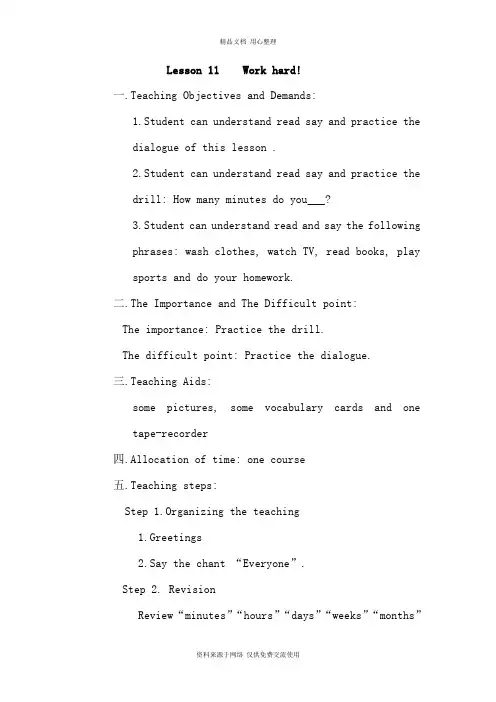
Lesson 11 Work hard!一.Teaching Objectives and Demands:1.Student can understand read say and practice thedialogue of this lesson .2.Student can understand read say and practice thedrill: How many minutes do you___?3.Student can understand read and say the followingphrases: wash clothes, watch TV, read books, play sports and do your homework.二.The Importance and The Difficult point:The importance: Practice the drill.The difficult point: Practice the dialogue.三.Teaching Aids:some pictures, some vocabulary cards and one tape-recorder四.Allocation of time: one course五.Teaching steps:Step anizing the teaching1.Greetings2.Say the chant “Everyone”.Step 2. RevisionReview “minutes”“hours”“days”“weeks”“months”and “years” with a game. Ask for a volunteer torecite the words in order as the teacher point tothem.Step 3.Key concepts: high low homework1.Introduce:a.Demonstrate “high”“low” with actions. Useobjects the Ss know and hold them high and low.Ask for volunteers to do some actions.e a puppet to demonstrate “homework”. Givethe puppet some “homework” to do. Act out adialogue with the puppet and then act one outwith a volunteer.T: (To the puppet) This evening, please write a story. Bring your story to school tomorrow. Thestory is your homework.P:Okay! I am going to work hard on my homework.Is it time to go home?T:Yes!It’s ___ (time). See you tomorrow.2.Student book :a.Play the audiotape as the Ss follow along theirbooks.3.Practice: Divide the class into small groups. Askeach group to make a living picture for “workinghard” at school, sports or home.六.Students’ activity:1. Chant “Everyone”.2.Review words with a drill.3.Puppet demonstration.4.Imitation.5.Group work to practice “work hard”.七.Blackboard:Lesson 11Work hardWork hard.Sports/school/ home.Teaching summing-up:。
冀教版小学六年级英语下册 lesson 11课件
选词填空 1.—Kim_a__lw__a_y_s__ (never/always)makes her lunch.
一Good work!
2. When did you do_y__o_u_r__ ( you/your) homework last night?
按 —I—al—wa—ys—m—a— ke—m—y l—un—ch—. —————————————— 要 3. I water the flowers at home. (改为一般疑问句) 求 Do you water the flowers at home? 完 —————————————————————————— 成 4. I dry the dishes about ten minutes a day. (对画线部分提问) 下 How many minutes do you dry the dishes a day? 列 —————————————————————————— 句 5.I clean my bedroom at home. (对画线部分提问) 子 —W—h—at—d—o — yo—u d—o—u a—t —ho—m—e?—————————————
3. Steven works hard__a_t__(on/ at) school.
4. He goes to school__o_n___(in/on) time. 5. I always dry the_d__is_h__e_s__(dish/dishes) after dinner.
1. always make I lunch my (.) (连词成句)
Thank you !
B
B. good B. always B. make B. touch B. parents
2024年冀教版小学六年级英语下册教案表格式Unit 2 Lesson 11
1.Let'srole play!对课文内容进行表演
【设计意图】练习本课重点单词、句型。
2.Text单项选择
【设计意图】巩固练习新学单词和课文内容。
Step5.Summary
建议用时:2min
通过擦除板书的形式,老师擦一个单词或句子,学生快速读出被擦掉的内容,让学生自己说出本节课所学的重点单词和句子。
5.学习课文第二部分以对话引出课文内容,出示问题要求学生在小组内进行学习。
6.组织小组进行问题学习。巡视学生的学习情形。鼓舞学生大胆回
答老师的问题。
7.让学生带着问题听磁带,跟读课文,齐读课文。
【设计意图】带着问题学习课文增加学生学习兴趣,能增强学生对课文内容的理解。
Step 4. Practice
例句:The building is high.大楼很高。
让学生在练习本上进行书写练习,及时巩固所学单词,接下来听教师的口令练习high、low.
3.Play a game要求学生做练习,上黑板展现。
【设计意图】游戏提高学生的学习爱好。
4.学习课文第一部分以对话引出课文内容。引出work hard
出示问题要求学生在小组内进行学习。学习完毕回答所提出的问题,随时进行鼓舞,激发学生的学习爱好,并让学生进行语句对话练习。
重点词汇:high高;高的low低的
重点句型:Jenny, do you think it’s important to work hard?詹妮,你认为努力学习重要吗?
Step 6
Homework
建议用时:1min
Writing:
Do you work hard at school, at home and at sports? What do you do?
冀教版六年级英语下册 lesson 11 教学课件
Yes, I do. I work hard at school, at home and at sports.
I always go to school on time. I always do my homework.
I do exercise every day!
I have fun with my friends.源自③ Let’s chant!
Everyone, everyone, Reach up high! Everyone, everyone, Touch the sky!
大家一起来,大家一起来, 向上高举手! 大家一起来,大家一起来, 触摸天空!
Everyone, everyone, Turn around! Everyone, everyone, Touch the ground!
上课时衣着要整洁不得穿无袖背心吊带上衣超短裙拖鞋等进入教室
Lesson 11 Work hard!
冀教版·六年级下
New words 高;高的;在高处
New words
① You can do it!
Jenny, do you think it’s important to work hard?
I always go home on time.
② Does Kim work hard?
Kim, do you help your family?
Yes! I always dry the dishes after dinner.
That’s good.
I often water the flowers at home.
What else do you do at home?
I clean my bedroom on Saturdays.
冀教版六年级英语下册全册教案
冀教版六年级英语下册全册教案Lesson 1 Ping-pong and Basketball一、教学目标1.学会这些词汇:basketball, ping-pong, sport, runners, shorts,T-shirt2.背会这些词组:play basketball , play soccer , like …best…teach sb. to do sth. need to do sth.would like …to do …3.运用所学句型进行简单交流;Badminton ,ping-pong ,soccer and basketball are sports.I like ping-pong best .Do you have any runnersI don’t have a T-shirt either.二.教学重难点1.重点:新单词、重点词组;2.难点:用所学简单句型进行口语交流;三.教学用具录音机、课本配套磁带;四.教学课时一课时五.教学过程.Lesson.1.学习新单词badminton、ping-pong、soccer、basketball、runners、T-shirt、score;并让学生知道:__________,_________,_________and ________ are sports.2.翻译下面词组:打篮球___________ 打乒乓球__________打网球___________踢足球___________3.我会翻译下面句子:李明,你玩什么运动________________________________我最喜欢的运动是乒乓球;____________________________我最喜欢篮球;______________________________________你能教我打篮球吗__________________________________你有一些乒乓球吗__________________________________我不这样认为;______________________________________我们去商店吧;______________________________________4.我会总结either 和too 的用法;例如:I have an English book . He has an English book, too.I can speak English. Danny can speak English ,too.I don’t have a T-shirt . He doesn’t have a T-shirt ,either.I don’t have a pen . Li Ming doesn’t have a pen ,either.__________________________________________________________________________________________________________5.我知道some 和any 的用法:例如:I have some friends, but Danny doesn’t have any friends.Do you have any friends______________________________________________________6.读课文;a.师领读一遍;b.听录音跟读;7.我能听课文填空;听录音What ______ do you play,Li Ming I play badminton and ping-pong .Ping-pong is my _______ sport. I likeyou have a T-shirt You need one to play basketball. No,I don’t hav e a T-shirt _______. We can buy ____ runners and a T-shirt. Do you have ____ ping-pong ballsI don’t think so. Let’s go to the store..1.我会填;sp_ _ts运动f_v_ _rite最喜欢的p_ _ y玩b_st最好的b_sk_tb_ll 篮球s_cc_ _ 足球b_dm_ _ton羽毛球l_ _ e 喜欢p_ng-p_ng乒乓球wh_ _ 什么_ _th_ _ 也ru_ _ er _运动鞋2.我会连;What sports do you play 乒乓球是我最喜欢的运动;I like ping-pong best. 你喜欢踢足球吗I play basketball and soccer. 你进行什么体育运动Ping-pong is my favourite sport. 我打篮球也踢足球;Do you like playing soccer. 我最喜欢乒乓球;Step4.知识拓展;单词记忆法+ball=basketball篮球foot+ball=football 足球volley+ball=volleyball排球base+ball=baseball 棒球+room=bedroom 卧室bath+room=bathroom浴室Class+room=classroom教室六、Homework.1.背诵本课单词、词组;2.熟读课文,会用简单句型进行口语交际;七、板书设计Lesson 1: Ping-Pong and Basketballbadmintonping-pongplay sportsoccer footballbasketball八、课后反思:本节课是本学期的第一课,学生上课积极性很高,可经过一个假期,好多学生遗忘的单词很多,课堂气氛不是怎么活跃;Lesson2:AtthesportsStore教学目标:1、能听说读写need,any,or三个生词;2、理解“some,any,”二词用法上的不同;3、让学生掌握并熟练运用“Ineed……”“Doyouhaveany……”“Doyouwantthis/theseorthat /those”“Howmucharethey”4、通过购物的情境练习,激发学生学习英语的兴趣;教学过程:一、Classopeningandreview.1、如果你去商声或超市看到过哪些商品,你能用英语把你看到的说出来吗2、如果你现在就在商场,你都想买些什么二、NewConcepts.1、播放课件,学生看手回答问题;1这是什么地方2有几个人物分别是谁他们在做什么3认真听,购物时最常用的几句话是什么根据学生的回答,学习生词need,any,or.举例说明some和any的区别;Ihavesomeping-pongyouhaveanyping-pongballs板书学生提出的购物常用句子;Ineedsomeping-pongyouhaveanyrunnersDoyouwanttheseballsorthoseballsHowmuc harethey2、把课堂变成一个百货商店;1由教师和事先通知准备好的学生演示购物的场景,其他学生认真看,认真听,认真学;2你想买什么东西吗到我们的百货商店里来吧把学生分成两组,一组扮演售货员,一组扮演购物者.之后,转换角色.老师走到学生当中,对有表达困难的学生加以帮助.学生汇报自己的购物情况.Ineeda________.Ibought________.三.达标测评:I.根据汉语提示完成下列单词或者短语;1. r______ 运动鞋2. T______ T恤3. t_______ 这些4. s______ 一些5. s____ ______ 运动用品店6. h______ 帮助7. d_______ 美元8. b_____ 买9. h___ ____多少钱10. n_____ 需要II.选择正确答案;1. I need some ______.A. bookB. ballsC. runner2. I want _______.A. a runnerB. a pair of runnerC. a pair of runners3. She has a brother _____ a sister.A. andB. orC. of4. Do you like red _____ blueA. andB. orC. of5. One of dollar _____ an apple.A. ofB. forC. on6. _____ are they Thirty dollars.A. How muchB. How manyC. HowIII.根据汉语补全句子;1. She needs ___________ 一双shoes.2. They are _______ 三十dollars.3. Do you like English _______ 还是Chinese4. I’m going to a _______ 运动store.5. I need some ________________乒乓球 .四.Classclosing.Let'shaveachant.Wearing,wearing,WhatareyouwearingShirt,T-shirt.I'mwearingashose.Buying,buying,WhatareyoubuyingRunners,balls,I'mbuyingbasketballs.五、板书设计Lesson2:AttheSportsStoreIneedsomeping-pongballs.DoyouhaveanyrunnersDoyouwanttheseballsorthoseballsHowmucharethey六、课后反思:本节课,比起上节课,课堂气氛活跃了很多,看到孩子们一双双渴求知识的双眼,我信心十足,一定要带好孩子们走英语之路;Lesson 3 At the Gym教学目标:让学生掌握四会单词:light ,heavy, catch, hit, throw教学重难点:让学生四会掌握单词:light ,heavy, catch, hit, throw教学时间:一课时;教具准备:录音机、卡片等;教学过程:一、复习用游戏来复习learn 和teach这两个单词;找两名自告奋勇的学生;老师悄悄地告诉这两名学生一名将扮作“教师”,一名将扮作“学生”;“教师”在教“学生”写数字;然后让全班学生猜他们在表演什么;教师可用如下问句:Who is the teacherWho is the studentWhat is the teacher doingWhat is the student doing二、新授1、用重和轻的实物,如一块石头和一片羽毛,演示light和heavy,用教师带进课堂的一个ping pong ball,或一个又大又软的球来向学生演示throw catch hit,用球来表示这些动作,同时说出这些单词;2、听录音带,跟读课文;3、学习新单词4、复习上节课刚刚学过的故事, Liming 和Jenny去商店买一些衣物;观察书上的图片,并思考下面的问题:are theyare they doing’s happening5、小组自学课文,并回答以上问题;6、全班交流反馈;三、检查理解情况四、完成配套与检测Lesson3五、家庭作业熟读课文,记忆单词;六、板书设计Lesson 3 : At the Gymlight 反义词heavy throw 反义词catcheasy 反义词hard easy 副词easilyhit 现在分词hitting throw 现在分词throwin七.课后反思:这节课的内容本身很有趣,同学们都很有兴趣,我的兴趣更大,是一堂很成功的一课;lesson4:WhereDidYouGo教学目标:1、能听说读写bought,taught,thought.2、复习巩固以前所学的四种时态,能能够正确地进行听说读写;3、学会唱“Whatdidyoudo"教学重点、难点:am throwing the basketball.and throwing教具、学具:录相机,磁带教学过程:一、Classopeningandreview.1、投影出示一些单词,让学生说出它们的过去时,和将来时;其中包括buy,teach,和thi nk.由于这三个词的过去时以前没有接触过,所以暂时放到一边2、对话练习;老师提问一些问题让学生回答;1Whatdidyoudoyesterday2Whatareyougoingtodotomorrow3Doyouusually......每个问题找几个同学回答;二、NewConcepts.继续看复习题1中留下的未知项,即buy,teach,和think三个词的过去时如何改写;老师将这三个词的过去时添加上去,教学生如何读,并反复拼写,加以识记;并共同找到bo ught,taught,thought三个词语在书写和发音方面的共同点和不同点,便于学生比较和掌握;2、阅读练习;要求学生自学课文第一部分,然后回答以下几个问题:Where didJenny andLiMinggoWhatdidJennydoWhatdidLiMingdoWhatdidJennydo学生读完后,共同交流学习成果,老师加以总结.3、根据课文第二部分的内容,设计一些时态填空,让学生试着自己填写;1Theyusually______teacheachotherasport.2Jenny______gototheparktomorrow.3Dannyalwys_______thinkhecancatchtheball.4Thismorning,JennyandLiMing______buysomethingsatthestore.5They_______teacheachotherasportyesterday.6Danny______thinkhecouldhittheball.4、学唱“Whatdidyoudo”学会后,将学生分成两组对唱,一问一答;三、ClassClosing.师生齐唱:“Whatdidyoudo”结束课堂;四、板书设计:Lesson4:WhereDidYouGoWhatdidyoudoteach---taughtbuy---boughtthink---thoughtlesson5:ABasketballGame教学目标1、能听说读写player,game,team,win和lose.学会jumpup等短语;2、能听明白在比赛中一些简单的指示,用win和lose.表示比赛的结果,以及比赛中分数的表示等;教具学具录相机一、Classopeningandreview.做游戏“Charades"以复习学生在前面已掌握的表示职业的词汇;这些词有:teacher,clerk,cashier,waitress,waiter,busdriver等;二、NewConcepts.1、为学生播放一段篮球比赛的实况录相;先为学生介绍比赛的双方,引入新词:playe r,team和game.在讲解这三个新词时,可引学生利用对比的方法,总结字母发音的规律;2、边放录相,边为学生做现场解说,把课文内容通过示范的形式展示给学生;看完录相后,总结如何介绍一场比赛,介绍一场比赛需要了解哪些内容;比如:比赛的地点,时间,比赛的双方对员,比赛中比分的情况,比赛的结果等;3、学生自学课文;要求:找出文中有关比赛的内容,画出来;找学生读出自己找出的有关语句;让学生自己把画出的语句读两次;4、将全班学生分为若干组;在每组中,找出一个学生向其他学生介绍本组的队员和比赛情况,并在最后根据比分的多少,判断出谁胜谁负;每组可根据自己的特长,选取不同的比赛内容;本组练习以后,老师组织各组学生在班内表演;表演前老师提出要求:1介绍本组表演的游戏名称;2介绍本组的队员分组或分工情况;3向大家汇报比赛的比安情况;4裁判胜负情况;各组表演完后,大家共同找出表演最好的一组,讲解最好的一个同学;并说明他们分别好在什么地方;三、Classclosing.老师向同学们提出希望,希望同学们在课下多做这样的比赛活动,用于练习巩固本节所学内容;四、板书设计:Lesson5:ABasketballGameThisisabasketballgame.Thisisblueteam.Thisisorange's78to78TheblueteamwinTheorangelose.五、课后反思:本节课,由于我的声情并茂,学生对英语的兴趣,我们配合的很好,继续发扬;lesson6:WhoWon教学目标:1、知识技能:能说听读写won 和lost;会运用What did you do2、过程与方法:通过学单词,培养学生口语表达能力;能用语言表达过去已发生的事情,并能用一段话试着写出来;通过创设情景,综合运用所学语言进行交流,培养学生在实际生活中综合运用语言的交际能力和对语言的应变能力;3、情感态度:让每一个学生都能积极主动参与教学活动,发挥学生主观能动性,从而使他们更加热爱英语学习,增强学习英语的信心;培养学生敢于表达自己的勇气和勇于改错的精神教学重点:能听、说、读、用句型:What did you do 和单词won lost.教学难点:学生能根据具体的情况进行问答;教具学具:录音机磁带教学过程:一、Classopeningandreview.用“What'swrong”游戏的形式来复习学过动词的过去时,进行时和将来时结构;1、Iamwas hthedishes.2.Iseehimyesterday.3.Igototheparktomorrow.二、NewConcepts.1.学生自学课文;要求画出不理解的词语或句子;学生提出来不懂的地方,老师加以解答,学习win和lo st的过去式;2.听课文录音,了解大意;3.学生分组分角色读课文;4.对话练习;老师提问:“What"didyoudoyesterday"给学生一定的时间思考后,把学生分成几组,每个学生在本组内说一说昨天都做了什么,其他同学负责评定,指出句子出现的错误,老师巡回指导,最后,本组选派一名代表,向全班同学说一说;5.写话练习;根据刚才回答的What"didyoudoyesterday",汲取其他同学的长处,改正自己的不足,把这些内容写成一段话;6.选取几名同学的短文,朗读给全班同学听;师生共同发现短文的优点,并指出不足之处或提出自己的见解,有错误的,尽量让学生们为之改正,老师适当加以指导;三、ClassClosing.要求学生把自己写的短文交上来,老师课下批改;四、板书设计:Lesson6:WhoWonwin--wonlose--lostWhatdidyoudoyesterdayLesson7 Are you ready for a quiz一、教学目标1、知识目标带领学生复习本单元的重点内容:①重点词汇:any, heavy, lightorbought, taught, thoughtsport, basketball, ping-pong, runners, shorts, T-shirt, game, player, teamcatch, throw, hit, need, win, lose②重点句型:—What did you do—I/We ____.③过去时的应用;2、能力目标要求学生能够灵活运用所学知识谈论与运动相关的话题;3、情感目标使学生明白体育运动的好处和重要性,鼓励学生积极参加体育运动;二、教学重点、难点:1、教学重点:回答本课问题;2、教学难点any, heavy, light,or,bought, taught, thought,sport, basketball, ping-pong, runners, shorts, T-shirt, game, player, team ,catch, throw, hit, need, win, lose—What did you do—I/We ____.过去时的应用;三、教具准备:磁带、录音机四、教学过程1、Class opening and review2、Play a game “What’s missing”规则:把词汇卡片竖放在教室前面,告诉学生看1分钟的卡片后闭上眼睛,然后教师移开一张卡片;让学生睁开眼睛,设法指出教师移走了哪张卡片;提问每个学生让其说出移走的卡片的名称,直到猜对正确答案为止;让学生重新看到那张移走的卡片,并把它放回原处;那名猜对正确答案的学生可以在移走另一张卡片,让大家接着猜;3、讨论lesson 7: 的这几幅图片;这几幅图片和问题都是本单元的重点知识,让学生讨论根据图片来描述不仅锻炼了孩子的口语表达能力,同时也复习了前面的知识;4、听课文录音;因为听力对于学生来说也很重要,安排这样一个练习,不仅强化了学生的知识,同时听力也得到了锻炼;5、练习Student book:Lesson 7Homework:Activity Book五、练习题一选择题:1 What sport do you like best I like to best .a , play the badmintonb , play badmintonc, play the guitar d, play the ping-pong2 would like to learn to play ping-ponga ,Yes ,I do b, No , I donotc ,Yes , I would . d , Yes , I can3. Jenny and Li Ming something at the store yesterday morning.A. boughtB. thoughtC. buy二写出相对应的过去式:play have go teach hithurt want think buyLesson 8 Again,please教学目标知识目标带领学生复习本单元的重点内容:①重点词汇:any, heavy, light orbought, taught, thoughtsport, basketball, ping-pong, runners, shorts, T-shirt, game, player, teamcatch, throw, hit, need, win, lose②重点句型:—What did you do—I/We ____.③过去时的应用;能力目标要求学生能够灵活运用所学知识谈论与运动相关的话题;情感目标使学生明白体育运动的好处和重要性,鼓励学生积极参加体育运动教学重、难点any, heavy, lightorbought, taught, thoughtsport, basketball, ping-pong, runners, shorts, T-shirt, game, player, teamcatch, throw, hit, need, win, lose—What did you do—I/We ____.过去时的应用;教学过程一、Class opening and review尽量采用游戏的方式带领学生复习;二、New concept1.以讨论话题的方式引入本课Talk about your favourite sports to the class.在话题讨论的过程中涉及到的本单元的重难点知识有条理的进行板书,如帮助学生总结归纳单词的记忆方法:heavy---light sports:basketball ping-pong ……catch---throw name---gamemany----anylose----win play----playershort----shorts2.对话的方式复习三种时态师:What sports do you like to playSs: I like to play……T: Guess What sports I like to play师做出相应的动作Ss: You like to play ping-pong.T: I am playing I played I am going to play ping-pong. What about youSs imitate the teacher.3.针对本单元的重点知识出一个小型的测试卷对学生进行检测;写出下列的过去式buy __________teach _________ think ___________ win __________lose ___________ play ___________ watch ___________写反义词;win ________ lost ___________ light ___________ catch _________选择填空;1. This ball is_______, I can throw it easily.A. lightB. heavyC. hard2. Jenny and Li Ming________ something at the store yesterday morning.A. boughtB. thoughtC. buy3. Do you like this T-shirt________ that T-shirtA. andB. asC. or按要求完成句子;1. What did you do yesterday回答问题2.What is Jenny doing now用打篮球回答四.板书设计Lesson 8 :Again,pleaseheavy---light sports:basketball ping-pong ……catch---throw name---gamemany----anylose----win play----playershort----shortsWhat did you doI /we _______.Lesson 9 Always eat breakfast一、教学目标:一知识:1. 巩固内容:always, sometimes, usually, never等表示频度的词汇;2. 掌握四会词汇和句型:①healthy, strong, weak, week②—How often do you ____—____ times a ____.二能力:学生能用所学词汇句型说出有关健康的句子;三情感:帮助学生明白早餐的重要性,培养学生关注健康、关心他人的品质;二、教学重点、难点:重点:四会词汇和句型难点:—How often do you ____ —____ times a ____.句型的理解和运用;三、教具、学具:图片、录音机、四、教学过程:Class Opening and ReviewGreeting.Play a game: Never, NeverKey Concepts①healthy, strong, weak, week②—How often do you ____—____ times a ____.IntroduceUse puppets to role-play “healthy”, “strong”,” weak”and “sick”.P1: Sad, coughing. I feel sick. Sick. Say it, please, class.C: Sick.P2: Happy, energetic. I don’t feel sick. I feel healthy Healthy. Say it, please.C: Healthy.P1: I am weak. Look Try to carry a chair, but can’t. This chair is too heavy. I am weak. Weak. Say it, please.C: Weak.P2: Not me. I am strong. To Puppet 1. May I help you with that chair Carry it. There The chair is heavy, but I am strong. Strong. Say it, please.C: Strong.Show the pictures and introduce these words.Write“healthy”, “strong”,” weak”and “sick”on the blackboard. Ask the student s try to translate them.DrillAsk the students to say who is strong/ healthy/ weak/ sick.Student bookIntroduceT: Everyone wants to be strong and healthy. Do you Let’s learn what to do. First, always eat breakfast. Because it’s good for you Do you always eat breakfast Let’s look. Here is a chart.This is a week. There are seven days in a week. What are they Say Monday, Tuesday……T: When did you eat breakfast last weekSundayMondayTuesdayWednesday ThursdayFridaySaturdayStudent 1Student 2……Introduce How often did you eat breakfast last week Once/ Twice/ Three times/…… a week.Student book and audiotapePlay the audiotape and answer the questions:How often did Danny/ Kim/ Li Ming eat breakfast last weekPracticeT: We can say other things. For example: How often do you play ping-pongAsk the students to say some sentences.Ask the students to make up appropriate sentences about how often and make up a chart.Ask the students to introduce their charts. Activity book. Class closing. 五、板书设计Lesson 9: Always eat breakfast图片Strong and healthy图片Weak and sick—How often do you ____—____ times a ____. Once a week; Twice a week.六、练习:一填空:1. I always eat breakfast. I am ______ and _______ .2. Liu Hong never eats breakfast. She is _______ and ______ .二写句子:Write three sentences with How often ________ Lesson 10 Always Brush Your Teeth一、教学目标A.知识目标1.Review and use the keywords : before and after .2.Students can read ,listen , say and write the vocabulary: teeth ,brush your teeth ,face ,wash your face , comb your hair .sentence :What do you do before / after ____B.能力目标1、学生能够正确运用短语brush…teeth , wash…face ,comb…hair ,并知道人称的变化;2.能够掌握before ,after 的用法;C. 情感目标通过学习,学生能对本课内容产生兴趣,主动参与教学活动,认真理解短文内容,并养成讲究卫生的好习惯;二、重难点after , before , teeth ,face , brush , comb三、教学准备Objects toothbrush , comb … word-cards , clock四、学具准备paper , clock , marker五、教学过程一Class Opening and Review:Good morning ,class How are you How’s the weather today:Look at some pictures and actions ,ask several questionsHow often do you ____ What do you do ___设计意图:在游戏中复习已经学过的单词,避免枯燥乏味的单纯记忆,让学生自己主动的记忆;a song :In the Bathroom .Review the names about body二New conceptsStep 1: Introduce :Show the cards to remember “teeth , face ”T: Do actions to introduce “brush your teeth ” and “comb your hair”设计意图:用实际动作演练介绍单词,学生既爱学,又学的快,理解的容易;T: Look , it’s 6:30 , I often brush my teeth .Then , I wash my face .T: What do you do What are you doingStep 2 : Play a game : GuessReview the phrases such as “eat breakfast , get up , wash …hands , wash …face , brush …teeth , comb …hair ”Step3 : Demonstrate: Draw three clocks to show :6:45 7:00 7:157:00 I want to eat breakfast at 7:00.6:45 Before I eat breakfast , I brush my teeth .7:15 After I eat breakfast , I go to school .设计意图:通过出示图片,创设情境,让学生在意义的、生动有趣的情景中接触所学的新内容;T : Let’s repeat ,before and after .Can you say some sentences with these two wordsPractice in groups . Show设计意图:通过小组中的互相练说,克服学生一个人怕说错的思想,在集思广义中说出自己能想到的句子,同时不限定于一个句型,培养学生的发散思维;在小组练习中,提高了学生发言的积极性,说的机会也增多了,加上教师或基础好的学生的及时指导,学生的表达能力也会有所提高;Play the audiotape and read the dialogue , check up understanding .Show the exercises : Listen and orderJenny wakes up .Jenny brushes her teeth .Jenny eats breakfast .Jenny washes her face and hands .Jenny combs her hair .Jenny goes to school .设计意图:在听的过程中为孩子预留了任务,符合英语课标中提倡的任务型教学,并且能引导学生注意听得重点内容,为他的学习提供了方向;三Class closingActivity Book : No 2 Listen .Answer the questions .Exercise写出下列单词的反义词1、weak---- 2. sick--- 3. this--- 4. that---8. before---回答问题1.How often do you go to school2.How often do you wash your face3、What do you do before you eat breakfast4、What do you do after you eat supper写出下列短语1.洗脸2、刷牙3、梳头4、吃早饭Lesson 11:This Is Good for You一、教学目标:1、知识技能:1学生能够听、说、读、写单词:bones, muscles ,skin 并能用英语进行表达;2学生能复习掌握并实际做对话:What`s your favourite fruit My favourite fruit is ;3学生能够联系旧知结合新知掌握课文中的重点单词和句子;2、过程与方法:通过师生、生生间的问答练习、游戏等活动,使学生在轻松、活跃的课堂中获得知识;3、情感态度:通过学习本单元的前三篇课文,学生知道什么是对身体健康有好处的,培养学生养成良好的卫生习惯;二、教学重点:1学生能掌握四会单词:bones, muscles ,skin;2并且能够运用句型What`s your favourite fruit My favourite fruit is ;做对话;三、教学难点:学生能够理解运用身体健康的句子;四、教具准备:实物水果、食物卡片、CAI课件等;五、教学过程:教学设计设计意图1Class Opening and Reviewa.Greeting :Good morning ,everyone…….b.Review words :apple , banana , grapes , orange , melon , strawberry with real objects and make dialogue : What`s your favourite fruit My favourite fruit is ;c . game : do the activityeg. Wash face ,wash hand ,comb hair ,get up ,eat breakfast ……2New conceptsa.Demonstrate : bones, muscles ,skin with some pictures on the compute r .Ask the Ss to pay more attention to “s” . Lead the Ss to read these new words several times .b . Introduce the sentences of part 1 on the computer too. Play the audiotape part 1 as the Ss follow. Then ask the Ss to discribe the pictures .c . Practice : listen to the radio and fill in the blank :★These are . For strong , you need to eat foods that are good for you ;★This is a .For strong , you need exercise .★This is .Healthy is clean .d .game : Show some pictures of food and let the Ss to divide them : which one is good for you or bad for you .And this food good for you is good food .just like : fish ,fruit ,meat ……e .Discussion : Ask Ss to make a discuss of what good for your health is .Then show the sentence :A healthy body has healthy bones ,muscles and skin .Blackboard design:Lesson 11:This Is Good for Youbones muscles skinWhat`s your favourite fruitMy favourite fruit is ;Exercise :1 .写出下列短语:洗脸刷牙梳头吃早饭2 .写单词:These are .骨头This is . 皮肤This is a .For strong , you need exercise .肌肉A healthy body has healthyand .3 . 回答问题:What`s your favourite fruit用游戏作为教学开头,活跃课堂气氛;复习了以前学过的单词,为后半部分教学做好铺垫;用CAI课件上的图片和身体的肢体去表达骨骼、肌肉、皮肤等单词的含义;使教学内容更简单、更直观,学生更容易理解和接受;活跃了学生的脑思维,将身体部位和英语单词有机结合起来,学生学起来比较感兴趣;听音做事是英语课堂教学中一种很有效的途径,也是练习听力的一种有效的方法,做到了听和写的结合;利用游戏使学生认识到什么食物是对身体有好处的,什么食物是对身体有害的;给学生创造一个快乐的学习环境;小组合作并讨论,在复习旧知的基础上总结巩固新知;Lesson12: Eat Your VegetablesTeaching contentStudent book 8 Unit2 Lesson12: Eat Your VegetablesGradeGrade SixTeaching time40 minutesTeaching objectives1.使学生能听、说、读和写词汇:cabbage, onions, month;2.使学生能够描述自己日常的饮食;3.能完成有关饮食的调查表;Teaching materialanalysesTeaching focal points1、使学生能听、说、读和写词汇:cabbage, onions, month;2、使学生能够描述自己日常的饮食;Teaching difficulty points1、能完成有关饮食的调查表;2、能够在日常生活中,恰当的使用How often…句型;Teaching aidstape recorder and tape, vegetables, CAI.Teaching stepsWarming-up and revision:一、Greeting.二、利用词汇卡片复习:beverage、meat、fruit;New concepts:一、学习cabbage、peas、onions.1、利用谜语学习peas;They are small.They are green.They live in the house.What are they2、使用实物学习cabbage、onions;⑴Put the cabbage in the box. Let student touch and guess. What is it⑵The students talk about the cabbage. For example: What colour is it Heave or light Do you like cabbage⑶Put the onion in the box. Let student touch and guess. What is it⑷The students talk about the onion.二、练习对话;1、T:How often do you eat peasS: Once a week.T: How often do you eat cabbageS: …2、小组练习对话;3、听录音并完成下表;不看书How often does Danny eatdayweekmonthyeardonutscabbagepeasonions4、订正上表,并让学生描述内容;三、小组练习,用调查表的形式调查一位同学的饮食习惯;a小组调查并填表;b展示各组表格;c描述并评论同学饮食是否健康;四、出示健康饮食表;a出示一张小学生健康饮食表;b谈论饮食表;c对照饮食表说说自己饮食有哪些不好的习惯五、Homework;制作一张适合自己的健康饮食表;六、Class closing.板书:Lesson 12 : Eat Your VegetablesHow often does Danny eatdayweekmonthyeardonutscabbagepeasonionsExercises :一、Choose the right answers to the questions .1.What colour is cabbage2.When do you wake up everyday3.Do you like peas4.How often does Danny eat donuts5.What do you do before supperA.I wake up at 7:00 in the morning .B.Danny eats donuts about twice a day .C.It’s green .D.I often do my homework .E.Yes , I do .二、Write the words in the correct order .1. do , how , eat , often , you , onions_________________________________2. like , would , some , you , cabbage_________________________________1.eat , I , month , a , about , peas , twiceLesson 13 :Exercise教学目标:1、Students can read,write,say and aurally understand the vocabulary:minutes,hours,exercise2、教授歌谣“Everyone, Everyone, Reach up High” 使学生能跟着节拍边做动作边说歌词;3、通过本课教学,使学生了解健康的生活方式应加强体育锻炼;教学重、难点:1、掌握本课四会单词: minutes, hours, exercise 是重点;2、如何在实际中灵活运用How much/How many/How often 是难点;教具、学具:一个带有分针的钟表、录音机、课文录音带;教学过程:一、Class Opening and Review:1、Play“ What Time Is It” to review how to say times.2、Play“Simon Says” to review actio ns and phrases such as:ride a bike, walk, run, jump,play ping-pong等;二、Key Concepts:1、Introduce:1 Demonstrate“minute, hour”with a big clock.2 Demonstrate“exercise” with five volunteers. Ask each volunteer in a whisper to perform an actionuse the actio ns recommended for “Simon Says” above. Ask the class to guess what he or she is doing. Then ask all the volunteers to perform their actions at the same time and lead a dialogue:T: Look They are exercisingPoint to each volunteer Riding a bikeis exercise. Playing ping-pong is is exercise. What else is exercisePoint to the next volunteer. __ing is ...C: …exercise.T: Right Point to the final volunteer. And __ing is …C: …exercise.T: Very good2、Use the Student Book and Audiotape:1教科书第一部分T:Exercise helps make your body healthy and strong.出示问题:What is exercise How much exercise do you need 学生边看书边听课文录音,同桌讨论后回答;回答第一题引出动名词短语作主语这一知识点,板书:Riding a bike/Walking to school/Running/Playing ping-pong is exercise. 回答第二题时引出How much 与How many 的区别, 并利用钟表演示使学生能回答:How many minutes are there in an hour/How many minutes make an hour2教科书第二部分出示问题:How many minutes dose Danny exercise How often dose Danny exercise How many minutes dose Danny walk to school 听课文录音小组讨论后得出结论:Danny needs to get more exercise. 采取多种方式操练:同桌对话、小记者采访的形式询问同学们的锻炼情况,在活动中复习并巩固句式的运用,深刻领悟锻炼的重要性;3、Practice: Teach “Everyone, Everyone, Reach up High” in Number 3 of the student book.1 Play the audiotape, the students follow words and pictures in their books.2 Teach line by line, students to repeat.3 Finally play the audiotape again, students chant along and do the actions.4 各组选派一名台前表演;三、Class Closing:Homework:1 画出一些动作或尽量用动作表演出来来练说:___ing is exercise. 2 课余将所学chant 带动作表演给家人或朋友; 3 Make a chart : 了解身边人的锻炼情况;板书:Lesson 13 ExerciseSixty minutes make an hourRiding a bikeWalking to school is exercisePlaying ping-pong习题:一、Fill in the blanks.1、_____ helps make your body healthy and strong.2、Sixty m_____make an h____.二、根据答句补全问句:1、_________exercise do you need a dayI need about twenty minutes of exercise a day. 2、__________minutes do you need to walk to schoolI need about five minutes to walk to school3、___________do you play ping-pongI play ping-pong three times a week.Lesson 14 Work Hard 教学设计教学目标:1.知识方面:能听、说、读、写和正确运用high、low和homework等单词;2.能力方面:能够在日常生活中灵活运用所学的词汇和句型;How often do you_______ times a .How many minutes do you _____ ____About ____ minutes.3.情感态度,价值观:通过分组练习、游戏培养学生合作互助精神、通过本课主题培养学生健康的生活观念;教学重难点:1.使学生听写词汇homework、high、low、等单词2. 使学生能灵活、运用并练习句型;How often do you ___ ___About ____minutes.教学过程:Step1 Warming-up and revision一、Greeting.二、Chant. 内容Everyone,everyone.reach up high,high、high、high.everyone, everyone.bend low, low、low、low.Step2 New Concepts一、出示单词卡high、low把high贴在黑板的高处low贴在低处;让学生在手里随意拿一样东西,听教师的口令练习high、low.然后同桌练习;二、观看幻灯,出示李明写作业的图片,放在屏幕的上方;提问:Is it low What is he doing 引出homework,进一步提问家庭作业还有那些形式;陆续出示所有图片,问What do they do Do they work hard 引出work hard 让学生说出自己最喜欢的事;问学生How How many minutes do you___三、 a game 将全班学生分成几个组,教师设置三个场景分别为学校、体育场、家中;要求学生用本单元所学的知识来编对话;最后用Work hard at in____.来概括;然后学生来教。
冀教版小学英语六年级下册Lesson 11 Work hard!英文版
Lesson 11 Work hard!一.Teaching Objectives and Demands:1.Student can understand read say and practice thedialogue of this lesson .2.Student can understand read say and practice thedrill: How many minutes do you___?3.Student can understand read and say the followingphrases: wash clothes, watch TV, read books, play sports and do your homework.二.The Importance and The Difficult point:The importance: Practice the drill.The difficult point: Practice the dialogue.三.Teaching Aids:some pictures, some vocabulary cards and one tape-recorder四.Allocation of time: one course五.Teaching steps:Step anizing the teaching1.Greetings2.Say the chant “Everyone”.Step 2. RevisionReview “minutes”“hours”“days”“weeks”“months”and “years” with a game. Ask for a volunteer torecite the words in order as the teacher point tothem.Step 3.Key concepts: high low homework1.Introduce:a.Demonstrate “high”“low” with actions. Useobjects the Ss know and hold them high and low.Ask for volunteers to do some actions.e a puppet to demonstrate “homework”. Givethe puppet some “homework” to do. Act out adialogue with the puppet and then act one outwith a volunteer.T: (To the puppet) This evening, please write a story. Bring your story to school tomorrow. Thestory is your homework.P:Okay! I am going to work hard on my homework.Is it time to go home?T:Yes!It’s ___ (time). See you tomorrow.2.Student book :a.Play the audiotape as the Ss follow along theirbooks.3.Practice: Divide the class into small groups. Askeach group to make a living picture for “workinghard” at school, sports or home.六.Students’ activity:1. Chant “Everyone”.2.Review words with a drill.3.Puppet demonstration.4.Imitation.5.Group work to practice “work hard”.七.Blackboard:Lesson 11Work hardWork hard.Sports/school/ home.Teaching summing-up:。