
人教版七年级下册英语知识点归纳总结
- 1 - 人教版七年级上册英语知识点归纳总结 第一课时 Revision (Unit1----Unit4 ) ◆短语归纳 1. play chess 下国际象棋 2. play the guitar 弹吉他 3. speak English 说英语 4. English club 英语俱乐部 5. talk to 跟…说 6. play the violin 拉小提琴 7. play the piano 弹钢琴 8. play the drums 敲鼓 9. make friends 交朋友 10. go to school 去上学 11. tell stories 讲故事 12. play games 做游戏 13. on the weekend/on weekends 在周末 14. what time 几点 15. in the morning/ afternoon/ evening 在上午/下午/晚上 16.get up 起床 17. take a shower 洗淋浴 18. brush teeth 刷牙 19. get to 到达 20. do homework 做家庭作业 21. go to work 去上班 22. go home 回家 23.. eat breakfast 吃早饭 24. get dressed 穿上衣服 25. get home 到家 26. either…or… 要么…要么… 27 go to bed 上床睡觉 28. take a walk 散步 29. lots of=a lot of 许多,大量 30. have to 不得不 31. at night 在晚上 32. be late for=arrive late for 迟到 33. ride a bike =go ... by bike 骑自行车 34. take the subway =go ... by subway 乘地铁 35.get to school 到达学校 36. how far 多远 37. from home to school 从家到学校 38. come true 实现 39.play with … 和…玩 40. take the bus =go ... by bus乘公共汽车 41. on time 准时,按时 42. listen to … 听…… 43. in class 在课上 44. be late for 做……迟到 45. make rules 制订规则 46. be quiet 安静 47. go out 外出 48. do the dishes 清洗餐具 49. make breakfast 做早饭 50. make (one’s) bed 铺床 51. be noisy 吵闹 52. keep one’s hair short 留短发 ◆用法集萃
Unit 1 1. play +棋类/球类 下……棋,打……球 2. play the +西洋乐器 弹/拉……乐器 3. be good at doing sth.= do well in doing sth. 擅长做某事 4. be good with sb. 和某人相处地好 5. need sb. to do sth. 需要某人做某事 6. can + 动词原形 能/会做某事 7. a little + 不可数名词 一点儿…… 8. join the …club 加入…俱乐部 9. like to do sth. =love to do sth. 喜欢/喜爱做某事 - 2 -
◆典句必背Unit1 1. Can you draw? Yes, I can. / No, I can’t. 2. What club do you want to join? I want to join the chess club. 3. You can join the English club. 4. Sounds good./That sounds good. 5. I can speak English and I can also play soccer. 6. Please call Mrs. Miller at 555-3721.
◆典句必背Unit2 1. What time do you usually get up? I usually get up at six thirty.
Unit 2 1. at + 具体时间点 在几点(几分) 2. eat breakfast/ lunch/dinner 吃早饭/午饭/晚饭 3. thirty\half past +基数词 ……点半 4. fifteen\a quarter to +基数词 差一刻到……点 5. take a/an +名词 从事……活动 6. from …to … 从……到…… 7. need to do sth 需要做某事
Unit3 1. take… to …= go to … by… 乘…去… 2. How do / does (sb)get to …? …是怎样到…的? 3. How far is it from … to …? 从…到…有多远? 4. It takes sb. some time to do sth. 做某事花费某人多长时间。 5. How long does it take to do sth.? …花费多长时间? 6. It is + adj. + to do sth. 做某事是…. 7. Thanks for + n. / Ving 感谢你(做)某事。
Unit4 1. Don’t + 动词原形+其他, 不要做某事。 2. help sb. (to) do sth. 帮助某人做某事 3. too many + 可数名词复数 太多的…… 4. practice doing sth. 练习做某事 5. be strict with sb. 对某人要求严格 6. be strict in sth. 对某事要要求严格 7. leave sth sp. 把某物忘在某地 8. keep + 宾语+形容词 使……保持某种状态 9. learn to do sth. 学会做某事 10. have to do sth. 不得不做某事 - 3 -
2. That’s a funny time for breakfast. 3. When do students usually eat dinner? They usually eat dinner at a quarter to seven in the evening. 4. In the evening, I either watch TV or play computer games. 5. At twelve, she eats lots of fruit and vegetables for lunch.. 6. She knows it’s not good for her, but it tastes good. 7. Here are your clothes.
◆典句必背Unit3 1. How do you get to school? I ride my bike. 2. How far is it from your home to school? 3. How long does it take you to get to school? 4. For many students, it is easy to get to school. 5. There is a very big river between their school and the village.
◆典句必背Unit4 1. Don’t arrive late for class. 上课不要迟到。 2. Can we bring music players to school? 我们可以带音乐播放器到学校吗? 3. And we always have to wear the school uniform. 并且我们总是不得不穿校服。 4. There are too many rules! 有太多的规则! 5. Don’t leave the dirty dishes in the kitchen! 不要把脏盘子留在厨房里! 6. I have to keep my hair short. 我不得不留短发。
第二课时 Revision (Unit5----Unit 8) ◆短语归纳 1. kind of 有几分,有点儿 2. be from / come from 来自3. South Africa 南非 4. all day 整天 5. for a long time 很长时间 6. get lost 迷路 7. places with food and water 有食物和水的地方 8. cut down 砍倒 9. in (great) danger 处于(极大)危险之中 10. watch TV 看电视 11. study hard 努力学习 12. read a newspaper 看报纸 - 4 -
13. talk on the phone 通过电话交谈 14. listen to music 听音乐 15. use the computer 使用电脑 16. make soup做汤 17. wash the dishes 洗餐具 18. take a message for … 为……捎个口信 19. have a good time / have a great time / have fun / enjoy oneself 过得很愉快 20. call sb. back 给某人回电话 21. no problem 没问题 22. right now 现在 23. on a vacation 在度假 24. write to sb. 给某人写信 25. right for… 适合…… 26. 给……拍一张照片 27. near here 附近 28. across from 在……对面 29. next to 挨着,靠近 30. between… and… 在……和……之间31. in front of 在……前面 32. excuse me 劳驾 33. far from 离……远 34. go along… 沿着……走 35. turn right / left 向右 / 左转 36. look like 看起来像 37. on the(或one’s) right / left 在(某人的)右边 / 左边 38. in life 一生中 39. be free 免费(有空)
Unit2单元知识点归纳总结人教版七年级英语下册
Unit 2 知识归纳重点短语get dressed 穿上衣服brush (one’s) teeth 刷牙take/have a shower 洗淋浴get up 起床go to bed 上床睡觉go to work/school 去上班/上学do (one’s) homework 做作业clean one’s room 打扫房间clean up 打扫take exercise= do exercise 锻炼,运动do some exercise 做练习(题)do math exercises 做数学练习do morning exercises 做早操do eye exercises 做眼保健操take a walk=have a walk= go for a walk 散步;走一走take sb. for a walk 带某人去散步walk to+地点步行/走路到……make breakfast 做早餐radio station / show 广播电台/ 节目best friend 最好的朋友at work 在工作(中);上班at night (在)晚上at noon (在)中午lots of=a lot of +n. 大量;许多on school days 在上学日(里)two hours and a half=two and a half hours 两个半小时half an hour 半小时 a quarter 15分钟either ... or ... 要么……要么……;或者……或者……;不是……就是……连接两个并列主语,谓语动词“就近原则”from...to... 从……到……in one’s life 在某人的一生中be late for school/class/work 上学/上课/上班迟到have time to do sth. 有时间做某事It’s time for sth. 该是……的时候了。
最全面人教版七年级下册英语第四单元知识点归纳总结
人教版七年级下册英语Unit 4 知识点总结Unit 4 Don't eat in class ?一、词汇与短语◆重点单词A部分1.rule 规则; 规章n.2.outside 在外面adv. 外面的adj. 3.arrive 到达v.4.wear 穿; 戴v.5.hallway 走廊; 过道n.6.important 重要的adj.7.hall 大厅; 礼堂n.8.bring 带来; 取来v.9.listen 听; 倾听v.10.uniform 校服; 制服n. 11.fight 打架; 战斗v. & n.12.quiet 安静的adj.13.sorry 抱歉的; 难过的; 惋惜的adj.B部分1.out 外出adv.2.terrible 非常讨厌的;可怕的adj. 3.practice 练习v. & n.4.feel 感受; 觉得v.5.dish 碟; 盘n.6.strict 严格的; 严厉的adj. 7.before 在…以前prep. & conj. 以前adv.8.remember 记住; 记起v. 9.dirty 脏的adj.10.follow 遵循; 跟随v. 11.kitchen 厨房n.12.luck 幸运; 运气n.13.more 更多(的) adj. & pron.14.keep 保持; 保留v. 15.noisy 吵闹的adj.16.hair 头发; 毛发n.17.relax 放松; 休息v.18.learn 学习; 学会v.19.read 读; 阅读v.◆重点短语A部分1.in class 在课堂上2.in the dining hall 在餐厅里3.arrive late for class 上课迟到4.at school 在学校5.a lot of 许多6.music player 音乐播放器7.in the hallways 在走廊里8.bring…to school 把…带到学校来9.listen to 听10.have to 必须; 不得不11.be late 迟到12.(be) on time 准时B部分1.too many 太多的2.go out 外出(娱乐)3.on school nights 在上学期间的晚上4.practice the guitar 练习吉他5.do the dishes. 清洗餐具6.make breakfast 做早饭7.make one's bed 铺床8.read a book 看书9.think about 考虑10.be strict (with sb.) (对某人)要求严格11.follow the rules 遵守规则12.good luck 祝好运◆重点句子A部分1.Don't arrive late for class. You must be on time. 不准上课迟到,务必守时。
人教版七年级下册英语Unit 10 知识点语法归纳总结
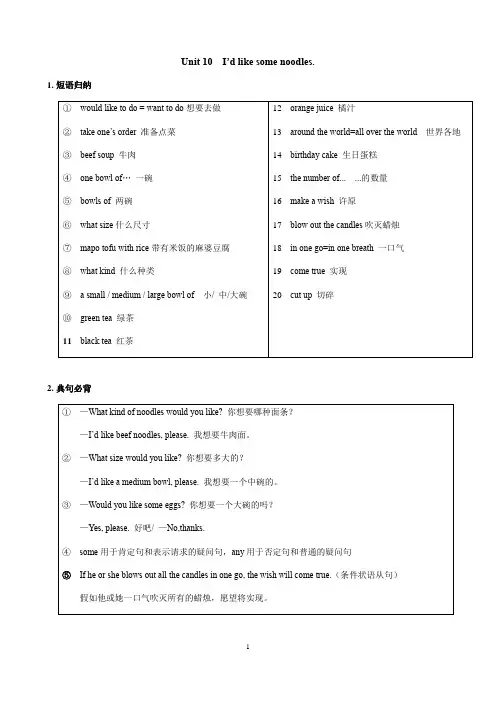
Unit 10 I’d like some noodles.1.短语归纳2.典句必背3.用法集萃(1)What would you like? 你想要什么?❖本句是含would like 的特殊疑问句,结构为“What would+主语+like?”,用于询问“某人想要什么”。
其中would like 意为“想要”,相当于want,但语气比want更加委婉,多用于口语中,并且would like 没有人称和数的变化。
例:—What would you like? 你想要什么?—I’d like some tomatoes. 我想要一些西红柿。
❖would like有如下两种常见的句式,它们的结构、用法和答语分别是:(2)May I take your order? 您现在点菜吗?❖take one’s order意为“点菜”,其中order作名词,意为“点菜”。
例:You can give your order to the waiter. 你可以把你点的菜告诉服务员❖拓展:order还有如下词性和用法牛刀小试If you are late again, the teacher will order you ______ outside the classroom.A. standB.to standC.standingD. stands(3)What size would you like? 你想要多大的?❖本句是what size引导的特殊疑问句,其中size是名词,意为“大小;尺码”,该句用于询问某人想要多大的。
答语通常含有large, medium或small等。
例:—What size is your jacket? 你的夹克是多大尺码的?—Large. 大号的。
❖拓展:what size属于“what+名词” 构成的特殊疑问词组。
此类词组归纳:牛刀小试—We have some different skirts. ______ does your daughter want?—She wants a medium one.A. What colorB.What kindC. What sizeD. What sport(4)The number of candles is the person’s age. 蜡烛的数量是人的年龄❖辨析:the number of, a number of牛刀小试In our city there _____ a number of cars and the number of them _____ growing larger and larger.A.are; isB.have; isC.is; are(5)The birthday person must make a wish and blow out the candles. 过生日的人必须许愿并把蜡烛吹灭。
人教版七年级下册英语Unit 1 知识点语法归纳总结

人教版七年级下册英语Unit 1 知识点语法归纳总结Unit 1 What’s the matter?1.短语归纳2.典句必背3.用法集萃(1)当别人心情不好,身体不适或遇到麻烦时,我们可以用如下表达表示关心:❖What’s the matter?❖What’s the matter with you?❖What’s wrong with …?❖What’s the trouble\problem with …?(2)英语中常用have描述身体的不适,此时have意为“患有”,常用结构:①have a + 疾病例:have a cold 感冒;have a fever 发烧;have a cough 咳嗽②have a + 身体部位-ache例:have a headache 头痛;have a toothache 牙痛③have a sore + 身体部位例:have a sore throat 咽喉痛;have a sore back 背痛(3)lie down躺下;tell lies/a lie 说谎(4)maybe & may be①maybe,“或许”,常用于句首,表示可能性,后加句子。
例:Maybe you are right.②may be,是情态动词+be的结构,意为“可能,也许”,后加名词、代词或形容词。
例:He may be angry.(5)sound like & sound①sound like+名词/代词/从句例:It sounds like you don’t know the truth. It sounds like a good idea.②sound+形容词,“听起来,好像”,例:The music sounds nice.(6)…when the driver saw an old man lying on the side of the road. ……这时司机看到意为老人躺在路边。
人教版七年级下册英语Unit 9知识点归纳总结与练习(含答案))

Unit 9 What does he look like?一、词汇集锦curly _______ straight _______ tall ________ medium __________ height __________ (be) of medium height __________ thin _______ heavy _______ build ________ (be) of medium build _________ a little _________ cinema _________glasses __________ later _________ handsome ________ actor _______ actress ________ person ________ nose _________ blonde__________ mouth_______ round ________face ________ eye _________ singer _______ artist _______ crime ________criminal ________ put _________ each ________way _______ describe ________ differently________ another _________ end _______in the end ______real _____jeans ________二、短语归纳1. look like 看起来像2. short/long/curly/straight hair 短/长/卷/直发2. medium height 中等身高3. medium build 中等身材4. be a little late 有点儿晚5. wear glasses 戴眼镜6. See you later then. 那么回头见。
七年级下册英语人教版unit1知识点总结
七年级下册英语人教版unit1知识点总结在七年级下册英语人教版的第一单元中,我们主要学习了有关学校生活和路线方向的词汇和语法知识。
在这篇文章中,我将对这些知识点进行总结,帮助大家更好地掌握和应用。
1. 学校生活相关词汇:1) subject:学科2) teacher:老师3) classroom:教室4) desk:书桌5) textbook:课本6) school bag:书包7) uniform:校服8) lunch:午餐9) library:图书馆10) playground:操场11) science lab:科学实验室12) computer room:电脑教室13) art room:美术室14) music room:音乐室2. 路线方向相关词汇:1) turn left:向左转2) turn right:向右转3) go straight:直走4) cross:穿过5) intersection:十字路口6) traffic light:红绿灯7) overpass:天桥8) underpass:地下通道9) bus stop:公交车站10) subway station:地铁站3. 学校生活和路线方向相关短语:1) get to school:到学校2) have classes:上课3) go to the cafeteria:去食堂4) play soccer:踢足球5) take a break:休息一下6) after class:放学后7) on the way to school:在上学路上8) go through the park:穿过公园9) at the traffic light:在红绿灯处10) across the street:穿过马路4. 一般现在时的用法:一般现在时表示经常性或习惯性的动作或状态。
一般现在时的构成为:主语+动词原形。
例如:1) I go to school by bus every day.(我每天坐公交车去学校。
期末复习人教版英语七年级下册单元重点知识点语法汇总
人教版七年级下册-单元重点语法汇总U1情态动词can的用法can是情态动词,意为“能,会”,表示某人或某物具备的能力,还可用来提出请求,没有人称和数的变化,后面直接接动词原形。
下面学习情态动词can的常见用法。
1.表示“能力”,意为“能,会”。
例句:I can speak English.我会讲英语。
2.表示“请求”或“许可”。
例句:Can you help me with my Chinese?你能帮我学汉语吗?You can go to the park after you finish your homework.你做完作业后可以去公园。
3.含有情态动词can的肯定句变否定句时,需在can后加not,其缩写形式为can’t;变疑问句时,情态动词can直接放在句首,构成一般疑问句。
例句:I can sing English songs.我会唱英文歌。
(肯定句)→I can’t sing English songs.我不会唱英文歌。
(否定句)Yao Ming can play basketball.姚明会打篮球。
→Can Yao Ming play basketball?姚明会打篮球吗?(一般疑问句)4.对Can…问句的回答可以用下面几种形式:对询问能力的问句的回答可以说“Yes,…can.”或“No,…can’t.”,表示对能力的肯定或否定;对表示请求的问句的回答可以说“OK./All right.”,表示同意对方的请求。
也可用certainly或sorry来回答。
用certainly作肯定回答,语气更肯定;用sorry作否定回答,语气则更委婉、客气。
例句:—Can you speak English?你会说英语吗?—Yes,I can.是的,我会。
—Can I see your pencil-box,please?请问,我可以看一下你的铅笔盒吗?—All right./Certainly.Here you are.可以。
最全面人教版七年级下册英语第二单元知识点归纳总结
人教版七年级下册英语Unit 2 知识点总结Unit 2 What time do you go to school?一、词汇与短语◆重点单词A部分1.up 向上adv.2.fifty 五十num.3.dress穿衣服v. 连衣裙n.4.job 工作;职业n.5.brush 刷;刷净v. 刷子n.6.work 工作n. & v.7.tooth 牙齿n.8.station 电(视)台;车站n. 9.shower 淋浴n. & v. 淋浴器(间)n.10.o'clock (表示整点)点钟adv. 11.usually 通常地;一般地adv.12.night 晚上;夜晚n.13.forty 四十num.14.funny 奇怪的; 滑稽好笑的adj. 15.wow 哇;呀interj.16.exercise 锻炼; 练习n. & v. 17.never 从不; 绝不adv.18.best 最好的adj. 最(好地) adv. 19.early 早(的) adv. & adj.20.group 组; 群n.B部分1.half 一半;半数n. & pron.2.past 晚于;过(时间) prep. 过去的adj. 3.quarter ―刻钟;四分之一n.4.homework 家庭作业n.5.run 跑;奔v.6.walk 行走;步行n. & v.7.clean 打扫;弄干净v. 干净的adj.8.quickly 很快地adv.9.either 或者conj. 也adv.10.life 生活;生命n.11.lot 大量;许多pron.12.sometimes 有时adv.13.taste 有…的味道;品尝v. 味道;滋味n.◆重点短语A部分1.eat breakfast 吃早餐2.get up 起床;站起3.at six forty 在六点四十4.take a shower 洗淋浴5.what time 什么时间6.on weekends (在)周末7.brush teeth 刷牙8.radio show 广播节目9.get dressed 穿上衣服10.after that 然后11.go to school 去上学12.radio station 广播电台B部分1.go home 回家2.go to Bob's home 去鲍勃家3.do (one's) homework 做作业4.clean sb.'s room 打扫某人的房间5.eat dinner 吃晚饭6.half an hour 半个小时7.go to bed 上床睡觉8.get home 到家9.play/do sports 做运动10.lots of 大量;许多11.a healthy life 一个健康的生活12.be good for 对…有好处13.take a walk 散步;走一走14.taste good 尝起来味道好15.get home from school 从学校回到家16.at a quarter past three in the afternoon 在下午三点一刻17.either…or…要么…要么…; 或者…或者…18.at a quarter to seven in the evening 在晚上差一刻七点19.at half past six in the morning 在早晨六点半◆重点句子A部分1.—What time do you usually get up,Rick? 里克,你通常几点起床?—I usually get up at six thirty. 我通常6:30起床。
最全面人教版七年级下册英语第十二单元知识点归纳总结
人教版七年级下册英语 Unit 12 知识点总结 Unit 12 What did you do last weekend? 一、词汇与短语 ◆ 重点单词 A部分 1.camp 扎营;搭帐篷 v. 2. lake 湖;湖泊 n. 3.beach 海滩;沙滩 n. 4.badminton 羽毛球运动 n. 5.sheep 羊;绵羊 n. 6.as 作为;当作 prep. 7.natural 自然的 adj. 8.butterfly 蝴蝶 n. 9.visitor 游客;访问者 n. 10.tired 疲倦的;疲劳的 adj. 11.stay 停留;待 v. 12.away 离开;远离 adv. 13.mouse 老鼠;耗子 n. 14.baby 幼小的adj. 婴儿n. 15.shout 呼叫;喊叫 v. 16.language 语言 n. B部分 1.fly 飞 v. 2.India 印度 n. 3.kite 风筝 n. 4.tent 帐篷 n.
5.high 高的(地) adj.&adv. 6.moon 月亮 n. 7.ago 以前 adv. 8.surprise 惊奇;惊讶n. 使吃惊v. 9.snake 蛇 n. 10.scared 惊慌的; 吓坏了的 adj. 11.move 移动 v. 12.start 开始;着手 v.
13.jump 跳; 跃 v. 14.wake 弄醒;醒 v. 15.into 到……里面;进入 prep. 16.forest 森林 n. 17.ear 耳朵 n. ◆ 重点短语 A部分 1.stay up late深夜不睡;熬夜 2.run away跑开 3.shout at…… 冲……大声 4.last weekend 上周末 5.go boating 去划船 6.camp by the lake 湖畔扎营 7.one's living habits某人的生活习惯 8.feed sheep 喂羊 9.as a guide作为一名导游 10.butterfly house 蝴蝶馆 11.tell sb. about…… 告诉某人关于…… 12.go with sb. 和某人一起去 13.have a good weekend 度过一个愉快的周末 14.play badminton 打羽毛球 B部分 1.fly a kite 放风筝 2.high school 中学 3.put up 搭起;举起 4.each other 互相;彼此 5.get a surprise 吃惊 6.shout to…… 对……大声喊叫 7.up and down 上上下下;起伏 8.wake……up 把……弄醒 9.a special gift 一件特殊的礼物 10.take a long bus ride to 乘长途车去 11.put up 搭起;举起 12.keep sb. warm 使某人暖和 13.on the first night 在第一个夜晚 14.tell a story 讲故事 15.go to sleep 入睡,睡着 16.look out of 朝外看 17.read a book about… 读关于…的书 18.know about 知道关于 19.start to do sth. 开始做某事 20.jump up and down 跳上跳下 21.move into 搬进 22.make a fire 生火 23.something interesting 有趣的事情 24.feel……doing sth. 觉得……正在做某事 25.finish high school 高中毕业 26.see……doing sth. 看见……正在做某事 27.clean one's room 打扫房间 28.so……that…… 如此……以至于…… 29.on Saturday night 在周六晚上 30.have dinner with sb.和某人一起吃晚饭 31.stay at home 待在家里 32.have a busy weekend度过一个繁忙的周末 33.talk show 脱口秀 34.study for…… 为……学习 ◆ 重点句子 A部分 1.—What did you do last weekend? 上个周末你做什么了? —I did my homework. 我做我的家庭作业了。 2.—Hi, Lisa. How was your weekend? 你好,Lisa, 周末过得怎么样? —Great, thanks. 好极了,谢谢。 3.—Did you have a good weekend? 你周末过得愉快吗? —Yeah, it was good, but I'm kind of tired now. I stayed up late to watch the soccer game. 愉快,但我现在有点累,我熬夜看足球赛了。 4.—Who did she go with? 她和谁一起去的? —She went with her classmates. 她和她的同班同学一起去的。 5.I worked as a guide at the Natural History Museum. 我在自然历史博物馆当了一名导游。 6.They have a butterfly house with over 200 kinds of butterflies! 它们(博物馆)有一座房子,里面有200多种蝴蝶! 7.Who visited her grandma? 谁拜访她的祖母了? 8.“ Well, son, that's why it's important to learn a second language,” answered Father Mouse. “所以嘛,儿子,那就是学会一门外语很重要的原因,”鼠爸爸回答道。 B部分 1.My sister finished high school two weeks ago. 我的姐姐两周前高中毕业了。 2.The next morning, my sister and I got a terrible surprise. 第二天早晨,我姐姐和我大吃一惊。 3.What an interesting job they have! 他们有一份多么有趣的工作啊! 4.As a special gift, our parents took us to India. 作为一份特殊的礼物,我爸妈带着我们去了印度。 5.There we put up our tents and made a fire to keep us warm and cook food on. 在那里我们搭起帐篷,生火取暖并做饭。 6.I was so tired that I went to sleep early. 我如此累以至于很早就睡着了。 7.When we looked out of our tent, we saw a big snake sleeping near the fire. 当我们向帐篷外面看时,我们看见一条大蛇正在火附近睡觉。 8.This woke the snake up and it moved into the forest near the lake. 这吵醒了蛇,它爬到湖附近的森林里了。 9.This was a very useful lesson for me. 这对我来说是很有用的一课。 ◆ 重点单词变形 A部分 1.beach—beaches(复数) 2.sheep—sheep(复数) 3.butterfly—butterflies(复数) 4.mouse—mice(复数) 5.baby—babies(复数) 6.visit—visitor(名词)游客 7.tell—told(过去式) 8.lose—lost(过去式) 9.two—second(序数词) B部分 1.scare—scared(形容词) 2.start—begin(同义词) 3.up—down(反义词) 4.use—useful(形容词) 5.read—read(过去式) 6.fly—flew(过去式) 7.wake—woke(过去式) 8.sit—sat(过去式) 二、语法知识点 A部分知识点 1.一般过去时—肯定句变为否定句 ❶ 当句中含有情态动词could, would, should等时,可直接在它们后面加not构成否定句。 eg:I could get you a concert ticket. 我能给你一张音乐会的票。 →I could not/couldn’t get you a concert ticket. 我不能给你一张音乐会的票。 ❷ 当句中含有连系动词was, were时,可直接在它们后面加not构成否定句。 eg:I was on the Internet when you called me.你给我打电话时我正在上网。 →I was not/wasn't on the Internet when you called me. 你给我打电话时我没在上网。 ❸ 当句中谓语是除情态动词、助动词、连系动词(was, were)以外的动词时,在该动词之前加did not/didn't,动词还原为原形,构成否定句。 eg:The famous singer sang some Chinese songs.这位著名的歌手唱了几首中文 歌曲。 →The famous singer did not/didn't sing any Chinese songs. 这位著名的歌手没有唱中文歌曲。 2.一般过去时—陈述句变为一般疑问句
最全面人教版七年级下册英语第七单元知识点归纳总结
人教版七年级下册英语Unit 7 知识点总结Unit 7 It's raining!一、词汇与短语◆重点单词A部分1.rain 下雨v. 雨水n.2.park 公园n.3.windy 多风的adj.4.message 信息; 消息n.5.cloudy 多云的adj.6.him 他(he的宾格)pron. 7.sunny 晴朗的adj.8.could 能;可以modal v.9.snow 下雪v. 雪n.10.back 回来;回原处adv. 11.weather 天气n.12.problem 困难;难题n. 13.cook 做饭v.14.again 再一次;又一次adv. 15.bad 坏的;糟的adj.B部分1.dry 干燥的adj.2.hard 努力地adv. 困难的adj.3.cold 寒冷的;冷的adj.4.Europe 欧洲n.5.hot 热的adj.6.mountain 高山n.7.warm 温暖的adj.8.country 国;国家n.9.visit 拜访;参观v.10.skate 滑冰v.11.Canada 加拿大n.12.snowy 下雪的adj.13.summer 夏天;夏季n.14.winter 冬天;冬季n.15.sit 坐v.16.Russian 俄罗斯的adj. 俄罗斯人;俄语n. 17.juice 果汁;饮料n.18.snowman 雪人n.19.soon 不久;很快adv.20.rainy 阴雨的;多雨的adj. 21.vacation 假期n.◆重点短语A部分1.take a message捎个口信;传话2.call (sb. ) back (给某人)回电话3.have a good/ great time玩得开心;过得愉快4.right now 马上;此刻5.no problem 没问题6.tell sb. to do sth. 叫某人做某事7.not bad马马虎虎8.play computer games 玩电脑游戏9.at one's home 在某人家中10.play soccer 踢足球11.study Chinese 学习汉语12.talk on the phone 通电话13.three hours 三个小时14.every day 每天B部分1.by the pool 在游泳池边2.study hard 努力学习3.have fun 玩得高兴4.on (a) vacation 度假5.write to sb. 给某人写信6.take a photo拍照7.call sb. at...... 给某人打电话,号码是......8.in the picture 在图画里9.go to summer school去暑期培训学校10.sit by...... 坐在......旁边11.drink orange juice 喝橙汁12.learn a lot学到很多东西13.in Europe 在欧洲14.summer vacation 暑假15.in the mountains 在山里16.write to sb. 给某人写信17.right for 适宜于18.next month 下个月19.in the snow 在雪中20.play ping-pong 打乒乓球21.in the rainy weather 在下雨天◆重点句子A部分1.—What are you doing? 你在干什么?—I'm cooking. 我在做饭。