
人教版四年级下册英语重点句型和语法
四年级英语 人教版四年级下册英语重点句型和语法 第一单元: Our school 一、对应词 my ---your I ---you our---your this --- that here ----there yes----no come----go teacher----student boy----girl his---her 二、知识点 1、表示在几楼上,要用介词on,如on the first floor.在一楼。 The first表示第一的,序数词在使用时前面一定要加the,表示事物的排列顺序。 2、介绍离自己近的事物时用this is …., 介绍离自己比较远的事物时用that is…如:This is my computer. 这是我的计算机。That is your computer.那是你的计算机。
3、how many…?多少? 用来询问物品的数量有多少,后面只能跟名词的复数形式。如How many books do you have?你有多少本书?
4、当表示有一个时,名词的前面可以用a或者an.元音前用an , 辅音前用a.如 an apple 一个苹果 an orange 一个橙子 a pear 一个梨 a dog 一只狗
5、当用Is this…? Is that…?提问时,一般用肯定回答是:Yes, it is .否定是: No , it isn’t.
三、句子: 1、This is the teacher’s office.这是老师办公室。 2、That is my classroom.那是我的教室。 3、Go to the library. Read a story-book..去图书馆。读故事书。 4、Is this the library? Yes, it is.这是图书馆吗?是的。 5、Is that the art room? No, it isn’t. the art room is on the second floor.(on the third; on the 4th; on the 5th…….) 四年级英语 那是美术室吗?不是,美术室在二楼。(三楼、四楼、五楼……) 6、Where is the canteen? It’s on the first floor. (on the third; on the 4th; on the 5th…….)食堂在哪里?在一楼。(三楼、四楼、五楼……)
7、How many students are there in you class? Forty.(数字) 8、Let’s go and have a look! 让我们去看一看。 第二单元: What time is it? 1、同义词: supper ===dinner 晚饭 2、say (第三人称单数)??says 3、同义句:What time is it? ===What’s the time?现在几点了? 4、Let’s …后面直接跟动词的原形。如:Let’s go! 让我们走吧! Let’s clean the classroom.让我们打扫教室吧! 5、It’s time for …后面跟名词。如:It’s time for dinner. 该吃晚饭了。 It’s time for English class. 该上英语课了。 It’s time to…后面跟动词。如:It’s time to eat dinner. 该吃晚饭了。 It’s time to have English class. 该上英语课了。 一、句子: 1、What time is it? 几点钟了? 2、It’s nine o’clock.现在九点。 3、It’s time for English class.该上英语课了。(lunch English class music class breakfast dinner P.E class)
4、School is over. Let’s go to the playground.放学了,让我们去操场吧! 5、It’s time to go to school.该去学校了!( get up go to school go to bed go home ) 6、 Where is the short hand? 7、That one is correct 第三单元: 四年级英语 一、对应词: close ----open put on----take off cold----hot warm----cool 复数形式:foot----feet (脚) 二、表示天气的几个形容词都是同是由相应的名词变化而来的,它们的对应形式是: 名词形式 形容词形式 rain 雨 rainy 下雨的 snow雪 snowy 下雪的 wind 风 windy 有风的 cloud 云 cloudy 有云的 sun 阳光 sunny 晴朗的 三、一般疑问句Can you…?的回答形式有两种,肯定回答是:Yes, I can. 否定回答是: No, I can’t. 一般疑问句Can I …? 的回答形式也有两种,肯定回答是:Yes, you can. 否定回答是: No, you can’t.
四、同义词: How about …? ===What about …? 怎么样? 五、当问某个地方的天气如何时,要用What’s the weather like in +地名? 如:What’s the weather like in Beijing?北京的天气怎么样? 第四单元: 一、复数形式 sheep? sheep (绵羊) hen? hens(母鸡) lamb? lambs(羊羔) goat? goats(山羊) cow? cows(奶牛) horse? horses(马) goose? geese(鹅) foot? feet(脚) tooth? teeth(牙齿) 二、可数名词变复数的规则: 1、一般情况下,在单数名词词尾加“s”.如: 四年级英语 cat? cats dog? dogs book? books ruler? rulers 2、在以s, ss , x , sh , ch 结尾的名词后面加“es”,如: box? boxes peach? peaches bus? buses class? classes 3、在以o结尾的单词后面加“es”,如: tomato? tomatoes potato? potatoes 4、以元音字母加y结尾的名词,直接加“s”如: boy? boys toy? toys day? days 以辅音字母加y结尾的名词,去掉y后加“ies”,如: baby? babies lady? ladies butterfly ?butterflies 5、以f, fe结尾的名词,去掉f或fe后加“ves”,如: shelf? shelves leaf? leaves knife? knives 三、I like…后面要加可数名词的复数形式或者不可数名词,如: I like apples . 我喜欢苹果。 I like chicken.我喜欢鸡肉。 四、特殊疑问句:What are these? What are those ? What are they?在回答时,都要用“They are…”
What is this ? What is that? What is it ? 在回答时都要用It’s a (an )… 一般疑问句:Are these …? Are those …? Are they…?的回答形式也都是一样的,肯定回答:Yes, they are. 否定回答:No, they aren’t.
一般疑问句:Is this a(an) …? Is that a(an ) …? Is it a(an)…?的回答形式也都是一样的,肯定回答:Yes, it is. 否定回答:No, it isn’t.
第五单元: 1、对应词:put on -- take off white?black these--those 2、特殊疑问词What colour ?什么颜色?用来问物体的颜色,回答时一定要有表示颜色的词语。如:What colour is your bag? It’s blue. 四年级英语 3、Who 和Whose的区别: Who谁。用来问人是谁。如:Who is that girl? 那个女孩是谁?She is my sister.她是我的姐姐。Who is that tall man?那个高个子男人是谁?He is my father.他是我的爸爸。
Whose 谁的。用来询问物品是谁的。在回答Whose引领的问题时,如果答案有人名,要在人名的后面加 ‘s, 其中的’s 表示“某人的”。如:Whose shirt is this? 这是谁的衬衣?
It’s Mike’s . 它是mike的。 Whose bike is blue? 谁的书包是蓝色的? My bag is blue. 我的书包是蓝色的。 4、have(第三人称单数)??has 5、pants , socks , shoes , shorts , jeans 这些单词都是成双成对出现的,所以在句子中一般都是复数形式。如:These are my shoes.这是我的鞋子。Those are your socks. 那是你的袜子。
6、人称代词和名词性物主代词对应:<="" span="" style="box-sizing: border-box;"><="" span="" style="box-sizing: border-box;">
我 I 我的 my 你you 你的 your 他 he 他的his 她she 她的 her 我们 we 我们的 our 你们you 你们的 your 他们they 他们的 their 她们they 她们的 their 人称代词一般在句中用作主语。 物主代词一般后面加名词。 第六单元: 一、Can I help you ? 是一般购物时,售货员的礼貌用语。 二、How much 与How many 的区别: 1、How much 意思是多少钱?用来问物品的价格。在回答时一般要有表示价钱的单位。如:问一件物品的价钱时用How much is …?
How much is this jacket? 这件夹克衫多少钱? It’s forty-five yuan. 它是45元。 问多件物品的价钱时用How much are …?
英语四年级下册第四单元的知识点(人教版pep)
英语四年级下册第四单元的知识点(人教版pep)摘要:一、四年级下册英语第四单元知识点概述1.单元主题:家庭与朋友2.单元目标:学习家庭成员的称呼和描述朋友的形容词3.主要单词和短语:妈妈、爸爸、哥哥、姐姐、弟弟、妹妹、朋友、漂亮的、聪明的、可爱的4.主要句型:这是我的……,他/她是我的……5.重点语法:家庭成员的复数形式及形容词的比较级二、四年级下册英语第四单元知识点详解1.家庭成员的称呼和描述朋友的形容词1) 家庭成员的称呼:妈妈、爸爸、哥哥、姐姐、弟弟、妹妹2) 描述朋友的形容词:漂亮的、聪明的、可爱的2.主要单词和短语1) 家庭成员:妈妈、爸爸、哥哥、姐姐、弟弟、妹妹2) 朋友:朋友3) 形容词:漂亮的、聪明的、可爱的3.主要句型1) 介绍家庭成员:这是我的妈妈/爸爸/哥哥/姐姐/弟弟/妹妹。
2) 介绍朋友:他/她是我的朋友。
4.重点语法1) 家庭成员的复数形式:妈妈们、爸爸们、哥哥们、姐姐们、弟弟们、妹妹们2) 形容词的比较级:更漂亮、更聪明、更可爱正文:英语四年级下册第四单元的知识点为人教版pep,单元主题为家庭与朋友。
本单元的目标是帮助学生学习家庭成员的称呼以及描述朋友的形容词。
在学习过程中,学生将掌握家庭成员的复数形式及形容词的比较级。
首先,本单元介绍了家庭成员的称呼,包括妈妈、爸爸、哥哥、姐姐、弟弟、妹妹等。
通过学习这些单词,学生可以更好地称呼自己的家人。
其次,学生们将学习如何描述朋友。
本单元提供了三个形容词:漂亮的、聪明的、可爱的。
学生可以运用这些形容词来描述他们的朋友,从而加深对朋友的了解。
此外,本单元还教授了两个重要的句型。
第一个句型是介绍家庭成员,例如:“这是我的妈妈/爸爸/哥哥/姐姐/弟弟/妹妹。
”通过这个句型,学生可以清楚地告诉别人他们家庭成员的身份。
第二个句型是介绍朋友,例如:“他/她是我的朋友。
”这个句型可以帮助学生向别人介绍他们的朋友。
最后,本单元的重点语法是家庭成员的复数形式及形容词的比较级。
人教版四年级英语下册语法复习
人教版四年级英语下册语法复习Unit 1: Present Simple Tense- The present simple tense is used to talk about habits, routines, and facts.- Example: My sister goes swimming every Saturday.Unit 2: Question Words- Question words are used to ask questions and get information.- Example: Where is the post office?Unit 3: Plural of Nouns- Most nouns in English form their plural by adding 's' to the singular form.- Example: There are two dogs in the park.Unit 4: Object Pronouns- Object pronouns are used as the object of a verb or a preposition.- Example: John gave me a gift.Unit 5: Possessive Pronouns- Possessive pronouns show ownership or possession.- Example: This book is mine.Unit 6: Imperative Sentences- Example: Please close the door.Unit 7: Adverbs of Frequency- Adverbs of frequency are used to talk about how often something happens.- Example: I always brush my teeth before bed.- Example: This car is faster than that one.Unit 9: Superlatives- Example: She is the tallest girl in the class.Unit 10: Prepositions of Time- Prepositions of time are used to talk about when something happens.- Example: I have English class at 9 am.Unit 11: Whose + Noun- Whose + noun is used to ask about ownership.- Example: Whose pencil is this?Unit 12: Past Simple Tense- The past simple tense is used to talk about actions that happened in the past.- Example: She played soccer yesterday.Unit 13: Adjectives- Adjectives are used to describe nouns.- Example: She has a beautiful dress.- Example: This book is more interesting than that one.Unit 15: Regular and Irregular Verbs- Regular verbs form the past tense by adding 'ed' to the base form, while irregular verbs have their own unique past tense forms.- Example: He walked to the park yesterday.Unit 16: Past Simple Tense of 'Be'- The past simple tense of the verb 'be' is used to talk about past states or situations.- Example: They were happy yesterday.Unit 17: Simple Future Tense- The simple future tense is used to talk about actions that will happen in the future.- Example: I will visit my grandparents next week.Unit 18: Can for Permission- 'Can' is used to ask for and give permission.- Example: Can I go to the bathroom?Unit 19: Present Continuous Tense- The present continuous tense is used to talk about actions happening now or in the near future.- Example: She is eating dinner right now.Unit 20: Adverbs of Manner- Adverbs of manner are used to describe how an action is done.- Example: He sings beautifully.- Example: She dances more gracefully than her sister.Unit 22: Connectors: And, But, Because- Connectors are used to join sentences and show relationships between ideas.- Example: I like ice cream because it is delicious.Unit 23: Countable and Uncountable Nouns- Countable nouns can be counted, while uncountable nouns cannot be counted.- Example: I bought three apples.Unit 24: Units of Time- Units of time are used to talk about specific durations.- Example: My piano lesson lasts for 30 minutes.Unit 25: Let's + Verb- 'Let's' + verb is used to make suggestions or give invitations.- Example: Let's go to the park.Unit 26: There is/There are- 'There is' is used to talk about one thing, while 'There are' is used to talk about more than one thing.- Example: There is a cat in the garden.Unit 27: Future Simple Tense- The future simple tense is used to talk about actions that will happen in the future.- Example: I will see you tomorrow.Unit 28: Can for Ability- 'Can' is used to talk about someone's ability to do something.- Example: She can swim very well.Unit 29: Present Continuous Tense for Future- The present continuous tense can be used to talk about future plans or arrangements.- Example: I am visiting my friend next weekend.Unit 30: Have to for Obligation- 'Have to' is used to talk about obligations or things that are necessary.- Example: I have to finish my homework tonight.以上是人教版四年级英语下册的语法复习内容总结,希望对您有所帮助!。
人教版小学四年级英语下册语法知识点
人教版小学四年级英语下册知识点及复习要点第一单元our school一、对应词my ---your I ---you our---your this --- thathere----there yes----no come----go teacher----studentboy----girl his---her二、知识点1、表示在几楼上,要用介词on,如on the first floor.在一楼。
The first表示第一的,序数词在使用时前面一定要加the,表示事物的排列顺序。
2、介绍离自己近的事物时用this is ., 介绍离自己比较远的事物时用that is 如:This is my computer. 这是我的计算机。
Thatis your computer.那是你的计算机。
3、how many多少用来询问物品的数量有多少,后面只能跟名词的复数形式。
如Howmany books do you have你有多少本书4、当表示有一个时,名词的前面可以用a或者an.元音前用an , 辅音前用a.如 an apple 一个苹果an orange 一个橙子apear 一个梨 a dog 一只狗5、当用Is this Is that提问时,一般用肯定回答是:Yes, itis.否定是: No , it isn’t.第二单元: What time is it一、知识点1、同义词:supper ===dinner 晚饭2、say(第三人称单数) says have =has3、同义句:Whattime is it ===What’s the time现在几点了4、Let’s后面直接跟动词的原形。
如:Let’s go!让我们走吧!Let’s clean the classroom.让我们打扫教室吧!5、It’stime for 后面跟名词。
如:It’s time fordinner.该吃晚饭了。
It’s time for Englishclass. 该上英语课了It’s time to后面跟动词。
人教版新起点四年级下册英语 知识汇总梳理
【目录】一、词汇汇总1.1 单词1.2 词组二、语法总结2.1 动词时态2.2 介词短语三、阅读理解3.1 短文阅读3.2 阅读练习四、句型梳理4.1 常用句型4.2 句子练习五、听力技巧5.1 听力训练5.2 听力练习【正文】一、词汇汇总1.1 单词在人教版新起点四年级下册英语中,学生需要掌握一定量的单词,包括日常生活中常见的动物、食物、家庭成员等,如cat, dog, apple, banana, father, mother等。
这些单词贴近学生的生活实际,有利于他们的记忆与理解。
1.2 词组适当引导学生掌握一些日常用语和常见短语也是必不可少的。
学会问候语hello, goodbye;描述天气的短语如It's sunny, It's rainy;表达时间的短语如What time is it?等。
二、语法总结2.1 动词时态在四年级下册的英语学习中,学生开始接触一些基础的动词时态,如一般现在时和一般过去时。
这些时态的掌握对于学生成长后期的语言学习打下了重要的基础。
通过反复的练习和对生活中实际场景的运用,学生可以更快地掌握动词时态的用法。
2.2 介词短语介词短语也是英语语法中的重要组成部分之一。
学生需要学会运用一些基础的介词短语,如in the park, on the table, at school等。
这些短语的正确使用可以丰富学生的语言表达,并提高他们的口语交流能力。
三、阅读理解3.1 短文阅读四年级下册的英语教学中,学生需要有一定的阅读能力。
教师需要选取适合学生水平的短文材料,让学生在阅读中逐渐理解语言,提高阅读理解能力。
短文内容可以包括日常生活场景、动物故事等,寓教于乐,激发学生的学习兴趣。
3.2 阅读练习为了检验学生的阅读理解能力,可以设计一些练习题目,包括问题回答、句子翻译等。
通过这些练习,可以帮助学生巩固所学知识,提高他们的语言应用能力。
四、句型梳理4.1 常用句型在四年级下册的英语课程中,教师需要引导学生掌握一些基础的句型,比如询问句、陈述句和祈使句等。
人教版小学四年级下册英语复习资料
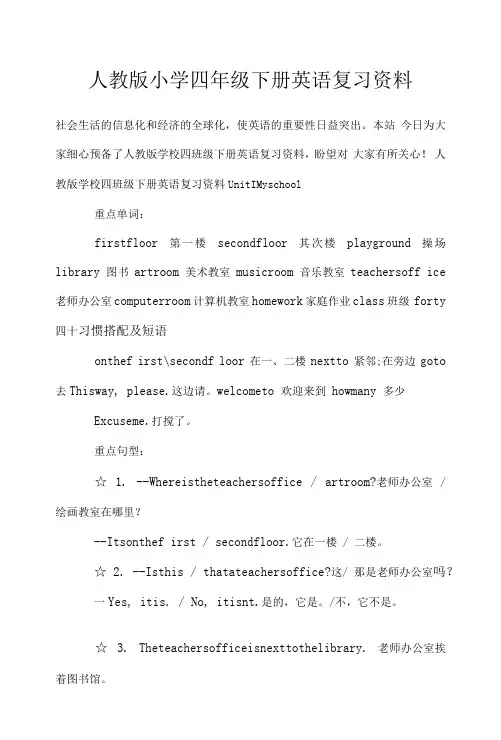
人教版小学四年级下册英语复习资料社会生活的信息化和经济的全球化,使英语的重要性日益突出。
本站今日为大家细心预备了人教版学校四班级下册英语复习资料,盼望对大家有所关心!人教版学校四班级下册英语复习资料UnitIMyschool重点单词:firstfloor 第一楼secondfloor 其次楼playground 操场library 图书artroom 美术教室musicroom 音乐教室teachersoff ice 老师办公室computerroom计算机教室homework家庭作业class班级forty 四十习惯搭配及短语onthef irst\secondf loor 在一、二楼nextto 紧邻;在旁边goto 去Thisway, please.这边请。
welcometo 欢迎来到howmany 多少Excuseme.打搅了。
重点句型:☆ 1. --Whereistheteachersoffice / artroom?老师办公室/ 绘画教室在哪里?--Itsonthef irst / secondfloor.它在一楼 / 二楼。
☆ 2. --Isthis / thatateachersoffice?这/ 那是老师办公室吗?一Yes, itis. / No, itisnt.是的,它是。
/不,它不是。
☆ 3. Theteachersofficeisnexttothelibrary. 老师办公室挨着图书馆。
☆ 4. --Doyouhaveal ibrary?你们(学校)有图书馆吗?--Yes, wedo. / No, wedont.语法点:特别疑问句Wheresthe+事物?在哪里?及其回答:Its+表地点的介词短语。
它一般疑问句:一Doyouhave+某物?你、你们有吗?确定回答:--Yes, I\wedo.否定回答:--No, I\wedont.Isthis / that?这 / 那是?确定回答:--Yes, itis.否定回答:No, itisnt.人教版学校四班级下册英语复习资料Unit2Whattimeisit?重点词汇:breakfast早餐lunch午餐dinner晚餐gotobed上床睡觉Englishclass 英语课musicclass 音乐课P. E. class 体育课getup 起床gohome回家gotoschool 上学习惯搭配及短语:hurryup快点comeon快;加油justaminute稍等一会儿Breakfastisready.早餐预备好了。
人教版(PEP)四年级英语下册(Unit 1-6)单元知识梳理(1)

人教版(PEP)四年级英语下册Unit 1-6单元知识梳理(1)Unit 1 My school重点单词:first floor一楼second floor二楼playground 操场library 图书馆art room美术教室music room 音乐教室teachers’ office教师办公室computer room计算机教室homework家庭作业class班级forty四十习惯搭配及短语on the first/second floor 在一/二楼next to...紧邻;在…...旁边go to…去…...This way,please.这边请。
welcome to…欢迎来到…...how many多少Excuse me. 打扰了。
重点句型:☆1.--Where is the teachers’ office∕art room?教师办公室∕美术教室在哪里?--It’s on the first∕second floor. 它在一楼∕二楼。
☆2.--Is this∕that a teachers’ office? 这∕那是教师办公室吗?--Yes,it is. ∕No,it isn’t. 是的,它是。
∕不,它不是。
☆3.The teachers’ office is next to the library. 教师办公室挨着图书馆。
☆4.--Do you have a library? 你们(学校)有图书馆吗?--Yes, we do. ∕No,we don’t.语法点:特殊疑问句Where’s the+事物? ……在哪里?及其回答:It’s+表地点的介词短语。
它在……一般疑问句:--Do you have+某物?你/你们有……吗?肯定回答:--Yes,I/we do.否定回答:--No,I/we don’t.Is this∕that…? 这∕那是…?肯定回答:--Yes, it is.否定回答:No, it isn’t.Unit2 What time is it?重点词汇:breakfast 早餐lunch午餐dinner 晚餐go to bed 上床睡觉English class 英语课music class音乐课PE class体育课get up 起床go home 回家go to school 上学习惯搭配及短语:hurry up快点come on快;加油just a minute稍等一会儿Breakfast is ready.早餐准备好了。
人教版四年级英语下册unit-6_知识点归纳
四年级英语下册重点知识归纳Unit 1 My School一、重点词汇:playground 操场library 图书馆music room音乐室first floor ——楼sec ond floor 二楼homework 作业computer room 电脑室art room 美术室music room 音乐教室n ext to在…近旁teachersoffice 教师办公室二、重点句型1. --Where‘ s the teachers office ? 老师办公室在哪里?--It' on the sec ond floor. 它在二楼。
2. --ls this the teache r office ?这是教师办公室吗--No,isn ' The teachers office libraryis next to the library .不,不是。
教师办公室挨着图书馆。
3. Is that the computer room?那是计算机房吗4--Do you have a library ? 你们有图书馆吗?-Yes, we do. 是的,有。
5. Go to the library. Read a book.去图书馆,看故事书6. 6. Go to the teachers office. Say hello. 去教师办公室,交作业7. Go to the playground. Play football.去操场,踢足球8. 8. Go to the garden. Water the flowers. 去花园,浇花三、重点知识讲解。
1、表示在几楼上,要用介词on,如on the first floor.在一楼。
The first表示第一的,序数词在使用时前面一定要加the,表示事物的排列顺序One —(基数词)f first第一(序数词)two二(基数词)f seco nd第二(序数词)2、介绍离自己近的事物时用this is….,介绍离自己比较远的事物时用that is…女口:This is my computer.这是我的计算机。
最新人教版四年级英语下册Unit_1-6_知识点归纳
四年级英语下册重点知识归纳Unit 1 My School一.重点词汇:playground操场library图书馆music room音乐室first floor 一楼second floor 二楼homework作业computer room 电脑室art room 美术室music room 音乐教室next to 在…近旁teacher’s office 教师办公室二、重点句型1.--Where’s the teacher’s office ? 老师办公室在哪里?--It’s on the second floor. 它在二楼。
2.--Is this the teacher’s office ? 这是教师办公室吗--No,isn’t. The teacher’s office libraryis next to the library .不,不是。
教师办公室挨着图书馆。
3.Is that the computer room? 那是计算机房吗4--Do you have a library ? 你们有图书馆吗?-Yes, we do. 是的,有。
5.Go to the library. Read a book. 去图书馆,看故事书6.6. Go to the teacher’s office. Say hello. 去教师办公室,交作业7.Go to the playground. Play football. 去操场,踢足球8.8. Go to the garden. Water the flowers. 去花园,浇花三、重点知识讲解。
1、表示在几楼上,要用介词on,如on the first floor.在一楼。
The first表示第一的,序数词在使用时前面一定要加the,表示事物的排列顺序。
One 一(基数词)→first 第一(序数词)two 二(基数词)→second 第二(序数词)2、介绍离自己近的事物时用this is …., 介绍离自己比较远的事物时用that is…如:This is my computer. 这是我的计算机。
(完整版)最新人教版四年级英语下册Unit_1-6_知识点归纳
四年级英语下册重点知识归纳Unit 1 My School一.重点词汇:playground操场 library 图书馆 music room音乐室first floor 一楼 second floor 二楼 homework作业computer room 电脑室 art room 美术室 music room 音乐教室next to 在…近旁 teacher's office 教师办公室二、重点句型1。
--Where’s the teacher’s office ?老师办公室在哪里?-—It’s on the second floor. 它在二楼。
2。
——Is this the teacher’s office ?这是教师办公室吗-—No,isn’t. The teacher’s office libraryis next to the library 。
不,不是。
教师办公室挨着图书馆。
3.Is that the computer room? 那是计算机房吗4——Do you have a library ? 你们有图书馆吗?—Yes, we do。
是的,有。
5.Go to the library。
Read a book. 去图书馆,看故事书6.6。
Go to the teacher’s office。
Say hello. 去教师办公室,交作业7.Go to the playground。
Play football. 去操场,踢足球8.8。
Go to the garden。
Water the flowers。
去花园,浇花三、重点知识讲解.1、表示在几楼上,要用介词on,如on the first floor。
在一楼。
The first表示第一的,序数词在使用时前面一定要加the,表示事物的排列顺序。
One 一(基数词)→first 第一(序数词) two 二(基数词)→second 第二(序数词)2、介绍离自己近的事物时用this is …。
(完整版)人教精通版小学英语四年级下册重要句型
人教精晓版小学英语四年级下册重要句型Unit 1. Welcome to my new home!要点句型1. Welcome to my new home.欢迎到达我的新家。
(Welcome to+地址)2. There’ snewa desk and a new chair.有一个新桌子和一把新椅子。
There be 动词 +a/an 或基数词 +物件名称(注意单复数) +(地址) There be 后边有几个并列名词做主语时, Be 的形式和近来的名词保持一致。
5. There are two sofas and four armchairs. 有两个沙发和四把椅子。
6. There are three kites and four balloons. 有三个风筝和四个汽球。
7.There is a new fridge. 有一个新冰箱。
8.Here ’ s a new table这.里是一张新桌子。
3. Can you write them?你能写下来吗?(答yes,I can,Ican)’t4.Look at the living room.看看起居室9. Go into the kitchen.到厨房里去。
10. What’s in my study?我的书斋里有什么?What’ s in +某处 /某物?答There is /are+ 物件( +in it )如There’s a big clock. 有一个大钟表。
或There’s a big fridge in the kitchen. 厨房里有一个大冰箱。
there be 句型不一般,物件跟在 be 后边, be 可变 is,are,there 永久不改变。
单数主语 is 复用 areUnit 2. There are forty students in our class.要点句型1、How many+ 名词复数are there ? -答There is/are+ 基数词 /基数词(咨询数目)2、How many+ 名词复数 do you have?答I/We have+ 基数词 +名词(咨询对方有多少某物件)1. How many students are there in your class?你们班有多少学生?----There are forty.有四十人。