
牛津译林版七年级上英语Unit4 Grammer课件(共32张PPT)
Unit1-4课文翻译中文2024-2025学年牛津译林版英语七年级上册
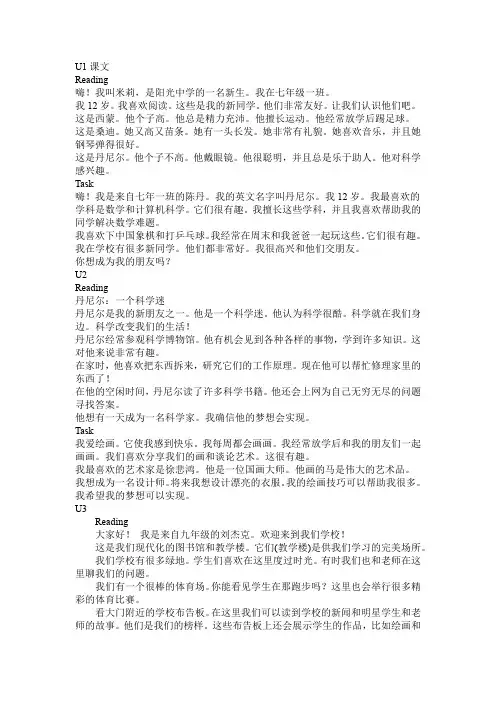
U1课文
Reading
嗨!我叫米莉,是阳光中学的一名新生。我在七年级一班。
我12岁。我喜欢阅读。这些是我的新同学。他们非常友好。让我们认识他们吧。
这是西蒙。他个子高。他总是精力充沛。他擅长运动。他经常放学后踢足球。
这是桑迪。她又高又苗条。她有一头长发。她非常有礼貌。她喜欢音乐,并且她钢琴弹得很好。
这是丹尼尔。他个子不高。他戴眼镜。他很聪明,并且总是乐于助人。他对科学感兴趣。
Task
嗨!我是来自七年一班的陈丹。我的英文名字叫丹尼尔。我12岁。我最喜欢的学科是数学和计算机科学。它们很有趣。我擅长这些学科,并且我喜欢帮助我的同学解决数学难题。
我喜欢下中国象棋和打乒乓球。我经常在周末和我爸爸一起玩这些。它们很有趣。
我在学校有很多新同学。他们都非常好。我很高兴和他们交朋友。
你想成为我的朋友吗?
U2
Reading
丹尼尔:一个科学迷
丹尼尔是我的新朋友之一。他是一个科学迷。他认为科学很酷。科学就在我们身边。科学改变我们的生活!
丹尼尔经常参观科学博物馆。他有机会见到各种各样的事物,学到许多知识。这对他来说非常有趣。
在家时,他喜欢把东西拆来,研究它们的工作原理。现在他可以帮忙修理家里的东西了!
在他的空闲时间,丹尼尔读了许多科学书籍。他还会上网为自己无穷无尽的问题寻找答案。
他想有一天成为一名科学家。我确信他的梦想会实现。
Task
我爱绘画。它使我感到快乐。我每周都会画画。我经常放学后和我的朋友们一起画画。我们喜欢分享我们的画和谈论艺术。这很有趣。
我最喜欢的艺术家是徐悲鸿。他是一位国画大师。他画的马是伟大的艺术品。
我想成为一名设计师。将来我想设计漂亮的衣服。我的绘画技巧可以帮助我很多。我希望我的梦想可以实现。
U3
Reading
大家好! 我是来自九年级的刘杰克。欢迎来到我们学校!
这是我们现代化的图书馆和教学楼。它们(教学楼)是供我们学习的完美场所。
我们学校有很多绿地。学生们喜欢在这里度过时光。有时我们也和老师在这里聊我们的问题。
unit 4 comic-reading讲解 牛津译林版英语七年级上册
1
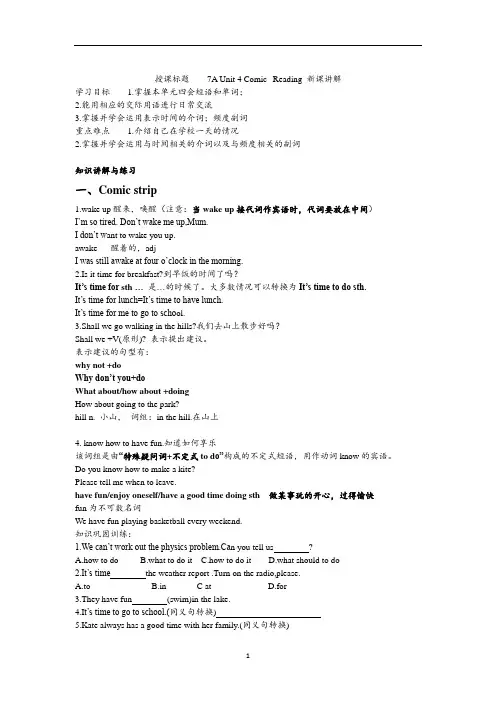
授课标题 7A Unit 4 Comic--Reading 新课讲解
学习目标 1.掌握本单元四会短语和单词;
2.能用相应的交际用语进行日常交流
3.掌握并学会运用表示时间的介词;频度副词
重点难点 1.介绍自己在学校一天的情况
2.掌握并学会运用与时间相关的介词以及与频度相关的副词
知识讲解与练习
一、Comic strip
1.wake up醒来,唤醒(注意:当wake up接代词作宾语时,代词要放在中间)
I’m so tired. Don’t wake me up,Mum.
I don’t want to wake you up.
awake 醒着的,adj
I was still awake at four o’clock in the morning.
2.Is it time for breakfast?到早饭的时间了吗?
It’s time for sth … 是…的时候了。大多数情况可以转换为It’s time to do sth.
It’s time for lunch=It’s time to have lunch.
It’s time for me to go to school.
3.Shall we go walking in the hills?我们去山上散步好吗?
Shall we +V(原形)? 表示提出建议。
表示建议的句型有:
why not +do
Why don’t you+do
What about/how about +doing
How about going to the park?
hill n. 小山, 词组:in the hill.在山上
4. know how to have fun.知道如何享乐
该词组是由“特殊疑问词+不定式to do”构成的不定式短语,用作动词know的宾语。
Do you know how to make a kite?
牛津译林版七年级英语上册unit4全单元教案

38 牛津译林版七年级英语上册牛津译林版七年级英语上册 Periods :031 Date : : Prepare – Oct.15th Title: Unit 4 My day Comic strip & Welcome to the unit Teaching aims: Students can master the following in this class. 1.words:wake shall seldom activity quarter 2.phrases:wake up, go out, do after-school activities, do homework, have fun, be late for , go to bed 3.sentences:I seldom go out . I’m never late for it . At a quarter past eight . Difficult points: Words about daily life . Students can use the words and sentences learned in this class to describe daily life . Procedures : Step1 Free talk Lead-in T: What time does your school day begin ? S: It begins at 6:45. T: Oh, it starts at 6:45. You start our school day at 6:45. So you need to wake up very early. (teach wake up and start) Show some pictures of clock. T: It is six o’clock in the morning. What does….do? Can you guess ? (Teach have breakfast /have lunch /have dinner; need; rest ;go out ; have fun) Step2 Practice T: Hobo wants to know something about you. He would like to ask the questions below. Please answer them. (1) What time do you wake up? (2) Do you often go out to play games /have dinner .have fun ? (3) Do you often have breakfast ? (4) Where do you have lunch ? (5) Do you always have a rest after lunch? According to the students’ answers, present “seldom”and “never”at the right time. Step3 Presentation T: Do you remember our friend Eddie ? What does he do every day? Can you guess ? Now let’s listen to the conversation between Eddie and Hobo and check if you are right. (Teach hill ) T: What does Hobo think of dogs like Eddie ? Step 4 Practice Practise the conversation and act it out. Step 5 Extention Here’s Hobo’s diary. Please help him complete it.
【2024秋】最新版译林版七年级上册英语第四单元Unit4《单词+短语+句子》默写专项练习(含答案)
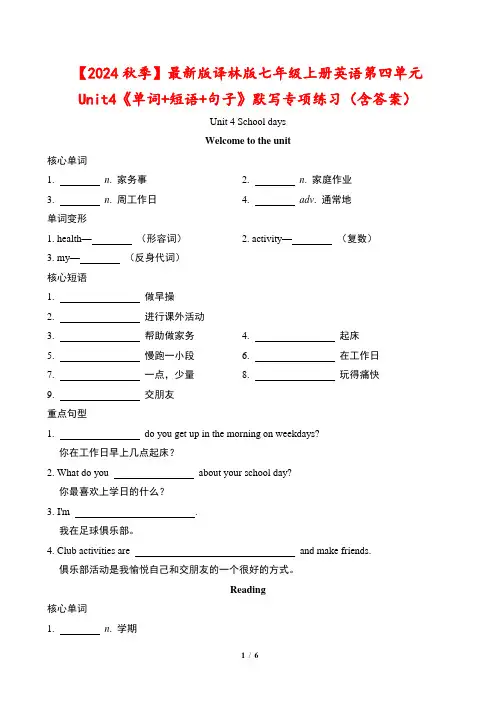
1 / 6 【2024秋季】最新版译林版七年级上册英语第四单元
Unit4《单词+短语+句子》默写专项练习(含答案)
Unit 4 School days
Welcome to the unit
核心单词
1. n. 家务事 2. n. 家庭作业
3. n. 周工作日 4. adv. 通常地
单词变形
1. health— (形容词) 2. activity— (复数)
3. my— (反身代词)
核心短语
1. 做早操
2. 进行课外活动
3. 帮助做家务 4. 起床
5. 慢跑一小段 6. 在工作日
7. 一点,少量 8. 玩得痛快
9. 交朋友
重点句型
1. do you get up in the morning on weekdays?
你在工作日早上几点起床?
2. What do you about your school day?
你最喜欢上学日的什么?
3. I'm .
我在足球俱乐部。
4. Club activities are and make friends.
俱乐部活动是我愉悦自己和交朋友的一个很好的方式。
Reading
核心单词
1. n. 学期 2 / 6 2. vi. (从……)开始vt. & vt. 开始,着手n. 开头,开端
3. n. 语言 4. adj. 令人大为惊奇的
5. n. 生物学 6. n. 大自然;天性
7. vi. & vt. 训练;练习 8. n. 田,地;领域
牛津译林版-英语-七上-4单元 Grammar教案

初中-英语-打印版
初中-英语-打印版 7A Unit4 My day P4 Grammar
Teaching Aims:
⒈ 用正确的介词来表达时间
⒉ 正确识别并使用频度副词
⒊ To recognize and use the indefinite articles to talk about things that are countable.
Difficult points:
To recognize and use adverbs of frequency and countable nouns.
教学环节
Part One: 预习作业与交流
预习作业﹕
《高效课堂导学案》P83 I II III
预习交流:
⒈Check out the prepared work
① Work in groups to check out the prepared work
② Let the students ask some questions
③ Solve some problems together
Part Two:展示探究﹕
A Prepositions of time
Step1 呈现
1.通过与学生进行真实语境下的交流,导入本课内容。
Hello,my young friends!What time do you go to school every day ?On what days do you
usually have your history lessons ? When do you usually have your Chinese lessons?鼓励学生根据实际情况回答并将答句写在黑板上:
(1)I go to school at 7 o’clock.
(2)We have our history lessons on Monday and Friday.
牛津译林版七年级上册 Unit 4 My day 课时4 (Grammar)教案

第 1 页 共 4 页 牛津译林版七年级上册 Unit 4 My day 课时4 (Grammar)教案
(7A U4) My Day Grammar-----Prepositions of Time
Analysis of teaching material:
This is grammar part of unit 4. The lesson focuses on the preposition of
time including in on at. These three prepositions of time are closely
related to students’ real life and in accord with students’ cognitive level,
thus helping students master the usage of prepositions could make
students know how to use these prepositions of time correctly and build
the confidence of English learning.
Analysis of students:
The objects of this lesson are students in Grade 7. Students in this level
has already learned a little about the prepositions of time, thus they
have the ability to learn the prepositions better and more clearly.
However, our students don’t know when to use it clearly. Therefore, it
英语选修Ⅵ牛津译林Unit4全程教学课件7(共187张)Grammar
Unit 4 Helping people around the worldSubjunctive Mood
虚拟语气虚拟语气
虚拟语气用来表示说话人的主观
愿望或假想,所说的是一个条件,
不一定是事实'或与事实相反。虚拟语气
条件句可分为两类,一类为真实条件 句,一类为非真实条件句。非真实条 件句表示的是假设的或实际可能性不 大的情况,故采用虚拟语气。
4)与现在事实相反:
4)与现在事实相反:
were V-ed
should (would
could, might) 2)与过去事实相反:2)与过去事实相反:
had V-ed
should (would
could, might)2)与过去事实相反:
had V-ed
should (would
could, might)
2)与将来事实相反:2)与过去事实相反:
had V-ed should (would
could, might)
2)与将来事实相反:
should were to did / were
should (would could, might)
1.假设条件从句谓语动词发生的时间与 主句所假设的谓语动词不一致,叫做 错综条件虚拟语气。主句和从句的谓 语动词要依照1.假设条件从句谓语动词发生的时间与 主句所假设的谓语动词不一致,叫做 错综条件虚拟语气。主句和从句的谓 语动词要依照假设的时间而顶。
If the weather had been finer, the crops
would be growing still better.1.假设条件从句谓语动词发生的时间与 主句所假设的谓语动词不一致,叫做 错综条件虚拟语气。主句和从句的谓 语动词要依照假设的时间而顶。
If the weather had been finer9 the crops
would be growing still better.
If you had followed the teacher^s advice,
七年级英语上册Unit4MydayGrammar牛津版(2)
1 Unit 4 My day
Grammar
Teaching aims
1. To use prepositions to talk about time correctly;
2. To use the adverbs of frequency correctly;
3. To grasp the usage of“how often”;
4. To use these items of grammar to talk about their daily life.
Teaching contents
1. New words and phrases:would, would like, life, all the best, roller skating
2. New structure:How often do they exercise?
Important and difficult points
1. Know better about some usages of the prepositions of time.
2. Tell the difference between ‘how often’ and “how many times”.
Teaching procedures
A Prepositions of time
Step 1 Presentation
1. Find out the phrases which should be put after ‘in/ on/ at’ one by one
T: Hello, boys and girls. This is our school. We know a lot about it. Today, there
will be a lot of
new students coming here. Will you help them find their classroom? Here they
牛津译林版七年级上册(新)英语教案Unit4Grammar
Unit 4 Grammar
Teaching aims 1. 能掌握冠词的用法。
2. 能运用方位介词来表达物体的位置。
Importance 能掌握冠词的用法。
能运用方位介词来表达物体的位置。
Difficulties 能掌握冠词的用法。
能运用方位介词来表达物体的位置。
Teaching
procedures Teaching pre-set Personalized
revisions
Step1
A Using a, an and the
Step Ⅰ Free talk
1. What’s this?
It’s a book.
Whose book is it?
It’s…’s.
Write the sentences on the blackboard: It’s a book.
The book is…’s.
2. Make sentences
eg: This is an apple. The apple is big and red.
Step ⅡPresentation
We use a or an when we mention a person or thing for the
first time. We use the before a noun when the person or
thing is mentioned again, or when we are talking about a
specific person or thing.
Show some pictures and ask students to say something
about the pictures:
1. This is a Panda House. We can see some pandas.
2. Look, here is panda. The panda is eating bamboo.
牛津译林版-英语-七上-七上4单元 Grammar教学设计
初中-英语-打印版
初中-英语-打印版 Unit 4教学设计
Grammar
教学内容分析
教学内容 《英语》(译林出版社)七年级上册Unit 4 Grammar
教学对象 初一学生
教学项目 语词 would , life, would like , all the best, roller skating
My parents watch TV in the evening. We do not go to school on
Sunday. Millie has breakfast at seven.
教学方法 Task-based language teaching, the deductive method
语言技能 l.Be able to use prepositions to talk about time correctly :in, on & at
2.Be able to use the adverbs of frequency correctly: never, seldom,
sometimes, often, usually, always
语言运用 Be able to use these items of grammar to talk about their daily life.
情感态度 Use the correct preposition to express time and learn how to arrange
your time properly and to cherish time.
学习策略 Autonomic learning strategy, cooperative learning strategy
教学重点 l. Be able to use prepositions to talk about time correctly;