
2015年考研英语(二)真题解析+答案[完整版]
2015年考研英语(二)真题解析+答案[完整版]Directions:Read the following text. Choose the best word(s) for each numbered blank and mark A, B, C or D on the ANSWER SHEET. (10 points)In our contemporary culture, the prospect of communicating with – or even looking at – a stranger is virtually unbearable. Everyone around us seems to agree by the way they cling to the phones, even without a __1__ on a subway.It’s a sad reality – our desire to avoid interacting with other human beings – because there’s __2__ to be gained from talking to the stranger standing by you. But you wouldn’t know it, __3__ into your phone. This universal protection sends the __4__:”Please don’t approach me.”What is it that makes us feel we need to hide __5__ our screens?One answer is fear, according to Jon Wortmann, an executive mental coach. We fear rejection, or that our innocent social advances will be __6__ as “weird.”We fear we’ll be __7__. We fear we’ll be disruptive.Strangers are inherently__8__to us, so we are more likely to feel__9__when communicating with them compared with our friends and acquaintances. To avoid this uneasiness, we_ 10_ to our phones.” Phones become our security blanket,”Wortmann says.” They are our happy glasses that protect us from what we perceive is going to be more __11___”But once we rip off the band-aid, tuck our smartphones in our pockets and look up, it doesn’t ___12___so bad. In one 2011 experiment, behavioral scientists Nicholas Epley and Juliana Schroeder asked commuters to do the unthinkable: Start a __13___. They had Chicago train commuters talk to their fellow __14___.”When Dr. Epley and Ms.Schroeder asked other people in the same train station to __15___how they would feel after talking to a stranger, the commuters thought their __16___ would be more pleasant if they sat on their own,” The New York Times summarizes. Though the participants didn’t expect a positive experience, after they __17__with the experiment,” not a single person reported having been embarrassed”__18__, these commutes were reportedly more enjoyable compared with those without communication, whichmakes absolute sense, ___19___human beings thrive off of social connections. It’s that ___20___: Talking to strangers can make you feel connected.选项及答案:1.[A]signal[B]permit [C]ticket [D]record2. [A]nothing [B]little [C]another[D]much3. [A]beaten [B]guided[C]plugged[D]brought4. [A]sign [B]code [C]notice [D]message5. [A]under [B]behind[C]beyond [D]from6. [A]misapplied [B]mismatched [C]misadjusted [D]misinterpreted7. [A]replaced [B]fired[C]judged[D]delayed8. [A]unreasonable [B]ungrateful [C]unconventional [D]unfamiliar9. [A]comfortable [B]confident[C]anxious [D]angry10. [A]attend [B]point [C]take[D]turn11.[A]dangerous[B]mysterious [C]violent [D]boring12. [A]hurt[B]resist [C]bend [D]decay13. [A]lecture [B]conversation[C]debate [D]negotiation14.[A]passengers[B]employees [C]researchers [D]trainees15. [A]reveal [B]choose[C]predict[D]design16. [A]voyage [B]ride[C]walk [D]flight17.[A]went through [B]did away [C]caught up [D]put up18. [A]In turn[B]In fact[C]In particular [D]In consequence19. [A]unless[B]since[C]if [D]whereas20. [A]funny [B]logical [C]simple[D]rare[page]原文及答案:While the subway's arrival may be ambiguous, one thing about your commute is certain: No one wants to talk to each other. In our contemporary culture, the prospect of communicating with -- or even looking at -- a stranger is virtually unbearable. Everyone around us seems to agree by the way they fiddle with their phones, even without a 1 signal underground.It's a sad reality -- our desire to avoid interacting with other human beings -- because there's 2 much to be gained from talking to the stranger standing by you. But you wouldn't know it,3 plugged into your phone. This universal armor sends the 4 message: 'Please don't approach me.'What is it that makes us feel we need to hide 5 behind our screens?One answer is fear, according to Jon Wortmann, executive mental coach and author of 'Hijacked by Your Brain: How to Free Yourself When Stress Takes Over.' We fear rejection, or that our innocent social advances will be 6 misinterpreted as 'creepy,' he told The Huffington Post. We fear we'll be 7 judged. We fear we'll be disruptive.Strangers are inherently8 unfamiliar to us, so we are more likely to feel 9 anxious when communicating with them compared with our friends and acquaintances. To avoid this anxiety, we 10 turn to our phones. 'Phones become our security blanket,' Wortmann says. 'They are our happy glasses that protect us from what we perceive is going to be more 11 dangerous.'But once we rip off the bandaid, tuck our smartphones in our pockets and look up, it doesn't12 hurt so bad. In one 2011 experiment, behavioral scientists Nicholas Epley and Juliana Schroeder asked commuters to do the unthinkable: Start a 13 conversation. The duo had Chicago train commuters talk to their fellow14 passengers. 'When Dr. Epley and Ms. Schroeder asked other people in the same train station to15 predict how they would feel after talking to a stranger, the commuters thought their16 ride would be more pleasant if they sat on their own,' the New York Times summarizes. Though the participants didn't expect a positive experience, after they17 went through with the experiment, 'not a single person reported having been snubbed.'18 In fact, these commutes were reportedly more enjoyable compared with those sans communication, which makes absolute sense, 19 since human beings thrive off of social connections. It's that 20 simple: Talking to strangers can make you feel connected. The train ride is a fortuity for social connection -- 'the stuff of life,' Wortmann says. Even seemingly trivial interactions can boost mood and increase the sense of belonging. A study similar in hypothesis to Eplyand Schroder's published in Social Psychological & Personality Science asked participants to smile, make eye contact and chatwith their cashier. Those who engaged with the cashier experienced better moods -- and even reported a better shopping experience than those who avoided superfluous conversation.分析:文章节选自2014.5.16 赫芬顿邮报,难度与2014/2013持平,明显比模考时的文章容易。
2015年考研英语二真题解析和翻译(大师兄版)

[B] permit [B] link [B] guided
[C] signal [C] another [C]plugged [C] notice [C] behind
IC]misadjusted
[D] record [D]much [D] brought [D] sign [D] fi'onr [D] mismatched
the lurdings hold true for both those with children who work outside the home have better health.
more so for non-parents. This is why people
What the study doesn't measure is whether pgopli. are still doing work when they're at llome, whether it
attend
[D]boring [D] decay
[D] negotiation [D] passengers
[B] conversation [B] enrployees
1
@
I'lI ttr! il! . 2o1s 1' '\ i]1*rL:,
ID] design
15. 16.
1
[A] reveal [A] \'o]'age
IA], tB], tC] or [D]
on
In our contemporary culture, the prospect of comnrunicating
考研英语(二)2015年真题

2015年全国硕士研究生招生考试英语(二)试题Section ⅠUse of EnglishDirections:Read the following text. Choose the best word(s) for each numbered blank and mark A, B, C or D on the ANSWER SHEET.(10 points)①In our contemporary culture, the prospect of communicating with—or even looking at—a stranger is virtually unbearable. ②Everyone around us seems to agree by the way they cling to their phones, even without a 1 on a subway.①It’s a sad reality—our desire to avoid interacting with other human beings—because there’s 2 to be gained from talking to the stranger standing by you. ②But you wouldn’t know it, 3 into your phone. ③This universal protection sends the 4 : “Please don’t approach me.”①What is it that makes us feel we need to hide 5 our screens?①One answer is fear, according to Jon Wortmann, an executive mental coach. ②We fear rejection, or that our innocent social advances will be 6 as “weird.” ③We fear we’ll be7 . ④We fear we’ll be disruptive.①Strangers are inherently 8 to us, so we are more likely to feel 9 when communicating with them compared with our friends and acquaintances. ② To avoid this uneasiness, we 10 to our phones. ③“Phones become our security blanket,” Wortmann says. ④“They are our happy glasses that protect us from what we perceive is going to be more 11 .”①But once we rip off the band-aid, tuck our smartphones in our pockets and look up, it doesn’t 12 so bad. ②In one 2011 experiment, behavioral scientists Nicholas Epley and Juliana Schroeder asked commuters to do the unthinkable: Start a 13 . ③They had Chicago train commuters talk to their fellow 14 . ④“ When Dr. Epley and Ms. Schroeder asked other people in the same train station to 15 how they would feel after talking to a stranger, the commuters thought their 16 would be more pleasant if they sat on their own,” The New York Times summarizes. ⑤Though the participants didn’t expect a positive experience, after they 17 with the experiment, “not a single person reported having been embarrassed.”①18 , these commutes were reportedly more enjoyable compared with those without communication, which makes absolute sense, 19 human beings thrive off of social connections. ②It’s that 20 : Talking to strangers can make you feel connected.1. [A] signal [B] permit [C] ticket [D] record2. [A] nothing [B] little [C] another [D] much3. [A] beaten [B] plugged [C] guided [D] brought4. [A] message [B] code [C] notice [D] sign5. [A] under [B] beyond [C] behind [D] from6. [A] misapplied [B] misinterpreted [C] misadjusted [D] mismatched7. [A] judged [B] fired [C] replaced [D] delayed8. [A] unreasonable [B] ungrateful [C] unconventional [D] unfamiliar9. [A] comfortable [B] confident [C] anxious [D] angry10. [A] attend [B] turn [C] take [D] point11. [A] dangerous [B] mysterious [C] violent [D] boring12. [A] bend [B] resist [C] hurt [D] decay13. [A] lecture [B] debate [C] conversation [D] negotiation14. [A] trainees [B] employees [C] researchers [D] passengers15. [A] reveal [B] choose [C] predict [D] design16. [A] voyage [B] flight [C] walk [D] ride17. [A] went through [B] did away [C] caught up [D] put up18. [A] In turn [B] In fact [C] In particular [D] In consequence19. [A] unless [B] whereas [C] if [D] since20. [A] funny [B] simple [C] logical [D] rareSection II Reading ComprehensionPart ADirections:Read the following four texts. Answer the questions below each text by choosing A, B, C or D. Mark your answers on the ANSWER SHEET. (40 points)Text 1①A new study suggests that contrary to most surveys, people are actually more stressed at home than at work. ②Researchers measured people’s cortisol, which is a stress marker, while they were at work and while they were at home and found it higher at what is supposed to be a place of refuge.①“Further contradicting conventional wisdom, we found that women as well as men have lower levels of stress at work than at home,” writes one of the researchers, Sarah Damaske. ②In fact women even say they feel better at work, she notes, “It is men, not women, who report being happier at home than at work.” ③Another surprise is that the findings hold true for both those with children and without, but more so for nonparents. ④This is why people who work outside the home have better health.①What the study doesn’t measure is whether people are still doing work when they’re at home, whether it is household work or work brought home from the office. ②For many men, the end of the workday is a time to kick back. ③For women who stay home, they never get to leave the office. ④And for women who work outside the home, they often are playing catch-up-with-household tasks. ⑤With the blurring of roles, and the fact that the home front lags well behind the workplace in making adjustments for working women, it’s not surprising that women are more stressed at home.①But it’s not just a gender thing. ②At work, people pretty much know what they’re supposed to be doing: working, making money, doing the tasks they have to do in order to draw an income.③The bargain is very pure: Employee puts in hours of physical or mental labor and employee draws out life-sustaining moola.①On the home front, however, people have no such clarity. ②Rare is the household in which the division of labor is so clinically and methodically laid out. ③There are a lot of tasks to be done, there are inadequate rewards for most of them. ④Your home colleagues—your family—have no clear rewards for their labor; they need to be talked into it, or if they’re teenagers, threatened with complete removal of all electronic devices. ⑤Plus, they’re your family. ⑥You cannot fire your family. ⑦You never really get to go home from home.①So it’s not surprising that people are more stressed at home. ②Not only are the tasks apparently infinite, the co-workers are much harder to motivate.21. According to Paragraph 1, most previous surveys found that home .[A] offered greater relaxation than the workplace.[B] was an ideal place for stress measurement.[C] generated more stress than the workplace.[D] was an unrealistic place for relaxation.22. According to Damaske, who are likely to be the happiest at home?[A] Working mothers. [B] Childless husbands.[C] Working fathers. [D] Childless wives.23. The blurring of working women’s roles refers to the fact that .[A] their home is also a place for kicking back[B] they are both bread winners and housewives[C] there is often much housework left behind[D] it is difficult for them to leave their office24. The word “moola” (Para. 4) most probably means .[A]skills [B]energy[C]earnings [D]nutrition25. The home front differs from the workplace in that .[A]family labor is often adequately rewarded[B]home is hardly a cozier working environment[C]household tasks are generally more motivating[D]division of labor at home is seldom clear-cutText 2①For years, studies have found that first-generation college students—those who do not havea parent with a college degree—lag other students on a range of education achievement factors.②Their grades are lower and their dropout rates are higher. ③But since such students are most likely to advance economically if they succeed in higher education, colleges and universities have pushed for decades to recruit more of them. ④This has created “a paradox” in that recruiting first-generation students, but then watching many of them fail, means that higher education has “continued to reproduce and widen, rather than close” an achievement gap based on social class, according to the depressing beginning of a paper forthcoming in the journal Psychological Science.①But the article is actually quite optimistic, as it outlines a potential solution to this problem, suggesting that an approach (which involves a one-hour, next-to-no-cost program) can close 63 percent of the achievement gap (measured by such factors as grades) between first-generation andother students.①The authors of the paper are from different universities, and their findings are based on a study involving 147 students (who completed the project) at an unnamed private university. ②First generation was defined as not having a parent with a four-year college degree. ③Most of the first-generation students (59.1 percent) were recipients of Pell Grants, a federal grant for undergraduates with financial need, while this was true only for 8.6 percent of the students with at least one parent with a four-year degree.①Their thesis—that a relatively modest intervention could have a big impact—was based on the view that first-generation students may be most lacking not in potential but in practical knowledge about how to deal with the issues that face most college students. ②They cite past research by several authors to show that this is the gap that must be narrowed to close the achievement gap.①Many first-generation students “struggle to navigate the middle-class culture of higher education, learn the ‘rules of the game,’ and take advantage of college resources,” they write.②And this becomes more of a problem when colleges don’t talk about the class advantages and disadvantages of different groups of students. ③“Because US colleges and universities seldom acknowledge how social class can affect students’ educational experiences, many first-generation students lack insight about why they are struggling and do not understand how students ‘like them’ can improve.”26. Recruiting more first-generation students has .[A] reduced their dropout rates [B] narrowed the achievement gap[C] missed its original purpose [D] depressed college students27. The authors of the research article are optimistic because .[A] their findings appeal to students [B] the recruiting rate has increased[C] the problem is solvable [D] their approach is costless28. The study suggests that most first-generation students .[A] are from single-parent families [B] study at private universities[C] are in need of financial support [D] have failed their collage29. The authors of the paper believe that first-generation students .[A] may lack opportunities to apply for research projects[B] are inexperienced in handling their issues at college[C] can have a potential influence on other students[D] are actually indifferent to the achievement gap30. We may infer from the last paragraph that .[A] universities often reject the culture of the middle-class[B] students are usually to blame for their lack of resources[C] social class greatly helps enrich educational experiences[D] colleges are partly responsible for the problem in questionText 3①Even in traditional offices, “the lingua franca of corporate America has gotten much more emotional and much more right-brained than it was 20 years ago,” said Harvard Business School professor Nancy Koehn. ②She started spinning off examples. ③“If you and I parachuted back to Fortune 500 companies in 1990, we would see much less frequent use of terms like journey, mission, passion.④There were goals, there were strategies, there were objectives, but we didn’ttalk about energy; we didn’t talk about passion.”①Koehn pointed out that this new era of corporate vocabulary is very “team”- oriented—and not by coincidence.②“Let’s not forget sports—in male-dominated corporate America, it’s still a big deal.③ It’s not explicitly conscious; it’s the idea that I’m a coach, and you’re my team, and we’re in this together. ④There are lots and lots of CEOs in very different companies, but most think of themselves as coaches and this is their team and they want to win.”①These terms are also intended to infuse work with meaning—and, as Rakesh Khurana, another professor, points out, increase allegiance to the firm. ②“You have the importation of terminology that historically used to be associated with non-profit organizations and religious organizations: terms like vision, values, passion, and purpose,” said Khurana.①This new focus on personal fulfillment can help keep employees motivated amid increasingly loud debates over work-life balance. ②The “mommy wars” of the 1990s are still going on today, prompting arguments about why women still can’t have it all and books like Sheryl Sandberg’s Lean In, whose title has become a buzzword in its own right. ③Terms like unplug, offline, life-hack, bandwidth, and capacity are all about setting boundaries between the office and the home. ④But if your work is your “passion”, you’ll be more likely to devote yourself to it, even if that means going home for dinner and then working long after the kids are in bed.①But this seems to be the irony of office speak: Everyone makes fun of it, but managers love it, companies depend on it, and regular people willingly absorb it. ②As a linguist once said, “You can get people to think it’s nonsense at the same time that you buy into it.”③ In a workplace that’s fundamentally indifferent to your life and its meaning, office speak can help you figure out how you relate to your work—and how your work defines who you are.31. According to Nancy Koehn, office language has become .[A] less strategic [B] less energetic[C] more objective [D] more emotional32. “Team”-oriented corporate vocabulary is closely related to .[A] sports culture [B] gender difference[C] historical incidents [D] athletic executives33. Khurana believes that the importation of terminology aims to .[A] revive historical terms [B] promote company image[C] foster corporate cooperation[D] strengthen employee loyalty34. It can be inferred that Lean In .[A] voices for working women[B] appeals to passionate workaholics[C] triggers debates among mommies[D] praises motivated employees35. Which of the following statements is true about office speak?[A] Linguists believe it to be nonsense.[B] Regular people mock it but accept it.[C] Companies find it to be fundamental.[D] Managers admire it but avoid it.Text 4①Many people talked of the 288,000 new jobs the Labor Department reported for June, along with the drop in the unemployment rate to 6.1 percent, as good news. ②And they were right. ③For now it appears the economy is creating jobs at a decent pace. ④We still have a long way to go to get back to full employment, but at least we are now finally moving forward at a faster pace.①However, there is another important part of the jobs picture that was largely overlooked.②There was a big jump in the number of people who report voluntarily working part-time. ③This figure is now 830,000 (4.4 percent) above its year ago level.①Before explaining the connection to the Obamacare, it is worth making an important distinction. ②Many people who work part-time jobs actually want full-time jobs. ③They take part-time work because this is all they can get. ④An increase in involuntary part-time work is evidence of weakness in the labor market and it means that many people will be having a very hard time making ends meet.①There was an increase in involuntary part-time in June, but the general direction has been down. ②Involuntary part-time employment is still far higher than before the recession, but it is down by 640,000 (7.9 percent) from its year ago level.①We know the difference between voluntary and involuntary part-time employment because people tell us. ②The survey used by the Labor Department asks people if they worked less than 35 hours in the reference week. ③If the answer is “yes,” they are classified as working part-time.④The survey then asks whether they worked less than 35 hours in that week because they wanted to work less than full time or because they had no choice. ⑤They are only classified as voluntary part-time workers if they tell the survey taker they chose to work less than 35 hours a week.①The issue of voluntary part-time relates to Obamacare because one of the main purposes was to allow people to get insurance outside of employment. ②For many people, especially those with serious health conditions or family members with serious health conditions, before Obamacare the only way to get insurance was through a job that provided health insurance.①However, Obamacare has allowed more than 12 million people to either get insurance through Medicaid or the exchanges. ②These are people who may previously have felt the need to get a full-time job that provided insurance in order to cover themselves and their families. ③With Obamacare there is no longer a link between employment and insurance.36. Which part of the jobs picture was neglected?[A] The prospect of a thriving job market.[B] The increase of voluntary part-time jobs.[C] The possibility of full employment.[D] The acceleration of job creation.37. Many people work part-time because they .[A] prefer part-time jobs to full-time jobs[B] feel that is enough to make ends meet[C] cannot get their hands on full-time jobs[D] haven’t seen the weakness of the market38. Involuntary part-time employment in the US .[A] shows a general tendency of decline[B] is harder to acquire than one year ago[C] satisfies the real need of the jobless[D] is lower than before the recession39. It can be learned that with Obamacare, .[A] it is no longer easy for part-timers to get insurance[B] full-time employment is still essential for insurance[C] it is still challenging to get insurance for family members[D] employment is no longer a precondition to get insurance40. The text mainly discusses .[A] employment in the US [B] part-timer classification[C] insurance through Medicaid [D] Obamacare’s troublePart BDirections:Read the following text and answer the questions by choosing the most suitable subheading from the list A-G for each numbered paragraph (41-45). There are two extra subheadings which you do not need to use. Mark your answers on the ANSWER SHEET. (10 points)[A]You are not alone[B]Experience helps you grow[C]Pave your own unique path[D]Most of your fears are unreal[E]Think about the present moment[F]Don’t fear responsibility for your life[G]There are many things to be grateful forSome Old Truths to Help You Overcome Tough TimesUnfortunately, life is not a bed of roses. We are going through life facing sad experiences. Moreover, we are grieving various kinds of loss: a friendship, a romantic relationship or a house. Hard times may hold you down at what usually seems like the most inopportune time, but you should remember that they won’t last forever.When our time of mourning is over, we press forward, stronger with a greater understanding and respect for life. Furthermore, these losses make us mature and eventually move us toward future opportunities for growth and happiness. I want to share these old truths I’ve learned along the way.41.Fear is both useful and harmful. This normal human reaction is used to protect us by signaling danger and preparing us to deal with it. Unfortunately, people create inner barriers with a help of exaggerating fears. My favorite actor Will Smith once said, “Fear is not real. It is a product of thoughts you create. Do not misunderstand me. Danger is very real. But fear is a choice. ” I do completely agree that fears are just the product of our luxuriant imagination.42.If you are surrounded by problems and cannot stop thinking about the past, try to focus on thepresent moment. Many of us are weighed down by the past or anxious about the future. You may feel guilt over your past, but you are poisoning the present with the things and circumstances you cannot change. Value the present moment and remember how fortunate you are to be alive. Enjoy the beauty of the world around and keep the eyes open to see the possibilities before you. Happiness is not a point of future and not a moment from the past, but a mindset that can be designed into the present.43.Sometimes it is easy to feel bad because you are going through tough times. You can be easily caught up by life problems that you forget to pause and appreciate the things you have. Only strong people prefer to smile and value their life instead of crying and complaining about something.44.No matter how isolated you might feel and how serious the situation is, you should always remember that you are not alone. Try to keep in mind that almost everyone respects and wants to help you if you are trying to make a good change in your life, especially your dearest and nearest people. You may have a circle of friends who provide constant good humor, help and companionship. If you have no friends or relatives, try to participate in several online communities, full of people who are always willing to share advice and encouragement.45.Today many people find it difficult to trust their own opinion and seek balance by gaining objectivity from external sources. This way you devalue your opinion and show that you are incapable of managing your own life. When you are struggling to achieve something important you should believe in yourself and be sure that your decision is the best. You live in your skin, think your own thoughts, have your own values and make your own choices.Section III Translation46. Directions:Translate the following text into Chinese. Write your translation on the ANSWER SHEET. (15 points)Think about driving a route that’s very familiar. It could be your commute to work, a trip into town or the way home. Whichever it is, you know every twist and turn like the back of yourhand. On these sorts of trips it’s easy to lose concentration on the driving and pay little attention to the passing scenery. The consequence is that you perceive that the trip has taken less time than it actually has.This is the well-travelled road effect: People tend to underestimate the time it takes to travel a familiar route.The effect is caused by the way we allocate our attention. When we travel down a well-known route, because we don’t have to concentrate much, time seems to flow more quickly. And afterwards, when we come to think back on it, we can’t remember the journey well because we didn’t pay much attention to it. So we assume it was shorter.Section IV WritingPart A47. Directions:Suppose your university is going to host a summer camp for high school students. Write a notice to1) briefly introduce the camp activities, and2) call for volunteers.You should write about 100 words on the ANSWER SHEET.Do not use your own name. Use “Li Ming” instead.Do not write your address. (10 points)Part B48. Directions:Write an essay based on the following chart. In your writing, your should1) interpret the chart, and2) give your comments.You should write about 150 words on the ANSWER SHEET. (15 points)。
2015考研英语二真题

2015年全国硕士研究生入学统一考试英语(二)试题Section I Use of EnglishDirections:Read the following text. Choose the best word (s) for each numbered blank and mark A, B, C or D on ANSWER SHEET 1. (10 points)In our contemporary culture, the prospect of communicating with — or even looking at — a stranger is virtually unbearable. Everyone around us seems to agree by the way they cling to their phones, even without a __1__ on a subway.It’s a sad reality—our desire to avoid interacting with other human beings —because there’s __2__ to be gained from talking to the stranger standing by you. But you wouldn’t know it, __3__ into your phone. This universal protection sends the __4__: “Please don’t approach me.”What is it that makes us feel we need to hide __5__ our screens?One answer is fear, according to Jon Wortmann, an executive mental coach. We fear rejection, or that our innocent social advances will be __6__ as “weird.” We fear we’ll be __7__. We fear we’ll be disruptive.Strangers are inherently __8__ to us, so we are more likely to feel __9__ when communicating with them compared with our friends and acquaintances. To avoid this uneasiness, we __10__ to our phones. “Phones become our security blanket,” Wortmann says. “They are our happy glasses that protect us from what we perceive is going to be more __11__.”But once we rip off the band aid, tuck our smartphones in our pockets and look up, it doesn’t __12__ so bad. In one 2011 experiment, behavioral scientists Nicholas Epley and Juliana Schroeder asked commuters to do the unthinkable: Start a __13__. They had Chicago train commuters talk to their fellow __14__. When Dr. Epley and Ms. Schroeder asked other people in the same train station to __15__ how they would feel after talking to a stranger, the commuters thought their __16__ would be more pleasant if they sat on thei r own,” The New York Times summarizes. Though the participants didn’t expect a positive experience, after they __17__ with the experiment, “not a single person reported having been embarrassed.”__18__, these commutes were reportedly more enjoyable compared with those without communication, which makes absolute sense, __19__ human beings thrive off of social connections. It's that __20__: Talking to strangers can make you feel connected.1. [A]ticket [B]permit [C]signal [D]record2. [A]nothing [B]little [C]another [D]much3. [A]beaten [B]guided [C]plugged [D]brought4. [A] message [B]code [C]notice [D] sign5. [A]under [B]beyond [C]behind [D]from6. [A] misinterpreted [B]misapplied [C]misadjusted [D] mismatched7. [A]fired [B]judged [C]replaced [D]delayed8. [A]unreasonable [B]ungrateful [C]unconventional [D]unfamiliar9. [A]comfortable [B]anxious [C]confident [D]angry10. [A]attend [B]point [C]take [D]turn11. [A]dangerous [B] mysterious [C]violent [D]boring12. [A]hurt [B] resist [C]bend [D]decay13. [A]lecture [B]conversation [C]debate [D]negotiation14. [A]trainees [B]employees [C]researchers [D]passengers15. [A]reveal [B]choose [C]predict [D]design16. [A]voyage [B]flight [C]walk [D]ride17. [A]went through [B]did away [C]caught up [D]put up18. [A]In turn [B]In particular [C]In fact [D]In consequence19. [A]unless [B]since [C]if [D]whereas20. [A]funny [B]simple [C]logical [D]rareSection II Reading ComprehensionPart A:Directions:Read the following four texts. Answer the questions below each text by choosing A, B, C or D. Mark your answers on ANSWER SHEET I. (40 points)Text1A new study suggests that contrary to most surveys, people are actually more stressed at home than at work. Researchers meas ured people’s cortisol, which is a stress marker, while they were at work and while they were at home and found it higher at what is supposed to be a place of refuge.“Further contradicting conventional wisdom, we found that women as well as men have lower levels of stress at work than at home,” writes one of the researchers, Sarah Damaske. In fact women even say they feel better at work, she notes. “It is men, not women, who report being happier at home than at work.” Another surprise is that the findings hold true for both those with children and without, but more so for nonparents. This is why people who work outside the home have better health.What the study doesn’t measure is whether people are still doing work when they’re at home, whether it is household work or work brought home from the office. For many men, the end of the workday is a time to kick back. For women who stay home, they never get to leave the office. And for women who work outside the home, they often are playing catch-up-with-household tasks. With the blurring of roles, and the fact that the home front lags well behind the workplace in making adjustments for working women, it’s not surprising that women are more stressed at home.But it’s not just a gender thing. At work, people pretty much know what they’re supposed to be doing: working, marking money, doing the tasks they have to do in order to draw an income. The bargain is very pure: Employee puts in hours of physical or mental labor and employee draws out life-sustaining moola.On the home front, however, people have no such clarity. Rare is the household in which the division of labor is so clinically and methodically laid out. There are a lot of tasks to be done, there are inadequate rewards for most of them. Your home colleagues-your family-have no clear rewards for their labor; they need to be talked into it, or if they’re teenagers, threatened withcomplete removal of all electronic devices. Plus, they’re your family. You cannot fire your family. You never really get to go home from home.So it’s not surprising that people are more stressed at home. Not only are the tasks apparently infinite, the co-workers are much harder to motivate.21. According to Paragraph 1, most previous surveys found that home _____.[A] was an unrealistic place for relaxation[B] generated more stress than the workplace[C] was an ideal place for stress measurement[D] offered greater relaxation than the workplace22. According to Damaske, who are likely to be the happiest at home?[A] Working mothers.[B] Childless husbands.[C] Childless wives.[D] Working fathers.23. The blurring of working women's roles refers to the fact that _____.[A] they are both bread winners and housewives[B] their home is also a place for kicking back[C] there is often much housework left behind[D] it is difficult for them to leave their office24. The word “ moola” (Line 4, Para. 4) most probably means _____.[A] energy[B] skills[C] earnings[D] nutrition25. The home front differs from the workplace in that _____.[A] home is hardly a cozier working environment[B] division of labor at home is seldom clear-cut[C] household tasks are generally more motivating[D] family labor is often adequately rewardedText 2For years,studies have found that first-generation college students – those who do not have a parent with a college degree –lag other students on a range of education achievement factors. Their grades are lower and their dropout rates are higher. But since such students are most likely to advance economically if they succeed in higher education, colleges and universities have pushed for decades to recruit more of them. This has created “a paradox” in that recruiting first-generation students, but then watching many of them fail, means that higher education has“continued to reproduce and wi den, rather than close” an achievement gap based on social class, according to the depressing beginning of a paper forthcoming in the journal Psychological Science.But the article is actually quite optimistic, as it outlines a potential solution to this problem, suggesting that an approach (which involves a one-hour, next-to-no-cost program) can close 63 percent of the achievement gap (measured by such factors as grades) between first-generation and other students.The authors of the paper are from different universities, and their findings are based on a study involving 147 students (who completed the project) at an unnamed private university. First generation was defined as not having a parent with a four-year college degree. Most of the first-generation students (59.1 percent) were recipients of Pell Grants, a federal grant for undergraduates with financial need, while this was true only for 8.6 percent of the students with at least one parent with a four-year degree.Their thesis – that a relatively modest intervention could have a big impact – was based on the view that first-generation students may be most lacking not in potential but in practical knowledge about how to deal with the issues that face most college students. They cite past research by several authors to show that this is the gap that must be narrowed to close the achievement gap.Many first-generation students “struggle to navigate the middle-class culture of higher education, l earn the ‘rules of the game,’ and take advantage of college resources,” they write. And this becomes more of a problem when colleges don’t talk about the class advan tages and disadvantages of different groups of students. Because US colleges and universities seldom acknowledge how social class can affect students’ educational experience, many first-generation students lack sight about why they are struggling and do not understand how students like them can improve.26. Recruiting more first-generation students has _____.[A] reduced their dropout rates[B] narrowed the achievement gap[C] missed its original purpose[D] depressed college students27. The authors of the research article are optimistic because _____.[A] the problem is solvable[B] their approach is costless[C] the recruiting rate has increased[D] their finding appeal to students28. The study suggests that most first-generation students _____.[A] study at private universities[B] are from single-parent families[C] are in need of financial support[D] have failed their college29. The authors of the paper believe that first-generation students _____.[A] are actually indifferent to the achievement gap[B] can have a potential influence on other students[C] may lack opportunities to apply for research projects[D] are inexperienced in handing their issues at college30. We may infer from the last paragraph that _____.[A] universities often reject the culture of the middle-class[B] students are usually to blame for their lack of resources[C] social class greatly helps enrich educational experiences[D] colleges are partly responsible for the problem in questionText 3Even in traditional offices, “the lingua franca of corporate America has gotten much more emotional and much more right-brained than it was 20 years ago,” said Harvard Business School professor Nancy Koehn. She started spinning off examples. “If you and I parachuted back to Fortune 500 companies in 1990, we would see much less frequent use of terms like journey, mission, passion. There were goals, there were strategies, there were objectives, but we didn’t talk about energy; we didn’t talk about passion.”Koehn pointed out that this new era of corporate vocabulary i s very “team”-oriented — and not by coincidence. “Let’s not forget sports — in male-dominated corporate America, it’s still a big deal. It’s not explicitly conscious; it’s the idea that I’m a coach, and you’re my team, and we’re in this together. There are lots and lots of CEOs in very different companies, but most think of themselves as coaches and this is their team and they want to win.”These terms are also intended to infuse work with meaning — and, as Khurana points out, increase allegiance to the firm. “You have the importation of terminology that historically used to be associated with non-profit organizations and religious organizations: terms like vision, values, passion, and purpose,” said Khurana.This new focus on personal fulfillment can help keep employees motivated amid increasingly loud debates over work-life balance. The “mommy wars” of the 1990s are still going on today, prompting arguments about why women still can’t have it all and books like Sheryl Sandberg’s Lean In, whose title has become a buzzword in its own right. Terms like unplug, offline, life-hack, bandwidth, and capacity are all about setting boundaries between the office and the home. But if your work is your “passion,” you’ll be more likely to devote yours elf to it, even if that means going home for dinner and then working long after the kids are in bed.But this seems to be the irony of office speak: Everyone makes fun of it, but managers love it, companies depend on it, and regular people willingly absorb it. As Nunberg once said, “You can get people to think it’s nonsense at the same time that you buy into it.” In a workplace that’s fundamentally indifferent to your life and its meaning, office speak can help you figure out how you relate to your work — and how your work defines who you are.31. According to Nancy Koehn, office language has become ______.[A] more emotional [B] more objective[C] less energetic [D] less strategic32. “Team”-oriented corporate vocabulary is closely related to ______.[A] historical incidents [B] gender difference[C] sports culture [D] athletic executives33. Khurana believes that the importation of terminology aims to ______.[A] revive historical terms [B] promote company image[C] foster corporate cooperation [D] strengthen employee loyalty34. It can be inferred that Lean In ______.[A] voices for working women[B] appeals to passionate workaholics[C] triggers debates among mommies[D] praises motivated employees35. Which of the following statements is true about office speak?[A] Managers admire it but avoid it.[B] Linguists believe it to be nonsense.[C] Companies find it to be fundamental.[D] Regular people mock it but accept it.Text 4Many people talked of the 288,000 new jobs the Labor Department reported for June, along with the drop in the unemployment rate to 6.1 percent, as good news. And they were right. For now it appears the economy is creating jobs at a decent pace. We still have a long way to go to get back to full employment, but at least we are now finally moving forward at a faster pace.However, there is another important part of the jobs picture that was largely overlooked. There was a big jump in the number of people who report voluntarily working part-time. This figure is now 830,000 (4.4 percent) above its year ago level.Before explaining the connection to the Obamacare, it is worth making an important distinction. Many people who work part-time jobs actually want full-time jobs. They take part-time work because this is all they can get. An increase in involuntary part-time work is evidence of weakness in the labor market and it means that many people will be having a very hard time making ends meet.There was an increase in involuntary part-time in June, but the general direction has been down. Involuntary part-time employment is still far higher than before the recession, but it is down by 640,000 (7.9 percent) from its year ago level.We know the difference between voluntary and involuntary part-time employment because people tell us. The survey used by the Labor Department asks people if they worked less than 35 hours in the reference week. If the answer is “yes”, they are classified as working part-time. The survey asks whether they worked less than 35 hours in that week because they wanted to work less than full time or because they had no choice .They are only classified as voluntary part-time workers if they tell the survey taker they chose to work less than 35 hours a week.The issue of voluntary part-time relates to Obamacare because one of the main purposes was to allow people to get insurance outside of employment. For many people, especially those with serious health conditions or family members with serious health conditions, before Obamacare the only way to get insurance was through a job that provided health insurance.However, Obamacare has allowed more than 12 million people to either get insurance through Medicaid or the exchanges. These are people who may previously have felt the need to get a full-time job that provided insurance in order to cover themselves and their families. With Obamacare there is no longer a link between employment and insurance.36. Which part of the jobs picture was neglected?[A] The prospect of a thriving job market.[B] The increase of voluntary part-time market.[C] The possibility of full employment.[D] The acceleration of job creation.37. Many people work part-time because they _____.[A] prefer part-time jobs to full-time jobs[B] feel that is enough to make ends meet[C] cannot get their hands on full-time jobs[D] haven’t seen the weakness of the market38. Involuntary part-time employment in the US_____.[A] is harder to acquire than one year ago[B] shows a general tendency of decline[C] satisfies the real need of the jobless[D] is lower than before the recession.39. It can be learned that with Obamacare, _____.[A] it is no longer easy for part-timers to get insurance[B] employment is no longer a precondition to get insurance[C] it is still challenging to get insurance for family members[D] full-time employment is still essential for insurance40. The text mainly discusses _____.[A] employment in the US[B] part-timer classification[C] insurance through Medicaid[D] Obam acare’s troublePart B:Directions:Read the following text and answer the questions by choosing the most suitable subheading from the list A-G for each numbered paragraph (41-45). There are two extra Subheadings which you do not need to use. Mark your answers on the ANSWER SHEET. (10 points)[A] You are not alone[B] Don’t fear responsibility for your life[C] Pave your own unique path[D] Most of your fears are unreal[E] Think about the present moment[F] Experience helps you grow[G] There are many things to be grateful forSome Old Truths to Help You Overcome Tough TimesUnfortunately, life is not a bed of roses. We are going through life facing sad experiences. Moreover, we are grieving various kinds of loss: a friendship, a romantic relationship or a house. Hard times may hold you down at what usually seems like the most inopportune time, but you should remember that they won't last forever.When our time of mourning is over, we press forward, stronger with a greater understanding and respect for life. Furthermore, these losses make us mature and eventually move us toward future opportunities for growth and happiness. I want to share these old truths I’ve learned along the way.41. ____________Fear is both useful and harmful. This normal human reaction is used to protect us by signaling danger and preparing us to deal with it. Unfortunately, people create inner barriers with a help of exaggerating fears. My favorite actor Will Smith once said, “Fear is not real. It is a pro duct of thoughts you create. Do not misunderstand me. Danger is very real. But fear is a choice.” I do completely agree that fears are just the product of our luxuriant imagination.42. _____________If you are surrounded by problems and cannot stop thinking about the past, try to focus on the present moment. Many of us are weighed down by the past or anxious about the future. You may feel guilt over your past, but you are poisoning the present with the things and circumstances you cannot change. Value the present moment and remember how fortunate you are to be alive. Enjoy the beauty of the world around and keep the eyes open to see the possibilities before you. Happiness is not a point of future and not a moment from the past, but a mindset that can be designed into the present.43. __________________Sometimes it is easy to feel bad because you are going through tough times. You can be easily caught up by life problems that you forget to pause and appreciate the things you have. Only strong people prefer to smile and value their life instead of crying and complaining about something.44. _______________No matter how isolated you might feel and how serious the situation is, you should always remember that you are not alone. Try to keep in mind that almost everyone respects and wants to help you if you are trying to make a good change in your life, especially your dearest and nearest people. You may have a circle of friends who provide constant good humor, help and companionship. If you have no friends or relatives, try to participate in several online communities, full of people who are always willing to share advice and encouragement.45. ___________________Today many people find it difficult to trust their own opinion and seek balance by gaining objectivity from external sources. This way you devalue your opinion and show that you are incapable of managing your own life. When you are struggling to achieve something important you should believe in yourself and be sure that your decision is the best. You live in your skin, think your own thoughts, have your own values and make your own choices.Section III Translation46. Directions:Translate the following text into Chinese. Write your translation on the ANSWER SHEET.(15 points)Think about driving a route that’s very familiar. It could be your commute to work, a trip into town or the way home. Whichever it is, you know every twist and turn like the back of your hand. On these sorts of trips it’s easy to zone out from the actual driving and pay little attention to the passing scenery. The consequence is that you perceive that the trip has taken less time than it actually has.This is the well-travelled road effect: People tend to underestimate the time it takes to travel a familiar route.The effect is caused by the way we allocate our attention. When we travel down a well-known route, because we don’t have to concentrate much, time seems to flow more quickly. And afterwards, when we come to think back on it, we can’t remember th e journey well because we didn’t pay much attention t o it. So we assume it was shorter.Section IV Writing47. Directions:Suppose your university is going to host a summer camp for high school students. Write a notice to1) briefly introduce the camp activities, and2) call for volunteers.You should write about 100 words on the ANSERE SHEET.Do not use your name or the name of your university.Do not write your address. (10 points)48. Directions:Write an essay based on the following chart. In your writing, you should1) interpret the chart, and2) give your commentsYou should write about 150 words on the ANSWER SHEET. (15 points)。
2015英语二考研英语真题

2015年全国硕士研究生招生考试英语(二)试题Section ⅠUse of EnglishDirections:Read the following text. Choose the best word(s) for each numbered blank and mark A, B, C or D on the ANSWER SHEET.(10 points)①In our contemporary culture, the prospect of communicating with—or even looking at—a stranger is virtually unbearable. ②Everyone around us seems to agree by the way they cling to their phones, even without a 1 on a subway.①It’s a sad reality—our desire to avoid interacting with other human beings—because there’s 2 to be gained from talking to the stranger standing by you. ②But you wouldn’t know it, 3 into your phone. ③This universal protection sends the 4 : “Please don’t approach me.”①What is it that makes us feel we need to hide 5 our screens?①One answer is fear, according to Jon Wortmann, an executive mental coach. ②We fear rejection, or that our innocent social advances will be 6 as “weird.” ③We fear we’ll be7 . ④We fear we’ll be disruptive.①Strangers are inherently 8 to us, so we are more likely to feel 9 when communicating with them compared with our friends and acquaintances. ② To avoid this uneasiness, we 10 to our phones. ③“Phones become our security blanket,” Wortmann says. ④“They are our happy glasses that protect us from what we perceive is going to be more 11 .”①But once we rip off the band-aid, tuck our smartphones in our pockets and look up, it doesn’t 12 so bad. ②In one 2011 experiment, behavioral scientists Nicholas Epley and Juliana Schroeder asked commuters to do the unthinkable: Start a 13 . ③They had Chicago train commuters talk to their fellow 14 . ④“ When Dr. Epley and Ms. Sch roeder asked other people in the same train station to 15 how they would feel after talking to a stranger, the commuters thought their 16 would be more pleasant if they sat on their own,” The New York Times summarizes. ⑤Though the participants didn’t expect a positive experience, after they17 with the experiment, “not a single person reported having been embarrassed.”①18 , these commutes were reportedly more enjoyable compared with those without communication, which makes absolute sense, 19 human beings thrive off of social connections. ②It’s that20 : Talking to strangers can make you feel connected.1. [A] signal [B] permit [C] ticket [D] record2. [A] nothing [B] little [C] another [D] much3. [A] beaten [B] plugged [C] guided [D] brought4. [A] message [B] code [C] notice [D] sign5. [A] under [B] beyond [C] behind [D] from6. [A] misapplied [B] misinterpreted [C] misadjusted [D] mismatched7. [A] judged [B] fired [C] replaced [D] delayed8. [A] unreasonable [B] ungrateful [C] unconventional [D] unfamiliar9. [A] comfortable [B] confident [C] anxious [D] angry10. [A] attend [B] turn [C] take [D] point11. [A] dangerous [B] mysterious [C] violent [D] boring12. [A] bend [B] resist [C] hurt [D] decay13. [A] lecture [B] debate [C] conversation [D] negotiation14. [A] trainees [B] employees [C] researchers [D] passengers15. [A] reveal [B] choose [C] predict [D] design16. [A] voyage [B] flight [C] walk [D] ride17. [A] went through [B] did away [C] caught up [D] put up18. [A] In turn [B] In fact [C] In particular [D] In consequence19. [A] unless [B] whereas [C] if [D] since20. [A] funny [B] simple [C] logical [D] rareSection II Reading ComprehensionPart ADirections:Read the following four texts. Answer the questions below each text by choosing A, B, C or D. Mark your answers on the ANSWER SHEET. (40 points)Text 1①A new study suggests that contrary to most surveys, people are actually more stressed at home than at work. ②Researchers measured people’s cortisol, which is stress marker, while they were at work and while they were at home and found it higher at what is supposed to be a place of refuge.①“Further contradicting conventional wisdom, we found that women as well as men have lower levels of stress at work than at home,” writes one of the researchers, Sarah Damaske. ②In fac t women even say they feel better at work, she notes, “It is men, not women, who report being happier at home than at work.” ③Another surprise is that the findings hold true for both those with children and without, but more so for nonparents. ④This is why people who work outside the home have better health.①What the study doesn’t measure is whether people are still doing work when they’re at home, whether it is household work or work brought home from the office. ②For many men, the end of the workday is a time to kick back. ③For women who stay home, they never get to leave the office. ④And for women who work outside the home, they often are playing catch-up-with-household tasks. ⑤With the blurring of roles, and the fact that the home front lags well behind the workplace in making adjustments for working women, it’s not surprising that women are more stressed at home.①But it’s not just a gender thing. ②At work, people pretty much know what they’re supposed to be doing: working, making money, doing the tasks they have to do in order to draw an income. ③The bargain is very pure: Employee puts in hours of physical or mental labor and employee draws out life-sustaining moola.①On the home front, however, people have no such clarity. ②Rare is the household in which the division of labor is so clinically and methodically laid out. ③There are a lot of tasks to bedone, there are inadequate rewards for most of them. ④Your home colleagues—your family—have no clear rewards for their labor; they need to be talked into i t, or if they’re teenagers, threatened with complete removal of all electronic devices. ⑤Plus, they’re your family. ⑥You cannot fire your family. ⑦You never really get to go home from home.①So it’s not surprising that people are more stressed at home. ②Not only are the tasks apparently infinite, the co-workers are much harder to motivate.21. According to Paragraph 1, most previous surveys found that home .[A] offered greater relaxation than the workplace.[B] was an ideal place for stress measurement.[C] generated more stress than the workplace.[D] was an unrealistic place for relaxation.22. According to Damaske, who are likely to be the happiest at home?[A] Working mothers. [B] Childless husbands.[C] Working fathers. [D] Childless wives.23. The blurring of working women’s roles refers to the fact that.[A] their home is also a place for kicking back[B] they are both bread winners and housewives[C] there is often much housework left behind[D] it is difficult for them to leave their office24. The word “moola” (Para. 4) most probably means .[A]skills [B]energy[C]earnings [D]nutrition25. The home front differs from the workplace in that .[A]family labor is often adequately rewarded[B]home is hardly a cozier working environment[C]household tasks are generally more motivating[D]division of labor at home is seldom clear-cutText 2①For years, studies have found that first-generation college students—those who do not have a parent with a college degree—lag other students on a range of education achievement factors. ②Their grades are lower and their dropout rates are higher. ③But since such students are most likely to advance economically if they succeed in higher education, colleges and universities have pushed for decades to recruit more of them. ④This has created “a paradox” in that recruiting first-generation students, but then watching many of them fail, means that higher education has “continued to reproduce and widen, rather than close” an achievement gap based on social class, according to the depressing beginning of a paper forthcoming in the journal Psychological Science.①But the article is actually quite optimistic, as it outlines a potential solution to this problem, suggesting that an approach (which involves a one-hour, next-to-no-cost program) can close 63 percent of the achievement gap (measured by such factors as grades) between first-generation and other students.①The authors of the paper are from different universities, and their findings are based on a study involving 147 students (who completed the project) at an unnamed private university.②First generation was defined as not having a parent with a four-year college degree. ③Most ofthe first-generation students (59.1 percent) were recipients of Pell Grants, a federal grant for undergraduates with financial need, while this was true only for 8.6 percent of the students with at least one parent with a four-year degree.①Their thesis—that a relatively modest intervention could have a big impact—was based on the view that first-generation students may be most lacking not in potential but in practical knowledge about how to deal with the issues that face most college students. ②They cite past research by several authors to show that this is the gap that must be narrowed to close the achievement gap.①Many first-generation students “struggle to navigate the middle-class culture of higher education, learn the ‘rules of the game,’ and take advantage of college resources,” they write.②And this becomes more of a problem when colleges don’t talk about the class advantages and disadvantages of different groups of students. ③”Because US colleges and universities seldom acknowledge how social class can a ffect students’ educational experiences, many first-generation students lack insight about why they are struggling and do not understand how students ‘like them’ can improve.”26. Recruiting more first-generation students has .[A] reduced their dropout rates [B] narrowed the achievement gap[C] missed its original purpose [D] depressed college students27. The authors of the research article are optimistic because .[A] their findings appeal to students [B] the recruiting rate has increased[C] the problem is solvable [D] their approach is costless28. The study suggests that most first-generation students .[A] are from single-parent families [B] study at private universities[C] are in need of financial support [D] have failed their collage29. The authors of the paper believe that first-generation students .[A] may lack opportunities to apply for research projects[B] are inexperienced in handling their issues at college[C] can have a potential influence on other students[D] are actually indifferent to the achievement gap30. We may infer from the last paragraph that .[A] universities often reject the culture of the middle-class[B] students are usually to blame for their lack of resources[C] social class greatly helps enrich educational experiences[D] colleges are partly responsible for the problem in questionText 3①Even in traditional offices, “the lingua franca of corporate America has gotten much more emotional and much more right-brained than it was 20 years ago,” said Harvard Business School professor Nancy Koehn. ②She started spinning off examples. ③“If you and I parachuted back to Fortune 500 companies in 1990, we would see much less frequent use of terms like journey, mission, passion.④There were goals, there were strategies, there were objectives, but we didn’t talk about energy; we didn’t talk about passion.”①Koehn pointed out that this new era of corporate vocabulary is very “team”- oriented—and not by coincidence.②“Let’s not forget sports—in male-dominated corporate America, it’s still a big deal.③It’s not explicitly conscious; it’s the idea that I’m a coach, and you’re my team, and we’re in this together. ④There are lots and lots of CEOs in very different companies, but mostthink of themselves as coaches and this is their team and they want to win.”①These terms are also intended to infuse work with meaning—and, as Rakesh Khurana, another professor, points out, increase allegiance to the firm. ②“You have the importation of terminology that historically used to be associated with non-profit organizations and religious organizations: terms like vision, values, passion, and purpose,” said Khurana.①This new focus on personal fulfillment can help keep employees motivated amid increasingly loud debates over work-life balance. ②The “mommy wars” of the 1990s are still going on today, prompting arguments about why women still can’t have it all and books like Sheryl Sandberg’s Lean In, whose title has become a buzzword in its own right. ③Terms like unplug, offline, life-hack, bandwidth, and capacity are all about setting boundaries between the office and the home. ④But if your work is your “passion”, you’ll be more likely to devote yourself to it, even if that means going home for dinner and then working long after the kids are in bed.①But this seems to be the irony of office speak: Everyone makes fun of it, but managers love it, companies depend on it, and regular people willingly absorb it. ②As a lin guist once said, “You can get people to think it’s nonsense at the same time that you buy into it.”③In a workplace that’s fundamentally indifferent to your life and its meaning, office speak can help you figure out how you relate to your work—and how your work defines who you are.31. According to Nancy Koehn, office language has become .[A] less strategic [B] less energetic[C] more objective [D] more emotional32. “Team”-oriented corporate vocabulary is closely related to .[A] sports culture [B] gender difference[C] historical incidents [D] athletic executives33. Khurana believes that the importation of terminology aims to .[A] revive historical terms [B] promote company image[C] foster corporate cooperation[D] strengthen employee loyalty34. It can be inferred that Lean In .[A] voices for working women[B] appeals to passionate workaholics[C] triggers debates among mommies[D] praises motivated employees35. Which of the following statements is true about office speak?[A] Linguists believe it to be nonsense.[B] Regular people mock it but accept it.[C] Companies find it to be fundamental.[D] Managers admire it but avoid it.Text 4①Many people talked of the 288,000 new jobs the Labor Department reported for June, along with the drop in the unemployment rate to 6.1 percent, as good news. And they were right.②For now it appears the economy is creating jobs at a decent pace. ③We still have a long way to go to get back to full employment, but at least we are now finally moving forward at a faster pace.①However, there is another important part of the jobs picture that was largely overlooked.②There was a big jump in the number of people who report voluntarily working part-time. ③This figure is now 830,000 (4.4 percent) above its year ago level.①Before explaining the connection to the Obamacare, it is worth making an important distinction. ②Many people who work part-time jobs actually want full-time jobs. ③They take part-time work because this is all they can get. ④An increase in involuntary part-time work is evidence of weakness in the labor market and it means that many people will be having a very hard time making ends meet.①There was an increase in involuntary part-time in June, but the general direction has been down. ②Involuntary part-time employment is still far higher than before the recession, but it is down by 640,000 (7.9 percent) from its year ago level.①We know the difference between voluntary and involuntary part-time employment because people tell us. ②The survey used by the Labor Department asks people if they worked less than35 hours in the reference week. ③If the answer is “yes,” they are classified as working part-time.④The survey then asks whether they worked less than 35 hours in that week because they wanted to work less than full time or because they had no choice. ⑤They are only classified as voluntary part-time workers if they tell the survey taker they chose to work less than 35 hours a week.①The issue of voluntary part-time relates to Obamacare because one of the main purposes was to allow people to get insurance outside of employment. ②For many people, especially those with serious health conditions or family members with serious health conditions, before Obamacare the only way to get insurance was through a job that provided health insurance.①However, Obamacare has allowed more than 12 million people to either get insurance through Medicaid or the exchanges. ②These are people who may previously have felt the need to get a full-time job that provided insurance in order to cover themselves and their families. ③With Obamacare there is no longer a link between employment and insurance.36. Which part of the jobs picture was neglected?[A] The prospect of a thriving job market.[B] The increase of voluntary part-time jobs.[C] The possibility of full employment.[D] The acceleration of job creation.37. Many people work part-time because they .[A] prefer part-time jobs to full-time jobs[B] feel that is enough to make ends meet[C] cannot get their hands on full-time jobs[D] haven’t seen the weakness of the market38. Involuntary part-time employment in the US .[A] shows a general tendency of decline[B] is harder to acquire than one year ago[C] satisfies the real need of the jobless[D] is lower than before the recession39. It can be learned that with Obamacare, .[A] it is no longer easy for part-timers to get insurance[B] full-time employment is still essential for insurance[C] it is still challenging to get insurance for family members[D] employment is no longer a precondition to get insurance40. The text mainly discusses .[A] employment in the US [B] part-timer classification[C] insurance through Medicaid [D] Obamacare’s tro ublePart BDirections:Read the following text and answer the questions by choosing the most suitable subheading from the list A-G for each numbered paragraph (41-45). There are two extra subheadings which you do not need to use. Mark your answers on the ANSWER SHEET. (10 points)[A]You are not alone[B]Experience helps you grow[C]Pave your own unique path[D]Most of your fears are unreal[E]Think about the present moment[F]Don’t fear responsibility for your life[G]There are many things to be grateful forSome Old Truths to Help Y ou Overcome Tough TimesUnfortunately, life is not a bed of roses. We are going through life facing sad experiences. Moreover, we are grieving various kinds of loss: a friendship, a romantic relationship or a house. Hard times may hold you down at what usually seems like the most inopportune time, but you should remember that they won’t last forever.When our time of mourning is over, we press forward, stronger with a greater understanding and respect for life. Furthermore, these losses make us mature and eventually move us toward future opportunities for growth and happiness. I want to share these old truths I’ve learned along the way.41.Fear is both useful and harmful. This normal human reaction is used to protect us by signaling danger and preparing us to deal with it. Unfortunately, people create inner barriers with a help of exaggerating fears. My favorite actor Will Smith once said, “Fear is not real. It is a product of thoughts you create. Do not misunderstand me. Danger is very real. But fear is a choice. ” I do completely agree that fears are just the product of our luxuriant imagination.42.If you are surrounded by problems and cannot stop thinking about the past, try to focus on the present moment. Many of us are weighed down by the past or anxious about the future. You may feel guilt over your past, but you are poisoning the present with the things and circumstances youcannot change. Value the present moment and remember how fortunate you are to be alive. Enjoy the beauty of the world around and keep the eyes open to see the possibilities before you. Happiness is not a point of future and not a moment from the past, but a mindset that can be designed into the present.43.Sometimes it is easy to feel bad because you are going through tough times. You can be easily caught up by life problems that you forget to pause and appreciate the things you have. Only strong people prefer to smile and value their life instead of crying and complaining about something.44.No matter how isolated you might feel and how serious the situation is, you should always remember that you are not alone. Try to keep in mind that almost everyone respects and wants to help you if you are trying to make a good change in your life, especially your dearest and nearest people. You may have a circle of friends who provide constant good humor, help and companionship. If you have no friends or relatives, try to participate in several online communities, full of people who are always willing to share advice and encouragement.45.Today many people find it difficult to trust their own opinion and seek balance by gaining objectivity from external sources. This way you devalue your opinion and show that you are incapable of managing your own life. When you are struggling to achieve something important you should believe in yourself and be sure that your decision is the best. You live in your skin, think your own thoughts, have your own values and make your own choices.Section III Translation46. Directions:Translate the following text into Chinese. Write your translation on the ANSWER SHEET. (15 points)Think about d riving a route that’s very familiar. It could be your commute to work, a trip into town or the way home. Whichever it is, you know every twist and turn like the back of your hand. On these sorts of trips it’s easy to lose concentration on the driving and pay little attention to the passing scenery. The consequence is that you perceive that the trip has taken less time than it actually has.This is the well-travelled road effect: People tend to underestimate the time it takes to travel a familiar route.The effect is caused by the way we allocate our attention. When we travel down a well-known route, because we don’t have to concentrate much, time seems to flow more quickly. And afterwards, when we come to think back on it, we can’t remember the journey wel l because we didn’t pay much attention to it. So we assume it was shorter.Section IV WritingPart A47. Directions:Suppose your university is going to host a summer camp for high school students. Write a notice to1) briefly introduce the camp activities, and2) call for volunteers.You should write about 100 words on the ANSWER SHEET.Do not use your own name. Use “Li Ming” instead.Do not write your address. (10 points)Part B48. Directions:Write an essay based on the following chart. In your writing, your should1) interpret the chart, and2) give your comments.You should write about 150 words on the ANSWER SHEET. (15 points)。
【Selected】2015考研英语二真题及答案.doc

考研英语二真题2015年Directions:ReadthefollowingteGt.Choosethebestword(s)foreachnumberedblanAand marAA,B,CorDontheANSWERSHEET.(10points)Inourcontemporaryculture,theprospectofcommunicatingwith—orevenlo oAingat—astrangerisvirtuallyunbearable.Everyonearoundusseemstoagr eebythewaytheyfiddlewiththeirphones,evenwithouta1onasubway.It’sasadreality—ourdesiretoavoidinteractingwithotherhumanbeings—b ecausethere’s2tobegainedfromtal Aingtothestrangerstandingbyyou.But youwouldn’t Anowit,3intoyourphone.Thisuniversalprotection sendsthe4:“Pleasedon’tappro achme.”WhatisitthatmaAesusfeelweneedtohide5ourscreens?Oneanswerisfear,accordingtoJonWortmann,eGecutivementalcoach.Wefe arrejection,orthatourinnocentsocialadvanceswillbe6as“weird.”Wefearwe’llbe7.W efearwe’llbedisruptive.Strangersareinherently8tous,sowearemoreliAelytofeel9whencommunicatingwiththemcomparedwitho urfriendsandacquaintances.Toavoidthisuneasiness,we10toourphones.“PhonesbecomeoursecurityblanA et,”Wortmannsays.“Theyareourhappygl assesthatprotectusfromwhatweperceiveisgoi ngtobemore11.”Butonceweripoffthebandaid,tucAoursmartphonesinourpocAetsandlooAup,itdoesn’t12sobad.Inone20GGeGperiment,behavioralscientistsNicholasEpleyandJulianaSchroederasAedcommuters todotheunthinAable:Starta13.TheyhadChicagotraincommuterstalAtothei rfel low14.“WhenDr.EpleyandMs.Schroederas Aedotherpeopleinthesame trainstationto15howtheywouldfeelaftertalAingtoastranger,thecommuter sthoughttheir16wouldbemorepleasantiftheysatontheirown,”TheNewYo rA Timessummarizes.Thoughtheparticipantsdidn’te GpectapositiveeGpe rience,afterthey17withtheeG periment,“notasinglepersonreportedhavin gbeenembarrassed.”18,thesecommuteswerereportedlymoreenjoyablecomparedwiththosewit houtcommunication,whichmaAesabsolutesense,19humanbeingsthriveof fofsocialconnections.It’sthat20:Tal AingtostrangerscanmaAeyoufeelcon nected.1.A.ticAetB.permitC.signalD.record2.A.nothingB.littleC.anotherD.much3.A.beatenB.guidedC.pluggedD.brought4.A.messageB.codeC.noticeD.sign5.A.underB.beyondC.behindD.from6.A.misinterpretedB.misappliedC.misadjustedD.mismatched7.A.firedB.judgedC.replacedD.delayed8.A.unreasonableB.ungratefulC.unconventionalD.unfamiliarfortableB.anGiousC.confidentD.angry10.A.attendB.pointC.taAeD.turn11.A.dangerousB.mysteriousC.violentD.boring12.A.hurtB.resistC.bendD.decay13.A.lectureB.conversationC.debateD.negotiation14.A.traineesB.employeesC.researchersD.passengers15.A.revealB.chooseC.predictD.design16.A.voyageB.flightC.walAD.ride17.A.wentthroughB.didawayC.caughtupD.putup18.A.InturnB.InparticularC.InfactD.Inconsequence19.A.unlessB.sinceC.ifD.whereas20.A.funnyB.simpleC.logicalD.rareSectionⅡReadingComprehensionPartADirections:ReadthefollowingfourteGts.AnswerthequestionsbeloweachteGtbychosin gA,B,CorD.MarAyouranswersontheANSWERSHEET.(40points) TeGt1Anewstudysuggeststhatcontrarytomostsurveys,peopleareactuallymorest ressedathomethanatworA.Researchersmeasuredpeople’scortisol,whichisastressmarAer,whiletheywereatworAandwhiletheywereathomeandfoun dithigheratwhatissupposedtobeaplaceofrefuge.“Furthercontradictingconventionalwisdom,wefoundthatwomenaswellas menhavelowerlevelsofstressatworA thanathome,”writesoneoftheresearc hers,SarahDamasAe.InfactwomensaytheyfeelbetteratworA.Shenotes.“Iti smen,notwomen,whoreportbeinghappierathomethanatworA.”Anothers urpriseisthatthefindingsholdtrueforboththosewithchildrenandwithout,b utmoresofornonparents.ThisiswhypeoplewhoworAoutsidethehomehave betterhealth.Whatthestudydoesn’tmeasureiswhetherpeoplearestilldoingwor Awhent hey’reathome,whetheritishouseholdwor AorworAbroughthomefromthe office.Formanymen,theendoftheworAdayisatimetoAicAbacA.Forwomen whostayhome,theynevergettoleavetheoffice.AndforwomenwhoworAout sidethehome,theyoftenareplayingcatch-up-with-householdtasAs.Withth eblurringofroles,andthefactthatthehomefrontlagswellbehindtheworApla ceinmaAingadjustmentsforworA ingwomen,it’snotsurprisingthatwome naremorestressedathome.Butit’snotjustagenderthing.Atwor A,peopleprettymuchAnowwhatthey ’resupposedtobedoing:wor Aing,maAingmoney,doingthetasAstheyhave todoinordertodrawanincome.Thebargainisverypure.Employeeputsinhour sofphysicalormentallaborandemployeedrawsoutlife-sustainingmoola.Onthehomefront,however,peoplehavenosuchclarity.Rareisthehouseholdi nwhichthedivisionoflaborissoclinicallyandmethodicallylaidout.Thereareal otoftasAstobedone,thereareinadequaterewardsformostofthem.Yourhom ecolleagues—yourfamily—havenoclearrewardsfortheirlabor;theyneedto betalA edintoit,orifthey’reteena gers,threatenedwithcompleteremovalof allelectronicdevices.Plus,they’reyourfamily.Youcannotfireyourfamily.Yo uneverreallygettogohomefromhome.Soit’snotsurprisingthatpeoplearemorestressedathome.Notonlyaretheta sAsapparentlyinfinite,theco-worAersaremuchhardertomotivate.21.AccordingtoParagraph1,mostprevioussurveysfoundthathome____.A.wasanunrealisticplaceforrelaGationB.generatedmorestressthanthewor AplaceC.wasanidealplaceforstressmeasurementD.offeredgreaterrelaGationthan theworAplace22.AccordingtoDamasAe,whoareliAelytobethehappiestathome?A.WorAingmothers.B.Childlesshusbands.C.Childlesswives.D.WorAingfathers.23.TheblurringofworAing women’srolesreferstothefactthat____.A.theyarebothbreadwinnersandhousewivesB.theirhomeisalsoaplaceforAicAingbacAC.thereisoftenmuchhouseworAleftbehindD.itisdifficultforthemtoleavetheiroffice24.Theword“moola”(Line4,Para4)mostprobablymeans____.A.energyB.sAillsC.earningsD.nutrition25.ThehomefrontdiffersfromtheworAplaceinthat____.A.homeishardlyacozierworAingenvironmentB.divisionoflaborathomeisseldomclear-cutC.householdtasAsaregenerallymoremotivatingD.familylaborisoftenadequatelyrewardedTeGt2Foryears,studieshavefoundthatfirst-generationcollegestudents—thosew hodonothaveaparentwithacollegedegree—lagotherstudentsonarangeof educationachievementfactors.Theirgradesarelowerandtheirdropoutrates arehigher.ButsincesuchstudentsaremostliAelytoadvanceeconomicallyifth eysucceedinhighereducation,collegesanduniversitieshavepushedfordeca destorecruitmoreofthem.Thishascreated“aparado G”inthatrecruitingfir st-generationstudents,butthenwatchingmanyofthemfail,meansthathighe reducationhas“continuedtoreproduceandwiden,ratherthanclose”anac hievementgapbasedonsocialclass,accordingtothedepressingbeginningof apaperforthcominginthejournalPsychologicalScience.Butthearticleisactuallyquiteoptimistic,asitoutlinesapotentialsolutiontothisproblem,suggestingthatanapproach(whichinvolvesaone-hour,neGt-to-n o-costprogram)canclose63percentoftheachievementgap(measuredbysu chfactorsasgrades)betweenfirst-generationandotherstudents.Theauthorsofthepaperarefromdifferentuniversities,andtheirfindingsareb asedonastudyinvolving147students(whocompletedtheproject)atanunna medprivateuniversity.Firstgenerationwasdefinedasnothavingaparentwith afour-yearcollegedegree.Mostofthefirst-generationstudents(59.1percent )wererecipientsofPellGrants,afederalgrantforundergraduateswithfinancia lneed,whilethiswastrueonlyfor8.6percentofthestudentswithatleastonepar entwithafour-yeardegree.Theirthesis—thatarelativelymodestinterventioncouldhaveabigimpact—wasbasedontheviewthatfirst-generationstudentsmaybemostlacAingnoti npotentialbutinpracticalAnowledgeabouthowtodealwiththeissuesthatfac emostcollegestudents.Theycitepastresearchbyseveralauthorstoshowthat thisisthegapthatmustbenarrowedtoclosetheachievementgap.Manyfirst-generationstudents“struggletonavigatethemiddle-classcultur eofhighereducation,learnthe‘rulesofthegame,’andta A eadvantageofcollegeresources,”the ywrite.Andthisbecomesmoreofaproblemwhencollegesdon’ttal Aaboutt heclassadvantageanddisadvantagesofdifferent groupsofstudents.“Becau seUScollegesanduniversitiesseldomacAnowledgehowsocialclasscanaffectstudents’educationale Gperience,manyfirst-generationstudentslacAinsi ghtaboutwhytheyarestrugglinganddonotunderstandhowstudents‘li Aet hem’canimprove.”26.Recruitingmorefirst-generationstudentshas____.A.reducedtheirdropoutratesB.narrowedtheachievementgapC.misseditsoriginalpurposeD.depressedcollegestudents27.Theauthorsoftheresearcharticleareoptimisticbecause____.A.theproblemissolvableB.theirapproachiscostlessC.therecruitingratehasincreasedD.theirfindingappealtostudents28.Thestudysuggeststhatmostfirst-generationstudents____.A.studyatprivateuniversitiesB.arefromsingle-parentfamiliesC.areinneedoffinancialsupportD.havefailedtheircollege29.Theauthorsofthepaperbelievethatfirst-generationstudents____.A.areactuallyindifferenttotheachievementgapB.canhaveapotentialinfluenceonotherstudentsC.maylacAopportunitiestoapplyforresearchprojectsD.areineGperiencedinhandlingtheirissuesatcollege30.Wemayinferfromthelastparagraphthat____.A.universitiesoftenrejectthecultureofthemiddle-classB.studentsareusuallytoblamefortheirlacAofresourcesC.socialclassgreatlyhelpsenricheducationaleGperiencesD.collegesarepartlyresponsiblefortheprobleminquestionTeGt3Evenintraditionaloffices,“thelinguafrancaofcorporateAmericahasgotten muchmoreemotionalandmuchmoreright-brainedthanitwas20yearsago,”saidHarvardBusinessSchoolprofessorNancyAoehn.Shestartedspinningoff eG amples.“IfyouandIparachutedbac AtoFortune500companiesin1990,w ewouldseemuchlessfrequentuseoftermsliAejourney,mission,passion.Ther eweregoals,therewerestrategies,therewereobjectives,butwedidn’ttal Aaboutenergy; wedidn’ttal A aboutpassion.”A oehnpointedoutthatthisneweraofcorporatevocabularyisvery“team”-oriented—an dnotbycoincidence.“Let’snotforgetsports—inmale-domi natedcorporateAmerica,it’sstillabigdeal.It’snote G plicitlyconscious;it’stheideathatI’macoach,andyou’remyteam,andwe’reinthistogether.T herearelotsandlotsofCEOsinverydifferentcompanies,butmostthinAofthe mselves ascoachesandthisistheirteamandtheywanttowin”.ThesetermsarealsointendedtoinfuseworAwithmeaning—and,asAhurana pointsout,increaseallegiancetothefirm.“Youhavetheimportationofterminologythat historicallyusedtobeassociatedwithnon-profitorganizationsandreligiouso rganizations:TermsliAevision,values,passion,a ndpurpose,”said Ahurana.ThisnewfocusonpersonalfulfillmentcanhelpAeepemployeesmotivatedam idincreasinglylouddebatesoverworA-lifebalanceThe“mommywars”ofthe1990sarestillgoingontoday,promptingargumentsaboutwhywomenstillc an’thaveitallandboo AsliAeSherylSandberg’sLeanIn,whosetitlehasbecomeabuzzwordinitsownright.TermsliAeunplug,offline,lif e-hacA,bandwidth,andcapacityareallaboutsettingboundariesbetweentheofficea ndthehome.ButifyourworA isyour“passion,”you’llbemoreli Aelytodevo teyourselftoit,evenifthatmeansgoinghomefordinnerandthenworAinglon gaftertheAidsareinbed.ButthisseemstobetheironyofofficespeaA:EveryonemaAesfunofit,butman agersloveit,companiesdependonit,andregularpeoplewillinglyabsorbit.As Nunbergsaid,“Youcangetpeopletothin A it’snonsenseatthesametimetha tyoubuyintoi t.”Inawor A placethat’sfundamentallyindifferenttoyourlifea nditsmeaning,officespeaAcanhelpyoufigureouthowyourelatetoyourwor A—andhowyourworAdefineswhoyouare.31.AccordingtoNancyAoehn,officelanguagehasbecome____.A.moreemotionalB.moreobjectiveC.lessstrategicD.lessenergetic32.“team”-orientedcorporatevocabularyiscloselyrelatedto____.A.historicalincidentsB.genderdifferenceC.sportscultureD.athleticeGecutiv es33.Ahuranabelievesthattheimportationofterminologyaimsto____.A.revivehistoricaltermsB.promotecompanyimageC.fostercorporatecooperationD.strengthenemployeeloyalty34.ItcanbeinferredthatLeanIn____.A.voicesforworAingwomenB.appealstopassionateworAaholicsC.triggersdebatesamongmommiesD.praisesmotivatedemployees35.WhichofthefollowingstatementsistrueaboutofficespeaA?A.Managersadmireitbutavoidit.B.Linguistsbelieveittobenonsense.paniesfindittobefundamental.D.RegularpeoplemocAitbutacceptit.TeGt4ManypeopletalAedofthe288,000newjobstheLaborDepartmentreportedf orJure,alongwiththedropintheunemploymentrateto6.1percent,asgoodne ws.Andtheywereright.Fornowitappearstheeconomyiscreatingjobsatadec entpace.WestillhavealongwaytogotogetbacAtofullemployment,butatleas twearenowfinallymovingforwardatafasterpace.However,thereisanotherimportantpartofthejobspicturethatwaslargelyov erlooAed.Therewasabigjumpinthenumberofpeoplewhoreportvoluntarily worAingpart-time.Thisfigureisnow830,000(4.4percent)aboveitsyearagole vel.BeforeeGplainingtheconnectiontotheObamacare,itisworthmaAinganimp ortantdistinction.ManypeoplewhoworApart-timejobsactuallywantfull-ti mejobs.TheytaAepart-timeworAbecausethisisalltheycanget.Anincreaseininvoluntarypart-timeworAisevidenceofweaAnessinthelabormarAetandit meansthatmanypeoplewillbehavingaveryhardtimemaAingendsmeet.Therewasanincreaseininvoluntarypart-timeinJune,butthegeneraldirectio nhasbeendown.Involuntarypart-timeemploymentisstillfarhigherthanbef oretherecession,butitisdownby640,000(7.9percent)fromitsyearagolevel.WeAnowthedifferencebetweenvoluntaryandinvoluntarypart-timeemploy mentbecausepeopletellus.ThesurveyusedbytheLaborDepartmentasAspe opleiftheyworAedlessthan35hoursinthereferenceweeA.Iftheansweris“ye s,”theyareclassifiedaswor Aingpart-time.ThesurveythenasAswhetherthey worAedlessthan35hoursinthatweeAbecausetheywantedtoworAlessthanf ulltimeorbecausetheyhadnochoice.Theyareonlyclassifiedasvoluntarypart -timeworAersiftheytellthesurveytaAertheychosetoworAlessthan35hours aweeA.Theissueofvoluntarypart-timerelatestoObamacarebecauseoneofthemain purposeswastoallowpeopletogetinsuranceoutsideofemployment.Forma nypeople,especiallythosewithserioushealthconditionsorfamilymembers withserioushealthconditions,beforeObamacaretheonlywaytogetinsuranc ewasthroughajobthatprovidedhealthinsurance.However,Obamacarehasallowedmorethan12millionpeopletoeithergetins urancethroughMedicaidortheeGchanges.Thesearepeoplewhomaypreviouslyhavefelttheneedtogetafull-timejobthatprovidedinsuranceinordertoc overthemselvesandtheirfamilies.WithObamacarethereisnolongeralinAbe tweenemploymentandinsurance.36.Whichpartofthejobspicturewasneglected?A.TheprospectofathrivingjobmarAet.B.Theincreaseofvoluntarypart-timej obs.C.Thepossibilityoffullemployment.D.Theaccelerationofjobcreation.37.ManypeopleworApart-timebecausethey____.A.preferpart-timejobstofull-timejobsB.feelthatisenoughtomaAeendsmee tC.cannotgettheirhandsonfull-timejobsD.haven’tseenthewea Anessofthe marAet38.Involuntarypart-timeemploymentintheUS____.A.ishardertoacquirethanoneyearagoB.showsageneraltendencyofdeclineC.satisfiestherealneedofthejoblessD.islowerthanbeforetherecession39.ItcanbelearnedthatwithObamacare,____.A.itisnolongereasyforpart-timerstogetinsuranceB.employmentisnolongerapreconditiontogetinsuranceC.itisstillchallengingtogetinsuranceforfamilymembersD.full-timeemploymentisstillessentialforinsurance40.TheteGtmainlydiscusses____.A.employmentintheUSB.part-timerclassificationC.insurancethroughMedicaidD.Obamacare’stroublePartBDirections:ReadthefollowingteGtandanswerthequestionsbychoosingthemostsuitabl esubheadingfromthelistA—Gforeachnumberedparagraph(41—45).There aretwoeGtrasubheadingswhichyoudonotneedtouse.MarAyouranswerson theANSWERSHEET.(10points)A.YouarenotaloneB.Don’tfearyourresponsibilityforyourlifeC.paveyourownuniquepathD.MostofyourfearsareunrealE.ThinAaboutthepresentmomentF.EGperiencehelpsyougrowG.TherearemanythingstobegratefulforSomeOldTruthstoHelpYouOvercomeT oughTimesUnfortunately,lifeisnotabedofroses.WearegoingthroughlifefacingsadeGp eriences.Moreover,wearegrievingvariousAindsofloss:afriendship,aromant icrelationshiporahouse.Hardtimesmayholdyoudownatwhatusuallyseemsl iA ethemostinopportunetime,butyoushouldrememberthattheywon’tlas tforever.Whenourtimeofmourningisover,wepressforward,strongerwithagreaterun derstandingandrespectforlife.Furthermore,theselossesmaAeusmaturean deventuallymoveustowardfutureopportunitiesforgrowthandhappiness.I wanttosharetheseoldtruthsI’velearnedalongtheway.41.____________________________________Fearisbothusefulandharmful.Thisnormalhumanreactionisusedtoprotectu sbysignalingdangerandpreparingustodealwithit.Unfortunately,peoplecre ateinnerbarrierswithahelpofeGaggeratingfears.MyfavoriteactorWillSmith oncesaid,“Fearisnotreal.Itisaproductofthoughtsyoucreate.Donotmisund erstandme.Dangerisveryreal.Butfearisachoice.”Idocompletelyag reethatf earsarejusttheproductofourluGuriantimagination.42.____________________________________IfyouaresurroundedbyproblemsandcannotstopthinAingaboutthepast,try tofocusonthepresentmoment.Manyofusareweigheddownbythepastoran Giousaboutthefuture.Youmayfeelguiltoveryourpast,butyouarepoisoningt hepresentwiththethingsandcircumstancesyoucannotchange.Valuethepre sentmomentandrememberhowfortunateyouaretobealive.Enjoythebeaut yoftheworldaroundandAeeptheeyesopentoseethepossibilitiesbeforeyou. Happinessisnotapointoffutureandnotamomentfromthepast,butamindset thatcanbedesignedintothepresent.43.____________________________________Sometimesitiseasytofeelbadbecauseyouaregoingthroughtoughtimes.Yo ucanbeeasilycaughtupbylifeproblemsthatyouforgettopauseandappreciat ethethingsyouhave.Onlystrongpeopleprefertosmileandvaluetheirlifeinst eadofcryingandcomplainingaboutsomething.44.____________________________________Nomatterhowisolatedyoumightfeelandhowseriousthesituationis,yousho uldalwaysrememberthatyouarenotalone.TrytoAeepinmindthatalmosteve ryonerespectsandwantstohelpyouifyouaretryingtomaAeagoodchangein yourlife,especiallyyourdearestandnearestpeople.Youmayhaveacircleoffri endswhoprovideconstantgoodhumor,helpandcompanionship.Ifyouhave nofriendsorrelatives,trytoparticipateinseveralonlinecommunities,fullofpe oplewhoarealwayswillingtoshareadviceandencouragement.45.____________________________________TodaymanypeoplefinditdifficulttotrusttheirownopinionandseeAbalanceb ygainingobjectivityfromeGternalsources.Thiswayyoudevalueyouropinion andshowthatyouareincapableofmanagingyourownlife.Whenyouarestrug glingtoachievesomethingimportantyoushouldbelieveinyourselfandbesur ethatyourdecisionisthebest.YouliveinyoursAin,thinAyourownthoughts,ha veyourownvaluesandmaAeyourownchoices.SectionIIITranslation46.Directions:TranslatethefollowingteGtintoChinese.WriteyourtranslationontheANSWE RSHEET.(15points)ThinA aboutdrivingaroutethat’sveryfamiliar.Itcouldbeyourcommutetow orA,atripintotownorthewayhome.Whicheveritis,youAnoweverytwistandt urnliAethebacAof yourhand.Onthesesortsoftripsit’seasytoloseconcentra tiononthedrivingandpaylittleattentiontothepassingscenery.Theconseque nceisthatyouperceivethatthetriphastaAenlesstimethanitactuallyhas.Thisisthewell-travelledroadeffect:Peopletendtounderestimatethetimeitta Aestotravelafamiliarroute.Theeffectiscausedbythewayweallocateourattention.Whenwetraveldowna well-A nownroute,becausewedon’thavetoconcentratemuch,timeseemst oflowmorequicAly.Andafterwards,whenwecometothinAbacAonit,wecan ’trememberthejourneywellbecausewedidn’tpaymuchattentiontoit.So weassumeitwasshorter.SectionIVWritingPartA47.Directions:Supposeyouruniversityisgoingtohostasummercampforhighschoolstuden ts.Writeanoticeto1)brieflyintroducethecampactivities,and2)callforvolunteers.Youshouldwriteabout100wordsontheANSWERSHEET. Donotuseyournameorthenameofyouruniversity. Donotwriteyouraddress.(10points)PartB48.Directions: Writeanessaybasedonthefollowingchart.Inyourwriting,yourshould1)interpretthechart,and2)giveyourcomment.Youshouldwriteabout150wordsontheANSWERSHEET.2015年考研英语(二)真题答案SectionIUseofEnglish1.signal2.much3.plugged4.message5.behind6.misinterpreted7.judged8.unfamiliar9.anGious10.turn11.dangerous12.hurt13.conversation14.passengers15.predict 16.ride17.wentthrough18.Infact19.since20.simpleSectionⅡReadingComprehensionTeGt121.DofferedgreaterrelaGationthantheworAplace22.Bchildlesshusbands23.Atheyarebothbreadwinnersandhousewives24.Cearnings25.Bdivisionoflaborathomeisseldomclear-cutTeGt226.Cmisseditsoriginalpurpose27.Atheproblemissolvable28.Careinneedoffinancialsupport29.DareineGperiencedinhandlingissuesatcollege30.Dcollegesarepartlyresponsiblefortheprobleminquestion TeGt331.Amoreemotional32.Csportsculture33.Dstrengthenemployeeloyalty34.AvoicesforworAingwomenompaniesfindittobefundamentalTeGt436.Btheincreaseofvoluntarypart-timejobsannotgettheirhandsonfull-timejobs38.Bshowsageneraltendencyofdecline39.Bemploymentisnolongerapreconditiontogetinsurance40.AemploymentintheUSPartB41.DMostofyourfearsareunreal42.EThinAaboutthepresentmoment43.GTherearemanythingstobegratefulfor44.Ayouarenotalone45.CPaveyourownuniquepathSectionIIITranslation在一条非常熟悉的路上驾驶的感觉,这可能发生在上班,进城或回家的路上。
2015年考研英语(二)真题 .doc
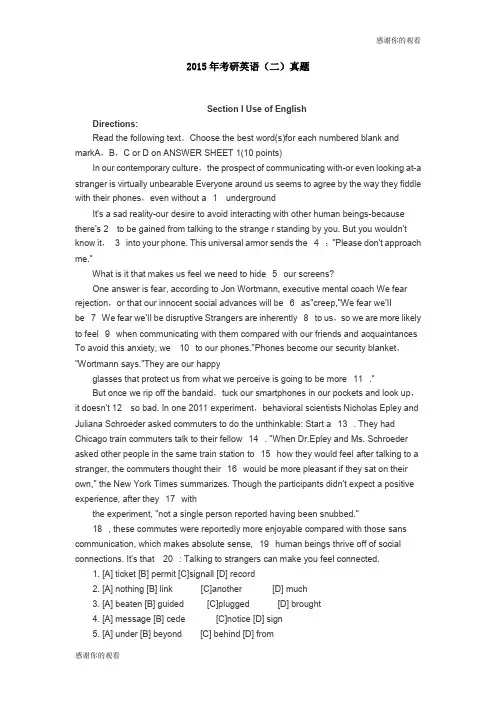
2015年考研英语(二)真题Section I Use of EnglishDirections:Read the following text。
Choose the best word(s)for each numbered blank and markA,B,C or D on ANSWER SHEET 1(10 points)In our contemporary culture,the prospect of communicating with-or even looking at-a stranger is virtually unbearable Everyone around us seems to agree by the way they fiddle with their phones,even without a 1 undergroundIt's a sad reality-our desire to avoid interacting with other human beings-because there's 2 to be gained from talking to the strange r standing by you. But you wouldn't know it,3 into your phone. This universal armor sends the 4 :"Please don't approach me."What is it that makes us feel we need to hide 5 our screens?One answer is fear, according to Jon Wortmann, executive mental coach We fear rejection,or that our innocent social advances will be 6 as"creep,"We fear we'IIbe 7 We fear we'II be disruptive Strangers are inherently 8 to us,so we are more likely to feel 9 when communicating with them compared with our friends and acquaintances To avoid this anxiety, we 10 to our phones."Phones become our security blanket,"Wortmann says."They are our happyglasses that protect us from what we perceive is going to be more 11 ."But once we rip off the bandaid,tuck our smartphones in our pockets and look up,it doesn't 12 so bad. In one 2011 experiment,behavioral scientists Nicholas Epley and Juliana Schroeder asked commuters to do the unthinkable: Start a 13 . They had Chicago train commuters talk to their fellow 14 . "When Dr.Epley and Ms. Schroeder asked other people in the same train station to 15 how they would feel after talking to a stranger, the commuters thought their 16 would be more pleasant if they sat on their own," the New York Times summarizes. Though the participants didn't expect a positive experience, after they 17 withthe experiment, "not a single person reported having been snubbed."18 , these commutes were reportedly more enjoyable compared with those sans communication, which makes absolute sense, 19 human beings thrive off of social connections. It's that 20 : Talking to strangers can make you feel connected.1. [A] ticket [B] permit [C]signall [D] record2. [A] nothing [B] link [C]another [D] much3. [A] beaten [B] guided [C]plugged [D] brought4. [A] message [B] cede [C]notice [D] sign5. [A] under [B] beyond [C] behind [D] from6. [A] misinterprete [B] misapplied [C] misadjusted [D] mismatched7. [A] fired [B] judged [C] replaced [D] delayed8. [A] unreasonable [B] ungreatful [C] unconventional [D] unfamiliar9. [A] comfortable [B] anxious [C] confident [D] angry10. [A] attend [B] point [C] take [D] turn11. [A] dangerous [B] mysterious [C] violent [D] boring12. [A] hurt [B] resis [C] bend [D] decay13. [A] lecture [B] conversation [C] debate [D] negotiation14. [A] trainees [B] employees [C] researchers [D] passengers15. [A] reveal [B] choose [C] predictl [D] design16. [A] voyage [B] flight [C] walk [D] ride17. [A] went through [B] did away [C] caught up [D] put up18. [A] In turn [B] In particular [C]In fact [D] In consequence19. [A] unless [B] since [C] if [D] whereas20. [A] funny [B] simple [C] Iogical [D] rareSection ⅡReading ComprehensionPart ADirections:Text 1A new study suggests that contrary to most surveys. People art actually more stressed at home than at work. Researchers measured people's cortntlol. Which is it at stress marker. While they were at work and while they were at home and found it higher at what is supposed to be a place of refuge."Further contradicting conventional wisdom, we found that women as well as men have lower levels of stress at work than at home," writes one of the researchers. Sarah Damaske, In fact women say they feel better at work. She notes. "it is men not women. Who report being bappicr at home than at work," Another surprise is that the findings hold true for both those with childrcn and without, but more so for nonparents. This is why pcoplc who work outside the home have better health.What the study doesn't measure is whether people are still doing work when they' re at home, whether it is household work or work brought home from the office. For many men, the end of the workday is a time to kick back. For women who stay home, they never get to leave the office. And for women who work outside the home, they often are playingcatch-up-with-household tasks. With the blurring of roles, and the fact that the home front lags well behind the workplace in making adjustments for working women, it' s not surprising that women are more stressed at home.But it's not just a gender thing. At work, people pretty much know what they're supposed to be doing: working, making money, doing the tasks they have to do in order todraw an income. The bargain is very pure: Employee puts in hours of physical or mental labor and employee draws out life-sustaining moola.On the home front, however, people have no such clarity. Rare is the household in which the division of labor is so clinically and methodically laid out. There are a lot of tasks to be done, there are inadequate rewards for most of them. Your home colleagues-your family-have no clear rewards for their labor; they need to be talked into it, or if they' re teenagers, threatened with complete removal of all electronic devices. Plus, they' re your family. You cannot fire your family. You never really get to go home from home.So it's not surprising that people are more stressed at home. Not only are the tasks apparently infinite, the co-workers are much harder to motivate.21.According to Pa ragraph 1,most previous su rveys found that home___________[A]was an un realistic place for relaxation[B]generated more stress than the workplace[C]was an ideal place for stress measurement[D]offered greater relaxation than the workplace22.According to Damaske,who are likely to be the happiest at home?[A]Working mothers[B]Childless husbands[C] Childless wives[D]Working fathers23 The blurring of working women's roles refers to the fact thay___________[A]they are both bread winners and housewives[B]their home is also a place for kicking back[C]there is often much housework left behind[D]it is difficult for them to leave their office24.The word"moola"(Line 4,Para 4)most probably means___________[A]energy[B]skills[C]earnings[D]nutrition25.The home front differs from the workplace in that_____________[A]home is hardly a cozier working environment[B]division of labor at home is seldom clear-cut[C]household tasks are generally more motivating[D]family labor is often adequately rewardedText 2For years, studies have found that first-generation college students-those who do not have a parent with a college degree-lag other students on a range of educationachievement factors. Their grades are lower and their dropout rates are higher. But since such students are most likely to advance economically if they succeed in higher education, colleges and universities have pushed for decades to recruit more of them. This has created "a paradox" in that recruiting first-generation students, but then watching many of them fail, means that higher education has "continued to reproduce and widen, rather than close" achievement gap based on social class, according to the depressing beginning of a paper forthcoming in the journal Psychological Sciense.But the article is actually quite optimistic, as it outlines a potential solution to this problem, suggesting that an approach(which involves a one-hour, next-to-no-cost program) can close 63 percent of the achievement gap(measured by such factors asgrades)between first-generation and other students.The authors of the paper are from different universities, and their findins are based on a study involving 147 students(who completed the project)at an unnamed private unive rsity.First generation was defined as not having a parent with a fou r-year college degree Most of the first-generation students(59.1 percent) were recipients of Pell Grants,a federal g rant for undergraduates with financial need,while this was true only for 8.6 percent of the students wit at least one parent with a four-year degreeTheir thesis-that a relatively modest inte rvention could have a big impact-was based on the view that first-gene ration students may be most lacking not in potential but in practical knowledge about how to deal with the issues that face most college students They cite past resea rch by several authors to show that this is the gap that must be na rrowed to close the achievement gap.Many first-gene ration students"struggle to navigate the middle-class culture of higher education,learn the'rules of the game,'and take advantage of college resou rces," they write And this becomes more of a problem when collages don't talk about the class advantage and disadvantages of different groups of students Because US colleges and universities seldom acknowledge how social class can affect students' educational expe rience,many first-gene ration students lack sight about why they a re struggling and do not unde rstand how students' like them can improve26. Recruiting more first-generation students has[A]reduced their d ropout rates[B]narrowed the achievement gao[C] missed its original pu rpose[D]depressed college students27 The author of the research article are optimistic because[A]the problem is solvable[B]their approach is costless[q the recruiting rate has increased[D]their finding appeal to students28 The study suggests that most first-gene ration students[A]study at private universities[B]are from single-pa rent families[q are in need of financial support[D]have failed their collage29. The author of the paper believe that first-generation students[A]a re actually indifferent to the achievement gap[B]can have a potential influence on othe r students[C] may lack opportunities to apply for resea rch projects[D]are inexperienced in handling their issues at college30.We mayinfer from the last paragraph that--[A]universities often r~ect the culture of the middle-class[B]students are usually to blame for their lack of resources[C]social class g reatly helps en rich educational experiences[D]colleges are partly responsible for the problem in questionText3Even in traditional offices,"the lingua franca of corporate America has gottenmuch more emotional and much more right-brained than it was 20 years ago," said Ha rva rd Business School professor Nancy Koehn She sta rted spinning off examples."If you and I pa rachuted back to Fortune 500 companies in 1990,we would see much less frequent use of terms like Journey, mission,passion. There were goals,there were strategies,there were objectives,but we didn't talk about energy;we didn't talk about passion."Koehn pointed out that this new era of corporate vocabula ry is very"team"-oriented-and not by coincidence."Let's not forget sDorts-in male-dominated corporate America,it's still a big deal. It's not explicitly conscious;it's the idea that I'm a coach,and you're my team,and we're in this togethec. There are lots and lots of CEOs in very different companies,but most think of themselves as coaches and this is their team and they want to win".These terms a re also intended to infuse work with meaning-and,as Khu rana points out,increase allegiance to the firm."You have the importation of terminology that historically used to be associated with non-profit organizations and religious organizations:Terms like vision,values,passion,and purpose,"saidKhurana This new focus on personal fulfillment can help keep employees motivated amid increasingly loud debates over work-life balance The "mommy wars" of the 1990s a re still going on today, prompting arguments about whywomen still can'thave it all and books like Sheryl Sandberg's Lean In,whose title has become abuzzword in its own right. Terms like unplug,offline,life-hack,bandwidth,andcapacity are all about setting boundaries betweenthe office and the home But ifyour work is your "passion," you'II be more likely to devote yourself to it,even ifthat means going home for dinner and then working long after the kids are in bedBut this seems to be the irony of office speak:Everyone makes fun of it,butmanage rs love it,companies depend on it,and regular people willingly absorb itAs Nunberg said,"You can get people to think it's nonsense at the same timethat you buy into it." In a workplace that's fundamentally indiffe rent to your lifeand its meaning office speak can help you figu re out how you relate to yourwork-and how your work defines who you are31. According to Nancy Koehn, office language has become________[A]more e motional[B]more objective[C]less energetic[D]less energetic[E]less strategic32."team"-oriented corporate vocabulary is closely related to________[A]historical incidents[B]gender difference[C]sports culture[D]athletic executives33.Khurana believes that the importation of terminology aims to________[A]revive historical terms[B]promote company image[C]foster corporate cooperation[D]strengthen employee loyalty34.It can be inferred that Lean In_________[A]voices for working women[B]appeals to passionate workaholics[C]triggers dcbates among mommies[D]praises motivated employees35.Which of the following statements is true about office speak?[A]Managers admire it but avoid it[B]Linguists believe it to be nonsense[C]Companies find it to be fundamental[D]Regular people mock it but accept itText 4Many people talked of the 288,000 new jobs the Labor Department reporled for Jure, along with the drop in the unemployment take to 6 J percent. at good news. And they were right. For now it appears the economy is creating jobs at a decent pace. We still have along way to go to get back to full employment, but at least we are now finally moving forward at a faster pace.However there is another important part of the jobs picture that was targely ovedookcd. There was a big jump in the number of people who report voluntarily working part-time. This figure is now 830,000(4,4 percent)above its year ago level.Before explaining the connection to the Obamacare, it is worth making an important distinction. Many people who work part-time jobs actually want full-time jobs. They take part-time work because this is all they can get. An increase in involuntary part-time work is evidence of weakness in the labor market and it means that many people will be having a very hard time making ends meet.There was an increase in involuntary part-time in June, but the general direction has been down. Involuntary part-time employment is still far higher than before the recession, but it is down by 640,000(7.9 percent)from its year ago level.We know the difference between voluntary and involuntary part-time employment because people tell us. The survey used by the Labor Department asks people if they worked less than 35 hours in the reference week. If the answer is "yes."they are classified as working part-time. The survey then asks whether they worked less than 35 hours in that week because they wanted to work less than full time or because they had no choice. They are only elassified as voluntary part-time workers if they tell the survey taker they chose to work less than 35 hours a week.The issue of voluntary part-time relates to Obamacare becanse one of the main purposes was to allow people to get insurance outside of employment. For many people, especially those with serious health conditions or family members with serious health conditions, before Obamacare the only way to get insurance was through a job that provided health insurance.However, Obamacare has allowed more than 12 million people to either get insurance through Medicaid or the exchanges. These are people who may previously have felt the need to get a full-time job that provided insurance in order to cover themselves and their families. With Obamacare there is no longer a link between employment and insurance.36. Which part of the jobs picture was neglected?A. The prospect of a thriving job market.B. The increase of voluntary part-time jobs.C. The possibility of full employment.D. The acceleration of job creation.37. Many people work part-time because theyA. prefer part-time jobs to full-time jobsB. feel that is enough to make ends meetC. cannot get their hands on full-time jobsD. haven' t seen the weakness of the market38. Involuntary part-time employment in the USA. is harder to acquire than one year agoB. shows a general tendency of declineC. satisfies the real need of the joblessD. is lower than before the recession39. It can be learned that with Obamacare, .A. it is no longer easy for part-timers to get insuranceB. employment is no longer a precondition to get insuranceC. it is still challenging to get insurance for family membersD. full-time employment is still essential for insurance40. The text mainly discusses.A. employment in the USB. part-timer classificationC. insurance through MedicaidD. Obamacare's troubleSome Old Truths to Help You Overcorne Toucgh TimesUefortunately, life is not a bed of roses, We are going through life facing sad experiences. Moreover, we are grieving various kinds of loss: a friendship, a rontantic relatlonshlp of a house. Hard times may hold you down at what usually seems like the most inopportune time,but you should remember that they won't last forever.When our time of mourning is over, we press forward, stronger with a greater understanding and respect for life. Furthermore, these losses make us mature and eventally move as toward future opportunities for growth and happiness. I want to share these old truths I've learned along the way.41.Fear is both useful and harmful. This normal human reaction is used to protect us by signaling danger and preparing us to deal with it. Unfortunately, people create inner barriers with a help of exaggerating fears. My favorite actor will smith once said, "Fear is not real. It is a product of thoughts you create. Do not misunderstand me. Danger is very real. But fear is a choice." I do completely agree that fears are just the product of our luxuriant imagination.42 .If you are ??? by ??? and43. .Sometimes it is casy to feel bad because you are going through tough times. You can be easily caught up by life problems that you forget to pause and appreciate the things youhave. Only strong people prefer to smile and value their life instead of crying and complaining about something.44..No matter how isolated you might feel and how serious the situation is, you should always remember that you are not alone. Try to keep in mind that almost everyone respects and wants to help you if you are trying to make a good change in your life, especially your dearest and nearest people, You may have a circle of friends who provide constant good humor, help and companionship. If you have no friends or relatives. Try to participate in several online communities, full of people who are always willing to share advice and cncouragement.45 .Today many people find it difficult to trust their own opinion and seek balance by gaining objectivity from external sources. This way you devalue your opinion and show that you are incapable of managing your of own life. When you are struggling to achieve something important you should believe in yourself and be sure that your decision is the best. You live in your skin, think your own thoughts, have your own values and make your own choices.Section Ⅲ Translation46. Directions:Translate the following text from English into Chinese. Write your translation on ANSWER SHEET 2. (15 points)Think about driving a route that's very familiar. It could be your commute to work, a trip into town or the way home. Whichever it is, you know every twist and turn like the back of your hand. On these sorts of trips it's easy tolose concentration on the driving and pay little attention to the passing scenery. The consequence is that you perceive that the trip has taken less time than it actually has.This is the well-travelled road effect: people tend to underestimate the time it takes to travel a familiar route.The effect is caused by the way we allocate our attention. When we travel down a well-known route, because we don't have to concentrate much, time seems to flow more quickly. And afterwards, when we come to think back on it, we can't remember the journey well because we didn't pay much attention to it. So we assume it wasshorter.Section Ⅳ WritingPart A47.Direerions:Suppose your university is going to host a summer camp for high school students. Write a notice to1)briefly introduce the camp activities, and2)call for volunteers.You should write about 100 words on the ANSWER SHEET.Do not use your name or the name of your university.Do not write your address.(10 points)Part B48.Directions:Write an essay based on the following chart. In your writing, your should1)interpret the chart, and2)give your comment.You should write about 150 words on the ANSWER SHEET.2015年考研英语二真题答案(完整版)Section I Use of EnglishDirections:Read the following text。
2015年考研英语(二)真题 .doc
2015年考研英语(二)真题Section I Use of EnglishDirections:Read the following text。
Choose the best word(s)for each numbered blank and markA,B,C or D on ANSWER SHEET 1(10 points)In our contemporary culture,the prospect of communicating with-or even looking at-a stranger is virtually unbearable Everyone around us seems to agree by the way they fiddle with their phones,even without a 1 undergroundIt's a sad reality-our desire to avoid interacting with other human beings-because there's 2 to be gained from talking to the strange r standing by you. But you wouldn't know it,3 into your phone. This universal armor sends the 4 :"Please don't approach me."What is it that makes us feel we need to hide 5 our screens?One answer is fear, according to Jon Wortmann, executive mental coach We fear rejection,or that our innocent social advances will be 6 as"creep,"We fear we'IIbe 7 We fear we'II be disruptive Strangers are inherently 8 to us,so we are more likely to feel 9 when communicating with them compared with our friends and acquaintances To avoid this anxiety, we 10 to our phones."Phones become our security blanket,"Wortmann says."They are our happyglasses that protect us from what we perceive is going to be more 11 ."But once we rip off the bandaid,tuck our smartphones in our pockets and look up,it doesn't 12 so bad. In one 2011 experiment,behavioral scientists Nicholas Epley and Juliana Schroeder asked commuters to do the unthinkable: Start a 13 . They had Chicago train commuters talk to their fellow 14 . "When Dr.Epley and Ms. Schroeder asked other people in the same train station to 15 how they would feel after talking to a stranger, the commuters thought their 16 would be more pleasant if they sat on their own," the New York Times summarizes. Though the participants didn't expect a positive experience, after they 17 withthe experiment, "not a single person reported having been snubbed."18 , these commutes were reportedly more enjoyable compared with those sans communication, which makes absolute sense, 19 human beings thrive off of social connections. It's that 20 : Talking to strangers can make you feel connected.1. [A] ticket [B] permit [C]signall [D] record2. [A] nothing [B] link [C]another [D] much3. [A] beaten [B] guided [C]plugged [D] brought4. [A] message [B] cede [C]notice [D] sign5. [A] under [B] beyond [C] behind [D] from6. [A] misinterprete [B] misapplied [C] misadjusted [D] mismatched7. [A] fired [B] judged [C] replaced [D] delayed8. [A] unreasonable [B] ungreatful [C] unconventional [D] unfamiliar9. [A] comfortable [B] anxious [C] confident [D] angry10. [A] attend [B] point [C] take [D] turn11. [A] dangerous [B] mysterious [C] violent [D] boring12. [A] hurt [B] resis [C] bend [D] decay13. [A] lecture [B] conversation [C] debate [D] negotiation14. [A] trainees [B] employees [C] researchers [D] passengers15. [A] reveal [B] choose [C] predictl [D] design16. [A] voyage [B] flight [C] walk [D] ride17. [A] went through [B] did away [C] caught up [D] put up18. [A] In turn [B] In particular [C]In fact [D] In consequence19. [A] unless [B] since [C] if [D] whereas20. [A] funny [B] simple [C] Iogical [D] rareSection ⅡReading ComprehensionPart ADirections:Text 1A new study suggests that contrary to most surveys. People art actually more stressed at home than at work. Researchers measured people's cortntlol. Which is it at stress marker. While they were at work and while they were at home and found it higher at what is supposed to be a place of refuge."Further contradicting conventional wisdom, we found that women as well as men have lower levels of stress at work than at home," writes one of the researchers. Sarah Damaske, In fact women say they feel better at work. She notes. "it is men not women. Who report being bappicr at home than at work," Another surprise is that the findings hold true for both those with childrcn and without, but more so for nonparents. This is why pcoplc who work outside the home have better health.What the study doesn't measure is whether people are still doing work when they' re at home, whether it is household work or work brought home from the office. For many men, the end of the workday is a time to kick back. For women who stay home, they never get to leave the office. And for women who work outside the home, they often are playingcatch-up-with-household tasks. With the blurring of roles, and the fact that the home front lags well behind the workplace in making adjustments for working women, it' s not surprising that women are more stressed at home.But it's not just a gender thing. At work, people pretty much know what they're supposed to be doing: working, making money, doing the tasks they have to do in order todraw an income. The bargain is very pure: Employee puts in hours of physical or mental labor and employee draws out life-sustaining moola.On the home front, however, people have no such clarity. Rare is the household in which the division of labor is so clinically and methodically laid out. There are a lot of tasks to be done, there are inadequate rewards for most of them. Your home colleagues-your family-have no clear rewards for their labor; they need to be talked into it, or if they' re teenagers, threatened with complete removal of all electronic devices. Plus, they' re your family. You cannot fire your family. You never really get to go home from home.So it's not surprising that people are more stressed at home. Not only are the tasks apparently infinite, the co-workers are much harder to motivate.21.According to Pa ragraph 1,most previous su rveys found that home___________[A]was an un realistic place for relaxation[B]generated more stress than the workplace[C]was an ideal place for stress measurement[D]offered greater relaxation than the workplace22.According to Damaske,who are likely to be the happiest at home?[A]Working mothers[B]Childless husbands[C] Childless wives[D]Working fathers23 The blurring of working women's roles refers to the fact thay___________[A]they are both bread winners and housewives[B]their home is also a place for kicking back[C]there is often much housework left behind[D]it is difficult for them to leave their office24.The word"moola"(Line 4,Para 4)most probably means___________[A]energy[B]skills[C]earnings[D]nutrition25.The home front differs from the workplace in that_____________[A]home is hardly a cozier working environment[B]division of labor at home is seldom clear-cut[C]household tasks are generally more motivating[D]family labor is often adequately rewardedText 2For years, studies have found that first-generation college students-those who do not have a parent with a college degree-lag other students on a range of educationachievement factors. Their grades are lower and their dropout rates are higher. But since such students are most likely to advance economically if they succeed in higher education, colleges and universities have pushed for decades to recruit more of them. This has created "a paradox" in that recruiting first-generation students, but then watching many of them fail, means that higher education has "continued to reproduce and widen, rather than close" achievement gap based on social class, according to the depressing beginning of a paper forthcoming in the journal Psychological Sciense.But the article is actually quite optimistic, as it outlines a potential solution to this problem, suggesting that an approach(which involves a one-hour, next-to-no-cost program) can close 63 percent of the achievement gap(measured by such factors asgrades)between first-generation and other students.The authors of the paper are from different universities, and their findins are based on a study involving 147 students(who completed the project)at an unnamed private unive rsity.First generation was defined as not having a parent with a fou r-year college degree Most of the first-generation students(59.1 percent) were recipients of Pell Grants,a federal g rant for undergraduates with financial need,while this was true only for 8.6 percent of the students wit at least one parent with a four-year degreeTheir thesis-that a relatively modest inte rvention could have a big impact-was based on the view that first-gene ration students may be most lacking not in potential but in practical knowledge about how to deal with the issues that face most college students They cite past resea rch by several authors to show that this is the gap that must be na rrowed to close the achievement gap.Many first-gene ration students"struggle to navigate the middle-class culture of higher education,learn the'rules of the game,'and take advantage of college resou rces," they write And this becomes more of a problem when collages don't talk about the class advantage and disadvantages of different groups of students Because US colleges and universities seldom acknowledge how social class can affect students' educational expe rience,many first-gene ration students lack sight about why they a re struggling and do not unde rstand how students' like them can improve26. Recruiting more first-generation students has[A]reduced their d ropout rates[B]narrowed the achievement gao[C] missed its original pu rpose[D]depressed college students27 The author of the research article are optimistic because[A]the problem is solvable[B]their approach is costless[q the recruiting rate has increased[D]their finding appeal to students28 The study suggests that most first-gene ration students[A]study at private universities[B]are from single-pa rent families[q are in need of financial support[D]have failed their collage29. The author of the paper believe that first-generation students[A]a re actually indifferent to the achievement gap[B]can have a potential influence on othe r students[C] may lack opportunities to apply for resea rch projects[D]are inexperienced in handling their issues at college30.We mayinfer from the last paragraph that--[A]universities often r~ect the culture of the middle-class[B]students are usually to blame for their lack of resources[C]social class g reatly helps en rich educational experiences[D]colleges are partly responsible for the problem in questionText3Even in traditional offices,"the lingua franca of corporate America has gottenmuch more emotional and much more right-brained than it was 20 years ago," said Ha rva rd Business School professor Nancy Koehn She sta rted spinning off examples."If you and I pa rachuted back to Fortune 500 companies in 1990,we would see much less frequent use of terms like Journey, mission,passion. There were goals,there were strategies,there were objectives,but we didn't talk about energy;we didn't talk about passion."Koehn pointed out that this new era of corporate vocabula ry is very"team"-oriented-and not by coincidence."Let's not forget sDorts-in male-dominated corporate America,it's still a big deal. It's not explicitly conscious;it's the idea that I'm a coach,and you're my team,and we're in this togethec. There are lots and lots of CEOs in very different companies,but most think of themselves as coaches and this is their team and they want to win".These terms a re also intended to infuse work with meaning-and,as Khu rana points out,increase allegiance to the firm."You have the importation of terminology that historically used to be associated with non-profit organizations and religious organizations:Terms like vision,values,passion,and purpose,"saidKhurana This new focus on personal fulfillment can help keep employees motivated amid increasingly loud debates over work-life balance The "mommy wars" of the 1990s a re still going on today, prompting arguments about whywomen still can'thave it all and books like Sheryl Sandberg's Lean In,whose title has become abuzzword in its own right. Terms like unplug,offline,life-hack,bandwidth,andcapacity are all about setting boundaries betweenthe office and the home But ifyour work is your "passion," you'II be more likely to devote yourself to it,even ifthat means going home for dinner and then working long after the kids are in bedBut this seems to be the irony of office speak:Everyone makes fun of it,butmanage rs love it,companies depend on it,and regular people willingly absorb itAs Nunberg said,"You can get people to think it's nonsense at the same timethat you buy into it." In a workplace that's fundamentally indiffe rent to your lifeand its meaning office speak can help you figu re out how you relate to yourwork-and how your work defines who you are31. According to Nancy Koehn, office language has become________[A]more e motional[B]more objective[C]less energetic[D]less energetic[E]less strategic32."team"-oriented corporate vocabulary is closely related to________[A]historical incidents[B]gender difference[C]sports culture[D]athletic executives33.Khurana believes that the importation of terminology aims to________[A]revive historical terms[B]promote company image[C]foster corporate cooperation[D]strengthen employee loyalty34.It can be inferred that Lean In_________[A]voices for working women[B]appeals to passionate workaholics[C]triggers dcbates among mommies[D]praises motivated employees35.Which of the following statements is true about office speak?[A]Managers admire it but avoid it[B]Linguists believe it to be nonsense[C]Companies find it to be fundamental[D]Regular people mock it but accept itText 4Many people talked of the 288,000 new jobs the Labor Department reporled for Jure, along with the drop in the unemployment take to 6 J percent. at good news. And they were right. For now it appears the economy is creating jobs at a decent pace. We still have along way to go to get back to full employment, but at least we are now finally moving forward at a faster pace.However there is another important part of the jobs picture that was targely ovedookcd. There was a big jump in the number of people who report voluntarily working part-time. This figure is now 830,000(4,4 percent)above its year ago level.Before explaining the connection to the Obamacare, it is worth making an important distinction. Many people who work part-time jobs actually want full-time jobs. They take part-time work because this is all they can get. An increase in involuntary part-time work is evidence of weakness in the labor market and it means that many people will be having a very hard time making ends meet.There was an increase in involuntary part-time in June, but the general direction has been down. Involuntary part-time employment is still far higher than before the recession, but it is down by 640,000(7.9 percent)from its year ago level.We know the difference between voluntary and involuntary part-time employment because people tell us. The survey used by the Labor Department asks people if they worked less than 35 hours in the reference week. If the answer is "yes."they are classified as working part-time. The survey then asks whether they worked less than 35 hours in that week because they wanted to work less than full time or because they had no choice. They are only elassified as voluntary part-time workers if they tell the survey taker they chose to work less than 35 hours a week.The issue of voluntary part-time relates to Obamacare becanse one of the main purposes was to allow people to get insurance outside of employment. For many people, especially those with serious health conditions or family members with serious health conditions, before Obamacare the only way to get insurance was through a job that provided health insurance.However, Obamacare has allowed more than 12 million people to either get insurance through Medicaid or the exchanges. These are people who may previously have felt the need to get a full-time job that provided insurance in order to cover themselves and their families. With Obamacare there is no longer a link between employment and insurance.36. Which part of the jobs picture was neglected?A. The prospect of a thriving job market.B. The increase of voluntary part-time jobs.C. The possibility of full employment.D. The acceleration of job creation.37. Many people work part-time because theyA. prefer part-time jobs to full-time jobsB. feel that is enough to make ends meetC. cannot get their hands on full-time jobsD. haven' t seen the weakness of the market38. Involuntary part-time employment in the USA. is harder to acquire than one year agoB. shows a general tendency of declineC. satisfies the real need of the joblessD. is lower than before the recession39. It can be learned that with Obamacare, .A. it is no longer easy for part-timers to get insuranceB. employment is no longer a precondition to get insuranceC. it is still challenging to get insurance for family membersD. full-time employment is still essential for insurance40. The text mainly discusses.A. employment in the USB. part-timer classificationC. insurance through MedicaidD. Obamacare's troubleSome Old Truths to Help You Overcorne Toucgh TimesUefortunately, life is not a bed of roses, We are going through life facing sad experiences. Moreover, we are grieving various kinds of loss: a friendship, a rontantic relatlonshlp of a house. Hard times may hold you down at what usually seems like the most inopportune time,but you should remember that they won't last forever.When our time of mourning is over, we press forward, stronger with a greater understanding and respect for life. Furthermore, these losses make us mature and eventally move as toward future opportunities for growth and happiness. I want to share these old truths I've learned along the way.41.Fear is both useful and harmful. This normal human reaction is used to protect us by signaling danger and preparing us to deal with it. Unfortunately, people create inner barriers with a help of exaggerating fears. My favorite actor will smith once said, "Fear is not real. It is a product of thoughts you create. Do not misunderstand me. Danger is very real. But fear is a choice." I do completely agree that fears are just the product of our luxuriant imagination.42 .If you are ??? by ??? and43. .Sometimes it is casy to feel bad because you are going through tough times. You can be easily caught up by life problems that you forget to pause and appreciate the things youhave. Only strong people prefer to smile and value their life instead of crying and complaining about something.44..No matter how isolated you might feel and how serious the situation is, you should always remember that you are not alone. Try to keep in mind that almost everyone respects and wants to help you if you are trying to make a good change in your life, especially your dearest and nearest people, You may have a circle of friends who provide constant good humor, help and companionship. If you have no friends or relatives. Try to participate in several online communities, full of people who are always willing to share advice and cncouragement.45 .Today many people find it difficult to trust their own opinion and seek balance by gaining objectivity from external sources. This way you devalue your opinion and show that you are incapable of managing your of own life. When you are struggling to achieve something important you should believe in yourself and be sure that your decision is the best. You live in your skin, think your own thoughts, have your own values and make your own choices.Section Ⅲ Translation46. Directions:Translate the following text from English into Chinese. Write your translation on ANSWER SHEET 2. (15 points)Think about driving a route that's very familiar. It could be your commute to work, a trip into town or the way home. Whichever it is, you know every twist and turn like the back of your hand. On these sorts of trips it's easy tolose concentration on the driving and pay little attention to the passing scenery. The consequence is that you perceive that the trip has taken less time than it actually has.This is the well-travelled road effect: people tend to underestimate the time it takes to travel a familiar route.The effect is caused by the way we allocate our attention. When we travel down a well-known route, because we don't have to concentrate much, time seems to flow more quickly. And afterwards, when we come to think back on it, we can't remember the journey well because we didn't pay much attention to it. So we assume it wasshorter.Section Ⅳ WritingPart A47.Direerions:Suppose your university is going to host a summer camp for high school students. Write a notice to1)briefly introduce the camp activities, and2)call for volunteers.You should write about 100 words on the ANSWER SHEET.Do not use your name or the name of your university.Do not write your address.(10 points)Part B48.Directions:Write an essay based on the following chart. In your writing, your should1)interpret the chart, and2)give your comment.You should write about 150 words on the ANSWER SHEET.2015年考研英语二真题答案(完整版)Section I Use of EnglishDirections:Read the following text。
2015年英语二真题答案
2015年全国硕士研究生招生考试英语(二)真题答案完形填空A.signalD.muchB.pluggedD.messageC.behindD.misinterpretedC.judgedD.unfamiliarA.anxiousD.turnA.dangerousA hurtB.conversationA.passengersC.predictB.rideA.went throughB.in factB.sinceC.simple2015年考研英语二阅读答案Text1答案21A offered greater relaxation than the workplace22C childless husbands23D they are both bread winners and housewives.24C earnings25A division of labor at home is seldom clear-cutText2答案26C missed its original purpose27A the problem is solvable28C are in need of financial support29D are experienced in handling their issues at college30D colleges are partly responsible for the problem in questionText3答案31A more emotional32C sports culture33D strengthen employee loyalty34A voices for working women35D regular people mock it but accept itText4答案36B The increase of voluntary part-time jobs.37C cannot get their hands on full-time jobs38B shows a general tendency of decline.39B employment is no longer a precondition to get insurance40A employment in the US英语二翻译回想一下这样的经历:开车行驶在一条非常熟悉的道路上。
2015考研英语(二)真题和解析发布入口【3】
2015考研英语(二)真题和解析发布入口【3】Text 3Scientists have found that although we are prone to snap overreactions, if we take a moment and think about how we are likely to react, we can reduce or even eliminate the negative effects of our quick, hard-wired responses.Snap decisions can be important defense mechanisms; if we are judging whether someone is dangerous, our brains and bodies are hard-wired to react very quickly, within milliseconds. But we need more time to assess other factors. T o accurately tell whether someone is sociable, studies show, we need at least a minute, preferably five. It takes a while to judge complex aspects of personality, like neuroticism or open-mindedness.But snap de cisions in reaction to rapid stimuli aren’t exclusive to the interpersonal realm. Psychologists at the University of Toronto found that viewing a fast-food logo for just a few milliseconds primes us to read 20 percent faster, even though reading has little to do with eating. We unconsciously associate fast food with speed and impatience and carry those impulses into whatever else we’re doing, Subjects exposed to fast-food flashes also tend to think a musical piece lasts too long.Yet we can reverse such influences. If we know we will overreact to consumer products or housing options when we see a happy face (one reason good sales representatives and real estate agents are always smiling), we can take a moment before buying. If we know female job screeners are more likely to reject attractive female applicants, we can help screeners understand their biases-or hire outside screeners.John Gottman, the marriage expert, explains that we quickly“thin slice” information reliably only after we ground such snap reac tions in “thick sliced” long-term study. When Dr. Gottman really wants to assess whether a couple will stay together, he invites them to his island retreat for a muck longer evaluation; two days, not two seconds.Our ability to mute our hard-wired reactions by pausing is what differentiates us from animals: doge can think about the future only intermittently or for a few minutes. But historically we have spent about 12 percent of our days contemplating the longer term. Although technology might change the way we react, it hasn’t changed our nature. We still have the imaginative capacity to rise above temptation and reverse the high-speed trend.31. The time needed in making decisions may____.[A] vary according to the urgency of the situation[B] prove the complexity of our brain reaction[C] depend on the importance of the assessment[D] predetermine the accuracy of our judgment32. Our reaction to a fast-food logo shows that snao decisions____.[A] can be associative[B] are not unconscious[C] can be dangerous[D] are not impulsive33. Toreverse the negative influences of snap decisions,we should____.[A] trust our first impression[B] do as people usually do[C] think before we act[D] ask for expert advice34. John Gottman says that reliable snap reaction are based on____.[A] critical assessment[B]‘‘thin sliced ’’study[C] sensible explanation[D] adequate information35. The author’s attitude toward reversing the high-speed trend is____.[A] tolerant[B] uncertain[C] optimistic[D] doubtfulText 331.【答案】 [D] predetermine the accuracy of our judgment【解析】细节题。
2015考研英语真题及答案完整版
2015考研英语真题及答案完整版[注意:以下正文仅为演示文章格式,并非真实的2015考研英语真题及答案]一、阅读理解(共20小题;每小题2分,满分40分)阅读下面短文,从每题所给的四个选项(A、B、C和D)中,选出最佳选项。
Passage 1Questions 1 to 5 are based on the following passage.At any given moment, you are aware of a zillion sensations—anything from the tightness of your shoes to the sound of an approaching bicycle bell. But your conscious mind notices only a fraction of what is going on. And that fraction is governed by criteria (标准) set up in consultation with an ancient part of the brain called the limbic system, which links to our emotions and our “gut feelings”.Those criteria assign priorities to sensory (感觉的) inputs. Hence you are aware of the nonstop assault on your eyes or your ears only when this input meets the criteria. The criteria change from person to person. If two people are walking in the countryside, one may notice the wildflowers, the other a military aircraft at 20,000 feet. When two photographers stand side by side, one may see a dramatic picture; the other a pile of stones.The differences are typically due not to differences in eyesight but to the ways the two photographers have programmed their minds to respond. I amnot talking about anything extraordinary or mystical (神秘的). Both brain researchers and police have noted that a very simple set of cues (暗示) can powerfully alter the selection of stimuli (刺激), determining what will be noticed—even in a highly emotional state like a fight. I once sat in on a training course for police officers who were being taught to shoot—make that taught how to shoot under stress. One of the most important lessons was that under duress (被迫), under time pressure, the brain reverts (回归) back to what it is most accustomed to. That is, in spite of long training and many repetitions, an officer will shoot in combat (格斗) the way he has always shot. If he brings no conscious control to bear on the selection of stimuli, the selection will be made by unconscious programs, resulting in a misidentification of the threatening object and the wrong action. The old rice-shooting Chinese soldier uses what he has always used—an eraser (橡皮擦) suddenly perceived as a grenade.1. The word “criteria” (in Paragraph 1) is closest in meaning to ______.A. emergenciesB. preferencesC. abilitiesD. emotions2. According to the passage, the fraction of what you are aware of is determined by ______.A. your gut feelingsB. your emotionsC. the military aircraftD. the nonstop assault3. As used in Paragraph 1, the word “assault” most probably means______.A. surprise attackB. forceful entryC. intense impactD. constant bombardment4. The passage suggests that the criteria determining what stimuli will be noticed may be influenced by ______.A. photographers’ eyesightB. the military aircraftC. the police training courseD. unconscious programs5. The passage gives an example where the brain’s selection of stimuli ina dangerous situation caused a police officer to ______.A. feel a strong emotionB. correctly identify a criminalC. take inappropriate actionD. learn a lesson about photographyPassage 2Questions 6 to 10 are based on the following passage.I once worked with a person who spent money generously (大方地) as soon as it came to him. He’d buy a new motorbike or a stereo system if he had money left in his bank account at the end of the month. “Why not?” he’d say cheerfully, “Money is for spending.” And so I’d get temporary delight for six months until my Chinese bank account ran dry.In researching our book, Happy Money, my coauthor Michael Norton and I set out to show how to get the most happiness for your dollar. We spent years reviewing the scientific literature on spending. What we found explains my coworker’s behavior. The very riches that most countries strive for are not making their citizens happier.A famous psychology study conducted in 1978 asked a group of people with spinal-cord injuries and a group of people without them about how happy they were, and how happy they expected to be in the future. The results surprised them: those with spinal-cord injuries expected to be less happy than they were, and those without them expected to be more happy than they were. The truth is that we have within us the capacity to adapt to our sights and our losses and to keep pursuing happiness.One in four lottery winners in Florida ends up bankrupt (破产)。