
新概念英语一 1-36课语法知识点总结复习以及相应习题
1
初一上学期新概念复习资料 英语国际音标表(48个)
辅音(28个) 轻辅音 /p/ / t/ / k/ /f/ /θ/ /s/ 浊辅音 /b/ /d/ /g/ /v/ /ð/ /z/ 轻辅音 /ʃ/ / h/ /ts/ /tʃ/ /tr/ 浊辅音 /ʒ/ / r/ /dz/ /dʒ/ /dr/ 鼻音 /m/ /n/ /ŋ/ 半元音 / j/ / w/ 边音 / ǀ/ 语法知识 一 人称代词 第一人称单数 I me my mine 第一人称复数 we us our ours 第二人称单/复数 you you your yours
第三人称单数 he him his his she her her hers it it its its 第三人称复数 they them their theirs 1. 主格做_________.一般放在________. I’m a student. It is a bird. She is a teacher. You look nice. They are friends. 人称代词语序:几个人称代词并列做主语时,顺序为: 单数形式(二,三,一) 如: you ,he and I. 复数形式 (一,二,三) we, you and they. ①.________ are playing cards in the garden. A. She , you and I B. You, she and I C. I, you and she ②. ____________ are Japanese. A You ,we and they B They,we and you C We, you and they. 2. 宾格做_______. 一般放在_______和________后面。 I give him a book. He loves me. They call us every day. We clean it every morning. She teaches us English. Look at me. Listen to her . 3. 形容词性物主代词相当于____________.中文意思是 ...的,后面必须要加_________-. This is my cat. That is his mother. Is this your umbrella? It is her car. That is their classroom. She is our English teacher. 4.名词性物主代词相当于_________. 后面不用加任何东西,名词性物主代词= ________________+__________. Whose is this coat? It’s mine. (It’s my coat) mine= my coat. Whose is that blouse? It’s hers. (It’s her blouse) hers=her blouse Whose ticket is this ? It’s his. (It’s his ticket.) his=his ticket. Our classroom is bigger than theirs. = Our classroom is bigger than their classroom. That car is yours. = That car is your car. These handbags are ours. =These handbags are our handbags.
元音(20个) 长元音 /ɑ:/ /ɔ:/ / ɜ:/ /i:/ /u:/ 短元音 / ʌ/ /ɒ/ /ə/ /ɪ/ /ʊ/ /e/ /æ/ 双元音 /eɪ/ /aɪ/ /ɔɪ/ /ɪə/ /eə / /ʊə/ /əʊ/ /aʊ/ 2 二 名词所有格 1. 表示两者之间的“所属”关系,有两种表现形式,一种是’s所有格,另一种是of所有格 Beijing is China’s capital. = Beijing is the capital of China. 2. 用 and连接来两个并列名词,表示共同拥有,在最后一个名词后面加’s This is Mary and her sister’s bedroom. This is Stella and her brother’s bike. 3. 用 and 连接两个并列名词,表示分别拥有各自的物品,两个名词都要加’s These are Leal’s and Zak’s handbags. 4. 以s结尾的名词,变成所有格时在后面加“’”,不以s结尾的直接加“s” She is the two boys’ mother. This is Stella’s photo. Children’s day Teachers’ Day 5 of形式的所有格 The door of the room He is a friend of mine. He is a friend of my brother’s.
三 特殊疑问句引导词 what什么答事物, who问谁来答人名, whose谁的表归属 when问时间答时间, where 在哪答地点,which哪一任你选, how是怎么表方式。
四 冠词 冠词有三个,不定冠词 a/an, 定冠词 the 冠词用在名词的前面。 1.a/an表示一个,用于修饰可数名词单数, an用在元音开头的单词前,a 用于以辅音开头的单词前面。 ____ interesting book ___ hat ___ umbrella _____keyboard operator _______ customs officers ______ ant ____ ice cream man ______ orange _____ hour ____ elephant 2. the ①指________________________事物 the moon the sun the earth ②指______________________________ Open the door. Give the pencil. ③指_________________________人或者事物 There is a book. The book is mine. ④_______________某些人或者事物. Beijing is the Capital of China. ⑤用在________以及____________________前面 This is the first time I come to China. He is the tallest in the class. ⑥用在某些____________前面 the Great Wall ⑦用在某些____________前,表示______________:the poor the old the young ⑧用在________复数前,表示______________ the Green’s the browns ⑨用在__________-前 on the left/right in the front of ⑩用在___________-名词前 I can play the piano. 此外还有一些固定词组中。 五 不定代词 some 与 any 1. some和any都可以修饰______________,以及___________. 表示 一些 Do you have any water/bananas? Would you like some tea/bananas? 2 some用于肯定句以及表示建议,请求期望并得到对方肯定回答的疑问句时候,多用some。 There are some students in the classroom. 3. any一般用于___________与___________ Are there any pigs in the house? No, there aren’t any pigs in the house.. 六 名词复数 可数名词的复数变化形式 1. 一般情况下直接加____, 在清辅音后面读____,在浊辅音和元音后面读_______,在t后面读______.在d后读_________. desk — ________ pen —_________ day-________ student-_________ bed-___________ 3
2. 以________________结尾的词,加________,读音为____ bus- ________ fox-_______ dish-_________ peach-________ 3. 以_________字母加y结尾的,直接加_________,读音为_______. boy -________ key-________ 4.以________字母加y结尾的,把________再加_________读音为_______. baby-________ fly-___________ 5 以____或者_____结尾的,把______或者_____改成_____,再加____.读音为_______ leaf-_________ knife-_______ wife-__________ 6 以o结尾的直接加_______,读音为______. zoo-______ photo-________ kangaroo-________ piano-_______ 7. 以o结尾的加_______,读音为_________. negro-_____ hero-__________ potato-________ tomato-________ 注意: mango 两者皆可 8 特殊变化 ① man,woman, ___变_____. ____________. man-_______ woman-_________ man doctor-________ woman teacher-_________ ② 孩子们都是_____ . child-________. ③ goose, foot, tooth,_______变_____. goose- _______ foot-_________ tooth-_________ ④ fish, deer, sheep, _________ fish— ________ deer-______ sheep-______ ⑤ 中日_______, 英法_____,其余 _____加后面。 Chinese- ________ Japanese-_________ English man -_________ French man -____________ German-________ mouse-_________ this-_________ that-_________ 七 be动词 1. I(我)用am, you(你)用am, is跟着 he(他),she(她), it(它),其他复数都用are 变疑问,往前提,句末问号莫丢弃, 变否定,更容易,be后not莫忘记。 他们是朋友。 (肯定句) (否定句) (疑问句) 2. There be表示存在有,我们告诉别人某人某事存在(或者不存在)常用这种结构。 河上有一些船 。 _____________________________________. 3. There be和 Here be句型 be动词的变化要遵循______原则 There _____ a teacher and some students in the classroom. There _________ some students and a teacher in the classroom. Here ____ your money and your passports. Here ____ your passports and your money . 4. 按要求改写句子: 有一个空瓶子在桌子上:(肯定句) (疑问句) (否定句) 有一些船在河上。 (肯定句) (疑问句) (否定句) 八 祈使句 祈使句表示请求,命令,建议等等,谓语动词一律用_______,句子通常不用主语,句末用叹号或者句号,用降调。 1. 肯定祈使句 Be careful. Open the door. (Lesson 29) 2. 否定祈使句 直接在前面加_________或者是never. 不要跑!_________________ 不要迟到___________________.
新概念英语第一册所有语法点汇总)
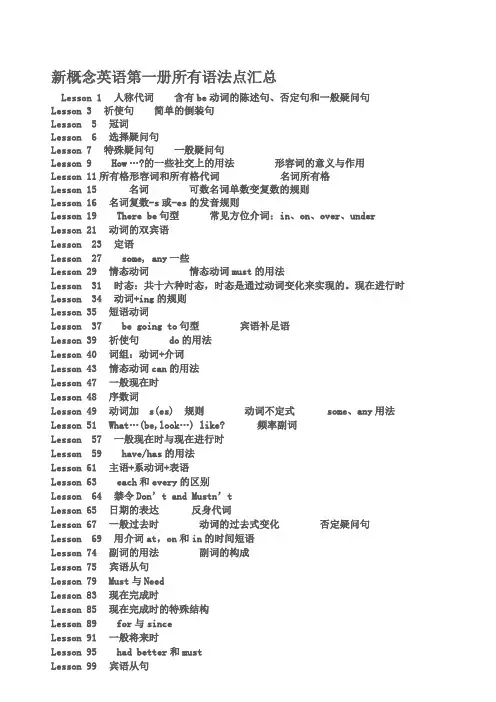
新概念英语第一册所有语法点汇总Lesson 1 人称代词含有be动词的陈述句、否定句和一般疑问句Lesson 3 祈使句简单的倒装句Lesson 5 冠词Lesson 6 选择疑问句Lesson 7 特殊疑问句一般疑问句Lesson 9 How…?的一些社交上的用法形容词的意义与作用Lesson 11所有格形容词和所有格代词名词所有格Lesson 15 名词可数名词单数变复数的规则Lesson 16 名词复数-s或-es的发音规则Lesson 19 There be句型常见方位介词:in、on、over、under Lesson 21 动词的双宾语Lesson 23 定语Lesson 27 some, any一些Lesson 29 情态动词情态动词must的用法Lesson 31 时态:共十六种时态,时态是通过动词变化来实现的。
现在进行时Lesson 34 动词+ing的规则Lesson 35 短语动词Lesson 37 be going to句型宾语补足语Lesson 39 祈使句do的用法Lesson 40 词组:动词+介词Lesson 43 情态动词can的用法Lesson 47 一般现在时Lesson 48 序数词Lesson 49 动词加s(es) 规则动词不定式some、any用法Lesson 51 What…(be,look…) like? 频率副词Lesson 57 一般现在时与现在进行时Lesson 59 have/has的用法Lesson 61 主语+系动词+表语Lesson 63 each和every的区别Lesson 64 禁令Don’t and Mustn’tLesson 65 日期的表达反身代词Lesson 67 一般过去时动词的过去式变化否定疑问句Lesson 69 用介词at,on和in的时间短语Lesson 74 副词的用法副词的构成Lesson 75 宾语从句Lesson 79 Must与NeedLesson 83 现在完成时Lesson 85 现在完成时的特殊结构Lesson 89 for与sinceLesson 91 一般将来时Lesson 95 had better和mustLesson 99 宾语从句Lesson 100 直接引语和间接引语Lesson 101 反意疑问句Lesson 103 too与enough的用法Lesson 105 动词不定式Lesson 107 形容词的比较级和最高级Lesson 111 形容词的平级比较级Lesson 113 so与neither引导的简短回答Lesson 116 不定代词Lesson 117 过去进行时概念和结构Lesson 119 过去完成时Lesson 121 定语从句Lesson 123 感叹句Lesson 125 must, have to和needn’tLesson 127 表示猜测和推断的情态助动词must和can’tLesson 131 情态助动词may表示可能性Lesson 133 需改变时态的间接陈述句Lesson 135 Let的用法Lesson 137 条件从句Lesson 141 被动语态新概念英语第一册语法点归纳大纲新概念英语第一册语法点归纳新概念一共144课,其中单课为课文,双课为语法和练习。
新概念英语第一册时态总结+练习
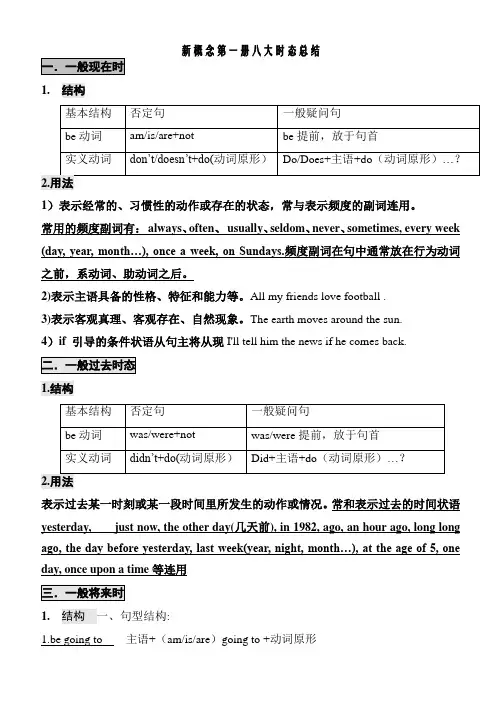
新概念第一册八大时态总结一.一般现在时1.结构基本结构否定句一般疑问句be动词am/is/are+not be提前,放于句首实义动词don’t/doesn’t+do(动词原形)Do/Does+主语+do(动词原形)…?2.用法1)表示经常的、习惯性的动作或存在的状态,常与表示频度的副词连用。
常用的频度副词有:always、often、usually、seldom、never、sometimes, every week (day, year, month…), once a week, on Sundays.频度副词在句中通常放在行为动词之前,系动词、助动词之后。
2)表示主语具备的性格、特征和能力等。
All my friends love football .3)表示客观真理、客观存在、自然现象。
The earth moves around the sun.4)if 引导的条件状语从句主将从现I'll tell him the news if he comes back.二.一般过去时态1.结构基本结构否定句一般疑问句be动词was/were+not was/were提前,放于句首实义动词didn’t+do(动词原形)Did+主语+do(动词原形)…?2.用法表示过去某一时刻或某一段时间里所发生的动作或情况。
常和表示过去的时间状语yesterday, just now, the other day(几天前), in 1982, ago, an hour ago, long long ago, the day before yesterday, last week(year, night, month…), at the age of 5, one day, once upon a time等连用三.一般将来时1.结构一、句型结构:1.be going to 主语+(am/is/are)going to +动词原形2.will :主语+will+动词原形(will为助动词,与情态动词用法相同,与动词原形构成谓语,不需要根据人称进行变化。
强烈推荐—新概念英语第一册语法点完全梳理(最完全版)

新概念英语第一册语法点梳理新概念一共144课,其中单课为课文,双课为语法和练习。
整本书是以单数课为正课,并附带有插图而双数课则是针对单数课所讲的内容有针对性地进行练习,从此出展现出整个新概念一教材区别于其他教材的独特之处。
以下是对新概念一整本教材的理解和剖析,以供各位对整个课本的理解和把握上参考和借鉴。
首先根据课本中出现的时态来分析:本册书的语法出现层次性和规律性是很强的,首先我们先来整本书中都出了哪些时态,这些时态的具体分布和讲解时我们大家需要注意的递进性。
Lesson 31—34 现在进行时Lesson 37—40 第一次出现be going to 的将来时Lesson 51—56 一般现在时Lesson 67—76 为一般过去式Lesson 83—90 为现在完成时Lesson 91—96 为一般将来时(will)Lesson 117—118 过去进行时Lesson 119—120 过去完成时除去前面所有时态和句型所占据的76课我们一起来看一下以下的68课,每一课小的语言点,语法点都是在什么地方,应该用什么样的方式来讲解。
在这里告诉学员新概念一的每一个单课的重点都是出现双课的标题和课后的练习题里面。
Lesson1—2语言点:与陌生人说话或引起别人的注意。
Excuse me. Yes? Pardon? Thank you very much.语法点:主系表结构this为主语,名词做表语1的一般疑问句以及它的肯定回答。
Is this your handbag? Yes, it is.Lesson 5—6语言点:如何介绍别人。
This is Miss Sophie Dupont. Nice to meet you.语法点:主语为第三人称单数的主系表结构。
She is French. He is German. It’s a Volvo.(L6)a/an 的使用。
Lesson 7—8语言点:如何自我介绍和相互认识。
新概念英语一册1-72课语法总结
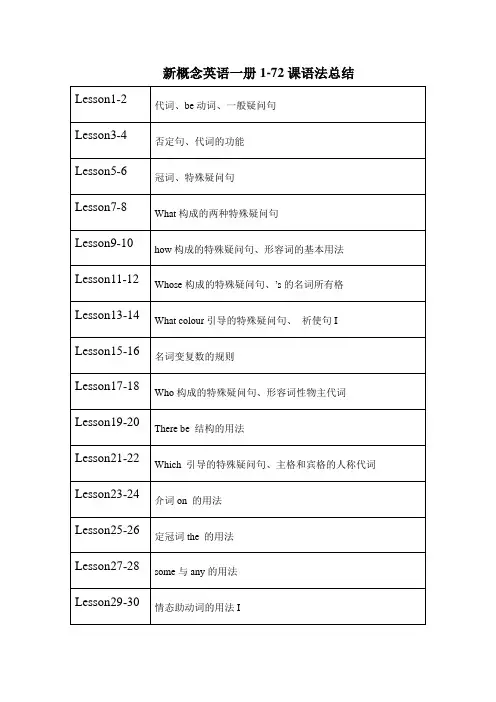
What colour引导的特殊疑问句、祈使句I
Lesson15-16
名词变复数的规则
Lesson17-18
Who构成的特殊疑问句、形容词性物主代词
Lesson19-20
There be结构的用法
Lesson21-22
Which引导的特殊疑问句、主格和宾格的人称代词
Lesson23-24
介词on的用法
Lesson25-26
定冠词the的用法
Lesson27-28
some与any的用法
Lesson29-30
情态助动词的用法I
Lesson31-32
现在进行时I
Lesson33-34
现在进行时II
Lesson35-36
不及物动词构成的短语动词
Lesson37-38
一般将来时I be going to构成的一般将来时
Lesson51-52
定冠词的省略
Lesson53-54
常用的不同国家的人的名词的单复数
Lesson55-56
一般现在时III
Lesson57-58
一般现在时与现在进行时的区别、时间I
Lesson59-60
have的用法I、all的用法
Lesson61-62
系动词的用法、have的用法II
Lesson63-64
新概念、一般疑问句
Lesson3-4
否定句、代词的功能
Lesson5-6
冠词、特殊疑问句
Lesson7-8
What构成的两种特殊疑问句
Lesson9-10
how构成的特殊疑问句、形容词的基本用法
Lesson11-12
Whose构成的特殊疑问句、’s的名词所有格
新概念英语第一册各课语法知识汇总
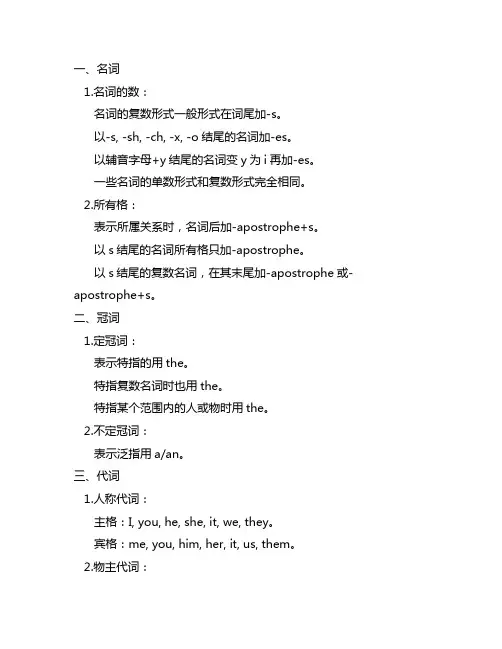
一、名词1.名词的数:名词的复数形式一般形式在词尾加-s。
以-s, -sh, -ch, -x, -o结尾的名词加-es。
以辅音字母+y结尾的名词变y为i再加-es。
一些名词的单数形式和复数形式完全相同。
2.所有格:表示所属关系时,名词后加-apostrophe+s。
以s结尾的名词所有格只加-apostrophe。
以s结尾的复数名词,在其末尾加-apostrophe或-apostrophe+s。
二、冠词1.定冠词:表示特指的用the。
特指复数名词时也用the。
特指某个范围内的人或物时用the。
2.不定冠词:表示泛指用a/an。
三、代词1.人称代词:主格:I, you, he, she, it, we, they。
宾格:me, you, him, her, it, us, them。
2.物主代词:形容词性物主代词:my, your, his, her, its, our, their。
名词性物主代词:mine, yours, his, hers, its, ours, theirs。
3.指示代词:this, that, these, those。
4.不定代词:some, any, no, every, each, many, much, few, little。
四、形容词1.形容词的用法:在名词前作定语。
在系动词之后作表语。
2.比较级和最高级:比较级:比较两者时,用比较级。
最高级:表示三者或三者以上之间的比较。
五、动词1.动词的三单形式:一般情况,动词第三人称单数在末尾加-s。
以辅音字母加y结尾的动词变y为i再加-es。
直接在词尾加-es的动词。
2.动词的现在进行时:am/is/are+动词的现在分词。
3.行为动词的过去式:动词过去式变化规则有规则动词和不规则动词。
六、副词1.副词的用法:修饰动词、形容词、副词。
表示时间、地点、原因、目的等。
2.比较级和最高级:副词比较级和最高级的构成。
七、介词1.介词的基本用法:表示方位、时间、原因、目的等。
新概念英语第一册语法知识点总结
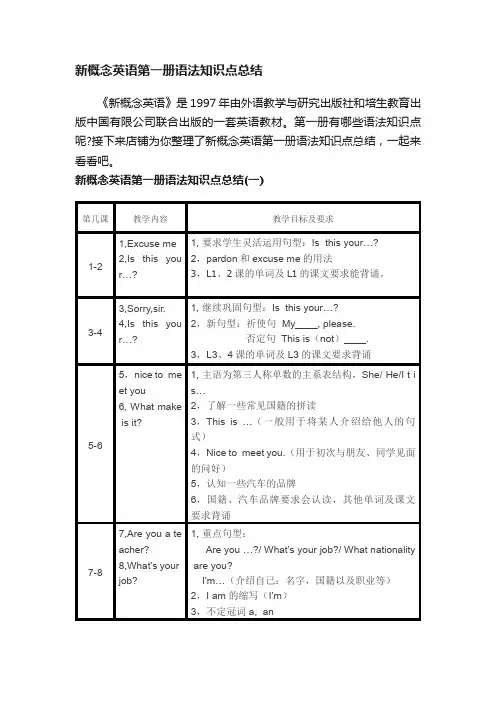
新概念英语第一册语法知识点总结《新概念英语》是1997年由外语教学与研究出版社和培生教育出版中国有限公司联合出版的一套英语教材。
第一册有哪些语法知识点呢?接下来店铺为你整理了新概念英语第一册语法知识点总结,一起来看看吧。
新概念英语第一册语法知识点总结(一)第几课教学内容教学目标及要求1-21,Excuse me2,Is this your…?1,要求学生灵活运用句型:Is this your…?2,pardon和excuse me的用法3,L1、2课的单词及L1的课文要求能背诵。
3-43,Sorry,sir.4,Is this your…?1,继续巩固句型:Is this your…?2,新句型:祈使句 My____, please.否定句 This is(not)____.3,L3、4课的单词及L3的课文要求背诵5-65,nice to meet you6, What makeis it?1,主语为第三人称单数的主系表结构,She/ He/I t is…2,了解一些常见国籍的拼读3,This is …(一般用于将某人介绍给他人的句式)4,Nice to meet you.(用于初次与朋友、同学见面的问好)5,认知一些汽车的品牌6,国籍、汽车品牌要求会认读,其他单词及课文要求背诵7-87,Are you a teacher?8,What’s yourjob?1,重点句型:Are you …?/ What’s your job?/ What nationality are you?I’m…(介绍自己:名字,国籍以及职业等)2,I am的缩写(I’m)3,不定冠词a, an9-109, How are you today?10, Look at…1,重点句型:How are you?(朋友或相识的人之间见面时的寒暄话)2,如何问候他人(How is …?)3,nice to see you .(见面时的客气话)4,Look at…(看…)。
新概念英语第一册课语法复习
So have I.
Neither can I.
❖ 注意:1. neither “也不”,本身已有否定意义;
❖
2. 句式倒装,即主谓调换位置
❖
3. 根据前一句的意义和时态选择相应动词,
❖
但在人称上要与本句人称保持一致。
❖ 结构:Neither + be/情态动词 / 助动词+主语
❖ Ex. I haven’t got any changes. 我也没有。
Grammars
Must I arrive on time? ❖ -Yes, you must. ❖ -No, you needn't.
Do I have to arrive on time? ❖ -Yes, you have to. ❖ -No, you don't have/need to.
Summary
❖
由neither或nor引起的,表示前面所说的情
况
❖
也适用于另一个人(或物)的句子
复合不定代词总表
后 缀 前缀 some-某个
any-任何
-one人
-body人 -thing东西 -where地方 事情
someone somebody something somewher e
anyone anybody anything anywhere
A had cooked B. cooked C. have cooked D. was cooked
❖ 3. By the time he was ten years old, he _________.
A has completed university B. has completed the university
新概念一册全部知识点总结
新概念一册全部知识点总结第一部分:基本单词和短语新概念一册的基本单词和短语分为多个单元,每个单元都围绕一个主题展开,学生在学习过程中将学会一定数量的基本单词和短语,并通过例句来掌握它们的用法和语境。
常见的主题包括家庭、学校、颜色、数字、动物、食物等。
第二部分:语法知识1. 名词:单数、复数、所有格、不可数名词的使用;2. 冠词:定冠词和不定冠词的使用;3. 代词:人称代词、物主代词、反身代词的用法;4. 动词:动词的时态、语态、不定式、动名词等;5. 形容词和副词:形容词和副词的比较级、最高级、修饰语法;6. 数词:基数词、序数词、分数词的用法;7. 介词:介词短语和介词的用法;8. 连词:并列连词、从属连词的用法。
第三部分:句型结构1. 肯定句:主语+谓语+宾语;2. 否定句:主语+助动词+否定词+谓语+宾语;3. 疑问句:一般疑问句、特殊疑问句的结构;4. 强调句:强调句的结构和用法;5. 祈使句:祈使句的结构和用法。
第四部分:阅读和理解新概念一册的阅读和理解部分包括一些简短的文章和对话,学生需要通过阅读理解来掌握文章的主题、要点和细节,并学会提取信息、做笔记、进行总结等技能。
第五部分:口语表达口语表达是新概念一册的重要内容之一,学生需要通过对话练习和角色扮演来提高自己的口语表达能力,包括问路、购物、介绍自己、谈论兴趣爱好等。
第六部分:听力训练新概念一册的听力训练部分主要包括一些简短的对话和独白,学生需要通过听力训练来提高自己的听力理解能力,并学会提取信息、概括主旨、回答问题等技能。
第七部分:写作技巧写作技巧是新概念一册的另一个重要内容,学生需要通过一些写作练习来提高自己的写作水平,包括书信、日记、口头通知等。
第八部分:语言运用语言运用是新概念一册的最后一个部分,学生需要通过语言运用来巩固和复习所学的知识点,包括语法练习、词汇练习、阅读理解练习等。
总结:新概念一册的知识点主要包括基本单词和短语、语法知识、句型结构、阅读和理解、口语表达、听力训练、写作技巧和语言运用等内容。
新概念一语法知识点总结.docx
新概念英语第一册语法知识点包括一般现在时,现在进行时,一般过去时,现在完成时,一般将来时,过去进行时,过去完成时,过去将来时1.一般现在时表示一般性,经常性的动作或一般性事实。
含有 be 动词的句子He is a teacher.The girl is very beautiful.Tim and Jack are students.★变疑问句将be 动词移到句首Is he a teacherIs the girl very beautifulAre Tim and Jack students★变否定句在be 动词后面加notHe is not a teacher.The girl is not very beautiful.Tim and Jack are not students.★肯定回答及否定回答Yes,he is.No, he is not.Yes,she is.No,she is not.Yes,they are.No,they are not.★不含有 be 动词的句子,即含有一般动词的句子第三人称单数及单数名词He likes books.She likes him.The dog likes bones.★变疑问句在句首加does,动词变为原型Does he like booksDoes she like himDoes the dog like bones?★变否定句在主语及动词之间加doesn’t,动词变为原型,原句中的动词不再有第三人称变化。
He doesn’t like books.She doesn’ t like him.The dog doesn’t like bones.★肯定回答及否定回答:Yes,he does.No,he doesn’ t.Yes,she does.No, she doesn’tYes,it does.No,it doesn’ t.注意:第三人称单数形式一般在动词后面加S,不要和名词复数混淆,变否定句或疑问句时名词复数没有任何变化。
新概念英语第一册语法每节课重点总结
新概念英语第一册语法每节课重点总结.docThe New Concept course consists of 144 lessons。
with each odd-numbered lesson being a text and each even-XXX。
The book includes XXX to the content of the preceding text.XXX XXX of the course are to reach a level of English proficiency equivalent to that of a first-year high school student。
to master basic English grammar。
to be XXX。
and to learn 800 to 1200 words。
with the 800 most frequently used words in English being the focus.The first volume (lessons 1-68) covers around 600 words。
including nouns。
adjectives。
verbs。
and a few ns。
with a strong XXX。
The grammar points covered in this volume include the present continuous tense。
the future tense using "be going to," the simple present tense。
and the simple past tense.Each XXX and requirements。
such as being able to use the sentence pattern "Is this your。