
2015年12月大学英语四级考试真题(第2套)
2015年12月大学英语四级考试真题(第2套)PartIWriting(30minutes)Directions:Forthispart,youareallowed30minutestowriteanessaycommentingonthesaying“Learningisadailyexperienceandalifetimemission.”Youcanciteexamplestoillustratetheimportanceoflifelonglearning.Youshouldwriteatleast120wordsbutnomorethan180words.
PartIIListeningComprehension(30minutes)SectionA
Directions:Inthissection,youwillhear8shortconversationsand2longconversations.Attheendofeachconversation,oneormorequestionswillbeaskedaboutwhatwassaid.Boththeconversationandthequestionswillhespokenonlyonce.Aftereachquestiontherewillbeapause.Duringthepause,youmustreadthefourchoicesmarkedA),B),C)andD),anddecidewhichisthebestanswer.ThenmarkthecorrespondingletteronAnswerSheet1withasinglelinethroughthecentre.1.A)Theagendafortheboardofdirectors’meeting.Thedetailsofthemeetingtobeheldnextweek.Thereasonfortheman’sabsencefromthemeeting.Thetimefortheman’svisittothewoman’scompany.2.A)Atatravelagency.C)Inalibrary.Atadepartmentstore.D)Inapostoffice.3.A)Hecannothearthewoman’scall.C)Hecannotrecallthephonenumber.HecannotgetthroughtoNewYork.D)Hecannotfindapublicphonenearby.4.A)Watchamoviewiththewoman.C)DosomeshoppingwithJane.Revisehisthesisintheoffice.D)DiscusshisthesiswithProf.Hudson.5.A)Hejustcannotworkproperlywithoutawatch.Hehasnoideawherehecanbuyagoldwatch.Hestilldoesnotknowwherehelefthiswatch.Heisnotsurewhatwentwrongwithhiswatch.6.A)Heforgotallaboutwhathesaid.C)Hewassorryforbeingoffsicklastweek.Heslippedandhurthishead.D)Hethoughtthewoman’scarhadbeensold.7.A)Sheshouldtrytocatchanearlierbus.C)Sheisalwaysmakingexcusesforbeinglate.Sheisabsentfromhisclasstoooften.D)Sheshouldcomeupwithabetterexcuse.8.A)Heisgoingtohelpthewomanout.C)Heisonhiswaytoseearealestateagent.Hehastomoveoutofthebuildingsoon.D)Hewillstaywiththewoman’sbrother.
Questions9to11arebasedontheconversationyouhavejustheard.9.A)Fromthewantedcolumn.C)Fromatelephonedirectory.Fromsomeofherfriends.D)Fromatelevisioncommercial.10.A)Shereceivedfull-timeeducationabroad.C)Shefinishedhersecondaryschool.)Shegraduatedfromanopenuniversity.D)Shestudiedinavocationalcollege.A)Sheisashorthand-typist.C)SheisapolicewomanB)Sheworksasatourguide.D)Sheteachesaneveningclass.Questions12to15arebasedontheconversationyouhavejustheard.12.A)Itprovideshimwithcareeropportunities.C)Ithasbeenoffandonfortenyears.
梦想不会辜负每一个努力的人B)Ithelpsenlargehiscustomernetwork.D)Itwasinterruptedforfouryears.13.A)Individualizedservice.C)Home-madebeer.B)Traditionalsetting.D)Socialgames.14.A)Thequalityofbeer.C)Theowner’sattitude.B)Theatmosphere.D)Therightlocation.15.A)Itisarathertoughjob.C)Ithelpsoldpeoplekilltime.B)Itisaprofitablebusiness.D)Itmakesretireesfeeluseful.SectionBDirections:Inthissection,youwillhear3shortpassages.Attheendofeachpassage,youwillhearsomequestions.Boththepassageandthequestionswillbespokenonlyonce.Afteryouhearaquestion,youmustchoosethebestanswerfromthefourchoicesmarkedA),B),C),andD).ThenmarkthecorrespondingletteronAnswerSheet1withasinglelinethroughthecentre.PassageOneQuestions16to18arebasedonthepassageyouhavejustheard.16.A)Itisbecomingincreasinglypopular.C)Itgivesrisetoserioussocialinstability.)Ithelpstheusertoescapereality.D)Ithurtsapersonandthosearoundthem.17.A)Theyusedrugsjustforfun.C)Theyusedrugsasmedicine.)Theytakedrugstogethigh.D)Theykeepdruguseasecret.18.A)Itisquitecommoninentertainmentcircles.)Itisthecauseofvarioussocialproblems.)Itishardtogetridof.)Itisfataltotheuser.
PassageTwoQuestions19to22arebasedonthepassageyouhavejustheard.19.A)Takingupexercisesafterrecovery.C)Findingnewwaystocureheartdisease.B)Producingtastyhealthyfrozenfood.D)Goingonadietuponleavingthehospital.20.A)Itwascarefullytestedwithconsumers.C)Itwasdisapprovedbymanydietexperts.B)Itwaspromotedbyhealthorganizations.D)Itwashighlyexpectedbythegeneralpublic.21.A)Competitiveprice.C)Vigorouspromotion.B)Lowexpectations.D)Uniqueingredients.22.A)Itwassuggestedbythefirm’svice-president.)Itmatchesthefood’sdarkgreenpackaging.)Ithasapositiveimplicationforconsumers.)Ittrickstheeldersintoimpulsepurchasing.PassageThreeQuestions23to25arebasedonthepassageyouhavejustheard.23.A)Itispracticedinmostofthestates.C)Ithasdrawnalotofcriticismfromoverseas.B)Itwillbeabolishedsoonerorlater.D)IthastobeapprovedbytheSupremeCourt.24.A)Whetherthepracticeshouldbeallowedtocontinueinfuture.B)Whetherthereshouldbeaminimumagelimitforexecution.C)Whattypeofcriminalsshouldreceiveit.D)Whateffectitmighthaveonyoungsters.25.A)Thecourtsentencedhimtolifeinprisonforkillingtwofriends.B)Thegovernorchangedhisdeathsentencetolifeinprison.C)HewasthefirstminortobeexecutedinSouthCarolina.
2022年12月大学英语四级考试真题(第2套)含答案

2022年12月大学英语四级考试真题(第2套)Part I Writing(30minutes) Directions:In this task,you are to write an essay on the necessity of developing social skills for college students.You will have30minutes for the task.You should write at least120 words but no more than180words.PartⅡListening Comprehension(25minutes) Section ADirections:In this section,you will hear three news reports.At the end of each news report, you will hear two or three questions.Both the news report and the questions will be spoken only once.After you hear a question,you must choose the best answer from the four choices marked A),B),C)and D).Then mark the corresponding letter on Answer Sheet1with a single line through the centre.Questions1and2are based on the news report you have just heard.1.A)Part of its dam wall collapsed.B)It released a lot of harmful gases.C)It was destroyed by an earthquake.D)Some miners were trapped underground.2.A)It posed a safety threat to the miners.B)It caused damage too heavy to assess.C)It brought the mine’s operations to a halt.D)It was followed by two more earthquakes.Questions3and4are based on the news report you have just heard.3.A)It prepared beds for all the six new citizens.B)It assigned a team of doctors for each expected baby.C)It made ample preparations for various possibilities.D)It brought in the most advanced instruments.4.A)They had to undergo2-3physical checkups.B)They were all of normal size except the sixth.C)They could go home together with their mother a day later.D)They needed to stay in the hospital for a couple of months.Questions5to7are based on the news report you have just heard.5.A)It is owned by the local government.B)It has been turned into a public park.C)It has been bought by an American.D)It is a perfect tourist destination.6.A)Its seafood.B)Its unusual coastline.C)Its unspoiled beaches.D)Its architecture.7.A)It has an unmatched location.B)It is worth over18million euros.C)It has beautiful weather all year round.D)It is an ideal place to meet famous stars.Section BDirections:In this section,you will hear two long conversations.At the end of each conversation,you will hear four questions.Both the conversation and the questions will be spoken only once.After you hear a question,you must choose the best answer from the four choices marked A),B),C)and D).Then mark the corresponding letter on Answer Sheet 1with a single line through the centre.Questions8to11are based on the conversation you have just heard.8.A)She has been attending some group classes.B)She has registered for two new gym classes.C)She became a member of the gym two months ago.D)She is entitled to a discount on all the gym exercises.9.A)Considering the promotion of its regular classes.B)Taking measures to expand its exercise programs.C)Recruiting coaches for hot yoga and advanced spinning.D)Offering existing members a discount of two new classes.10.A)She missed the deadline for the10-week course.B)She missed out on the gym’s general discount.C)She didn’t sign up for membership in time.D)She wasn’t so much interested in hot yoga.11.A)She doesn’t want to reveal her card details over the phone.B)She doesn’t think it wise to pay before attending any class.C)She might have to cancel her registration any minute.D)She prefers to have the fee added to her monthly billQuestions12to15are based on the conversation you have just heard.12.A)To make investments.B)To sign a business contract.C)To research new markets.D)To open a new office.13.A)Dubai.B)Beijing.C)Amsterdam.D)Earl’s Court.14.A)Rent a bike for him to get around the town.B)Reserve a meeting room in the head office.C)Help him prepare his presentation.D)Send him a map of the hotel area.15.A)Bring his projector.B)Keep all his receipts.C)Submit his claims form.D)Pay with his credit card.Section CDirections:In this section,you will hear three passages.At the end of each passage,you will hear three or four questions.Both the passage and the questions will be spoken only once. After you hear a question,you must choose the best answer from the four choices marked A), B),C)and D).Then mark the corresponding letter on Answer Sheet1with a single line through the centre.Questions16to18are based on the passage you have just heard.16.A)Whether a country’s educational level is linked to women’s rights.B)Whether women’s rights are making good progress around the world.C)Whether a country’s protection of women’s rights is related to its public health.D)Whether women’s rights are more often overlooked in less-developed countries.17.A)Their people still have better health if women’s rights are respected.B)They must make efforts to increase women’s access to health care.C)Their people tend to attach importance to women’s rights.D)They need to invest more in hospital staff and facilities.18.A)Their link with a country’s public health.B)Their potential impact on social progress.C)Their value to a country’s international image.D)Their positive effect on economic development.Questions19to21are based on the passage you have just heard.19.A)It creates a wonderful setting for dating.B)It may cause strange physical reactions.C)It turns parks into picnic sites.D)It may result in a crowded beach.20.A)Breathing difficulty.B)Bad breath.C)Excessive sweating.D)High blood pressure.21.A)It protects people against bacteria.B)It enables people to build up endurance.C)It accelerates people’s blood circulation.D)It provides people with extra energy.Questions22to25are based on the passage you have just heard.22.A)They are more likely to win in combat sports.B)They are in the minority among the population.C)They have a higher chance of joining sports teams.D)They have more disadvantages in getting ahead.23.A)Their brain is more powerful than that of right-handed people.B)The left side of their brain is more powerful than its right side.C)They tend to be a lot more aggressive than right-handed people.D)Their brain has a stronger connection between its two sides.24.A)They have a larger brain.B)It still remains unknown.C)It is related to their genes.D)They are better at reasoning.25.A)Teach them how to perform tasks with their right hand.B)Help them fully develop their mathematical abilities.C)Encourage them to play fast-paced interactive sports.D)Advise them to choose jobs that require quick reactionsPart III Reading Comprehension(40minutes) Section ADirections:In this section,there is a passage with ten blanks.You are required to select one word for each blank from a list of choices given in a word bank following the passage.Read the passage through carefully before making your choices.Each choice in the bank is identified by a letter.Please mark the corresponding letter for each item on Answer Sheet 2with a single line through the centre.You may not use any of the words in the bank more than once.Researchers,writing in the journal Heart,pooled data from23studies and found that social isolation or feelings of loneliness were tied to an increased risk of coronary heart disease(冠心病)and strokes.The studies included data from181,006men and women ages18and over.There were4,628 coronary events and3,002strokes in follow-up periods26from three to21years. Three of the papers27loneliness,18looked at social isolation and two included both. Social isolation and loneliness were determined with questionnaires;the researchers depended on medical records and death28for determining coronary events and strokes.The scientists found that loneliness and social isolation increased the29risk of having a heart attack or a death from heart disease by29percent,and the risk of stroke by32 percent.There were no30between men and women.“People have tended to focus from a policy point of view on31lonely people to make them more32,”said the lead author,Nicole K.Valtorta,a research fellow at the University of York in England.“Our study33that if this is a risk factor,then we should be trying to prevent the risk factor in the first place.”The authors34that this was a review of observational studies and did not35 cause and effect.A)acknowledge F)establish K)producesB)certificates G)formats L)rangingC)connected H)measured M)relativeD)demonstrates I)narrow N)submittingE)differences J)permanent O)targetingSection BDirections:In this section,you are going to read a passage with ten statements attached to it. Each statement contains information given in one of the paragraphs.Identify the paragraph from which the information is derived.You may choose a paragraph more than once.Each paragraph is marked with a letter.Answer the questions by marking the corresponding letter on Answer Sheet2.The hidden costs colleges don’t want you to know aboutA)This fall,thousands of college students from across the country will begin theirundergraduate studies at colleges around the nation.They will inevitably pack too much to fit in their tiny dorm rooms.They will also carry with them a huge student loan debt,in addition to countless“hidden”out-of-pocket costs paid for by their bank accounts and the bank accounts of their families.B)At my well-respected,private,four-year university in Washington,D.C.,which boasts ayearly tuition of$44,046not including room and board,I receive over$57,000yearly in financial aid.As a student from a family that is struggling to make ends meet,my financial aid package is a combination of federal grants and federal work study,university merit scholarships and financial aid awards,and about$8,000yearly in federally subsidized(有补贴的)and unsubsidized loans.On paper,my expenses and my financial aid just about even out.Off paper,they don’t.C)Universities today are in the business of making money,and mine is no exception.Theyhit me right out of gate with a$160fee to attend my freshman orientation,a price which does not include the cost of travel to and from the District.Almost every class has an associated fee not included in the cost of tuition,most between$40and$100.Fees for lab science classes are the highest,and all students at my university are required to take at least one lab before they graduate.Buying a laptop proved a necessity and,thankfully,a relative bought me one as a gift.Renting a mini-fridge for my dorm room costs my roommates and me about$140a year.D)Schools will charge you whatever they can.The costs of any damage to the dorm,including elevators,bathrooms,and common areas,are billed to every person on a dorm floor,or even the entire building if they do not know who caused the damage.After I fell out of my bed twice during my freshman year,the university installed a railing—for$20, billed to my student account.My financial aid did not anticipate any of the costs and so it did not cover them.E)An Internet search of“hidden costs”of college turns up a host of articles on parent-centered websites on the college application process.These articles are almost always geared towards upper-and middle-class families.For students already struggling to pay tuition,these costs may be the least of their worries.F)So what hidden costs should low-income students really be paying attention to?My college experience offers a few examples.G)If you are a low-income student who will be attending school out-of-state,make sure youknow if you can use your state benefits,such as the Supplemental Nutrition Assistance Program,or SNAP.It wasn’t until after I had accepted admission to an out-of-state school that I learned that I could not use my Ohio Medicaid on campus for anything other than emergency care.My benefits became invalid the second I moved out of Ohio.After my freshman year,I had to opt for the school’s insurance plan,which costs around$2,000a year.Even if your school offers a flat-rate fee for a doctor’s appointment at the student health center(mine is$20a visit),these fees often do not include extra fees for lab tests or prescription medications(药物).H)If you plan on paying off bills in your student account with a credit card,be aware of anyadditional costs.My school charges an additional fee for the use of a credit card to settle outstanding charges,which can add upwards of3%of the balance to your bill.I)There is another depressing reality hidden within even the largest financial aid packages:Colleges often offer the most generous packages during freshman year as a way to attract new students.My family was careful to ask about the chances of financial aid being taken away after my freshman year.We were assured that,except for low grades or a raise in family income,no money would be taken away.We did not know to ask—and the school did not readily point out—that even if tuition rises,my financial aid package will stay the same.So when my university voted to raise tuition costs3%at the end of my freshman year,my financial aid package remained the same and I was suddenly responsible for an additional$1,200for the next year.The university administration will likely vote to raise costs at least once more before my graduation.J)Yes,I chose to attend an expensive university far from my hometown.Yes,there were cheaper options.But there are promising students from struggling families across the nation who should not rule out their dream schools entirely.All things considered,I am paying significantly less than the ticket price of my university,and having an educational experience in Washington,D.C.,that I would not have had anywhere else.As a low-income student from a down-and-out Rust Belt community,these educational experiences have enormous potential to brighten my future—and my family’s future.K)The key is to make sure that students and their families understand that hidden costs exist, and that they may prove problematic.Fill out a more comprehensive checklist,and be wary of listed prices that seem too low.Understand just how complicated the financial aid process is.L)Students and families must also understand their ability to self-advocate.They should not pay student bills or excess fees blindly.If something does not look right,ask about it.If it still doesn’t look right,negotiate it.In cases where parents are working multiple jobs,are less knowledgeable about college bureaucracies,have limited English language skills,orare not contributing financially to their child’s education,the burden of self-advocacy will fall on the student.I understand the difficulty,and the embarrassment.But it is necessary. M)In the grand scheme of things,however,colleges also must come to understand that the hidden fees they ask for may prove unmanageable for the very kinds of low-income or first-generation students they are trying desperately to attract.36.Students’financial aid remains unchanged even when tuition rises.37.Students may not be able to enjoy their state benefits when they go to college out of the state.38.The financial aid the author receives is supposed to cover all her college expenses.39.When the person who damages dorm facilities is not identified,students are required to share the cost.40.Though it is difficult and embarrassing,students should make inquiries about what fees they have to pay and why.41.Today,many Americans have to go to college on student loans.42.Receiving education in a private university in the nation’s capital may change the author’s future life and that of her family’s.43.Students may no longer be qualified for financial aid if they perform poorly in school or if their family income has increased.44.In addition to tuition,college students have to pay extra fees for the courses they take.45.Some schools charge students a fee to their student accounts for using credit cards to pay billsSection CDirections:There are2passages in this section.Each passage is followed by some questions or unfinished statements.For each of them there are four choices marked A),B),C)and D). You should decide on the best choice and mark the corresponding letter on Answer Sheet2 with a single line through the centre.Passage OneQuestions46to50are based on the following passage.To write his2010book,The5-Factor World Diet,nutritionist Harley Pasternak traveled to the healthiest countries around the world to learn more about what made their meals extra nourishing.He noted that Japanese people ate a wonderful variety of seaweeds,and that Chinese people tried to include at least five different colors in every meal.Pasternak also came away with some valuable observations about how different the North American way of life was, compared with many other countries.For starters,Americans eat much bigger portions than people in other countries.“We don’t prioritize eating seasonally or locally,and we also add lots of salt,sugar and thickening agents to our foods,”explained Pasternak.Contrast that to the healthy Mediterranean,Nordicand Okinawan diets listed in Pasternak’s book.They all seem to stick to the ethos(特质)of regional,seasonal produce.For example,a traditional Mediterranean diet includes fruits,vegetables,whole grains, nuts and olive oil as the main components of nutritional intake.Fish,chicken and red wine make moderate appearances,while red meat,salt and sugar are used much less often.The benefits of a traditional Mediterranean diet have been studied since the1970s,and researchers have found that living that olive oil life can help people lose weight,lower their heart disease risk and reverse diabetes.Most other healthy eating cultures also make meals an event—say,multiple courses around the family table,or a glass or two of red wine at a long lunch—as opposed to hastily wolfing down handfuls of cereal above the kitchen sink and calling it dinner.Each of the healthy eating cultures has its own unique feature.But Pasternak did take note of one unifying factor in all of the healthy societies he observed.“The only overlapping feature in most of these healthy countries is that they all walk way more than the average American,”said Pasternak,“So really,regardless of what you’re eating,if someone’s walking four miles more than you each day,they’re going to be a lot thinner and live a lot longer than you.”46.What characterizes Japanese and Chinese foods?A)Variety.B)Flavor.C)Color.D)Naturalness.47.What is typical of Americans in the way of eating?A)They emphasize nutrition.B)They tend to eat quite a lot.C)They prioritize convenience.D)They care about flavors.48.What features in Mediterranean,Nordic and Okinawan diets?A)Fruits and vegetables.B)Olive oil and red wine.C)Seasonal local produce.D)Unprocessed ingredients.49.What do people in most healthy eating cultures have in common?A)They get the whole family to eat at a table.B)They eat their meals regularly and punctually.C)They consume plenty of cereal for breakfast.D)They attach great importance to their meals.pared with the average American,people in healthy societies______.A)walk at least4miles a dayB)do considerably more walkingC)pay more attention to body shapeD)consume a lot more organic foodPassage TwoQuestions51to55are based on the following passage.Recognizing when a friend or colleague feels sad,angry or surprised is key to getting along with others.But a new study suggests that being sensitive to people’s feelings may sometimes come with an extra dose of stress.This and other research challenge the prevailing view that emotional intelligence is uniformly beneficial to its bearer.In a study,psychologist Myriam Bechtoldt of the Frankfurt School of Finance and Management in Germany asked166male university students a series of questions to measure their emotional intelligence.For example,they showed the students photographs of people’s faces and asked them to what extent feelings such as happiness or disgust were being expressed.The students then had to give job talks in front of judges who displayed serious facial expressions.The scientists measured concentrations of stress hormones in the students’saliva(唾液)before and after the talk.In students who were rated more emotionally intelligent,the stress measures increased more during the experiment and took longer to go back to baseline.The findings suggest that some people may be too emotionally clever for their own good,says Bechtoldt.“Sometimes you can be so good at something that it causes trouble,”she notes.Indeed,the study adds to previous research hinting at a dark side of emotional intelligence.A study published in2002in Personality and Individual Differences suggested that emotionally perceptive people might be particularly influenced by feelings of depression and hopelessness.Furthermore,several studies have implied that emotional intelligence can be used to manipulate others for personal gains.More research is needed to see how exactly the relation between emotional intelligence and stress would play out in women and in people of different ages and education levels. Nevertheless,emotional intelligence is a useful skill to have,as long as you learn to also properly cope with emotions—both others’and your own,says Bechtoldt.For example,some sensitive individuals may assume responsibility for other people’s sadness or anger,which ultimately stresses them out.Remember,as Bechtoldt says,“you are not responsible for how other people feel.”51.What is the finding of the new study?A)Emotional intelligence helps people get along with others.B)Emotional intelligence is generally beneficial to its bearer.C)People who are aware of others’feelings may experience more stress.D)People who are emotionally stressed may have trouble making friends.52.What was the purpose of psychologist Myriam Bechtoldt’s experiment?A)To define different types of human feelings.B)To assess the impacts of being emotionally clever.C)To demonstrate how to distinguish different feelings.D)To identify gender differences in emotional intelligence.53.What does the finding of Myriam Bechtoldt’s study indicate?A)Greater emotional cleverness means less trouble in one’s life.B)Emotional intelligence helps people succeed in job interviews.C)People’s psychological wellbeing is related to various factors.D)People may suffer from having a high emotional intelligence.54.What do we learn about emotional intelligence from a number of studies?A)People suffering from depression are emotionally immature.B)People who look at the dark side of life often feel depressed.C)Some people may take advantage of it and benefit themselves.D)Some people may lack it and are easily manipulated by others.55.What does the author suggest sensitive individuals do?A)Avoid burdening themselves with others’feelings.B)Rid themselves of worries over worldly affairs.C)Learn to cope with people’s negative feelings.D)Help people to deal with their troubles in life.PartⅣTranslation(30minutes) Directions:For this part,you are allowed30minutes to translate a passage from Chinese into English.You should write your answer on Answer Sheet2.立春(Start of Spring)在中国农历中表示春天的开始。
2019年12月大学英语四级考试真题完整版(第二套)

2019年12月大学英语四级考试真题完整版(第二套)Part ⅠWriting (30 minutes)Directions:For this part, you are allowed 30 minutes to write a letter to a foreign friend who wants to teach English in China. Please recommend a city to him. You should write at least 120 words but no more than 180 words.Part ⅡListening Comprehension (25 minutes)Section ADirections: In this section, you will hear three news reports. At the end of each news report, you will hear two or three questions. Both the news report and the questions will be spoken only once. After you hear a question, you must choose the best answer from the four choices marked A), B), C) and D). Then mark the corresponding letter on Answer Sheet 1 with a single line through the centre.Questions l and 2 are based on the news report you have just heard.1. A)Many facilities were destroyed by a wandering cow.B) A wandering cow knocked down one of its fences.C) Some tourists were injured by a wandering cow.D) A wandering cow was captured by the police.2. A) It was shot to death by a police officer.B) It found its way back to the park’s zoo.C) It became a great attraction for tourists.D) It was sent to the animal control department.Questions 3 and 4 are based on the news report you have just heard.3. A) It is the largest of its kind.B) It is going to be expanded.C) It is displaying more fossil specimens.D) It is staring an online exhibition.4. A)A collection of bird fossils from Australia.B) Photographs of certain rare fossil exhibits.C) Some ancient wall paintings from Australia.D) Pictures by winners of a wildlife photo contest.Questions 5 to 7 are based on the news report you have just heard.5. A) Pick up trash.B) Amuse visitors.C) Deliver messages.D) Play with children.6. A) They are especially intelligent.B) They are children’s favorite.C They are quite easy to tame.D) They are clean and pretty.7. A) Children may be harmed by the rooks.B) Children may be tempted to drop litter.C) Children may contract bird diseases.D) Children may overfeed the rooks. Section BDirections: In this section, you will hear two long conversations. At the end of each conversation, you will hear four questions. Both the conversation and the questions will be spoken only once. After you hear a question, you must choose the best answer from the four choices marked A), B), C) and D). Then mark the corresponding letter on Answer Sheet 1 with a single line through the centre.Questions 8 to 11 are based on the conversation you have just heard.8. A) It will be produced at Harvard University.B) It will be hosted by famous professors.C) It will cover different areas of science.D) It will focus on recent scientific discoveries.9. A)It will be more futuristic.B) It will be more systematic.C) It will be more entertaining.D) It will be easier to understand.10. A) People interested in science.B) Youngsters eager to explore.C) Children in their early teens.D) Students majoring in science.11. A) Offer professional advice.B) Provide financial support.C) Help promote it on the Internet.D) Make episodes for its first season.Questions 12 to 15 are based on the conversation you have just heard.12. A) Unsure.B) Helpless.C) Concerned.D) Dissatisfied.13. A) He is too concerned with being perfect.B) He loses heart when faced with setbacks.C) He is too ambitious in achieving goals.D) He takes on projects beyond his ability.14. A) Embarrassed.B) Unconcerned.C) Miserable.D) Resentful.15. A) Try to be optimistic whatever happens.B) Compare his present with his past only.C) Always learn from others’ achievements.D) Treat others the way he would be treated.Section CDirections: In this section, you will hear three passages. At the end of each passage, you will hear three or four questions. Both the passage and the questions will be spoken only once. After you hear a question, you must choose the best answer from the four choices marked A), B), C) and D). Then mark the corresponding letter on Answer Sheet 1 with a single line through the centre.Questions 16 to 18 are based on the passage you have just heard.16. A) They have a stronger sense of social responsibility.B) They are more likely to succeed in the humanities.C) They are more likely to become engineers.D) They have greater potential to be leaders.17. A) Praise girls who like to speak up frequently.B) Encourage girls to solve problems on their own.c) Insist that boys and girls work together more.D) Respond more positively to boys’ comments.18. A) Offer personalized teaching materials.B) Provide a variety of optional courses.C) Place great emphasis on test scores.D) Pay extra attention to top students.Questions 19 to 21 are based on the passage you have just heard.19. A) It often rains cats and dogs.B) It seldom rains in summer time.C) It does not rain as much as people think.D) It is one of the most rainy cities in the US.20. A) They drive most of the time.B) The rain is usually very light.C) They have got used to the rain.D) The rain comes mostly at night.21. A) It has a lot of places for entertainment.B) It has never seen thunder and lighting.C) It has fewer cloudy days than any other coastal city.D) It has mild weather both in summer and in winter.Questions 22 to 25 are based on the passage you have just heard.22. A) It occurs when people are doing a repetitive activity.B) It results from exerting one’s muscles continuously.C) It happens when people engage in an uncommon activity.D) It comes from staining one’s muscles in an unusual way.23. A) Blood flow and body heat increase in the affected area.B) Body movements in the affected area become difficult.C) They begin to make repairs immediately.D) They gradually become fragmented.24. A) About one week.B) About two days.C) About ten days.D) About four weeks.25. A) Apply muscle creams.B) Drink plenty of water.C) Have a hot shower.D) Take pain-killers.Part ⅢReading Comprehension (40 minutes)Section AFinally, some good news about airplane traverl. If you are on a plane with a sick passenger, you are unlikely to get sick. That is the 26 of a new study that looked at how respiratory(呼吸道)viruses 27 on airplanes. Researchers found that only people who were seated in individual – had a high risk of catching the illness. All other passengers had only a very 28 chance of getting sick ,according to the findings. Media reports have not necessarily presented 29 information about the risk of getting infected on an airplane in the past. Therefore , these new findings should help airplane passengers to feel less 30 to catching respiratory infections while traveling by air.Prior to the new study, litter was known about the risks of getting 31 infected by common respiratory viruses, such as the flu or common cold, on an airplane, the researchers said. So,to 32 the risks of infection, the study team flew on 10 different 33 in the U.S. 34 side of a person infected with flu, as well as those sitting one roe in front of or behind this individual, had about an 80 person chance of getting sick. But other passengers were 35 safe from infection. They had a less than 3 percent chance of catching the flu.A) accurateB) conclusionC) directlyD) eitherE) evaluateF) explorationsG) flightsH) largelyI) nearbyJ) respondK) slimL) spreadM) summitN) vividlyO) vulnerableSection BDirections: In this section, you are going to read a passage with ten statements attached to it. Each statement contains information given in one of the paragraphs. Identify the paragraph from which the information is derived. You may choose a paragraph more than once. Each paragraph ismarked with a letter. Answer the questions by marking the corresponding letter on Answer Sheet 2.A South Korean city designed for the future takes on a life of its ownA) Getting around a city is one thing - and then ther e’s the matter of getting from one city to another. One vision of the perfect city of the future: a place that offers easy access to air travel.In 2011, a University of North Carolina business professor named John Kasarda published a book called Aerotropolis: The Way We’ll Live Next. Kasarda says future cities should be built intentionally around or near airports. The idea, as he has put it, is to offer businesses “rapid, long-distance connectivity on a massive scale.”B) “The 18th century really was a waterborne (水运的) century, the 19th century a rail century. the 20th century a highway, car, truck century一and the 21st century will increasingly be an aviation century, as the globe becomesincreasingly connected by air,”Kasarda says. Songdo, a city built from scratch in South Korea, is one of Kasarda’s prime examples. It has existed for just a few years.“ From the get-go, it was designed on the basis of connectivity and competitiveness,”says Kasada. “The government built the bridge directly from the airport to the Songdo International Business District. And the surface infrastructure was built in tandem with the new airport.”C) Songdo is a stone’s throw from South Korea’s Incheon Airport, its main international hub (枢纽). But it takes a lot more than a nearby airport to be a city of the future. Just building a place as an “international business district”doesn’t mean it will become one. Park Yeon Soo conceived (构想)this city of the future back in 1986. He considers Songdo his baby. “I am a visionary,”he says. Thirty years after he imagined the city, Park’s baby is close to 70 percent built, with 36.000 people living in the business district and 90,000 residents in greater Songdo. It’s about an hour outside Seoul, built on reclaimed tidal flats along the Ye llow Sea, There’s a Coast Guard building and a tall trade tower, as well as a park, golf course and university.D) Chances are you’ve actually seen this place. Songdo appears in the most famous music video ever to come ou of South Korea. “Gangnam Style” r efers to the fashionable Gangnam district in Seoul. But some of the video was filmed in Songdo.“I don’t know if you remember, there was a scene in a subway station. That was not Gangnam. That was actually Songdo,” says Jung Won Son, a professor of urbande velopment at London’s Bartlett School of Planning, “Part of the reason to shoot there is that it’s new and nice.”E) The city was supposed to be a hub for global companies, with employees from all over the world. But hat’s not how it has turned out. Songd o’s reputation is as a futuristic ghost town. But the reality is more complicated. A bridge with big, light-blue loops leads into the business district. In the center of the main road, there’s a long line of flags of the world. On the corner, there’s a Sta rbucks and a 7-Eleven--all of the international brands that you see all over the world nowadays.F) The city is not empty. There are mothers pushing strollers,old women with walkers -- even in the middle of the day. when it’s 90 degrees out. Byun Young-Jin chairs the Songdo real estate association and started selling property here when the first phase of the city opened in 2005. He says demand has boomed in the past couple of years. Most of his clients are Korean. In fact, the developer says, 99 percent of the homes here are sold to Koreans. Young families move here because the schools are great. And that’s the problem: Songdo has become a popular Korean city 一more popular as a residential area than a business one. It’s not yet the futuristic international business hub that planners imagined. “It’s a great place to live. And it’s becoming a great place to work,”says Scott Summers, the vice president of Gale International, the developer of the city. The floor-to-ceiling windows of his company’s offices overlook Songdo Central Park, with a canal full of kayaks and paddle boats. Shimmering (闪烁的)glass towe rs line the canal’s edge.G) “What’s happened is, because we focused on creating that quality of life first, which enabled the residents to live here, what has probably missed the mark is for companies to locate here,” he says. “There needs to be strong economic incentives.”The city is still unfinished, and it feels a bit like a theme park. It doesn’t feel all that futuristic. There’s a high-tech underground trash disposal system. Buildings are environmentally friendly. Everybody’s television set is connected to a system that streams personalized language or exercise classes.H) But Star Trek this is not. And to some of the residents, Songdo feels hollow. “I’m, like, in prison for weekdays. That’s what we call it in the workplace,” says a woman in her 20s. She doesn’t want to use her name for fear of being fired from her job. She goes back to Seoul every weekend. “I say I’m prison-breaking on Friday nights.” B ut she has to make the prison break in her own car. There’s no high-speed train connecting Songdo to Seoul, just over 20 miles away.I) The man who first imagined Songdo feels frustrated. too. Park says he built South Korea a luxury vehicle, “like Mercede s or BMW. It’s a good car now. But we’re waiting for a good driver to accelerate.”But there are lots of other good cars out there, too. The worldis dotted with futuristic, high-tech cities trying to attract the biggest international companiesJ) Songdo’s backers contend that it’s still early, and business space is filling up-about 70 percent of finished offices are now occupied. Brent Ryan, who teaches urban design at MIT, says Songdo proves a universal principle. “There have been a lot of utopian (乌托邦的) cities in history. And the reason we don’t know about a lot of them is that a lot of them have vanished entirely.”In other words, when it comes to cities-or anything else-it is hard to predict the future.36. Songdo’s popularity lies more in its quality of life than its business attraction.37. The man who conceives Songdo feels disappointed because it has fallen short of his expectations.38. A scene in a popular South Korean music video was shot in Songdo.39. Songdo still lacks the financial stimulus for businesses toset up shop there.40. Airplanes will increasingly become the chief means of transportation, according to a professor.41. Songdo has ended up different from the city it was supposed to be.42. Some of the people who work in Songdo complain about boredom in the workplace.43. A business professor says that a future city should have easy access to international transportation.44. Acording to an urban design professor, it is difficult for city designers to foresee what happen in the future.45. Park Yeon So. Who envisioned Songdo, feels a parental connection with the city.Section CDirections: There are 2 passages in this section. Each passage is followed by some questions or unfinished statements. For each of them there are four choices marked A), B), C) and D). You should decide on the best choice and mark the corresponding letter on Answer Sheet 2 with a single line through the centre.Passage OneQuestions 46 to 50 are based on the following passage.The fifth largest city in the US passed a significant soda tax proposal that will levy (征税)1.5 cents per liquid ounce on distributors.Philadelphia’s new measure was approved by a 13 to 4 city council vote. It sets a new bar for similar initiatives across the county. It is proof that taxes on sugary drinks can win substantial support outside super-liberal areas. Until now, the only city to successfully pass and implement a soda tax was Berkeley, California, in 2014.The tax will apply to regular and diet sodas, as well as other drinks with added sugar, such as Gatorade and iced teas. It’s expected to raise $410 million over the next five years, most of which will go toward funding a universal pre-kindergarten program for the city.While the city council vote was met with applause inside the council room, opponents to the measure, including soda lobbyists made sharp criticisms and a promise to challenge the tax in court.“The tax passed today unfairly singles outbeverages-including low- and no-calorie choices,” sai d Lauren Kane, spokeswoman for the American Beverage Association. “But most importantly, it is against the law. So we will side with the majority of the people of Philadelphia who oppose this tax and take legal action to stop it.”An industry backed anti-tax campaign has spent at least $4 million on advertisements. The ads criticized the measure. characterizing it as a“grocery tax.”Public health groups applauded the approved tax as a step toward fixing certain lasting health issues that plague Americans. “The move to recapture a small part of the profits from an industry that pushes a product that contributes to diabetes, obesity and heart disease in poorer communities in order to reinvest in those communities will sure be inspirational to many other plac es,” said Jim Krieger, executive director of Healthy Food America. “Indeed, we are already hearing from some of them. It’s not just Berkeley’ anymore.”Similar measures in California’s Albany, Oakland, San Francisco and Colorado’s Boulder are becoming hot-button issues Health advocacy groups have hinted that even more might be coming.46. What does the passage say about the newly-approved soda tax in Philadelphia?A) It will change the lifestyle of many consumers.B) It may encourage other US cities to follow suit.C) It will cut soda consumption among low-income communities.D)It may influence the marketing strategies of the soda business.47. What will the opponents probably do to respond to the soda tax proposal?A) Bargain with the city council.B) Refuse to pay additional tax.C) Take legal action against it.D) Try to win public support.48. What did the industry-backed anti-tax campaign do about the soda tax proposal?A) It tried to arouse hostile feelings among consumers.B) It tried to win grocers’ support against the measure.C) It kept sending letters of protest to the media.D) It criticized the measure through advertising.49. What did public health groups think the soda tax would do?A) Alert people to the risk of sugar-induced diseases.B) Help people to fix certain long-time health issues.C) Add to the fund for their research on diseases.D) Benefit low-income people across the country.50. What do we learn about similar measures concerning the soda tax in some other cities?A) They are becoming rather sensitive issues.B) They are spreading panic in the soda industry.C) They are reducing the incidence of sugar-induced diseases.D)They are taking away lot of profit from the soda industry. Passage TwoQuestions 51 to 55 are based on the following passage.Popping food into the microwave for a couple of minutes may seem utterly harmless, but Europe’s stock of thesequick-cooking ovens emit as much carbon as nearly 7 million cars, a new study has found. And the problem is growing. With costs falling and kitchen appliances becoming “status” items, owners are throwing away microwaves after an average of eight years. This is pushing sales of new microwaves which are expected to reach 135 million annually in the EU by the end of the decade.A study by the University of Manchester calculated the emissions of CO2-the main greenhouse gas responsible forclimate change-at every stage of microwaves, from manufacture to waste disposal. “It is electricity consumption by microwaves that has the biggest impact on the environment,” say the authors. The authors also calculate that the emissions from using 19 microwaves over a year are the same as those from using a car. According to the same study, efforts to reduce consumption should focus on improving consumer awareness and behaviour. For example, consumers could use appliances in a more efficient way by adjusting the time of cooking to the type of food.However, David Reay, professor of carbon management, argues that, although microwaves use a great deal of energy, their emissions are minor compared to those from cars. In the UK alone, there are around 30 million cars. These cars emit more than all the microwaves in the EU. Backing this up, recent data show that passenger cars in the UK emitted 69 million tons of CO2 in 2015. This is 10 times the amount this new microwave oven study estimates for annual emissions for all the microwave ovens in the EU. Further, the energy used by microwaves is lower than any other from of cooking. Among common kitchen appliances used for cooking, microwaves arethe most energy efficient, followed by a stove and finally a standard oven. Thus, rising microwave sales could be seen as a positive thing.51. What is the finding of the new study?A) Quick-cooking microwave ovens have become more popular.B) The frequent use of microwaves may do harm to our health.C) CO2 emissions constitute a major threat to the environment.D) The use of microwaves emits more CO2 than people think.52. Why are the sales of microwaves expected to rise?A) They are becoming more affordable.B) They have a shorter life cycle than other appliances.C) They are getting much easier to operate.D) They take less time to cook than other appliances.53. What recommendation does the study by the University of Manchester make?A) Cooking food of different varieties.B) Improving microwave users’ habits.C) Eating less to cut energy consumption.D) Using microwave ovens less frequently.54. What does Professor David Reay try to argue?A) There are far more emissions from cars than from microwaves.B) People should be persuaded into using passenger cars lessoften.C) The UK produces less CO2 than many other countries in the EU.D) More data are needed to show whether microwaves are harmful.55. What does Professor David Reay think of the use of microwaves?A) It will become less popular in the coming decades.B) It makes everyday cooking much more convenient.C) It plays a positive role in environmental protection.D) It consumes more power than conventional cooking.Part ⅣTranslation (30 minutes)Directions: For this part, you are allowed 30 minutes totranslate a passage from Chinese into English. You should write your answer on Answer Sheet 2.中国的家庭观念与其文化传统有关。
2017年12月大学英语四级真题参考答案(第二套)

2017年12月大学英语四级真题参考答案Part I WritingAs we widely know that the relationship between parents and children plays a significant role in the domestic relationship, which not only serves as crucial bridge to build trust and connection between two generations but also exerts a profound and subtle influence toward to children’s personal growth.In order to strengthen the relationship, it is imperative to cultivate the respect between generations, which not only includes the respect to parents from children but also the other way around. Furthermore, it is sensible for the parents to spend more time on the company with their children, enhancing the affection between each other. Finally, it is wise for the parents to set an example rather than make demands, enabling the children to follow and achieve spiritual development.To sum up, the sound relationship between two generations requires the integration of numerous measures derived from the joint effort of parents, children and schools.Part II Listening Comprehension1.B) Her little brother.2.C) By selling lemonade and pictures.3.C) Providing clean energy to five million people.4.B) They can be laid right on top of existing highways.5.A) Endless fighting in the region.6.D) To find evidence of the existence of the “lost lions”.7.B) Lions’ tracks.8.D) A special gift from the man.9.D) Threw her a surprise party.10.B) The trip her husband has planned.11.C) He is eager to learn how the couple’s holiday turns out.12.A) They are sensitive to the dynamics of a negotiation.13.B) They know when to stop.14.C) They learn quickly.15.D) Get to know the other side.16.D) How space research benefits people on Earth.17.B) They developed objects for astronauts to use in outer space.18.A) They are extremely accurate.19.C) It marked the beginning of something new.20.A) They believed in working for goals.21.D) Doing needlework by the fire.22.C) Sit down and try to calm yourself.23.B) You may expose yourself to unexpected dangers.24.D) Walk uphill.25.A) Inform somebody of your plan.Part ⅢReading Comprehension26. G)exposure27. L)levels28. F)enroll29. O)participated30. C)championships31. E) developing32. M)local33. N)operates34. I)feeding35. B)career36 H)to be curious, we need to realize first of all that there are many things we don' t know.37. D). according to leslie, curiosity is essential to one s success.38. O)we should feel happy when we pursue knowledge for knowledge s sake39 M)political leaders' lack of curiosity will result in bad consequences.40. B) there are often accusations about.politicians and the media s lack of curiosity to find out the truth41. L)the less curious a child is , the less knowledge the child may turn out to have.42. k) it is widely accepted that academic accomplishment lies in both intelligence and diligence.43. J) a bookshop as curiosity eads us can be a good way to entertain ourselves.44. G)both the rise of the internet and reduced appetite for literary fiction contribute to people' s declining curiosity.45. F)mankind wouldn' t be so innovative without curiosity.46-50: BADCA51-55: CCBDD46. what do believe about aging ?b)they just cannot do anything about It47. how do many scientists view aging now?a) might be prevented and treated48. what does alex zhavoronkov think of describing aging as a disease ?d)it will motivate doctors and pharmacists to find ways to treat aging.49. what do we learn about the medical community?c)they can contribute to people's health only to a limited extend,50. what does professor leonard hayflick believea)the human lifespan cannot be pro-longed51. what do we learn about applicants postdoctoral positions in geosciences?c)more males than females are likely to get outstanding letters of recommendafion52. what do studies about men and women in scientific research show?C)Men are believed to be better able to excel in stem disciplines53. what do the studies find about the recommendation letters for women appli cants?b). they contain nothing that distinguishes the application.54. what did dutt and her colleagues do with the more than 1, 200 letters of recommendationd) they deleted all information about gender.55. what does dutt aim to do with her study?d) start a public discussion on how to raise women's status in academic circles.Part ⅣTranslationMountain Tai, 2,700 m above sea level and 400 square kilometers, which is located in the western part of China. It enjoys not only the magnificent sight, but the high reputation for its historical culture. Mountain Tai is a place of worship for pilgrims for 3,000 thousand years.According to the record, it was visited by 72 emperors in total. Many writers obtain inspiration and compose poems and compositions by visiting Mountain Tai. Besides, artists also draw paintings here. Consequently, there are a lot of cultural relics and historic sites. Nowadays, Mountain Tai has become one of the most well-known tourist attractions in China.。
2019年12月四级考试真题及参考答案完整版(第二套)

2019年12月大学英语四级考试真题完整版(第二套)Part Ⅰ Writing (30 minutes)Directions:For this part, you are allowed 30 minutes to write a letter to a foreign friend who wants to teach English in China. Please recommend a city to him. You should write at least 120 words but no more than 180 words.Part Ⅱ Listening Comprehension (25 minutes)Section ADirections: In this section, you will hear three news reports. At the end of each news report, you will hear two or three questions. Both the news report and the questions will be spoken only once. After you hear a question, you must choose the best answer from the four choices marked A), B), C) and D). Then mark the corresponding letter on Answer Sheet 1 with a single line through the centre.Questions l and 2 are based on the news report you have just heard.1. A)Many facilities were destroyed by a wandering cow.B) A wandering cow knocked down one of its fences.C) Some tourists were injured by a wandering cow.D) A wandering cow was captured by the police.2. A) It was shot to death by a police officer.B)It found its way back to the park’s zoo.C) It became a great attraction for tourists.D) It was sent to the animal control department.Questions 3 and 4 are based on the news report you have just heard.3. A) It is the largest of its kind.B) It is going to be expanded.C) It is displaying more fossil specimens.D) It is staring an online exhibition.4. A)A collection of bird fossils from Australia.B) Photographs of certain rare fossil exhibits.C) Some ancient wall paintings from Australia.D) Pictures by winners of a wildlife photo contest.Questions 5 to 7 are based on the news report you have just heard.5. A) Pick up trash.B) Amuse visitors.C) Deliver messages.D) Play with children.6. A) They are especially intelligent.B)They are children’s favorite.C They are quite easy to tame.D) They are clean and pretty.7. A) Children may be harmed by the rooks.B) Children may be tempted to drop litter.C) Children may contract bird diseases.D) Children may overfeed the rooks.Section BDirections: In this section, you will hear two long conversations. At the end of each conversation, you will hear four questions. Both the conversation and the questions will be spoken only once. After you hear a question, you must choose the best answer from the four choices marked A), B), C) and D). Thenmark the corresponding letter on Answer Sheet 1 with a single line through the centre.Questions 8 to 11 are based on the conversation you have just heard.8. A) It will be produced at Harvard University.B) It will be hosted by famous professors.C) It will cover different areas of science.D) It will focus on recent scientific discoveries.9. A)It will be more futuristic.B) It will be more systematic.C) It will be more entertaining.D) It will be easier to understand.10. A) People interested in science.B) Youngsters eager to explore.C) Children in their early teens.D) Students majoring in science.11. A) Offer professional advice.B) Provide financial support.C) Help promote it on the Internet.D) Make episodes for its first season.Questions 12 to 15 are based on the conversation you have just heard.12. A) Unsure.B) Helpless.C) Concerned.D) Dissatisfied.13. A) He is too concerned with being perfect.B) He loses heart when faced with setbacks.C) He is too ambitious in achieving goals.D) He takes on projects beyond his ability.14. A) Embarrassed.B) Unconcerned.C) Miserable.D) Resentful.15. A) Try to be optimistic whatever happens.B) Compare his present with his past only.C)Always learn from others’ achievements.D) Treat others the way he would be treated.Section CDirections: In this section, you will hear three passages. At the end of each passage, you will hear three or four questions. Both the passage and the questions will be spoken only once. After you hear a question, you must choose the best answer from the four choices marked A), B), C) and D). Then mark the corresponding letter on Answer Sheet 1 with a single line through the centre.Questions 16 to 18 are based on the passage you have just heard.16. A) They have a stronger sense of social responsibility.B) They are more likely to succeed in the humanities.C) They are more likely to become engineers.D) They have greater potential to be leaders.17. A) Praise girls who like to speak up frequently.B) Encourage girls to solve problems on their own.c) Insist that boys and girls work together more.D)Respond more positively to boys’ comments.18. A) Offer personalized teaching materials.B) Provide a variety of optional courses.C) Place great emphasis on test scores.D) Pay extra attention to top students.Questions 19 to 21 are based on the passage you have just heard.19. A) It often rains cats and dogs.B) It seldom rains in summer time.C) It does not rain as much as people think.D) It is one of the most rainy cities in the US.20. A) They drive most of the time.B) The rain is usually very light.C) They have got used to the rain.D) The rain comes mostly at night.21. A) It has a lot of places for entertainment.B) It has never seen thunder and lighting.C) It has fewer cloudy days than any other coastal city.D) It has mild weather both in summer and in winter.Questions 22 to 25 are based on the passage you have just heard.22. A) It occurs when people are doing a repetitive activity.B)It results from exerting one’s muscles continuously.C) It happens when people engage in an uncommon activity. D)It comes from staining one’s muscle s in an unusual way.23. A) Blood flow and body heat increase in the affected area. B) Body movements in the affected area become difficult.C) They begin to make repairs immediately.D) They gradually become fragmented.24. A) About one week.B) About two days.C) About ten days.D) About four weeks.25. A) Apply muscle creams.B) Drink plenty of water.C) Have a hot shower.D) Take pain-killers.Part Ⅲ Reading Comprehension (40 minutes)Section AFinally, some good news about airplane traverl. If you are on a plane with a sick passenger, you are unlikely to get sick. That is the 26 of a new study that looked at how respiratory(呼吸道)viruses 27 on airplanes. Researchers found that only people who were seated in individual – had a high risk of catching the illness. All other passengers had only a very 28 chance of getting sick ,accordingto the findings. Media reports have not necessarily presented 29 information about the risk of getting infected on an airplane in the past. Therefore , these new findings should help airplane passengers to feel less 30 to catching respiratory infections while traveling by air.Prior to the new study, litter was known about the risks of getting 31 infected by common respiratory viruses, such as the flu or common cold, on an airplane, the researchers said. So, to 32 the risks of infection, the study team flew on 10 different 33 in the U.S. 34 side of a person infected with flu, as well as those sitting one roe in front of or behind this individual, had about an 80 person chance of getting sick. But other passengers were 35 safe from infection. They had a less than 3 percent chance of catching the flu.A) accurateB) conclusionC) directlyD) eitherE) evaluateF) explorationsG) flightsH) largelyI) nearbyJ) respondK) slimL) spreadM) summitN) vividlyO) vulnerableSection BDirections: In this section, you are going to read a passage with ten statements attached to it. Each statement contains information given in one of the paragraphs. Identify the paragraph from which the information is derived. You may choose a paragraph more than once. Each paragraph is marked with a letter. Answer the questions by marking the corresponding letter on Answer Sheet 2.A South Korean city designed for the future takes on a life of its ownA) Getting around a city is one thing —and then there’s the matter of getting from one city to another. One vision of the perfect city of the future: a place that offers easy access to air travel.In 2011, a University of North Carolina business professor named John Kasarda published a book called Aerotropolis: The Way We’ll Live Next. Kasarda says future cities should be built intentionally around or near airports. The idea, as he has put it, is to offer businesses “rapid, long-distance connectivity on a massive scale.”B)“The 18th century really was a waterborne (水运的) century, the 19th century a rail century. the 20th century a highway, car, truck century一and the 21st century will increasingly be an aviation century, as the globe becomes increasi ngly connected by air,” Kasarda says. Songdo, a city built from scratch in South Korea, is one of Kasarda’s prime examples. It has existed for just a few years.“ From the get-go, it was designed on the basis of connectivity and competitiveness,”says Kasada. “The government built the bridge directly from the airport to the Songdo International Business District. And the surface infrastructure was built in tandem with the new airport.”C)Songdo is a stone’s throw from South Korea’s Incheon Airport, its main international hub (枢纽). But it takes a lot more than a nearby airport to be a city of the future. Just building a place as an “international business district” doesn’t mean it will become one. Park Yeon Soo conceived (构想) this city ofthe future back in 1986. He considers Songdo his baby. “I am a visionary,” he says. Thirty years after he imagined the city, Park’s baby is close to 70 percent built, with 36.000 people living in the business district and 90,000 residents in greater Songdo. It’s about an hour outside Seoul, built on reclaimed tidal flats along the Yellow Sea, There’s a Coast Guard building and a tall trade tower, as well as a park, golf course and university.D)Chances are you’ve actually seen this place. Songdo appears in the most famous musi c video ever to come ou of South Korea. “Gangnam Style” refers to the fashionable Gangnam district in Seoul. But some of the video was filmed in Songdo.“I don’t know if you remember, there was a scene in a subway station. That was not Gangnam. That was act ually Songdo,” says Jung Won Son, a professor of urban development at London’s Bartlett School of Planning, “Part of the reason to shoot there is that it’s new and nice.”E) The city was supposed to be a hub for global companies, with employees from all ov er the world. But hat’s not how it has turned out. Songdo’s reputation is as a futuristic ghost town. But the reality is more complicated. A bridge with big, light-blue loops leads into the business district. In the center of the main road, there’s a long line of flags of the world. On the corner, there’s a Starbucks and a 7-Eleven--all of the international brands that you see all over the world nowadays.F) The city is not empty. There are mothers pushing strollers, old women with walkers -- even in the mi ddle of the day. when it’s 90 degrees out. Byun Young-Jin chairs the Songdo real estate association and started selling property here when the first phase of the city opened in 2005. He says demand has boomed in the past couple of years. Most of his clients are Korean. In fact, the developer says, 99 percent of the homes here are sold to Koreans. Young families move here because the schools are great. And that’s the problem: Songdo has become a popular Korean city 一more popular as a residential area than a business one. It’s not yet the futuristic international business hub that planners imagined. “It’s a great place to live. And it’s becoming a great place to work,” says Scott Summers, the vice president of Gale International, the developer of the city. The floor-to-ceiling windows of his company’s offices overlook Songdo Central Park, with a canal full of kayaks and paddle boats. Shimmering (闪烁的)glass towers line the canal’s edge.G)“What’s happened is, because we focused on creating that quality of life first, which enabled the residents to live here, what has probably missed the mark is for companies to locate here,” he says. “There needs to be strong economic incentives.” The city is still unfinished, and it feels a bit like a theme park. It doesn’t feel all that futuristic. There’s a high-tech underground trash disposal system. Buildings are environmentally friendly. Everybody’s television set is connected to a system that streams personalized language or exercise classes.H) But Star Trek this is not. And to some of the residents, Songdo feels hollow. “I’m, like, in prison for weekdays. That’s what we call it in the workplace,” says a woman in her 20s. She doesn’t want to use her name for fear of being fired from her job. She goes back to Seoul every wee kend. “I say I’m prison-breaking on Friday nights.” But she has to make the prison break in her own car. There’s no high-speed train connecting Songdo to Seoul, just over 20 miles away.I) The man who first imagined Songdo feels frustrated. too. Park says he built South Korea a luxury vehicle, “like Mercedes or BMW. It’s a good car now. But we’re waiting for a good driver to accelerate.”But there are lots of other good cars out there, too. The world is dotted with futuristic, high-tech cities trying to attract the biggest international companiesJ)Songdo’s backers contend that it’s still early, and business space is filling up—about 70 percent of finished offices are now occupied. Brent Ryan, who teaches urban design at MIT, says Songdo proves a universal principle. “There have been a lot of utopian (乌托邦的)cities in history. And the reason we don’t know about a lot of them is that a lot of them have vanished entirely.” In other words, when it comes to cities—or anything else—it is hard to predict the future.36. Songdo’s popularity lies more in its quality of life than its business attraction.37. The man who conceives Songdo feels disappointed because it has fallen short of his expectations.38. A scene in a popular South Korean music video was shot in Songdo.39. Songdo still lacks the financial stimulus for businesses to set up shop there.40. Airplanes will increasingly become the chief means of transportation, according to a professor.41. Songdo has ended up different from the city it was supposed to be.42. Some of the people who work in Songdo complain about boredom in the workplace.43. A business professor says that a future city should have easy access to international transportation.44. Acording to an urban design professor, it is difficult for city designers to foresee what happen in the future.45. Park Yeon So. Who envisioned Songdo, feels a parental connection with the city.Section CDirections: There are 2 passages in this section. Each passage is followed by some questions or unfinished statements. For each of them there are four choices marked A), B), C) and D). You should decide on the best choiceand mark the corresponding letter on Answer Sheet 2 with a single line through the centre.Passage OneQuestions 46 to 50 are based on the following passage.The fifth largest city in the US passed a significant soda tax proposal that will levy (征税)1.5 cents per liquid ounce on distributors.Philadelphia’s new measure was approve d by a 13 to 4 city council vote. It sets a new bar for similar initiatives across the county. It is proof that taxes on sugary drinks can win substantial support outside super-liberal areas. Until now, the only city to successfully pass and implement a soda tax was Berkeley, California, in 2014.The tax will apply to regular and diet sodas, as well as other drinks with added sugar, such as Gatorade and iced teas. It’s expected to raise $410 million over the next five years, most of which will go toward funding a universal pre-kindergarten program for the city.While the city council vote was met with applause inside the council room, opponents to the measure, including soda lobbyists made sharp criticisms and a promise to challenge the tax in court.“The ta x passed today unfairly singles out beverages—including low- and no-calorie choices,” said Lauren Kane, spokeswoman for the American Beverage Association. “But most importantly, it is against the law. So we will side with the majority of the people of Philadelphia who oppose this tax and take legal action to stop it.”An industry backed anti-tax campaign has spent at least $4 million on advertisements. The ads criticized the measure. characterizing it as a“grocery tax.”Public health groups applauded the approved tax as a step toward fixing certain lasting health issues that plague Americans. “The move to recapture a small part of the profits from an industry that pushes a product that contributes to diabetes, obesity and heart disease in poorer communities in order to reinvest in those communities will sure be inspirational to many other places,” said Jim Krieger, executive director of Healthy Food America. “Indeed, we are already hearing from some of them. It’s not just Berkeley’ anymore.”Similar measures in California’s Albany, Oakland, San Francisco and Colorado’s Boulder are becoming hot-button issues Health advocacy groups have hinted that even more might be coming.46. What does the passage say about the newly-approved soda tax in Philadelphia?A) It will change the lifestyle of many consumers.B) It may encourage other US cities to follow suit.C) It will cut soda consumption among low-income communities.D)It may influence the marketing strategies of the soda business.47. What will the opponents probably do to respond to the soda tax proposal? A) Bargain with the city council.B) Refuse to pay additional tax.C) Take legal action against it.D) Try to win public support.48. What did the industry-backed anti-tax campaign do about the soda tax proposal?A) It tried to arouse hostile feelings among consumers.B)It tried to win grocers’ support against the measure.C) It kept sending letters of protest to the media.D) It criticized the measure through advertising.49. What did public health groups think the soda tax would do?A) Alert people to the risk of sugar-induced diseases.B) Help people to fix certain long-time health issues.C) Add to the fund for their research on diseases.D) Benefit low-income people across the country.50. What do we learn about similar measures concerning the soda tax in some other cities?A) They are becoming rather sensitive issues.B) They are spreading panic in the soda industry.C) They are reducing the incidence of sugar-induced diseases.D)They are taking away lot of profit from the soda industry.Passage TwoQuestions 51 to 55 are based on the following passage.Popping food into the microwave for a couple of minutes may seem utterly harmless, but Europe’s stock of these quick-cooking ovens emit as much carbon as nearly 7 million cars, a new study has found. And the problem is growing. Withcosts falling and kitchen appliances becoming “status” items, owners are throwing away microwaves after an average of eight years. This is pushing sales of new microwaves which are expected to reach 135 million annually in the EU by the end of the decade.A study by the University of Manchester calculated the emissions of CO2—the main greenhouse gas responsible for climate change—at every stage of microwaves, from manufacture to wast e disposal. “It is electricity consumption by microwaves that has the biggest impact on the environment,” say the authors. The authors also calculate that the emissions from using 19 microwaves over a year are the same as those from using a car. According to the same study, efforts to reduce consumption should focus on improving consumer awareness and behaviour. For example, consumers could use appliances in a more efficient way by adjusting the time of cooking to the type of food.However, David Reay, professor of carbon management, argues that, although microwaves use a great deal of energy, their emissions are minor compared to those from cars. In the UK alone, there are around 30 million cars. These cars emit more than all the microwaves in the EU. Backing this up, recent data show that passenger cars in the UK emitted 69 million tons of CO2 in 2015. This is 10 times the amount this new microwave oven study estimates for annual emissions for all the microwave ovens in the EU. Further, the energy used by microwaves is lower than any other from of cooking. Among common kitchen appliances usedfor cooking, microwaves are the most energy efficient, followed by a stove and finally a standard oven. Thus, rising microwave sales could be seen as a positive thing.51. What is the finding of the new study?A) Quick-cooking microwave ovens have become more popular.B) The frequent use of microwaves may do harm to our health.C) CO2 emissions constitute a major threat to the environment.D) The use of microwaves emits more CO2 than people think.52. Why are the sales of microwaves expected to rise?A) They are becoming more affordable.B) They have a shorter life cycle than other appliances.C) They are getting much easier to operate.D) They take less time to cook than other appliances.53. What recommendation does the study by the University of Manchester make?A) Cooking food of different varieties.B)Improving microwave users’ habits.C) Eating less to cut energy consumption.D) Using microwave ovens less frequently.54. What does Professor David Reay try to argue?A) There are far more emissions from cars than from microwaves. B) People should be persuaded into using passenger cars less often. C) The UK produces less CO2 than many other countries in the EU. D) More data are needed to show whether microwaves are harmful.55. What does Professor David Reay think of the use of microwaves? A) It will become less popular in the coming decades.B) It makes everyday cooking much more convenient.C) It plays a positive role in environmental protection.D) It consumes more power than conventional cooking.Part Ⅳ Translation (30 minutes)Directions: For this part, you are allowed 30 minutes to translate a passage from Chinese into English. You should write your answer on Answer Sheet 2.中国的家庭观念与其文化传统有关。
201712月大学英语四级真题与答案解析第二套
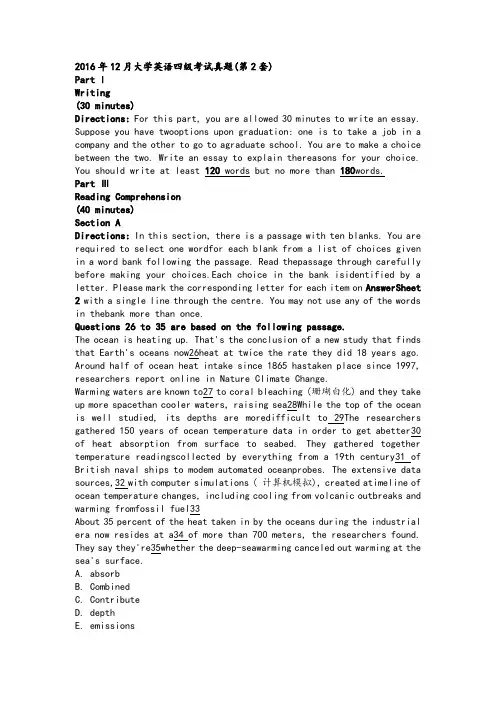
2016年12月大学英语四级考试真题(第2套)Part IWriting(30 minutes)Directions: For this part, you are allowed 30 minutes to write an essay. Suppose you have twooptions upon graduation: one is to take a job in a company and the other to go to agraduate school. You are to make a choice between the two. Write an essay to explain thereasons for your choice. You should write at least 120 words but no more than 180words.Part ⅢReading Comprehension(40 minutes)Section ADirections: In this section, there is a passage with ten blanks. You are required to select one wordfor each blank from a list of choices given in a word bank following the passage. Read thepassage through carefully before making your choices.Each choice in the bank isidentified by a letter. Please mark the corresponding letter for each item on AnswerSheet 2with a single line through the centre. You may not use any of the words in thebank more than once.Questions 26 to 35 are based on the following passage.The ocean is heating up. That's the conclusion of a new study that finds that Earth's oceans now26heat at twice the rate they did 18 years ago. Around half of ocean heat intake since 1865 hastaken place since 1997, researchers report online in Nature Climate Change.Warming waters are known to27 to coral bleaching (珊瑚白化) and they take up more spacethan cooler waters, raising sea28While the top of the ocean is well studied, its depths are moredifficult to 29The researchers gathered 150 years of ocean temperature data in order to get abetter30 of heat absorption from surface to seabed. They gathered together temperature readingscollected by everything from a 19th century31 of British naval ships to modem automated oceanprobes. The extensive data sources,32 with computer simulations ( 计算机模拟), created atimeline of ocean temperature changes, including cooling from volcanic outbreaks and warming fromfossil fuel33About 35 percent of the heat taken in by the oceans during the industrial era now resides at a34 of more than 700 meters, the researchers found. They say they're35whether the deep-seawarming canceled out warming at the sea's surface.A. absorbB. CombinedC. ContributeD. depthE. emissionsF. excursionG. exploreH. floorI. heightsJ. indifferentK. levelsL. mixedM. pictureN. unsureO. voyageSection BDirections: In this section, you are going to read a passage with ten statements attached to it. Eachstatement contains information given in one of the paragraphs. Identify the paragraphfrom which the information is derived. You may choose a paragraph more than once.Each paragraph is marked with a letter.Answer the questions by marking thecorresponding letter on Answer Sheet 2.The Secret to Raising Smart KidsA) I first began to investigate the basis of human motivation--and how people persevere aftersetbacks--as a psychology graduate student at Yale University in the 1960s. Animal experiments bypsychologists at the University of Pennsylvania had shown that after repeated failures, most animalsconclude that a situation is hopeless and beyond their control. After such an experience an animaloften remains passive even when it can effect change--a state they called learned helplessness.B) People can learn to be helpless, too. Why do some students give up when they encounter difficulty,whereas others who are no more skilled continue to strive and learn? One answer, I soondiscovered, lay in people's beliefs about why they had failed.C) In particular, attributing poor performance to a lack of ability depresses motivation more than doesthe belief that lack of effort is to blame. When I told a group of school children who displayedhelpless behavior that a lack of effort led to their mistakes in math, they learned to keep tryingwhen the problems got tough. Another group of helpless children who were simply rewarded fortheir success on easier problems did not improve their ability to solve hard math problems. Theseexperiments indicated that a focus on effort can help resolve helplessness and generate success.D) Later, I developed a broader theory of what separates the two general classes of learners--helplessversus mastery-oriented. I realized these different types of students not only explain their failuresdifferently, but they also hold different "theories" of intelligence.The helpless ones believeintelligence is a fixed characteristic: you have only a certain amount, and that's that. I call this a"fixed mind-set (思维模式). "Mistakes crack their self-confidence because they attribute errors toa lack of ability, which they feel powerless to change. They avoid challenges because challengesmake mistakes more likely. The mastery-oriented children, on the other hand, think intelligence isnot fixed and can be developed through education and hard work. Such children believe challengesare energizing rather than intimidating (令人生畏); they offer opportunities to learn. Studentswith such a growth mind-set were destined (注定) for greater academic success and were quitelikely to outperform their counterparts.E) We validated these expectations in a study in which two other psychologists and I monitored 373students for two years during the transition to junior high school, when the work gets more difficultand the grading more strict, to determine how their mind-sets might affect their math grades. At thebeginning of seventh grade, we assessed the students' mind-sets by asking them to agree or disagreewith statements such as "Your intelligence is something very basic about you that you can't reallychange. " We then assessed their beliefs about other aspects of learning and looked to see whathappened to their grades.F) As predicted, the students with a growth mind-set felt that learning was a more important goal thangetting good grades. In addition, they held hard work in high regard. They understood that evengeniuses have to work hard. Confronted by a setback such as a disappointing test grade, studentswith a growth mind-set said they would study harder or try a different strategy. The students whoheld a fixed mind-set, however, were concerned about looking smart with less regard for learning.They had negative views of effort, believing that having to work hard was a sign of low ability.They thought that a person with talent or intelligence did not need to work hard to do well.Attributing a bad grade to their own lack of ability, those with a fixed mind-set said that they wouldstudy less in the future, try never to take that subject again and consider cheating on future tests.G) Such different outlooks had a dramatic impact on performance. At the start of junior high, the mathachievement test scores of the students with a growth mind-set were comparable to those ofstudents who displayed a fixed mind-set. But as the work became more difficult, the students witha growth mind-set showed greater persistence. As a result, their math grades overtook those of theother students by the end of the first semester--and the gap between the two groups continued towiden during the two years we followed them.H) A fixed mind-set can also hinder communication and progress in the workplace and discourage orignore constructive criticism and advice. Research shows that managers who have a fixed mind-setare less likely to seek or welcome feedback from their employees than are managers with a growthmind-set.I) How do we transmit a growth mind-set to our children? One way is by telling stories aboutachievements that result from hard work. For instance, talking about mathematical geniuses whowere more or less born that way puts students in a fixed mind-set, but descriptions of greatmathematicians who fell in love with math and developed amazing skills produce a growth mind-set.J) In addition, parents and teachers can help children by providing explicit instruction regarding themind as a learning machine. I designed an eight-session workshop for 91 students whose mathgrades were declining in their first year of junior high.Forty-eight of the students receivedinstruction in study skills only, whereas the others attended a combination of study skills sessionsand classes in which they learned about the growth mind-set and how to apply it to schoolwork. Inthe growth mind-set classes, students read and discussed an article entitled "You Can Grow YourBrain. " They were taught that the brain is like a muscle that gets stronger with use and thatlearning prompts the brain to grow new connections. From such instruction, many students beganto see themselves as agents of their own brain development. Despite being unaware that there weretwo types of instruction, teachers reported significant motivational changes in 27% of the childrenin the growth mind-set workshop as compared with only 9% of students in the control group.K) Research is converging (汇聚) on the conclusion that great accomplishment and even genius istypically the result of years of passion and dedication and not something that flows naturally from agift. 36. The author's experiment shows that students with a fixed mind-set believe having to work hard is an indication of low ability.37. Focusing on effort is effective in helping children overcome frustration and achieve success.38. We can cultivate a growth mind-set in children by telling success stories that emphasize hard work and love of learning.39. Students' belief about the cause of their failure explains their attitude toward setbacks.40. In the author's experiment, students with a growth mind-set showed greater perseverance in solving difficult math problems.41. The author conducted an experiment to find out about the influence of students' mind-sets on math learning.42. After failing again and again, most animals give up hope.43. Informing students about the brain as a learning machine is a good strategy to enhance their motivation for learning.44. People with a fixed mind-set believe that one's intelligence is unchangeable.45. In the workplace, feedback may not be so welcome to managers with a fixed mind-set.Section CDirections:There are 2 passages in this section. Each passage is followed by some questions orunfinished statements. For each of them there are four choices marked A., B., C. AndD . You should decide on the best choice and mark the corresponding letter on AnswerSheet 2 with a single line through the centre.Passage OneQuestions 46 to 50 are based on the following passage."Sugar, alcohol and tobacco," economist Adam Smith once wrote," are commodities which arenowhere necessaries of life, which have become objects of almost universal consumption, and whichare, therefore, extremely popular subjects of taxation. "Two and a haft centuries on, most countries impose some sort of tax on alcohol and tobacco. Withsurging obesity levels putting increasing strain on public health systems, governments around the worldhave begun to toy with the idea of taxing sugar as well.Whether such taxes work is a matter of debate. A preliminary review of Mexico's taxation found afall in purchases of taxed drinks as well as a rise in sales of untaxed and healthier drinks. By contrast,a Danish tax on foods high in fats was abandoned a year after its introduction, amid claims thatconsumers were avoiding it by crossing the border to Germany to satisfy their desire for cheaper, fattierfare.The food industry has, in general, been firmly opposed to such direct government action.Nonetheless, the renewed focus on waistlines means that industry groups are under pressure todemonstrate their products are healthy as well as tasty.Over the past three decades, the industry has made some efforts to improve the quality of itsofferings. For example, some drink manufacturers have cut the amount of sugar in their beverages.Many of the reductions over the past 30 years have been achieved either by reducing the amount ofsugar, salt or fat in a product, or by finding an alternative ingredient. More recently, however, somecompanies have been investing money in a more ambitious undertaking: learning how to adjust thefundamental make-up of the food they sell. For example, having salt on the outside, but none on theinside, reduces the salt content without changing the taste.While reformulating recipes ( 配方) is one way to improve public health, it should be part of amulti-sided approach. The key is to remember that there is not just one solution. To deal with obesity,a mixture of approaches--including reformulation, taxation and adjusting portion sizes--will beneeded. There is no silver bullet.46. What did Adam Smith say about sugar, alcohol and .tobacco?A. They were profitable to manufacture.B. They were in ever-increasing demand.C. They were subject to taxation almost everywhere.D. They were no longer considered necessities of life.47. Why have many countries started to consider taxing sugar?A. They are under growing pressure to balance their national budgets.B. They find it ever harder to cope with sugar-induced health problems.C. The practice of taxing alcohol and tobacco has proved both popular and profitable.D. The sugar industry is overtaking alcohol and tobacco business in generating profits.48. What do we learn about Danish taxation on fat-rich foods?A. It did not work out as well as was expected.B. It gave rise to a lot of problems on the border.C. It could not succeed without German cooperation.D. It met with firm opposition from the food industry.49. What is the more recent effort by food companies to make foods and drinks both healthy and tasty?A. Replacing sugar or salt with alternative ingredients.B. Setting a limit on the amount of sugar or salt in their products.C. Investing in research to find ways to adapt to consumers' needs.D. Adjusting the physical composition of their products.50. What does the author mean by saying, at the end of the passage, "There is no silver bullet" ( Line 4, Para.7)?A. There is no single easy quick solution to the problem.B. There is no hope of success without public cooperation.C. There is no hurry in finding ways to solve the obesity problem.D. There is no effective way to reduce people's sugar consumption.Passage TwoQuestions 51 to 55 are based on the following passage.You may have heard some of the fashion industry horror stories: models eating tissues or cottonballs to hold off hunger, and models collapsing from hunger-induced heart attacks just seconds afterthey step off the runway.Excessively skinny models have been a point of controversy for decades, and two researchers saya model's body mass should be a workplace health and safety issue. In an editorial released Monday inthe American Journal of Public Health, Katherine Record and Bryn Austin made their case forgovernment regulation of the fashion industry.The average international runway model has a body mass index (BMI) under 16--low enough toindicate starvation by the World Health Organization's standard. And Record and Austin are worried notjust about the models themselves, but about the vast number of girls and women their images influence."Especially girls and teens," says Record. "Seventy percent of girls aged 10 to 18 report that theydefine perfect body image based on what they see in magazines. " That's especially worrying, she says,given that anorexia(厌食症) results in more deaths than does any other mental illness, according tothe National Institute of Mental Health.It's commonly known that certain diseases are linked with occupations like lung disease in coalminers. Professional fashion models are particularly vulnerable to eating disorders resulting fromoccupational demands to maintain extreme thinness.Record's suggestion is to prohibit agents from hiring models with a BMI below 18.In April, France passed a law setting lower limits for a model's weight. Agents and fashion houseswho hire models with a BMI under 18 could pay $ 82,000 in fines and spend up to 6 months in jail.Regulating the fashion industry in the United States won't be easy, Record says. But with the new rulesin France, U.S. support could make a difference. "A designer can't survive without participating inParis Fashion Week", she says, adding," Our argument is that the same would be true of New YorkFashion Week. "51. What do Record and Austin say about fashion models' body mass?A. It has caused needless controversy.B. It is but a matter of personal taste.C. It is the focus of the modeling business.D. It affects models' health and safety.52. What are Record and Austin advocating in the Monday editorial?A. A change in the public's view of female beauty.B. Government legislation about models' weight.C. Elimination of forced weight loss by models.D. Prohibition of models eating non-food stuff.53. Why are Record and Austin especially worried about the low body mass index of models?A. It contributes to many mental illnesses.B. It defines the future of the fashion industry.C. It has great influence on numerous girls and women.D. It keeps many otherwise qualified women off the runway.54. What do we learn about France's fashion industry?A. It has difficulty hiring models.B. It has now a new law to follow.C. It allows girls under 18 on the runway.D. It has overtaken that of the United States.55. What does Record expect of New York Fashion Week?A. It will create a completely new set of rules.B. It will do better than Paris Fashion Week.C. It will differ from Paris Fashion Week.D. It will have models with a higher BMI.Part ⅣTranslation( 30 minutes )Directions: For this part, you are allowed 30 minutes to translate a passage from Chinese intoEnglish. You should write your answer on Answer Sheet 2.在中国文化中,黄颜色是一种很重要的颜色,因为它具有独特的象征意义。
14~15年大学英语四级作文真题及范文汇总

2015年6月大学英语四级考试作文真题及范文How Will Our Life Go on without Internet?If asked whether the Internet is the greatest discovery of the 20th century, my answer would be yes. The Internet has drawn the world closer together, realized countless incredible dreams, and provided modern people with a great many conveniences and a brilliant life.Today, many people simply feel they cannot live without the Internet. Governments publish their latest policies and decisions online for worldwide recognition. Political campaigns are often done online to gain wider public support. Companies and enterprises resort to the Internet for more business opportunities and potential customers home and abroad. Univers ities and researchers turn to the Internet if they’d seek international cooperation or funding. Common folks like us also rely on the cyber world in various ways, for communication, entertainment, banking and shopping.True, the power of the Internet is all pervasive and its many negative effects are already visible. For example, Internet addicts tend to withdraw to their own fantasy world rather than communicate with a real person. Children are exposed to online pornography and violence. Internet frauds are an everyday occurrence. In view of all this, you are advised to use the Internet with wisdom. Keep it at a safe distance and never lose yourself.范文一As is clearly depicted in the above picture, a daughter tells his mother a piece of good news that she has been admitted to a university as her mother desires. There is no denial in saying that the cartoon leaves us such a deep impression that we cannot help thinking over a question: What role should parents play in their children’s growth?From my point of view, during the process of a child’s growth, the role of parents is mainly listed as the following two aspects. On one hand, there is no doubt that parents are liable to take good care of their children. On the other hand, in children’s personal growth, parents ought to play a role as a person who helps children develop self-dependence, which carries more significant to children’s future life. In other words, parents should encourage their sons or daughters to be independent rather than reliant on others.To conclude, in children’s personal growth, parents are responsible to care for their children. However, considering that they will grow up and live their own life in some day,parents should enable their children to acquire the ability to be self-independent.Go to school, the right choiceAs is vividly depicted in the cartoon given above, we can observe that a son, holding a smart phone, says to his mom, “why am I going to school if my phone already knows everything?”there is no doubt that the picture strongly reflects that phenomenon that more and more students object the idea of going to school when they have a phone, which can help them knoweverything. However, it is by no means a sensible idea.It is generally acknowledged that going to school is not outdated. Whereas, it will remain as vital as it used to be. To begin with, going to school makes it possible to study with classmates and make progress together. As the old saying goes, “many hands make light work.”I f students can study together, they can arouse the interest and cooperate with each other, thus making study more easy and enjoyable. What’s more, going to school means the face-to-face communication. It goes without saying that this way is more direct and effective, where we can raise questions and solve all the questions on spot. Last but not least, mobile phones cannot replace school. When using mobile phones. There are more chances for students to distract their attention. In addition, they may easily addicted to the games on the phone.On the whole, as far as I am concerned, mobile phones do help us study in some ways. Nevertheless, it can by no means replace go to school. Going to school is the sensible choice. And school is the place where you can benefit the most.2015年12月英语四级作文及范文(三套全)(第一套)For this part,you are allowed 30 minutes to write an essay commenting on the saying "Learning is a daily experience and a lifetime mission." You can cite examples to illustrate the importance of lifelong learning“. You should write at least120 words but no more than 180 words.参考范文:Learning is a daily experience and lifetime mission.Undoubtedly, learning is a daily experience and lifetime mission. For instance, Madam Curie, who conducted pioneering research on radioactivity and became the first woman to win a Nobel Prize, was known for her persistence in learning.Several reasons, both social and individual, could account for the importance of constant learning. Firstly, in an age of ruthless and relentless competition, only by learning constantly can we bring our potential and ability into full play and catch up with the times. Secondly, learning does not only help us acquire knowledge, but also enriches our lives and broadens our horizons. Thirdly, science and technology change with each passing day. Without constant learning, it would be impossible for us to update our knowledge.Accordingly, it is constant learning that really matters in achieving success in modern society. In my humble opinion, it is high time that parents and teachers made joint efforts to encourage children to read more books instead of playing computer games all day.(第二套)For this part, you are allowed 30 minutes to write an essay commenting on the saying "Listening is more important than talking." You can cite examples to illustrate the importance of paying attention to others' opinions. You should write at least 120 words but no more than 180 words.参考范文:Listening is more important than talkingIt is no exaggeration to say that listening is more important than talking. For instance, without listening, a baby won’t know how to speak; without enough listening, we cannot speak English fluently; without listening carefully in classroom, we cannot follow our teachers.There are several reasons to account for the importance of listening. First and foremost, only by listening to others carefully can we understand their points of views. Secondly, more listening can not only broaden our horizons, but also helps us absorb others’wisdom. Last but not least, listening is an input and talking is an output. It is unwise to voice our opinions in those topics that we are unfamiliar with.As an old Chinese old saying goes, silence is gold. Therefore, in my humble opinion, it is of great significance for us to spend more time in listening instead of rushing to speak.Never go out there to see what happens, go out there to makesomething happenThere is no doubt that we should never go out there to see what happens; instead, we should take actions to make things happen. A telling example is Youyou Tu. She and her colleagues made 380 extracts from 2,00 herbs before they finally succeeded in discovering the pure substance qinghaosu, which can be used to treat malaria. As we all know, there were numerous scientists who wanted to find this substance, but it was her firm actions that made her the first Chinese Nobel laureate in medicine.Why?Reasons are quite simple and can be listed as follows. To begin with, only by taking actions can we find the best way to solve those problems we are facing, but as a bystander, we can learn nothing meaningful. In addition, in an age full of ruthless and relentless competitions, without taking actions to make things happen, we are bound to lose those valuable opportunities. For instance, if Apple had just gone out there to see what happens in mobile phones, it could not have presented the amazing product, iPhone, to us.Accordingly, we college students should not just be a watcher but a doer. In my humble opinion, we can start from applying what we have learned into practice.2014年6月英语四级作文及范文(三套全)If my foreign friend comes to my hometown, I will take her to the Central Avenue .When it comes to the reasons why I choose this place, they can be briefly summed up as below. To start with, Central Avenue is a symbol of Harbin, which has a long history. There are European-style buildings in mounting numbers along the street, attracting a great many tourists to take photos with them. Moreover, a variety of delicious foods are tempting. Taking a look around, I can find examples too numerous to list. The best illustration might be ice-cream brick of Ma Dieer. Finally, brilliant historic culture can widen vision and enhance knowledge, laying a solid foundation for the understanding of this fabulous city. Harbin is a city full of vitality and energy. I believe my foreign friend will enjoy her dayshere. Not only can she appreciate the landscape of the Songhua River but also taste authentic northeast food. No better place can be chosen than Central Avenue!英语四级作文题目二:Suppose a foreign friend of yours is coming to visit your campus , what is the most interesting place you would like to take him/her to see and why?假设你的一位外国朋友来参观你的校园,你最感兴趣的地方想带他/她去看?为什么?【参考范文】The Cherry AvenueIf I’m the guide of my foreign friend’s visit to our campus, I will choose the Cherry Avenue as our first destination.As the name implies, the Cherry Avenue is lined with hundreds of neatly-placed cherry blossom trees. It is about 200 meters long and a major scenic spot in our campus. In spring when the cherry trees bloom, the flowers are so dense that looking from a distance, it seems as if the road were surrounded by pink-hued clouds. Especially when there is a breeze, petals of cherry blossoms flutter and fall gently like a drizzle. Such breath-taking scene will put visitors into a kind of trance.What’s more special is the buildings along the avenue. Built in early 1900s, they are now called "cherry blossom castle". They’ve witnessed the history of our school and even our country. You can learn a lot about our school there.In a word, a tour to the Cherry Avenue is both an amazing sight-seeing and a great opportunity to know about the culture of our school.英语四级作文题目三:Suppose a foreign friend of yours is coming to visit your China , what is the most interesting place you would like to take him/her to see and why?假设你的一位外国朋友来参观中国,你最感兴趣的地方想带他/她去看?为什么?【参考范文】Guilin –A Beautiful City in ChinaIn China, there’s a saying that "The landscape of Guilin tops that of any other place under heaven." In light of this, I will recommend Guilin as the first destination of my foreign friend’s trip to China.Overlooking the Li Jiang River, Guilin is located in the northeast of Guangxi. The name was derived from the cassia trees of the location. The trees line the streets of the town with yellow flowers blossoming every September, filling the air with sweet scent.Guilin is a place of breath-taking scenery. From ancient times, Guilin has been noted for its elegant landscape. It features beautiful mountains, clear rivers, grotesque rocks andmystic crags, which is a feast for the eyes. Sitting on a bamboo raft drifting down the river, visitors can see the varied shapes of the pinnacles reflected in the water. They will feel as if they were in a scroll of Chinese landscape painting.I believe that my foreign friend will marvel at the unparalleled beauty of Guilin.2014年12月大学英语四级考试作文真题及范文Directions: From this part, you are allowed 30 minutes to write a short essayabout a camp activity that has benefited you most. You should state the reasons andwrite at least 120 words but more than 180 words。
英语四级真题2015年12月英语四级考试真题(第3套)大学英语四级(CET-4)真题试卷及参考答案
2015年12月英语四级考试真题试卷(第三套)Part I Writing(30minutes)Directions:For this part,you are allowed30minutes to write an essay commenting on the saying "Never go out there to see what happens,go out there to make things happen."You can cite examples to illustrate the importance of being participants rather than mere onlookers in life.You should write at least120words but no more than180words.注意:此部分试题在答题卡1上_______________________________________________________________________________ _______________________________________________________________________________ _______________________________________________________________________________ PartⅡListening Comprehension(30minutes)Section ADirections:In this section,you will hear8short conversations and2long conversations.At the end of each conversation,one or more questions will be asked about what was said.Both the conversation and the questions will be spoken only once.After each question there will be a pause.During the pause,you must read the four choices marked A,B,C,and D.and decide which is the best answer.Then mark the corresponding letter on Answer.Sheet I with a single line through the center.1.A)They admire the courage of space explorers.B)They were going to watch a wonderful movie.C)They enjoyed the movie on space exploration.D)They like doing scientific exploration very much.2.A)In a school library.B)At a gift shop.C)In the office of a travel agency.D)At a graduation ceremony.3.A)He used to work in the art gallery.B)He does not have a good memory.C)He is not interested in any part-time jobs.D)He declined a job offer from the art gallery.4.A)He will be unable to attend the birthday party.B)The woman should have informed him earlier.C)He will go to the birthday party after the lecture.D)Susan has been invited to give a lecture tomorrow.5.A)Set a deadline for the staff to meet.B)Assign more workers to the project.C)Reward those having made good progress.D)Encourage the staff to work in small groups.6.A)Where she can leave her car.B)The rate for parking in Lot C.C)How far away the parking lot is.D)The way to the visitor's parking.7.A)He regrets missing the classes.B)He has benefited from exercise.C)He plans to take the fitness classes.D)He is looking forward to a better life.8.A)How to select secretaries.B)How to raise work efficiency.C)The responsibilities of secretaries.D)The secretaries in the man's company. Questions9to11are based on the conversation you have just heard.9.A)It is used by more people than English.B)It is more difficult to learn than English.C)It will be as commonly used as English.D)It will eventually become a world language.10.A)Its popularity with the common people.B)The effect of the Industrial Revolution.C)The influence of the British Empire.D)Its loan words from many languages.11.A)It has a growing number of newly coined words.B)It includes a lot of words from other languages.C)It is the largest among all languages in the world.D)It can be easily picked up by overseas travellers.Questions12to15are based on the conversation you have just heard.12.A)To place an order.B)To apply for a job.C)To return some goods.D)To make a complaint.13.A)He works on a part-time basis for the company.B)He has not worked in the sales department for long.C)He is not familiar with the exact details of the goods.D)He has become somewhat impatient with the woman.14.A)It is not his responsibility.B)It win be free for large orders.C)It depends on a number of factors.D)It costs£15more for express delivery.15.A)Make inquiries with some other companies.B)Report the information to her superior.C)Pay a visit to the saleswoman in charge.D)Ring back when she comes to a decision.Section BDirections:In this section,you will hear3short passages.At the end of each passage,you will hear some questions.Both the passage and the questions will be spoken only once.After you hear a question,you must choose the best answer from the four choices marked A,B,C.and D.Then mark the corresponding letter on Answer Sheet1with a single line through the center.Questions16to18are based on the conversation you have just heard.16.A)No one knows for sure when they came into being.B)No one knows exactly where they were first made.C)No one knows for what purpose they were invented.D)No one knows what they will look like in the future.17.A)Measure the speed of wind.B)Give warnings of danger.C)Pass on secret messages.D)Carry ropes across rivers.18.A)To find out the strength of silk for kites.B)To test the effects of the lightning rod.C)To prove that lightning is electricity.D)To protect houses against lightning. Passage TwoQuestions19to22are based on the passage you have just heard.19.A)She was born with a talent for languages.B)She was trained to be an interpreter.C)She can speak several languages.D)She enjoys teaching languages.20.A)They want to learn as many foreign languages as possible.B)They have an intense interest in cross-cultural interactions.C)They acquire an immunity to culture shock.D)They would like to live abroad permanently.21.A)She became an expert in horse racing.B)She learned to appreciate classical music.C)She was able to translate for a German sports judge.D)She got a chance to visit several European countries.22.A)Take part in a cooking competition.B)Taste the beef and give her comment.C)Teach vocabulary for food in English.D)Give cooking lessons on Western food. Passage ThreeQuestions23to25are based on the passage you have just heard.23.A)He had only a third-grade education.B)He once threatened to kill his teacher.C)He often helped his mother do housework.D)He grew up in a poor single-parent family.24.A)Stupid.B)Active.C)Brave.D)Careless.25.A)Watch educational TV programs only.B)Write two book reports a week.C)Help with housework.D)Keep a diary.Directions:In this section,you will hear a passage three times.When the passage is read for the first time,you should listen carefully for its general idea.When the passage is read for the second time,you are required to fill in the blanks with the exact words you have just heard.Finally,when the passage is read for the third time,you should check what you have written.When you look up at the night sky,what do you see?There are other__26__bodies out there besides the moon and stars.One of the most__27__of these is a comet(彗星).Comets were formed around the same time the Earth was formed.They are__28__ice and other frozen liquids and gases.__29__these"dirty snowballs"begin to orbit the sun,just as the planets do.As a comet gets closer to the sun,some gases in it begin to unfreeze.They__30__dust particles from the comet to form a huge cloud.As the comet gets even nearer to the sun,a solar wind blows the cloud behind the comet,thus forming its tail.The tail and the__31__fuzzy(模糊的) atmosphere around a comet are__32__that can help identify this__33__in the night sky.In any given year,about a dozen known comets come close to the sun in their orbits.The average person can't see them all,of ually there is only one or two a year bright enough to be seen with the__34__et Hale-Bopp,discovered in1995,was an unusually bright comet. Its orbit brought it__35__close to the Earth,within122million miles of it.But Hale-Bopp came a long way on its earthly visit.It won't be back for another four thousand years or so.PartⅢReading Comprehension(40minutes)Section ADirections:In this section,there is a passage with ten blanks.You are required to select one word for each blank from a list of choices given in a word bank following the passage.Read the passage through carefully before making your choices.Each choice in the bank is identified by a letter.Please mark the corresponding letter for each item on Answer Sheet2with a single line through the center.You may not use any of the words in the bank more than once.Questions36to45are based on the following passage.Children do not think the way adults do.For most of the first year of life,if something is out of sight,it's out of mind.If you cover a baby's__36__toy with a piece of cloth,the baby thinks the toy has disappeared and stops looking for it.A4-year-old may__37__that a sister has more fruit juice when it is only the shapes of the glasses that differ,not the__38__of juice.Yet children are smart in their own way.Like good little scientists,children are always testing their child-sized__39__about how things work.When your child throws her spoon on the floor for the sixth time as you try to feed her,and you say,"That's enough!I will not pick up your spoon again!"the child will__40__test your claim.Are you serious?Are you angiy?What will happen if she throws the spoon again?She is not doing this to drive you__41__;rather,she is learningthat her desires and yours can differ,and that sometimes those__42__are important and sometimes they are not.How and why does children's thinking change?In the1920s,Swiss psychologist Jean Piaget proposed that children's cognitive(认知的)abilities unfold__43__,like the blooming of a flower, almost independent of what else is__44__in their lives.Although many of his specific conclusions have been__45__or modified over the years,his ideas inspired thousands of studies by investigators all over the world.A)advocate B)amount C)confirmed D)crazy E)definiteF)differences G)favorite H)happening I)immediately J)naturallyK)obtaining L)primarily M)protest N)rejected O)theoriesSection BDirections:In this section,you are going to read a passage with ten statements attached to it.Each statement contains information given in one of the paragraphs.Identify the paragraph from which the information is derived.You may choose a paragraph more than once.Each paragraph is marked with a letter.Answer the questions by marking the corresponding letter on Answer Sheet2.The Perfect EssayA)Looking back on too many years of education,I can identify one truly impossible teacher.She cared about me,and my intellectual life,even when I didn't.Her expectations were high-impossibly so.She was an English teacher.She was also my mother.B)When good students turn in an essay,they dream of their instructor returning it to them in exactly the same condition,save for a single word added in the margin of the final page:" Flawless."This dream came true for me one afternoon in the ninth grade.Of course,I had heard that genius could show itself at an early age,so I was only slightly taken aback that I had achieved perfection at the tender age of14.Obviously,I did what any professional writer would do;I hurried off to spread the good news.I didn't get very far.The first person I told was my mother.C)My mother,who is just shy of five feet tall,is normally incredibly soft-spoken,but on the rare occasion when she got angry,she was terrifying.I am not sure if she was more upset by my hubris(得意忘形)or by the fact that my English teacher had let my ego get so out of hand.In any event,my mother and her red pen showed me how deeply flawed a flawless essay could be.At the time,I am sure she thought she was teaching me about mechanics,transitions(过渡), structure,style and voice.But what I learned,and what stuck with me through my time teaching writing at Harvard,was a deeper lesson about the nature of creative criticism.D)First off,it hurts.Genuine criticism,the type that leaves a lasting mark on you as a writer,also leaves an existential imprint(印记)on you as a person.I have heard people say that a writer should never take criticism personally.I say that we should never listen to these people.E)Criticism,at its best,is deeply personal,and gets to the heart of why we write the way we do. The intimate nature of genuine criticism implies something about who is able to give it,namely, someone who knows you well enough to show you how your mental life is getting in the way of good writing.Conveniently,they are also the people who care enough to see you through this painful realization.For me it took the form of my first,and I hope only,encounter with writer's block-I was not able to produce anything for three years.F)Franz Kafka once said:"Writing is utter solitude(独处),the descent into the cold abyss(深渊) of oneself."My mother's criticism had shown me that Kafka is right about the cold abyss,and when you make the introspective(内省的)descent that writing requires you are not always pleased by what you find.But,in the years that followed,her sustained tutoring suggested that Kafka might be wrong about the solitude.I was lucky enough to find a critic and teacher who was willing to make the journey of writing with me."It is a thing of no great difficulty,"according to Plutarch,"to raise objections against another man's speech,it is a very easy matter;but to produce a better in its place is a work extremely troublesome."I am sure I wrote essays in the later years of high school without my mother's guidance,but I can't recall them.What I remember,however,is how she took up the"extremely troublesome"work of ongoing criticism.G)There are two ways to interpret Plutarch when he suggests that a critic should be able to produce"a better in its place."In a straightforward sense,he could mean that a critic must be more talented than the artist she critiques(评论).My mother was well covered on this count. But perhaps Plutarch is suggesting something slightly different,something a bit closer to Marcus Cicero's claim that one should"criticize by creation,not by finding fault."Genuine criticism creates a precious opening for an author to become better on his own terms-a process that is often extremely painful,but also almost always meaningful.H)My mother said she would help me with my writing,but first I had to help myself.For each assignment,I was to write the best essay I could.Real criticism is not meant to find obvious mistakes,so if she found any-the type I could have found on my own-I had to start from scratch. From scratch.Once the essay was"flawless,"she would take an evening to walk me through my errors.That was when true criticism,the type that changed me as a person,began.I)She criticized me when I included little-known references and professional jargon(行话)?She had no patience for brilliant but irrelevant figures of speech."Writers can't bluff(虚张声势)their way through ignorance."That was news to me-I would need to find another way to structure my daily existence.J)She trimmed back my flowery language,drew lines through my exclamation marks and argued for the value of restraint in expression."John,"she almost whispered.I leaned in to hear her:"I can't hear you when you shout at me."So I stopped shouting and bluffing,and slowly my writing improved.K)Somewhere along the way I set aside my hopes of writing that flawless essay.But perhaps I missed something important in my mother's lessons about creativity and perfection.Perhaps thepoint of writing the flawless essay was not to give up,but to never willingly finish.Whitman repeatedly reworked"Song of Myself'between1855and1891.Repeatedly.We do our absolute best with a piece of writing,and come as close as we can to the ideal.And,for the time being,we settle.In critique,however,we are forced to depart,to give up the perfection we thought we had achieved for the chance of being even a little bit better.This is the lesson I took from my mother.. If perfection were possible,it would not be motivating.46.The author was advised against the improper use of figures of speech.47.The author's mother taught him a valuable lesson by pointing out lots of flaws in his seemingly perfect essay.48.A writer should polish his writing repeatedly so as to get closer to perfection.49.Writers may experience periods of time in their life when they just can't produce anything.50.The author was not much surprised when his school teacher marked his essay as"flawless".51.Criticizing someone's speech is said to be easier than coming up with a better one.52.The author looks upon his mother as his most demanding and caring instructor.53.The criticism the author received from his mother changed him as a person.54.The author gradually improved his writing by avoiding fancy language.55.Constructive criticism gives an author a good start to improve his writing.Section CDirections:There are2passages in this section.Each passage is followed by some questions or unfinished statements.For each of them there are four choices marked A,B,C.And D.You should decide on the best choice and mark the corresponding letter on Answer.Sheet2with a single line through the center.Passage OneQuestions56to60are based on the following passage.Could you reproduce Silicon Valley elsewhere,or is there something unique about it?It wouldn't be surprising if it were hard to reproduce in other countries,because you couldn't reproduce it in most of the US either.What does it take to make a Silicon Valley?It's the right people.If you could get the right ten thousand people to move from Silicon Valley to Buffalo,Buffalo would become Silicon Valley.You only need two kinds of people to create a technology hub(中心):rich people and nerds(痴迷科研的人)Observation bears this out.Within the US,towns have become startup hubs if and only if they have both rich people and nerds.Few startups happen in Miami,for example,because although it's full of rich people,it has few nerds.It's not the kind of place nerds like.Whereas Pittsburgh has the opposite problem:plenty of nerds,but no rich people.The top USComputer Science departments are said to be MIT,Stanford,Berkeley,and Carnegie-Mellon.MIT yielded Route128.Stanford and Berkeley yielded Silicon Valley.But what did Cainegie-Mellon yield in Pittsburgh?And what happened in Ithaca,home of Cornell University,which is also high on the list?I grew up in Pittsburgh and went to college at Cornell,so I can answer for both.The weather is terrible,particularly in winter,and there's no interesting old city to make up for it,as there is in Boston.Rich people don't want to live in Pittsburgh or Ithaca.So while there're plenty of hackers (电脑迷)who could start startups,there's no one to invest in them.Do you really need the rich people?Wouldn't it work to have the government invest in the nerds? No,it would not.Startup investors are a distinct type of rich people.They tend to have a lot of experience themselves in the technology business.This helps them pick the right startups,and means they can supply advice and connections as well as money.And the fact that they have a personal stake in the outcome makes them really pay attention.注意:此部分试题请在答题卡2上作答。
2015年12月大学英语四级考试真题及答案(第三套)
2015年12月大学英语四级考试真题及答案(第3套)Part Ⅰ Writing ( 30 minutes)Directions: For this part, you are allowed 30 minutes to write an essay commenting on the saying" Never go out there to see what happens, go out there to make things happen." You can cit examples to illustrate the importance of being participants rather than mere onlookers in life. You should write at least 120 words but no more than 180 words.Part Ⅱ Listening Comprehension ( 30 minutes)Sheet 1 with a single line through the centre.1 A. Children should be taught to be more careful.B. Children shouldn't drink so much orange juice.C. There is no need for the man to make such a fuss.D. Timmy should learn to do things in the right way.2. A. Fitness training. B. The new job offer.C. Computer programming.D. Directorship of the club.3. A. He needs to buy a new sweater.B. He has got to save on fuel bills.C. The fuel price has skyrocketed.D. The heating system doesn't work.4. A. Committing theft. B. Taking pictures.C. Window shopping.D. Posing for the camera.5. A. She is taking some medicine.B. She has not seen a doctor yet.C. She does not trust the man's advice.D. She has almost recovered from the cough.6. A. Pamela's report is not finished as scheduled.B. Pamela has a habit of doing things in a hurry.C. Pamela is not good at writing research papers.D. Pamela's mistakes could have been avoided.7. A. In the left-luggage office. B. At the hotel reception.C. In a hotel room.D. At an airport.8. A. She was an excellent student at college.B. She works in the entertainment business.C. She is fond of telling stories in her speech.D. She is good at conveying her message.Questions 9 to 11 are based on the conversation you have just heard.9. A. Arranging the woman's appointment with Mr. Romero.B. Fixing the time for the designer's latest fashion show.C. Talking about an important gathering on Tuesday.D. Preparing for the filming on Monday morning.10.A. Her travel to Japan.B. The awards ceremony.C. The proper hairstyle for her new role.D. When to start the make-up session.11.A. He is Mr. Romero's agent.B. He is an entertainment journalist.C. He is the woman's assistant.D. He is a famous movie star.Questions 12 to 15 are based on the conversation you have just heard.12.A. Make an appointment for an interview.B. Send in an application letter.C. Fill in an application form.D. Make a brief self-introduction on the phone.13.A. Someone having a college degree in advertising.B. Someone experienced in business management.C. Someone ready to take on more responsibilities.D. Someone willing to work beyond regular hours.14.A. Travel opportunities. B. Handsome pay.C. Prospects for promotion.D. Flexible working hours.15.A. It depends on the working hours.B. It is about 500 pounds a week.C. It will be set by the Human Resources.D. It is to be negotiated.Section BDirections..In this section, you will hear 3 short passages. At the end of each passage, you will hear some questions. Both the passage and the questions will be spoken only once. After you hear a question, you must choose the best answer from the four choices marked A., B, C and D..Then mark the corresponding letter on Answer Sheet 1 with a single line through the center.Passage OneQuestions 16 to 19 are based on the passage you have just heard.16.A. To give customers a wider range of choices.B. To make shoppers see as many items as possible.C. To supply as many varieties of goods as it can.D. To save space for more profitable products.17.A. On the top shelves. B. On the bottom shelves.C. On easily accessible shelves.D. On clearly marked shelves.18.A. Many of them buy things on impulse.B. A few of them are fathers with babies.C. A majority of them are young couples.D. Over 60% of them make shopping lists.19.A. Sales assistants promoting high margin goods.B. Sales assistants following customers around.C. Customers competing for good bargains.D. Customers losing all sense of time.Passage TwoQuestions 20 to 22 are based on the passage you have just heard.20.A. Teaching mathematics at a school.B. Doing research in an institute.C. Studying for a college degree.D. Working in a hi-tech company21.A. He studied the designs of various clocks.B. He did experiments on different materials.C. He bought an alarm clock with a pig face.D. He asked different people for their opinions.22.A. Its automatic mechanism.B. Its manufacturing process.C. Its way of waking people up.D. Its funny-looking pig face.Passage ThreeQuestions 23 to 25 are based on the passage you have just heard.23.A. It is often caused by a change of circumstances.B. It actually doesn't require any special treatment.C. It usually appears all of a sudden.D. It generally lasts for several years.24.A. They cannot mix well with others.B. They irrationally annoy their friends.C. They depend heavily on family members.D. They blame others for ignoring their needs.25.A. They lack consistent support from peers.B. They doubt their own popularity.C. They were born psychologically weak.D. They focus too much on themselves.Part Ⅲ Reading Comprehension(40 minutes)Section ADirections: In this section, there is a passage with ten blanks. You are required to select one word for each blank from a list of choices given, in a word bank following the passage. Read the passage through carefully before making your choices. Each. choice in the bank is identified by a letter. Please mark the corresponding letter for each item on Answer Sheet2 with a single line through the center. You may not use any of the words in the bank more than once.Questions 36 to 45 are based on the following passage.Children do not think the way adults do. For most of the first year of life, if something is out of sight, it's out of mind. If you cover a baby's36toy with a piece of cloth, the baby thinks the toyhas disappeared and stops looking for it. A 4-year-old may 37 that a sister has more fruit juice when it is only the shapes of the glasses that differ, not the38 of juice.Yet children are smart in their own way. Like good little scientists, children are always testing their child-sized39 about how things work. When your child throws her spoon on the floor for the sixth time as you try to feed her, and you say, "That's enough! I will not pick up your spoon again!" the child will 40 test your claim. Are you serious? Are you angry? What will happen if she throws the spoon again? She is not doing this to drive you41; rather, she is learning that her desires and yours can differ, and that sometimes those42 are important and sometimes they are not.How and why does children's thinking change? In the 1920s, Swiss psychologist Jean Piaget proposed that children's cognitive (认知的) abilities unfold 43, like the blooming of a flower, almost independent of what else is44in their lives. Although many of his specific conclusions havebeen45 or modified over the years, his ideas inspired thousands of studies by investigators all over the world. A. advocate B. amount C. confirmed D. crazy E. definiteF. differencesG. favoriteH. happeningI. ImmediatelyJ. NaturallyK. Obtaining L. Primarily M. Protest N. Rejected O. theoriesSection BDirections: In this section, you are going to read a passage with, ten statements attached to it. Each statement contains information given in one of the paragraphs. Identify the paragraph from which the information is derived. You may choose a paragraph more than once. Each paragraph is marked with a letter. Answer the questions by marking the corresponding letter on Answer Sheet 2.The Perfect EssayA. Looking back on too many years of education, I can identify one truly impossible teacher. She cared about me, and my intellectual life, even when I didn't. Her expectations were high--impossibly so. She was an English teacher. She was also my mother.B. When good students turn in an essay, they dream of their instructor returning it to them in exactly the same condition, save for a single word added in the margin of the final page : "Flawless." This dream came true for me one afternoon in the ninth grade. Of course, I had heard that genius could show itself at an early age, so I was only slightly taken aback that I had achieved perfection at the tender age of 14.Obviously, I did what any professional writer would do; I hurried off to spread the good news. I didn't get very far. The first person I told was my mother.C. My mother, who is just shy of five feet tall, is normally incredibly soft-spoken, but on the rare occasion when she got angry, she was terrifying. I am not sure if she was more upset by my hubris(得意忘形) or by the fact that my English teacher had let my ego get so out of hand. In any event, my mother and her red pen showed me how deeply flawed a flawless essay could be. At the time, I am sure she thought she was teaching me about mechanics, transitions (过渡), structure, style and voice. But what I learned, and what stuck with me through my time teaching writing at Harvard, was a deeper lesson about the nature of creative criticism.D. First off, it hurts. Genuine criticism, the type that leaves a lasting mark on you as a writer, also leaves an existential imprint (印记) on you as a person. I have heard people say that a writer should never take criticism personally. I say that we should never listen to these people.E. Criticism, at its best, is deeply personal, and gets to the heart of why we write the way we do. The intimate nature of genuine criticism implies something about who is able to give it, namely, someone who knows you well enough to show you how your mental life is getting in the way of good writing. Conveniently, they are also the people who care enough to see you through this painful realization. For me it took the form of my first, and I hope only, encounter with writer's block--I was not able to produce anything for three years.F. Franz Kafka once said: "Writing is utter solitude (独处), the descent into the cold abyss (深渊) of oneself." My mother's criticism had shown me that Kafka is right about the cold abyss, and when you make the introspective (内省的) descent that writing requires you are not always pleased by what you find. But, in the years that followed, her sustained tutoring suggested that Kafka might be wrong about the solitude. I was lucky enough to find a critic and teacher who was willing to make the journey of writing with me."It is a thing of no great difficulty," according to Plutarch, "to raise objections against another man's speech, it is a very easy matter; but to produce a better in its place is a work extremely troublesome." I am sure I wrote essays in the later years of high school without my mother's guidance, but I can't recall them. What I remember, however, is how she took up the "extremely troublesome" work of ongoing criticism.G. There are two ways to interpret Plutarch when he suggests that a critic should be able to produce "a better in its place." In a straightforward sense, he could mean that a critic must be more talented than the artist she critiques (评论).My mother was well covered on this count. But perhaps Plutarch is suggesting something slightly different, something a bit closer to Marcus Cicero's claim that one should "criticize by creation, not by finding fault." Genuine criticism creates a precious opening for an author to become better on his own terms--a process that is often extremely painful, but also almost always meaningful.H. My mother said she would help me with my writing, but first I had to help myself. For each assignment, I was to write the best essay I could. Real criticism is not meant to find obvious mistakes, so if she found any--the type I could have found on my own--I had to start from scratch. From scratch. Once the essay was "flawless," she would take an evening to walk me through my errors. That was when true criticism, the type that changed me as a person, began.I. She criticized me when I included little-known references and professional jargon (行话).Shehadno patience for brilliant but irrelevant figures of speech."Writers can't bluff (虚张声势) their way through ignorance." That was news to me--I would need to freed another way to structure my daily existence.J. She trimmed back my flowery language, drew lines through my exclamation marks and argued for the value of restraint in expression."John," she almost whispered. I leaned in to hear her: "I can't hear you when you shout at me." So I stopped shouting and bluffing, and slowly my writing improved.K. Somewhere along the way I set aside my hopes of writing that flawless essay. But perhaps I missed something important in my mother's lessons about creativity and perfection. Perhaps the point of writing the flawless essay was not to give up, but to never willingly finish. Whit man repeatedly reworked "Song of Myself' between 1855 and 1891.Repeatedly.We do our absolute best with a piece of writing, and come as close as we can to the ideal. And, for the time being, we settle. In critique, however, we are forced to depart, to give up the perfection we thought we had achieved for the chance of being even a little bit better. This is the lesson I took from my mother: If perfection were possible, it would not be motivating.46.The author was advised against the improper use of figures of speech.47.The author's mother taught him a valuable lesson by pointing out lots of flaws in his seemingly perfect essay.48.A writer should polish his writing repeatedly so as to get closer to perfection.49.Writers may experience periods of time in their life when they just can't produce anything.50.The author was not much surprised when his school teacher marked his essay as "flawless".51.Criticizing someone's speech is said to be easier than coming up with a better one.52.The author looks upon his mother as his most demanding and caring instructor.53.The criticism the author received from his mother changed him as a person.54.The author gradually improved his writing by avoiding fancy language.55.Constructive criticism gives an author a good start to improve his writing.Section CDirections:There are 2 passages in this section. Each passage is followed by some questions or unfinished statements. For each of them there are four choices marked A, B, C. and D .You should decide on the best choice and mark the corresponding letter on Answer Sheet 2 with a single line through the center.Passage OneQuestions 56 to 60 are based on the following passage.Could you reproduce Silicon Valley elsewhere, or is there something unique about it?It wouldn't be surprising if it were hard to reproduce in other countries, because you couldn't reproduce it in most of the US either. What does it take to make a Silicon Valley?It's the right people. If you could get the right ten thousand people to move from Silicon Valley to Buffalo, Buffalo would become Silicon Valley.You only need two kinds of people to create a technology hub (中心) : rich people and nerds (痴迷科研的人).Observation bears this out. Within the US, towns have become star, up hubs if and only if they have both rich people and nerds. Few startups happen in Miami, for example, because although it's full of rich people, it has few nerds. It's not the kind of place nerds like.Whereas Pittsburgh has the opposite problem: plenty of nerds, but no rich people.The top US Computer Science departments are said to be MIT, Stanford, Berkeley, and Carnegie-Mellon. MIT yielded Route 128.Stanford and Berkeley yielded Silicon Valley. But what did Carnegie-Mellon yield in Pittsburgh? And what happened in Ithaca, home of Cornell University, which is also high on the list?I grew up in Pittsburgh and went to college at Cornell, so I can answer for both. The weather isterrible, particularly in winter, and there's no interesting old city to make up for it, as there is in Boston. Rich people don't want to live in Pittsburgh or Ithaca. So while there're plenty of hackers (电脑迷) who could start startups, there's no one to invest in themDo you really need the rich people? Wouldn't it work to have the government invest in the nerds?No, it would not. Start up investors are a distinct type of rich people. They tend to have a lot of experience themselves in the technology business. This helps them pick the right startups, and means they can supply advice and connections as well as money. And the fact that they have a personal stake in the outcome makes them really pay attention.56.What do we learn about Silicon Valley from the passage?A. Its success is hard to copy anywhere else.B. It is the biggest technology hub in the US.C. Its fame in high technology is incomparable.D. It leads the world in information technology.57.What makes Miami unfit to produce a Silicon Valley?A. Lack of incentive for investment.B. Lack of the right kind of talents.C. Lack of government support.D. Lack of famous universities.58.In what way is Carnegie-Mellon different from Stanford, Berkeley and MIT?A. Its location is not as attractive to rich people.B. Its science departments are not nearly as good.C. It does not produce computer hackers and nerds.D. It does not pay much attention to business startups.59.What does the author imply about Boston?A. It has pleasant weather all year round.B. It produces wealth as well as high-tech.C. It is not likely to attract lots of investors and nerds.D. It is an old city with many sites of historical interest.60.What does the author say about startup investors?A. They are especially wise in making investments.B. They have good connections in the government.C. They can do more than providing money.D. They are rich enough to invest in nerds.Passage TwoQuestions 61 to 65 are based on the following passage.It's nice to have people of like mind around. Agreeable people boost your confidence and allow you to relax and feel comfortable. Unfortunately, that comfort can hinder the very learning that can expand your company and your career.It's nice to have people agree, but you need conflicting perspectives to dig out the truth .If everyone around you has similar views, your work will suffer from confirmation bias (偏颇).Take a look at your own network. Do your contacts share your point of view on most subjects? If yes, it's time to shake things up .As a leader, it can be challenging to create an environment in which people will freely disagree and argue, but as the saying goes: From confrontation comes brilliance.It's not easy for most people to actively seek conflict. Many spend their lives trying to avoid arguments. There's no need to go out and find people you hate, but you need to do some self-assessment to determine where you have become stale in your thinking. You may need to start by encouraging your current network to help you identify your blind spots.Passionate, energetic debate does not require anger and hard feelings to be effective. But it does require moral strength. Once you have worthy opponents, set some ground rules so everyone understands responsibilities and boundaries. The objective of this debating game is not to win but to get to the truth that will allow you to move faster, farther, and better.Fierce debating can hurt feelings, particularly when strong personalities are involved. Make sure you check in with your opponents so that they are not carrying the emotion of the battles beyond the battlefield. Break the tension with smiles and humor to reinforce the idea that this is friendly discourse and that all are working toward a common goal.Reward all those involved in the debate sufficiently when the goals are reached. Let your sparring partners (拳击陪练) know how much you appreciate their contribution. The more they feel appreciated, the more they'll be willing to get into the ring next time.61.What happens when you have like-minded people around you all the while?A. It will help your company expand more rapidly.B. It will create a harmonious working atmosphere.C. It may prevent your business and career from advancing.D. It may make you feel uncertain about your own decisions.62.What does the author suggest leaders do?A. Avoid arguments with business partners.B. Encourage people to disagree and argue.C. Build a wide and strong business network.D. Seek advice from their worthy competitors.63.What is the purpose of holding a debate?A. To find out the truth about an issue.B. To build up people's moral strength.C. To remove misunderstandings.D. To look for worthy opponents.64.What advice does the author give to people engaged in a fierce debate?A. They listen carefully to their opponents' views.B. They show due respect for each other's beliefs.C. They present their views clearly and explicitly.D. They take care not to hurt each other's feelings.65.How should we treat our rivals after a successful debate?A. Try to make peace with them.B. Try to make up the differences.C. Invite them to the ring next time.D. Acknowledge their contribution.Part Ⅳ Translation( 30 minutes )Directions: For this part, you are allowed 30 minutes to translate a passage from Chinese into English. You should write your answer on Answer Sheet 2.今年在长沙举行了一年一度的外国人汉语演讲比赛.这项比赛证明是促进中国和世界其他地区文化交流的好方法.它为世界各地的年轻人提供了更好地了解中国的机会.来自87个国家共计126位选手聚集在湖南省省会参加了从7月6日到8月5日进行的半决赛和决赛.比赛并不是唯一的活动.选手们还有机会参观了中国其他地区的著名景点和历史名胜.2015年12月大学英语四级考试真题答案与详解(第3套)Part ⅠWriting这是一篇四级考试中常见的议论文.话题围绕“Never go out there to see what happens,go out there to make things happen.”这句话展开,要求考生进行评论,同时在题目要求中也明确给出了作文主题the importance of being participants rather than mere onlookers in life.考生应该明确这一主题,并围绕其展开论述.一、点明主题:不做看客,要做实践者(being participants instead of onlookers in life)二、分析原因三、提出问题和建议主题词汇put…into practice将……付诸实践carry out执行;实现gain获得accumulate积累gradually逐渐地make a progress取得进步theory理论action行动would rather…than比起……更情愿……stand by袖手旁观句式拓展1.For some people, watching what happens to others is good enough to learn a lesson, while for others, only practicing by themselves can finally make them get the real skills in对一些人而言,看发生在别人身上的事情足以让他们吸取教训,而对于其他人而言,他们只有亲身实践才能最终得到生活中的真正技能.2.No matter how many authentic theories you've got before,nothing will happen until you put them into practice.无论你曾经接受了多少权威的理论,若不付诸实践,一切都无济于事.Part ⅡListening ComprehensionM: I don't know what to do with Timmy. This morning I found orange juice spilled all over the kitchen floor.W: Don't be so hard on him. He's only four.Q: What does the woman mean?C.四个选项中出现了children,careful,juice和Timmy等词,故推测本题考查的内容与孩子的行为相关.对话中,男士抱怨说他都不知道该拿蒂米怎么办了,今天早上,他发现桔子汁在厨房洒了一地,而女士则说,别对蒂米太严厉了,他才四岁.由此可见,女士认为男士不用小题大做,故答案为C..2.W: Excuse me, sir. I would like to know about the fitness training program in your club.M: I'll have you speak with the director in charge of new accounts.Q: What is the woman interested in?A.四个选项均为名词短语,且出现了fitness,job,computer和club等词,故推测本题考查的内容与健身或者工作相关.对话中,女士向男士询问俱乐部健身锻炼的事情,男士则说他会带着女士去找专门负责新会员的经理.由此可知,女士是对俱乐部健身锻炼感兴趣,故答案为A..3.W: It's really cold in this apartment. Can we turn up the heat a little bit?M: Sorry. I've run out of money and can hardly pay the fuel bill. Maybe you'd better put on a sweater. Q: what does the man mean?B.四个选项中出现了sweater,save,fuel bills和heating等词,故推测本题考查的内容与寒冷天气以及取暖相关.对话中,女士说她觉得很冷,问能不能把暖气开大一点,而男士则表示抱歉,说自己没钱了,都快付不起燃料费账单了,建议女士穿上毛衣.由此可知,男士想要节省燃料费,故答案为B.4.M: I'm sorry, Miss. But you have to come with me to the security office. The video cameras in our shop have recorded everything you did.W: No, no. I...I didn't do anything. I'll call the police if you dare insult me.Q: What does the man think the woman was doing?A.四个选项均为动名词短语,且出现了theft,pictures,shopping和camera等词,故推测本题考查的内容与商店里发生的事情相关.对话中,男士要将女士带到保安室去,并说商店里的摄像头已经把女士所做的事都录下来了,而女士则表示自己什么都没有做,如果男士敢侮辱她的话,她就报警.由此可知,男士认为女士偷了商店里的东西,故答案为A.5.M: I think you ought to see a doctor right away about that cough.W: Well, I'll wait a few more days.I'm sure I'll get over it soon.Q: What do we learn about the woman?B.选项均以she开头,且出现了medicine,doctor和cough等词,故推测本题考查的内容与女士的健康状况相关.男士说女士应该马上去看医生,而女士则说再等几天,她相信自己的咳嗽很快就会好的.由此可知,直到本对话发生时,女士都还没有去看医生,故答案为B..6.M: I've heard that Pamela made quite a few mistakes in her lab report.W: Well, she wouldn't have if she hadn't been in such a hunt to get it done.Q: What does the woman imply?D.四个选项均提到了Pamela,且出现了report,hurry,writing和mistakes等词,故推测本题考查的内容与帕米拉的报告相关.对话中,男士说他听说帕米拉的实验报告出了很多错,而女士则说,如果她不是那么急着做完的话,就不会出这么多的错.由此可知,帕米拉实验报告中的错误本来是可以避免的,故答案为D..7.M: We'd better check out before 12 o'clock, Marry. And now there are only 30 minutes left.W: Let's hurry up. You go pay the bill and I'll call the reception to have our luggage taken downstairs. Q : Where did this conversation most probably take place?C.四个选项均是表示地点的介词短语,故推测本题考查的内容与对话发生的地点相关.对话中,男士说他们最好能在中午l2点之前退房,现在只剩半小时了,女士建议加快速度,并让男士去付账,她自己给前台打电话,叫人把行李送到楼下.由此可知,对话发生的时候,两人还没有开始办理退房手续,还在宾馆的房间里,故答案为C..8.W: Have you ever heard this speaker before?M: Yeah. She's excellent. She gets her point across and it's entertaining at the same time.Q: what does the man say about the speaker?D.四个选项均以she开头,且出现了college,works,speech和message等词,可以推测本题考查的内容与女士的情况相关.对话中,女士问男士以前是否听过这个演讲者的讲座,男士说他听过,并认为这位演讲的女士很棒,她不仅将自己的观点表达得很清楚,而且讲得很有趣.由此可知,这位女演讲者擅长传达自己想要传达的信息,故答案为D..Conversation OneM: (8) What should I do about Mr. Romero? Remember? He said it was important and couldn't wait. I think he may want you for that new movie he's directing.W: That's absolutely correct.(9) Now, we have to fit him in somewhere. Uh...what does Monday morning look like?M: That doesn't look so good. You have a make-up session starting at 6:00, then filming starts at 8:00, and that's going to take the whole morning.W: Well, what's after that?M: (10) You have lunch with your agent to discuss the awards ceremony and you'll have to meet him at one o'clock at the restaurant.W: Oh, terrific! Listen. I cannot miss that. But I still have to make time for Mr. Romero.M: Well, now, don't forget you got a three-o'clock appointment with your fashion designer.W: That's right. You know he's showing the latest fashions from Japan? You know that loose-fitting look?Those clothes are so in this year.M: At 4:30 you have an appointment with your hairdresser. Then at 7:00, you have dinner with a journalist. Now remember, be nice to that guy.W: Do I have to? That won't be easy and it's likely to run late. How does Tuesday look?M: Well, you have to spend the whole morning at the photographer's. They are taking photos to publicize your new movie.W: What about the afternoon? Am I free then?M: Let me see...Yes, you are free after 3:30.W: Then you can set up a meeting with Mr. Romero at 4:00.M: OK.(11) I'll get on it right away.预览三道题各选项,其中出现了the woman’s appointment,her travel,awards ceremony和make-up session等词,因此推测对话内容可能与女士的工作安排相关.9.What are the speakers doing?A.对话开头男士说罗梅罗先生急着见女士,可能是想让女士出演他导演的新电影,女士说一定得把他安排进来.由此可以推断,对话中的两人正在安排女士的时间,好让她能够与罗梅罗先生见面,故答案为A..10.What is the woman going to discuss with her agent over lunch on Monday?B.对话中,男士告诉女士她周一需要和自己的经纪人吃午饭,讨论一下关于颁奖仪式的事情,故答案为B..11.What do we learn from the conversation about the man?C.对话中,男士和女士一起讨论女士的日程安排,从第一句罗梅罗先生想要让女士出演他导演的新电影可知,女士是位电影演员,而男士对女士的日程安排非常了解,并且由最后一句可知,男士服从女士的安排.综合这些内容可以推断出,男士是女士的助理,故答案为C.. Conversation TwoM: I'm phoning up about this job you advertised in the paper. This...er...young sales manager?W: Oh, yes.M: I'd like to apply for it. Would you send me an application form?W: (12) No. You simply send in a written application, a letter.M: Can you tell me a bit more about the job?W: (13) Well, we are very looking for someone who isn't too concerned about working fairly long hours.M: What do you mean by long hours?W: (13) This is a job which does, as the advertisement says, have travel possibilities, and very often, one would be away at weekends, for instance.M: Oh, I thought you meant working in the evenings and working overtime.W: Well, it could also mean working in the evenings. But for a managerial post, I'm afraid we don't pay over time. Um...that's for other grades.M: Oh. What kind of money are you paying then?W: (15) Well, this is to be negotiated. Uh, it depends partly on your experience and education. Perhaps you can tell me briefly what that is?M: I've just left school and got A level in geography.。
2016年12月大学英语四级考试真题(第2套)及答案详解
2016年12月大学英语四级考试真题(第2套)Part IWriting(30 minutes)Directions: For this part, you are allowed 30 minutes to write an essay. Suppose you have twooptions upon graduation: one is to take a job in a company and the other to go to agraduate school. Y ou are to make a choice between the two. Write an essay to explain thereasons for your choice. Y ou should write at least 120 words but no more than 180words.Part ⅡListening Comprehension(25 minutes )Section ADirections: In this section, you will hear three news reports. At the end of each newsreport, you will hear two or three questions. Both the news report and thequestions will be spoken only once. After you hear a question, you mustchoose the best answer from the four choices marked A, B, C and D .Then mark the corresponding letter on Answer Sheet I with a single linethrough the centre.Questions 1 and 2 are based on the news report you have just heard.1. A. To satisfy the curiosity of tourists.B. To replace two old stone bridges.C. To enable tourists to visit Goat Island.D. To improve utility services in the state.2. A. Countless tree limbs.B. A few skeletons.C. Lots of wrecked boats and ships.D. Millions of coins on the bottom.Questions 3 and 4 are based on the news report you have just heard.3. A. It suspended diplomatic relations with Libya.B. It urged tourists to leave Tunisia immediately.C. It shut down two border crossings with Libya.D. It launched a fierce attack against Islamic State.4. A. Advise Tunisian civilians on how to take safety precautions.B. Track down the organization responsible for the terrorist attack.C. Train qualified security personnel for the Tunisian government.D. Devise a monitoring system on the Tunisian border with Libya.Questions 5 to 7 are based on the news report you have just heard.5. A. An environment-friendly battery.B. An energy-saving mobile phone.C. A plant-powered mobile phone charger.D. A device to help plants absorb sunlight.6. A. While sitting in their school's courtyard.B. While playing games on their phones.C. While solving a mathematical problem.D. While doing a chemical experiment.7. A. It increases the applications of mobile phones.B. It speeds up the process of photosynthesis.C. It improves the reception of mobile phones.D. It collects the energy released by plants.Section BDirections:In this section, you will hear two long conversations. At the end of each conversation,you will hear four questions. Both the conversation and the questions will be spokenonlyonce. After you hear a question, you must choose the best answer from the four choicesmarked A, B, C and D. Then mark the corresponding letter on Answer Sheet 1with a single line through the centre.Questions 8 to 11 are based on the conversation you have just heard.8. A. He visited the workshops in the Grimsby plant.B. He called the woman and left her a message.C. He used stand-ins as replacements on all lines.D. He asked a technician to fix the broken production line.9. A. It is the most modern production line.B. It assembles super-intelligent robots.C. It has stopped working completely.D. It is going to be upgraded soon.10. A. To seek her permission.B. To place an order for robots.C. To request her to return at once.D. To ask for Tom's phone number.11. A. She is on duty.B. She is having her day off.C. She is on sick leave.D. She is abroad on business.Questions 12 to 15 are based on the conversation you have just heard.12. A. He saved a baby boy's life.B. He wanted to be a superhero.C. He prevented a train crash.D. He was a witness to an accident.13. A. He has a 9-month-old boy.B. He is currently unemployed.C. He enjoys the interview.D. He commutes by subway.14. A. A rock on the tracks.B. A misplaced pushchair.C. A strong wind.D. A speeding car.15. A. She stood motionless in shock.B. She cried bitterly.C. She called the police at once.D. She shouted for help.Section CDirections: In this section, you will hear three passages. At the end of each passage, you will hearthree or four questions. Both the passage and the questions will be spoken only once.After you hear a question, you must choose the best answer from the four choices markedA, B, C and D. Then mark the corresponding letter on Answer Sheet I with asingle line through the centre.Questions 16 to 18 are based on the passage you have just heard.16. A. She inherited her family ice-cream business in Billings.B. She loved the ice-cream business more than teaching primary school.C. She started an ice-cream business to finance her daughter's education.D. She wanted to have an ice-cream truck when she was a little girl.17. A. To preserve a tradition.B. To amuse her daughter.C. To help local education.D. To make some extra money.18. A. To raise money for business expansion.B. To make her truck attractive to children.C. To allow poor kids to have ice-cream too.D. To teach kids the value of mutual support.Questions 19 to 21 are based on the passage you have just heard.19. A. The reasons for imposing taxes.B. The various services money can buy.C. The various burdens on ordinary citizens.D. The function of money in the modem world.20. A. Educating and training citizens.B. Improving public transportation.C. Protecting people's life and property.D. Building hospitals and public libraries.21. A. By asking for donations.B. By selling public lands.C. By selling government bonds.D. By exploiting natural resources.Questions 22 to 25 are based on the passage you have just heard.22. A. It is located at the center of the European continent.B. It relies on tourism as its chief source of revenues.C. It contains less than a square mile of land.D. It is surrounded by France on three sides.23. A. Its beauty is frequently mentioned in American media.B. Its ruler Prince Rainier married an American actress.C. It is where many American movies are shot.D. It is a favorite place Americans like to visit.24. A. Tobacco.B. Potatoes.C. Machinery.D. Clothing.25. A. European history.B. European geography.C. Small countries in Europe.D. Tourist attractions in Europe.Part ⅢReading Comprehension(40 minutes)Section ADirections: In this section, there is a passage with ten blanks. Y ou are required to select one wordfor each blank from a list of choices given in a word bank following the passage. Read thepassage through carefully before making your choices.Each choice in the bank isidentified by a letter. Please mark the corresponding letter for each item on AnswerSheet 2with a single line through the centre. Y ou may not use any of the words in thebank more than once.Questions 26 to 35 are based on the following passage.The ocean is heating up. That's the conclusion of a new study that finds that Earth's oceans now26heat at twice the rate they did 18 years ago. Around half of ocean heat intake since 1865 hastaken place since 1997, researchers report online in Nature Climate Change.Warming waters are known to27 to coral bleaching (珊瑚白化) and they take up more spacethan cooler waters, raising sea28While the top of the ocean is well studied, its depths are moredifficult to 29The researchers gathered 150 years of ocean temperature data in order to get abetter30 of heat absorption from surface to seabed. They gathered together temperature readingscollected by everything from a 19th century31 of British naval ships to modem automated oceanprobes. The extensive data sources,32 with computer simulations ( 计算机模拟), created atimeline of ocean temperature changes, including cooling from volcanic outbreaks and warming fromfossil fuel33About 35 percent of the heat taken in by the oceans during the industrial era now resides at a34 of more than 700 meters, the researchers found. They say they're35whether the deep-seawarming canceled out warming at the sea's surface.A. absorbB. CombinedC. ContributeD. depthE. emissionsF. excursionG. exploreH. floorI. heightsJ. indifferentK. levelsL. mixedM. pictureN. unsureO. voyageSection BDirections: In this section, you are going to read a passage with ten statements attached to it. Eachstatement contains information given in one of the paragraphs. Identify the paragraphfrom which the information is derived. Y ou may choose a paragraph more than once.Each paragraph is marked with a letter.Answer the questions by marking thecorresponding letter on Answer Sheet 2.The Secret to Raising Smart KidsA) I first began to investigate the basis of human motivation--and how people persevere aftersetbacks--as a psychology graduate student at Y ale University in the 1960s. Animal experiments bypsychologists at the University of Pennsylvania had shown that after repeated failures, most animalsconclude that a situation is hopeless and beyond their control. After such anexperience an animaloften remains passive even when it can effect change--a state they called learned helplessness.B) People can learn to be helpless, too. Why do some students give up when they encounter difficulty,whereas others who are no more skilled continue to strive and learn? One answer, I soondiscovered, lay in people's beliefs about why they had failed.C) In particular, attributing poor performance to a lack of ability depresses motivation more than doesthe belief that lack of effort is to blame. When I told a group of school children who displayedhelpless behavior that a lack of effort led to their mistakes in math, they learned to keep tryingwhen the problems got tough. Another group of helpless children who were simply rewarded fortheir success on easier problems did not improve their ability to solve hard math problems. Theseexperiments indicated that a focus on effort can help resolve helplessness and generate success.D) Later, I developed a broader theory of what separates the two general classes of learners--helplessversus mastery-oriented. I realized these different types of students not only explain their failuresdifferently, but they also hold different "theories" of intelligence.The helpless ones believeintelligence is a fixed characteristic: you have only a certain amount, and that's that. I call this a"fixed mind-set (思维模式). " Mistakes crack their self-confidence because they attribute errors toa lack of ability, which they feel powerless to change. They avoid challenges because challengesmake mistakes more likely. The mastery-oriented children, on the other hand, think intelligence isnot fixed and can be developed through education and hard work. Such children believe challengesare energizing rather than intimidating (令人生畏); they offer opportunities to learn. Studentswith such a growth mind-set were destined (注定) for greater academic success and were quitelikely to outperform their counterparts.E) We validated these expectations in a study in which two other psychologists and I monitored 373students for two years during the transition to junior high school, when the work gets more difficultand the grading more strict, to determine how their mind-sets might affect their math grades. At thebeginning of seventh grade, we assessed the students' mind-sets by asking them to agree or disagreewith statements such as "Y our intelligence is something very basic about you that you can't reallychange. " We then assessed their beliefs about other aspects of learning and looked to see whathappened to their grades.F) As predicted, the students with a growth mind-set felt that learning was a more important goal thangetting good grades. In addition, they held hard work in high regard. They understood that evengeniuses have to work hard. Confronted by a setback such as a disappointing test grade, studentswith a growth mind-set said they would study harder or try a different strategy. The students whoheld a fixed mind-set, however, were concerned about looking smart with less regardfor learning.They had negative views of effort, believing that having to work hard was a sign of low ability.They thought that a person with talent or intelligence did not need to work hard to do well.Attributing a bad grade to their own lack of ability, those with a fixed mind-set said that they wouldstudy less in the future, try never to take that subject again and consider cheating on future tests.G) Such different outlooks had a dramatic impact on performance. At the start of junior high, the mathachievement test scores of the students with a growth mind-set were comparable to those ofstudents who displayed a fixed mind-set. But as the work became more difficult, the students witha growth mind-set showed greater persistence. As a result, their math grades overtook those of theother students by the end of the first semester--and the gap between the two groups continued towiden during the two years we followed them.H) A fixed mind-set can also hinder communication and progress in the workplace and discourage orignore constructive criticism and advice. Research shows that managers who have a fixed mind-setare less likely to seek or welcome feedback from their employees than are managers with a growthmind-set.I) How do we transmit a growth mind-set to our children? One way is by telling stories aboutachievements that result from hard work. For instance, talking about mathematical geniuses whowere more or less born that way puts students in a fixed mind-set, but descriptions of greatmathematicians who fell in love with math and developed amazing skills produce a growth mind-set.J) In addition, parents and teachers can help children by providing explicit instruction regarding themind as a learning machine. I designed an eight-session workshop for 91 students whose mathgrades were declining in their first year of junior high.Forty-eight of the students receivedinstruction in study skills only, whereas the others attended a combination of study skills sessionsand classes in which they learned about the growth mind-set and how to apply it to schoolwork. Inthe growth mind-set classes, students read and discussed an article entitled "Y ou Can Grow Y ourBrain. " They were taught that the brain is like a muscle that gets stronger with use and thatlearning prompts the brain to grow new connections. From such instruction, many students beganto see themselves as agents of their own brain development. Despite being unaware that there weretwo types of instruction, teachers reported significant motivational changes in 27% of the childrenin the growth mind-set workshop as compared with only 9% of students in the control group.K) Research is converging (汇聚) on the conclusion that great accomplishment and even genius istypically the result of years of passion and dedication and not something that flows naturally from agift.36. The author's experiment shows that students with a fixed mind-set believe having to work hard is an indication of low ability.37. Focusing on effort is effective in helping children overcome frustration and achieve success.38. We can cultivate a growth mind-set in children by telling success stories that emphasize hard work and love of learning.39. Students' belief about the cause of their failure explains their attitude toward setbacks.40. In the author's experiment, students with a growth mind-set showed greater perseverance in solving difficult math problems.41. The author conducted an experiment to find out about the influence of students' mind-sets on math learning.42. After failing again and again, most animals give up hope.43. Informing students about the brain as a learning machine is a good strategy to enhance their motivation for learning.44. People with a fixed mind-set believe that one's intelligence is unchangeable.45. In the workplace, feedback may not be so welcome to managers with a fixed mind-set.Section CDirections: There are 2 passages in this section. Each passage is followed by some questions orunfinished statements. For each of them there are four choices marked A., B., C. AndD . Y ou should decide on the best choice and mark the corresponding letter on AnswerSheet 2 with a single line through the centre.Passage OneQuestions 46 to 50 are based on the following passage."Sugar, alcohol and tobacco," economist Adam Smith once wrote," are commodities which arenowhere necessaries of life, which have become objects of almost universal consumption, and whichare, therefore, extremely popular subjects of taxation. "Two and a haft centuries on, most countries impose some sort of tax on alcohol and tobacco. Withsurging obesity levels putting increasing strain on public health systems, governments around the worldhave begun to toy with the idea of taxing sugar as well.Whether such taxes work is a matter of debate. A preliminary review of Mexico's taxation foundafall in purchases of taxed drinks as well as a rise in sales of untaxed and healthier drinks. By contrast,a Danish tax on foods high in fats was abandoned a year after its introduction, amid claims thatconsumers were avoiding it by crossing the border to Germany to satisfy their desire for cheaper, fattierfare.The food industry has, in general, been firmly opposed to such direct government action.Nonetheless, the renewed focus on waistlines means that industry groups are under pressure todemonstrate their products are healthy as well as tasty.Over the past three decades, the industry has made some efforts to improve the quality of itsofferings. For example, some drink manufacturers have cut the amount of sugar in their beverages.Many of the reductions over the past 30 years have been achieved either by reducing the amount ofsugar, salt or fat in a product, or by finding an alternative ingredient. More recently, however, somecompanies have been investing money in a more ambitious undertaking: learning how to adjust thefundamental make-up of the food they sell. For example, having salt on the outside, but none on theinside, reduces the salt content without changing the taste.While reformulating recipes ( 配方) is one way to improve public health, it should be part of amulti-sided approach. The key is to remember that there is not just one solution. To deal with obesity,a mixture of approaches--including reformulation, taxation and adjusting portion sizes--will beneeded. There is no silver bullet.46. What did Adam Smith say about sugar, alcohol and .tobacco?A. They were profitable to manufacture.B. They were in ever-increasing demand.C. They were subject to taxation almost everywhere.D. They were no longer considered necessities of life.47. Why have many countries started to consider taxing sugar?A. They are under growing pressure to balance their national budgets.B. They find it ever harder to cope with sugar-induced health problems.C. The practice of taxing alcohol and tobacco has proved both popular and profitable.D. The sugar industry is overtaking alcohol and tobacco business in generating profits.48. What do we learn about Danish taxation on fat-rich foods?A. It did not work out as well as was expected.B. It gave rise to a lot of problems on the border.C. It could not succeed without German cooperation.D. It met with firm opposition from the food industry.49. What is the more recent effort by food companies to make foods and drinks both healthy and tasty?A. Replacing sugar or salt with alternative ingredients.B. Setting a limit on the amount of sugar or salt in their products.C. Investing in research to find ways to adapt to consumers' needs.D. Adjusting the physical composition of their products.50. What does the author mean by saying, at the end of the passage, "There is no silver bullet" ( Line 4, Para.7)?A. There is no single easy quick solution to the problem.B. There is no hope of success without public cooperation.C. There is no hurry in finding ways to solve the obesity problem.D. There is no effective way to reduce people's sugar consumption.Passage T woQuestions 51 to 55 are based on the following passage.Y ou may have heard some of the fashion industry horror stories: models eating tissues or cottonballs to hold off hunger, and models collapsing from hunger-induced heart attacks just seconds afterthey step off the runway.Excessively skinny models have been a point of controversy for decades, and two researchers saya model's body mass should be a workplace health and safety issue. In an editorial released Monday inthe American Journal of Public Health, Katherine Record and Bryn Austin made their case forgovernment regulation of the fashion industry.The average international runway model has a body mass index (BMI) under 16--low enough toindicate starvation by the World Health Organization's standard. And Record and Austin are worried notjust about the models themselves, but about the vast number of girls and women their images influence."Especially girls and teens,"says Record. "Seventy percent of girls aged 10 to 18 report that theydefine perfect body image based on what they see in magazines. " That's especially worrying, she says,given that anorexia (厌食症) results in more deaths than does any other mental illness, according tothe National Institute of Mental Health.It's commonly known that certain diseases are linked with occupations like lung disease in coalminers. Professional fashion models are particularly vulnerable to eating disorders resulting fromoccupational demands to maintain extreme thinness.Record's suggestion is to prohibit agents from hiring models with a BMI below 18.In April, France passed a law setting lower limits for a model's weight. Agents and fashion houseswho hire models with a BMI under 18 could pay $ 82,000 in fines and spend up to 6 months in jail.Regulating the fashion industry in the United States won't be easy, Record says. But with the new rulesin France, U.S. support could make a difference. "A designer can't survive without participating inParis Fashion Week", she says, adding," Our argument is that the same would be true of New Y orkFashion Week. "51. What do Record and Austin say about fashion models' body mass?A. It has caused needless controversy.B. It is but a matter of personal taste.C. It is the focus of the modeling business.D. It affects models' health and safety.52. What are Record and Austin advocating in the Monday editorial?A. A change in the public's view of female beauty.B. Government legislation about models' weight.C. Elimination of forced weight loss by models.D. Prohibition of models eating non-food stuff.53. Why are Record and Austin especially worried about the low body mass index of models?A. It contributes to many mental illnesses.B. It defines the future of the fashion industry.C. It has great influence on numerous girls and women.D. It keeps many otherwise qualified women off the runway.54. What do we learn about France's fashion industry?A. It has difficulty hiring models.B. It has now a new law to follow.C. It allows girls under 18 on the runway.D. It has overtaken that of the United States.55. What does Record expect of New Y ork Fashion Week?A. It will create a completely new set of rules.B. It will do better than Paris Fashion Week.C. It will differ from Paris Fashion Week.D. It will have models with a higher BMI.Part ⅣTranslation( 30 minutes )Directions:For this part, you are allowed 30 minutes to translate a passage from Chinese intoEnglish. Y ou should write your answer on Answer Sheet 2.在中国文化中,黄颜色是一种很重要的颜色,因为它具有独特的象征意义。
大学英语四级考试真题解析
大学英语四级考试真题解析2016大学英语四级考试真题解析2016年6月英语四级考试真题暂未公布,下文店铺为同学们分享2015年12月英语四级真题及解析,希望对同学们考试复习有所帮助!写作解析— Jack一总体介绍:1 出题题型:在经历了2014年2次的开放式写作和2015年6月的图画作文考试后,今年12月19日的四级写作出现了“名言警句类”作文的考察,并且还是以多卷多题的方式出现。
这种类型的考试在四级考试的写作中只出现了一次,即2011年12月的写作考试。
这个类型的题目在六级中出现了多次,笔者对于这种题型的解题思路已经在课堂上做了多次详尽的讲解,对于同学们解答起来,应该难度不大。
2 审题:纵观这三篇名言警句类作文题目,首先要读懂题目要求,这三篇写的都是议论文,其次要读懂这三句话的意思,并提炼出要论证的观点,进行深入的论证。
具体的题目解析见下文。
3 写作结构:虽然三篇作文的写作主旨不同,但是写作框架基本一样,均可以采用三段式的结构来进行写作。
同学们可以通过审题,接着自己写出中文的写作提纲,然后再根据5大功能段落写作法,写出优秀文章。
4 话题种类:依然是围绕四级考试写作的高频话题来出题,这次考察的是“终身学习的意义”(教育类话题),“倾听别人意见”(人生哲理类),“实践的重要性”(人生哲理类)来出题。
二具体解析:(由于篇幅关系,就以一篇作文为例,大家可以举一反三,融会贯通)1 根据审题,写出中文提纲:第一段:简单引述这句话第二段:深度分析这句话的深层含义(即为什么要“终身学习”,或者“终身学习”有什么的好处等方面来展开分析)第三段:表达观点,提出自己的建议(提出“如何养成终身学习”这个习惯的相关建议)2 转化为6大功能段落写作第一段:引言描述段(描述名言段)第二段:原因分析段第三段:表达观点段+建议措施段3 参考范文:(Jack船长原创范文 )There is a thought-provoking say” Learningis a daily experience and a lifetime mission.” This saying can be naturally associated with thesignificance of lifelong learning. If one intends to succeed, it is advisablefor him / her to learn constantly during his/her lifetime.In the contemporary society, it is a commonphenomenon for individuals to learn something for various purposes. Meanwhile,a host of intelligent people find it less likely to succeed, if they just learnsomething for a limited time. Hence, there is no denying the fact that it islifelong learning that enables people to accumulate adequate knowledge, skillsand experience for their future life. As a matter of fact, wise people ingrowing numbers realize that lifelong learning is of utmost significance.As a college student, I am convinced that it isvery necessary for teenagers to foster the awareness of lifelong learning.Without this attitude towards learning, it is impossible for one to holdconstant opportunity in life, work and study. Therefore,we should educate,advocate and encourage our friends, classmates and acquaintances to cultivatethe habit of lifelong learning.三备考建议:1 对于四级写作任何一种作文类型(开放式作文,图表作文,图画作文,名言警句类评论式作文)都必须认真准备。