
北师大版八年级英语下册 Unit 1 Technology and the Future Less.
Unit 1 Technology and the Future
Lesson 1 Schools of the Future
The School of Tomorrow
Schools keep changing. Every year, new inventions and products
appear. Some of them are very helpful for students and
teachers. Which of them will schools use? No one is sure, but
here are some possible developments.
1. There will be robots in the schools of the future. Some
people think that these robots will help students with their
homework. The robots will have special software from the
school. They will know what the students are studying and they
will be able to help them solve problems easily.
2. Many teachers do not believe there will be traditional
classes or classrooms. Each student in a class might study
different materials at the same time. Classrooms might be in
open areas and use large LCD screens.
3. Many people believe schools will use less paper and fewer
books. In the future, students may only need to bring an e-book
to school. In fact, some schools are already doing this. The
e-book will store all their school materials and students can
write notes and answers on the screen. They can also search for
information on the Internet. Most people think students will be happy to have lighter schoolbags.
4. Teachers will give homework online in the future. This can
help parents follow their child’s progress closely. They can check
their child’s work and their marks through the Internet. The
system will also allow students to see teaching videos and notes
online. Some people wonder if students will even need to go to
school any more.
Do you believe they will come true?
高中英语北师大版选修八教学案:Unit 24 Section 1 含答案

Ⅰ.根据首字母及英文释义写出单词
1.deposit:_put money or something valuable in a bank where it will be safe
2.burden:_something difficult or worrying that you are responsible for
3.rag:_old worn-out clothes
4.diverse:_a variety of
5.bare:_not covered by trees or grass; not covered by clothes
6.resign:_to give up (a job or position)
Ⅱ.根据词性及汉语意思写出单词
1.graphn. 图表
2.abundantadj. 大量的
3.currencyn. 货币
4.taxpayern. 纳税人
5.ownershipn. 所有权
6.pensionn. 退休金,养老金
7.hydrogenn. 氢
8.shrinkvi. (使)收缩,缩小
9.voluntary adj.自愿的→volunteerv.自愿做→volunteern.志愿者
10.governvt.统治,治理→governorn.(美国的)州长→governmentn.政府
11.accumulatev.积累→accumulationn.积累
12.diverseadj.各种各样的→diversityn.多样性,多元化
13.vacantadj.未住人的,空置的→vacancyn.空缺
14.adjustmentn.调整,调节→adjustv.调节
Ⅲ.补全短语
1.on the decrease 减少
2.on the increase增加
3.be trapped in困住;陷入困境
4.in the hope that 抱着……的希望
北师大版高中英语选修八Unit 23《Lesson 3 War Memories》教案 1

1
The Fifth Period Lesson 3 War Memories (I)
Teaching goals教学目标
1. Target language目标语言
a. 重点词汇和短语
slavery, oilfield, security, ending, weep, shoot, unconscious, pile, frontier, representative, greet,
remark, distribute, consume, bond, shot, salute, sob, swear, acquaintance, westwards, handful, in
surprise, in peace, take sb in one’s arms
b. 重点句子
This really turned me off to begin with …
This patient still had fresh scars from his first visit to us and this time he’d had both his legs blown
off — he was all of about twenty years old.
2. Ability goals 能力目标
Enable students to learn that wars bring great suffering to people.
Enable students to learn to read under pressure.
3. Learning ability goals学能目标
Students will do their best to call on people to live in peace.
Practise reading strategies: Reading under pressure.
北师大版高中英语选择性必修第一册课后习题 UNIT 1 Section B

第1页 共23页 SectionB LESSON2&LESSON3
A级必备知识基础练
Ⅰ.单词拼写
1.The writer gets no immediate (反馈) and simply has to
imagine the reader’s reaction.
2.You should learn how to (处理) the problems it has
caused.
3.I don’t want to (使生气) you,but I found your menu so
limited.
4.How can you eprove your spoken English if you are (羞愧的) of making mistakes and never open your mouth?
5.As well as helping with treatments,Ricochet also (筹集) £5,000 to help continue Ian’s recovery.
Ⅱ.单句语法填空
1.The English (prefer) for the weather has nothing to do
with the natural phenomena.
2.He returned with the (intend) of spending the New
Year with his family. 第2页 共23页 3.He found he could no longer deal with his (demand)
job.
4.Although these measures are not (effect) forever, they
are important now.
北师大版九年级全一册 Unit 1 Language课文原文及翻译

第 1 页 共 7 页 北师大版九年级全一册 Unit 1 Language课文原文及翻译
北师大版英语九年级全一册课文原文及翻译UNIT 1
Unit1 Language-Reading(1)
Body language is an important form of communication that is used
verywhere, although we don't often think about it. Some messages are
understood by people around the world simply because they are not
communicated by words. For example, in many countries, people nod
their heads to show agreement and they put their fingers up to their
mouths to ask for silence.
尽管我们不经常研究肢体语言,但它已成为一种重要的交流形式,无处不在。世界各地的人们正是通过这些非语言交流形式来获得某些信息。举例来说,许多国家人们点头表示赞许,手指立着放嘴巴上表示安静。
However, body language is used differently in different cultures. For
example, in some western cultures, people shrug their shoulders to show
they don't understand or they don't care about something. This isn't
common in other places. In Asian countries, such as Japan, people bow
(北师大版)初中英语八年级下册 Unit 4单元测试试卷02及答案

Unit 4 Dealing with Problems 单元测试
一、听力(听力)(共20小题;共20分)
听力理解(共两节;满分20分)
第一节(共5小题;每小题1分,满分5分)
听下面五段对话。每段对话后有一个小题,从题中所给的A、B、C三个选项中选出最佳选项,并在答题卡
上将该项涂黑。听完每段对话后,你都有10秒钟的时间来回答有关小题和阅读下一小题。每段对话读两遍。
1. Whose pen is it?
A. Tom’s. B. Jim’s. C. Bob’s.
2. Where are they?
A. At a bookstore.B. At a clothes shop.C. At a restaurant.
3. When’s the boy’s birthday?
A. March 3rd. B. January 3rd.C. January 2nd.
4. How does the man study for the English test?
A. By asking the teacher for help.
B. By doing homework.
C. By listening to the tape.
5. What does the man think of Mary?
A. Lazy.B. Very hard-working.C. Clever.
第二节(共15小题;每小题1分,满分15分)
听下面五段对话或独白。每段对话或独白后有几个小题,从题中所给的A、B、C三个选项中选出最佳选项,
并在答题卡上将该项涂黑。听每段对话或独白前,你将有时间阅读各个小题,每小题5秒钟;听完后,各
小题将给出5秒钟的作答时间。每段对话或独白读三遍。
听第6段材料,回答第6至第7两个小题。现在你有10秒钟的时间阅读下面两个小题。
6. How does the boy get to school?
A. On foot.B. By bike.C. By bus.
(完整版)北师大版初二英语下册单词表+词组
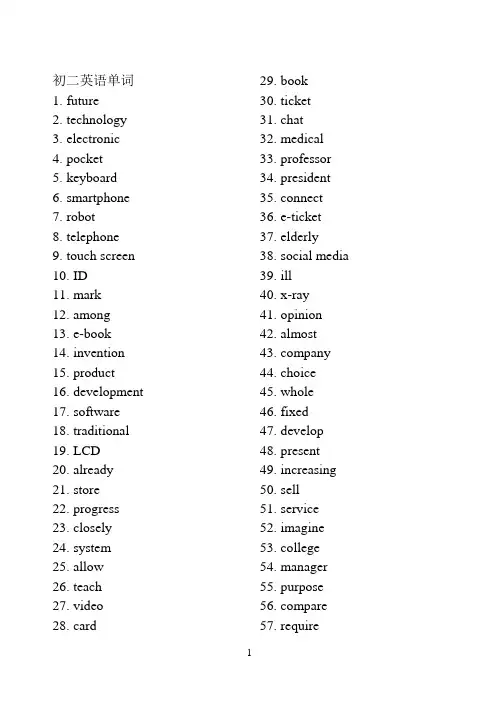
1 初二英语单词
1. future
2. technology
3. electronic
4. pocket
5. keyboard
6. smartphone
7. robot
8. telephone
9. touch screen
10. ID
11. mark
12. among
13. e-book
14. invention
15. product
16. development
17. software
18. traditional
19. LCD
20. already
21. store
22. progress
23. closely
24. system
25. allow
26. teach
27. video
28. card 29. book
30. ticket
31. chat
32. medical
33. professor
34. president
35. connect
36. e-ticket
37. elderly
38. social media
39. ill
40. x-ray
41. opinion
42. almost
43. company
44. choice
45. whole
46. fixed
47. develop
48. present
49. increasing
50. sell
51. service
52. imagine
53. college
54. manager
55. purpose
56. compare
57. require 2 58. include
59. decision-making
60. problem-solving
61. express
62. listener
63. plan
64. decision
65. situation
66. guide
67. conclusion
北师大版 高中英语必修二
必修二 Unit 4
Lesson 1 Tomorrow’s World 明天的世界
The Future of Cyberspace 网络空间的未来
Peter Taylor finds out how computers and the Internet
are going to affect our lives.
彼得泰勒发现了计算机和因特网会怎样影响我们的生活。
In last thirty years, the Internet has grown rapidly.
In 1983, there were only 200 computers connected to the
Internet; now there are around 50 million and this
growth is clearly going to continue.
在过去的三十年中,互联网的迅速发展。1983,仅有200台计算机连接到Internet;现在有左右,这一增长显然是要继续下去。
Some expert are pessimistic about the future. One
worry is crime in cyberspace. Even now, young hackers
can get into the computers of banks and governments.
In the future, terrorists may “attack” the world’s
computers, cause chaos, and make planes and trains
crash.
一些专家对未来感到悲观。一个担心是网络犯罪。即使是现在,年轻的黑客可以进入银行和政府的电脑。在未来,恐怖分子可能会“攻击”全世界的计算机,造成混乱,使飞机和火车事故。
人教版八年级英语下册:Unit 1 Will people have robots- (第一课时)优秀教案
人教版八年级英语下册:Unit 1 Will
people have robots? (第一课时)优秀教案
课题 人教版八年级英语下册:Unit 1 Will people
have robots? (第一课时)
教材分析
本单元主要学习动词will及there be的一般将来时的用法,学会运用will及there will be的一般将来时态的陈述句,否定句,疑问句及回答。并能正确使用more,less,fewer .本单元围绕对未来预测这一话题展开,先从人们将来的日常生活着手,练习使用will的一般将来时的用法及其肯,否定的回答,其次从人们居住的环境的污染问题入手,练习使用there will be 以及more,less,fewer的用法,最后又谈论过去,现在和将来的事情来练习一般过去时,一般现在时和一般将来时.来练习,巩固所学的语言目标。
学情分析
本单元的主题是利用will 及there will be对未来进行预测,能正确使用一般将来时,同时引导学生使用所学句型对未来进行预测,一般将来时这一时态是初中英语英语教学中的一个重要时态,八年级的学生已经有一定的语言表达能力,在语言运用上有一定的基础,应对学生的知识的延伸和扩展做好充分的准备,针对学生这一青少年的年龄特点,他们有很强的求知欲和表现欲,自主探究的合作学习无疑是给他们一个发展和接受新知识的良好空间。
Section A
教师寄语:Confidence in yourself is the first step
on the road to success.
自信是走向成功的第一步。
Knowledge goals(知识目标)
Words&phrases: robot, paper, less, fewer, will,
pollution,space station,on computers,in 100
高中英语Unit2SportsandFitnessSectionⅡ课后习题北师大版必修第一册(含答案
新教材适用高中英语北师大版必修第一册:
SectionⅡ
Lesson2RulesoftheGame&Lesson3RunningandFitness
一、用适当的介词填空
1.My mother reminded me the date of my birthday.
2.As we all know,sunshine is beneficial plants.
3.The high cost of equipment prevents many people taking up this sport.
4.What you said just now relieved her her stress.
5.They occupied themselves the television.
6.They told other curious travellers about their adventure in the desert
detail.
7.The immune system is the body’s defence infection(感染).
8.Finally,we won the football match due our hard practice.
二、用方框中所给短语的适当形式填空
in case sign up ought to in particular be fed up with cheer up be capable of
make sure
1.Of all the scientists,I admire Hawking
.
2. all the windows and doors are locked before travelling.
2019北师大版高中英语必修二课文翻译(全册精校)
1
UNIT 4 INFORMATION TECHNOLOGY
LESSON 1 AVATARS 虚拟形象 (P 8-9)
The avatar you choose says a lot about you. The article will help you understand your choice of avatars better.
你选择的虚拟形象能透露出你的很多信息。这篇文章将帮助你更好地理解关于虚拟形象的选择。
When you are online, you can be anyone or anything. You can create your own image and a new personality. These
digital identities, known as avatars, are a key part of how people use the Internet to communicate and express
themselves.
当你上网时,你可以是任何人或任何事物。你可以创设自己的形象,并且拥有新的个性。这些数字身份,被称作“虚拟形象”,这是人们利用互联网进行交流和表达自己的关键部分。
The first simple 2D avatars appeared in role-playing computer games in the 1980s. Yet, very few people knew that
future avatars would have such a wide variety of forms and uses. By the late1990s, they had been used in web chats
like instant messenger.
二维虚拟形象最早出现在20世纪80年代的角色扮演电脑游戏中,当时,很少有人知道虚拟形象后来会有如此广泛的形式和用途。20世纪90年代末,虚拟形象被用于网络聊天,如即时通讯。