
新外研版英语七年级下册知识点总结
七年级下复习资料M1---M12 Module 1 1. whose 疑问代词 Whose bag is it 此时的whose是形容词性物主代词。 Whose is this bag 此时的whose是名词性物主代词。 2. 人称代词归纳(必背) 主格 宾格 形物代 名物代 反身代词 我 I me my mine myself 你 you you your yours yourself 他 he him his his himself 她 she her her hers herself 它 it it its its itself 我们 we us our ours ourselves 你们 you you your yours yourselves 他们 they them their theirs themselves 3. welcome back to +地点 欢迎回到某地 Welcome to +地点 欢迎到某地来 Welcome sb to+地点 欢迎某人到某地来 4. everyone 每个人(指人)后面不能接of every one 每个人或物(根据上下文,可指人也可指物)后面可以接of every one of us我们中每个人 5. first of all = at first = firstly 首先 6. lost and found box失物招领箱 7. here’s、here’re句型,其后be动词的形式由后面的名词决定 Here is a book. Here are some books. 8. be careful with sth. 仔细保管某物 9. from now on从现在开始 from then on 从那时开始 10. watch 手表(名词);观看(动词) Watch 观看(电视,电影,比赛等) Look 看(表示动作,后接at) See 看见(强调结果) Read 看(看书、报纸,杂志等) 11. lost and found office失物招领办公室(前面用介词at) 12. look for寻找(强调动作) find找到(强调结果) 13. get on上(公交车,飞机,轮船,火车等) get off下(公交车,飞机,轮船,火车等) Get in上(小轿车) get out of 下(小轿车) 14. lose 动词,丢失,失败 lost(lose的过去式,同时lost也作为形容词,意为丢失的) I lost my way。我迷路了。(动词) I am lost。我迷路了(形容词) 15. travel 旅行 注意ing形式:travelling 16. leave 离开 leave+地点 离开某地 leave for+地点 动身去某地 leave sp for sp 来开某地去某地 注意:把什么东西落在某地,用leave,而不用forget 17. hundreds of 数以百计的 thousands of数以千计的 millions of数以百万计的 注意:有s必须有of,没有of,后面不能加s 18. every day每一天 everyday 形容词,日常的 19. many other things 许多其他的东西 20. at the moment = at this moment此时此刻 at that moment在那时 21. fifteen kilos of sausages 15公斤的香肠 22. in a hurry匆忙的 hurry to do sth匆忙做某事 23. talk about sth 谈论某事 talk to/with sb 与某人谈话 talk to/with sb about sth 与某人谈论某事 Speak+语言 say+说话内容 tell 告诉 tell sb to do sth 告诉某人做某事 24. that’s why + 从句 那就是为什么…. 25. help sb (to)do sth 帮助某人做某事 help sb with sth在…方面帮助某人 26. think about 考虑 think of想起,想出 think over仔细考虑
Module 2 1. the new clubs for this term这个学期的俱乐部,注意此处用for,而不是of 2. on the board 在布告板上 3. would like+名词 想要某物 I would like a cup of coffee。我想要一杯咖啡 Would like to+动词原形 想要做某事 I would like to play basketball。我想打篮球。 Would like sb to do sth 想要某人做某事 I would like you to come to my school。我想要你到我学校来。 4. join 参加(组织团体) join in=take part in 参加(活动,比赛等) 5. well 好,表示做某事做的好,一定要用well,不能用good 6. worry about sb/sth 担心某人或某事 7. teach 教 teach sb sth 教某人某事(sb要用宾格)错误; teach our English. 正确:teach us English Teach sb to do sth 教某人做某事 8. what about = how about 9. I think…我认为…(后接肯定句)如果后面是否定句,要否定前置,变为I don’t think,如: I think he isn’t a good student. 应改为 I don’t think he is a good student. 10. the start of… 。。。的开始 11. get on with sb与某人相处 get on well with sb与某人相处融洽 12. do well in+名词或动词ing be good at+名词或动词ing 意为“擅长” 注意:用了do well in句子中就不能再出现be动词 13. promise to do sth 承诺做某事 make a promise 许下承诺 14. enjoy+doing 喜爱做某事 15. be sure of sth对某事有把握 be sure to do sth 务必做某事 be sure+that+ 从句 对…有信心 16. make sb/sth + adj 使某人或某物具有…状态 make me angry使我生气 Make sth for sb为某人制作某物 make sb do sth 使某人做某事(注意:make与let后面都不能有to) 17. 询问职业:1. what does your father do 2. What is your father 3. what is your father’s job 18. a kind of 一种… all kinds of各种各样的 kind of有点 19. be ready to do sth乐于做某事 20. other其他的(修饰名词)the other另一个(两者中) another另一个(三者或三折以上) The others其他的人或物(剩下的全部) others其他的人或物(剩下的一部分) 21. want to do sth想要做某事 want sb to do sth想要某人做某事
Module 3 1. be going to+动词原形 表示将来,意为打算做某事 注意:当be going to后接go to sp时,、go to通常省略,直接用be going to+地点,如: I am going to go to the zoo.应该写为:I am going to the zoo. 2. else 其他的,修饰代词,放在代词之后;other其他的,修饰名词,放在名词之前。 3. have a picnic吃野餐 4. plan to do sth计划做某事 make a plan制定计划 5. look forward to+名词或动词ing形式 期待做某事 6. make friendship with sb和某人交朋友 7. win赢得(比赛,战争,荣誉,奖品) beat 战胜(对手) 8. hope to do sth希望做某事 错误:hope sb to do sth hope for… 希望… hope that+从句 9. go on a summer camp去参加夏令营 10. go sightseeing去观光 11. 花费:it takes sb some time to do sth做某事花费某人多长时间 Sb spend some time/some money (in) doing sth 某人花费多少钱/多长时间做某事 Sb spend some time/some money on sth某人在某事上花费时间或金钱 Sb spend some time with sb某人花费时间和某人在一起 某物 cost sb some money、某物花了某人多少钱 Sb pay for sth某人为某物支付金钱 12. on the beach在沙滩上 13. be busy (in)doing sth忙于做某事 be busy with sth忙于某事 14. be different from 与…不同 be the same as与…相同 15. maybe可能 maybe he is a student.也许他是名学生。 May be可能是 he may be a student.他可能是名学生 16. it’s time for sth/doing sth 该是做某事的时候了
Module 4 1. in the future在将来 2. in + 一段时间 表示某个动作还要多久才会发生,用于将来时,提问用how soon 3. use sth to sth使用某物做某事 use sth for sth为了某事使用某物 4. ask a question问问题 ask sb to do sth要求某人做某事 ask for寻求… 5. the answer to the question问题的答案
外研版七年级英语下册各模块语法知识汇总+专项练习
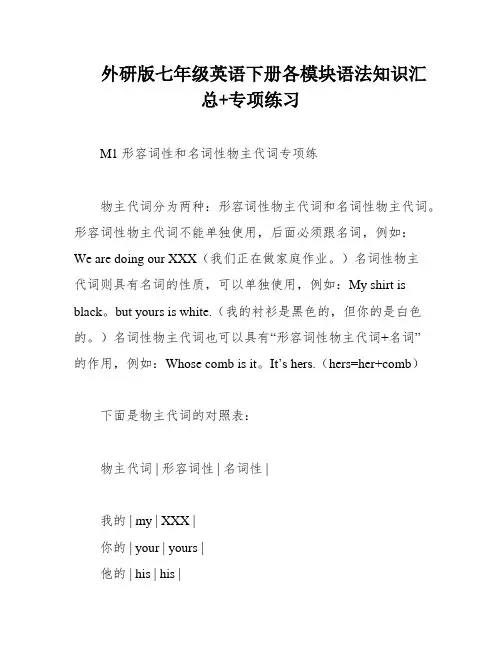
外研版七年级英语下册各模块语法知识汇总+专项练习M1 形容词性和名词性物主代词专项练物主代词分为两种:形容词性物主代词和名词性物主代词。
形容词性物主代词不能单独使用,后面必须跟名词,例如:We are doing our XXX(我们正在做家庭作业。
)名词性物主代词则具有名词的性质,可以单独使用,例如:My shirt is black。
but yours is white.(我的衬衫是黑色的,但你的是白色的。
)名词性物主代词也可以具有“形容词性物主代词+名词”的作用,例如:Whose comb is it。
It’s hers.(hers=her+comb)下面是物主代词的对照表:物主代词 | 形容词性 | 名词性 |我的 | my | XXX |你的 | your | yours |他的 | his | his |她的 | her | hers |它的 | its | its |我们的 | our | ours |你们的 | your | yours |他们的 | their | theirs |需要注意的是,名词性物主代词可指一件东西,也可指很多件东西,需要根据上下文来决定。
例如:选择填空:1.This is my teapot。
It’s not __________。
(your/ yours)2.My hairdryer is on the desk。
Where’s ____________?(her/ hers)3.___________ hairdryer is not on the table。
___________ is there。
(Her/ Mine)4.Whose calculator is it?It’s __________。
It’s __________ XXX)5.Are they ___________ (your/ yours) combs。
Yes。
they’re _________(our/ ours).用所给词的适当形式填空:1.That is not _________ kite。
外研版七年级下册英语重点知识点汇总

外研版七年级下册英语重点知识点汇总Module 1 Lost and Found重点短语:1.失物招领箱:lost and found box2.小心:be careful with…3.从现在开始:from now on4.匆忙:XXX5.成百上千:hundreds of6.寻找(过程):look for7.首先:first of all8.找到(结果):find9.努力做某事(会成功):try to do sth10.从…中挑选:choose from11.试图做某事(成功与否未知):XXX12.此时此刻:XXX13.例如(用于列举):such as14.例如:for example重点句型:1.这是谁的 (XXX)2.帮助某人做某事:help sb do XXX.3.请小心保管…:XXX…4.欢迎来到…:e to +地点5.给某人打call sb at +电话号码语法总结:物主代词:表示所属关系的代词(…属于谁的)单数:人称形容词性物主代词名词性物主代词第一人称 my XXX第二人称 your yours第三人称 his hers its复数形容词性物主代名词性物主代第一人称 our ours第二人称 your yours第三人称 their theirs形容词性物主代词:必须和名词在一起,例如XXX,your XXX…名词性物主代词:相当于与之相对应的形容词性物主代词+名词,例如XXX.Module 2 What Can You Do?重点短语:1.与某人相处融洽:get on well with sb.2.弹钢琴:play the piano3.打乒乓球:play table XXX4.…怎么样?=how about…。
what about…5.担心…:XXX…6.擅长做某事:be good at doing sth.7.放风筝:fly a kite重点句型:无语法总结:无2.high-tech高科技的3.XXX虚拟现实4.XXX机器人仆人5.XXX太空旅行6.XXX可再生能源7.self-driving cars自动驾驶汽车8.ic engineering基因工程9.XXX寿命10.artificial intelligence人工智能重点句型】1.In the future。
外研版七下英语知识点总结大全
外研版七下英语知识点总结大全
1.单词拼写:外研版七下英语中涉及的各种单词的正确拼写。
2.词汇释义:外研版七下英语中涉及的各种词汇的含义和用法。
3.句型转换:外研版七下英语中常见的句型转换题型,包括主动语态
和被动语态、一般现在时和一般过去时等。
4.语法知识:外研版七下英语中的语法知识点,包括名词、动词、形
容词、副词、冠词、代词、介词、连词等。
5.短语搭配:外研版七下英语中涉及的各种短语的搭配和用法。
6.句子结构:外研版七下英语中常见的句子结构,包括简单句、复合句、并列句、主从句等。
7.语篇理解:外研版七下英语中的各种语篇理解题型,包括阅读理解、完形填空等。
8.写作训练:外研版七下英语中的写作训练题型,包括书面表达、句
子填空等。
9.听力训练:外研版七下英语中的各种听力理解题型,包括听对话选
择图片、听句子选择答案等。
10.阅读训练:外研版七下英语中的阅读理解题型,包括选择题、填
空题、选择短文标题等。
11.口语表达:外研版七下英语中常见的口语表达题型,包括问答题、情景对话等。
12.语法填空:外研版七下英语中涉及的语法填空题型,包括完成句子、完成短文等。
13.同义替换:外研版七下英语中的同义替换题型,包括同义词、近义词等。
14.听音识图:外研版七下英语中的听音识图题型,包括听音选图、听音选词等。
16.听说训练:外研版七下英语中的听说训练题型,包括听音说话、听音对话等。
外研版英语七年级下册Module 2知识点梳理总结+课时练习+随堂测试卷(含答案)
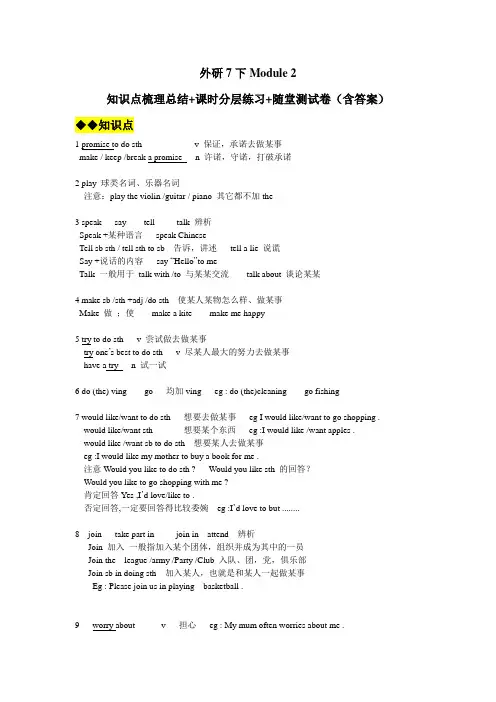
外研7下Module 2知识点梳理总结+课时分层练习+随堂测试卷(含答案)◆◆知识点1 promise to do sth v 保证,承诺去做某事make / keep /break a promise n 许诺,守诺,打破承诺2 play 球类名词、乐器名词注意:play the violin /guitar / piano 其它都不加the3 speak say tell talk 辨析Speak +某种语言speak ChineseTell sb sth / tell sth to sb 告诉,讲述tell a lie 说谎Say +说话的内容say “Hello”to meTalk 一般用于talk with /to 与某某交流talk about 谈论某某4 make sb /sth +adj /do sth 使某人某物怎么样、做某事Make 做;使make a kite make me happy5 try to do sth v 尝试做去做某事try one’s best to do sth v 尽某人最大的努力去做某事have a try n 试一试6 do (the) ving go 均加ving eg : do (the)cleaning go fishing7 would like/want to do sth 想要去做某事eg I would like/want to go shopping . would like/want sth 想要某个东西eg :I would like /want apples .would like /want sb to do sth 想要某人去做某事eg :I would like my mother to buy a book for me .注意Would you like to do sth ? Would you like sth 的回答?Would you like to go shopping with me ?肯定回答Yes ,I’d love/like to .否定回答,一定要回答得比较委婉eg :I’d love to but ........8 join take part in join in attend 辨析Join 加入一般指加入某个团体,组织并成为其中的一员Join the league /army /Party /Club 入队、团,党,俱乐部Join sb in doing sth 加入某人,也就是和某人一起做某事Eg : Please join us in playing basketball .9 worry about v 担心eg : My mum often worries about me .be worried about adj 担心eg : My mum is often worried about me .◆◆语法专项情态动词can的用法1 can 的含义Can 是情态动词,意为“能;会”,表示能力,通常指在体力或脑力方面的能力,这是can 的基本用法。
外研版英语(新标准)七年级下册模块知识点归纳总结(全册)
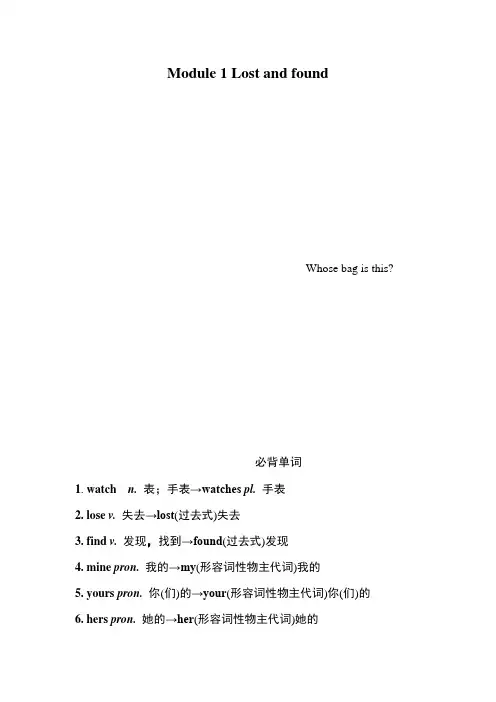
Module 1 Lost and foundWhose bag is this?必背单词1. watch n.表;手表→watches pl.手表2. lose v.失去→lost(过去式)失去3. find v.发现,找到→found(过去式)发现4. mine pron.我的→my(形容词性物主代词)我的5. yours pron.你(们)的→your(形容词性物主代词)你(们)的6. hers pron.她的→her(形容词性物主代词)她的7. careful adj.仔细的;认真的;小心的→carefully adv.仔细地;认真地;小心地8. crayon n. 蜡笔9. eraser n. 橡皮擦10. glove n. 手套11. wallet n. 钱包12. whose pron. 谁的13. tape n. 录音带;录像带14. purple adj. 紫色的;紫红色的;n. 紫色;紫红色必背短语15. first of all 首先,第一16. look at 看17. be careful with 小心(对待)……18. from now on 从现在开始19. a lot of 许多,大量20. lost and found box 失物招领箱必背句子21. Welcome back to school, everyone!欢迎大家返校!22. Whose bag is this?这是谁的书包?23. Here's a purple wallet!这里有一个紫色的钱包!24. Let me see...让我看看……Are they yours?必背单词1. leave v.丢下;遗忘→left(过去式)丢下;遗忘2. strange adj.奇怪的→stranger n.陌生人3. camera n. 照相机4. phone n. 电话;电话机5. plane n. 飞机6. taxi n. 出租车7. why adv. 为什么8. airport n. 机场;航空港9. hundred num. 百10. thousand num. 千11. boat n. 船12. duck n. 鸭13. pig n. 猪14. sausage n. 香肠;腊肠必背短语15. mobile phone 移动电话;手机16. lost and found office 失物招领处17. in a hurry 匆匆忙忙18. hundreds of 几百;成百上千19. look for 寻找20. at the moment 目前;此时必背句子21. Welcome to the New York City Lost and found office.欢迎来到纽约市的失物招领处。
新外研版七年级英语下册知识点整理
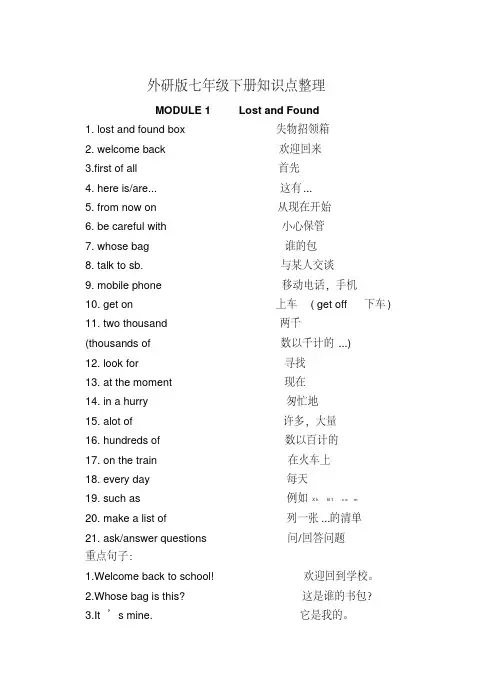
外研版七年级下册知识点整理MODULE 1 Lost and Found1. lost and found box 失物招领箱2. welcome back 欢迎回来3.first of all 首先4. here is/are... 这有...5. from now on 从现在开始6. be careful with 小心保管7. whose bag 谁的包8. talk to sb. 与某人交谈9. mobile phone 移动电话,手机10. get on 上车( get off 下车)11. two thousand 两千(thousands of 数以千计的...)12. look for 寻找13. at the moment 现在14. in a hurry 匆忙地15. alot of 许多,大量16. hundreds of 数以百计的17. on the train 在火车上18. every day 每天19. such as 例如X k B 1 . c o m20. make a list of 列一张...的清单21. ask/answer questions 问/回答问题重点句子:1.Welcome back to school! 欢迎回到学校。
2.Whose bag is this? 这是谁的书包?3.It’s mine.它是我的。
4.Are these crayons yours? 这些是你的蜡笔吗?5. Whose tapes are these? 这些是谁的磁带?urple wallet! 这儿有个紫色钱包。
6. Here’s a p. 我认为它是玲玲的。
7. I think it’s Betty’s. Lingling8. Everyone, please be careful with your things from now on.请大家从今以后仔细对待你们的东西。
外研版英语七年级下册知识点总结
外研版英语七年级下册知识点总结外研新版英语七年级下册知识点总结Module 1 Lost and found1、lost and found 失物招领the lost and found box 失物招领箱2、(1) welcome back to 欢迎回到某地... Welcome back to school.(2) welcome to +地点的名词欢迎来某地Welcome to China.(3) Welcome 跟地点副词时不带to welcome home 欢迎回家Welcome here .(4) You are welcome. 不用谢。
(5) give sb. a warm welcome 热烈欢迎某人They gave a warm welcome to us.3、first of all 首先= at first / firstly (常位于句首作状语,强调首要的事情或动作)First of all, you should finish your homework.4、there be 句型中谓语动词采用就近原则There is some food in the fridge.5、a lot of =lots of 许多既可以修饰可数名词复数,也可以修饰不可数名词。
There is a lot of water in the glass. I have lots of books in my room.6、(1) look at 看(强调“看”的动作)Come and look at my new coat.(2) look (不及物动词,单独使用,用以引起对方的注意) Look! That’s an English car.(3) see 看见(及物动词,强调“看”的结果) Can you see the bird in the tree?(4) watch 观看,仔细地看(比赛、电视、戏等)They arewatching TV now.(5) read 看(书、报纸、杂志等) My mother is reading a book /a magazine /a newspaper.7、everyone/everybody 做主语,谓语动词用单数形式。
外研版七年级英语英语(下册)知识点归纳
外研版七年级英语英语(下册)知识点归纳路漫漫其修远兮,吾将上下而求索。
第一模块:本模块主要介绍了一些常用短语和句型结构。
其中包括“失物招领箱”、“小心保管”、“从现在开始”、“首先”、“寻找”、“找到”、“努力做某事”、“从…中挑选”、“例如”等。
此外,还介绍了一些常用的语法专项,如物主代词的单数和复数形式等。
第二模块:本模块主要介绍了一些与爱好和运动相关的短语和句型结构。
其中包括“与某人相处融洽”、“弹钢琴”、“打乒乓球”、“担心”、“擅长做某事”、“放风筝”等。
此外,还介绍了一些常用的句型结构,如“做…怎么样”、“愿意做某事”、“承诺做某事”等。
改写建议:第一模块:这一模块介绍了一些常用的短语和句型结构,例如失物招领箱、小心保管、从现在开始、首先、寻找、找到、努力做某事、从…中挑选、例如等。
此外,还介绍了一些常用的语法专项,比如物主代词的单数和复数形式等。
第二模块:这一模块介绍了一些与爱好和运动相关的短语和句型结构,例如与某人相处融洽、弹钢琴、打乒乓球、担心、擅长做某事、放风筝等。
此外,还介绍了一些常用的句型结构,比如做…怎么样、愿意做某事、承诺做某事等。
The journey is long and arduous。
but I will XXX。
In terms of grammar。
it is XXX of using "your"。
"his"。
"her"。
or "its"。
it is best to use specific names or XXX。
Moving on to Module 3.some useful phrases include "have a ic"。
"check one's email"。
and "go over"。
外研版七年级下英语知识点总结
Unit1 Can you play the guitar?1.常见的情态动词:cancouldmaymightmust shall shouldwillwould等情态动词+动词原形,疑问句中情态动词提前,否定句在情态动词后加not。
2.Play+ the+乐器play the guitar. play the drums. play the piano. play the violin Play +球类.棋类.牌类游戏play volleyball. play chess.play cards.Play(games)with sb. 和某人一起玩(游戏)3.Join+组织或者人Join the art club join sb. Join in+竞赛.娱乐.游戏等Take part in+活动加入到某活动中Be in 参加.加入.穿着4. what club do you want to join?你想要参加什么俱乐部?The singing club唱歌俱乐部the drawing club 绘画俱乐部the dancing club舞蹈俱乐部the swimming club游泳俱乐部the story telling club 讲故事俱乐部The music /English /art/chess/sports club 音乐/英语/美术/象棋/运动俱乐部5. Pianist钢琴家violinist小提琴手singer歌手dancer舞蹈家musician音乐家6.Let sb do sth 让某人做某事Let’s+动词原形让我们做某事7.Say+内容say hello to sb. say sorry to sb. say to sb.Speak+语言speak English/Chinese/Japanese speak to sb.Talk 谈论talk about sth. talk with sb. talk to sb. talk show脱口秀Tell 告诉.讲述tell sb. sth= tell sth to sb.告诉某人某事tell sb. about sth 告诉某人关于某事tell sb. to do sth. 告诉某人去做某事tell sb. not to do sth 告诉某人不要去做某事tell stories/ jokes/lies讲故事/讲笑话/说谎Ask问.要求ask for 请求ask sb for sth 向某人索要某物ask about询问关于某事ask sb. about sth询问某人关于某事ask sb to do sth 要求某人去做某事ask sb not to do sth要求某人不要去做某事8.Want to do sth.= would like to do sth.=feel like doing sth.想要做某事Want sb. to do sth.= would like sb. to do sth.想要某人做某事Want to be+adj want to be + 职业9.What about =how about,后接名词,代词,动名词what about you你呢?what about the book这本书怎么样?what about dancing跳舞怎么样?10.也:too 肯定句末(前面加逗号)Either否定句末(前面加逗号)Also 实前助后As well 口语中(前面不加逗号)11.be good at+ sth/doing sth=do well in 擅长于…be good for 对…有益(be bad for对…有害)be good to 对…友好(good 可用friendly.nice.kind替换)be good with和…相处好=get on well with= get along well with12.感官动词(look. sound. taste. smell. feel)+ adj做表语13.选择疑问句用or来连接选择部分.回答不用Yes或No.要从中选择一个回答14.students wanted for school show(wanted表示招募.含有被动意义)15.show sth to sb=show sb sth让某人看某物the school show 学校演出give sth to sb=give sb sth给某人某物16.help sb do sth Help sb with sth helpful有帮助的With one’s help= with the help of sb在某人的帮助下Help oneself to 随便享用can't help doing sth.情不自禁做某事17.be busy doing sth忙于做某事be busy with sth忙于某事18.need to do sth need sb to do sth need….for…19.be free to do sth= have time to do sth有时间去做某事Have no time= don’t have time=be busy 没有时间20.make friends with sb 和某人交朋友make money 赚钱make a living 谋生make faces做鬼脸make fun of sb取笑某人21.call sb. at +电话号码call sb. back 给某人回电话22.on the weekend= on weekends23. English-speaking students说英语的学生(English-speaking有连词符,是形容词)24.do kung fu练功夫The old people’s home老人之家the Students’Sports Center25.It is +adj +for sb to do sth做某事对于某人是...形容词修饰名词.副词修饰动词或者形容词26.teach sb sth教某人…. Teach me Chinese teach him MathTeach sb to do sth 教某人去做某事Learn to do sth 学习做某事learn from sb./sth向某人学习、从某事中学习27. Write down写下write to sb =write a letter to sb.给某人写信write back to sb 给某人回信hear from sb 收到某人的来信At least至少make a poster制作海报28.定冠词the的用法(1)特指某(些)人或某(些)物,这是定冠词的基本用法。
七年级英语下册语法知识点归纳总结外研版
七年级英语下册语法知识点归纳总结外研版一、时态1. 一般现在时:主要用来表示经常性、习惯性、规律性的动作或状态,也可用来表示现阶段发生的事件和现阶段存在的事物状态。
其用法主要通过动词的形式来体现。
2. 现在进行时:用来表示现阶段正在进行或经常发生的动作,其用法与一般现在时类似,通过动词的现在分词形式来体现。
二、名词复数规则1. 一般情况下,直接在词尾加s。
如:book-books,map-maps 等。
2. 以s,x,sh,ch结尾的名词,加es。
如:bus-buses,box-boxes等。
3. 以辅音字母加y结尾的名词,变y为i再加es。
如:country-countries,factory-factories等。
三、代词用法1. 人称代词:表示代词所指的人或事物在句子中的关系,分为主格和宾格两种形式。
2. 物主代词:表示所有关系的代词,分为形容词性物主代词和名词性物主代词两种形式。
四、介词用法1. in,on,at表示时间或地点的方式。
如:in the morning,on Monday,at the table等。
2. by,with表示方式或工具。
如:by bus,with a pen等。
五、形容词比较等级用法1. 比较级:表示两者之间的比较,通过比较级后缀-er或连词than来体现。
2. 最高级:表示三者或三者以上之间的比较,通过最高级后缀-est或副词very,most来体现。
六、一般疑问句及回答一般疑问句是将疑问句以系动词be或助动词do及其时态形式提出,并用简短的肯定或否定回答。
通常用yes或no来回答。
以上就是七年级英语下册语法知识点归纳总结外研版的主要内容,希望对学生们的学习有所帮助。