
【2020高 考全国Ⅰ卷英语真题】2020年普通高等学校招生全国统一考试(Ⅰ卷)英语试卷含答案解析
绝密★启用前
2020年普通高等学校招生全国统一考试(全国卷I)
英语
注意事项:
1. 答卷前,考生务必将自己的姓名、准考证号填写在答题卡和试卷指定位置上。
2. 回答选择题时,选出每小题答案后,用铅笔把答题卡上对应题目的答案标号涂黑。
如需改动,用橡皮擦干净后,再选涂其他答案标号。
回答非选择题时,将答案写在答题卡上,写在本试卷上无效。
3. 考试结束后,将本试卷和答题卡一并交回。
第一部分听力(共两节,满分30分)
做题时,先将答案标在试卷上。
录音内容结束后,你将有两分钟的时间将试卷上的答案转涂到答题卡上。
第一节(共5小题;每小题1.5分,满分7.5分)
听下面5段对话。
每段对话后有一个小题,从题中所给的A、B、C三个选项中选出最佳选项。
听完每段对话后,你都有10秒钟的时间来回答有关小题和阅读下一小题。
每段对话仅读一遍。
例:How much is the shirt?
A. £19.15.
B. £9.18.
C. £9.15.
答案是C。
1. Where are the speakers?
A. At a swimming pool.
B. In a clothing shop.
C. At a school lab.
2. What will Tom do next?
A. Turn down the music.
B. Postpone the show.
C. Stop practicing.
3. What is the woman busy doing?
A. Working on a paper.
B. Tidying up the office.
C. Organizing a party.
4. When will Henry start his vacation?
A. This weekend.
B. Next week.
C. At the end of August.
5. What does Donna offer to do for Bill?
A. Book a flight for him.
B. Drive him to the airport.
C. Help him park the car.
第二节(共15小题;每小题1.5分,满分22.5分)
听下面5段对话或独白。
每段对话或独白后有几个小题,从题中所给的A、B、C三个选项中选出最佳选项。
听每段对话或独白前,你将有时间阅读各个小题,每小题5秒钟;听完后,各小题将给出5秒钟的作答时间。
每段对话或独白读两遍。
听第6段材料,回答第6、7题。
6. Why does Pete call Lucy?
A. To say that he’ll be late.
B. To tell her about his work.
C. To invite her to dinner.
7. When is Pete going to see Lucy?
A. At 6:00 pm.
B. At 6:45 pm.
C. At 8:00 pm.
听第7段材料,回答第8至10题。
8.Why does Cathy want to quit her job?
A. She’ll join another firm.
B. She’ll run her own business.
C. She’s fed up with it.
9. What is Mark’s attitude towards Cathy’s decision?
A. Forgiving.
B. Sympathetic.
C. Supportive.
10. What might Cathy do for the present company?
A. Apply for a project.
B. Train a new person.
C. Recommend an engineer.
听第8段材料,回答第11至13题。
11. How did the man feel about his performance today?
A. Greatly encouraged.
B. A bit dissatisfied.
C. Terribly disappointed.
12. What did the man say helped him overcome the problem?
A. Patience.
B. Luck.
C. Determination.
13. What is the woman doing?
A. Conducting an interview.
B. Holding a press conference.
C. Hosting a ceremony.
听第9段材料,回答第14至16题。
14.What is next to the apartment building?
A. A restaurant.
B. A laundry.
C. A grocery store.
15.Which is included in the rent?
A. Electricity.
B. The Internet.
C. Satellite TV.
16.What does the woman think of the apartment?
A. It’s quite large.
B. It’s well furnished.
C. It’s worth the money.
听第10段材料,回答第17至20题。
17. Where is Jeff from?
A. Liverpool.
B. Coventry.
C. Newcastle.
18.Where do young men go to watch big games according to Jeff?
A. Pubs.
B. Stadiums.
C. Friends’ homes.
19.Why does Jeff have to pick a team to support?
A. To avoid being bothered.
B. To open a conversation.
C. To earn respect from others.
20.What does Jeff mainly talk about?
A. England’s moment of success.。
2020年高考英语试题(全国卷Ⅰ)

2020年普通高等学校招生全国统一考试(全国卷I)英语试题(河南、河北、山西、江西、湖北、湖南、广东、安徽、福建)注意事项:1. 答卷前, 考生务必将自己的姓名、准考证号填写在答题卡和试卷指定位置上。
2. 回答选择题时, 选出每小题答案后, 用铅笔把答题卡上对应题目的答案标号涂黑。
如需改动, 用橡皮擦干净后, 再选涂其他答案标号。
回答非选择题时, 将答案写在答题卡上, 写在本试卷上无效。
3. 考试结束后, 将本试卷和答题卡一并交回。
第一部分听力(共两节, 满分30分)做题时, 先将答案标在试卷上。
录音内容结束后, 你将有两分钟的时间将试卷上的答案转涂到答题卡上。
第一节(共5小题,每小题1.5分,满分7.5分)听下面5段对话。
每段对话后有一个小题,从题中所给的A、B、C三个选项中选出最佳选项,并标在试卷的相应位置。
听完每段对话后,你都有10秒钟的时间来回答有关小题和阅读下一小题。
每段对话仅读一遍。
例:How much is the shirt?A. ₤19.15.B. ₤9.18.C. ₤9.15 答案是C.1. Where are the speakers?A. At a swimming pool.B. In a clothing shop.C. At a school lab.2. What will Tom do next?A. Turn down the music.B. Postpone the show.C. Stop practicing.3. What is the woman busy doing?A. Working on a paper.B. Tidying up the office.C. Organizing a party.4. When will Henry start his vacation?A. This weekend.B. Next week.C. At the end of August.5. What does Donna offer to do for Bill?A. Book a flight for him.B. Drive him to the airport.C. Help him park the car.第二节(共15小题;每小题1.5分,满分22.5分)听下面5段对话或独白。
2020年普通高等学校招生全国统一考试英语(全国卷I,解析版)

2020年普通高等学校招生全国统一考试英语(全国卷I,解析版)本试卷分第一卷(选择题)和第二卷(非选择题)两部分。
第一卷1至14页。
第二卷15至16页。
考试结束后,将本试卷和答题卡一并交回。
第一卷注意事项:1.答题前,考生在答题卡上务必用直径0.5毫米黑色墨水签字笔将自己的姓名、准考证号填写清楚,并贴好条形码。
请认真核准条形码上的准考证号、姓名和科目。
2.每小题选出答案后,用2B铅笔把答题卡上对应题目的答案标号涂黑,如需改动,用橡皮擦干净后,再选图其他答案标号,在试题卷上作答无效。
第一节(共5小题;每小题1.5分,满分7.5分)听下面5段对话。
每段对话后有一个小题,从题中所给的A、B、C三个选项中选出最佳选项,并标在试卷的相应位置。
听完每段对话后,你都有10秒钟的时间来回答有关小题和阅读下一小题。
每段对话仅读一遍。
例:How much is the shirt?A. £19.15B.£9.15C. £9.18答案是B。
1. What do the speakers need to buy?A. A fridgeB. A dinner tableC. A few chairs2. Where are the speakers?A. In a restaurant.B. In a hotelC. In a school.3. What does the woman mean?A. Cathy will be at the party.B. Cathy is too busy to come.C. Cathy is going to be invited4. Why does the woman plan to go to town?A. To pay her bills in the bank.B. To buy books in a bookstore.C. To get some money from the bank5. What is the woman trying to do?A. Finish some writing.B. Print an article.C. Find a newspaper.第二节(共15小题,每小题1.5分,满分22.5分)听下面5段对话或独白。
2020年高考全国卷Ⅰ英语试题文档版(含答·案)
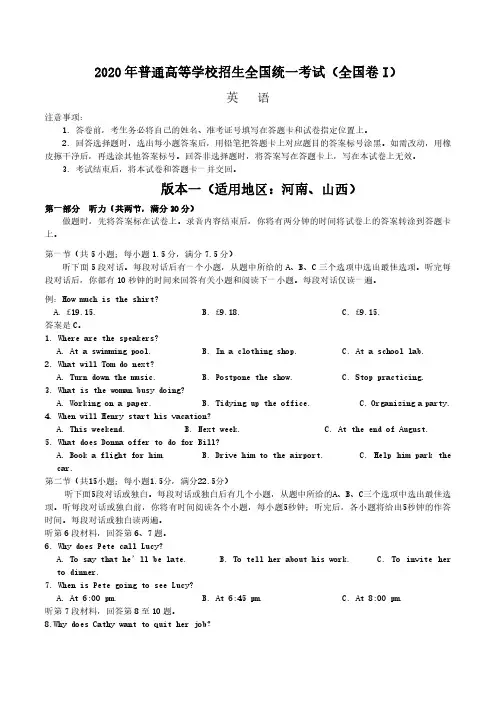
例:How much is the shirt?
A. £19.15.
B. £9.18.
C. £9.15.
答案是 C。
1. Where are the speakers?
A. At a swimming pool.
B. In a clothing shop.
15.Which is included in the rent?
A. Electricity.
B. The Internet.
C. Satellite TV.
16.What does the woman think of the apartment?
A. It’s quite large.
B. It’s well furnished.
A. At 6:00 pm.
B. At 6:45 pm.
C. At 8:00 pm.
听第 7 段材料,回答第 8 至 10 题。
8.Why does Cathy want to quit her job?
A. She’ll join another firm. B. She’ll run her own business. C. She’s fed up with
版本一(适用地区:河南、山西)
第一部分 听力(共两节,满分 30 分) 做题时,先将答案标在试卷上。录音内容结束后,你将有两分钟的时间将试卷上的答案转涂到答题卡
上。
第一节(共 5 小题;每小题 1.5 分,满分 7.5 分) 听下面 5 段对话。每段对话后有一个小题,从题中所给的 A、B、C 三个选项中选出最佳选项。听完每
2020年高考真题——英语(全国卷Ⅰ) 无听力部分Word版含答案

2020年普通高等学校招生全国统一考试(全国卷I)英语注意事项:1. 答卷前,考生务必将自己的姓名、准考证号填写在答题卡和试卷指定位置上。
2. 回答选择题时,选出每小题答案后,用铅笔把答题卡上对应题目的答案标号涂黑。
如需改动,用橡皮擦干净后,再选涂其他答案标号。
回答非选择题时,将答案写在答题卡上,写在本试卷上无效。
3. 考试结束后,将本试卷和答题卡一并交回。
第二部分阅读理解(共两节,满分40分)第一节(共15小题;每小题2分,满分30分)阅读下列短文,从每题所给的A、B、C和D四个选项中,选出最佳选项。
ATrain InformationAll customers travelling on TransLink services must be in possession of a valid ticket before boarding. For ticket information,please ask at your local station or call 13 12 30.While Queensland Rail makes every effort to ensure trains run as scheduled,there can be no guarantee of connections between trains or between train services and bus services.Lost property(失物招领)Call Lost Property on 13 16 17 during business hours for items lost on Queensland Rail services.The lost property office is open Monday to Friday 7:30am to 5:00pm and is located(位于)at Roma Street station.Public holidaysOn public holidays, generally a Sunday timetable operates. On certain major event days,i.e.Australia Day, Anzac Day, sporting and cultural days, special additional services may operate.Christmas Day services operate to a Christmas Day timetable,Before travel please visit translink. com. au or call TransLink on 13 12 30 anytime.Customers using mobility devicesMany stations have wheelchair access from the car park or entrance to the station platforms.For assistance, please Queensland Rail on 13 16 17.Guardian trains (outbound)21. What would you do get ticker information?A. Call 13 16 17.B. Visit translink .com.au.C. Ask at the local station.D. Check the train schedule.22. At which station can you find the lost property office?A. Altandi.B. Roma Street.C. Varsity Lakes.D. Fortitude Valley.23. Which train would you take if you go from Central to Varsity Lakes?A.6:42 pm.B.7:29 pm.C.8:57 pm.D.11:02 pm.BReturning to a book you’ve read many times can feel like drinks with an old friend. There’s a welcome familiarity —but also sometimes a slight suspicion that time has changed you both, and thus the relationship. But books don’t change, people do. And that’s what makes the act of rereading so rich and transformative.The beauty of rereading lies in the idea that our bond with the work is based on our present mental register. It’s true, the older I get, the more I feel time has wings. But with reading, it’s all about the present. It’s about the now and what one contributes to the now, because reading is a give and take between author and reader. Each has to pull their own weight.There are three books I reread annually The first, which I take to reading every spring is Eme st Hemningway’s A Moveable Feast. Published in 1964, it’s his classic memoir of 1920s Paris. The language is almost intoxicating (令人陶醉的),an aging writer looking back on an ambitious yet simpler time. Another is Annie Dillard’s Holy the Firm, her poetic 1975 ramble (随笔) about everything and nothing. The third book is Julio Cortazar’s Save Twilight: Selected Poems, because poetry. And because Cortazar.While I tend to buy a lot of books, these three were given to me as gifs, which might add to the meaning I attach to them. But I imagine that, while money is indeed wonderful and necessary, rereading an author’s work is the highest currency a reader can pay them. The best books are the ones that open further as time passes. Butremember, it’s you that has to gr ow and read and reread in order to better understand your friends.24. Why does the author like rereading?A. It evaluates the writer-reader relationship.B. It’s a window to a whole new world.C. It’s a substitute for drinking with a friend.D. It extends the understanding of oneself.25. What do we know about the book A Moveable Feas!?A. It’s a brief account of a trip.B. It’s about Hemingway’s life as a young man.C. It’s a record of a historic event.D. It’s about Hemingway’s friends in Paris.26. What does the underlined word "currency"in paragraph 4 refer to?A. DebtB. Reward.C. Allowance.D. Face value.27. What can we infer about the author from the text?A. He loves poetry.B. He’s an editor.C. He’s very ambitious.D. He teaches reading.CRace walking shares many fitness benefits with running, research shows, while most likely contributing to fewer injuries. It does, however, have its own problem.Race walkers are conditioned athletes. The longest track and field event at the Summer Olympics is the 50-kilometer race walk, which is about five miles longer than the marathon. But the sport’s rules require that a race walker’s knees stay straight through most of the leg swing and one foot remain in contact (接触) with the ground at all times. It’s thi s strange form that makes race walking such an attractive activity, however, says Jaclyn Norberg, an assistant professor of exercise science at Salem State University in Salem, Mass.Like running, race walking is physically demanding, she says, According to most calculations, race walkersmoving at a pace of six miles per hour would burn about 800 calories(卡路里) per hour, which is approximately twice as many as they would burn walking, although fewer than running, which would probably burn about 1,000 or more calories per hour.However, race walking does not pound the body as much as running does, Dr. Norberg says. According to her research, runners hit the ground with as much as four times their body weight per step, while race walkers, who do not leave the ground, create only about 1.4 times their body weight with each step.As a result, she says, some of the injuries associated with running, such as runner’s knee, are uncommon among race walkers. But the sport’s strange form does place considerable stress o n the ankles and hips, so people with a history of such injuries might want to be cautious in adopting the sport. In fact, anyone wishing to try race walking should probably first consult a coach or experienced racer to learn proper technique, she says. It takes some practice.28. Why are race walkers conditioned athletes?A. They must run long distances.B. They are qualified for the marathon.C. They have to follow special rules.D. They are good at swinging their legs.29. What advantage does race walking have over running?A. It’s more popular at the Olympics.B. It’s less challenging physically.C. It’s more effective in body building.D. It’s less likely to cause knee injuries.30 What is Dr. Norberg’s suggestion for someone trying race walking?A. Get ting experts’ opinions.B. Having a medical checkup.C. Hiring an experienced coach.D. Doing regular exercises.31. Which word best describes the author’s attitude to race walking?A. Skeptical.B. Objective.C. Tolerant.D. Conservative.DThe connection between people and plants has long been the subject of scientific research. Recent studies have found positive effects. A study conducted in Youngstown,Ohio,for example, discovered that greener areas of the city experienced less crime. In another,employees were shown to be 15% more productive when their workplaces were decorated with houseplants.The engineers at the Massachusetts Institute of Technology(MIT)have taken it a step further changing the actual composition of plants in order to get them to perform diverse,even unusual functions. These include plants that have sensors printed onto their leaves to show when they’re short of water and a plant that can detect harmful chemicals in groundwater. "We’re thinking about how we can engineer plants to replace functions of the things that we use every day,"explained Michael Strano, a professor of chemical engineering at MIT.One of his latest projects has been to make plants grow(发光)in experiments using some common vegetables. Strano’s team found tha t they could create a faint light for three-and-a-half hours. The light,about one-thousandth of the amount needed to read by,is just a start. The technology, Strano said, could one day be used to light the rooms or even to turn tree into self-powered street lamps.in the future,the team hopes to develop a version of the technology that can be sprayed onto plant leaves in a one-off treatment that would last the plant’s lifetime. The engineers are also trying to develop an on and off"switch"where the glow would fade when exposed to daylight.Lighting accounts for about 7% of the total electricity consumed in the US. Since lighting is often far removed from the power source(电源)—such as the distance from a power plant to street lamps on a remote highway-a lot of energy is lost during transmission(传输).Glowing plants could reduce this distance and therefore help save energy.32. What is the first paragraph mainly about?A. A new study of different plants.B. A big fall in crime rates.C. Employees from various workplaces.D. Benefits from green plants.33. What is the function of the sensors printed on plant leaves by MIT engineer?A. To detect plants’ lack of waterB. To change compositions of plantsC. To make the life of plants longer.D. To test chemicals in plants.34. What can we expect of the glowing plants in the future?A. They will speed up energy production.B. They may transmit electricity to the home.C. They might help reduce energy consumption.D. They could take the place of power plants.35. Which of the following can be the best title for the text?A. Can we grow more glowing plants?B. How do we live with glowing plants?C. Could glowing plants replace lamps?D. How are glowing plants made pollution-free?第二节(共5小题;每小题2分,满分10分)根据短文内容,从短文后的选项中选出能填入空白处的最佳选项。
高考_2020年全国卷Ⅰ高考英语试题及答案

2020年全国卷Ⅰ高考英语试题及答案A卷注意事项:1. 答卷前,考生务必将自己的姓名、准考证号填写在答题卡和试卷指定位置上。
2. 回答选择题时,选出每小题答案后,用铅笔把答题卡上对应题目的答案标号涂黑。
如需改动,用橡皮擦干净后,再选涂其他答案标号。
回答非选择题时,将答案写在答题卡上,写在本试卷上无效。
3. 考试结束后,将本试卷和答题卡一并交回。
第一部分听力(共两节,满分30分)做题时,先将答案标在试卷上。
录音内容结束后,你将有两分钟的时间将试卷上的答案转涂到答题卡上。
第一节(共5小题;每小题1.5分,满分7.5分)听下面5段对话。
每段对话后有一个小题,从题中所给的A、B、C三个选项中选出最佳选项。
听完每段对话后,你都有10秒钟的时间来回答有关小题和阅读下一小题。
每段对话仅读一遍。
例:How much is the shirt?A. £19.15.B. £9.18.C. £9.15.【答案】C。
1. Where are the speakers?A. At a swimming pool.B. In a clothing shop.C. At a school lab.【分值】1.5分【答案】B2. What will Tom do next?A. Turn down the music.B. Postpone the show.C. Stop practicing.【分值】1.5分【答案】C3. What is the woman busy doing?A. Working on a paper.B. Tidying up the office.C. Organizing a party.【分值】1.5分【答案】C4. When will Henry start his vacation?A. This weekend.B. Next week.C. At the end of August.【分值】1.5分【答案】A5. What does Donna offer to do for Bill?A. Book a flight for him.B. Drive him to the airport.C. Help him park the car.【分值】1.5分【答案】B第二节(共15小题;每小题1.5分,满分22.5分)听下面5段对话或独白。
2020英语高考卷(全国卷I)含答案

2020年普通高等学校招生全国统一考试(全国卷I)英语第二部分阅读理解(共两节,满分40分)第一节(共15小题;每小题2分,满分30分)阅读下列短文,从每题所给的A、B、C和D四个选项中,选出最佳选项。
ATrain InformationAll customers travelling on TransLink services must be in possession of a valid ticket before boarding. For ticket information,please ask at your local station or call 13 12 30.While Queensland Rail makes every effort to ensure trains run as scheduled,there can be no guarantee of connections between trains or between train services and bus services.Lost property(失物招领)Call Lost Property on 13 16 17 during business hours for items lost on Queensland Rail services.The lost property office is open Monday to Friday 7:30am to 5:00pm and is located(位于)at Roma Street station.Public holidaysOn public holidays, generally a Sunday timetable operates. On certain major event days,i.e.Australia Day, Anzac Day, sporting and cultural days, special additional services may operate.Christmas Day services operate to a Christmas Day timetable,Before travel please visit translink. com. au or call TransLink on 13 12 30 anytime.Customers using mobility devicesMany stations have wheelchair access from the car park or entrance to the station platforms.For assistance, please Queensland Rail on 13 16 17.Guardian trains (outbound)21. What would you do get ticker information?A. Call 13 16 17.B. Visit translink .com.au.C. Ask at the local station.D. Check the train schedule.22. At which station can you find the lost property office?A. Altandi.B. Roma Street.C. Varsity Lakes.D. Fortitude Valley.23. Which train would you take if you go from Central to Varsity Lakes?A.6:42 pm.B.7:29 pm.C.8:57 pm.D.11:02 pm.BReturning to a book you’ve read many times can feel like drinks with an old friend. There’s a welcome familiarity —but also sometimes a slight suspicion that time has changed you both, and thus the relationship. But books don’t change, people do. And that’s what makes the act of rereading so rich and transformative.The beauty of rereading lies in the idea that our bond with the work is based on our present mental register. It’s true, the older I get, the more I feel time has wings. But with reading, it’s all about the present. It’s about the now and what one contributes to the now, because reading is a give and take between author and reader. Each has to pull their own weight.There are three books I reread annually The first, which I take to reading every spring is Emest Hemningway’s A Moveable Feast. Published in 1964, it’s his classic memoir of 1920s Paris. The language is almost intoxicating (令人陶醉的),an aging writer looking back on an ambitious yet simpler time. Another is Annie Dillard’s Holy the Firm, her poetic 1975 ramble (随笔) about everything and nothing. The third book is Julio Cortazar’s Save Twilight: Selected Poems, because poetry. And because Cortazar.While I tend to buy a lot of books, these three were given to me as gifs, which might add to the meaning I attach to them. But I imagine that, while money is indeed wonderful and necessary, rereading an author’s work is the highest currency a reader can pay them. The best books are the ones that open further as time passes. But remember, it’s you that has to grow and read and reread in order to better understand your friends.24. Why does the author like rereading?A. It evaluates the writer-reader relationship.B. It’s a window to a whole new world.C. It’s a substitute for drinking with a friend.D. It extends the understanding of oneself.25. What do we know about the book A Moveable Feas!?A. It’s a brief account of a trip.B. It’s about Hemingway’s life as a yo ung man.C. It’s a record of a historic event.D. It’s about Hemingway’s friends in Paris.26. What does the underlined word "currency"in paragraph 4 refer to?A. DebtB. Reward.C. Allowance.D. Face value.27. What can we infer about the author from the text?A. He loves poetry.B. He’s an editor.C. He’s very ambitious.D. He teaches reading.CRace walking shares many fitness benefits with running, research shows, while most likely contributing to fewer injuries. It does, however, have its own problem.Race walkers are conditioned athletes. The longest track and field event at the Summer Olympics is the 50-kilometer race walk, which is about five miles longer than the marathon. But the sport’s rules require that a race walker’s knees stay straight throu gh most of the leg swing and one foot remain in contact (接触) with the ground at all times. It’s this strange form that makes race walking such an attractive activity, however, says Jaclyn Norberg, an assistant professor of exercise science at Salem State University in Salem, Mass.Like running, race walking is physically demanding, she says, According to most calculations, race walkers moving at a pace of six miles per hour would burn about 800 calories(卡路里) per hour, which is approximately twice as many as they would burn walking, although fewer than running, which would probably burn about 1,000 or more calories per hour.However, race walking does not pound the body as much as running does, Dr. Norberg says. According to her research, runners hit the ground with as much as four times their body weight per step, while race walkers, who do not leave the ground, create only about 1.4 times their body weight with each step.As a result, she says, some of the injuries associated with running, such as runner’s k nee, are uncommon among race walkers. But the sport’s strange form does place considerable stress on the ankles and hips, so people with a history of such injuries might want to be cautious in adopting the sport. In fact, anyone wishing to try race walking should probably first consult a coach or experienced racer to learn proper technique, she says. It takes some practice.28. Why are race walkers conditioned athletes?A. They must run long distances.B. They are qualified for the marathon.C. They have to follow special rules.D. They are good at swinging their legs.29. What advantage does race walking have over running?A. It’s more popular at the Olympics.B. It’s less challenging physically.C. It’s more effective in body building.D. It’s less likely to cause knee injuries.30 What is Dr. Norberg’s suggestion for someone trying race walking?A. Getting experts’ opinions.B. Having a medical checkup.C. Hiring an experienced coach.D. Doing regular exercises.31. Which word best describes the author’s a ttitude to race walking?A. Skeptical.B. Objective.C. Tolerant.D. Conservative.DThe connection between people and plants has long been the subject of scientific research. Recent studies have found positive effects. A study conducted in Youngstown,Ohio,for example, discovered that greener areas of the city experienced less crime. In another,employees were shown to be 15% more productive when their workplaces were decorated with houseplants.The engineers at the Massachusetts Institute of Technology(MIT)have taken it a step further changing the actual composition of plants in order to get them to perform diverse,even unusual functions. These include plantsthat have sensors printed onto their leaves to show when they’re short of water and a plant that can detect harmful chemicals in groundwater. "We’re thinking about how we can engineer plants to replace functions of the things that we use every day,"explained Michael Strano, a professor of chemical engineering at MIT.One of his latest projects has been to make plants grow(发光)in experiments using some common vegetables. Strano’s team found that they could create a faint light for three-and-a-half hours. The light,about one-thousandth of the amount needed to read by,is just a start. The technology, Strano said, could one day be used to light the rooms or even to turn tree into self-powered street lamps.in the future,the team hopes to develop a version of the technology that can be sprayed onto plant leaves in a one-off treatment that would last th e plant’s lifetime. The engineers are also trying to develop an on and off"switch"where the glow would fade when exposed to daylight.Lighting accounts for about 7% of the total electricity consumed in the US. Since lighting is often far removed from the power source(电源)—such as the distance from a power plant to street lamps on a remote highway-a lot of energy is lost during transmission(传输).Glowing plants could reduce this distance and therefore help save energy.32. What is the first paragraph mainly about?A. A new study of different plants.B. A big fall in crime rates.C. Employees from various workplaces.D. Benefits from green plants.33. What is the function of the sensors printed on plant leaves by MIT engineer?A. To detect plants’ lack of wate rB. To change compositions of plantsC. To make the life of plants longer.D. To test chemicals in plants.34. What can we expect of the glowing plants in the future?A. They will speed up energy production.B. They may transmit electricity to the home.C. They might help reduce energy consumption.D. They could take the place of power plants.35. Which of the following can be the best title for the text?A. Can we grow more glowing plants?B. How do we live with glowing plants?C. Could glowing plants replace lamps?D. How are glowing plants made pollution-free?第二节(共5小题;每小题2分,满分10分)根据短文内容,从短文后的选项中选出能填入空白处的最佳选项。
2020年普通高等学校招生全国统一考试英语试题(全国卷1,含解析)
绝密★启封前试卷类型A2020普通高等学校招生全国统一考试(新课标I)英语注意事项:1.答题前,先将自己的姓名、准考证号填写在试题卷和答题卡上,并将准考证号条形码粘贴在答题卡上的指定位置。
用2B铅笔将答题卡上试卷类型A后的方框涂黑。
2.选择题的作答:每小题选出答案后,用2B铅笔把答题卡上对应题目的答案标号涂黑,写在试题卷、草稿纸和答题卡上的非答题区域均无效。
3.非选择题的作答:用签字笔直接答在答题卡上对应的答题区域内。
写在试题卷、草稿纸和答题卡上的非答题区域均无效。
4.考试结束后,请将本试题卷和答题卡一并上交。
第Ⅰ卷第一部分听力(共两节,满分 30 分)做题时,现将答案标在试卷上,录音内容结束后,你将有两分钟的时间将试卷上的答案转涂到答题卡上。
第一节(共 5 小题;每小题 1.5 分,满分 7.5 分)听下面 5 段对话,每段对话后有一个小题。
从题中所给的 A,B,C 三个选项中选出最佳选项,并标在试卷的相应位置。
听完每段对话后,你都有 10 秒钟的时间来回答有关小题和阅读下一小题。
每段对话仅读一遍。
例: How much is the shirt?A.£ 19.15B.£ 9.18C.£ 9.15答案是 C。
1.What are the speakers talking about?A. Having a birthday party.B. Doing some exercise.C. Getting Lydia a gift2.What is the woman going to do?A. Help the man.B. Take a bus.C. Get a camera3.What does the woman suggest the man do?A. Tell Kate to stop.B. Call Kate, s friends.C. Stay away from Kate.4.Where does the conversation probably take place?A. In a wine shop.B. In a supermarket.C. In a restaurant.5.What does the woman mean?A. Keep the window closed.B. Go out for fresh air.C. Turn on the fan.听第6段材料,回答第6、7题。
2020高考全国卷Ⅰ英语(答案精析)
2020 年普通高等学校招生全国统一考试英语Ⅰ卷第二部分阅读理解(共两节,满分40 分)第一节(共15 小题;每小题2 分,满分30 分)阅读下列短文,从每题所给的A、B、C 和D 四个选项中,选出最佳选项,并在答题卡上将该项涂黑。
ATrain InformationAll customers travelling on TransLink services must be in possession of a valid ticket before boarding. For ticket information, please ask at your local station or call 13 12 30.While Queensland Rail makes every effort to ensure trains run as scheduled, there can be no guarantee of connections between trains or between train services and bus services.Lost property (失物招领)Call Lost Property on 13 16 17 during business hours for items lost on Queensland Rail services. The lost property office is open Monday to Friday 7:30am to 5:00pm and is located (位于) at Roma Street station.Public holidaysOn public holidays, generally a Sunday timetable operates. On certain major event days, i.e. Australia Day, Anzac Day, sporting and cultural days, special additional services may operate. Christmas Day services operate to a Christmas Day timetable. Before travel please visit . au or call TransLink on 13 12 30 anytime.Customers using mobility devicesMany stations have wheelchair access from the car park or entrance to the station platforms.For assistance, please call Queensland Rail on 13 16 17.Guardian trains (outbound)【主旨大意】这是一篇应用文。
2020年普通高等学校招生全国统一考试(英语全国卷I)(word附答案)
绝密★启用前2020年普通高等学校招生全国统一考试(全国卷I)英语注意事项:1. 答卷前,考生务必将自己的姓名、准考证号填写在答题卡和试卷指定位置上。
2. 回答选择题时,选出每小题答案后,用铅笔把答题卡上对应题目的答案标号涂黑。
如需改动,用橡皮擦干净后,再选涂其他答案标号。
回答非选择题时,将答案写在答题卡上,写在本试卷上无效。
3. 考试结束后,将本试卷和答题卡一并交回。
版本一(适用地区:河南、山西)第一部分听力(共两节,满分30分)做题时,先将答案标在试卷上。
录音内容结束后,你将有两分钟的时间将试卷上的答案转涂到答题卡上。
第一节(共5小题;每小题1.5分,满分7.5分)听下面5段对话。
每段对话后有一个小题,从题中所给的A、B、C三个选项中选出最佳选项。
听完每段对话后,你都有10秒钟的时间来回答有关小题和阅读下一小题。
每段对话仅读一遍。
例:How much is the shirt?A. £19.15.B. £9.18.C. £9.15.答案是C。
1. Where are the speakers?A. At a swimming pool.B. In a clothing shop.C. At a school lab.2. What will Tom do next?A. Turn down the music.B. Postpone the show.C. Stop practicing.3. What is the woman busy doing?A. Working on a paper.B. Tidying up the office.C. Organizing a party.4. When will Henry start his vacation?A. This weekend.B. Next week.C. At the end of August.5. What does Donna offer to do for Bill?A. Book a flight for him.B. Drive him to the airport.C. Help him park the car.第二节(共15小题;每小题1.5分,满分22.5分)听下面5段对话或独白。
2020年普通高等学校招生全国统一考试英语试题(全国卷1,含答案)(1)
铁路电力施工方案一、项目概述铁路电力施工方案主要针对新建、改扩建的铁路线路,在其中完成电力设备的安装调试和电力供应系统的建设。
本方案的主要目标是确保铁路线路的电力供应可靠、高效、安全,并满足客运与货运的电力需求。
二、施工流程1. 前期准备(1)项目立项:根据铁路线路规划和设计方案,确定电力设备的种类、数量和位置。
(2)采购材料:根据设备需求,及时采购电缆、绝缘子、接触网等电力设备。
(3)人员培训:为施工人员进行电力设备安装、调试和维护的培训,确保施工质量和安全。
2. 施工准备(1)工程检查:对施工地点进行现场检查,确保施工区域的平整度和安全性。
(2)施工队伍组织:根据施工计划,组织安排施工人员,确保工作有序进行。
(3)施工设备准备:准备工作所需的电动工具、起重设备以及施工所需的其他设备和材料。
3. 施工步骤(1)电源接入:根据设计要求,确定电力供应点,并进行电源接入施工。
(2)安装设备:按照设计方案和施工图纸,进行电力设备的安装和维护。
(3)电力线路布置:根据线路的长度和电力负荷,安装电缆、绝缘子和接触网等电力线路设备。
(4)调试设备:对安装的电力设备进行调试,确保其性能达到设计要求。
(5)运行与维护:监测电力设备的运行情况,并进行定期维护和故障排除。
4. 施工注意事项(1)安全第一:施工人员必须严格遵守安全操作规程,佩戴好防护用品,并保持施工区域的清洁和整齐。
(2)合理布局:根据线路的特点和负荷要求,合理布置电力设备,确保电力供应的稳定性和可靠性。
(3)施工质量:施工人员必须按照相关标准和规范进行施工,确保工程的质量和可持续性。
(4)环境保护:施工过程中必须注意对环境的保护,合理利用资源,减少对周围环境的影响。
三、施工方案的技术要求1. 设备选型与配置:根据铁路线路的负荷需求和电力供应要求,选用适合的电力设备,并进行合理配置,以满足电力需求。
2. 施工材料:选用符合国家标准和规范的电缆、绝缘子和接触网等电力材料,确保材质和质量合格。