
外研版七年级英语下册教案Module 11 第1课时
Module 11Body language 模块目标
第一课时Unit 1 They touch noses! 单元目标
国家的人做法不同。
5.In the US some people shake hands, and some kiss or hug each other.在美国,有一些人握手,还有一些人亲吻或者相互拥抱。
教学难点能听懂不同国家见面礼仪的听力材料;学会理解和描述不同国家初次见面和表达问候时的肢体语言
自主学习
根据句意及音标提示写出单词及其汉语意思。
1.They bow /baʊ/ to greet each other.鞠躬
2.The two girls smile /smaIl/ at each other to show
their kindness.微笑
3.They nod /nɒd/ to the teacher, which shows their
understanding of this question.点(头)
4.Let's go to school together /tə'geðə/ tomorrow.
一起;共同
5.The light turns on when we touch /tʌtʃ/ the switch.触摸;接触
教学过程
环节1新课导入
教师用PPT展示以下几张图片,然后询问学生以下问题。
T:Hi, boys and girls.How do you usually greet others when you meet them?
S1:We say hello and often smile at each other.
S2:Some adults shake their hands.
T:Very good.Now let's enjoy some pictures first.Could you tell me how they greet each other
in the first and the second pictures?
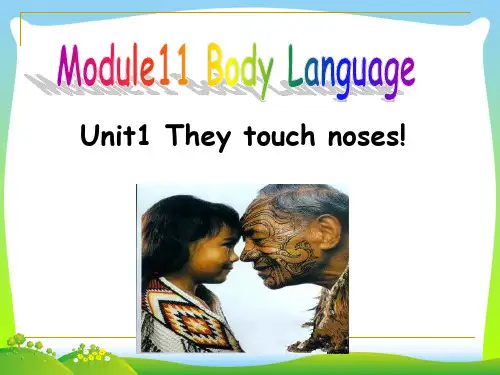
S3:They touch their noses.
S4:They kiss to greet each other.
T:Good.What about the other pictures?
S5:The girl is smiling.
S6:They bow to each other.
T:Excellent.
Give students several minutes to discuss with their partner which country may use the body language above.
设计意图:通过展示图片并提出问题让学生思考讨论,引起学生的学习兴趣;同时让学生了解一些常见的肢体语言,从而自然地过渡到本课的学习上。
环节2学习活动1-3
1.让学生浏览活动1中的单词和短语,了解其意思,并观察右边的三幅图片,从这些图片中选择与词或短语意思相符的图片。
教师带领大家一起核对答案。
2.让学生浏览并熟悉活动2下方的国家名称,教师播放录音,学生认真听并完成活动2的听力任务。
教师随机邀请三名学生起来分享他们的答案,稍后教师核对答案。
3.让学生根据活动1的图片内容,仿照活动2给出的例子,与同桌进行对话练习,教师可随机抽两三组学生在班上表演对话,教师给予点评。
4.学生快速阅读活动3的对话,随后教师播放活动3的录音,学生认真听并轻声跟读,整体把握对话内容。
5.让学生仔细阅读活动3的对话,包括“Everyday English”中的内容,将其中的生词、重要短语和难句标记出来。
教师随后讲解本课时的重难点知识,在讲解的过程中可以适时邀请学生进行讲解、分析或翻译,然后补充讲解学生仍有疑惑的地方。
6.让学生再通读一遍活动3的对话,根据对话内容,从对话后的方框中选择适当的单词并用它们正确的形式完成表格填空。
教师邀请两名学生分享自己的答案,然后订正答案。
7.教师邀请两名学生分角色表演活动3的对话。
学生在表演对话的同时,教师应注意学生的发音问题,并及时指正。
8.教师讲解Learning to learn 的内容,并邀请两名学生翻译其大致意思。
9.要点点拨。
(1)We Chinese often shake hands and smile when we meet visitors, and sometimes we nod our heads.
①shake v.握手。
shake hands with sb.意为“与某人握手”。
shake的过去式为shook。
②nod v.(点)头。
其第三人称单数形式为nods,过去式和过去分词均为nodded,现在分词为nodding。
常用搭配:nod one's head 点头;nod to sb.向某人点头示意。
(2)That's because people do different things in different countries.
That's because ...那是因为…… because引导表语从句,作is的表语,表示某事发生的原因。
(3)In the US some people shake hands, and some kiss or hug each other.
①each other意为“相互”,相当于one another。
例:We respect each other/one another.我们互相尊重。
②each pron.每个。
它强调个体,指两者或两者以上中的每一个。
each of意为“……中的每一个”,其后可接代词/名词的复数形式;若接名词,名词前需加限定词。
该结构作主语时,谓语动词习惯上使用第三人称单数形式。
10.学以致用。
(根据汉语意思完成句子)
(1)在中国,人们初次见面时应该握手。
People in China should shake hands when they meet for the first tim
(2)“他今早为什么迟到了?”
“那是因为他起得太晚了。
”
—Why was he late for class this morning.
—That's because he got up too late.
(3)玛丽刚才向我点头示意。
Mary nodded to me just now.
(4)他们中的每个人都有其优点。
Each of them has his advantages.
(5)今天学校来了一些德国人。
Some Germans came to our school today.
设计意图:通过听力练习,培养学生在听力过程中获取重要信息的能力;通过分角色表演对话,既可以培养学生之间相互合作的默契,又可以提高他们的口语表达能力;通过练习,可以让学生巩固本节课所学的知识。
板书设计
练习设计
请完成本课对应训练!。
七年级英语下册Module11Unit1课精品课件外研版

a mountain.
A train is going through the tunnel now.
Activity4.Read and answer these questions:
1. What did Zhan Tianyou do? He built a famous railroad. 2. When did Zhan Tianyou die? He died in 1919. 3. Where did the railroad start? It started in Beijing. 4. Where did it finish? It finished in Zhangjiakou .
5.Why didn’t the government want
foreign engineers?
Because they wanted a Chinese engineer to build it. 6.When did Zhan Tianyou work on it? He worked on it from 1905 to 1909. 7.What did the Chinese do when he died? They opened a museum about his life.
They are patriotic.
She was a heroine. Lin Zexu (1785-1850)
He was born in Hulan (1932-1947)
Who was he/she? Chairman
(1893-1976)
1. Who was he? He was Zhan Tianyou. 2.What did he do?
外研版初中英语七年级下册教案:Module11

Module 11 National heroes一、题材内容本模块以民族英雄为话题, 向学生介绍历史上的民族英雄詹天佑及当今的航天英雄杨立伟。
介绍杨立伟的文章是以报刊材料形式出现的,学生可以围绕这一话题进行大量的听、说、读、写方面的语言实践活动, 展示一般过去时的特殊疑问句应用,让学生在使用语言的过程中学习语言,促使学生更有意识地自觉学习英语。
语法难点仍是动词的一般过去时句子的用法。
要求读懂、听懂与介绍历史人物有关的描述,明白故事的中心大意、时间、地点、人物关系、原因、结果等;准确理解并运用一般过去时的表达方式。
教学中教师应随时随地灵活利用各种素材组织教学过程和内容。
充分调动学生的积极性。
教学目标5)情感态度:在用英语交流时要有礼貌,尊重对方,感受学习的乐趣。
参加各种英语活动,克服困难,在新环境中进一步树立准确的语言学习观。
6)任务:能够运用一般现在时和一般过去时谈论人物。
教学重点和难点重点:1.通过谈论民族英雄训练学生的听、说、读、写能力,掌握一般过去时特殊疑问句。
难点:掌握一般过去时的特殊疑问句,养成正确使用一般过去时的能力。
教学方法基于课程改革的理念及“第二语言习得论”,培养实现人的可持续发展和人的主体精神的自我完善和发展所必需的能力和素质,运用任务型教学途径,围绕核心任务,设定小任务,开展和谐愉悦的课堂活动,强调兴趣第一的原则,初步设计“P—T—P”自主学习立体模式:pre-task…task-cycle…post-task。
二、教材处理核心任务:能够运用所学句型结构谈论人物。
三个环节如下:pre-task:学生联系生活实际,激活背景知识,。
task –cycle:通过整个模块的听说读写的训练,强化描述过去的经历的表达能力,为完成任务做好铺垫post-task:达成任务,展示成果,反馈学习情况三、教材安排根据学生学习英语的特点和规律,我们把本模块划分为4课时:Period 1: V ocabulary and Listening &Pronunciation and SpeakingPeriod 2: Reading and V ocabularyPeriod 3: Writing& Around the world &Module TaskPeriod 4: Language in use注:教学时应根据学生的学习水平、生活实际水平、接受程度及课堂出现的临时状况进行运用、调整及筛选。
外研版七年级英语下册Modele11 Unit1 优质课课件(共13张PPT)
What are they doing?
They are _b_o_w_i_n_g_________.
_k_i_s_si_n_g_________.
_t_o_u_c_h_i_n_g_n_o_s_e_s__.
_s_h_a_k_i_n_g_h_a_n_d_s___. He is from_C_h_in_a.
German( ) India ( )
Maori People
Listen and answer
1: Who will Linging meet tomorrow?
Russia or Russian
2: What will she do to welcome the visitors?
In _R_u_s_s_ia, people usually _k_is_s_t_h_r_e_e_t_im_e_s,
_s_m__il_in_g_________. _h_u_g_g_i_n_g________.
He is_C_h_in_e_s_e.
_n_o_d_d_i_n_g_t_h_e__h_e_a_d_____.
_p_u_t_t_in_g__h_a_n_d_s_t_o_g_e_t_h_e_r.
He is from_J_a_p_a_n.He is from_I_n_d_ia. He is from_R_u_ss_i_a. He is_J_a_p_a_n_es_e_. He is_I_n_d_ia_n_. He is_R_u_s_si_a_n. He is_B_r_it_is_h_. She is__G_er_m__an_. He is_F_r_e_n_ch__.
__le_f_t_, r_i_gh_t_,_l_ef_t_ when they meet visitors.
外研版七年级下册英语Module11 Unit1课件(共25张PPT)

• 6. Maori people touch faces when they
meet. ×
In China Shake hands and smile
In Russia Kiss three times, left, right, left
In America
Shake hands
hug
In India Put hands together and nod their head
Maori people Touch noses
Read and complete the table.
In China, peopleshake hands and
left, right, left.
Conclusion
• In this unit, we learnt what people in Russia, China, India, the US do when they meet visitors. They have different greetings. Why ?
when they meet visitors. √ • 3. Chinese never kiss. ×
• 4. Americans shake hands, and some
kiss or hug each other. √
• 5. People put their hands together and
SpБайду номын сангаасaking contest
• Make small dialogues according to the form given (根据前面的表格内容编对话,一问一答).
外研版七年级下Module11 Unit1课件(共13张PPT)
• an American
• a Russian
Listen and repeat.
[tʃ] Chinese each French teacher touch
[ʃ] British shake [pl] people [fr] French [br] British
Exercise
I. 根据首字母及句子意思,填入恰当的词。
A. shake hands
B. touch noses
C. hug each other
Read and complete the table with the correct form of the words from the box.
India kiss Russia together touch visitor
— I smile, say hello and kiss each other three times.
— What do you do and say when you meet your
parents after school? — Kiss and hug each other. — What do you do and
say when you meet your teacher in the morning? — I smile and say good morning.
• your teacher • your head teacher • your parents after school • your best friend • your best friend’s parents • your favourite film star • a visitor to your school
初中英语外研版七年级下册《Module11Unit1》教学课件PPT

2)Miss Yang is shaking hands with my
bother.
摇晃
总结shake 的用法(1)_____s_h__ake hand with sb
(2) 和某人握手________________ 3)我的爸爸正在is 跟一个德sh国ak人in握g手。hands
Mwy iftahther __G__e_r_m_ a_n_______ _________ _______a
1. 请把那些红苹果放在一起。 Please ___p__u_t_ those red appletsog__e_t_h__e_r_.
2. 他们经常点头当他们碰面的时候。 They oftenn__o_d_____ __t_h_e__ir__ _h__e_a_d__swhen they
meet. T3h.a那t’是s因为b她e不ca会us打e 篮球。
________ ________ she can’t play basketball. 4. 见到朋友s时ha我ke们通常h握an手d。s
__________.
4)我很高兴因为周杰伦刚才和我握手s了ho。ok
I haamndsos hapwpiythbecaumseeJay Chou _______
________ ________ ______ just now.
PART 02
教学过程
2. three times 三次 一次___o__n_c_e___
Module 11 Unit One Body language
外研版初中英语七年级下册课件
教学目标
目
教学过程
录
教学重点
拓展练习
PART 01
教学目标
外研版英语七年级下册Module11Unit1Theytouchnoses课件
【重点探究1】 shake hands作动词短语,意为“握手”,shake hands with sb.意为“与某人握手”。 Do you shake hands with your friends when you meet them? 你和朋友见面时会握手吗?
在美国,有些人握手,有些人亲吻或彼此拥抱。 【重点探究1】 each other 构 成 固 定 短 语 , 意 为 “ 互 相 ” , 相 当 于 one another。
【重点探究2】 each指两个或两个以上的人或事物中的“每个”。each作 形容词时修饰单数名词;作代词时,单独使用,充当主语时谓 语动词使用单数形式。each of...作主语时,谓语动词使用单数 或复数形式均可。放在复数名词和代词后作同位语时,谓语动 词使用复数形式。 He gave a book to each of his parents.他给他父母各送了一本 书。 He gave each boy an apple.他给每个男孩一个苹果。
动词(v.):
1.bow / ________ / 鞠躬;弯腰
2.________ /ʃeɪk/ 摇晃
C.quickly D.correctly
3.nod / ________ / 点(头) ): ________ /'brɪtɪʃ/ 英国的;
shake hands作动词短语,意为“握手”,shake hands with sb.
代词(pron.): each / ________ / 各个;每个
副词(adv.): ________ /tə'geðə/ 一起;共同
兼类词: 1.kiss / ________ / v.&n.吻;亲吻 2. ________ /smaɪl/ v.&n.微笑
外研版七年级下册英语 Module 11 unit 1 They touch noses导学案设计
4.Finish Activity 4 and 5.
合
作
探
究
导
学
过
程
四
步
设
计
交
流
展
示
【交流展示】
一、辨析1:“time”
1.time表示“时间”时是不可数名词
2.time表示“次数”时是可数名词。three times意为“三次”,一次是“once”;两次是“twice”;三次或三次以上用“基数词+times”
重点
难点
祈使句的用法经典句型:
(1)That’s because people do different things in different countries.(2)I don’t know that.
导学
模式
自学--------展示-------反馈
导学策略及学法指导(师生互动设计)
导
学
过
程
4.如果你看见他们,就点点头。
If you see them, please _________ __________ _________.
5.这里是一些欢迎他们的方法。
_________ ___________ some ways to welcome them.
6.触摸人怎么样?
____________ __________ touching people?
B.填空
1.那是因为我们都累了。_________ __________ we are all tired.
2.你知道他们来自哪里吗?
Do you know _________ _________ __________ from?
外研版英语七年级下册Module11_Unit 1 第2课时单元教案与反思
Unit l 第2课时原创不容易,为有更多动力,请【关注、关注、关注】,谢谢!东宫白庶子,南寺远禅师。
——白居易《远师》自主学习方案1.学生自学新词汇(见教材P109)。
2.学生自学教材(P67),找出课文中重点词组和句子。
课堂导学方案Step 1情景导入教师播放一些国家见面时的礼节的幻灯片,然后邀请同学们跟着学习,同学们一定会兴致勃勃地学习。
Step 2完成任务3的后续任务用下列方框里的词的适当形式填空。
2.小结训练。
(1)在中国,人们(见面时)握手和微笑。
In China people shake hands and smile.(2)美国人(见面时)握手有时互相拥抱。
American people shake hands and sometimes hug each other.(3)在印度,人们把手放在一起。
In India, people put their hands together.环节说明:通过阅读短文2,可提高学生阅读理解的能力和概括能力。
小结训练让学生掌握本节重点语法和词汇。
Step 3完成教材4~5的任务1.听并重复单词,完成任务4。
2.小组练习。
讨论一下你碰见……时候做什么、说什么。
参考案例Step 4问题探究1.three times 意为“三次”,其他表示次数的词有 once“一次”,twice “两次”,三次以上用“基数词+ times”来表示。
2.【辨析】sometime & some time & some times(1)sometimes是频率副词,它暗指某动作(在过去、现在或将来)有时候重复。
(2)sometime用作副词,表示某个不确切或不具体的时间,表示“某个时候”,它后面应该接一个过去或将来的时间。
(3)some time 表示“一些时间”或“一段时间”,可以用作名词或副词短语。
some time表“某一段时间”时,常常修饰延续性的谓语。
外研版七年级英语下册Modele11 Unit 1 优质课课件
1. Who will come to Lingling’s school? Some Russian teachers.
2. What will Maori people do when they meet? They will touch noses.
Now complete the table with the correct form of the words from the box.
2. Chinese often _____ when they meet. A. shake hands B. shakes hands C. touch noses
3. They help ______ when they are in trouble. A. each B. each other C. the other
India kiss Russia together touch visitor
In China, people shake hands and smile American people shake hands and sometimes (1) __kut when they
5. They touch noses! touch noses 表示“碰鼻子”。
6. That’s because people do different things in different countries. That’s because … 表示“那是因为……”。
1. Some ______ visit the Great Wall every year. A. visiter B. visitor C. visitors
3. And some kiss or hug each other. each other 表示“彼此,互相”, 通常