
七年级下Unit4说课稿
说课稿 我说课的内容是新目标英语七年级下Unit12 Don't eat in class。本节课根据新课标提出的以学生为本的教学理念,注重学生兴趣和实际应用英语能力的培养,把掌握知识,形成技能,发展能力与培养学生个性健康发展结合起来,努力创设真实情境,在真实的情境中培养学生英语学习的积极情感和语言实践能力、文化意识,为学生的可持续发展打下坚实基础。接下来我将从教材,教学目标,重难点,教法,学法,教学程序设计,板书设计这七个方面进行我的说课。 一、说教材 本单元是人教版《新目标》七年级下册的第四单元。总体而言,这本教材的词汇量很大,有难度,但是,内容新颖,尤其是生动活泼的卡通化的画面,很符合七年级学生的年龄特点和心理特点,其中还囊括了丰富多彩的文化知识,以及合作探究的活动,十分贴近学生的实际生活经验。本单元的话题Talk about rules.与日常生活密切相关。作为一名中学生,遵守校纪班规家法,和社会公共场所的规章制度是必须的。在谈论规则时,一般运用祈使句、情态动词can和have to等。这是英语新课程标准中规定所必须掌握的内容,是交际英语中必不可少的项目。因此,本单元对于提升学生的学习兴趣和提高学生的听、说、读、写能力都有很大的帮助。本课由两部分构成,第一部分通过学习学校的规章制度展示祈使句和情态动词can的用法,第二部分通过听力和模仿制定各部门的规章制度,对所学祈使句进行巩固和强化。初中生对英语学习具有较浓厚的兴趣,求知欲旺胜,而且在前面的教学中学生们已经涉及了一些祈使句的用法,而本课主要学习一些校规,比较贴近学生们的生活实际,学生们渴望知道用英语如何表达校规校纪,因此它为本课学习垫定了情感上的基础。 二、说教学目标 根据新课标的要求,结合教材内容及七年级学生的认知特点,我确定目标如下: 1.语言知识目标: (1) 掌握词汇:rule, arrive, classroom, hallway, outside, fight, uniform, sports shoes, gym, dining hall, (2) 掌握语法:祈使句,情态动词can/ have to 的用法。 (3) 掌握交际用语:Don’t eat in class! Can you wear hats in school? Do you have to wear a uniform at school;? What do you have to do …… What are the rules ? No talking! 2.语言技能目标: (1) 能正确使用情态动词can,have to和祈使句。 (2) 能熟练使用目标词汇和语言,围绕规章制度展开话题,发表自己的看法与观点。 3.学习策略目标: (1)通过组织学生进行听说读写训练活动,提高学生听说读写技能。 (2)促使学生在课内学习活动中能够用英语与他人交流。 4.情感态度目标: 通过合作与竞赛等小组活动形,增强学生的集体荣誉感,培养学生的合作意识和竞争意识。 5.文化意识目标:了解不同场合中应该遵守的不同规则,通过对规章制度的学习与讨论,教育学生从小规范自己的行为。 三、重难点 1.重点: (1) 掌握词汇:rule, arrive, classroom, hallway, outside, fight, uniform, sports shoes, gym, dining hall, (2) 掌握语法:祈使句,情态动词can/ have to 的用法。 2.难点: 能熟练使用目标词汇和语言,围绕规章制度展开话题,发表自己的看法与观点。 四、说教法 (1)直观教学法:充分利用图片与实例,创设真实的情景,引起学生学习兴趣。 (2)听说教学法:以听、说、读、写、练为主,通过对本课重点句型的学习培养学生听力、口语以及书面语的能力。 (3)任务型教学法:设计各种活动如结对活动、小组合作,促使学生为用而学,增强集体荣誉感。 五、说学法 (1)自主学习:能提前预习课文及相关知识,使其对教师教学内容起补充作用。 (2)合作探究学习:采用小组合作的学习方式,使他们能够相互交流,从而获得知识和技 能,能体会到成功的快乐。 六、教学程序设计
Ⅰ. Warming-up and revision (5)
做一个小游戏:教师使用祈使句请学生们完成一系列动作: Please stand up/ sit down. Close the door, please. Look at me and listen to me. Don’t open your books. Don’t talk. Let’s begin our class. 学生听教师的指令完成各种动作,教师也可将指令写到黑板上,让学生从视觉上考察祈使句的特点。 Ⅱ. Presentation(10) 教师播放视频,向学生提问。 T:What’s the boy doing? S: He’s running. T: Where is he running? S: He’s running in the hallways.(板书,教读) T:Can you run in the hallways? S: No, I can’t. T: So please don’t run in the hallways.(板书,教读) (= You can’t run in the hallways.) 学生跟读数遍,明白祈使句和“can”的表达含意。 T:Why is he running in the hallways? S: He’s late. T: Oh, he’s late for class.(板书,教读) You can’t arrive late for class.(板书,教书) = Don’t arrive late for class. … Ⅲ. 1a T: Now, Look at the picture on your textbook. Each of the students is breaking one of these rules. Please finish 1a. 学生看图,完成1a的内容,检查答案并大声朗读校规。 Ⅳ. Listening 1. T: Now let’s listen! What rules are these students breaking? Write the numbers after names? 2. 学生们听录音,完成1b,选出四位学生都违反了哪条校规;听之前,学生要读会英文名。 3. Check the answers: Ⅴ. Pair work 请两位学生朗读1c部分的句型;要求学生两人一组对话表演,SA扮演外校转来新生,SB告知本校校规。(学生可经过讨论,多说出他们想到的校规,不必只限于书上;教师应给予帮助) Ⅵ. Listening 1. Work on 2a: First, let's read the sentences in 2a together. T: Now, let's listen to the recording. Check the activities Alan and Cindy talk about. Ss listen to the recording and check the activities they hear. Play the recording again for the Ss to check the answers. 2. Work on 2b: Make Sure Ss know what they should do. Listen to the recording again. Can Alan and Cindy do these activities? Circle can or can't above. 3. Check the answers: Ⅶ. Pair work 1. Suppose you are Alan and your partner is Cindy. Talk about the rules in 2a. 2. Let some students come to the front and act out the conversations. Ⅷ. Role-play one or two students play the scene of breaking the rule. one plays the teacher to tell the students what can\can’t he or she do. Act a short play. ( Don't be late for school. Don't bring music players to school. You always have to wear the school uniform. You have to be quiet in the library. ) 七、板书设计 本课板书设计为纲目式
Section A (1a-2d) Main sentences: 1. Don't arrive late for school. You must be on time. 2. —What are the rules? —Well, we can't arrive late for class. We must be on time. 3. Listen to music in the music room. 4. We always have to wear the school rules. 5. We have to be quiet in the library.
[七年级(下)Unit4教案]七年级下unit4教案
![[七年级(下)Unit4教案]七年级下unit4教案](https://360docs-1393072327.cos.ap-beijing.myqcloud.com/c6241cff4431b90d6d85c728.webp)
[七年级(下)Unit4教案]七年级下unit4教案<b style=“mso-bidi-font-weight: normal“>七年级英语公开课教案<b style="mso-bidi-font-weight: normal"> <o:p></o:p><b style="mso-bidi-font-weight: normal"><b style="mso-bidi-font-weight: normal">课<b style="mso-bidi-font-weight: normal"><b style="mso-bidi-font-weight: normal">题<b style="mso-bidi-font-weight: normal"><b style="mso-bidi-font-weight: normal">七年级(下)Unit4 Section A <st1:chmetcnv w:st="on" unitname="a" sourcevalue="1" hasspace="false" negative="false" numbertype="1" tcsc="0"> 1a </st1:chmetcnv> <st1:chmetcnv w:st="on" unitname="c" sourcevalue="1" hasspace="false" negative="true" numbertype="1" tcsc="0"> -1c </st1:chmetcnv><b style="mso-bidi-font-weight: normal"><b style="mso-bidi-font-weight: normal">课型<b style="mso-bidi-font-weight: normal"><b style="mso-bidi-font-weight: normal">新课<b style="mso-bidi-font-weight: normal"><b style="mso-bidi-font-weight: normal">课<b style="mso-bidi-font-weight: normal"><b style="mso-bidi-font-weight: normal">时<b style="mso-bidi-font-weight: normal"><b style="mso-bidi-font-weight: normal">1<b style="mso-bidi-font-weight: normal"><b style="mso-bidi-font-weight: normal">授课<b style="mso-bidi-font-weight: normal"><b style="mso-bidi-font-weight: normal">时间<b style="mso-bidi-font-weight: normal"><b style="mso-bidi-font-weight: normal"> <o:p></o:p><b style="mso-bidi-font-weight: normal"><b style="mso-bidi-font-weight: normal">授课班级<b style="mso-bidi-font-weight: normal"><b style="mso-bidi-font-weight: normal"> <o:p></o:p><b style="mso-bidi-font-weight: normal"><b style="mso-bidi-font-weight: normal">授课地点<b style="mso-bidi-font-weight: normal"><b style="mso-bidi-font-weight: normal"> <o:p></o:p><b style="mso-bidi-font-weight: normal"><b style="mso-bidi-font-weight: normal">授课人<b style="mso-bidi-font-weight: normal"><b style="mso-bidi-font-weight: normal"> <o:p></o:p><b style="mso-bidi-font-weight: normal"><b style="mso-bidi-font-weight: normal">教<b style="mso-bidi-font-weight: normal"><b style="mso-bidi-font-weight: normal">学<b style="mso-bidi-font-weight: normal"><b style="mso-bidi-font-weight: normal">目<b style="mso-bidi-font-weight: normal"><b style="mso-bidi-font-weight: normal">标<b style="mso-bidi-font-weight: normal"><b style="mso-bidi-font-weight: normal">知识与能力<b style="mso-bidi-font-weight: normal"><b style="mso-bidi-font-weight: normal">1, words: assistant. sales assistant. doctor. reporter. police. officer. police officer. waiter. bank. clerk. hospital. show. star<b style="mso-bidi-font-weight: normal"><b style="mso-bidi-font-weight: normal">2. What do you want to be? 3. What does she do?<b style="mso-bidi-font-weight: normal"><b style="mso-bidi-font-weight: normal">I want to be a doctor. She’s a doctor.<b style="mso-bidi-font-weight: normal"><b style="mso-bidi-font-weight: normal">过程与方法<b style="mso-bidi-font-weight: normal"><b style="mso-bidi-font-weight: normal">师生互动,共同完成教学目标。
七下北师大版Unit4旅游拓宽视野,感受自然之美说课稿初中英语核心素养学科教学专题培训系列

3.听力练习:播放一段关于旅游的短文或对话,让学生回答相关问题,检验他们的听力理解能力。
4.书面练习:设计一些填空、改写句子等书面练习,让学生在纸上完成,巩固语法和词汇知识。
(四)总结反馈
在总结反馈阶段,我将采取以下方式引导学生自我评价并提供有效的反馈和建议:
1.让学生自我总结本节课学到的知识点,分享自己的学习体会和收获。
2.通过提问或小测验的方式,检验学生对知识点的掌握情况,并给予及时的反馈。
3.针对学生的表现,提供个性化的建议和指导,鼓励他们继续努力,改进学习方法。
4.对学生的进步给予肯定和表扬,增强他们的自信心和成就感。
(五)作业布置
课后作业的布置情况如下:布置一篇关于描述个人最难忘的旅游经历的短文,要求学生运用本节课所学的词汇和句型,以及一般现在时和一般过去时。作业的目的是巩固学生的书面表达能力,同时让他们在实践中运用所学知识,提高语言应用能力。此外,我还将布置一些在线学习资源,如英语学习网站或视频,让学生在课后自主学习和拓展知识。
4.引导学生进行思考和讨论,如询问他们最喜欢的旅游地点、旅游经历等,激发他们的学习兴趣和积极性。
5.针对学生的反馈,进行针对性的讲解和辅导,确保学生能够理解和掌握知识点。
(三)巩固练习
为了帮助学生巩固所学知识并提升应用能力,我将设计以下巩固练习和实践活动:
1.小组讨论:让学生在小组内分享自己的旅游经历,用英语描述旅游地点和感受,互相纠正错误。
5.对学生的进步给予及时反馈和鼓励,增强他们的自信心和学习动力。
”。
三、教学方法与手段
(一)教学策略
本节课我将主要采用以下教学策略:任务型教学法、情境教学法和合作学习法。任务型教学法强调以学生为中心,通过完成具体的任务来学习语言,这有助于提高学生的实际语言运用能力。情境教学法通过创设真实或仿真的语言环境,帮助学生更好地理解语言和运用语言。合作学习法则鼓励学生之间相互协作,共同完成任务,这有助于培养学生的团队精神和沟通能力。选择这些方法的理论依据是它们能够激发学生的学习兴趣,促进学生的主动参与和知识内化,同时符合语言学习的交际性和实践性特点。
冀教版英语七年级下册unit1Lesson4说课稿

1.知识与技能目标:学生能够掌握表示家庭成员的英文单词和短语,如mother, father, sister, brother等,并能够运用这些词汇组成句子进行表达。
2.过程与方法目标:通过小组合作、角色扮演等方式,学生能够运用所学知识进行实际交流,提高口语表达能力。
3.情感态度与价值观目标:通过本节课的学习,学生能够增强对英语学习的兴趣,培养积极的家庭观念,学会尊重和关心家人。
五、板书设计与教学反思
(一)板书设计
我的板书设计将注重清晰性、简洁性和知识结构的把握。布局上,我会将板书分为几个部分,包括家庭成员词汇的列表、句型结构示例和相关练习。主要内容包括本节课所学的家庭成员词汇、句型结构和练习题目。风格上,我会使用简洁明了的字体和颜色,突出重点信息。板书在教学过程中的作用是提供清晰的视觉辅助,帮助学生理解和记忆知识点,同时方便学生进行复习和回顾。为确保板书清晰、简洁且有助于学生把握知识结构,我会提前进行规划和设计,并在教学过程中根据学生的反馈进行适当的调整。
(二)教学反思
在教学过程中,我预见到可能出现的问题或挑战包括学生对家庭成员词汇的理解和运用、在实际交流中的紧张和害羞等。为应对这些问题,我将提供及时的反馈和指导,通过重复练习和鼓励学生积极参与来加深他们对词汇和句型的理解。同时,我会给予学生更多的机会进行实际交流,如小组合作和角色扮演,以提高他们的口语表达能力。
(三)互动方式
在师生互动环节,我计划采用提问、回答、讨论等方式。通过提问,我可以了解学生对家庭成员词汇和句型的掌握情况,及时进行反馈和指导。回答和讨论则可以激发学生的思考,培养他们的口语表达能力。在生生互动环节,我将设计小组合作和角色扮演等活动。小组合作让学生在小组内互相介绍家庭成员,提高他们的合作能力。角色扮演则可以让学生在实际语境中运用所学知识,增强他们的语言实践能力。通过这些互动方式,我希望能够促进学生的积极参与和合作,提高他们的学习效果。
七年级下册北师大版Unit2Lesson4HelpingatHome(第二课时)说课稿
板书在教学过程中的作用是帮助学生构建知识结构,强化记忆。为确保板书清晰、简洁且有助于学生把握知识结构,我将遵循以下原则:1.突出重点,避免冗余;2.逻辑清晰,体现知识间的内在联系;3.注重美观,吸引学生注意力。
(二)教学反思
(四)总结反馈
在总结反馈阶段,我将采取以下方式引导学生自我评价并提供有效的反馈和建议:
1.让学生回顾本节课所学内容,进行自我评价,总结自己在课堂上的收获和不足;
2.组织学生互相评价,鼓励他们提出建议和改进措施;
3.教师针对学生的表现给予积极反馈,强调优点,指出不足,并提出针对性的改进建议。
(五)作业布置
在教学过程中,我预见到以下可能出现的问题或挑战:
1.部分学生对情态动词can的用法掌握不够牢固;
2.口语练习中,部分学生可能因紧张或词汇量不足而无法积极参与;
3.课堂时间分配不合理,可能导致某个环节过于紧凑或拖延。
为应对这些问题,我将采取以下措施:
1.针对情态动词can的用法,设计更多的例句和练习,帮助学生巩固;
(三)学习动机
为了激发学生的学习兴趣和动机,我拟采取以下策略或活动:
1.创设真实情境,让学生在角色扮演中体验学习的乐趣;
2.设计有趣的游戏和竞赛,激发学生的学习积极性;
3.鼓励学生积极参与课堂讨论,给予肯定和表扬,增强他们的自信心;
4.结合学生的生活实际,引导他们认识到学习英语在生活中的实用性,提高他们的学习兴趣。
三、教学方法与手段
(一)教学策略
我将采用任务型教学法、情景教学法和合作学习法作为主要教学方法。这些方法的选择基于以下理论依据:
1.任务型教学法:该方法强调学生在完成实际任务的过程中运用语言知识,有助于提高学生的语言运用能力和解决问题的能力。通过设置与家务相关的任务,让学生在实践中学习和掌握目标语言。
人教版英语七年级下册《Unit 4 Section B 1a-1d》课件
f
clean his room
√
before dinner
√
after dinner
in the evening
√
every morning
√
every Saturday
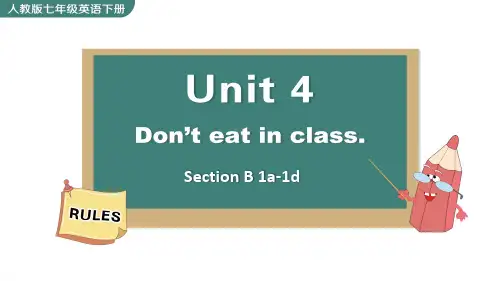
1d Talk about the rules in Dave’s house.
He can’t watch TV in the evening.
A: Can you …? B: Yes, I (we) can./No, I (we) can’t.
go out on school nights
A: Do you have to …? B: Yes, I (we) do./No, I (we) don’t.
do your homework after school
He can’t go out on school nights.
He can’t see his friends on school days.
He has to do his homework after school.
He has to help his mom make breakfast every morning.
He must practice the guitar before dinner.
He must clean his room every Saturday.
Report Dave’s rules. See who is the best.
七年级下册英语优质教案unit4

七年级下册英语优质教案unit 4推荐文章人教版七年级下册英语单词表2021版热度:人教版七年级下册英语单词表2021新版热度:人教版七年级下册英语课本单词表热度:人教版七年级下册英语单词表默写热度:人教版七年级下册英语单词默写热度:英语教案还可以给教师带来更多的反思,更好地促进七年级英语教师的专业成长与发展。
下面是小编为大家精心整理的七年级下册英语优质教案unit 4 ,仅供参考。
七年级下册英语优质教案unit 4 范文Period l Section A(la-lc)I.教学准备1.教师:制作课件;准备录音机、磁带和la部分的教学挂图。
2.学生:搜集一些常见的标识,并画在纸上。
Ⅱ,教学目标1.通过看图会话、师生问答、听录音、角色扮演等形式,掌握arrlve,listen,fight和rule,sorry等词。
2.通过师生问答、角色扮演等形式,学会“Don't+动词原形”以及“We can't/must…‟等句子结构,并能用英语谈论、描述学校里的规章制度。
Ⅲ.教学重点1.本课时出现的arrlve,listen,fight,rule,sorry.等词;2.祈使句。
Ⅳ.教学难点1.can表示请求的用法;2.must表示命令或建议的用法。
V.教学步骤Step I: Revision&Warming-up建议1:通过师生自由交际进行复习与热身。
教师问学生一些事情能不能做,为导入新课做准备。
For example:T:Can we play football in the street?Sl:No,we can't.T:Yes. Don't play football in the street. It's dangerous. Can we sleep in class?S2:No,we can't.T:Yes,you are right. Don't sleep in class.建议2:教师呈现一组禁止标识,通过谈论这些标识进行课前热身。
Unit 1 Section A 1a~pronunciation说课稿2025人教版七下
课题人教版七年级下册Unit 1 Animal friends Section A 1a-pronunciation说课稿课型新授时间课时 1 主备人一、说教材本单元的主题是“动物朋友”,旨在通过学习与动物相关的词汇、句型和对话,培养学生对动物的热爱和保护意识,同时提高学生的英语语言运用能力。
Section A 1a-pronunciation 部分是本单元的基础,通过图片展示和听力练习,引入了各种动物的词汇,并对部分发音规则进行了初步的讲解和练习。
这部分内容不仅为后续的学习打下了词汇和语音基础,也为学生的口语表达和听力理解提供了必要的支持。
二、说学情七年级的学生正处于身心发展的关键时期,他们对新鲜事物充满好奇心,具有较强的模仿能力和表现欲。
经过一段时间的英语学习,他们已经掌握了一定的基础词汇和基本句型,但在语音语调方面还存在一些问题,需要进一步的指导和练习。
同时,学生对动物话题比较感兴趣,这为教学活动的开展提供了有利条件。
三、说教学目标基于对教材和学情的分析,我将本节课的教学目标设定为:(一)语言知识目标1. 学生能够正确认读和拼写fox、lion、tiger、giraffe、monkey、wolf、penguin、eagle 等动物词汇。
2. 学生能够理解并运用以下句型:What's your favourite animal? It's the monkey. Why do you like monkeys? Because they're clever and funny.3. 学生能够掌握元音字母及组合ai、ay、aw 的发音规则,以及名词复数和弱读单词的发音方法。
(二)语言技能目标1. 学生能够听懂关于动物的简单对话和指令,并能做出正确的反应。
2. 学生能够用英语谈论自己最喜欢的动物及其原因,表达流畅、语音语调基本正确。
(三)情感态度目标1. 培养学生对动物的热爱之情,增强保护动物的意识。
人教版新目标 初中英语 七年级英语下册说课稿
一、说教材 1.教材分析 本单元的核心教学内容是“谈论自己在某方面所具有的能力”(Talking about abilities),整个单元的内容都是围绕情态动词 can 展开的。通过本单元的学习,使学生能 够运用情态动词 can 表达自己某一方面所具有的才能,谈论自己的喜好与意愿,能自荐或参 加各种课外俱乐部,并制作海报而且学会写出招聘广告。并让学生在实践中学会和使用目标 语,鼓励学生积极参加稳中有降种课外各种文体活动,培养学生的多方面才华及团队精神。 而本课是这一单元的第一课时,通过对本节课词汇和句型的学习,学生能够运用所学知识去 表达他们能做些什么,并能开展为参加兴趣小组的调查活动,通过以上活动的开展为后面的
一、分析教材 本课是人教英语七年级下册的内容,本单元主要围绕“会做什么”这个话题展开,初步 掌握本单元的语法项目“情态动词 can”的用法。本单元的一个突出特点是:语言目标和语 言功能能够有机结合起来,即使用情态动词 can 来谈论学习自己某一方面所具备的能力。本 课是本单元的第一课时,要求学生掌握新的词汇和重点句型。要求学生根据自己的爱好选择 自己喜欢的俱乐部,并会表达自己在该俱乐部中会做什么。 二、分析学生 七年级学生性格特点是活泼好动,参与活动的热情会很高。面对可塑性很强的学生,作为 英语教师,我们一定要保护他的对英语学习的热情。让学生运用所学知识来解决问题。 三、教学目标及要求 1、知识目标: (1)单词:sing ,dance, play the guitar, join ,speak English, play chess , swim (2) 重点句型:Can you… ? Yes , I can. No, I can’t . What club do you want to join? I want to join the music club. 2、能力目标: (1)掌握用情态动词表达自己在某方面的才能,谈谈彼此的特长与爱好。 (2)通过相互的对话练习,培养学生的群体意识和合作能力。 3、情感目标: 通过学习,让学生意识到能力在社会上的重要性,从而激发学生不断进行探究,自主学 习意识,为自己的人生道路积累更多的、更丰富的才艺。 四、教学重点、难点 本课中的重点内容是使用情态动词 can 谈论自己在某一方面所具有的能力。 难点是:can 的一般疑问句,用情态动词 can 来谈论彼此的特长与爱好。 五、教具:图片,录音机 六、教学方法 (说教法) 根据教材内容和学生因素的特点,我主要采用下列教学方法和手段。 (1)图片教学:利用图片来激起学生的兴趣,并培养学生的观察能力。
外研版英语七年级下册Module4Unit1《Everyonewillstudyathome》说课稿
外研版英语七年级下册Module 4 Unit 1《Everyone will study at home》说课稿一. 教材分析外研版英语七年级下册Module 4 Unit 1《Everyone will study at home》是一篇关于家庭学习主题的课文。
本课主要讲述了一篇寓言故事,通过讲述一只小鸟和一只兔子在学习上的竞争,引导学生认识到学习的重要性以及适合自己的学习方式。
本课的内容贴近学生的生活实际,有利于激发学生的学习兴趣,培养他们良好的学习习惯。
二. 学情分析针对七年级的学生,他们对学习英语已有了一定的基础,能运用简单的英语进行日常交流。
但学生在语言表达和听力理解方面还存在一定的困难,需要教师在教学过程中给予耐心指导和反复练习。
此外,学生对家庭学习这一主题可能存在不同的看法和经历,教师在教学中应关注学生的个体差异,充分调动学生的积极性和参与度。
三. 说教学目标1.知识目标:学生能掌握本课的生词、短语和句子,并能运用所学知识进行简单的交流。
2.能力目标:学生能提高听力理解能力,能正确朗读和表演课文内容。
3.情感目标:学生能认识到学习的重要性,学会尊重他人的学习方式,培养良好的学习习惯。
四. 说教学重难点1.教学重点:学生能熟练掌握课文内容,并能运用所学知识进行交流。
2.教学难点:学生能正确理解课文中的寓意,学会如何找到适合自己的学习方式。
五. 说教学方法与手段1.情境教学法:通过设置寓言故事的情境,引导学生积极参与课堂活动。
2.互动式教学法:引导学生进行小组讨论和角色扮演,提高学生的口语表达能力。
3.任务型教学法:布置相关的家庭作业,让学生将所学知识运用到实际生活中。
六. 说教学过程1.导入:教师通过提问学生对家庭学习的看法,引出本课的主题。
2.新课展示:教师播放课文音频,学生跟随录音朗读课文。
3.课文讲解:教师讲解课文中的生词、短语和句子,引导学生理解课文内容。
4.小组讨论:学生分小组讨论课文中的寓意,分享自己的学习经历。
新目标七年级英语下册全册Unit 4英文教案
新目标七年级英语下册全册Unit 4英文教案Unit 4: I ant t be an atrLanguage galIn this unit, students learn t tal abut bsNe languagehat d u d? I’ a reprterhat des he d’ He’s a studenthat d u ant t be? I ant t be an atrhat des she ant t be? She ants t be a plie ffiernaes f bs and prfessinsSetin ABrainstr ith students a list f bs that friends r relatives d (“Brainstring” is an ativit in hih u set a tpi and students sa hatever rds the an thin f relating t that tpi) rite the rd bs n the bard and list all the bs students entinPint t the bs ne b ne and as students t sa hat ever the an abut these bs Aept single rd ansers r siple sentenes suh as, It’s fun It’s a gd bla This ativit intrdues the e vabularFus attentin n the art As students t tell hat the see in eah sene As students t nae as an f the bs shn as the an Then pint t a sene, nae the b, and as students t repeatPint t the nubered list f rds Sa eah ne and as students t repeatThen as students t ath eah rd llfa ne f the senes Sa, rite the letter f eah sene next t ne f the ivrds Pint t the saple anser1 b This ativit gives students pratie in understanding the target language in spen nversatinPint t the different peple shn in the pitureAs varius students t tell hat the d as u pint t eah ne,Sa, N u ill hear three nversatins The nversatins are abut three f the peple in this piturePla the rerding the first tie Students nl listenPla the rerding a send tie This tie as students t rite a nuber 1 next t the persn being taled abut in nversatin 1 Have students put a 2 and 3 next t the peple being taled abut in nversatins 2 and 3rret the ansers1 This ativit prvides guided ral pratie using the target language-As a student t read the exaple nversatin ith u Hld up the b and pint t the dtr in the pitureSa, N r ith ur partner ae ur n nversatins abut the piture u an use senteneslie the nes in ativit 1bSa a dialgue ith a student Pint t a piture f ne f the peple Guide the student t anser using ne f the rds in ativit 1aAs students r in pairs, ve arund the r nitring their r ner language r prnuniatin supprt as needed2a This ativit gives students pratie in understanding the target language in spen nversatinAs students t l at the three pitures As different students t tell u hat the se in eah piture hat are the peple ding? hat bs d the have?Pla the rerding the first tie Students nl listenSa, u ill hear nversatins abut the peple in these pituresPla the rerding a send tie Sa, rite the nuber f eah nversatin bel the piture f the persn being taled abutrret the ansers2b This ativit gives students pratie in understanding the target language in spen nversatinPint t the three headings in the hart and read the headings t the lass As students, hat des “ants t be” ean? (It is nt the b the persn lias n It is the b the persn ants in the future)Pla the rerding the first tie Students nl listenSa, u iU hear abut the peple in these pitures u ill hear the b the ha n and the b the ant in the futurePla the rerding a send tie This tie as students t fill in the blans ith the bs the peple have n and the nes the ant in the future Pint ut the saple2 This ativit prvides guided ral pratie using the target languagePint ut the pitures in ativit 2a As h eah persn is (The are Susan’s brther Anna’s ther, and Tn’s father)Sa, N r ith ur partner As and anser questins abut the pitures As, “hat des he r she d?” Then as, “hat des he r she ant t be?”Sa a dialgue ith a student Pint t Anna’s ther and then t the exaple in the speeh ballns Pratie the dialgue ith a studentAs students r In pairs, ve arund the r nitring their r ffer language supprt as needed3a This ativit intrdues the naes fr the plaes here peple r, and gives reading pratie using the target languageall attentin t the pitures As students t read the nae fr eah plae As the nae eah plae, rite the rd n the bard and-as the lass t repeat itPint ut the list f bs ith the nubers next t eah Then all attentin t the peple in the pitures and the speeh bubbles Pint ut the saple anser and have a student read ut the speeh bubbleAs students t r alne Sa, rite the nuber f eah b in the square next t eah rplae he the ansers3b This ativit prvides guided ral pratie using the target languagePint ut the pitures in ativit 3a As students t nae the rplae shn In eah pitureThen pint ut the nversatin in the speeh bubbles As t students t read It t the lassSa, r ith a partner First pratie the nversatin in the piture Then ae ne nversatins Use bs and plaes fr ativit 3aSa a dialgue ith a student Pint t the rd aiter in ativit 3a and then t the piture f the restaurant As a student here des he r? Guide the student t anser using the rret plae: He rs in a restaurantThen as hat des he d? and guide the student t anser, He’s a aiterAs students r in pairs, ve arund the r nitring their r ffer language supprt as needed4 This ativit prvides listening and speaing pratie using the target language all attentin t the pitures in the b shing h t pla the gae Sa, u ill dra a piture f sene ring ther students ill as questins abut the ind f b u are draing After t questins sene an tr t guess the bDenstrate b draing a piture n the bard f a sti figure reprter Add details (irphne, nteb,et) until students guess hat b it isAs a student t g t the bard Sa, Dra a piture f a persn ring If neessar, help the student add details that sh the b the persn is ding He r she an add a ban interir t sh that the persn is a ban ler A student uld als use an ee hart n the all t sh that the plae is a dtr’s ffie and the persn is a dtrAs t different students t as questins abut the b, and then as a third student t guess hat b it isPla the gae using draings b several different studentsAlternative: If u d nt ant students t ve fr their seats, then u an as the t d this ativit sitting dn in grups f fur The ill need piees f paper n hih t dra their pitures The ill als need penilsSetin BNe languagerds that desribe bs, suh as exiting, dangerus,bring, diffiult, bus, fun Additinal aterials t bring t lass:help anted ads fr an English-language nespaper1 a This ativit intrdues the e vabularFus attentin n the six pitures As, hat b des the persn have? here des the persn ivnr?Pint ut the nubered list f rds Sa eah ne and as students t repeat Then use siple explanatins and shrt saple sentenes t help students understand hat eah rd eans Fr exaple, Exiting eans ver interesting and ver fast-ving A plie ffier has an exiting b The b is alas hanging Sething is alas happening Fr dangerus u ight sa, Dangerus eans nt safe u ight be hurt r illed in a dangerus bThen as students t ath eah rd ith ne f the pitures Sa, rite the letter f eahpiture next t ne f the rds Pint ut the saple anserhe the ansers1 b This ativit prvides guided ral pratie using the target languageall attentin t the piture In this ativit and as a student t read the stateent t the lass Then pint t the piture f the plie ffier and sa It’s an exiting b As the lass t repeat Then sa, hat else an u sa abut being a plie ffier? Sene a anser, It’s a dangerus b As the lass t repeat eah rret anserThen as students t r in pairs Suggest that the eah pint t the pitures f the rers and ae stateents abut the As students pratie, ve arund the lassr nitring their r1 This ativit prvides an pprtunit fr ral pratieSa, Nae se f the bs fr this unit rite this list f bs n the bard Sa, an u nae se ther bs? Add an ne bs t the listAs se students t ae stateents abut bs n the list using the rds in ativit la u a ish t rite se f the sentenes n the bard s that students an p the sentenes int their ntebs2a This ativit prvides listening and riting pratie ith the target languageall attentin t the t headings and as a student t read die headings t the lass Pint ut the blan lines here students ill rite the nae f a b (under the rds ants t be)Pla Ihe rerding the first tie Students nl listenSa, N I ill pla the tape again This tie rite the nae f a b under the rds “ants tbe”2b This ativit prvides listening and riting pratie ith the target language,all attentin t the send heading and as a student t read it t the lass Sa, This tie u ill unite h eah persn ants the bPla the rerding again Students nl listenThen sa, N I ill pla the tape again This tie rite the reasn the persn ants the b under the rd “h?”Pla the rerding Students rite their ansershe the ansers2 This ativit prvides pen-ended ral pratie using the target languageSa, hat d u ant t be? hat rds desribe eah b? Help the lass ae up a list f bs the ight lie t d As students suggest pssible bs, as the lass t suggest rds t desribe the Use a bilingual ditinar, if neessar, t find the naes f bs and rds t desribe eah neThen as students t r in sall grups The tell eah ther hat the ant t d and h Enurage students t use ditinaries if neessar ve fr grup t grup ffering assistane as neededAs individual students t tell the lass abut hat the ant t be and h3a This ativit prvides reading and riting pratie using the target language all attentin t the three nespaper ads and read these ads t the lass Sa blan eah tie u e t a blan lineThen read eah ad again separatel, pausing t all students t as questins abutanthing the dn’t understand Fr exaple, in the first ad, students a nt n that ring late eans “ring at night” T r hard eans t use a lt f energ t d the bAs students t fill In (he blans in the ads using the rds atr, reprter, and aiter he the ansers3b This ativit prvides reading and riting pratie using the target language all attentin t the nespaper ad and as a student t read it, saing blan fr eah blan lineAs students t fill in the blans using rds fr This setin Sa,L at the pitures next t eah blan line The pitures ill help u guess the rret rdSuggest that the l at the naes f bs and the rds that desribe bs in the first part f Setin Bhe the ansers,3 This ativit prvides riting pratie using the targetlanguagePint ut the blan strip f nespae need a plie ffierall the Sithtn Plie Statin at -2323As students t read their ads t a partner As the pairs t rret eah ther’s r4 This ativit prvides guided ral pratie using thetarget languageAs t students t read the nversatin in the speeh bubbles Anser an questins students a have abut itThen sa, Ne please r in grups As efuestins t find ut hat bs eah persn rte abut u an use sentenes lie the nes e ust readAs students as questins, ve fr grup t grup Rephrase an inplete r inrret questinsAls rephrase an inaurate ansers。