
译林版6年级上册Unit2 What a day!笔记
Unit2 What a day !
一、四会单词
sunny晴朗的become 变成,变为windy 有风的
cloudy 多云的sky天空bring 带来
drink 饮料rainy 多雨的meet 遇见
二、短语
1. beome windy and cloudy 变成多云和多风的
2. in the sky 在天空中
3. some drinks 一些饮料
4. bring some dumplings 带一些饺子
5. go away 走开
6. go to the park by bike 骑自行车去公园
7. a parrot show 一场鹦鹉表演
8. some interesting parrots 一些有趣的鹦鹉
an interesting parrot一只有趣的鹦鹉9. fly kites high 风筝放的很高10. black clouds 乌云
11.hungry and wet 又饿又(浑身)湿透12. play basketball 打篮球13. in the playground 在操场上14. Well done!做得好。
15. look sad 看上去难过16. lose my new kite 丢了我的新风筝17. climb up the hill 爬上18. want to know why 想要知道为什么19. fly too high (放风筝)放的太高了20. hold onto 抓紧21. fly away 飞走22. near the hill 在小山附近23、watch a film 看电影24、have a picnic 野餐25、do the housework 做家务26、some bread and honey 一些面包和蜂蜜27、see some ants 看见一些蚂蚁28、on the bread and honey在面包和蜂蜜上29、fly my new kite放我的新风筝30、all day 整天
31..on their lunch 在他们的午饭上32.bring lunch to the park 带午饭去公园
33 this morning 今天早上34. on Monday morning 在星期一早上
35、cheer together 一起欢呼36、nearly here 快到了
三、句子
1. It was sunny/ cloudy /windy / rainy
2. I / We / He / She / brought / saw / flew …
3. What happened ? 发生什么了?
四、知识点讲解
1. 感叹句:what a day ! 多么糟糕的一天!/ 多么难忘的一天!
例如:What a nice day ! = How nice the day is ! 多么美好的一天!
What beautiful clothes (they are)!= How beautiful (the clothes are)! 多么漂亮的衣服!
2. be time for + n. / be time for +v.ing/ be time to do sth 该是做某事的时候了。
3.询问今天的天气: How’s the weather today? (今天天气怎么样?)
What’s the weather like today? (今天天气怎么样?)
4. 英文日记的格式:
Sunday , 20th September 读作:Sunday,the twentieth of September
5. 用所给词的适当形式填空;
It rained(rain)the whole weekend.整个周未都在下雨. (过去的周未,过去式)
It is raining. (rain)现在天正下着雨. (现在进行时)
rainy 是形容词, 指"多雨的" 如: Yesterday was a rainy(rain)day. 昨天是多雨的一天Does it often rain (rain) in winter. ? (冬天经常下雨吗?)
It often rains (rain) in winter. ( 冬天经常下雨)
不规则变化的动词过去式
can –could fly ---flew go --- went see ---saw take---took find ----found lose---lost run----ran meet---met hold---held tell---told eat---ate make---made say---said meet---met
sleep---slept sweep---swept stand---stood speak---spoke
wear---wore hear---heard hold---held
do/does--did get(得到)--got have/has--had become(变得,变成)--became bring(拿来,带来)--brought 补充:
(1)改成a
sit---sat swim---swam drink---drank begin---began
give---gave sing---sang ring---rang run---ran
come---came
(2)改成aught
teach---taught catch ---caught
(3)改成ought
buy---bought think---thought
(4)ow改成ew
draw---drew grow---grew know---knew
(5)改成o
drive---drove forget---forgot ride---rode write---wrote
(6)情态动词
will---would shall---should may---might
(7)过去式和原形相同
read---read put---put cut---cut let---let
hurt---hurt
补充第一单元:
can(过去式could)+动词原形(能做...)
have to (过去式had to)+动词原形(不得不做...)。
六年级上册英语-Unit 2 What a day!A-译林版PPT课件
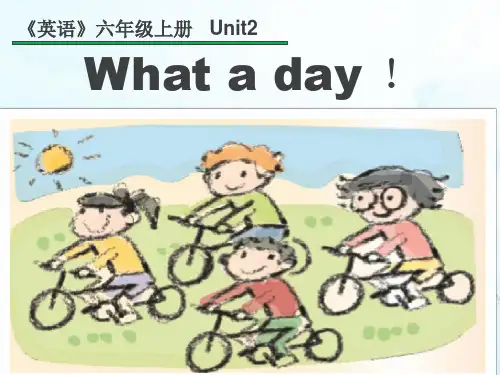
《英语》六年级上册 Unit2
What a day !
教学目标:
1 能听懂、会说有关天气的单词。 2 了解动词go , see, become, fly, bring, can 的过去式。 3 听懂了解句型 It was sunny/cloudy/windy.I/We/He/She brought/saw/flew... 4 初步掌握英语日记的格式。 5 能熟读并简单复述课文内容。
special(特别的)things
Yang Ling’s diary
date 日期
Can you find the date? What date was it?
Can you find the date? What date was it?
How to read ?
the 20th of September
Yang Ling’s diary
weather 天气
Underline the sentences. 划出描写天气的句子。
Do some exercise
3、抓住课文的主要内容有多种方法,允许学生用行之有效的、适合自己需要的方法,并给予鼓励推广。 2. 积累优美句子,我们得先辨析哪些是优美词句。一般带有想象、比喻、拟人的句子,带有一些优美词语的句子,表现细致,描写生 动的句子都是值得我们学习的,可以把它们积累下来,学习运用。 每天阅读,关键在于坚持,使孩子的阅读习惯自觉的养成。例如,孩子每天临睡前留出半小时至一小时的时间,进行读书,天天如此, 最后形成孩子的自觉行为,哪一天不读书,不读报,就寝食难安。在这当中,我们要充分考虑到孩子的兴趣、个性,要给孩子自由选 择阅读材料的空间,循序渐进,慢慢进入正轨。这一良好习惯的养成,对人的一生将有极大的帮助。 本次口语交际的话题是“我敬佩的一个人”,要求一是选择身边具有执著追求精神的人,通过具体事例表达敬佩之情;二是如果觉得人
六年级上册英语教案-Unit2Whataday!译林版(三起)
教案:六年级上册英语教案 Unit 2 What a day! 译林版(三起)教学目标:1. 能够听说读写本课的生词和重点句子。
2. 能够运用所学知识描述一天的活动。
3. 能够通过图片和文字理解故事内容,培养学生的阅读能力。
4. 培养学生的团队合作能力和交际能力。
教学内容:1. 生词和短语:weather, sunny, cloudy, rainy, windy, hot, cold, morning, afternoon, evening, day, go to school, have lunch, do homework, watch TV, go to bed。
2. 重点句子:What a day! It's sunny today. It's cloudy today. It's rainy today. It's windy today. It's hot today.It's cold today. In the morning, I go to school. In the afternoon, I have lunch. In the evening, I watch TV. It'stime to go to bed.3. 故事内容:故事描述了一个小学生一天的活动,包括早上去学校、下午吃午饭、晚上看电视、睡觉等。
教学重点与难点:1. 重点:本课的重点是学生能够听说读写生词和短语,以及能够运用所学知识描述一天的活动。
2. 难点:本课的难点是学生能够正确运用句子结构描述一天的活动,以及能够理解故事内容。
教具与学具准备:1. 教具:PPT、黑板、粉笔、故事书。
2. 学具:学生课本、练习册、铅笔、橡皮。
教学过程:1. 热身活动(5分钟):通过简单的英语歌曲或游戏,引导学生进入学习状态。
2. 引入新课(10分钟):利用PPT展示本课的生词和短语,引导学生进行听说读写的练习。
译林版英语六年级上册Unit2 What a day!教案

译林版英语六年级上册Unit2 What a day!教案教学目标•给学生灌输新词汇和短语,例如 wash, get dressed, brush teeth, comb hair, have breakfast, go to school, have lunch, do homework, have dinner, take a shower, go to bed 等等•告诉学生日常生活中的活动顺序,帮助建立时间意识和时间管理能力•强化学生口语表达能力和听说能力教学步骤1. 词汇教学•引入新词汇和短语:wash, get dressed, brush teeth, comb hair, have breakfast, go to school, have lunch, do homework, have dinner, take a shower, go to bed•为每个词汇讲解并提供例句,让学生理解每个词汇的含义和用法。
2. 故事讲解•讲解故事及故事中的细节,例如主人公在每天的不同时间段做什么,并说出每个动作对应的词汇•学生也可以跟着老师一起说出每个动作对应的词汇•对于学生可能不理解的单词或短语,老师需要适时给予解释,让学生更好地理解故事3. 对话练习•设计一些对话场景(可以是故事中出现的场景),让学生分组进行练习,并让每组演出他们练习的对话•对话可以偏向于固定句子或是自由发挥,可以让学生有更多的口语表达机会4. 作业•让学生完整地回顾一天的时间表,写出每个时间段主人公做什么事情,提醒他们使用到本次课程中学到的单词和短语•对于较为担心作业望而却步的学生,思考教师是否可以让同学分享自己的作业并互相核对教学总结•通过这次课程,学生可以掌握更多单词和短语,并且懂得如何更好地安排自己的时间,从而更好地管理自己的生活。
•在教学过程中,老师需要留意学生的理解程度,及时追问和鼓励学生,让学生对课程内容有充分的掌握和理解。
牛津译林版六年级英语上册Unit-2-What-a-day!-课件全
It’s cloudy.
What’s the weather like today?
It’s windy.
Grammar time
不规则动词的过去式
不规则动词的过去式需要逐 个记忆。为记忆方便,可以 参照下列几种变化形式:
1、改变动词中的元音:
begin---- began grow---- grew drink----drank
What is ty
windy
rainy
What’s the weather like today?
It’s rainy.
What’s the weather like today?
It’s sunny.
What’s the weather like today?
3. 不作任何改变:
hit---hit shut----shut
cost----cost put----put
hurt---hurt cut----cut
4. 少数动词变-ay, 为-aid:
say----said
pay----paid
lay---- laid
5. 少数动词的过去式采用不同词根的词:
Unit 2 What a day!
Read and answer
1. How was the weather in the morning?
2. What they saw in the park?
3. What they did in the park?
4. Why they could not eat their lunch?
2024/8/212024/8/21 • 16、好奇是儿童的原始本性,感知会使儿童心灵升华,为其为了探究事物藏下本源。2024年8月2024/8/212024/8/212024/8/218/21/2024 17、一个人所受的教育超过了自己的智力,这样的人才有学问。
六年级上册英语Unit 2 What a day(Sound time Culture译林版
Write a diary.
Wednesday, 28th September
Today we _____ happy in our class. We _____ an English song Rain, Rain , Go away. And we also _____ a cartoon Sam and Bobby .In the morning, Bobby and Tina ____ his new kite in the park. It _____ windy there. So they ______ up the hill. It ____windy there. The kite ____too high, they _______ hold onto it. The kite flew away. Sam _____ it near the hill. He ____ it to Bobby .He ___ very happy.
译林英语六年级上册
Unit 2 What a day !
(Sound time & song time &Cartoon time)
Let’s learn
/Iə/
dear hear year near
here cheer
nearly
The New Year is nearly here. Let's cheer together, my dear!
cloud find—found
Listen and repeat
Let’s read
Tip: Choose one to read in four. 选择一种四人练习。
新译林版六年级上册英语知识点归纳总结

Unit 1 The king's new clothes1、一般过去时●一般过去时的概念一般过去时表示过去某个时间发生的动作或存在的状态。
●一般过去时的形式○1be动词的一般过去时形式be动词的一般过去时的构成是“主语+be(was/were)+其他”。
例如:I was ill yesterday. 我昨天生病了。
The boys were happy last weekend. 男孩们上周末很开心。
○2实义动词的一般过去时形式实义动词的一般过去时的构成是“主语+动词的过去式+其他”。
例如:She went shopping last Sunday. 她上周日去购物了。
I caught a big fish on the farm last weekend. 我上周末在农场抓了一条大鱼。
●一般过去时的句型○1肯定句:“主语+谓语动词的过去式+其他”。
例如:It was rainy yesterday. 昨天下雨了。
We had a picnic last week. 上周我们去野餐了。
○2否定句:“主语+was/were +not+ 其他”或者“主语+didn't+谓语动词原形+其他”。
例如:It wasn't rainy yesterday. 昨天没下雨。
We didn't have a picnic last week. 上周我们没有去野餐。
○3一般疑问句及回答:“Was/Were+主语+其他”或者“Did+主语+谓语动词原形+其他”,其肯定回答分别为“Yes,主语+did”或“Yes,主语+was/were”,否定回答分别为“No,主语+didn't”或“No,主语+wasn't/weren't”。
例如:—Was it rainy yesterday? 昨天下雨了吗?—Yes, it was. 是的,下雨了。
—Did you have a picnic last week? 你们上周去野餐了吗?—No, we didn't. 不,我们没有去。
六年级上册英语课件-Unit 2 What a day!A-译林版
What did you do at Mid-Autumn Festival?
Yang Ling’s diary 日记
Unit 2 What a day!
date 日期
[eɪ]
HHooww atboout YwarnitgeLaindgi’sardyi?ary?
weather 天气
[e] [ǝ]
(你认为他们度过了怎样的一天呢?)
happy
wonderful
bad
(精彩的)
interesting
terrible(可怕的) …
Unit 2 What a day!
What a day!
这是怎样的一天啊!
注解:这一句是感叹语,需要与 前后文相连来理解意思。可以是 糟糕的一天,忙碌的一天,累人 的一天,倒霉的一天等等。但是 肯定这一天是要让人难忘的!
40.不求尽如人意,但求问心无愧。 9、坚强者能在命运之风暴中奋斗。 80.眼睛为你下着雨,心却为你撑着伞。 54.最可怕的不是有人比你优秀,而是比你优秀的人还比你更努力。 22.不做准备的人是准备失败的人!在任何苦难中能发现好的一面! 88.你的所有不甘和怨气来源于你的不自信和没实力。 15.总有那么一个人,不管他以前如何对你,你总会找到原谅他的理由。
40.你的气质里,藏着你跑过的步和你读过的书。 68.别让情绪左右着你的每一天。 49.脚踏实地过好每一天,最简单的恰恰是最难的。 33.努力永远不会骗人,总有一天你会发现你的坚持回报了你的期许。 77.人生最大的悲哀不是失去太多,而是计较太多,这也是导致一个人不快乐的重要原因。 66.累吗?累就对了,舒服是留给死人的! 47.世上所有美好的感情加在一起,也抵不上一桩高尚的行动。 12.没本事的男人才会要死要活。 64.天下大事必作于细,天下难事必作于易!
六年级上册英语素材unit2 what a day基础知识卷(默写 知识点) 译林版
六年级(上)Unit 2 基础知识卷四会内容一、语音ear的发音/ɪə /ear, n ear, h ear, y ear, d ear/ eə/ p ear, b ear, w ear /ɜ:/ l ear n, ear ly, ear th地球二、四会单词1. sʌn/ 太阳2. / sʌnɪ / 晴朗的3. /ʃəʊ/展示、展览4. /'weðə/ 天气5. /'ɪnt(ə)rɪstɪŋ/ 有趣的,有意思的6. /haɪ/ 在高处7. /bɪ'kʌm/ 变成,变为8. / wɪnd / 风9. / 'wɪndɪ /有风的,刮风的10. /klaʊd/ 云11. /'klaʊdɪ/ 多云的12. /skaɪ/ 天空13. / brɪŋ/ 带来14. /'hʌnɪ/ 蜂蜜15. /reɪn/ 雨,下雨16. /'reɪnɪ/ 多雨的17. /drɪŋk/饮料18. /ænt/ 蚂蚁19. /biː/蜜蜂20. /miːt/遇见21. /luːz/丢失22. /nəʊ/ 知道23. /sep'tembə/ 九月24. /'pærət/ 鹦鹉25. /'dʌmplɪŋ/饺子26. /wet/ 潮湿的27. /'hæp(ə)n/ 发生三、四会词组1. 骑自行车2. 一些有趣的鹦鹉3. 风筝放得高4.变得刮风又多云5.一场鹦鹉表演6.在天空中7.买一些饺子8.乌云9.一些面包蜂蜜10.又饿又湿11.在操场上12.做得好13.走开14.飞走15. 看上去难过16. 丢了我的新风筝17.想要知道为什么18.爬上山顶19.飞得太高20.抓紧它/风筝21.在小山附近22.看电影23.野餐24.做家务25.去游泳26.在周一上午四、四会句子U2所有句子五、不规则动词的过去式(注:括号内为三会内容,其余为四会内容)1. put→read→let →(*cut-cut割,切)2.give→sit→swim→drink→sing→begin →3. f ly→draw→4. bring→buy→think→5. come→become→6. ride →drive →write→7. catch→teach→8. sleep→sweep→keep→feel→smell→9. grow →know →(*throw →threw扔blow →blew吹)10. stand→understand-11. am, is→are→do/does→can→has/have→go→get→find→make→tell→say→see→lose→eat→w ear→run →take→win →meet →leave →send →speak →hear →fall→(*ring → rang铃响shake →shook摇摆feed →fed喂forget →forgot忘记spend →spent花费)四会内容(复习)一、单词1. /`dʒænjuərɪ/一月2. /`februərɪ/ 二月3. /ma: tʃ/ 三月4. /`eɪprəl/ 四月5. /meɪ/ 五月6. /dʒu: n/ 六月7. /dʒu`laɪ/ 七月8. /`ɔ: gəst/ 八月9. /ɔk`təubə/ 十月10. /nəu`vembə/ 十一月11. /dɪ`sembə/ 十二月二、几月几号两种表达:1. 月份+the + 序数词(September the tenth缩写:Sep. the 10th)2. the+序数词+ of +月份(the first of September缩写:the 10th of Sep.)三、基数词变序数词口诀:one,two,three,特殊记,first, second, third别忘记;th要从four尾始,八减t,九减e,f要把ve替,ty变成tie;若是遇到几十几,几十不变只变几;序数词前要加the,千万要牢记。
译林版六年级英语上册第二课课文译中文
译林版六年级英语上册第二课课文译中文Unit 2 What a day!多么糟糕的一天!Pages 16-17 Story timeSunday, 20th September星期日,九月二十日It was sunny in the morning.Su Hai, Mike, Liu Tao and I went to the park by bike.早上阳光灿烂。
苏海,迈克,刘涛和我骑车去公园。
There was a parrot show in the park.We saw some interesting parrots.公园里有一场鹦鹉秀。
我们看到了一些有趣的鹦鹉。
Then, the weather became windy and cloudy. We flewkites high in the sky.然后,天气变得多风多云。
我们将风筝高高地放到空中。
It was time for lunch. We brought some jiaozi, some bread andhoney and some drinks.是时候吃午饭了。
我们带了一些饺子、面包和蜂蜜,还有一些饮料。
We saw some ants on the bread and honey. There were some bees too. We could not eat our lunch!我们在面包和蜂蜜上看到了一些蚂蚁。
还有一些蜜蜂。
我们不能吃我们的午餐了!In the afternoon, there were black clouds in the sky. It rained. We were hungry and wet.下午,天空出现了乌云。
下雨了。
我们很饿,还淋湿了。
What a day!多么糟糕的一天!单词cloudy 多云的rainy 多雨的sunny 晴朗的windy 有风的,多风的Page 21 Sound timeeardear 亲爱的hear 听见near 在……附近year 年The New Year is nearly here.新年临近。
译林版英语 6上 U2 知识点精讲(非常全)
6下Unit 2 知识点精讲1) 就用what a/an;是不可数名词或可数名词复数,只用what。
2a/an/the/my/your/this/that/Tom’s等等乱七八糟的东西,想都不用想,直接用how就OK了。
如:例句1:What a boy he is! 他是个多么好的男孩啊!/ \单数名词例句2:boys they are! 他们是多么好的男孩啊!/ \复数名词例句3:What weather it is! 多么冷的天气啊!/ \不可数名词例句4:the boy is! 这男孩多好啊!/ \乱糟糟★★★若没有形容词,而出现副词或是句子,直接用how.例:How well he plays the guitar! 他吉他弹得多好啊!/副词(what不可以修饰副词,看到副词直接用howHow fast Liu Xiang runs打油诗一首: 感叹句往后看, ,就用what a或what an;形后若是不可数或名复数,只用what就可以;形容词后乱糟糟,只写how就OK了。
1.多么糟糕的一天!What a day! = (What a bad day! /What a terrible day!)2.九月二十日--- 20th September (读法:the twentieth of September )September 20th ( 读法:September the twentieth )日期的表示方法:the + 日子(序数词)+ of + 月份/ 月份+ the + 日子(序数词)在7月5日:on the fifth of July/ July the fifth在3月18日:on the eighteenth of March/ March the eighteenth (在具体日期前,用“on”) 3.晴朗的sunny 名词sun 太阳,多云的cloudy 名词cloud 云多雨的rainy 名词/动词rain, 多风的windy 名词wind 风表示天气的句型:It is + 形容词。