
2002年考研英语真题答案及解析
2002 年全国硕士研究生入学统一考试英语试题答案与解析第一部分英语知识应用试题解析一、文章总体分析本文主要介绍了计算机的发展对通信革命及人们的生存方式产生的影响。
文章第一段从早期的通信革命入手,指出在15、16 世纪和20 世纪之间发生了很多事情,特别是通信革命加快了步伐。
第二段接着提到20 世纪计算机的出现极大地改变了这一进程。
第三段指出随着计算机的发展,我们步入了一个信息社会。
在计算机影响下,通信革命改变了我们的工作和休闲方式,也影响了我们的思考和感知方式。
在结尾部分,文章提到,当然,关于这种通信革命在经济、政治、社会和文化各方面的影响是利大于弊还是弊大于利,还存在争议。
二、试题具体解析1. [A] between 在…当中,在空间、位置或时间的中间[B] before 在此之前早些时候,在…前面[C] since 自从…以后,以前[D] later 后来,稍后,随后[答案] A[解析] 本题考核的知识点是:时间副词的用法辨析。
解此题关键看两个方面,一是理解文章第一句话的含义:人们曾对20 世纪电视的发展以及15 世纪和16 世纪印刷术的传播进行了比较。
二是注意转折连词yet 的用法,yet 一般标志着接下来的内容与前面的内容出现了较大的不同,如:She said she would be late, yet she arrived on time.(她说她会迟到,但她却准时到达了)。
文中第二句话结构非常简单,主语和谓语都无法体现与第一句话的强烈对照,这时只能通过空格里填入的时间状语来体现了,因此这个时间副词应与第一句话中的时间状语in the 20th century 和in the 15th and 16th centuries 相呼应并对照。
接下来关键看这个时间副词表示的是哪个时间段,15、16 世纪之前,20 世纪之后还是两者之间。
其实我们从下文中的the 19th century 也可以推断出正确答案是between,即“然而,在这两个时段之间却发生了很多事情”。
2. [A] after [B] by [C] during [D] until[答案] D[解析] 本题考核的知识点是:固定句型。
空格所在的句子是一个强调句型:it was + 时间状语+ that。
四个选项中能与not 搭配的只有until,not until 表示“直到……才……”,整个句意是“直到十九世纪,报纸才成为电子时代到来前主要的……”。
如:It was n ot u ntil t he afternoon that he begun to tackle the problem.(直到下午他才开始解决问题)。
知识点补充:在这种强调状语的结构中,表示状语的成分可以是单词、词组或句子。
强调句子时可以是主语从句、宾语从句或状语从句。
如:It was at a n evening p arty that I first met her.(强调地点状语);It was because t he w ater h adrisen that they could not cross the river(.强调原因状语从句,引导词只能用because,不能用since,as 或why);It is what you w ill d o that is essential.(强调主语从句)。
3. [A] means 方式,方法,手段[B] method 方法[C] medium(表达或传播的)媒介[D] measure 措施,步骤,方法[答案] C[解析] 本题考核的知识点是:名词词义辨析。
本题相关部分是the newspaper became the dominant pre-electronic_ 3 _, following in the wake of the pamphlet andthe book,其中in the wake of 意为“紧跟…之后,接踵而来”,如:Outbreaks of disease occurred in the wake of the drought. (那场旱灾过后,疾病肆虐)。
因此整个句子的含义是“报纸继宣传册和书之后成为电子时代到来前主要的3_ _” 从句意来看,空格处填入的名词应概括newspaper、pamphlet 和book 的共同特点,根据常识,报纸、宣传册和图书都只能是传播信息的媒介(medium),而不是方法或措施。
Medium 可特指“大众传播手段,包括报纸、杂志、广播或电视等”,如:Commercial television is a medium for advertising.(商业电视是一种广告媒介)。
词汇补充:注意means 和medium 都可以表示借以成就某事或达到某目的人或物。
means (单复数同形)可以指人或物,其含义为“手段”或“工具”。
这个词不仅用于具体的东西,也可以用于抽象的意念。
如:Thoughts of one individual could be communicated to another by means of speech(一个人的思想能够借助于语言传递给另一个人);medium 的含义是“媒介,手段”,通过它能完成、传输或转移某种事物的东西:如:Air is a medium of sound.(空气是声音传播的媒体)。
method 所表示的“方法”可以指做某件事的具体步骤或程序,也可以指抽象概念“条理”,如:To do this, scientists have to devise methods using radar and underwater television.(为此,科学家还要设计出使用雷达和水下电视的方法);measures 表示“手段,策略,为达到目的采取的行动,权宜之计”,如:They took strong measures against dangerous drivers.(他们对危害公众的司机采取强硬的措施)。
4. [A] (in the) process (of) 在……过程中[B] (in the) company (of) 在……陪伴下,与……同时出现[C] (in the) light (of) 按照,根据[D] (in the) form (of) 以……的形式[答案] B[解析] 本题考核的知识点是:上下文语义+ 介词短语辨析。
文章相关部分是newspaper became the dominant pre-electronic medium, following in the wake of the pamphlet and the book and in the 4 of the periodical,从结构上来看,现在分词结构following in the wake of 和介词短语in the 4 of 是并列成分,都做主句的伴随状语,newspaper,pamphlet and book,periodical 也是三个平行的部分,它们之间的关系是通过in the wake of 和in the 4 of 两个部分来体现的。
分词结构following in the wake of…意为“随着宣传册和书的出现以后”,体现了时间上的先后。
因此空格处的动词构成的短语应既需要与分词结构表并列含义,又需要体现newspaper 和periodical 之间的时间关系。
四个选项从意义上来看,只有B 符合。
5. [A] gathered (up) 收集,蜷缩,概括[B] speeded (up) 加速[C] worked (up) 逐步建立,逐步发展,逐步引起,整理[D] picked (up) 拾起,染上,学到,整理,收听到,好转[答案] B[解析] 本题考核的知识点是:动词短语辨析。
本题要求考生判断哪个动词可以与up 搭配,构成短语动词,且符合文意。
该动作的发出者是前面的主语communication revolution。
根据语义,恰当选项是speeded up,表示“通信革命加速发展”。
文中所在句子用了强调结构It was during the same time that,强调时间状语19 世纪,表明在这一时期不但报纸成为主要媒介,而且通信革命也取得了重大的成果:运输业、铁路、电报、电话、无线电、电影都在发展。
知识点补充:与up 搭配组成的短语动词还包括:beat up(毒打),choke up(说不出话),dress up(盛装),end up (结束),hold up(阻止,妨碍),mix up(混淆),play up(强调),sign up(签约),take up(从事),wash up(洗餐具)等。
例句补充:The child gathered u p his toys and put them away(.孩子把他的玩具收拾起来放好);I worked u p this business from nothing(.我在一无所有的情况下把这个事业逐步发展起来的,或,我白手起家);Trade has been slack for the past six months, but it is now picking u p.(过去六个月里商业一直很萧条,但现在情况正在好转)。
6. [A] (lead) on 引导,率领……继续前进[B] (lead) out 开始,领舞伴起舞[C] over 不与lead 搭配[D] (lead) off(begin)开始[答案] A[解析] 本题考核的知识点是:短语动词搭配+ 副词词义辨析。
事实上本题和下一个题目可以一起解答。
因为第六空和第七空是所在句子整体中不可分割的两个部分。
考生首先需判断选项中哪个副词可以与lead 和through 搭配。
首先排除over,它不能与lead 搭配。
从结构上看,空格所在部分中的beginning with…和leading…都是现在分词状语成分,说明通信革命是怎样加速发展的:开始于运输和铁路,接着通过电报、电话、收音机和电影的发展,直到二十世纪的汽车和飞机。
四个选项只有副词on 可以表示“继续,向前”的含义,用在句子中强调“电报、电话、收音机和电影行业推动通信革命的继续发展”。
7. [A] of …的,属于…的;有关…的[B] for 为了;代表;以…为目的地;因为[C] beyond 超出(理解、范围、眼界)之上[D] into 进入…之内;成为…状态[答案] D[解析] 本题考核的知识点是:介词用法辨析。
根据上一题的分析,句子空格处需要一个介词和前面的begin with,lead on through 一起来表达通信革命发展的全过程。
2002年全国硕士研究生入学统一考试英语试题及答案

2002年全国硕士研究生入学统一考试英语试题Section I Listening ComprehensionDirections:This Section is designed to test your ability to understand spoken English. You will hear a selectionof recorded materials and you must answer the questions that accompany them. There are three parts in this section, Part A, Part B and Part C.Remember, while you are doing the test, you should first put down your answers in your test booklet. At the end of the listening comprehension section, you will have 5 minutes to transfer allyour answers from your test booklet to A NSWER SHEET 1.Now look at Part A in your test booklet.Part ADirections:For Questions 1-5, you will hear an introduction about the life of Margaret Welch. While you listen,heard. Some of the information has been given to youfill out the table with the information you’vein the table. Write only 1 word or number in each numbered box. You will hear the recording twice. You now have 25 seconds to read the table below. (5 points)Welch’s Personal InformationPlace of Birth PhiladelphiaYear of Birth 1901Transfer to Barnard University (Year) 1920Major at University 1Final Degree PhDYear of Marriage 1928Growing Up In New Guinea Published (Year) 2Field Study in the South Pacific (Age) 3Main Interest 4Professorship at Columbia Started (Year) 5Death (Age) 77Part BDirections:For questions 6-10, you will hear a talk by a well-known U.S. journalist. While you listen, completethe sentences or answer the questions. Use not more than 3 words for each answer. You will hear the recording twice. You now have 25 seconds to read the sentences and questions below. (5 points)Besides reporters, who else were camped out 6for days outside the speaker’s home?apartmentOne reporter got to the speaker’s 7pretending to pay.The speaker believed the reporter wanted a 8picture of her lookingWhere is a correction to a false story usually 9placed?According to the speaker, the press will lose10readers unless the editors and the newsdirectorsPart CDirections:You will hear three pieces of recorded material. Before listening to each one, you will have time to read the questions related to it. While listening, answer each question by choosing [A], [B], [C] or[D]. After listening, you will have time to check your answers. You will hear each piece once only.(10 points)Questions 11-13 are based on a report about children’s healthy development. You now have 15 seconds to read Questions 11-13.11. What unusual question may doctors ask when giving kids a checkup next time? [A] How muchexercise they get every day.[B] What they are most worried about.[C] How long their parents accompany them daily.[D] What entertainment they are interested in.12. The academy suggests that children under age two ________.[A] get enough entertainment[B] have more activities[C] receive early education[D] have regular checkups13. According to the report, children’s bedrooms should ________.[A] be no place for play[B] be near a common area[C] have no TV sets[D] have a computer for studyQuestions 14-16 are based on the following talk about how to save money. You now have 15 seconds to read Questions 14-16.14. According to the speaker, what should one pay special attention to if he wants to save up?[A] Family debts.[B] Bank savings.[C] Monthly bills.[D] Spending habits.15. How much can a person save by retirement if he gives up his pack-a-day habit?[A] $190,000.[B] $330,000.[C] $500,000.[D] $1,000,000.16. What should one do before paying monthly bills, if he wants to accumulate wealth?[A] Invest into a mutual fund.[B] Use the discount tickets.[C] Quit his eating-out habit.[D] Use only paper bills and save coins.Questions 17-20 are based on an interview with Herbert A. Glieberman, a domestic-relations lawyer. You now have 20 seconds to read Questions 17-20.17. Which word best describes the lawyer’s prediction of the change in divorce rate?[A] Fall[B] Rise[C] V-shape[D] Zigzag18. What do people nowadays desire to do concerning their marriage?[A] To embrace changes of thought.[B] To adapt to the disintegrated family life.[C] To return to the practice in the ‘60s and ‘70s.[D] To create stability in their lives.19. Why did some people choose not to divorce 20 years ago?[A] They feared the complicated procedures.[B] They wanted to go against the trend.[C] They were afraid of losing face.[D] they were willing to stay together.20. Years ago a divorced man in a company would have ________.[A] been shifted around the country.[B] had difficulty being promoted.[C] enjoyed a happier life.[D] tasted little bitterness of disgrace.You now have 5 minutes to transfer all your answers from your test booklet to ANSWER SHEET 1.THIS IS THE END OF SECTION IDO NOT READ OR WORK ON THE NEXT SECTIONUNTIL YOU ARE TOLD TO CONTINUE全国硕士研究生入学考试英语试题(二)National Entrance Test of English for MA/MS Candidates (2002)考生注意事项1. 考生必须严格遵守各项考场规则,得到监考人员指令后方可开始答题。
2002考研英语真题
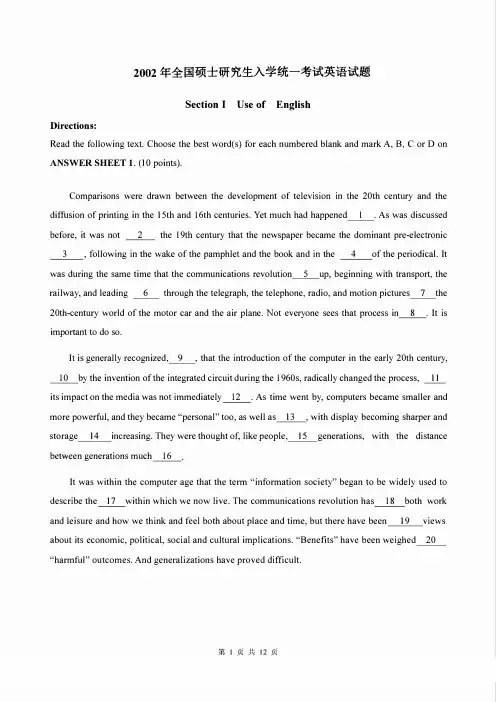
2002年全国硕士研究生入学统一考试英语试题Section I Use of EnglishDirections:Read the following text. Choose the best word(s) for each numbered blank and mark A, B, C or Don ANSWER SHEET 1. (10 points).Comparisons were drawn between the development of television in the 20th century and the diffusion of printing in the 15th and 16th centuries. Yet much had happened 1 . As was discussed before, it was not 2 the 19th century that the newspaper became the dominant pre-electronic 3 , following in the wake of the pamphlet and the book and in the 4 of the periodical. It was during the same time that the communications revolution 5 up, beginning with transport, the railway, and leading 6 through the telegraph, the telephone, radio, and motion pictures 7 the 20th-century world of the motor car and the air plane. Not everyone sees that process in 8 . It is important to do so.It is generally recognized, 9 , that the introduction of the computer in the early 20th century, 10 by the invention of the integrated circuit during the 1960s, radically changed the process, 11 its impact on the media was not immediately 12 . As time went by, computers became smaller and more powerful, and they became "personal" too, as well as 13 , with display becoming sharper and storage 14 increasing. They were thought of, like people, 15 generations, with the distance b e tween generat10ns much 16It was within the computer age that the term "information society" began to be widely used to describe the 17 within which we now live. The communications revolution has 18 both work and leisure and how we think and feel both about place and time, but there have been 19 views about its economic, political, social and cultural implications. "Benefits" have been weighed 20 "harmful" outcomes. And generalizations have proved difficult.。
2002考研英语一真题及答案
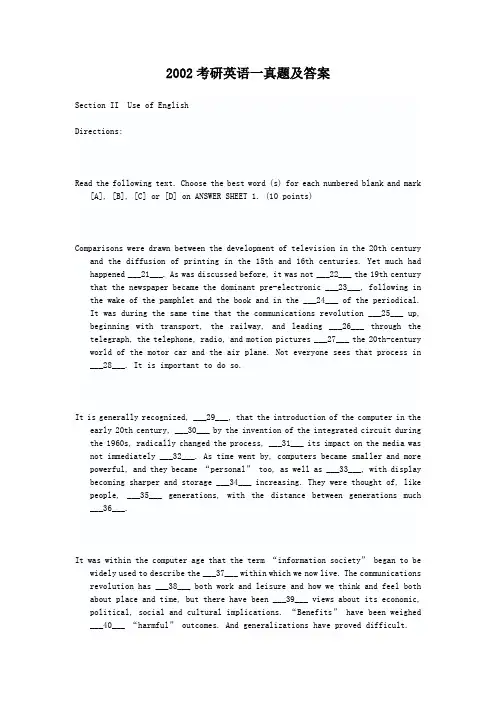
2002考研英语一真题及答案Section II Use of EnglishDirections:Read the following text. Choose the best word (s) for each numbered blank and mark[A], [B], [C] or [D] on ANSWER SHEET 1. (10 points)Comparisons were drawn between the development of television in the 20th century and the diffusion of printing in the 15th and 16th centuries. Yet much had happened ___21___. As was discussed before, it was not ___22___ the 19th century that the newspaper became the dominant pre-electronic ___23___, following in the wake of the pamphlet and the book and in the ___24___ of the periodical.It was during the same time that the communications revolution ___25___ up, beginning with transport, the railway, and leading ___26___ through the telegraph, the telephone, radio, and motion pictures ___27___ the 20th-century world of the motor car and the air plane. Not everyone sees that process in ___28___. It is important to do so.It is generally recognized, ___29___, that the introduction of the computer in the early 20th century, ___30___ by the invention of the integrated circuit during the 1960s, radically changed the process, ___31___ its impact on the media was not immediately ___32___. As time went by, computers became smaller and more powerful, and they became “personal” too, as well as ___33___, with display becoming sharper and storage ___34___ increasing. They were thought of, like people, ___35___ generations, with the distance between generations much ___36___.It was within the computer age that the term “information society” began to be widely used to describe the ___37___ within which we now live. The communications revolution has ___38___ both work and leisure and how we think and feel both about place and time, but there have been ___39___ views about its economic, political, social and cultural implications. “Benefits” have been weighed ___40___ “harmful” outcomes. And generalizations have proved difficult.21. [A] between[B] before[C] since[D] later22. [A] after[B] by[C] during[D] until23. [A] means[B] method[C] medium[D] measure24. [A] process[B] company[C] light[D] form25. [A] gathered[B] speeded[C] worked[D] picked26. [A] on[B] out[C] over[D] off27. [A] of[B] for[C] beyond[D] into28. [A] concept[B] dimension[C] effect[D] perspective29. [A] indeed[B] hence[C] however[D] therefore30. [A] brought[B] followed[C] stimulated[D] characterized31. [A] unless[B] since[C] lest[D] although32. [A] apparent[B] desirable[C] negative[D] plausible33. [A] institutional[B] universal[C] fundamental[D] instrumental34. [A] ability[B] capability[C] capacity[D] faculty35. [A] by means of[B] in terms of[C] with regard to[D] in line with36. [A] deeper[B] fewer[C] nearer[D] smaller37. [A] context[B] range[C] scope[D] territory38. [A] regarded[B] impressed[C] influenced[D] effected39. [A] competitive[B] controversial[C] distracting[D] irrational40. [A] above[B] upon[C] against[D] withSection III Reading ComprehensionPart ADirections:Read the following four texts. Answer the questions below each text by choosing [A],[B], [C] or [D]. Mark your answers on ANSWER SHEET 1. (40 points)Text 1If you intend using humor in your talk to make people smile, you must know how to identify shared experiences and problems. Your humor must be relevant to the audience and should help to show them that you are one of them or that you understand their situation and are in sympathy with their point of view.Depending on whom you are addressing, the problems will be different. If you are talking to a group of managers, you may refer to the disorganized methods of their secretaries; alternatively if you are addressing secretaries, you may want to comment on their disorganized bosses.Here is an example, which I heard at a nurses’ convention, of a story which works well because the audience all shared the same view of doctors. A man arrives in heaven and is being shown around by St. Peter. He sees wonderful accommodations, beautiful gardens, sunny weather, and so on. Everyone is very peaceful, politeand friendly until, waiting in a line for lunch, the new arrival is suddenly pushed aside by a man in a white coat, who rushes to the head of the line, grabs his food and stomps over to a table by himself. “Who is that?” the new arrival asked St. Peter. “Oh, that’s God,” came the reply, “but sometimes he thinks he’s a doctor.”If you are part of the group, which you are addressing, you will be in a position to know the experiences and problems which are common to all of you and it’ll be appropriate for you to make a passing remark about the inedible canteen food or the chairman’s notorious bad taste in ties. With other audiences you mustn’t attempt to cut in with humor as they will resent an outsider making disparaging remarks about their canteen or their chairman. You will be on safer ground if you stick to scapegoats like the Post Office or the telephone system.If you feel awkward being humorous, you must practice so that it becomes more natural. Include a few casual and apparently off-the-cuff remarks which you can deliver in a relaxed and unforced manner. Often it’s the delivery which causes the audience to smile, so speak slowly and remember that a raised eyebrow or an unbelieving look may help to show that you are making a light-hearted remark.Look for the humor. It often comes from the unexpected. A twist on a familiar quote “If at first you don’t succeed, give up” or a play on words or on a situation. Search for exaggeration and understatements. Look at your talk and pick out a few words or sentences which you can turn about and inject with humor.41. To make your humor work, you should ________________________.[A] take advantage of different kinds of audience[B] make fun of the disorganized people[C] address different problems to different people[D] show sympathy for your listeners42. The joke about doctors implies that, in the eyes of nurses, they are ________________________.[A] impolite to new arrivals[B] very conscious of their godlike role[C] entitled to some privileges[D] very busy even during lunch hours43. It can be inferred from the text that public services ________________________.[A] have benefited many people[B] are the focus of public attention[C] are an inappropriate subject for humor[D] have often been the laughing stock44. To achieve the desired result, humorous stories should be delivered ________________________.[A] in well-worded language[B] as awkwardly as possible[C] in exaggerated statements[D] as casually as possible45. The best title for the text may be ________________________.[A] Use Humor Effectively[B] Various Kinds of Humor[C] Add Humor to Speech[D] Different Humor StrategiesText 2Since the dawn of human ingenuity, people have devised ever more cunning tools to cope with work that is dangerous, boring, burdensome, or just plain nasty. That compulsion has resulted in robotics -- the science of conferring various human capabilities on machines. And if scientists have yet to create the mechanical version of science fiction, they have begun to come close.As a result, the modern world is increasingly populated by intelligent gizmos whose presence we barely notice but whose universal existence has removed much human labor. Our factories hum to the rhythm of robot assembly arms. Our banking is done at automated teller terminals that thank us with mechanical politeness for the transaction. Our subway trains are controlled by tireless robot-drivers. And thanks to the continual miniaturization of electronics and micro-mechanics, there are already robot systems that can perform some kinds of brain and bone surgery with submillimeter accuracy -- far greater precision than highly skilled physicians can achieve with their hands alone.But if robots are to reach the next stage of laborsaving utility, they will have to operate with less human supervision and be able to make at least a few decisions for themselves -- goals that pose a real challenge. “While we know how to tell a robot to handle a specific error,” says Dave Lavery, manager of a robotics program at NASA, “we can’t yet give a robot enough ‘common sense’ to reliably interact with a dynamic world.”Indeed the quest for true artificial intelligence has produced very mixed results. Despite a spell of initial optimism in the 1960s and 1970s when it appeared that transistor circuits and microprocessors might be able to copy the action of the human brain by the year 2010, researchers lately have begun to extend that forecast by decades if not centuries.What they found, in attempting to model thought, is that the human brain’s roughly one hundred billion nerve cells are much more talented -- and human perception far more complicated -- than previously imagined. They have built robots that can recognize the error of a machine panel by a fraction of a millimeter in a controlled factory environment. But the human mind can glimpse a rapidly changing scene andimmediately disregard the 98 percent that is irrelevant, instantaneously focusing on the monkey at the side of a winding forest road or the single suspicious face in a big crowd. The most advanced computer systems on Earth can’t approach that kind of ability, and neuroscientists still don’t know quite how we do it.46. Human ingenuity was initially demonstrated in ________________________.[A] the use of machines to produce science fiction[B] the wide use of machines in manufacturing industry[C] the invention of tools for difficult and dangerous work[D] the elite’s cunning tackling of dangerous and boring work47. The word “gizmos”(Line 1, Paragraph 2) most probably means ________________________.[A] programs[B] experts[C] devices[D] creatures48. According to the text, what is beyond man’s ability now is to design a robot that can ________________________.[A] fulfill delicate tasks like performing brain surgery[B] interact with human beings verbally[C] have a little common sense[D] respond independently to a changing world49. Besides reducing human labor, robots can also ________________________.[A] make a few decisions for themselves[B] deal with some errors with human intervention[C] improve factory environments[D] cultivate human creativity50. The author uses the example of a monkey to argue that robots are ________________________.51.[A] expected to copy human brain in internal structure52.53.[B] able to perceive abnormalities immediately54.55.[C] far less able than human brain in focusing on relevant information56.57.[D] best used in a controlled environment58.59.Text 360.Could the bad old days of economic decline be about to return? Since OPEC agreed to supply-cuts in March, the price of crude oil has jumped to almost $26 a barrel, up from less than $10 last December. This near-tripling of oil prices calls up scary memories of the 1973 oil shock, when prices quadrupled, and 1979-80, when they also almost tripled. Both previous shocks resulted in double-digit inflation and global economic decline. So where are the headlines warning of gloom and doom this time?61.62.The oil price was given another push up this week when Iraq suspended oil exports. Strengthening economic growth, at the same time as winter grips the northern hemisphere, could push the price higher still in the short term.63.64.Yet there are good reasons to expect the economic consequences now to be less severe than in the 1970s. In most countries the cost of crude oil now accounts for a smaller share of the price of petrol than it did in the 1970s. In Europe, taxes account for up to four-fifths of the retail price, so even quite big changes in the price of crude have a more muted effect on pump prices than in the past.65.66.Rich economies are also less dependent on oil than they were, and so less sensitive to swings in the oil price. Energy conservation, a shift to other fuels and a decline in the importance of heavy, energy-intensive industries have reduced oil consumption. Software, consultancy and mobile telephones use far less oil than steel or car production. For each dollar of GDP (in constant prices) rich economies now use nearly 50% less oil than in 1973. The OECD estimates in its latest Economic Outlook that, if oil prices averaged $22 a barrel for a full year, compared with $13 in 1998, this would increase the oil import bill in rich economies by only 0.25-0.5% of GDP. That is less than one-quarter of the income loss in 1974 or 1980. On the other hand, oil-importing emerging economies -- to which heavy industry has shifted -- have become more energy-intensive, and so could be more seriously squeezed.67.68.One more reason not to lose sleep over the rise in oil prices is that, unlike the rises in the 1970s, it has not occurred against the background of general commodity-price inflation and global excess demand. A sizable portion of the world is only just emerging from economic decline. The Economist’s commodity price index is broadly unchanging from a year ago. In 1973 commodity prices jumped by 70%, and in 1979 by almost 30%.69.70.51. The main reason for the latest rise of oil price is ________________________.71.72.[A] global inflation73.74.[B] reduction in supply75.76.[C] fast growth in economy77.78.[D] Iraq’s suspension of exports79.80.52. It can be inferred from the text that the retail price of petrol will go up dramatically if ________________________.81.82.[A] price of crude rises83.84.[B] commodity prices rise85.86.[C] consumption rises87.88.[D] oil taxes rise89.90.53. The estimates in Economic Outlook show that in rich countries ________________________.91.92.[A] heavy industry becomes more energy-intensive93.94.[B] income loss mainly results from fluctuating crude oil prices95.96.[C] manufacturing industry has been seriously squeezed97.98.[D] oil price changes have no significant impact on GDP99.100.54. We can draw a conclusion from the text that ________________________.101.102.[A] oil-price shocks are less shocking now103.104.[B] inflation seems irrelevant to oil-price shocks105.106.[C] energy conservation can keep down the oil prices107.108.[D] the price rise of crude leads to the shrinking of heavy industry109.110.55. From the text we can see that the writer seems ________________________.111.112.[A] optimistic113.114.[B] sensitive115.116.[C] gloomy117.118.[D] scared119.120.Text 4121.The Supreme Court’s decisions on physician-assisted suicide carry important implications for how medicine seeks to relieve dying patients of pain and suffering.122.123.Although it ruled that there is no constitutional right to physician-assisted suicide, the Court in effect supported the medical principle of “double effect,”a centuries-old moral principle holding that an action having two effects -- a good one that is intended and a harmful one that is foreseen -- is permissible if the actor intends only the good effect.124.125.Doctors have used that principle in recent years to justify using high doses of morphine to control terminally ill patients’ pain, even though increasing dosages will eventually kill the patient.126.127.Nancy Dubler, director of Montefiore Medical Center, contends that the principle will shield doctors who “until now have very, very strongly insisted that they could not give patients sufficient mediation to control their pain if that might hasten death.”128.129.George Annas, chair of the health law department at Boston University, maintains that, as long as a doctor prescribes a drug for a legitimate medical purpose, the doctor has done nothing illegal even if the patient uses the drug to hasten death. “It’s like surgery,” he says. “We don’t call those deaths homicides because the doctors didn’t intend to kill their patients, although they risked their death. If you’re a physician, you can risk your patient’s suicide as long as you don’t intend their suicide.”130.131.On another level, many in the medical community acknowledge that the assisted-suicide debate has been fueled in part by the despair of patients for whom modern medicine has prolonged the physical agony of dying.132.Just three weeks before the Court’s ruling on physician-assisted suicide, the National Academy of Science (NAS) released a two-volume report, Approaching Death: Improving Care at the End of Life. It identifies the undertreatment of pain and the aggressive use of “ineffec tual and forced medical procedures that may prolong and even dishonor the period of dying” as the twin problems of end-of-life care.The profession is taking steps to require young doctors to train in hospices, to test knowledge of aggressive pain management therapies, to develop a Medicarebilling code for hospital-based care, and to develop new standards for assessing and treating pain at the end of life.Annas says lawyers can play a key role in insisting that these well-meaning medical initiatives translate into better care. “Large numbers of physicians seem unconcerned with the pain their patients are needlessly and predictably suffering,”to the extent that it constitutes “systematic patient abuse.” He says medical licensing boards “must make it clear… that painful deaths are presumptively ones that are incompetently managed and should result in license suspension.”56.From the first three paragraphs, we learn that ________________________.[A] doctors used to increase drug dosages to control their patients’ pain[B] it is still illegal for doctors to help the dying end their lives[C] the Supreme Court strongly opposes physician-assisted suicide[D] patients have no constitutional right to commit suicide57.Which of the following statements is true according to the text?[A] Doctors will be held guilty if they risk their patients’ death.[B] Modern medicine has assisted terminally ill patients in painless recovery.[C] The Court ruled that high-dosage pain-relieving medication can beprescribed.[D] A doctor’s medication is no longer justified by his intentions.58.According to the NAS’s report, one of the problems in end-of-life care is________________________.[A] prolonged medical procedures[B] inadequate treatment of pain[C] systematic drug abuse[D] insufficient hospital care59.Which of the following best defines the word “aggressive” (Line 3, Paragraph7)?[A] Bold[B] Harmful[C] Careless[D] Desperate60.George Annas would probably agree that doctors should be punished if they________________________.[A] manage their patients incompetently[B] give patients more medicine than needed[C] reduce drug dosages for their patients[D] prolong the needless suffering of the patientsPart BDirections:Read the following text carefully and then translate the underlined segments into Chinese. Your translation should be written clearly on ANSWER SHEET 2. (10 points)Almost all our major problems involve human behavior, and they cannot be solved by physical and biological technology alone. What is needed is a technology of behavior, but we have been slow to develop the science from which such a technology might be drawn. 61) One difficulty is that almost all of what is called behavioral science continues to trace behavior to states of mind, feelings, traits of character, human nature, and so on. Physics and biology once followed similar practices and advanced only when they discarded them. 62) The behavioral sciences have been slow to change partly because the explanatory items often seem to be directly observed and partly because other kinds of explanations have been hard to find. The environment is obviously important, but its role has remained obscure. It does not push or pull, it selects, and this function is difficult to discover and analyze.63) The role of natural selection in evolution was formulated only a little more than a hundred years ago, and the selective role of the environment in shaping and maintaining the behavior of the individual is only beginning to be recognized and studied. As the interaction between organism and environment has come to be understood, however, effects once assigned to states of mind, feelings, and traits are beginning to be traced to accessible conditions, and a technology of behavior may therefore become available. It will not solve our problems, however, until it replaces traditional prescientific views, and these are strongly entrenched. Freedom and dignity illustrate the difficulty. 64) They are the possessions of the autonomous (self-governing) man of traditional theory, and they are essential to practices in which a person is held responsible for his conduct and given credit for his achievements. A scientific analysis shifts both the responsibility and the achievement to the environment. It also raises questions concerning “values.” Who will use a technology and to what ends? 65) Until these issues are resolved, a technology of behavior will continue to be rejected, and with it possibly the only way to solve our problems.Section IV Writing66.Directions:Study the following picture carefully and write an essay entitled “Cultures -- National and International”.In the essay you should1) describe the picture and interpret its meaning, and2) give your comment on the phenomenon.You should write about 200 words neatly on ANSWER SHEET 2. (20 points)An American girl in traditional Chinese costume (服装)参考答案Section I: Listening Comprehension (20 points)Part A (5 points)1. sociology2. 19303. 234. religions5. 1954Part B (5 points)6. cameramen/camera men7. a personal visit8. depressed9. among advertisements10. take firm actionPart C (10 points)11. [D]12. [B]13. [C]14. [D]15. [B]16. [A]17. [A]18. [D]19.[C]20. [B]21. [A]22. [D]23. [C]24. [B]25. [B]26. [A]27. [D]28. [D]29. [C]30. [B]31. [D]32. [A]33. [A]34. [C]35. [B]Section III: Reading Comprehension (50 points)Part A (40 points)Part B (10 points)61.难题在于所谓的行为科学几乎全都依然从心态、情感、性格特征、人性等方面去寻找行为的根源。
2002年全国攻读硕士学位研究生入学考试英语试题

2002年全国攻读硕士学位研究生入学考试英语试题Section I Use of EnglishDirections:Read the following text. Choose the best word(s) for each numbered blank and mark A, B, C OR D on ANSWER SHEET 1. (10 points)Comparisons were drawn between the development of television in the 20th century and the diffusion of printing in the 15th and 16th centuries. Yet much had happened 1 . As was discussed before, it was not 2 the 19th century that the newspaper became the dominant pre-electronic_ 3 _ ,following in the wake of the pamphlet and the book and in the 4 of the periodical. It was during the same time that the communications revolution 5 up, beginning with transport, the railway, and leading 6 through the telegraph, the telephone, radio, and motion pictures 7 the 20th century world of the motor car and the air plane. Not everyone sees that Process in 8 . It is important to do so.It is generally recognized, 9 , that the introduction of the computerin the early 20th century, 10 by the invention of the integrated circuit during the 1960s, radically changed the process, 11 its impact on the media was not immediately 12 . As time went by, computers became smaller and more powerful, and they became “personal” too, as well as 13 , with display becoming sharper and storage 14 increasing. They were thought of, like people, 15 generations, with the distance between generations much 16 .It was within the computer age that the term “information society” began to be widely used to describe the 17 within which we now live. The communications revolution has 18 both work and leisure and how we think and feel both about place and time, but there have been 19 view about its economic, political, social and cultural implication s. “Benefits” have been weighed20 “harmful” outcomes. And generalizations have proved difficult.1. [A]between [B]before [C]since [D]later2. [A]after [B]by [C]during [D]until3. [A]means [B]method [C]medium [D]measure4. [A]process [B]company [C]light [D]form5. [A]gathered [B]speeded [C]worked [D]picked6. [A]on [B]out [C]over [D]off7. [A]of [B]for [C]beyond [D]into8. [A]concept [B]dimension [C]effect [D]perspective9. [A]indeed [B]hence [C]however [D]therefore10. [A]brought [B]followed [C]stimulated [D]characterized11. [A]unless [B]since [C]lest [D]although12. [A]apparent [B]desirable [C]negative [D]plausible13. [A]institutional [B]universal [C]fundamental [D]instrumental14. [A]ability [B]capability [C]capacity [D]faculty15. [A]by means of [B]in terms of [C]with regard to[D]in line with16. [A]deeper [B]fewer [C]nearer [D]smaller17. [A]context [B]range [C]scope [D]territory18. [A]regarded [B]impressed [C]influenced [D]effected19. [A]competitive [B]controversial [C]distracting [D]irrational20. [A]above [B]upon [C]against [D]withSection II Reading ComprehensionPart ADirections:Read the following four texts. Answer the questions below each text by choosing [A], [B], [C] or [D]. Mark your answers on ANSWER SHEET 1. (40 points)Text 1If you intend using humor in your talk to make people smile, you must know how to identify shared experiences and problems. Your humor must be relevant to the audience and should help to show them that you are one of them or that you understand their situation and are in sympathy with their point of view. Depending on whom you are addressing, the problems will be different. If you are talking to a group of managers, you may refer to the disorganized methods of their secretaries; alternatively if you are addressing secretaries, you may want to comment on their disorganized bosses.Here is an example, which I heard at a nurses’convention, of a story which works well because the audience all shared the same view of doctors. A man arrives in heaven and is being shown around by St. Peter. He sees wonderful accommodations, beautiful gardens, sunny weather, and so on. Everyone is very peaceful, polite and friendly until, waiting in a line for lunch, the new arrival is suddenly pushed aside by a man in a white coat, who rushes to the head of the line, grabs his food and stomps over to a table by himself. “Who is that?”the new arrival asked St. Peter. “Oh, that’s God,”came the reply, “but sometimes he thinks he’s a doctor.”If you are part of the group which you are addressing, you will be in a position to know the experiences and problems which are common to all of you and it’ll be appropriate for you to make a passing remark about the inedible canteen food or the chairman’s notorious bad taste in ties. With other audiences you mustn’t attempt to cut in with humor as they will resent an outsider making disparaging remarks about their canteen or their chairman. You will be on saferground if you stick to scapegoats like the Post Office or the telephone system.If you feel awkward being humorous, you must practice so that it becomes more natural. Include a few casual and apparently off-the-cuff remarks which you can deliver in a relaxed and unforced manner. Often it’s the delivery which causes the audience to smile, so speak slowly and remember that a raised eyebrow or an unbelieving look may help to show that you are making a light-hearted remark.Look for the humor. It often comes from the unexpected. A twist on a familiar quote “If at first you don’t succeed, give up” or a play on words or on a situation. Search for exaggeration and understatement. Look at your talk and pick out a few words or sentences which you can turn about and inject with humor.21. To make your humor work, you should .[A] take advantage of different kinds of audience[B] make fun of the disorganized people[C] address different problems to different people[D] show sympathy for your listeners22. The joke about doctors implies that, in the eyes of nurses, they are .[A] impolite to new arrivals[B] very conscious of their godlike role[C] entitled to some privileges[D] very busy even during lunch hours23. It can be inferred from the text that public services .[A] have benefited many people[B] are the focus of public attention[C] are an inappropriate subject for humor[D] have often been the laughing stock24. To achieve the desired result, humorous stories should be delivered .[A] in well-worded language[B] as awkwardly as possible[C] in exaggerated statements[D] as casually as possible25. The best title for the text may be .[A] Use Humor Effectively[B] Various Kinds of Humor[C] Add Humor to Speech[D] Different Humor StrategiesText 2Since the dawn of human ingenuity, people have devised ever more cunning tools to cope with work that is dangerous, boring, burdensome, or just plain nasty. That compulsion has resulted in robotics—the science of conferring various human capabilities on machines. And if scientists have yet to createthe mechanical version of science fiction, they have begun to come close.As a result, the modern world is increasingly populated by intelligent gizmos whose presence we barely notice but whose universal existence has removed much human labor. Our factories hum to the rhythm of robot assembly arms. Our banking is done at automated teller terminals that thank us with mechanical politeness for the transaction. Our subway trains are controlled by tireless robot-drivers. And thanks to the continual miniaturization of electronics and micro-mechanics, there are already robot systems that can perform some kinds of brain and bone surgery with submillimeter accuracy—far greater precision than highly skilled physicians can achieve with their hands alone.But if robots are to reach the next stage of laborsaving utility, they will have to operate with less human supervision and be able to make at least a few decisions for themselves—goals that pose a real challenge. “While we know how to tell a robot to handle a specific error," says Dave Lavery, manager of a robotics program at NASA, “we can't yet give a robot enough ‘common sense’ to reliably interact with a dynamic world.”Indeed the quest for true artificial intelligence has produced very mixed results. Despite a spell of initial optimism in the 1960s and 1970s when it appeared that transistor circuits and microprocessors might be able to copy the action of the human brain by the year 2010, researchers lately have begun to extend that forecast by decades if not centuries.What they found, in attempting to model thought, is that the human brain's roughly one hundred billion nerve cells are much more talented—and human perception far more complicated—than previously imagined. They have built robots that can recognize the error of a machine panel by a fraction of a millimeter in a controlled factory environment. But the human mind can glimpse a rapidly changing scene and immediately disregard the 98 percent that is irrelevant, instantaneously focusing on the monkey at the side of a winding forest road or the single suspicious face in a big crowd. The most advanced computer systems on Earth can't approach that kind of ability, and neuroscientists still don’t know quite how we do it.26. Human ingenuity was initially demonstrated in .[A] the use of machines to produce science fiction.[B] the wide use of machines in manufacturing industry.[C] the invention of tools for difficult and dangerous work.[D] the elite’s cunning tackling of dangerous and boring work.27. The word “gizmos” (line 1, paragraph 2) most probably means .[A] programs[B] experts[C] devices [D] creatures28. According to the text, what is beyond man's ability now is to design a robotthat can .[A] fulfill delicate tasks like performing brain surgery.[B] interact with human beings verbally.[C] have a little common sense.[D] respond independently to a changing world.29. Besides reducing human labor, robots can also .[A] make a few decisions for themselves.[B] deal with some errors with human intervention.[C] improve factory environments.[D] cultivate human creativity.30. The author uses the example of a monkey to argue that robots are .[A] expected to copy human brain in internal structure.[B] able to perceive abnormalities immediately.[C] far less able than human brain in focusing on relevant information.[D] best used in a controlled environment.Text 3Could the bad old days of economic decline be about to return? Since OPEC agreed to supply-cuts in March, the price of crude oil has jumped to almost $26 a barrel, up from less than $10 last December. This near-tripling of oil prices calls up scary memories of the 1973 oil shock, when prices quadrupled, and 1979-1980, when they also almost tripled. Both previous shocks resulted in double-digit inflation and global economic decline. So where are the headlines warning of gloom and doom this time?The oil price was given another push up this week when Iraq suspended oil exports. Strengthening economic growth, at the same time as winter grips the northern hemisphere, could push the price higher still in the short term.Yet there are good reasons to expect the economic consequences now to be less severe than in the 1970s. In most countries the cost of crude oil now accounts for a smaller share of the price of petrol than it did in the 1970s. In Europe, taxes account for up to four-fifths of the retail price, so even quite big changes in the price of crude have a more muted effect on pump prices than in the past.Rich economies are also less dependent on oil than they were, and so less sensitive to swings in the oil price. Energy conservation, a shift to other fuels and a decline in the importance of heavy, energy-intensive industries have reduced oil consumption. Software, consultancy and mobile telephones use far less oil than steel or car production. For each dollar of GDP (in constant prices) rich economies now use nearly 50% less oil than in 1973. The OECD estimates in its latest Economic Outlook that, if oil prices averaged $22 a barrel for a full year, compared with $13 in 1998, this would increase the oil import bill in rich economies by only 0.25-0.5% of GDP. That is less than one-quarter of the income loss in 1974 or 1980. On the other hand, oil-importing emerging economies—to which heavy industry has shifted—have become more energy-intensive, and so could be more seriously squeezed.One more reason not to lose sleep over the rise in oil prices is that, unlike the rises in the 1970s, it has not occurred against the background of general commodity-price inflation and global excess demand. A sizable portion of theworld is only just emerging from economic decline. The Economist’s commodity price index is broadly unchanging from a year ago. In 1973 commodity prices jumped by 70%, and in 1979 by almost 30%.31. The main reason for the latest rise of oil price is_______[A] global inflation. [B] reduction in supply.[C]fast growth in economy. [D] Iraq’s suspension of exports.32. It can be inferred from the text that the retail price of petrol will goup dramatically if______.[A] price of crude rises. [B] commodity prices rise.[C] consumption rises. [D] oil taxes rise.33. The estimates in Economic Outlook show that in rich countries_______.[A]heavy industry becomes more energy-intensive.[B]income loss mainly results from fluctuating crude oil prices.[C]manufacturing industry has been seriously squeezed.[D]oil price changes have no significant impact on GDP.34. We can draw a conclusion from the text that_______.[A]oil-price shocks are less shocking now.[B]inflation seems irrelevant to oil-price shocks.[C]energy conservation can keep down the oil prices.[D]the price rise of crude leads to the shrinking of heavy industry.35. From the text we can see that the writer seems__________.[A]optimistic. [B]sensitive. [C]gloomy. [D]scared.Text 4The Supreme Court’s decisions on physician-assisted suicide carry important implications for how medicine seeks to relieve dying patients of pain and suffering.Although it ruled that there is no constitutional right to physician-assisted suicide, the Court in effect supported the medical principle of “double effect”, a centuries-old moral principle holding that an action having two effects—a good one that is intended and a harmful one that is foreseen—is permissible if the actor intends only the good effect.Doctors have used that principle in recent years to justify using high doses of morphine to control terminally ill patients’pain, even though increasing dosages will eventually kill the patient.Nancy Dubler, director of Montefiore Medical Center, contends that the principle will shield doctors who “until now have very, very strongly insisted that they could not give patients sufficient medication to control their pain if that might hasten death”.George Annas, chair of the health law department at Boston University, maintains that, as long as a doctor prescribes a drug for a legitimate medical purpose, the doctor has done nothing illegal even if the patient uses the drugto hasten death. “It’s like surgery,”he says. “We don’t call those deaths homicides because the doctors didn’t intend to kill their patients, although they risked their death. If you’re a physician, you can risk your patient’s suicide as long as you don’t intend their suicide.”On another level, many in the medical community acknowledge that the assisted-suicide debate has been fueled in part by the despair of patients for whom modern medicine has prolonged the physical agony of dying.Just three weeks before the Court’s ruling on physician-assisted suicide, the National Academy of Science (NAS) released a two-volume report, Approaching Death: Improving Care at the End of Life. It identifies the undertreatment of pain and the aggressive use of “ineffectual and forced medical procedures that may prolong and even dishonor the period of dying” as the twin problems of end-of-life care.The profession is taking steps to require young doctors to train in hospices, to test knowledge of aggressive pain management therapies, to develop a Medicare billing code for hospital-based care, and to develop new standards for assessing and treating pain at the end of life.Annas says lawyers can play a key role in insisting that these well-meaning medical initiatives translate into better care. “Large numbers of physicians seem unconcerned with the pain their patients are needlessly and predictably suffering”, to the extent that it constitutes “systematic patient abuse”. He says medical licensing boards “must make it clear...that painful deaths are presumptively ones that are incompetently managed and should result in license suspension”.36. From the first three paragraphs, we learn that .[A] doctors used to increase drug dosages to control their patients’pain[B] it is still illegal for doctors to help the dying end their lives[C] the Supreme Court strongly opposes physician-assisted suicide[D] patients have no constitutional right to commit suicide37. Which of the following statements its true according to the text?[A] Doctors will be held guilty if they risk their patients’death.[B] Modern medicine has assisted terminally ill patients in painless recovery.[C] The Court ruled that high-dosage pain-relieving medication can beprescribed.[D] A doctor’s medication is no longer justified by his intentions.38. According to the NAS’s report, one of the problems in end-of-life care is .[A] prolonged medical procedures [B] inadequate treatment of pain[C] systematic drug abuse [D] insufficient hospital care39. Which of the following best defines the word “aggressive”(line 4,paragraph 7)?[A] Bold. [B] Harmful. [C] Careless. [D] Desperate40. George Annas would probably agree that doctors should be punished ifthey .[A] manage their patients incompetently[B] give patients more medicine than needed[C] reduce drug dosages for their patients[D] prolong the needless suffering of the patientsPart BDirections:Read the following text carefully and then translate the underlined segments into Chinese. Your translation should be written clearly on ANSWER SHEET 2. (10 points)Almost all our major problems involve human behavior, and they cannot be solved by physical and biological technology alone. What is needed is a technology of behavior, but we have been slow to develop the science from which such a technology might be drawn.(41)One difficulty is that almost all of what is called behavioral science continues to trace behavior to states of mind, feelings, traits of character, human nature, and so on. Physics and biology once followed similar practices and advanced only when they discarded them. (42)The behavioral sciences have been slow to change partly because the explanatory items often seem to be directly observed and partly because other kinds of explanations have been hard to find. The environment is obviously important, but its role has remained obscure. It does not push or pull, it selects, and this function is difficult to discover and analyze.(43)The role of natural selection in evolution was formulated only a little more than a hundred years ago, and the selective role of the environment in shaping and maintaining the behavior of the individual is only beginning to be recognized and studied. As the interaction between organism and environment has come to be understood, however, effects once assigned to states of mind, feelings, and traits are beginning to be traced to accessible conditions, and a technology of behavior may therefore become available. It will not solve our problems, however, until it replaces traditional prescientific views, and these are strongly entrenched. Freedom and dignity illustrate the difficulty. (44)They are the possessions of the autonomous(self-governing)man of traditional theory, and they are essential to practices in which a person is held responsible for his conduct and given credit for his achievements. A scientific analysis shifts both the responsibility and the achievement to the environment. It also raises questions concerning “values”. Who will use a technology and t o what ends? (45)Until these issues are resolved, a technology of behavior will continue to be rejected,and with it possibly the only way to solve our problems.Section III Writing46. Directions:Study the following picture carefully and write an essay entitled “Cultures National and International”.In the essay you should1. describe the picture and interpret its meaning, and2. give your comment on the phenomenon.You should write about 200 words neatly on ANSWER SHEET 2. (20 points)An American girl in traditional Chinese costume(服装)第一部分英语知识应用试题解析一、文章总体分析本文主要介绍了计算机的发展对通信革命及人们的生存方式产生的影响。
2002年考研英语一真题答案解析红宝书

2002年考研英语一真题答案解析红宝书
引言
《红宝书》是考研英语一真题解析的经典教材之一。
本文
将针对2002年考研英语一真题,对《红宝书》中的答案解析进行详细分析,并提供高质量的Markdown格式输出,以便
更好地阅读和学习。
题目解析
Section I Use of English
本节共有15个小题,涵盖了词汇、语法和阅读理解等内容。
下面将逐题进行解析:
1. A 选项:此题为词汇选择题,正确答案是根据上下
文推理得出的。
通过细读原文,我们可以发现答案为A选
项。
2. B 选项:此题为语法填空题,需要根据语法规则选
取正确答案。
根据语法规则,应选取B选项。
3.…
Section II Reading Comprehension
本节共有4篇阅读理解,涵盖了不同主题和文体。
下面将对每篇文章进行解析:
Passage 1
…
Passage 2
…
Passage 3
…
Passage 4
…
解题技巧
•积累词汇:词汇是考研英语重点内容之一,积累词汇是提高阅读理解能力的有效手段。
•理解语法规则:语法是考研英语的基础,掌握语法规则有助于正确解答语法题。
•多练习阅读理解:阅读理解是考研英语的重点,通过多做相关的练习题,提高阅读理解能力。
总结
本文对2002年考研英语一真题进行了答案解析,包括了Use of English和Reading Comprehension两个部分。
同时,还提供了解题技巧,帮助考生更好地备考。
希望本文对考生备战考研英语一有所帮助!。
2002年考研英语真题
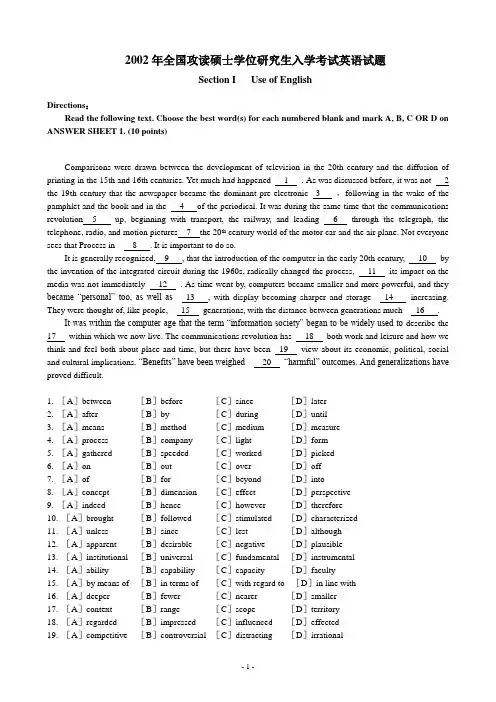
2002年全国攻读硕士学位研究生入学考试英语试题Section I Use of EnglishDirections:Read the following text. Choose the best word(s) for each numbered blank and mark A, B, C OR D on ANSWER SHEET 1. (10 points)Comparisons were drawn between the development of television in the 20th century and the diffusion of printing in the 15th and 16th centuries. Yet much had happened 1 . As was discussed before, it was not 2 the 19th century that the newspaper became the dominant pre-electronic_ 3 _ ,following in the wake of the pamphlet and the book and in the 4 of the periodical. It was during the same time that the communications revolution 5 up, beginning with transport, the railway, and leading 6 through the telegraph, the telephone, radio, and motion pictures 7 the 20th century world of the motor car and the air plane. Not everyone sees that Process in 8 . It is important to do so.It is generally recognized, 9 , that the introduction of the computer in the early 20th century, 10 by the invention of the integrated circuit during the 1960s, radically changed the process, 11 its impact on the media was not immediately 12 . As time went by, computers became smaller and more powerful, and they became “personal” too, as well as 13 , with display becoming sharper and storage 14 increasing. They were thought of, like people, 15 generations, with the distance between generations much 16 .It was within the computer age that the term “information society” began to be widely used to describe the 17 within which we now live. The communications revolution has 18 both work and leisure and how we think and feel both about place and time, but there have been 19 view about its economic, political, social and cultural implications. “Benefits” have been weighed 20 “harmful” outcomes. And generalizations have proved difficult.1. [A]between [B]before [C]since [D]later2. [A]after [B]by [C]during [D]until3. [A]means [B]method [C]medium [D]measure4. [A]process [B]company [C]light [D]form5. [A]gathered [B]speeded [C]worked [D]picked6. [A]on [B]out [C]over [D]off7. [A]of [B]for [C]beyond [D]into8. [A]concept [B]dimension [C]effect [D]perspective9. [A]indeed [B]hence [C]however [D]therefore10. [A]brought [B]followed [C]stimulated [D]characterized11. [A]unless [B]since [C]lest [D]although12. [A]apparent [B]desirable [C]negative [D]plausible13. [A]institutional [B]universal [C]fundamental [D]instrumental14. [A]ability [B]capability [C]capacity [D]faculty15. [A]by means of [B]in terms of [C]with regard to [D]in line with16. [A]deeper [B]fewer [C]nearer [D]smaller17. [A]context [B]range [C]scope [D]territory18. [A]regarded [B]impressed [C]influenced [D]effected19. [A]competitive [B]controversial [C]distracting [D]irrational20. [A]above [B]upon [C]against [D]withSection II Reading ComprehensionPart ADirections:Read the following four texts. Answer the questions below each text by choosing [A], [B], [C] or [D]. Mark your answers on ANSWER SHEET 1. (40 points)Text 1If you intend using humor in your talk to make people smile, you must know how to identify shared experiences and problems. Your humor must be relevant to the audience and should help to show them that you are one of them or that you understand their situation and are in sympathy with their point of view. Depending on whom you are addressing, the problems will be different. If you are talking to a group of managers, you may refer to the disorganized methods of their secretaries; alternatively if you are addressing secretaries, you may want to comment on their disorganized bosses.Here is an example, which I heard at a nurses’ convention, of a story which works we ll because the audience all shared the same view of doctors. A man arrives in heaven and is being shown around by St. Peter. He sees wonderful accommodations, beautiful gardens, sunny weather, and so on. Everyone is very peaceful, polite and friendly until, waiting in a line for lunch, the new arrival is suddenly pushed aside by a man in a white coat, who rushes to the head of the line, grabs his food and stomps over to a table by himself. “Who is that?” the new arrival asked St. Peter. “Oh, that’s God,” c ame the re ply, “but sometimes he thinks he’s a doctor.”If you are part of the group which you are addressing, you will be in a position to know the experiences and prob lems which are common to all of you and it’ll be appropriate for you to make a passing remark about the inedible canteen food or the chairman’s notorious bad taste in ties. With other audiences you mustn’t attempt to cut in with humor as they will resent an outsider making disparaging remarks about their canteen or their chairman. You will be on safer ground if you stick to scapegoats like the Post Office or the telephone system.If you feel awkward being humorous, you must practice so that it becomes more natural. Include a few casual and apparently off-the-cuff remarks which you can deliver in a r elaxed and unforced manner. Often it’s the delivery which causes the audience to smile, so speak slowly and remember that a raised eyebrow or an unbelieving look may help to show that you are making a light-hearted remark.Look for the humor. It often com es from the unexpected. A twist on a familiar quote “If at first you don’t succeed, give up” or a play on words or on a situation. Search for exaggeratio n and understatement. Look at your talk and pick out a few words or sentences which you can turn about and inject with humor.21. To make your humor work, you should .[A] take advantage of different kinds of audience [B] make fun of the disorganized people[C] address different problems to different people [D] show sympathy for your listeners22. The joke about doctors implies that, in the eyes of nurses, they are .[A] impolite to new arrivals [B] very conscious of their godlike role[C] entitled to some privileges [D] very busy even during lunch hours23. It can be inferred from the text that public services .[A] have benefited many people [B] are the focus of public attention[C] are an inappropriate subject for humor [D] have often been the laughing stock24. To achieve the desired result, humorous stories should be delivered .[A] in well-worded language [B] as awkwardly as possible[C] in exaggerated statements [D] as casually as possible25. The best title for the text may be .[A] Use Humor Effectively [B] Various Kinds of Humor[C] Add Humor to Speech [D] Different Humor StrategiesText 2Since the dawn of human ingenuity, people have devised ever more cunning tools to cope with work that is dangerous, boring, burdensome, or just plain nasty. That compulsion has resulted in robotics—the science of conferring various human capabilities on machines. And if scientists have yet to create the mechanical version of science fiction, they have begun to come close.As a result, the modern world is increasingly populated by intelligent gizmos whose presence we barely notice but whose universal existence has removed much human labor. Our factories hum to the rhythm of robot assembly arms. Our banking is done at automated teller terminals that thank us with mechanical politeness for the transaction. Our subway trains are controlled by tireless robot-drivers. And thanks to the continual miniaturization of electronics and micro-mechanics, there are already robot systems that can perform some kinds of brain and bone surgery with submillimeter accuracy—far greater precision than highly skilled physicians can achieve with their hands alone.But if robots are to reach the next stage of laborsaving utility, they will have to operate with less human supervision and be able to make at least a few decisions for themselves—goals that pose a real challeng e. “While we know how to tell a robot to handle a specific error," says Dave Lavery, manager of a robotics program at NASA, “we can't yet give a robot enough ‘common sense’ to reliably interact with a dynamic world.”Indeed the quest for true artificial intelligence has produced very mixed results. Despite a spell of initial optimism in the 1960s and 1970s when it appeared that transistor circuits and microprocessors might be able to copy the action of the human brain by the year 2010, researchers lately have begun to extend that forecast by decades if not centuries.What they found, in attempting to model thought, is that the human brain's roughly one hundred billion nerve cells are much more talented—and human perception far more complicated—than previously imagined. They have built robots that can recognize the error of a machine panel by a fraction of a millimeter in a controlled factory environment. But the human mind can glimpse a rapidly changing scene and immediately disregard the 98 percent that is irrelevant, instantaneously focusing on the monkey at the side of a winding forest road or the single suspicious face in a big crowd. The most advanced computer systems on Earth can't approach that kind of ability, and neuroscientists still don’t know quite how we do it.26. Human ingenuity was initially demonstrated in.[A] the use of machines to produce science fiction.[B] the wide use of machines in manufacturing industry.[C] the invention of tools for difficult and dangerous work.[D] the elite’s cunning tackling of dangerous and boring work.27. The word “gizmos” (line 1, paragraph 2) most probably means.[A] programs[B]experts[C]devices [D]creatures28. According to the text, what is beyond man's ability now is to design a robot that can.[A] fulfill delicate tasks like performing brain surgery.[B] interact with human beings verbally.[C] have a little common sense.[D] respond independently to a changing world.29. Besides reducing human labor, robots can also.[A] make a few decisions for themselves.[B] deal with some errors with human intervention.[C] improve factory environments.[D] cultivate human creativity.30. The author uses the example of a monkey to argue that robots are.[A] expected to copy human brain in internal structure.[B] able to perceive abnormalities immediately.[C] far less able than human brain in focusing on relevant information.[D] best used in a controlled environment.Text 3Could the bad old days of economic decline be about to return? Since OPEC agreed to supply-cuts in March, the price of crude oil has jumped to almost $26 a barrel, up from less than $10 last December. This near-tripling of oil prices calls up scary memories of the 1973 oil shock, when prices quadrupled, and 1979-1980, when they also almost tripled. Both previous shocks resulted in double-digit inflation and global economic decline. So where are the headlines warning of gloom and doom this time?The oil price was given another push up this week when Iraq suspended oil exports. Strengthening economic growth, at the same time as winter grips the northern hemisphere, could push the price higher still in the short term.Yet there are good reasons to expect the economic consequences now to be less severe than in the 1970s. In most countries the cost of crude oil now accounts for a smaller share of the price of petrol than it did in the 1970s. In Europe, taxes account for up to four-fifths of the retail price, so even quite big changes in the price of crude have a more muted effect on pump prices than in the past.Rich economies are also less dependent on oil than they were, and so less sensitive to swings in the oil price. Energy conservation, a shift to other fuels and a decline in the importance of heavy, energy-intensive industries have reduced oil consumption. Software, consultancy and mobile telephones use far less oil than steel or car production. For each dollar of GDP (in constant prices) rich economies now use nearly 50% less oil than in 1973. The OECD estimates in its latest Economic Outlook that, if oil prices averaged $22 a barrel for a full year, compared with $13 in 1998, this would increase the oil import bill in rich economies by only 0.25-0.5% of GDP. That is less than one-quarter of the income loss in 1974 or 1980. On the other hand, oil-importing emerging economies—to which heavy industry has shifted—have become more energy-intensive, and so could be more seriously squeezed.One more reason not to lose sleep over the rise in oil prices is that, unlike the rises in the 1970s, it has not occurred against the background of general commodity-price inflation and global excess demand. A sizable portion of the world is only just emerging from economic decline. The Economist’s co mmodity price index is broadly unchanging from a year ago. In 1973 commodity prices jumped by 70%, and in 1979 by almost 30%.31. The main reason for the latest rise of oil price is_______[A] global inflation.[B] reduction in supply.[C]fast growth in economy.[D] Iraq’s suspension of exports.32. It can be inferred from the text that the retail price of petrol will go up dramatically if______.[A] price of crude rises. [B] commodity prices rise.[C] consumption rises. [D] oil taxes rise.33. The estimates in Economic Outlook show that in rich countries_______.[A]heavy industry becomes more energy-intensive.[B]income loss mainly results from fluctuating crude oil prices.[C]manufacturing industry has been seriously squeezed.[D]oil price changes have no significant impact on GDP.34. We can draw a conclusion from the text that_______.[A]oil-price shocks are less shocking now.[B]inflation seems irrelevant to oil-price shocks.[C]energy conservation can keep down the oil prices.[D]the price rise of crude leads to the shrinking of heavy industry.35. From the text we can see that the writer seems__________.[A]optimistic. [B]sensitive. [C]gloomy. [D]scared.Text 4The Su preme Court’s decisions on physician-assisted suicide carry important implications for how medicine seeks to relieve dying patients of pain and suffering.Although it ruled that there is no constitutional right to physician-assisted suicide, the Court in effect supported the medical principle of “double effect”, a centuries-old moral principle holding that an action having two effects—a good one that is intended and a harmful one that is foreseen—is permissible if the actor intends only the good effect.Doctors have used that principle in recent years to justify using high doses of morphine to control terminally ill patients’pain, even though increasing dosages will eventually kill the patien t.Nancy Dubler, director of Montefiore Medical Center, contends that the principle will shield doctors who “until now have very, very strongly insisted that they could not give patients sufficient medication to control their pain if that might hasten dea th”.George Annas, chair of the health law department at Boston University, maintains that, as long as a doctor prescribes a drug for a legitimate medical purpose, the doctor has done nothing illegal even if the patient uses the drug to hasten death. “It’s like surgery,” he says. “We don’t call those deaths homicides because the doctors didn’t intend to kill their patients, although they risked their death. If you’re a physician, you can risk your patient’s suicide as long as you don’t intend their suicide.”On another level, many in the medical community acknowledge that the assisted-suicide debate has been fueled in part by the despair of patients for whom modern medicine has prolonged the physical agony of dying.Just three weeks before the Court’s ruli ng on physician-assisted suicide, the National Academy of Science (NAS) released a two-volume report, Approaching Death: Improving Care at the End of Life. It identifies the undertreatment of pain and the aggressive use of “ineffectual and forced medical p rocedures that may prolong and even dishonor the period of dying” as the twin problems of end-of-life care.The profession is taking steps to require young doctors to train in hospices, to test knowledge of aggressive pain management therapies, to develop a Medicare billing code for hospital-based care, and to develop new standards for assessing and treating pain at the end of life.Annas says lawyers can play a key role in insisting that these well-meaning medical initiatives translate into better care. “Large numbers of physicians seem unconcerned with the pain their patients are needlessly and predictably suffering”, to the extent that it constitutes “systematic patient abuse”. He says medical licensing boards “must make it clear...that painful deaths ar e presumptively ones that are incompetently managed and should re sult in license suspension”.36. From the first three paragraphs, we learn that .[A] doctors used to increase drug dosages to control their patients’pain[B] it is still illegal for doctors to help the dying end their lives[C] the Supreme Court strongly opposes physician-assisted suicide[D] patients have no constitutional right to commit suicide37. Which of the following statements its true according to the text?[A] Doctors will b e held guilty if they risk their patients’death.[B] Modern medicine has assisted terminally ill patients in painless recovery.[C] The Court ruled that high-dosage pain-relieving medication can be prescribed.[D] A doctor’s medication is no longer justifi ed by his intentions.38. According to the NAS’s report, one of t he problems in end-of-life care is .[A] prolonged medical procedures [B] inadequate treatment of pain[C] systematic drug abuse [D] insufficient hospital care39. Which of the following best defines the word “aggressive” (lin e 4, paragraph 7)?[A] Bold. [B] Harmful. [C] Careless. [D] Desperate40. George Annas would probably agree that doctors should be punished if they .[A] manage their patients incompetently[B] give patients more medicine than needed[C] reduce drug dosages for their patients[D] prolong the needless suffering of the patientsPart BDirections:Read the following text carefully and then translate the underlined segments into Chinese. Your translation should be written clearly on ANSWER SHEET 2. (10 points)Almost all our major problems involve human behavior, and they cannot be solved by physical and biological technology alone. What is needed is a technology of behavior, but we have been slow to develop the science from which such a technology might be drawn.(41)One difficulty is that almost all of what is called behavioral science continues to trace behavior to states of mind, feelings, traits of character, human nature, and so on. Physics and biology once followed similar practices and advanced only when they discarded them. (42)The behavioral sciences have been slow to change partly because the explanatory items often seem to be directly observed and partly because other kinds of explanations have been hard to find. The environment is obviously important, but its role has remained obscure. It does not push or pull, it selects, and this function is difficult to discover and analyze.(43)The role of natural selection in evolution was formulated only a little more than a hundred years ago, and the selective role of the environment in shaping and maintaining the behavior of the individual is only beginning to be recognized and studied. As the interaction between organism and environment has come to be understood, however, effects once assigned to states of mind, feelings, and traits are beginning to be traced to accessible conditions, and a technology of behavior may therefore become available. It will not solve our problems, however, until it replaces traditional prescientific views, and these are strongly entrenched. Freedom and dignity illustrate the difficulty. (44)They are the possessions of the autonomous(self-governing)man of traditional theory, and they are essential to practices in which a person is held responsible for his conduct and given credit for his achievements. A scientific analysis shifts both the responsibility and the achievement to the environment. It also raises questions concerning “values”. Who will use a technology and to what ends? (45)Until these issues are resolved, a technology of behavior will continue to be rejected, and with it possibly the only way to solve our problems.Section III Writing46. Directions:Study the following picture carefully and write an essay entitled “Cultures National and International”.In the essay you should1. describe the picture and interpret its meaning, and2. give your comment on the phenomenon.You should write about 200 words neatly on ANSWER SHEET 2. (20 points)An American girl in traditional Chinese costume(服装)。
2002 考研英语(一)真题
2002年全国硕士研究生入学统一考试英语试题S ection I Use of EnglishDirections:Read the following text.Choose the best word(s)for each numbered blank and mark A,B,C or D on ANSWER SHEET1.(10points).Comparisons were drawn between the development of television in the20th century and the diffusion of printing in the15th and16th centuries.Yet much had happened1.As was discussed before,it was not2the19th century that the newspaper became the dominant pre-electronic 3,following in the wake of the pamphlet and the book and in the4of the periodical.It was during the same time that the communications revolution5up,beginning with transport,the railway,and leading6through the telegraph,the telephone,radio,and motion pictures7the 20th century world of the motor car and the air plane.Not everyone sees that Process in8.It is important to do so.It is generally recognized,9,that the introduction of the computer in the early20th century, 10by the invention of the integrated circuit during the1960s,radically changed the process,11 its impact on the media was not immediately12.As time went by,computers became smaller and more powerful,and they became“personal”too,as well as13,with display becoming sharper and storage14increasing.They were thought of,like people,15generations, with the distance between generations much16.It was within the computer age that the term“information society”began to be widely used to describe the17within which we now live.The communications revolution has18both work and leisure and how we think and feel both about place and time,but there have been19 view about its economic,political,social and cultural implications.“Benefits”have been weighed 20“harmful”outcomes.And generalizations have proved difficult.1.[A]between[B]before[C]since[D]later2.[A]after[B]by[C]during[D]until3.[A]means[B]method[C]medium[D]measure4.[A]process[B]company[C]light[D]form5.[A]gathered[B]speeded[C]worked[D]picked6.[A]on[B]out[C]over[D]off7.[A]of[B]for[C]beyond[D]into8.[A]concept[B]dimension[C]effect[D]perspective9.[A]indeed[B]hence[C]however[D]therefore10.[A]brought[B]followed[C]stimulated[D]characterized11.[A]unless[B]since[C]lest[D]although12.[A]apparent[B]desirable[C]negative[D]plausible13.[A]institutional[B]universal[C]fundamental[D]instrumental14.[A]ability[B]capability[C]capacity[D]faculty15.[A]by means of[B]in terms of[C]with regard to[D]in line with16.[A]deeper[B]fewer[C]nearer[D]smaller17.[A]context[B]range[C]scope[D]territory18.[A]regarded[B]impressed[C]influenced[D]effected19.[A]competitive[B]controversial[C]distracting[D]irrational20.[A]above[B]upon[C]against[D]withSection II Reading ComprehensionPart ADirections:Read the following four texts.Answer the questions below each text by choosing[A],[B],[C]or[D]. Mark your answers on ANSWER SHEET1.(40points)Text1If you intend using humor in your talk to make people smile,you must know how to identify shared experiences and problems.Your humor must be relevant to the audience and should help to show them that you are one of them or that you understand their situation and are in sympathy with their point of view.Depending on whom you are addressing,the problems will be different.If you are talking to a group of managers,you may refer to the disorganized methods of their secretaries; alternatively if you are addressing secretaries,you may want to comment on their disorganized bosses.Here is an example,which I heard at a nurses’convention,of a story which works well because the audience all shared the same view of doctors.A man arrives in heaven and is being shown around by St.Peter.He sees wonderful accommodations,beautiful gardens,sunny weather,and so on. Everyone is very peaceful,polite and friendly until,waiting in a line for lunch,the new arrival is suddenly pushed aside by a man in a white coat,who rushes to the head of the line,grabs his food and stomps over to a table by himself.“Who is that?”the new arrival asked St.Peter.“Oh,that’s God,”came the reply,“but sometimes he thinks he’s a doctor.”If you are part of the group which you are addressing,you will be in a position to know the experiences and problems which are common to all of you and it’ll be appropriate for you to make a passing remark about the inedible canteen food or the chairman’s notorious bad taste in ties.With other audiences you mustn’t attempt to cut in with humor as they will resent an outsider making disparaging remarks about their canteen or their chairman.You will be on safer ground if you stick to scapegoats like the Post Office or the telephone system.If you feel awkward being humorous,you must practice so that it becomes more natural.Include a few casual and apparently off-the-cuff remarks which you can deliver in a relaxed and unforced manner.Often it’s the delivery which causes the audience to smile,so speak slowly and remember that a raised eyebrow or an unbelieving look may help to show that you are making a light-hearted remark.Look for the humor.It often comes from the unexpected.A twist on a familiar quote“If at first you don’t succeed,give up”or a play on words or on a situation.Search for exaggeration and understatement.Look at your talk and pick out a few words or sentences which you can turn about and inject with humor.21.To make your humor work,you should.[A]take advantage of different kinds of audience[B]make fun of the disorganized people[C]address different problems to different people[D]show sympathy for your listeners22.The joke about doctors implies that,in the eyes of nurses,they are.[A]impolite to new arrivals[B]very conscious of their godlike role[C]entitled to some privileges[D]very busy even during lunch hours23.It can be inferred from the text that public services.[A]have benefited many people[B]are the focus of public attention[C]are an inappropriate subject for humor[D]have often been the laughing stock24.To achieve the desired result,humorous stories should be delivered.[A]in well-worded language[B]as awkwardly as possible[C]in exaggerated statements[D]as casually as possible25.The best title for the text may be.[A]Use Humor Effectively[B]Various Kinds of Humor[C]Add Humor to Speech[D]Different Humor StrategiesText2Since the dawn of human ingenuity,people have devised ever more cunning tools to cope with work that is dangerous,boring,burdensome,or just plain nasty.That compulsion has resulted in robotics—the science of conferring various human capabilities on machines.And if scientists have yet to create the mechanical version of science fiction,they have begun to come close.As a result,the modern world is increasingly populated by intelligent gizmos whose presence we barely notice but whose universal existence has removed much human labor.Our factories hum to the rhythm of robot assembly arms.Our banking is done at automated teller terminals that thank us with mechanical politeness for the transaction.Our subway trains are controlled by tireless robot-drivers. And thanks to the continual miniaturization of electronics and micro-mechanics,there are already robot systems that can perform some kinds of brain and bone surgery with submillimeter accuracy—far greater precision than highly skilled physicians can achieve with their hands alone.But if robots are to reach the next stage of laborsaving utility,they will have to operate with less human supervision and be able to make at least a few decisions for themselves—goals that pose a real challenge.“While we know how to tell a robot to handle a specific error,"says Dave Lavery,manager of a robotics program at NASA,“we can't yet give a robot enough‘common sense’to reliably interact with a dynamic world.”Indeed the quest for true artificial intelligence has produced very mixed results.Despite a spell of initial optimism in the1960s and1970s when it appeared that transistor circuits and microprocessors might be able to copy the action of the human brain by the year2010,researchers lately have begun to extend that forecast by decades if not centuries.What they found,in attempting to model thought,is that the human brain's roughly one hundred billion nerve cells are much more talented—and human perception far more complicated—than previously imagined.They have built robots that can recognize the error of a machine panel by a fraction of a millimeter in a controlled factory environment.But the human mind can glimpse a rapidly changing scene and immediately disregard the98percent that is irrelevant,instantaneously focusing on the monkey at the side of a winding forest road or the single suspicious face in a big crowd.The most advanced computer systems on Earth can't approach that kind of ability,and neuroscientists still don’t know quite how we do it.26.Human ingenuity was initially demonstrated in.[A]the use of machines to produce science fiction.[B]the wide use of machines in manufacturing industry.[C]the invention of tools for difficult and dangerous work.[D]the elite’s cunning tackling of dangerous and boring work.27.The word“gizmos”(line1,paragraph2)most probably means.[A]programs[B]experts[C]devices[D]creatures28.According to the text,what is beyond man's ability now is to design a robot that can.[A]fulfill delicate tasks like performing brain surgery.[B]interact with human beings verbally.[C]have a little common sense.[D]respond independently to a changing world.29.Besides reducing human labor,robots can also.[A]make a few decisions for themselves.[B]deal with some errors with human intervention.[C]improve factory environments.[D]cultivate human creativity.30.The author uses the example of a monkey to argue that robots are.[A]expected to copy human brain in internal structure.[B]able to perceive abnormalities immediately.[C]far less able than human brain in focusing on relevant information.[D]best used in a controlled environment.Text3Could the bad old days of economic decline be about to return?Since OPEC agreed to supply-cuts in March,the price of crude oil has jumped to almost$26a barrel,up from less than$10 last December.This near-tripling of oil prices calls up scary memories of the1973oil shock,when prices quadrupled,and1979-1980,when they also almost tripled.Both previous shocks resulted in double-digit inflation and global economic decline.So where are the headlines warning of gloom and doom this time?The oil price was given another push up this week when Iraq suspended oil exports. Strengthening economic growth,at the same time as winter grips the northern hemisphere,could push the price higher still in the short term.Yet there are good reasons to expect the economic consequences now to be less severe than in the 1970s.In most countries the cost of crude oil now accounts for a smaller share of the price of petrol than it did in the1970s.In Europe,taxes account for up to four-fifths of the retail price,so even quite big changes in the price of crude have a more muted effect on pump prices than in the past.Rich economies are also less dependent on oil than they were,and so less sensitive to swings in the oil price.Energy conservation,a shift to other fuels and a decline in the importance of heavy, energy-intensive industries have reduced oil consumption.Software,consultancy and mobile telephones use far less oil than steel or car production.For each dollar of GDP(in constant prices)rich economies now use nearly50%less oil than in1973.The OECD estimates in its latest Economic Outlook that,if oil prices averaged$22a barrel for a full year,compared with$13in1998,this would increase the oil import bill in rich economies by only0.25-0.5%of GDP.That is less than one-quarter of the income loss in1974or1980.On the other hand,oil-importing emerging economies—to which heavy industry has shifted—have become more energy-intensive,and so could be more seriously squeezed.One more reason not to lose sleep over the rise in oil prices is that,unlike the rises in the1970s,it has not occurred against the background of general commodity-price inflation and global excess demand.A sizable portion of the world is only just emerging from economic decline.The Economist’s commodity price index is broadly unchanging from a year ago.In1973commodity prices jumped by 70%,and in1979by almost30%.31.The main reason for the latest rise of oil price is_______[A]global inflation.[B]reduction in supply.[C]fast growth in economy.[D]Iraq’s suspension of exports.32.It can be inferred from the text that the retail price of petrol will go up dramatically if______.[A]price of crude rises.[B]commodity prices rise.[C]consumption rises.[D]oil taxes rise.33.The estimates in Economic Outlook show that in rich countries_______.[A]heavy industry becomes more energy-intensive.[B]income loss mainly results from fluctuating crude oil prices.[C]manufacturing industry has been seriously squeezed.[D]oil price changes have no significant impact on GDP.34.We can draw a conclusion from the text that_______.[A]oil-price shocks are less shocking now.[B]inflation seems irrelevant to oil-price shocks.[C]energy conservation can keep down the oil prices.[D]the price rise of crude leads to the shrinking of heavy industry.35.From the text we can see that the writer seems.[A]optimistic.[B]sensitive.[C]gloomy.[D]scaredText4The Supreme Court’s decisions on physician-assisted suicide carry important implications for how medicine seeks to relieve dying patients of pain and suffering.Although it ruled that there is no constitutional right to physician-assisted suicide,the Court in effect supported the medical principle of“double effect”,a centuries-old moral principle holding that an action having two effects—a good one that is intended and a harmful one that is foreseen—is permissible if the actor intends only the good effect.Doctors have used that principle in recent years to justify using high doses of morphine to control terminally ill patients’pain,even though increasing dosages will eventually kill the patient.Nancy Dubler,director of Montefiore Medical Center,contends that the principle will shield doctors who“until now have very,very strongly insisted that they could not give patients sufficient medication to control their pain if that might hasten death”.George Annas,chair of the health law department at Boston University,maintains that,as long as a doctor prescribes a drug for a legitimate medical purpose,the doctor has done nothing illegal even if the patient uses the drug to hasten death.“It’s like surgery,”he says.“We don’t call those deaths homicides because the doctors didn’t intend to kill their patients,although they risked their death.If you’re a physician,you can risk your patient’s suicide as long as you don’t intend their suicide.”On another level,many in the medical community acknowledge that the assisted-suicide debate has been fueled in part by the despair of patients for whom modern medicine has prolonged the physical agony of dying.Just three weeks before the Court’s ruling on physician-assisted suicide,the National Academy of Science(NAS)released a two-volume report,Approaching Death:Improving Care at the End of Life. It identifies the undertreatment of pain and the aggressive use of“ineffectual and forced medical procedures that may prolong and even dishonor the period of dying”as the twin problems of end-of-life care.The profession is taking steps to require young doctors to train in hospices,to test knowledge of aggressive pain management therapies,to develop a Medicare billing code for hospital-based care,and to develop new standards for assessing and treating pain at the end of life.Annas says lawyers can play a key role in insisting that these well-meaning medical initiatives translate into better care.“Large numbers of physicians seem unconcerned with the pain their patients are needlessly and predictably suffering”,to the extent that it constitutes“systematic patient abuse”. He says medical licensing boards“must make it clear...that painful deaths are presumptively ones that are incompetently managed and should result in license suspension”.36.From the first three paragraphs,we learn that.[A]doctors used to increase drug dosages to control their patients’pain[B]it is still illegal for doctors to help the dying end their lives[C]the Supreme Court strongly opposes physician-assisted suicide[D]patients have no constitutional right to commit suicide37.Which of the following statements its true according to the text?[A]Doctors will be held guilty if they risk their patients’death.[B]Modern medicine has assisted terminally ill patients in painless recovery.[C]The Court ruled that high-dosage pain-relieving medication can be prescribed.[D]A doctor’s medication is no longer justified by his intentions.38.According to the NAS’s report,one of the problems in end-of-life care is.[A]prolonged medical procedures[B]inadequate treatment of pain[C]systematic drug abuse[D]insufficient hospital care39.Which of the following best defines the word“aggressive”(line3,paragraph7)?[A]Bold.[B]Harmful.[C]Careless.[D]Desperate40.George Annas would probably agree that doctors should be punished if they.[A]manage their patients incompetently[B]give patients more medicine than needed[C]reduce drug dosages for their patients[D]prolong the needless suffering of the patientsPart BDirections:Read the following text carefully and then translate the underlined segments into Chinese.Your translation should be written clearly on ANSWER SHEET2.(10points)Almost all our major problems involve human behavior,and they cannot be solved by physical and biological technology alone.What is needed is a technology of behavior,but we have been slow to develop the science from which such a technology might be drawn.(41)One difficulty is that almost all of what is called behavioral science continues to trace behavior to states of mind,feelings,traits of character,human nature,and so on.Physics and biology once followed similar practices and advanced only when they discarded them.(42)The behavioral sciences have been slow to change partly because the explanatory items often seem to be directly observed and partly because other kinds of explanations have been hard to find.The environment is obviously important,but its role has remained obscure.It does not push or pull,it selects,and this function is difficult to discover and analyze.(43)The role of natural selection in evolution was formulated only a little more than a hundred years ago, and the selective role of the environment in shaping and maintaining the behavior of the individual is only beginning to be recognized and studied.As the interaction between organism and environment has come to be understood,however,effects once assigned to states of mind,feelings,and traits are beginning to be traced to accessible conditions,and a technology of behavior may therefore become available.It will not solve our problems,however,until it replaces traditional prescientific views,and these are strongly entrenched.Freedom and dignity illustrate the difficulty.(44)They are the possessions of the autonomous(self-governing)man of traditional theory,and they are essential to practices in which a person is held responsible for his conduct and given credit for his achievements.A scientific analysis shifts both the responsibility and the achievement to the environment.It also raises questions concerning“values”.Who will use a technology and to what ends?(45)Until these issues are resolved,a technology of behavior will continue to be rejected,and with it possibly the only way to solve our problems.S ection III Writing46.Directions:Study the following picture carefully and write an essay entitled“Cultures National and International”.In the essay you should1)describe the picture and interpret its meaning,and2)give your comment on the phenomenon.You should write about200words neatly on ANSWER SHEET2.(20points)An American girl in traditional Chinese costume(服装)。
2002年全国硕士研究生考试英语真题及答案2
B] Use the discount tickets.[C] Quit his eating-out habit.[D] Use only paper bills and save coins.Questions 17-20 are based on an interview with Herbert A. Glieberman, a domestic-relations lawyer. You now have 20 seconds to read Questions 17-20.17. Which word best describes the lawyer’s prediction of the change in divorce rate?[A] Fall[B] Rise[C] V-shape[D] Zigzag18. What do people nowadays desire to do concerning their marriage?[A] To embrace changes of thought.[B] To adapt to the disintegrated family life.[C] To return to the practice in the ‘60s and ‘70s.[D] To create stability in their lives.19. Why did some people choose not to divorce 20 years ago?[A] They feared the complicated procedures.[B] They wanted to go against the trend.[C] They were afraid of losing face.[D] they were willing to stay together.20. Years ago a divorced man in a company would have.[A] been shifted around the country.[B] had difficulty being promoted.[C] enjoyed a happier life.[D] tasted little bitterness of disgrace.You now have 5 minutes to transfer all your answers from your test booklet to ANSWER SHEET 1.THIS IS THE END OF SECTION IDO NOT READ OR WORK ON THE NEXT SECTIONUNTIL YOU ARE TOLD TO CONTINUE全国硕⼠研究⽣⼊学考试英语试题 (⼆)National Entrance Test of English for MA/MS Candidates (2002)考⽣注意事项1. 考⽣必须严格遵守各项考场规则,得到监考⼈员指令后⽅可开始答题。
2002年考研英语翻译真题解析
2002年61) One difficulty is that almost all of what is called behavioral science continues to trace behavior to states of mind, feelings, traits of character, human nature, and so on.句子分析:第一、句子可以拆分为两段:One difficulty is that almost all of what is called behavioral science / continues to trace behavior to states of mind, feelings, traits of character, human nature, and so on.第二、句子的结构是:1)主干结构是表语从句One difficulty is that...2)almost all of what is called behavioral science是表语从句中的主语部分,后面是简单的谓语和宾语结构。
第三、词的处理:continues to trace behavior to继续针对……研究行为behavioral science 行为科学states of mind 心态,意识状态feelings 感情traits of character 性格特点完整的译文:61)难题之一在于所谓的行为科学几乎全都依然从心态、情感、性格特征、人性等方面去寻找行为的根源。
62) The behavioral sciences have been slow to change partly because the explanatory items often seem to be directly observed and partly because other kinds of explanations have been hard to find.句子分析:第一、句子可以拆分为三段:The behavioral sciences have been slow to change/partly because the explanatory items often seem to be directly observed and/partly because other kinds of explanations have been hard to find.第二、句子的主干结构是:主句+两个并列关系的原因状语从句之所以……,部分是因为……,部分是因为……第三、词的处理:the explanatory items 用以解释的要素(内容,项目)other kinds of explanations 其他解释方式完整的译文:62)行为科学之所以发展缓慢,部分原因是用来解释行为的依据似乎往往是直接观察到的,部分原因是其他的解释方式一直难以找到。
2002年研究生入学考试英语试题及解析(2)
2002年研究生入学考试英语试题及解析(2) National Entrance Test of English for MA/MS Candidates(2002)考生注意事项1.考生必须严格遵守各项考场规则,得到监考人员指令后方可开始答题。
2. 全国硕士研究生入学考试英语分为试题(一)、试题(二)。
3.本试题为试题(二),共11页(5~15页),含有英语知识运用、阅读理解、写作三个部分。
英语知识运用、阅读理解A节的答案必须用2B铅笔按要求直接填涂在答题卡1上,如要改动,必须用橡皮擦干净。
阅读理解B节和写作部分必须用蓝(黑)圆珠笔在答题卡2上答题,注意字迹清楚。
4.考试结束后,考生应将答题卡1、答题卡2一并装入原试卷袋中,将试题(一)、试题(二)交给监考人员。
Section II Use of EnglishDirections:Read the following text. Choose the best word(s) for each numbered blank and mark A, B, C or D on ANSWER SHEET 1. (10 points)Comparisons were drawn between the development of television in the 20th century and the diffusion of printing in the 15th and 16th centuries. Yet much had happened 21.As was discussed before, it was not 22 the 19th century that the newspaper became the dominant pre-electronic 23, following in the wake of the pamphlet and the book and in the 24 of the periodical. It was during the same time that the communications revolution 25up,beginning with transport, the railway, and leading 26 through the telegraph, the telephone, radio, and motion pictures 27 th e 20th-century world of the motor car and the airplane. Not everyone sees that process in 28 . It is important to do so.It is generally recognized, 29 , that the introduction of the computer in the early 20th century, 30 by the invention of the integrated circuit during the 1960s, radically changed the process, 31 its impact on the media was not immediately 32 . As time went by, computers became smaller and more powerful,and they became “personal” too, as well as 33 , with display becoming sharper and storage 34 in creasing. They were thought of, like people, 35 generations, with the distance between generations much 36 .It was within the computer age that the term“information society” began to be widely used to describe the 37 within which we now live. The communications revolution has 38 both work and leisure and how we think and feel both about place and time, but therehave been 39 views about its economic ,political, social and cultural implications. “Benefits” have been weighed40 “harmful” outcomes. And generalizatio ns have proved difficult.21. [A] between [B] before [C] since [D] later22. [A] after [B] by [C] during [D] until23. [A] means [B] method [C] medium [D] measure24. [A] process [B] company [C] light [D] form25. [A] gathered [B] speeded [C] worked [D] picked26. [A] on [B] out [C] over [D] off27. [A] of [B] for [C] beyond [D] into28. [A] concept [B] dimension [C] effect [D]perspective29. [A] indeed [B] hence [C] however [D] therefore30. [A] brought [B] followed [C] stimulated [D]characterized31. [A] unless [B] since [C] lest [D] although32. [A] apparent [B] desirable [C] negative [D]plausible33. [A] institution [B] universal [C] fundamental [D]instrumental34. [A] ability [B] capability [C] capacity [D] faculty35. [A] by means of [B] in terms of [C] with regard to[D] in line with36. [A] deeper [B] fewer [C] nearer [D] smaller37. [A] context [B] range [C] scope [D] territory38. [A] regarded [B] impressed [C] influenced [D]effected39. [A] competitive [B] controversial [C] distracting [D] irrational40. [A] above [B] upon [C] against [D] withSection III Reading ComprehensionPart ADirections:Read the following four texts. Answer the questions below each text by choosing A, B, C or D. Mark your answers on ANSWER SHEET 1. (40 points)Text 1If you intend using humor in your talk to make people smile, you must know how to identify shared experiences and problems. Your humor must be relevant to the audience and should help to show them that you are one of them or that you understand their situation and are in sympathy with their point of view. Depending on whom you are addressing, the problems will bedifferent. If you are talking to a group of managers, you may refer to the disorganized methods of their secretaries; alternatively if you are addressing secretaries, you may want to comment on their disorganized bosses.Here is an example, which I heard at a nurses' convention, of a story which works well because the audience all shared the same view of doctors. A man arrives in heaven and is being shown around by St. Peter. He sees wonderful accommodations, beautiful gardens, sunny weather, and so on. Everyone is very peaceful, polite and friendly until, waiting in a line for lunch, the new arrival is suddenly pushed aside by a man in a white coat, who rushes to the head of the line, grabs his food and stomps over to a table by himself. “Who is that?” the new arrival asked St. Peter. “Oh, that's God,” came the reply, “but sometimes he thinks he's a doctor.”If you are part of the group which you are addressing, you will be in a position to know the experiences and problems which are common to all of you and it'll be appropriate for you to make a passing remark about the inedible canteen food or the chairman's notorious bad taste in ties. With other audiences you mustn't attempt to cut in with humor as they will resent an outsider making disparaging remarks about their canteen ortheir chaiman. You will be on safer ground if you stick to scapegoats like the Post Office or the telephone system.If you feel awkward being humorous, you must practice so that is becomes more natural. Include a few casual and apparently off-the-cuff remarks which you can deliver in a relaxed and unforced manner. Often it's the delivery which causes the audience to smile, so speak slowly and remember that a raised eyebrow or an unbelieving look may help to show that you are making a light-hearted remark. Look for the humor. It often comes from the unexpected. A twist on a familiar quote “If at first you don't succeed, give up” or a play on words or on a situation. Search for exaggeration and understatements. Look at your talk and pick out a few words or sentences which you can turn about and inject with humor.41. To make your humor work, you should .[A] take advantage of different kinds of audience.[B] make fun of the disorganized people.[C] address different problems to different people.[D] show syMPAthy for your listeners.42. The joke about doctors implies that, in the eyes of nurses, they are .[A] impolite to new arrivals.[B] very conscious of their godlike role.[C] entitled to some privileges.[D] very busy even during lunch hours.43. It can be inferred from the text that public services .[A] have benefited many people.[B] are the focus of public attention.[C] are an inappropriate subject for humor.[D] have often been the laughing stock.44. To achieve the desired result, humorous stories should be delivered .[A] in well-worded language.[B] as awkwardly as possible.[C] in exaggerated statements.[D] as casually as possible.45. The best title for the text may be .[A] Use Humor Effectively.[B] Various Kinds of Humor.[C] Add Humor to Speech.[D] Different Humor Strategies.Text 2Since the dawn of human ingenuity, people have devised ever more cunning tools to cope with work that is dangerous, boring, burdensome, or just plain nasty. That compulsion has resulted in robotics-the science of conferring various human capabilities on machines. And if scientists have yet to create the mechanical version of science fiction, they have begun to come close.As a result, the modern world is increasingly populated by intelligent gizmos whose presence we barely notice but whose universal existence has removed much hum an labor. Our factories hum to the rhythm of robot assembly arms. Our banking is done at automated teller terminals that thank us with mechanical politeness for the transaction. Our subway trains are controlled by tireless robo-drivers. And thanks to the continual miniaturization of electronics and micro-mechanics, there are already robot systems that can perform some kinds of brain and bone surgery with submillimeter accuracy-far greater precision than highly skilled physicians can achieve with their hands alone. But if robots are to reach the next stage of laborsaving utility, they will have to operate with less human supervision and be able to make at least a few decisions forthemselves-goals that pose a real challenge. “While we know how to tell a robot to handle a specific error,” says Dave Lavery, manager of a robotics program at NASA, “we can't yet give a robot enough ‘commonsense’ to reliably interact with a dynamic world.”Indeed the quest for true artificial intelligence has produced very mixed results. Despite a spell of initial optimism in the 1960s and 1970s when it appeared that transistor circuits and microprocessors might be able to copy the action of the human brain by the year 2010, researchers lately have begun to extend that forecast by decades if not centuries. What they found, in attempting to model thought, is that the human brain's roughly one hundred billion nerve cells are much more talented-and human perception far more complicated-than previously imagined. They have built robots that can recognize the error of a machine panel by a fraction of a millimeter in a controlled factory environment. But the human mind can glimpse a rapidly changing scene and immediately disregard the 98 percent that is irrelevant, instantaneously focusing on the monkey at the side of a winding forest road or the single suspicious face in a big crowd. The most advanced computer systems on Earth can't approach that kind of ability, and neuroscientists still don't know quite how we do it.46. Human ingenuity was initially demonstrated in .[A] the use of machines to produce science fiction.[B] the wide use of machines in manufacturing industry. [C] the invention of tools for difficult and dangerous work.[D] the elite's cunning tackling of dangerous and boring work.47. The word “gizmos" (line 1, paragraph 2) most probab ly means .[A] programs.[B] experts.[C] devices. [D]creatures.48. According to the text, what is beyond man's ability now is to design a robot that can .[A]fulfill delicate tasks like performing brain surgery.[B] interact with human beings verbally.[C] have a little common sense.[D] respond independently to a changing world.49. Besides reducing human labor, robots can also .[A] make a few decisions for themselves.[B] deal with some errors with human intervention.[C] improve factory environments.[D] cultivate human creativity.50. The author uses the example of a monkey to argue that robots are .[A] expected to copy human brain in internal structure.[B] able to perceive abnormalities immediately.[C] far less able than human brain in focusing on relevant information.[D] best used in a controlled environment.。