
外研版(新标准)英语八年级下册Module 2 Experiences模块知识点归纳总结
Module 2 Experiences
I've also entered lots of speaking competitions.
必背单词
1. ever (adv.) 曾经;从来;在任何时候→never(反义词)从不
2.dream (v.) 做梦;梦到;梦想→dreamed/dreamt(过去
式)→dreamed/dreamt(过去分词)
3. afford (v.) (有财力)买得起,付得起→afford to do sth. 干某事负担
得起
4. invite (v.) 邀请→invitation (n.) 邀请
5. enter (v.) (使)参加;(使)报名
6. competition (n.) 比赛;竞争
7. prize (n.) 奖品;奖项
必背短语
8. enter a competition 参加比赛
9. first prize 一等奖
10. good luck 好运
11. think about 思考;考虑
12. write about 编写;写作
13. make up 编写;创作
14. invite sb. to do sth. 邀请某人去做某事
必背句子
15. Have you ever won any prizes before?
以前你曾得过奖吗?
16. But I can't afford it.
但是我支付不起费用。
17. That's a pity.那很遗憾。
They have seen the Pyramids.
必背单词
1. move (v.) 搬家;改变……的位置→movement (n.) 搬动
2. send (v.) 派遣去;命令……去→sent(过去式)→sent(过去分词)
3. Germany (n.) 德国→German ( adj.) 德国的,德语的,德国人的
4. France (n.) 法国→French (adj.) 法语的,法国的,法国人的
5. way (n.) 方面;态度→ways (pl.)
6. mix (v.) 相混合;融合→mixes(第三人称单数形式)
7. miss (v.) 惦念;怀念;想念→misses(第三人称单数形式)
8. tower (n.) 塔
9. ancient (adj.) 古老的;古代的
10. king (n.) 国王;君王
11. queen (n.) 女王;王后
必背短语
12. at the moment 目前,现在
13. for example 例如
14. be different from 和……不同
15. in many ways 在许多方面
16. all over the world 全世界
17. count down 倒数;倒计时
18. look forward to 渴望;期盼
必背句子
19. They have been to many interesting places.
他们去过许多有趣的地方。
20. They find it hard to spell and pronounce the words.
他们发现拼、读单词很难。
21. However,they still enjoy learning it.
然而,他们仍然喜欢学它。
Language in use
必背短语
1. what's more 此外,而且;更有甚者
2. find out 弄清楚,搞明白
3. something special 特别的东西
4. a pair of 一双,一副,一对
5. lack of 缺少
必背句子
6. Have you ever wanted to save the trees in the forest?
你曾想过挽救森林中的树木吗?
7. The world needs more trees—buy one today,watch it grow bigger and
feel proud!
世界需要更多的树——今天买下一棵树,看着它成长,由此你会感
到自豪!
8. I've done so many things!我已经做了很多事情!
新外研版八年级英语下册导学案Module 2-Experiences(Unit1-Unit3)
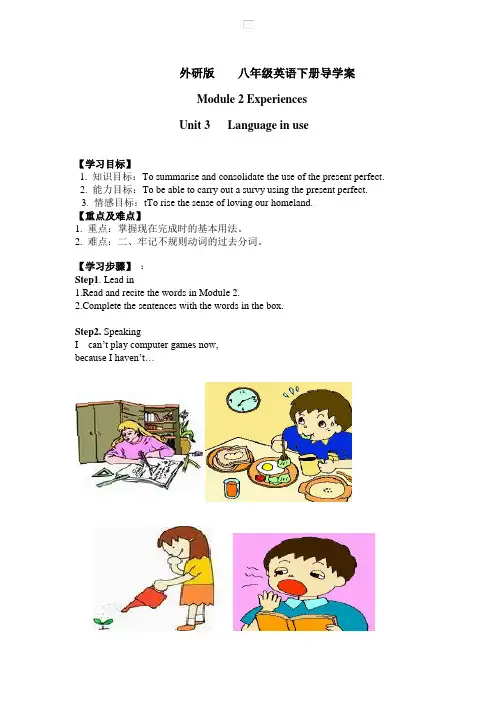
外研版八年级英语下册导学案Module 2 ExperiencesUnit 3 Language in use【学习目标】1. 知识目标:To summarise and consolidate the use of the present perfect.2. 能力目标:To be able to carry out a survy using the present perfect.3. 情感目标:tTo rise the sense of loving our homeland.【重点及难点】1. 重点:掌握现在完成时的基本用法。
2. 难点:二、牢记不规则动词的过去分词。
【学习步骤】:Step1. Lead in1.Read and recite the words in Module2.plete the sentences with the words in the box.Step2. SpeakingI can’t play computer games now,because I haven’t…Step3. Write a questionnaire about your experiences.Have you ever …had a Western meal?lived in another city?entered a singing competition?travelled by train?travelled to the seaside?tried seafood?cooked dinner for your parents?------Yes, I have. / No, I haven’t.Step4 Complete the sentences.1. He/She _____________________ a Western meal.2.He/She ______________________ in another city.3.He/She ______________________ a singing competition.4. He/She _____________________ by train.5.He/She ______________________ the seaside.6.He/She ______________________ seafood.7.He/She ______________________ for his/her parents.Step5. Complete the postcard. Use the list of Things to do in China to help you.Things to do in China!------go to Beijing,see the Beijing Opera,climb the Great Wall,eat Beijing duck,visit the Palace MuseumStep6 Activity4Dear David,I’m having a wonderful time in China. I’ve done so many things!I’ve__________________________________________________________________________________ ___________________________________________________________ There’s only one thing I haven’t don e :I...______________________________________Bye for now,RobStep7. Complete the sentences with the words in the box.afford, competition, pronounce, spell, tower1.I wrote a story for a(n) ___________ in my English class and I won a prize.2.Alice can _______ very well, and what's more, she can write beautifully.3.Some English words are difficult to ____________.4.We visited an ancient palace with a tall_______ and a beautiful garden.5.Mary wants to visit the US, but the plane tickets are very expensive and she cannot ______ to go.Step8.Listen and check (√) the correct answer.Places visitedPeople China Europe USAWinnieDianaBobStep9. Listen again and answer the questions.1. ( ) How many times has Winnie been to the US?A. two timesB. three timesC. four times2. ( ) Where would Diana like to go again?A. the USB. EnglandC. China3. ( ) Which part of China has Diana travelled around?A. NorthB. SouthC. West4. ( ) How did Diana travel there?A. by boatB. by trainC. by plane5. ( ) Has Bob ever visited Germany?A. No, he hasn’tB. Yes, he has【知识结构】(一)、Grammar现在完成时如果你想说“我已经看过某部电影,所以不想看了” “某人曾经做过什么事情”等等,该如何表达呢?首先请看下面的句子:(1)I have seen the f ilm. I don’t want to see it again.(2) Have you ever read a travel brochure?(3) I have never visited the USA.以上句子的谓语动词有一个共同的特点就是“have/has+动词的过去分词”, 用于表示在以前的某个时间曾经做过的、发生的事情,这种行为对目前有某种影响,如(1); 还可以表示到目前为止曾经经历或没经历的事情,如(2)(3)。
[荐]外研版英语八年级下M3U1、2、3重点句子集锦-全考点
![[荐]外研版英语八年级下M3U1、2、3重点句子集锦-全考点](https://360docs-1393072327.cos.ap-beijing.myqcloud.com/0783c58958fafab068dc0281.webp)
外研版英语八年级下M3U1、2、3重点句子集锦-全考点外研版新标准英语八下M3U1的主要内容是Daming 和Tony关于制作飞船模型的对话,涉及登月、火星探索等信息。
通过谈论新闻里关于宇宙飞船登上火星的报道,两人交换了关于火星上是否存在生命、人类登上火星等问题的看法。
重点句子1.What are you up to? 你在干什么呢?be up to 正在做某事,忙于某事;从事于......(1)be up to (doing) sth.能胜任......I'm up to going to work today.我今天能上班。
/He is up to this job.他能胜任这份工作。
(2)be up to sb.是......的职责;由......决定This job is up to you. 这个工作是你的职责。
2.I haven't started yet because I'm not sure how to make it. 我还没开始呢,因为我不确定怎么做它。
(1)I'm sure+句子,我相信/确定......(2)how to make it 怎么样做它,how是特殊疑问词,后面可以接动词不定式形式。
3.Sure, no problem. Have you heard the latest news? 当然,没问题。
你曾听说这个最新消息了吗?(1)no problem 没问题(2)the latest news 最新消息4.Scientists have sent a spaceship to Mars.科学家已经发送一个宇宙飞船到火星。
send sb./sth.to地点/do sth.......派/发送某物/某人去....../做某事His father sent him to study in Beijing./The company sent him to Shanghai last week.5.The journey has taken several months.这次旅行已花费好几个月时间。
外研版八年级英语下册Module2 Unit2 课件

【拓展】think, believe, make,feel等与find的用法类 似。如: We think it important to come here on time.=We think that it is important to come here on time.我们认为按时 到这儿是重要的。
years. / For about two / 2 years.
3.How many foreign languages have Mike and Clare learnt to speak?
Mike and Clare / They have learnt to speak four / 4 foreign languages. / Four / 4.
示一段时间的状语连 用
Shenzhen three times. 他去过深圳3 次。
I’ve never been to Italy. 我从来没有去 过意大利。
比较项 含 义
用法
举例
have gone to
已经 去……
了
指现在人还没有 —Where is Ann?
安在哪里? 回来,此时可能在
途中或已经到了 —She has gone to
二、仔细阅读课本P12的内容,回答下列问题 1.How old is Mike? Mike / He is fifteen / 15 (years old). / Fifteen / 15 (years old). 2.How long does Peter usually stay in a country? Peter / He usually stays in a country for about two / 2
外研版英语八年级下册 Module2Unit3课件 (共46张PPT)

4. How did Diana travel there? She travelled there by train.
5. Has Bob ever visited Germany? Yes, he has. He’s been all over Europe.
8 Complete the passage with the sentences in the box. There is one extra sentence.
2) live in another city Have you ever lived in another city?
3) enter a singing competition
Have you ever entered a singing competition?
4) travel by train
2) Alice can _sp__el_l_/p_r_o_n_o_u_n_c_e_ very well, and what’s more, she can write beautifully.
3) Some English words are difficult to _p_r_o_n_o_u_n_c_e_/s_p_e_l_l __.
2. I haven’t _tr_a_v_e_l_le_d_ much. 3.They _h_a_v_e_ _b_e_e_n_ to many interesting
places.
Summary
现在完成时
一、句式结构
1. 肯定句式: 主语+have / has+动词过去分词+其他。 2. 否定句式: 主语+have / has+not+动词过去分词+ 其他。
【教育学习文章】XX八年级英语下册第二单元知识点总结(外研版)
XX八年级英语下册第二单元知识点总结(外研版)ever['evə]adv.曾经;从来;在任何时候enter['entə]v.参加;报名competition[ˌkɒmpəˈtɪʃ ;n]n.比赛;竞争prize[praɪz]n.奖品;奖项firstprize一等奖dream[dri:m]n.梦;梦想;[只用于名词前]梦寐以求的v.做梦;梦到;梦想afford[ə'fɔ:d]v.买得起,付得起writeabout编写;写作makeup编写;创作invite[ɪn'vaɪt]v.邀请move[mu:v]v.搬家;改变…的位置send[send]v.派遣去;命令……去Germany[ˈdʒɜ:məni:]n.德国France[frɑ:ns]n.法国tower['taʊə]n.塔ancient['eɪnʃənt]adj.古老的;古代的king[kɪŋ]n.国王;君王queen[kwi:n]n.女王;王后Arabic[ˈærəbɪk]n.阿拉伯语way[weɪ]n.方面;态度mix[mɪks]v.相混合;融合miss[mɪs]v.惦念;怀念;想念count[kaʊnt]v.数;清点countdown倒数;倒计时重点单词[单词学习]1.experiencen.经验,经历【例句】Shehaslittleexperiencebecauseshehasworkedforonlyone month.HehadmanyinterestingexperienceswhiletravellinginAfr ica.[考题链接]mr.Guoisateacherofmuchteaching__________.【用法】用作动词,表示“体验”“经历”等。
嘉兴市秀洲区八年级英语下册Module2Experiences语法试题(新版)外研版
Module 2 Experiences语法精选1。
ever adv。
曾经常用于现在完成时的否定句或疑问句中。
如:Have you ever been there?你曾去过那儿吗?2. experience n。
经历experience作“经历"讲时为可数名词。
如:Camping with them is a wonderful experience。
和他们一起宿营是一次很棒的经历。
此外,experience还可作不可数名词及动词。
(1)n。
经验,为不可数名词。
如:Experience is the best teacher。
经验是最好的老师。
(2)v。
体验;经历.(3)experienced adj。
有经验的。
3. sound v. 听起来作系动词,后常跟形容词作表语。
如:This piece of music sounds beautiful。
这首曲子听起来很美。
listen to, hear与sound的区别:(1)listen to表示有意识地去听,强调“听”的动作,但不强调“听”的结果。
如:They are listening to the teacher。
他们正在听老师说。
(2)hear表示耳朵听到了,但不一定是有意识地听,强调“听”的结果。
如:I’m sorry to hear that。
听到那个消息我很难过。
(3)sound意为“听起来”,为系动词,后接形容词,还可以和like连用.4。
make up 编写;创作如:He made up an interesting story and told it to his friends。
他编了一个有趣的故事,讲给了他的朋友们听。
5。
afford v。
(有财力)买得起;付得起afford通常与can, could或be able to连用,常用于否定句或疑问句中。
如:①Can we afford a new car?我们买得起一辆新车吗?②We can’t afford to go abroad.我们没有足够的钱出国。
2020-2021学年八年级英语外研版下册Module2Experiences教案
(一)导入新课(用时5分钟)
同学们,今天我们将要学习的是Module 2 Experiences这一章节。在开始之前,我想先问大家一个问题:“你们在假期中有没有去过什么特别的地方?”这个问题与我们将要学习的内容密切相关。通过这个问题,我希望能够引起大家的兴趣和好奇心,让我们一同探索旅行经历的奥秘。
-学生需要学会在语境中使用这些词汇,如描述旅行的舒适度或某次经历。
(3)口语交流:能够询问和回答关于旅行经历的问题,进行简单的交流。
-学生需要掌握提问和回答的句型,如:“Have you ever been to...?”(你曾经去过……吗?)和“Yes, I have./No, I haven't.”(是的,我去过。/不,我没去过。)
2020-2021学年八年级英语外研版下册Module 2 Experiences教案
一、教学内容
本节课选自2020-2021学年八年级英语外研版下册Module 2 Experiences。教学内容主要包括以下章节:
1. Unit 1: He has been to the Great Wall.
-讨论过去旅行经历。
-学习使用现在完成时描述过去发生且与现在有关的动作。
2. Unit 2: It was very comfortable.
-描述过去假期中的活动。
-继续巩固现在完成时的运用。
3. Unit 3: Language in use.
-综合运用本模块所学语法、词汇和表达,进行口语交流。
三、教学难点与重点
1.教学重点
(1)核心语法:现在完成时的结构和用法,包括动词过去分词的变化规则。
-学生需要掌握“have/has +过去分词”结构,并能正确应用于描述过去发生的、与现在有关联的动作或经历。
2020春外研版八年级英语下册课件-Module 2-M2 Unit 1 I've also entered lots of speaking competitions
3
Listen and read. Tony: Hi, Lingling. What are you doing? Lingling: I'm entering a competition. Tony: What kind of competition? Lingling: A speaking competition. Tony: Great. It'll help you improve your speaking. And
考向三 afford 后面可以接双宾语,即afford sb.sth. “为某人提供某物”。 eg: Reading will afford you much pleasure. 阅读会给你提供很多乐趣。
知识点 4 invite/ɪn'vaɪt/v.邀请 eg: Did Jim invite you last night? 昨晚吉姆邀请你了吗?
典例 —Anna, have you (《中国达人秀》)? —Of course.I
D seen China's Got Talent it last weekend.(咸宁)
A.never; saw
B.ever; have seen
C.never; have seen D.ever; saw
【点拨】此题用语法分析法。由答语可知问句 中应用ever,由last weekend 可知是一般过去时。
2
Listen again and choose the correct answer. 1. Lingling has visited/_h_a_sn_'_t _e_v_e_r _v_is_i_te_d the US.
外研版八年级英语下册Module2 Unit1 课件
up?
—My
is to become a taikonaut.
A. hobby C. job
B. dream D. advice
afford的用法 afford为动词,意为“(有财力)买得起,付得起”,常用 于否定句和疑问句中。它常与can, could, be able to 等连用,其后可接名词或代词作宾语,表示“担负得起 (费用、损失、后果等)”。常见搭配有:afford to do sth.负担得起做某事,afford … to do sth. 有足够 的……以做某事。如:
.
A. to sing
B. sing
C. singing
句型“That’s a pity.”的用法 句型“That’s a pity.”常用来表示对某事或某物感到惋惜, 相当于句型“What a pity!”。如: —My computer is lost. 我的电脑丢了。 —That’s a pity./ What a pity! 真可惜!
( B )2. Who is going to enter the writing competition?
A. Lingling. C. Daming.
B. Tony. D. No one.
( B )3. Which of the following is TRUE?
A. Tony thinks the speaking competition will help Lingling with her grammar. B. Tony has entered lots of speaking competitions before. C. The story for the writing competition can’t be made up. D. Tony knows the first prize for the writing competition is only a book in the beginning.
外研版八年级英语下册重点短语和句型
外研版八年级英语下册重点短语和句型Module 1 Feelings and nsKey Phrases】1.look sb。
in the eye - to look XXX's eyes2.look + adjective - to appear or XXX3.be afraid that + clause - to fear that something may happenbe afraid to do sth - to feel scared to do somethingbe afraid of doing sth - to be scared of doing something4.thank (sb) for doing sth - to express gratitude towards XXXthank (sb) for sth - to express gratitude towards XXX5.can't wait to do sth - to be eager to do something6.spend time/money + (in) doing sth - to use time/money to do somethingspend time/money + on sth - to use time/money on something7.be proud of。
- to feel proud of something8.be proud to do sth - to feel proud of doing somethingXXX。
- XXXXXX。
- XXX11.each other - to refer to two or more people or things that are doing something to each other12.arrive in/at - XXX13.be good at - to be XXX14.have a try - to attempt to do something15.on top - located above or in a r n16.in the middle - located in the center17.as well - also。