
苏教牛津译林版英语二年级下册 Unit 5 Can you 第二课时 fun time 试卷
Unit 5 Can you?
第二课时Fun Time习题
一、 英汉互译。
1.ride a bike________ 2.swim__________
3.skate__________ 4.跳绳 ____________
5.画画________
二.选择对应的图片。
( )1Can you swim?
A. B.
( )2.I can ride a bike.
A. B.
( )3 .I can skate.
A. B.
( )4.Can you skip?
A. B.
( )5.Can you sing?
A. B.
三.选择。
( )1. Can you ______?
A. swim B swimming C. swiming
( )2. I can ______a bike.
A. swim B. ride C. skip
( )3. I ______ sing.
A.cann’t B. can’t C. ca’t
( )4. Can you swim?_______
A. Yes, I can. B. No, I can. C. Yes, I can’t.
( )5. Can you sing? ________
A. No, I can. B. No, I can’t. C. Yes, I can’t.
四、选出和句子对应的图片。
( )1.I can ride a bike. A.
( )2.I can skate. B.
( )3. I can skip. C.
( )4.I can sing. D.
( )5.I can swim. E.
五 句型转换。
1.I can swim.(否定句)
I _____ ______ swim.
2.I can ride a bike.(一般疑问句)
______ ______ _______ a bike?
3.Can you sing?(否定回答)
______,______ _______.
4.Can you skate?(肯定回答)
________, _______ _______.
Unit 5 Can you ?
第二课时Fun Time习题
参考答案
一、 英汉互译。
【解析】
1.答案:骑自行车
2.答案:游泳
3.答案:滑雪
4.答案:skip
5. 答案:draw
二.看图补全句子。
三.选择
1. 答案:A can 后面加上动词原形,所以选A.
2. 答案:B ride a bike骑自行车,固定短语。
3. 答案:B
4. 答案:A
5. 答案:B
四、选出和句子对应的图片。
EDCBA
牛津译林版二年级英语下册 Unit 4 I have big eyes 单元测试卷

班级____________ 姓名_____________ 座号_____________ 牛津译林版小学英语二年级下册单元测试卷Unit 4 I have big eyes听力部分(40%)一、听录音,选出你所听到的单词。
(12分)1.()A.big B.small C.long2.()A.ear B.eye C.hair3.()A.nose B.mouth C.face4.()A.how B.about C.you5.()A.balloon B.for C.hello6.()A.I B.look C.have二、听录音,给下列图片排序。
(12分)()()()()()()三、听录音,选出你所听到的句子。
(12分)1.()A.Hello, I’m Charlie.B.Hello, Charlie. 2.()A.Hello, I’m Su Hai. B.Hello, Su Hai. 3.()A.A balloon for you.B.How about you? 4.()A.I have big eyes. B.I have big ears. 5.()A.I have a big nose. B.I have a small mouth. 6.()A.I have long hair. B.I have small eyes. 四、听句子,选答语,填字母编号。
(4分)1.()A.Hello, I’m Charlie.B.Hello, Charlie. 2.()A.Hello, I’m Su Hai. B.Hello, Su Hai.笔试部分(60%)一、看图,选词,填字母编号。
(12分)A.eye B.nose C.mouth D.ear E.face F.hair二、看图,选句子,填字母编号。
(4分)A.I have big eyes. I have long ears. I have a small nose. I have a small mouth. B.I have small eyes. I have big ears. I have a big nose. I have a big mouth.()()三、找出不同类的一项。
苏教译林版英语五年级下册第三单元同步练习题
【精品】Unit 3 Asking the wayFun time, Sound time & Culture time(练习)译林版(三起)五年级英语下一、根据中文意思,完成句子。
1.---打扰了,请问我怎么到书店?---沿着这条街直走,在交通灯处左转,然后沿着太阳街直走,你会看见它就在你的右边。
---__________ me, how do I get to the __________?---________ _______ this street, _______ _________ at the traffic lights.Then ________ _________ Sun Street, you can see it ________ your _________.2.---我们怎么去动物园?---我们可以在花园站上地铁,在城市图书馆下地铁。
然后走到月亮街,它就在那条街上。
---How _______ we get to the _________?---We can_______ _______ the ________ at Garden Station and ________ ________ at City Library Station. Then _____ _______Moon Street. It’s on that street.二、看图回答问题。
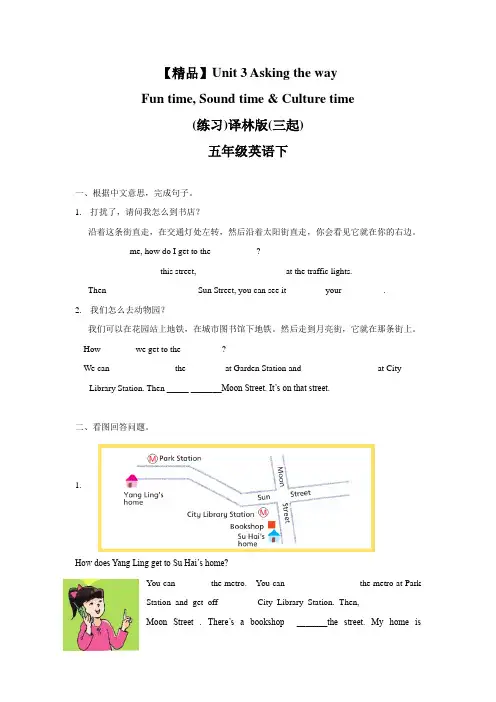
1.How does Yang Ling get to Su Hai’s home?You can _______ the metro. You can _______ _______ the metro at ParkStation and get off ______ City Library Station. Then, ______ _____Moon Street . There’s a bookshop _______the street. My home is_________ ________ it.2.How does Yang Ling get to the bookshop on Moon Street?________ _______ this street. _______ ________ at the trafficlights. Then, _______ _______ Moon Street.You cansee the bookshop ______ ________ __________.3.A: How can I get to the cinema?B: Go along _______ __________ . Turn ______ at the ________ traffic lights.Then, go along ___________ ________. You can see the cinema.It’s on your _________ .三、阅读理解,选择正确的答案。
牛津小学英语(译林版)五年级下册U2 教案

B: He/ She comes to school by/ on …
A: Oh, I see.
Finish Read and circle (page 18)
Read together
Step3:Fun time
What about Joe and Jane?
3. 出示图片
Who can you see in the picture?
4. Listen and answer:
Where do they live?
5. Watch and match(P18)
How do they come to school?
6. Read the dialogue and underline.
3. 收集更多的交通工具。
板书设计
Unit 2 How do you come to school?
Who Where How...? Why?
YangLing
Su Yang
Mike
Liu Tao
教
后
记
(第 篇)
课 题
Unit 2 How do you come to school?
Grammar time and F复习巩固词汇及How do/ does …come to school? 及回答:及其应答I… by/ on ….
2、能够看图片复述故事内容
3、学习Fun time, 引导学生用所学句型交流并汇报。
4、 学生能理解并掌握Where...? How …?及其它疑问词,学会提问,并进一步学习第三人称动词的变化。
Why do they come to school by/ on …?
五年级英语下册 Unit 56测试卷 (新版)牛津译林版

Unit5-Unit6Name Class Score ______听力部分30%一.听录音,选出你所听到的内容。
10%()1. A. sweet B. sweep C. sleep()2. A. pest B. next C. best()3. A. small B. smell C. smart()4. A. spot B. sport C. spare()5. A. clean the car B. clean the table C. clean the room()6. A. wash clothes B. wash the dishes C. wash the shoes()7. A. fish soup B. meat soup C. tomato soup()8. A. cooking meat B. buying meat C. eating meat()9. A. It’s sleeping. B. He’s sleeping. C. They’re sleeping.()10. A. Are you looking for some juice?B. Are they looking for some bread?C. Is she buying some bread?二. 听录音,根据你所听到的问题,选择相应的答句。
5%()1. A. He’s playing. B. She’s playing.()2. A. She’s in the garden. B. He’s in the bedroom.()3. A. Yes, he is. B. Yes, she is.()4. A. No, I am not. B. No, we are not.()5. A. There is some tea. B. There are some cakes.三. 听录音,根据你所听到的对话及问题,选择相应的答句。
牛津英语译林版8上单元能力检测试卷 Unit 2
牛津英语译林版8上单元能力检测试卷Unit 2一、单项选择 (每小题1分, 共15分)1. Linda is ______ eleven-year-old girl and she is in ______ grade.A. a; the fifthB. an;fiveC. a;fifthD. an; the fifth2. —Do people in the UK and the USA use different words to refer to the same thing?—Yes. People in Britain say “holiday”, while people in the USA say“______”.A. lorryB. autumnC. yardD. vacation3. Because of the disease, there are ______ people in the street this year than last year.A. moreB. mostC. fewerD. fewest4. —Look! How ______ Nancy is writing! —Oh, she is the ______ girl in my class.A. carefully; most carefulB. careful; most carefulC. carefully; carefulD. careful; careful5. You’d better leave ______, or trouble will come to you.A. livelyB. friendlyC. heavilyD. quickly6. Is Shanghai much ______ than ______ cities in China?A. bigger; the otherB. bigger; any othersC. the biggest; the otherD. the biggest; any other7. The radio says there will be much ______ next week. Maybe we will have ______ off.A. rainier; two daysB. rain; two days’C. rainier;two daysD. rain;two days8. —Could you please tell me when people eat mooncakes traditionally in China, Li Hua? —______ the Mid-Autumn Festival.A. FromB. DuringC. AmongD. Between9. I like the TV programme The Readers best. I think we should spend as much time as we can ______ in our spare time.A. readB. to readC. readingD. reads10. ______ great fun we have ______ kites on windy days!A. What; to flyB. What a; flyingC. What;flyingD. What a; to fly11. The subjects students study in America are different from ______ in ChinaA. thoseB. thatC. itD. one12. If we can’t ______ better services to our customers, our business won’t improve.A. provideB. bringC. offerD. lend13. —______ do you play table tennis with your father? —Once a month.A. How longB. How soonC. WhenD. How often14. Little Tom kept ______ and his mother was ______ .A. to cry;worryingB. crying;worriedC. to cry;worriedD. crying;worry15. —Shall we go to the supermarket after school? I need to buy something.—______ Let’s meet at the school gate at 5:00 p. m.A. It doesn’t matter.B. Are you OK?C. Why not?D. That’s all right.二、完形填空 (每小题1分, 共10分)A few weeks ago, John went to a new school. He likes it better than his ___1___ school. The classrooms are big and clean. Every classroom has a computer in it. The ___2___ is also really great! There are lots of books and newspapers. It also has the most comfortable chairs and students can sit on them when they ___3___, The food in the school dining hall is delicious and not ___4___. All the students like to eat there The beef noodles are John’s favourite. The ___5___ he likes best is the school hall The students often go there to listen to speeches (演讲) . Last week John went there for an interesting speech and he ___6___ it.The school has all kinds of activities. ___7___, there is a music festival every June. The students like their school band (乐队) very much. The sports meeting is ___8___ one of the most popular activities at the school. It is in September every year.John is happy that he can ___9___ at this school. He enjoys his school life here ___10___ he has the best teachers and the friendliest classmates.1. A. old B. new C. big D. small2. A. classroom B. library C. dining hall D. sports centre3. A. sing B. dance C. read D. sleep4. A. expensive B. popular C. healthy D. enough5. A. time B. place C. person D. subject6. A. forgot B. waited C. stopped D. liked7. A. Of course B. At last C. For example D. At first8. A. only B. almost C. always D. also9. A. study B. run C. swim D. travel10. A. but B. because C. so D. or三、阅读理解 (每小题2分, 共20分)(A)King’s College Summer School is an annual (每年的) training programme for all the middle school students who want to improve their English. Courses are given by the teachers of King’s College and other colleges in New York. Trips to museums and culture centres are also organized.1. You can most probably read the material in ______ .A. a newspaperB. a travel guideC. a textbookD. a telephone book2. According to the material, who will give the courses?A. The teachers of King’s College and the middle schools in AmericaB. The teachers of King’s College and other colleges in the United StatesC. The teachers of the middle schools and King’s College in New York.D. The teachers of King’s College and other colleges in New York.3. When should foreign students send their applications?A. Before April 10, 2019.B. Before June 1, 2019.C. Before April 16, 2019.D. Before July 15, 2019.4. If you want to live with your friends in New York, you will have to pay the school ______ .A. $300B. $400C. $500D. $9005. Which of the following is TRUE about King’s College Summer School?A. Only top students can take part in the programme.B. Visits to museums and culture centres are part of the programme.C. King’s College Su mmer School is not organized every year.D. You can get in touch with the school by telephone or by email.(B)All schools have their own rules. The rules change from one school to another. Some schools are much stricter than others. There are also some rules that are strange or funny to us. Here are some funny school rules:Strict Japanese rulesMost schools ask students to wear uniforms, such as sports suits or skirts. But Japanese schools even have rules about thecolour of the underwear! They also require that girls’ socks should be folded (被折叠) in a certain way and that boys’ heads should be shaved (剃) .Other Japanese schools tell students that they can’t watch the films after sunset.Different shoes in the USAAt some American schools, students have to change their shoes when they go into the schools every day. This makes sure that students won’t fall over on the floors and will keep the schools clean.No strange hair in the UKStrange hairstyles are not allowed in some British schools. But they may allow students to wear certain hairstyles during the World Cup years. After the World Cup, their teachers will a sk them to go to the barber’s at once.1. How many strange or funny school rules are mentioned in this passage?A. Three.B. Four.C. Five.D. Six2. Students in most Japanese schools should wear ______ .A. uniformsB. indoor shoesC. shirtsD. strange hairstyles3. Why do students in some American schools have to wear indoor shoes?A. Be cause in that way they won’t get hurt if they fight.B. Because in that way they will feel comfortable.C. Because in that way they won’t fall over and can keep the schools clean.D. Because in that way they won’t make any noise when walking.4. Wh ich country’s schools have rules about students’ hair?A. Schools in Japan only.B. Schools in the USA and the UK.C. Schools in Japan and the UK.D. Schools in the UK only.5. What’s the best title for the passage?A. Different school uniformsB. Different hairstylesC. Different shoesD. Different school rules四、词汇 (每小题1分, 共10分)(A) 根据汉语提示完成单词。
五年级下册英语教案Unit2 How do you come to school Fun time译林版(三起)
课 题 主备人: Unit 2 How do you come to school? 课型 新授 课时
学习目标 教学目标: 1、复习巩固词汇及How do/ does …come to school? 及回答:及其应答I… by/ on …. 2、能够看图片复述故事内容 3、学习Fun time, 引导学生用所学句型交流并汇报。 4、 学生能理解并掌握Where...? How …?及其它疑问词,学会提问,并进一步学习第三人称动词的变化。
学情分析 1.重点、难点:学习Fun time, 引导学生用所学句型交流并汇报。 2. 学生能理解并掌握Where...? How …?及其他疑问词,学会提问,并进一步学习第三人称动词的变化。
易混、易错点:肯定句中动词三单形式
学生认知基础:学生能理解并掌握Where...? How …?及其他
疑问词,学会提问 时间分配 学 15 讲 10 练 15
教法与学法 小组合作学习 任务型教学 教学准备 CAI 学生活动 教师助学 课后改进 Step 1 Warming-up Review words Free talk (work in pairs) Step2 Pre-task See the pictures or words and say them quickly. 1. Free talk Where do I live? How do I go to Wan Da? How do I come to school? Why? What about you? 1.Review story time Magic eyes. Talk about story (work in pairs)
Read together
Step3 Task 1 Listen and write Check in pairs (work in pairs)
Step4 Task 2 (work in groups) Report in class.
牛津译林版五年级英语下册5B Unit3story time课时作业(含答案)
5B Unit3 story time练习一一、英汉互译。
二、单项选择。
( ) 1.Helen often _______ in summer.A. swimmingB. swimsC. swim( ) 2. – _______ do you go to school? –By school bus.A. WhereB. HowC. When( ) 3.He likes his new school _______.A. eitherB. manyC. very much ( ) 4. _______ often go to the park on Sunday afternoons.A. I and NancyB. Nancy and IC. Nancy and me ( ) 5.He doesn’t think _______.A. soB.thisC. too( ) 6. –How does Yang Ling get _______? –By bus.A. to homeB. homeC. cinema( ) 7.How do you get to the hospital? – I get _______ by taxi.A. thereB. to thereC. the hospital ( ) 8.Can you show your new book _______ us?A. toB. forC. with( ) 9.We live near the zoo. We often go _______ on Sundays.A .to there B. here C. there( ) 10.I can _______.A .ride a bikeB .by a bike C. by bike练习二一、单项选择。
( )1. Yang Ling lives Xingfu Street.A. toB. onC. along ( )2. We can go to the cinema metro.A. byB. takeC. with ( )3. Let’s go to the zoo. How do we ?A. to getB. get thereC. get to there ( )4. Look, the bus is coming. Let’s it.A. get onB. get offC. get away ( )5. The shop is your left.A. inB. onC. at( )6. —_______ do I get to the cinema?—Walk _________Sun Street and then you can see it.A. What; alongB. How; forC. How; along ( )7. The shoes are nice. He doesn’t know to choose.A. whatB. whichC. who ( )8. My home is her home.A. next toB. next onC. next at ( )9. How your teacher to school?A. do; comeB. does; comeC. do; comes ( )10. I can a policeman help.A. ask; toB. ask; withC. ask; for二、用括号内所给词的适当形式填空。
新改版:牛津译林版五年级英语下册Unit5 第2课时教案
Unit5 第2课时教学设计一、板块介绍本板块归纳呈现了现在进行时的特殊疑问句和肯定句,同时归纳了本单元出现的动词现在分词形式。
二、教学目标教授学生熟知并运用句型:—What … doing …?—… doing …三、教学重难点熟练掌握现在进行时的特殊疑问句的肯定句。
四、教学过程Step 1: Warm-up/Lead-in读句子,感知结构教师安排学生两人一组,朗读第一和第二个表格中呈现的句子,一人读问句,一人读答句,感知现在进行时的结构。
如:S1: What are you doing?S2: I am sweeping the floor.…Step 2: Presentation & Practice1. 熟悉时态的结构教师可以用多媒体或者在黑板上呈现表格中的句子,然后将其中的关键词覆盖,要求学生填空。
如:• What are you doing? I am sweeping the floor.• What are you doing? We are watching TV.• What are they doing? They are eating fruit.• What is he doing? He is sleeping.• What is she doing? She is washing the dishes.2. 两人一组,造句比赛教师可以让学生两人一组,用现在进行时造句比赛。
一人在纸条上写人名,一人写动词或动词短语,然后二人同时出示纸条并造句。
最快说出正确句子的人获胜。
如:S1: (出示my father字条)S2: (出示play football字条)S1: My father is playing football.…3. 归纳现在分词的构成教师要求学生观察本板块中罗列的现在分词,然后拓展介绍swimming, running, taking, skating, writing, dancing, flying等,引导他们归纳现在分词的构成规则。
2022年牛津译林版七年级英语下册Unit 5单元检测卷(附答案)
Unit 5单元检测卷I.按要求完成下列各题(共15小题;每小题1分,满分15分)A 根据提示或句意完成句子1.Mrs Lu was very ___________ (grate ) for Jack’s help.2.I would like to ___________ (推荐) Daniel for this Year’s Youth Award.3. Su Ning is clever and c___________ (快乐的).4.Don’t p___________ the water over your clothes.5.I f ___________to bring our tennis rackets, so we couldn’t play tennis yesterday.6.I remember all the new words. I have a very good m___________.7.I was reading a book at home. S___________the telephone rang.B 用所给动词的适当形式填空8. Listen! I can hear someone ____________ (call) for help.9. It is time for us ____________ ( have ) dinner.10. The dog kept ____________ (run) after a cat.11. Could you ____________ ( help) me with my English?12. Walking and swimming ____________ (be ) good for our health.13. The teacher said the earth ____________(move) around the sun.14. We will go out for a picnic if it ____________(not rain) tomorrow.15. Sometimes dogs are very ____________(noise).Ⅱ.单项选择(共15小题;每小题1分,满分15分)( )16.There was a big fire last night, but the firemen_______soon.A. put down itB. put it downC. put out itD. put it out( )17.Wood catches fire easily. So ______fire.A. keep it away fromB. don’t keep it away fromC. keep it awayD. don’t keep it away( )18.Daniel is helpful, and he always________.A. thinks of himself firstB. thinks of others firstC. thinks himself firstD. thinks others first( )19.Listen! Can you hear Tom________ in the next room?A. singB. singsC. sangD. singing( )20.--Can I play with Jack, Mom? --______. He is a lazy boy.A. No, you needn’tB. No, you can’tC. Yes, you doD.Yes, you may ( )21.--Could you post these postcards for us on your way home? --________.A. NoB. No problemC. It’s all rightD.I hope ( )22.A car hit her yesterday and she is now______. Let’s _______her this afternoon.A. in the hospital; go and to seeB. in hospital; go and seeC. in hospital; go and to seeD. in the hospital; to go and to see( )23.______ lovely weather it is!A. WhatB. What aC. HowD. How a( )24. ______ of the boys ______ a yoyo.A. Each;haveB. Each;hasC. Every;hasD. All;have( )25.He is looking forward to _______ with you soon.A. chatB. chattedC. chatsD. chatting( )26.On ______ home, Susan found a robber getting out of a van yesterday.A. her way toB. her way forC. her way atD. her way( )27.She is good at Chinese but sometimes she is _______.A. carefulB. braveC. carelessD. polite( )28.There are some ________ between the two pictures.A. differentB.differentsC. differenceD. differences( )29.I have _______ money than you, but I have_______ friends than you.A. less; fewerB. more; moreC.less; moreD.fewer; more( )30. The book is _______ one of the two.A.cheaperB. cheapestC. the cheaperD.the cheapestⅢ.句型转换根据句后的要求,改写句子(共10个空;每个空1分,满分10分)31.I don’t want to drive to my office. I would like to ride there. (合并为一句)I want to ride to my office____________ ____________ ____________ there.32. They are going to see the doctor tomorrow. (对划线部分提问)____________ ____________ they going to ____________ tomorro w?33. She wa tches TV every day. (用tomorrow 改写)She ____________ ____________ TV tomorrow.34. He goes to work by underground. (对划线部分提问)____________ ____________ he go to work?Ⅳ.完形填空(共10小题;每小题1分,满分10分)Farmer Jones is buying some things at a hardware (五金) shop. The shopkeeper has many 35 in the shop and wants to sell one to the 36 . He says, “Look here, I have some good bikes to 37 . I can sell you a first-class bike 38 you can ride around your 39 on it every day.”“Oh, 40 ,” says the farmer. “I don’t want a bike. I think a 41 is better in my style and the price is the same.”“But just think,” says the shopkeeper, “You can’t 42 a cow around the town. That’s 43 .”“Oh, I don’t know,” says the farmer 44 , “ Which is more foolish to ride on a cow or to milk a bike.”( )35. A. bikes B. cars C. buses D. trains( )36. A. drive B. farmer C. policeman D. conductor( )37. A. see B. mend C. buy D. sell( )38. A. yet B. but C. and D. or( )39. A. factory B. farm C. city D. town( )40. A. no B. yes C. certainly D. of course( )41. A. cow B. pig C. horse D. dog( )42. A. ride B. walk C. fly D. swim( )43. A. nice B. clever C. interesting D. foolish( )44. A. in surprise B. with a smile C. angry D. sadlyⅤ.阅读理解(共15小题;每小题2分,共30分)ASleep is good for us. Sleep can let us have a good rest. And it can help us grow. Everybody needs sleep. People sleep for a long time every night. Sometimes they sleep for a short time in the day.We call the short time sleep nap. Cats take short naps all the time. So a short nap is called a catnap. Catnaps are good for people, too. If you have time, you’d better have a catnap in the day, it will help you work or study better.45. Sleep can let us ____________ .A. become fatB. become badC. have a good restD. eat more46. People sleep for ____________ every night.A. a long timeB. six hoursC. eight hoursD. a short time47. Which of the following is wrong?A. Everybody needs to sleep.B. People don’t need catnaps.C.Catnaps are good for people.D. Sometimes people sleep for a short time in the day.48. What’s the Chinese meaning of the word “nap”?A. 休息B. 睡觉C. 小睡D. 睡眠49. In the daytime you can have a ___________. It can help you work or study better.A. long time sleepB. napC. short time sleepD. B and CBAt school many things happen to us. We may feel excited when we have success in a school play. We may feel sorry if we lose an important game. We want to keep the memory for the rest of our lives.How to keep the memory? Our English teacher, Miss Wang, has taught us a good way of remembering things to make our own yearbook. What is a yearbook? A yearbook is a kind of book which is used to keep the memory of exciting moments. It’s usually made at the end of the year.Last December, we began to make our yearbook. First we chose the persons who had done something special, then some students interviewed (采访) them, some wrote down their stories, others took photos of them. Everyone in our class had something to do. Finally our teacher helped us to put the things together. We had our first yearbook.All of us put a lot of love into making the yearbook. It is so wonderful that not only the students but also our parents and teachers will remember the special time forever. 50. When we have success in a school play, we may feel ______.A. sorryB. angryC. excitedD. interested51. Miss Wang’s good way of remembering things is to ______.A. buy a new bookB. write down storiesC. take a lot of photosD. make a yearbook52. A yearbook is made to ______.A. take notesB. keep the memoryC. do our homeworkD. remember English words53. Usually a yearbook is made in ______.A. JanuaryB. FebruaryC. MayD. December54. We made our first yearbook ______.A. without any helpB. without putting our love into itC. with the help of our teacherD. with the help of our parentsCSINA—In order to let people go out more easily during the Olympic Games,Beijing is going to start a special bus line and seven more night bus lines. 40% of thetaxis will be in service for 24 hours. The subway will run longer hours, too.(December 27, )YAHOO— An old man called Shen Yuanyan made five Fuwa toys with 6,000pieces of paper. It took him a few months to finish them. Mr. Shen will make anotherfive bigger Fuwa toys and send them to Beijing. (January 7, )BAIDU —The Olympic Flame (圣火) has arrived in Beijing, showing that theOlympic Games in China will soon begin. From today, the torch (火炬) will carry theFlame across the world. (March 31, )XINHUA—Yang Yang, a famous Chinese s kater, received the Beijing Olympictorch from a leader in Sanya, May 4, . Yang ran the first 200 meters during the torchrelay (接力) in Sanya, the first leg in the Chinese mainland(大陆) . (May 4, )55. ______ isn’t mentioned in the news above.A. The busB. The taxiC. The subwayD. The plane56. The old man’s Fuwa toys were made of______.A. glassB. paperC. cottonD. silk57. The torch has carried the Flame across the world since _______A. December 27,B. January 7,C. March 31,D. May 4,58. In the Chinese mainland, the first leg of the torch relay started in ______.A. BeijingB. ChongqingC. ShanghaiD. Sanya59. There ______ of news about the Olympic torch relay here.A. is only one pieceB. are two piecesC. are three piecesD. are four piecesⅥ.完成句子(共10个空;每空1分,满分10分)60. 他冲进房子去救一位有病的老人。
苏教版新译林英语5BUnit1-2默写练习纸答案
Unit1-2 默写练习纸2016年3月班级________ 姓名___________ 学号 _________ 写出下列动词的第三人称单数d rinks has plants fits goes passes flies tries stays carries studies washesmakes comes brushes plays looks watches teaches does翻译词组1. 不得不;必须have to2. 留下一只鞋leavea shoebehind3. 帮助我help me4. 这么悲伤so sad5. 让我let me6. 穿上新的衣服put on new clothes7. 脱掉她的外套take off her coat8. 在12 点之前before twelve o'clock9. 在12 点at twelve o'clock10. 在12 点之后after twelve o'clock11. 在聚会上at the party12. 走访每家每户visit every house13. 有害的be bad for…14. 在王子的家里at the prince'shouse15. 我的手套my gloves16. 参加聚会go to the party17. 回来(说话人在家)comeback18. 玩得高兴have a good time/ have a lot of fun/play happily19. 试穿它try it on20. 表演这个英语剧puton this English play21. 喝一杯饮料haveadrink22. 画一条连衣裙draw a dress23. 童话故事fairy tales24. 《西游记》the Monkey King25. 在森林里in the forest26. 发现一些蘑菇find some mushrooms27. 快点hurry up28. 吃它们eat them 30. 真遗憾what a pity31. 对 ... 有害be badfor…32. 对 ... .有益be goodfor …33. 非常喜欢她like herverymuch34. 非常合适fit well35. 步行on foot36. 在篮子里in the basket37. 你的新家your new home38. 离…… 远be far from39. 住在月亮街live on Moon Street40. 来学校come to school41. 乘公交车by bus42. 住在学校附近live nearschool43. 乘地铁by metro44. 乘出租车by taxi45. 一位出租车司机a taxi driver46. 一辆新自行车a new bike47. 去上学go to school48. 骑自行车(动词短语)ridea bike49. 骑自行车(介词短语)by bike50. 太年轻too young51. 在城市图书馆附近near City Library52. 住在阳光小镇live in SunshineTown53. 住在公园街live onPark Street54. 穿过树林through the trees55. 公交车上的轮子the wheels on the bus56. 转啊转go round and round57. 这样认为think so58. 住在北京live in Beijing59. 去哪儿go there三、 翻译句子1. 你为什么这么悲伤? Why are you so sad?2. 因为我不能参加舞会。