
2020期七年级英语下册 Unit 3 Food and Drink Lesson 8 At a Restaurant教案
精 品
Unit 3 Food And Drink
Lesson 8 At A Restaurant
本课是北师大版《初中英语》七年级下册教材第三单元Unit 3 Food and Drink,话题为购物、食物、点餐、
饮食习惯。其中Lesson 8 At a restaurant 的话题为就餐对话。
【知识与能力目标】
1. Key vocabulary
2. Key structures:
【过程与方法目标】
1. To understand conversations about food and drinks.
2. To talk with the partners about the food and drinks.
【情感态度价值观目标】
Learn to respect others when we talk with others.
【教学重点】
Learn to talk about the food and drinks..
【教学难点】
Learn to use the verb “be”.
◆ 教材分析
◆ 教学目标
◆ 教学重难点
◆ 课前准备
精 品
Tape recorder, Multimedia
Step 1. Brainstorm
1. Say out the words of food and drink. Let Ss do the brainstorm about “food and drink”.
2. Ask Ss to tell their partners what food and drinks they like using: I like ….
Step 2. Warm-up
Ask Ss how they buy food and drink at a restaurant.
Read all the menu items aloud.
Work in pairs:
Are they all healthy?
If you are at the restaurant, what will you order?
Step 3. Reading
1. Show the word builder to the students and ask them to read these words.
2. After reading, ask students to practice ordering in pairs.
Work in pairs.
Act it out.
2. Show some key expressions to the students, and ask them to read these sentences.
3. Ask students to work in groups
◆ 教学过程
精 品
Step 4. Listening and tick.
1. Listen and tick what items they ordered.
Check the answers.
2. Listen and write down how many items.
Ask the students to read and check.
Step 5. Read and answer.
Read the dialogue and answer the questions.
What does Sam think the salad?
Why do they say “What” together?
Because dad orders too much.
Some food are not healthy.
Step 6 Read the dialogue and fill in the blanks
Sam: Dad, ________ have two hot dogs, please?
Dad: No. They’re not healthy!
Mum: How about some salad?
Sam: Again? I have salad every day!
Waiter: ________take your order?
Mum: Yes, please. Can I have a green salad?
Waiter: OK. ________________a drink?
Mum: No, thanks.
Sam: _________ a sandwich and a glass of milk, please.
Linda: _________________ a sandwich and a glass of orange juice, please?
Waiter: OK. And you , sir? ____________________to have?
Dad: ____________ two sandwiches, two pieces of chocolate
cake, an ice cream and a cup of coffee.
Step 7 Practice
Work in groups of five.
Role-play the dialogue in Exercise2.
精 品
略。
◆ 教学反思
七年级下册英语1-8单元知识点
七年级下册英语1-8单元知识点全文共3篇示例,供读者参考篇1**Seventh Grade English knowledge points (Units 1-8)**Unit 1: Greetings and Introductions- Greetings: Hello, Hi, Good Morning, Good Afternoon, Good Evening- Introductions: My name is..., What’s your name?, Nice to meet you- Formal and informal ways of greeting someoneUnit 2: Personal Information- Age: How old are you?, I am ___ years old- Nationality: Where are you from?, I am from...- Family: Do you have any brothers or sisters? How many brothers/sisters do you have?Unit 3: Hobbies and Leisure Activities- Hobbies: What do you like to do in your free time? I like to...- Leisure activities: Do you play any sports? What is your favorite sport?Unit 4: School Life- Subjects: What subjects do you study in school? I study Math, English, Science...- School schedule: What time does your school start/finish?- School facilities: Does your school have alibrary/gymnasium/computer lab?Unit 5: Daily Routine- Daily activities: What time do you wake up/go to bed? What do you do in the morning/afternoon/evening?- Adverbs of frequency: Always, usually, often, sometimes, rarely, neverUnit 6: Food and Drink- Food preferences: What is your favorite food/drink? I like pizza/soda- Meals: What do you usually have forbreakfast/lunch/dinner?Unit 7: Health and Well-being- Feelings: How do you feel today? I feel happy/tired/sick- Illnesses: Do you have a headache/stomachache/fever?Unit 8: Shopping and Clothing- Clothes: What do you like to wear? I like to wearjeans/t-shirts/dresses- Shopping: Where do you like to shop for clothes? Do you prefer shopping online or in stores?Overall, these units cover a wide range of topics that are essential for communication in English. By mastering these knowledge points, students will be able to engage in basic conversations and feel more confident in using the language in various situations.篇2Unit 11. Talking about the future using "will" and "going to"- We use "will" to talk about future actions or events we decide at the moment of speaking.Ex: I will go to the park tomorrow.- We use "going to" to talk about future plans or intentions.Ex: I am going to study harder next semester.2. Making predictions with "will" and "going to"- We use "will" to make predictions based on our opinion or judgment.Ex: I think it will rain tomorrow.- We use "going to" to make predictions based on evidence or current circumstances.Ex: Look at those dark clouds. It's going to rain soon.3. Using the future perfect tense- We use the future perfect tense to talk about an action or event that will be completed before a certain point in the future.Ex: By the time you arrive, I will have finished my homework.Unit 21. Talking about past experiences with "used to"- We use "used to" to talk about past habits or states that no longer exist.Ex: When I was a child, I used to play with toys all day.2. Talking about past actions with "would"- We use "would" to talk about repeated actions or habits in the past.Ex: Every morning, he would walk to the park.3. Using the past perfect tense- We use the past perfect tense to talk about an action that happened before another action in the past.Ex: I had already eaten breakfast when you arrived.Unit 31. Talking about the present continuous tense- We use the present continuous tense to talk about actions or events that are happening at the moment of speaking.Ex: I am reading a book right now.2. Talking about temporary situations with the present continuous tense- We can also use the present continuous tense to talk about temporary situations or actions that are not permanent.Ex: She is staying with us until her new house is ready.3. Using adverbs of frequency- Adverbs of frequency are used to show how often something happens.Ex: I always go for a run in the morning.Unit 41. Talking about the past continuous tense- We use the past continuous tense to talk about actions or events that were ongoing in the past.Ex: She was cooking dinner when the phone rang.2. Talking about interrupted actions with the past continuous tense- We can use the past continuous tense to talk about actions that were interrupted by another action in the past.Ex: I was watching TV when the power went out.3. Using time clauses- Time clauses are used to show when an action happened in relation to another action.Ex: I will call you as soon as I get home.Unit 51. Talking about the present perfect tense- We use the present perfect tense to talk about actions or events that have a connection to the present.Ex: I have visited Paris several times.2. Talking about recent actions with the present perfect tense- We can use the present perfect tense to talk about recent actions that have a result in the present.Ex: He has just finished his homework.3. Using since and for with the present perfect tense- We use "since" to show when an action started, and "for" to show how long an action has lasted.Ex: I have studied English for five years.Unit 61. Talking about the past perfect continuous tense- We use the past perfect continuous tense to talk about actions or events that were ongoing in the past and continued up to another point in the past.Ex: He had been working at the company for ten years before he was promoted.2. Talking about parallel actions with the past perfect continuous tense- We can use the past perfect continuous tense to talk about two actions that were happening simultaneously in the past.Ex: She had been studying while her brother had been playing video games.3. Using the had better structure- We use "had better" to give advice or make recommendations.Ex: You had better revise for the exam.Unit 71. Talking about the zero conditional- The zero conditional is used to talk about general truths or scientific facts.Ex: If you heat water, it boils.2. Talking about the first conditional- The first conditional is used to talk about real possibilities or predictions in the future.Ex: If it rains tomorrow, we will stay indoors.3. Using conjunctions in conditional sentences- We can use conjunctions such as "if," "unless," "provided," and "as long as" to introduce conditional clauses.Ex: We will go hiking as long as the weather is nice.Unit 81. Talking about the second conditional- The second conditional is used to talk about hypothetical situations in the present or future.Ex: If I had a million dollars, I would travel the world.2. Talking about the third conditional- The third conditional is used to talk about imaginary or unreal situations in the past.Ex: If we had studied harder, we would have passed the exam.3. Using inversion in conditional sentences- In formal or literary language, we can invert the subject and verb after "should," "were," or "had" to make a conditional sentence.Ex: Were she to arrive on time, we could start the meeting early.Overall, the knowledge points covered in the seventh-grade English curriculum are essential for building a strong foundation in understanding and communicating in English. By mastering these concepts, students can improve their language skills and become more confident in using English in various contexts.篇3Unit 1: School Life- Vocabulary: school subjects, daily routines, school activities- Grammar: Present simple tense, adverbs of frequency, question words- Skills: reading and listening comprehension, speaking and writing about school life- Cultural notes: school systems in different countries, extracurricular activitiesUnit 2: Family and Friends- Vocabulary: family members, describing people, hobbies and interests- Grammar: Present continuous tense, possessive pronouns, comparatives and superlatives- Skills: describing people, talking about relationships, writing about family and friends- Cultural notes: family structures and traditions in different cultures, the importance of friendshipUnit 3: Health and Daily Routine- Vocabulary: parts of the body, health problems, healthy habits- Grammar: imperatives, going to for future plans, can for ability- Skills: giving advice, talking about daily routines, writing a health plan- Cultural notes: health care systems around the world, traditional remedies and practicesUnit 4: Food and Shopping- Vocabulary: types of food, shopping for groceries, ordering in a restaurant- Grammar: countable and uncountable nouns, much/many, some/any- Skills: describing food, role-playing shopping conversations, writing a recipe- Cultural notes: food traditions in different countries, food markets and street vendorsUnit 5: Holidays and Traditions- Vocabulary: holidays and celebrations, customs and traditions, travel vocabulary- Grammar: past simple tense, used to for past habits, time expressions- Skills: talking about past holidays, describing customs and traditions, writing a travel journal- Cultural notes: holiday traditions around the world, popular tourist destinationsUnit 6: Environment and Global Issues- Vocabulary: environmental problems, conservation efforts, climate change- Grammar: modal verbs for obligation (should, must), expressing opinions, conditionals- Skills: discussing environmental issues, writing a letter to a local official, participating in a debate- Cultural notes: environmental initiatives in different countries, the impact of global warmingUnit 7: Technology and Communication- Vocabulary: types of technology, social media, communication devices- Grammar: present perfect tense, past continuous tense, relative clauses- Skills: discussing technology trends, writing a blog post, giving a presentation- Cultural notes: digital divide in different regions, online privacy concernsUnit 8: Future Plans and Careers- Vocabulary: jobs and professions, career paths, future plans- Grammar: will for predictions, going to for intentions, expressing desires- Skills: talking about future aspirations, writing a resume and cover letter, preparing for a job interview- Cultural notes: work culture in different countries, opportunities for higher education and vocational trainingOverall, these eight units cover a wide range of topics that are relevant to the daily lives of seventh-grade students. By studying and practicing the vocabulary, grammar, skills, and cultural notes in each unit, students will improve their English language proficiency and gain a better understanding of the world around them.。
全国首届小学英语优质课竞赛一等奖《In a Fastfood Restaurant》教案

全国首届小学英语优质课竞赛一等奖《In a Fast-food Restaurant》教案全国首届学校英语优质课竞赛一等奖《In a Fast-food Restaurant》教案In a Fast-food Restaurant(浙江宁波市戎徐学校朱雪君)I.教学内容In a Fast-food RestaurantWaiter: Hello, can I help you?Mum: Yes. What ould you like, Dick?Dick: Id like a hamburger.Mum: Me, too.Waiter: Would you like something to drink?Mum: Oh, yes. To glasses of orange juice, please.Dick: Mum, can I have an ice-cream?Mum: Sure. To hamburgers, to glasses of orange juice and anice-cream.Waiter: OK. Here you are. 38 yuan, please.Mum: Here the money.Waiter: Thanks.生词:fast-food / resaurant / hamburger句型:What ould you like?Would you like something to eat/ drink?II、教学目标:1. 能听、读、说fist-food/restaurant/hamburger,并了解其含义;2.能敏捷运用重点句型,并清晰其运用的场合和语气;(1) What ould you like?(2)Would you like something to eat/drink?3.能效仿本文对话,并能在肯定的语境中运用所学语言进行交际;4.培育同学的留意力和观看力,激发同学主动思维,挖掘同学运用语言的缔造力量。
Restaurant_英语口语简单用法
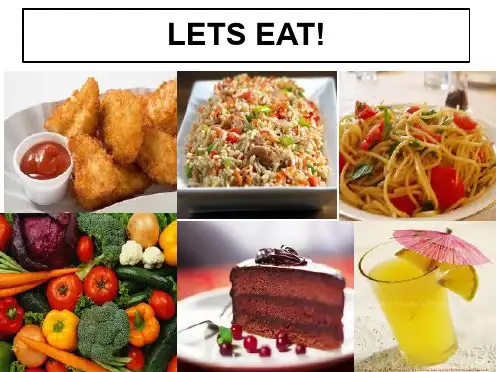
ICE-CREAM
FOOD CATEGORIES
TYPES OF FRUIT:
APPLE
BANANAS
ORANGE
STRAWBERRIES
FOOD CATEGORIES
TYPES OF VEGETABLES:
CARROTS
LETTUCE
MUSHROOMS
BROCCOLI
TOMATO
POTATOES
(ie. Italian, Greek, Korean etc...)
Then tell the class your partner's answers....
MENU CATEGORIES
• Appetizers or Starters: Foods you eat before the main meal. These are usually smaller amounts of food.
SIDE DISH: A smaller dish that goes with the main
meal (usually vegetables or rice dishes).
MIXED VEGETABLES
RICE DISH
BROCOLI WITH GINGER
MENU CATEGORIES
MAIN MEAL OR ENTREE: You eat this after the
appetizers and with the side dishes.
HAMBURGER
NOODLES WITH MEAT
STEAMED FISH
MENU CATEGORIES
MAIN MEAL OR ENTREE: You eat this after the
实用英语2 Unit 5 At a restaurant

A Teaching Plan for Unit 5(In New Practical English Book 2)I. Teaching Aims:1. The students should know how to take order, order food, ask for recommendation, and make recommendation while having dinner at a restaurant.2. Train the students’ ability t o understand the cultural differences in ordering western and Chinese food3. The students should know the way to make a toast speech at a wedding4.Teach the students some practical writing skills.II. Teaching Contents:·SectionⅠTalking Face to Face·SectionⅡBeing All Ears·SectionⅢMaintaining a Sharp EyePassage I: Toledo: A Problem of MenusPassage II: Toast at a Wedding·SectionⅣTrying Y our HandIII. Teaching Time:Eight class hoursIV. Teaching Focal Points:1.Patterns those are appropriate for taking order, ordering food, asking forrecommendation, and making recommendation while having dinner at a restaurant 2. The way to make a toast speech at a weddingV. Teaching Difficult Points:1. Grammar---- Adverbial clauseVI. Teaching Methods:1. Interactive approach2. Situational teaching approach3. Teamwork method4. Task-based teaching methodⅦ. Teaching Aids:Tape-recorder, BlackboardⅧ. Teaching Procedure1. The first two-class-hour session for SectionⅠ Talking Face to Face.2. Next two-class-hour session for SectionⅡ Being All Ears.3. The next four-class-hour session for SectionⅢ Maintaining a Sharp Eye.4. The fifth two-class-hour session for Section ⅣTrying Your Hand. Section I T alking Face to Face(two-class-hour)1. Read the samplesFind out useful expressions in Dialogue 1 Are you ready to order?. Sentences used in taking order①.Are you ready to order now?②.How would you like that?③.Would you like a baked potato or French fries with that?④.What would you like to drink?⑤.What are you having?⑥.Anything to drink?Sentences used in ordering food①.I’ll have the New Y ork steak.②.What’s the soup of the day?③. I’ll have a cup of that.④. I’d also like a chef’s salad.⑤. Just water, please.Find out useful expressions in Dialogue 2 I want the steak dinner Sentences used in taking order①.May I take your order?②.What do you prefer, soup or salad?③. We have vegetable soup and onion soup.④.What would you like for dessert?Sentences used in ordering food①.I want the steak dinner.②.Bring me a bottle of wine and a glass of water.③. I order my steak rare or medium.④.May I have some more bread and some more water, please?⑤.Nothing, thank you.2. Act outRole playMake up dialogues for ordering some typical Chinese food for your foreign friend and asking to go Dutch with your friend who wants to pay the bill for both of you.Section II Being All Ears(two-class-hour)1. DialoguePre-listening taskRead the printed materials in Listen and Decode in ONE minute.While-listening task①. Listen to the tape WITHOUT looking at the book.②. Listen to the tape one sentence after another, taking notes during the pause.③. Repeat the sentences after the tape.Dialogue scriptKim: Where’s our food? The service in this place is really slow.Dan: They seem to be very busy today. I’m sure the waitress didn’t forget our order. Kim: I’ve got to ask her to hurry things up. I’m thinking of never coming to this restaurant again.Dan: Relax, Kim. We’re not in a hurry. Our food should be here soon.(A few minutes later)Kim: Waitress. What happened to our order?Waitress: It will be ready any minute, sir.Kim: What’s holding it up? I gave you our order over twenty minutes ago. Waitress: I’m sorry. We’re very busy.Kim: I hate to complain, but we’re on our lunch hour. Do you think you could speed things up?Waitress: I’ll do my best, sir.Post-listening taskDo the exercises in Listen and Decode and Listen and Respo2. PassagePre-listening taskRead the printed materials in Listen and Read in THREE minutes.While-listening task①. Listen to the tape and fill in the blanks.②. Listen again and check up the answers.Answers:1.follow2.catch3.poorly4.15 percent5.add6.table7.bag 8.home9.give the food 10.themselvesPost-listening taskDo the exercises in Listen and Match and Listen and Conclude.3. Assignments①. Pair work: Make up dialogues for make up dialogues about having dinner at a restaurant referring to the dialogues in the Workbook.②. Preview Passage I and do the exercises.Section III (four-class-hour)Passage I Toledo: A Problem of Menus1. W arm-up questions①.What kind of food do you like better, Chinese food or western food? References: Chinese food, I think Chinese food is more delicious than other food and it is healthy.②.What do you know about western table manners?References: Open2. Reading comprehensionA) Background Knowledge:Likes or dislikes with regard to food vary greatly from culture to culture. What is disgusting to one person can be a delicacy to another. Sometimes we need to change our eating habits. If we move or travel to a new place with a different culture, our favorite meat, fruit and vegetables may not be available to us. As a result, we have to eat what is different from the food we are used to. Slowly, this strange food may become familiar to us. Our tastes may change, too, and we begin to enjoy eating the food that used to seem unusual to us.B) Questions:Paras. 1-3: If customers make their order on the tourist menu, what will they have to pay?Paras. 4-6: Why did the Englishman call the waiter after his partridge was served? Paras. 7-12: In order to calm the Englishman, what did the author say and do? Para. 13: What’ the trouble with the author’s chicken?C) Summary:Suggested answers to questions:①.They will have to pay a surcharge.②.Becaouse he thought his partridge was rotten and uneatble.③.He tasted the partridge and said that there was nothing wrong with it,it just tasked like that.④.It tasted just like the partridge and it was uneatble.3. Useful words and expressions①. escape v. get away from prison; get free temporarilye.g. The prisoners escaped by climbing over the wall.②. smell n.&v. to use the sense of nose; have an effect on the nosee.g. Now smell;what do you think this liquid is?③. whereupon ad.(at once) after thate.g. His department was shut down, whereupon he returned to London.④.mood n. a state of the feeling at a particular timee.g. The beautiful sunny morning put him in a happy mood.⑤. acknowledge v. to recognize; show that one is grateful fore.g. He was acknowledged as one of America’s finest writers.⑥.scene n. a view of something from a specific placee.g. They caused a scene at the supermarket.⑦.embarrass vt. cause to feel ashamed or shye.g. It embarrasses me even to think about it.4. Difficult Sentences①. I escaped but projected myself into an even worse situation.The manager escaped being dismissed but projected himself into an even more embarrassing situation.②. I ordered three dishes, each of which carried a surcharge.I reserved three rooms with the hotel, each of which had a different view of the scenery.③.The good-looking, red-faced Englishman in suit gave me the impression that he must at home have been a hunting man.Their appearance gave us the impression that they had been working for a long time.④.He had, as I suspected he might, ordered the partridge.We have, as the professor suspected we might, found the solution so easily.⑤. I was now in a relaxed mood and had no desire to see the Englishman make a foolof himself.The manager is now in a delighted mood and has no desire to see the customers turn away from his business.5. Assignments①. Prepare to retell the story told in Passage I in about 100 words.②. Preview Passage II and do exercises of Passage I.Passage II T oast at a Wedding1. W arm-up activityWeddings are a time for two people to come together in holy matrimony. It is also the time for dear ones to play their role - parents, friends, bridesmaids, the best man, and others. Make a wedding toast to express your hearty congratulations to the people involved.Given below is a top 5 list of wedding toasts.①Wedding Toast, from the Bride's Mother to the Groom: To the man who has conquered the bride's heart, and her mother's.②Wedding Toast, to the Bride and Groom. There is nothing nobler or more admirable than when two people who see eye to eye keep house as man and wife, confounding their enemies and delighting their friends.③Wedding Toast, to the Bride and Groom. Here’s to the groom with bride so fair, and here's to the bride with groom so rare!④Wedding Toast, to the Bride and Groom coming together is a beginning; keeping together is progress; working together is success.⑤Wedding Toast, to the Bride and Groom seek a happy marriage with wholeness of heart, but do not expect to reach the Promised Land without going through some wilderness together.2. Read the passage and do Exercise13. Useful words and expressions①.it’s with great pleasure that: do sth. With happiness or satisfactione.g.I t’s with great pleasure that we can meet our old friends in America.②. add joy to: put great happiness toe.g. The good news of his finding an ideal job added joy to the family gathering.③. bring back memories to one’s heart of: cause sb. to remember sth.e.g. What he said bring back memories to my heart of those difficult days.④.a toast to sb./sth.: suggest a drink to sb./sth.e.g.let’s drink a toast to our beloved uncle.⑤. with sb. all the happiness: hope sb. will be happy all the timee.g. People often write the words with you all the happiness on a Season’s Greetings Cards.4. AssignmentsDo the left exercises of Passage IISection IV Writing----Menu(two-class-hour)1. Sample analysisFood menu is used to provide customers with information about the food available at the restaurant. Y ou may find a separate catalogue of dishes, soup and drinks with prices on a menu. Only phrases are written on a menu and they are direct, concise and clear.2. Items included in a menuRoom Service MenuA Sandwiches & Burgers (汉堡包) To Place Orders, Ex 194(分机194)Breakfast 7:00 a.m.---10:00 a.m.(Served with French Fries) Lunch 11:30 a.m.--- 4:00 p.m.Dinner 4:00 a.m.---10:00 p.m. Roast Beef or Turkey (火鸡)……………………$ 7.25Anna’s Club Sandwich ………………………$ 6.95All-American Burger……………………………$ 5.25Anna’s Burger. …………………………………$ 6.50Bacon (熏肉) Cheeseburger …………………….$ 6.50(2 strips bacon with American Cheese)ROGER MILLER RESTAURANT MENU~ Breakfast ~New Y ork Steak & Eggs………………………………………………………..$ 9.95 Ham (火腿)、Bacon or Sausage (香肠) & Eggs……………………………….$ 6.95 CheeseOmelet(煎蛋)……………………………………………………………$ 5.95 Ham & Cheese Omelet…………………………………………………………..$ 6.75 Greek Omelet…………………………………………………………………….$ 6.95~ Lunch Special ~ $ 4.99Baked Turkey Wing (Served with one vegetable)Two All Beef Hot Dogs (Served with baked beans)Fried Chicken Leg (Served with one vegetable)Ham (Served with one vegetable)~ Dinner ~Please Ask Server about Our Chef’s Special for TodayTwoPork Chops……………………………………………………….$10.95 Southern Fried Chicken………………………………………………$ 8.95Two Fresh Ham Slices………………………………………………$ 8.95V egetable Plate (Choice of 3)……………………………………….$ 5.95All Dinner Served with Two V egetables and Bread3. AssignmentsFinish Simulate and Create exercises.Section V Grammar----Adverbial Clauses1. Sample analysisAn adverbial clause is a clause that has an adverb-like function in modifying another clause. It is also a dependent clause that does the same job as an adverb or an adverb phrase. Most adverbial clauses can be recognized because they are introduced by a particular word or phrase, such as when, where, why, how, because, as, though, in order that. Adverbial clauses are usually used to indicate place, time, cause, purpose, concession and condition.2. AssignmentsDo the grammar exercises in the Workbook.。
冀教版七年级英语上册《In the restaurant》Food and Restaurants1
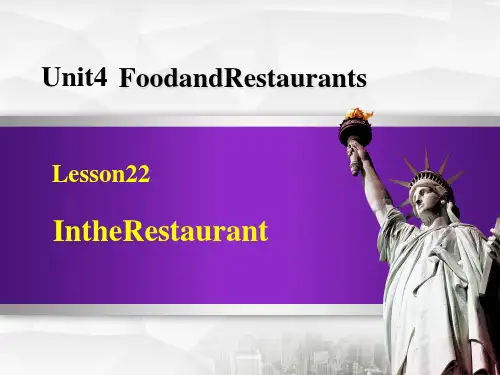
Food Dumplingswithmeatandcabbage 15yuan Dumplingswithcarrotandegg 13yuan Beef/Chickennoodles 14yuan Tomatoandeggnoodles 11yuan Ricewithfish/chicken 12yuan
考向二
拓展
or意为“和”时,只用于否定句。 eg:Idon’thaveanybrothersorsisters.我没有兄弟姐妹。 还有“否则”之意,常见于祈使句后。 eg:Studyhard,oryouwon’tpassthe exam.努力学习,否则你考试会不及格。
典例
Bequick,________we’llbelateforthemeeting. (雅安) A.and B.but C.so D.or
Howmuchwater
Fourteenyuanforbeeforchickennoodles.牛肉或鸡肉面14元。
知识点
3
for是介词,表示对象,“…yuanforsth.”表示“某物……元”。 eg:It’s80yuanforapairofshoes. 一双鞋80元。
Irunfor2, 000metreseveryday.我每天跑2000米。
Here is the present for you.这是给你的礼物。
④表示时间、距离,意为“达,计”
I run for 2 , 000 metres every day.我每天跑2 000米。
or意为“或者”,是表示选择关系的连词,用来连接两个并列的句子成分。 eg:Youcanhaveacanofcokeorabottleof water.你可以喝一罐可乐或一瓶水。
Restaurant英语口语简单用法
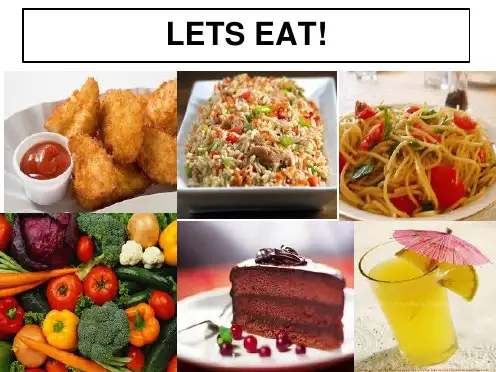
FOOD CATEGORIES
TYPES OF MEAT:
CHICKEN
PORK
BEEF
Hale Waihona Puke FOOD CATEGORIES
TYPES OF SEAFOOD:
FISH
SQUID
CRAB
OYSTER
FOOD CATEGORIES
TYPES OF DAIRY PRODUCTS:
MILK
YOGURT
CHEESE
2012
• Menu • Restaurant • Appetizer • Side dish • Entree • Dessert • Beverage • Fruit • Salad
• Soup • Vegetables • Grains • Categories • Seafood • Chicken • Dairy • Snacks • Yogurt
STEAK
BARBECUE RIBS
PIZZA
MENU CATEGORIES
DESSERT: A sweet dish you eat at the end of a meal.
MAIN MEAL OR ENTREE: You eat this after the
appetizers and with the side dishes.
HAMBURGER
NOODLES WITH MEAT
STEAMED FISH
MENU CATEGORIES
MAIN MEAL OR ENTREE: You eat this after the
appetizers and with the side dishes.
ROAST DUCK
冀教版七年级英语上册《In the restaurant》Food and Restaurants
Drinks Acanofcoke3yuan Aglassofjuice4yuan Acupoftea3yuan Abottleofwater2yuan Aglassofmilk5yuan
Let'sDoIt!
1WhatdoJackandLiMingorder? Readandmatcheachpersonwiththefoodanddrinks.
try to do sth.
尽力做某事;试图做某事
I'll try to finish my homework on time. 我会尽力按时完成我的家庭作业的。
try doing sth.
尝试做某事
Can you try singing a song? 你能试着唱一首歌吗?
06Wouldyoulikesomethingtodrink? 你们想要些喝的东西吗?(教材P56)
LiMing:OK. I'llhavethechickennoodles.Whatwouldyoulike, Jack? Jack:Hmm… Waitress:Wealsohavedumplingsandrice. ③Ricewithfishorchickenistwelveyuan. Jack:Howmuchforthedumplings? Waitress:Fifteenyuanfordumplingswithmeatandcabbage, andthirteenyuanfordumplingswithcarrotandegg.
【复习必备】2019秋期七年级英语下册 Unit 3 Food and Drink Lesson 9 Food for Sport同步练习 (新版)北
Unit 3 Food And Drink Lesson 9 Food For Sport同步练习1. We always have three (一顿饭) a day.2. Our school uniforms are quite (不同) from theirs.3. It's raining hard. (然而), I still have to ride to school.4. We should eat green (蔬菜).5. Would you like some (鸡肉)? It's delicious(好吃的).1. Eating too much without any exercise will certainly cause w problems.2. Simon wants to c his diet because he wants to healthier.3. We can enjoy f air in the countryside.4. Amy often has lunch in a r .5. I have some good friends and they come from d countries.6. Eating more fruits and v is good for your health.7. The p of the computer is 5000 yuan. I can't afford it.8. I usually buy some vegetables at the big m .9. If you want to stay h , you should often move your body.10. You must believe in yourself. That's the s of success.1. I have three pen pals. One is______, the other two are _______A. Japanese; AmericaB. English; FrenchmenC. Canada; AustraliaD. Russian; Germany2. Do you know how many_____a horse has and how many______a bee (蜜蜂) has?A. teeth; feetB. tooth; footC. tooth; feetD. teeth; foot3. --- What can I do for you?--- Err, I want a glass of milk, some bread and_______ A . some chickensB. any chickensC. some chicken4. I'm so hungry. Please give me_______ to eat.A. three breadB. three pieces of breadC. three piece of breadD. three breads5.______oranges do you want and______ orange would you like?A. How many; how manyB. How much; how muchC. How many; how muchD. How much; how many6. --- Would you like a drink?--- ________. A coke.A. Yes, it isB. No, thanksC. Yes, pleaseD. No, I don't7. ---_______are the lemons?--- They are thirteen yuan a kilo.A. How manyB. How muchC. How oldD. How8. I'm so hungry. Please give me______ to eat.A. three breadB. three pieces of breadC. three piece of breadD. three breads9.______ oranges do you want and _____ orange would you like?A. How many; how manyB. How much; how muchC. How many; how muchD. How much; how many10. --- May I take your order?--- _____________ .A. That'll be 80 yuanB. Yes, you mayC. Yes, I'd like gongbao chickenD. Large, please阅读与表达(问答式)(共5小题;共10分)Thanksgiving Day is very important in America. It is on the fourth Thursday of November. On the eve(前夕) of Thanksgiving, the members of the family usually go back home. They sit around the table and have a big dinner the next day.Robert works for a computer company. Two days before Thanksgiving Day, he has to fly to China to have a meeting. And the meeting lasts(持续) for four days. So he can't get back home to stay with his family. He has a bad Thanksgiving Eve because he feels lonely. But the next morning, someone knocks at the door. He opens the door and finds his wife and daughter standing outside. He is so surprised. His wife brings his favorite food-pumpkinpie and pudding. In the evening, the meeting organizer(组织者) holds a big party for the foreign friends.1. When is Thanksgiving Day?2. How long does the meeting last?3. Why does Robert feel surprised when he opens the door?4. What is Robert's favorite food?5. What does the meeting organizer do in the evening?1. People can't go to Sweet Tomatoes for a meal.A. on SundayB. on MondayC. on TuesdayD. on Thursday2. Anna may call to order the seats, because she lives near Wangfujing.A. (010) 2341 1182B. (010) 2332 6531C. (010) 2369 7341D. (010) 2369 14733. What is a "coupon" used for?A. To save money.B. To get a VIP card.C. To invite a friend.D. To be a reader of China Daily.4. Where would you probably read this passage?A. In a novel.B. In a newspaper.C. In a math book.D. In a story book.5. Mr. and Mrs. Black visited Sweet Tomatoes with two kids, Sara, age 10; Tom, age 5. They have to pay for the meal.A. ¥110B. ¥120C. ¥150D. ¥180参考答案1. meals2. different3. However4. vegetables5. chicken1. weight2. change3. fresh4. restaurant5. different6. vegetables7. price8. market9. healthy 10. secret1. B2. B3. C4. A5. C6. B7. C8. B9. C10. C1. On the fourth Thursday of November.2. For four days.3. Because he finds his wife and daughter standing outside.4. Pumpkin pie and pudding.5. The organizer holds a big party for the foreign friends.1. B2. D3. A4. B5. C。
小学英语_鲁科版四年级下册Unit3RestaurantLesson3教学设计学情分析教材分析课后反思
鲁科版四年级下册Unit 3 RestaurantLesson 3 Would you like something to drink?教学设计一、教学目标:1.能听懂、会说、认读、规范书写单词:fruit ;能听懂、会说、认读单词pizza ,drink, pear.2.能听懂、会说、认读表达点餐的句型:“Would you like something to drink?”“Yes, I’d like some pear juice.”3.能运用所学句型进行点餐,表达自己的饮食爱好、需要等。
4.引导学生对中西方的饮食进行更安全的对比了解,倡导健康的饮食习惯。
二、教学重、难点:在实际生活中会点餐及表达饮食爱好,灵活使用句型“Would you like something to drink?”“Yes, I’d like some pear juice.”三、教学手段:课件四、教学过程:Step 1 Warming up1.Greetings2.播放本单元的chant “What would you like?”学生跟录音说唱。
Step 2 Revision呈现一组图片,提问:“What would you like?”,学生根据所给图片,给出相应的回答。
Step 3 Presentation1.呈现李明一家在餐厅吃饭的图片,提问:What would Liming’s father like?学生观看视频,给出答案。
2.核对答案,引出新词pizza,呈现一组pizza menu,学生尝试读出各种pizza。
3.做对话--What would you like?--I’d like …pizza.4.给出fruit pizza,让学生尝试去读,在不能读出的情况下,播放第三幅图视频,让学生找到答案,学习fruit。
5.呈现侍者的图片,先让学生听侍者提出的问题,再出示问题跟读。
6.让学生自读第二幅图内容,找到问题答案。
冀教版英语七年级下册单元要点概括(全册)
冀教版英语七年级下册单元要点概括(全册)Unit 1: Nice to Meet You- Greetings and introductions- Personal information (name, age, nationality)- Talking about daily routines- Classroom expressionsUnit 2: What's This in English?- Classroom objects and school subjects- Asking and answering questions about objectsUnit 3: My Friends and Family- Describing people's appearances and personalities- Talking about family members and relationships- Asking and answering questions about familyUnit 4: What Does He Look Like?- Describing people's appearances and personalities in more detail- Talking about people's hobbies and interests- Inviting people and accepting or declining invitations - Talking about activities and events- Expressing preferencesUnit 6: Shopping- Vocabulary related to shopping and clothes- Talking about prices and quantities- Making requests and asking for help in a shopUnit 7: How Are You Feeling Today?- Talking about feelings and emotions- Physical and mental health- Giving advice and expressing concernUnit 8: Our Pets- Vocabulary related to pets and animals- Describing animals' appearances and behaviors- Asking and answering questions about petsUnit 9: What's the Weather Like Today?- Vocabulary related to weather and seasons- Talking about different types of weatherUnit 10: What Would You Like?- Food and drink vocabulary- Ordering food and drinksUnit 11: At the Movies- Vocabulary related to films and cinema- Talking about types of films- Making plans and suggestions for going to the cinemaUnit 12: At the Restaurant- Vocabulary related to restaurants and food- Ordering food in a restaurant- Talking about likes and dislikesUnit 13: What Time Is It?- Telling the time- Talking about daily schedules and activities - Using prepositions of timeUnit 14: My Favorite Subject- Talking about school subjects and interests - Expressing opinions and reasons- Discussing future plans and ambitionsUnit 15: My Holiday Plan- Talking about holidays and travel- Expressing preferences for holiday activities - Discussing and describing holiday plansUnit 16: It's a Nice Day!- Talking about outdoor activities and sports - Making suggestions and invitationsUnit 17: What's the Matter?- Talking about health problems and symptoms- Giving and asking for advice on health issues - Offering and accepting helpUnit 18: Let's Go Shopping- Vocabulary related to clothes and fashion- Describing colors, patterns, and sizes- Talking about shopping experiencesUnit 19: The World of Animals- Describing animals and their habitats- Talking about animal abilities and behaviors - Expressing preferences for different animalsUnit 20: Let's Learn Chinese- Learning and using basic Chinese language - Talking about Chinese culture and traditions - Greetings and simple phrases in Chinese。