
人教版新目标英语七年级下册unit2课件
人教版新目标英语七年级下册unit2全单元教案
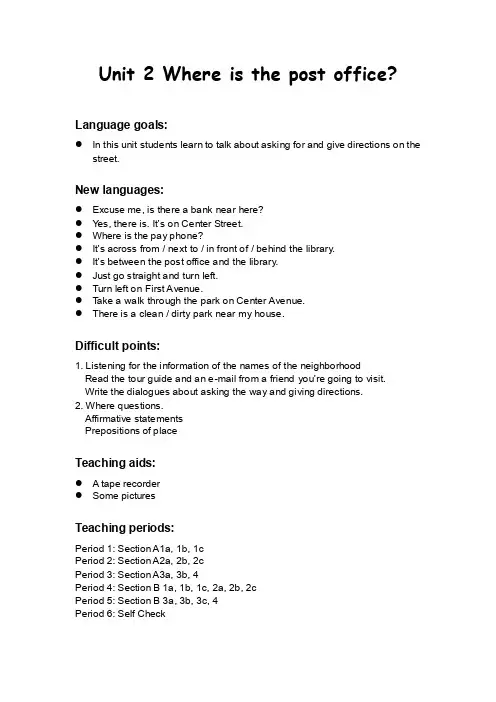
Unit 2 Where is the post office?
Language goals:
In this unit students learn to talk about asking for and give directions on the
street.
New languages:
Excuse me, is there a bank near here?
Yes, there is. It’s on Center Street. Where is the pay phone?
It’s across from / next to / in front of / behind the library.
It’s between the post office and the library.
Just go straight and turn left.
Turn left on First Avenue. Take a walk through the park on Center Avenue.
There is a clean / dirty park near my house.
Difficult points:
1. Listening for the information of the names of the neighborhood
Read the tour guide and an e-mail from a friend you’re going to visit.
Write the dialogues about asking the way and giving directions.
2. Where questions.
Affirmative statements Prepositions of place
人教版(新目标)初中英语七年级下册Unit 2预习自学
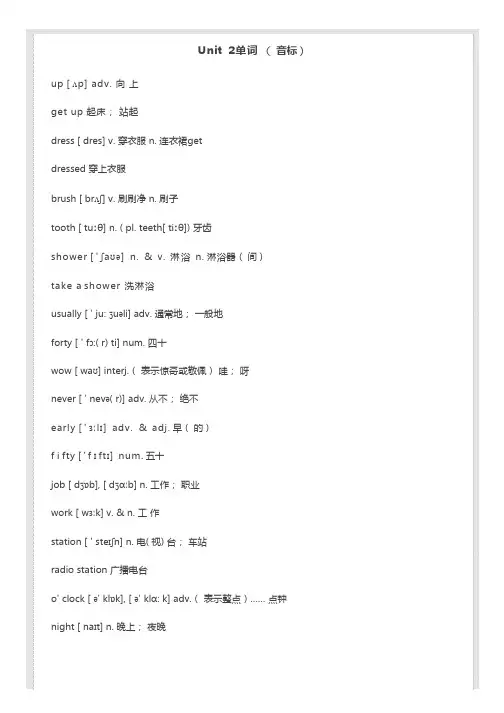
Unit 2单词 (
音标)
up [ ʌp] adv. 向
上get up 起床; 站起 dress [ dres] v. 穿衣服 n. 连衣裙get dressed 穿上衣服 brush [ brʌʃ] v. 刷刷净 n. 刷子 tooth [ tuːθ] n. ( pl. teeth[ tiːθ]) 牙齿 shower [ ' ʃaʊə] n. & v. 淋浴
n.
淋浴器(
间)
take a shower 洗淋浴
usually [ ' ju: ʒuəli] adv. 通常地;
一般地forty [ ' fɔ:( r) ti] num. 四十
wow [ waʊ] interj.( 表示惊奇或敬佩)
哇;
呀never [ ' nevə( r)] adv. 从不;
绝不
early [ ' ɜːlɪ]
adv.
&
adj.
早(
的)
f i fty [ ' f
ɪ
ftɪ]
num.
五十
job [ dʒɒb], [ dʒɑːb] n.
工作;
职业work [ wɜːk] v. & n.
工
作
station [ ' steɪʃn] n.
电(
视)
台;
车站radio station
广播电台
o' clock [
ə' klɒk], [
ə' klɑ: k] adv.(
表示整点)…… 点钟night [ naɪt] n.
晚上; 夜晚 funny [ ' fʌnɪ] adj. 奇怪的; 滑稽好笑的
exercise [ ' eksəsaɪz] v. & n. 锻炼; 练习on weekends ( 在) 周末
best [ best] adj. 最好的 adv. 最好地; 最group [ gruːp] n. 组; 群
half [ hɑːf], [ hæf] n. & pron. 一半; 半数
past [ pɑːst],[ pæst] prep. 晚于; 过( 时间) adj. 过去的quarter [ ' kwɔː( r) tə( r)] n. 一刻钟; 四分之一
人教新目标七年级下册英语课课练 Unit2 Section A(1a-2c)
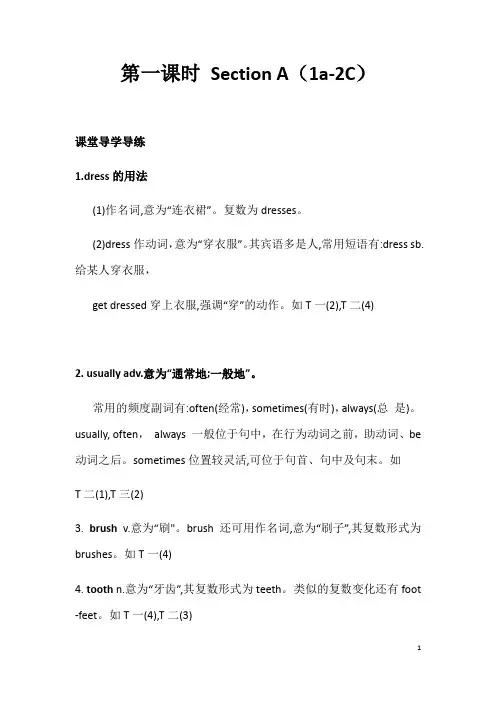
1 第一课时 Section A(1a-2C)
课堂导学导练
1.dress的用法
(1)作名词,意为“连衣裙”。复数为dresses。
(2)dress作动词,意为“穿衣服”。其宾语多是人,常用短语有:dress sb.给某人穿衣服,
get dressed穿上衣服,强调“穿”的动作。如T一(2),T二(4)
2. usually adv.意为“通常地;一般地”。
常用的频度副词有:often(经常),sometimes(有时),always(总 是)。usually, often, always 一般位于句中,在行为动词之前,助动词、be动词之后。sometimes位置较灵活,可位于句首、句中及句末。如
T二(1),T三(2)
3. brush v.意为“刷"。brush 还可用作名词,意为“刷子”,其复数形式为brushes。如T一(4)
4. tooth n.意为“牙齿”,其复数形式为teeth。 类似的复数变化还有foot
-feet。如T一(4),T二(3)
2 5.What time do you usually get up,Rick?里克,你通常什么时候起床?
(1)what time意为“几点;什么时候”,用来询问具体时刻,常用于“What
time do/does+主语+动词原形+... ?”句型中。如T-(3),T三(1)
[拓展]when意为“什么时候”,所表示的时间范围较广,既可询问具体时刻,也可询问日期、月份、年份等。如T-(5),T四(1)
(2)time n.意为“时间”。询问时间的常用句型有What's the time now?
/What time is it now?
课内基础训练
一、单项选择。
( )1. We have breakfast 7 :00 the morning.
A. at ;at
B. in;on
人教新目标七年级英语下册Unit 2What time do you go to school课时分层训练
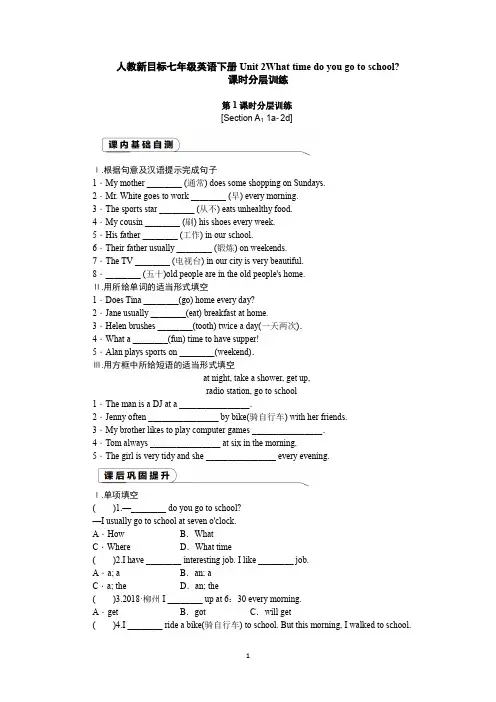
1 人教新目标七年级英语下册Unit 2What time do you go to school?
课时分层训练
第1课时分层训练
[Section A1 1a2d]
Ⅰ.根据句意及汉语提示完成句子
1.My mother ________ (通常) does some shopping on Sundays.
2.Mr. White goes to work ________ (早) every morning.
3.The sports star ________ (从不) eats unhealthy food.
4.My cousin ________ (刷) his shoes every week.
5.His father ________ (工作) in our school.
6.Their father usually ________ (锻炼) on weekends.
7.The TV ________ (电视台) in our city is very beautiful.
8.________ (五十)old people are in the old people's home.
Ⅱ.用所给单词的适当形式填空
1.Does Tina ________(go) home every day?
2.Jane usually ________(eat) breakfast at home.
3.Helen brushes ________(tooth) twice a day(一天两次).
4.What a ________(fun) time to have supper!
5.Alan plays sports on ________(weekend).
Ⅲ.用方框中所给短语的适当形式填空
at night, take a shower, get up,
人教新目标七年级英语下册素材 Unit2 分析

Unit 2 What time do you go to school?
Review教材分析
人教版《新目标英语》七年级下册第二单元中心话题是通过对日常生活作息时间的谈论,让学生学会时间的表达法。主要学习用what time和when来引导的特殊疑问句询问时间的标准用法,还有不同时间段的表达法以及表示频率副词的学习。
通过本单元的学习使学生学会不同时间段的表达法,学会用频率副词谈论自己日常生活习惯。通过对不同时间段的系统学习和理解,学会调整和安排自己的学习和课外活动时间,能够运用所学知识对某一活动进行合理的安排;使学生深刻理解时间的重要性, 学会珍惜时间,并逐步养成良好的作息习惯。
本节课是复习课,所以在这节课中我要在40分钟内复习完所有的重点,并且还得进行巩固练习。时间的重要性是众所周知的,生活中我们经常谈论某人在何时做了某事,可是怎样才能用正确的时间表达方法来描述呢?在学生学过了一些数词和日常行为动作术语的基础上,教材在本单元的开篇通过谈论日常作息时间安排的对话来让学生认知时间,表达时间,适时而又合理。学好此课是为学习本单元乃至今后更多的有关时间的对话和短文打下良好的基础,因此学好本课至关重要。
Unit+2+补全对话专项练习人教版新目标英语七年级下册

人教版新目标七年级英语Unit 2
补全对话
专项练习
A
从方框中选择恰当的句子补全对话。
A:Hi,Lucy!1.____
B:Well,I live near my school,so I get up at a quarter to seven.I'm never late for school.
A:Do you have breakfast at home?
B:Yes,2.____
A:When do you go to school?
B:3.____ So I go to school at seven fortyfive.
A:4.____
B:I leave school at five past five and 5.____
A.Class begins at eight o'clock.
B.I get home at five twenty.
C.When do you get home?
D.What time do you usually get up on weekdays?
E.I usually have some cakes and a glass of milk.
B
从方框中选择合适的选项补全对话。
A:Morning,Jack!
B:Morning,Bruce!
A:1.____
B:Yes,I do.
A:Oh,it's early.I usually go to school at seven thirty.2.____
B:Yes,I do.What about you?
A:I eat lunch at school.3.____
B:Great!I also like playing chess.
A:Do you exercise in the morning?
B:No,I don't have much time.4.____ A:5.____
2019-2020学年七年级英语下册 Unit 2 What time do you go to school知识点总结+导学案(新版)人教新目标版
2019-2020学年七年级英语下册 Unit 2 What time do you go
to school知识点总结+导学案(新版)人教新目标版
学习目标:
1.熟练读出书写本节课的表示活动的单词。
2.学会询问时间的句型,熟练的谈论表示时间的话题。
重难点:what time/when 引导的特殊疑问句;频率副词的用法。
情感目标:通过询问和谈论彼此的作息习惯,培养良好的学习习惯。
学习过程:
Ⅰ.【课前热身】预习效果检测: 默写下列短语。
去上学 起床 跑步
吃早餐 洗澡 通常
几点,什么时候 穿上衣服 刷牙
Ⅱ.【自主学习】
1.给图片找到对应的短语 1a
2.听录音完成下列部分1b,2a,2b
Ⅲ.【合作学习】
与同伴练习1b中的对话
Ⅳ.【拓展提升】
根据1b,2b部分创编新对话, 完成1c,2c对话表演。
Ⅴ.【答疑解惑】
针对本课提出困惑的知识点或问题。
Ⅵ.【课堂小结】
总结本课所学知识点。
Ⅶ.【达标检测】
一、翻译句子。
1.你通常几点钟起床?
What _______ do you ________get ________?
2.我通常在12:00吃午餐。
I ________ eat _______ ________12:00.
3.你通常什么时候起床?
______do you usually _____ ______?
4.我通常6点钟起床。 I usually _____ _____at six______.
5. 我从来不起这么早。I _____get up so______.
6. 他有一份有趣的工作。He _____ an ______ job.
Unit 2 英语教案人教版新目标七年级英语下册
Unit 2 what time do you go to school?
(Section A)
教学目标:
能够听懂、会说并正确使用日常生活中的时间表达方式。
能够用英语描述自己或他人的日常作息时间。
教学重点:
时间表达方式。
熟练使用句型“What time do you...?”和“I usually... at...”。
教学难点:
用英语描述自己或他人的日常作息时间。
区分at、in、on的用法。
教学准备:
课件、多媒体设备。
钟表、日常生活用品图片等教具。
教学过程:
Step 1: Warm-up
Show some pictures of daily activities, such as getting up, having breakfast, going to school, doing
homework, watching TV, and going to bed.
Ask students to describe what they usually do at each time of day.
Step 2: Presentation
Present some common time expressions, such as "in the morning", "in the afternoon", "in the
evening", "at night", "at 6 o'clock", "at 7:30", and "on Monday".
Explain the different uses of "at", "in", and "on".
Step 3: Practice
Have students work in pairs to ask and answer questions about each other's daily routines using
人教版七年级英语下册Unit2_知识点思维导图(可编辑版)
1
人教新目标版七年级下册
Unit 2 What time do you go to school?
1、get up起床
go to bed 上床睡觉
Rick is a students. he usually _____at eight o'clock in the morning.
A. goes to bed B. goes to school C. goes to the bed D.goes to the school
2、go to school
go to school 侧重功能
go to the school 侧重地点
in hospital
in the hospital
at table
at the table
---Would you like to come to my party this afternoon?
---I'd like to, but my mother is ill in ___hospital. I will go to ___ hospital to see her
A./ ; a B. a; the C. the; the D./; the
3、get dressed
get dressed in +衣服或表示颜色的词
dress sb. 给...穿衣服
He gets____quickly, and then_____ his brother.
A. dresses;dressed B. dressed; dresses C. dresses; dresses D. dressed; dressed
4、brush teeth
teeth 是 tooth 的复数形式
Do you know how many____ you have?
人教版新目标版七年级英语下册 Unit 2 What time do you go to school教案
Unit2 What time do you go to school
主备教师 小组教师
上课教师 科 目 英语 班级
上课时间 累计课时 总第 课时
课题 Unit2 What time do you go to school? Section A 1a—1c(第1课时)
教学目标:
1. 重点词汇:up dreessed brush never early work station o’clock night funny
exercise
2. 重点词词组:get up get dressed take a shower radio station
3. 谈论时间的句型:
—What time do you usually take a shower?? —When do you go to school?.
教学重点:
1.生词 2. what time 和when引导的特殊疑问句
教学难点:
what time 和when引导的特殊疑问句
教学方法及措施:
指导预习,合作探究,点拨总结 直观教学法、
教学过程 修订、增减
一.预习导学
预习单词和词组,完成下列各题:根据提示完成单词和短语
向上_______ 穿着衣服__________刷_________ 牙齿__________通常___________从不____________早 ____________工作____________奇怪的___________锻炼____________起床 ________穿上衣服_________洗淋浴_________广播电台_________
二. 情景导入,自主学习
Step1情景导入
通过询问时间,引导学生复习和掌握时间的表达法,激发学生的学习兴趣,让学生熟练的掌握时间表达的方法,导入新课的单元话题。