
七年级英语上册教案新版牛津深圳版新
Unit 1 Making friends 一.教学目标: 1.掌握本单元的所有重要的单词和短语 2.掌握不定冠词a, an的用法和特殊疑问句 二.教学重难点 重点:重点单词,短语和语法的运用 难点:对划线部分提问时疑问词的选用 三.教学内容
核心词汇: Blog博客 grammar语法 sound声音 complete 完成 hobby 爱好 country 国家 dream 梦想 age 年龄 everyone 人人 Germany 德国 elder 年长的 mountain 山脉 friendly 友好的 engineer 工程师 world 世界 Japan 日本 flat 公寓 yourself 你自己 US 美国 重要短语: Favourite subjects 最喜欢的功课 welcome to欢迎来到... be from 来自于... close to接近 go to school 去上学 be good at 擅长 play basketball 打篮球 make friends with与...交朋友 all over遍及 教学内容: Getting ready often write to each other about their hobbies. write to sb. about sth. 就某事写信给某人 each other= one another彼此,互相 2.. Write down your hobbies. 写下你的爱好。 write down写下 write to sb. 写信给某人 3. Can you match the hobbies in the box with the picture below match……with 把……和……匹配 in the box 在方框里 4. tell sb sth. 告诉某人某事 tell a lie/ story 说谎/ 讲故事 speak to sb. 对某人说话 speak English 说英语 talk to/ with sb 与某人交谈(to :单向;with:双向) say 指说的内容 Reading 5. Anna’s blog. sb’s 某人的 Her parents’ names. 以s结尾时,只加’即可。 6. I’m from Germany. 我来自德国。 be from = come from 来自于….. Peter is from America. 比特来自美国。= Peter comes from America. 7. I’m 11 years old. 我十一岁。 问句:What is his age = How old is he 他多大了 1) at the age of= when sb. was … years old 在……岁的时候 He could swim at the age of six. = He could swim when he was six years old 2)the same age of = as old as 和……一样大 She is the same age of Kate. = She is as old as Kate. (注意:the same height as = as tall as 和……一样高; the same length as = as long as 和……一样长) 8. I have long hair. 我有长头发。 have “有” have sth. to do 有某事要做 have a cold 感冒 have ”吃,,喝” have a cup of tea喝一杯茶 have breakfast/ lunch/ supper吃早/中/晚餐 have to 不得不 have sth. on= have on sth.=wear sth. 穿着… 9. I live with my family in a house close to some mountains. 我与家人一起住在靠近山区的一栋房子里。 1) live with与……一起生活 live in 居住在…… 2) close to= near 接近,离……近(也可放于被修饰词之后做后置定语) I live close to the shops. 我住得离商店很近。 She is buying a flat close to her office. 她正在购买一套靠近她办公室的公寓。 our school is close to Baoan stadium. 我们学校靠近保安体育馆。 3) family, house与home (1) Family 指家庭,一家人或全体家庭成员。如父母,子女等,与居住的房子无关。 (2) House 指家庭住宅,着重房屋的概念。 (3) Home 指家庭共同生活的地方,又是也指出生的城市或国家。 如:My family are very tall. 我们全家人的个子都很高。 He has one house in the city. 他在城里有栋房子。 I leave home at 8:30 every morning. 我每天早晨8:30离家。 10. I have an elder sister and an elder brother. 我有一个姐姐,一个哥哥。 elder 是old的比较级,意为‘年长的,较大的’,old还有一个比较级为older. elder对应younger, older对应newer. younger brother弟弟 younger sister妹妹 elder sister姐姐 elder brother哥哥 I have an elder sister and an elder brother. 我有一个姐姐,一个哥哥。 My English book is older than yours. But my math book is newer than yours. 11. I go to school by school bus. by bus= in a bus乘公共汽车 go to……by…… 乘坐……去…… take a bus to sp=go to sp by bus 乘公交车去学校 12. My favourite subjects are Maths, Art and Science. favourite= like…best 最喜欢 favourite: things I like doing in my free time = Some students don’t do well in math. be good/ nice/ friendly to sb.对某人友好 be good/ bad for 对……有益处/害处 13. My dream is to be an engineer. I want to be= My dream is to be 我的梦想是成为…… to be 成为 work as = be (am / is / are) 是……职位 14. I’m good at swimming and playing basketball. 我擅长游泳和打篮球。 ]be good at = do well in 擅长于… Some students aren’t good at maths. 有些学生数学学不好。 15. These are my favourite hobbies. this复数为 these;that复数为those 谓语动词are与hobbies单复数统一 16. I want to make friends with young people from all over the world ! =.I want to make friends with young people from_________ __________ __________ . 我想跟世界各地的年轻人交朋友。 (1) want to do sth.想要做某事 = would like to do sth. = feel like doing sth make friends with sb. 与……交朋友 (2) all over 遍及,全部的 all over the world=around the world 全世界 17. I like my school because the teacher are all very friendly. friendly: adj. 友好的 通常以ly结尾的词是副词,但friendly, lovely, lonely, lively及friendly是形容词。 “对某人友好”用be friendly to sb. = be good/ nice to sb. make friends with sb. 与某人交朋友 The owner of the shop is very friendly to us. 18. Do you live close to or far away from school be far away from 离……远 19. Anna enjoys her school school life. enjoy: v. 喜欢,享受……的乐趣 enjoy后面接名词、代词或动词ing形式,即enjoy sth. / doing sth. 喜欢做某事 拓展:enjoy oneself = have a good/great time = have fun 玩得开心,过得愉快 Did you enjoy the movie last night
七年级英语上册 Unit 4 Seasons教案6 (新版)牛津深圳版-牛津深圳版初中七年级上册英语
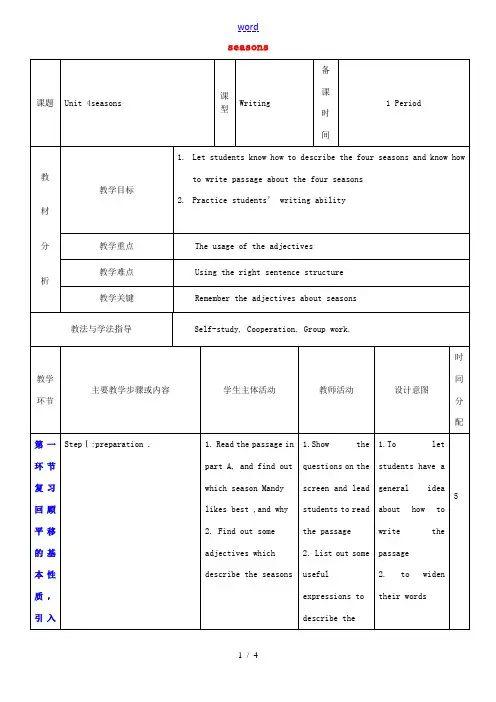
思
What do you do or eat in that festivals ?
3.To train their ability to express as well asimprove their speaking abilityandto get ready for the writing and train their ability to cooperate.
5
10
10
第三环节 课堂练习
Step III: Writing
Step IV: Check the passage
4.Write a passage about the season which you like best
5. Let students check theirpassageswith their partner
Self-study, Cooperation, Group work.
教学环节
主要教学步骤或内容
学生主体活动
教师活动
设计意图
时间
分配
第一环节 复习回顾平移的基本性质,引入课题
StepⅠ:preparation.
1.Read the passage in part A, and find out which season Mandy likes best ,and why
5
第四环节 课时小结
Summerize
How to organize the writing.
Summerize the writing:use the correct adjectives
List thebeautiful sentences they writein thepassages
推荐七年级英语上册Unit7Schoolclub教案6(新版)牛津深圳版
3.To train their ability to express as well as improve their speaking ability and to get ready for the writing and train their ability to cooperate.
1.To arouse their interest about the class
5
第二环节 观察操作、探索归纳平移的作法
StepⅡ: Read the phrases given in P95 and try to use them when writing
3. Fill in the blanks according the passage according to the information given about the Insect Club
4.remind students to pay attention to their handwriting
and check the mistakes students make
4.To train the students’ writing ability.
15
第四环节 课时小结
Step five Sum up
10
第三环节 课堂练习
Step III: Writing
Step IV: Check the passage
4.Write a passage about the Insect Club, should contain the following information : the activities of the club, what can you learn in the club , the time of the activities of the club, the teacher who attend the club
最新牛津深圳版初中英语七年级上册Module 1 My life 1 making friends 公开课教学设计 (3)

The mastering of the useful sentence structure and useful phrases.
What are your hobbies ? My hobby is playing football, be from etc.
教学难点
Learn the structure “My dream is to be an engineer”
5.Give them an example to do the exercise.
6. work in group to check the answers.
5.To provide the chances for everyone to check their learning effects.
4.To cultivate their spirit of competition and strengthen th eir learning fruit.
第三环节 课堂练习
StepVI: More practice
5. Use the right forms of the expressions to finish the sentences.
教案3
课题
课型
Reading (Ⅱ)
备课时间
1 period
教
材
教学目标
1.The students can use the expressions and the useful sentence structures freely.
2.To master some usages of some useful expressions and develop an ability of how to get a further understanding of the text.
七年级英语上册 Chapter 1 Making friends教案 牛津深圳版
Chapter 1 Making friendsTeaching PlanAn extra period: the new words preparation for the textTeaching aims:To teach the Ss some new words which are needed in the text.Teaching Difficulties:Get the Ss to master the wordsTeaching focuses:Get the Ss to listen read, write and use the wordsTeaching procedures:Step 1: Task 1Find out the Ss’ favorite sport.Class work:The teacher talks about himself/h erself,“I liking sing.”“I’m keen on sports.”“I’m keen on reading.”“I like p laying football./table-tennis/swimming...”What’s your favorite sport?Teach: volleyball, badminton, rugby, basketball, tennis, chess...Group work:Each group talks about their favorite sport. The group leader completes a form to show everyone’s favorite sport.Step 2: Task 2: Guess GameTalk about sports games by using EnglishClass work:Ask some students to make gesture according to the word the teacher gave and ask other Ss to guess what’s the name of the sports by using English.Name of the sports:high jump running/racefootball swimmingPingpon g rugbytennisbadmintonThe first period: word preparation and scann ingTeaching aims:To teach the Ss some new words which are needed in the text.Get information by scanning.Teaching Difficulties:Get the Ss to master th e words.Get the Ss to learn to read a letter.Teaching focuses:New words, reading skills.Step 1: presentationShow an envelope to teach :an envelope a stamppostal code an addressdate post officepost a letter deliver a letterStep 2: practiceTask 1: complete an envelopeIndividual work: ask each student make an envelope, and then ask the Ss to write the postal code and an address on the envelope.Step 3: PresentationShow a letter on the screen. Tell the students it’s from your penfriend . Teach: the address the dateat the top right corner greetingthe first sentence the bodythe ending the signatureStep 4: scanningShow the letter in the text, ask the Ss about the address, the date, ... For example:What’s the address?What’s the da te?Who’s the sender?Who’s the receiver?...Text Page2 Part B; look and thinkTask 1:Part B1; Before you read the letter on the next page,take a look at it. How can you tell it is a letter andnot a story or a p oem? tick the things that tell you. Task 2:Part B2; read the five parts of the letter and completethe paragraph . Don’t read th e whole letter yet. Step 5: extra readingShow another letterGet the Ss to get information from the five parts.Step 6: homeworkRead the new words and listen to the tape. Cope the new words five times.The second period:Vocabulary & SentencesThree-dimensional teaching aims and demands:1.knowledge goals : a. new words, phrases and useful expressionsb. make the Ss fully understand the letter2. ability goals : a. enable the Ss to master the components and format of an English letterb. promote the Ss’ competence of finding i nformation3. moral goals: a. forster Ss consciousness of cooperationb. arouse the Ss to be aware of the importance of the friendship Teaching focuses and difficulties:1.teaching focuses: a. key words , phrases and sentencesb. the comprehension to the letter2. difficulties: a. getting students involved in readingb. the use of some expressionsTeaching aids: a tape recorder, multimediaTeaching procedures:Step1 : Warm-up: What sports do you know?W hat’s your favourite sport?Step2: Revison: name of some sportsLook and say.Step3: Lead-in: introduce teacher’s American penfriend to the SsStep4: Task-based learning:1.ask students to think about the components of a letter2.answers checking3.show the Ss a letter, teach the format of an English letter4.instant exercise: read the letter on P3 and fill the blanks above. Step5: Task-based learning II:1.Groupwork: What can you tell your new friends in a letter?2.answer checking3.Listen to the tape , answer ” What does Simon mention in his letter?”Step6: Task-based learning III:Groupwork: Ss read the letter again very carefully, each group has a different task. After finishing reading, the leader collect all the members’ answers and show them to all.Step7: word, phrases and sentences1.Teacher show them on the screen, teach students the meaning ,the use,the differences between the similary ones…and so on2.Excercises to consolidationStep8: Homework1.According to the format, write an English letter( key words given.)2.Exercises on Exercises Book.The third period:ReadingTeaching aims:1.To know about the format of a letter2.To learn how the writer introduced himself as a penfriend by reading the letter.3. To learn some useful patterns and use these patterns to do some practice. Teaching Difficulties:Design general reading tasks and specific reading tasks to help students to fully understand the text and improv e their reading skills.Teaching focuses:1.Help students to introduce themselves to their penfriends by designing threetopics: talk about yourself (include your name, age, height, hobby…), your family and your school.2.Introduce some sentence patterns about each topic, divide the whole class intogroups to practice introducing themselves to their penfriendsTeaching aids: some paper, a tape recorder and multi-media, an envelope and a letter. Teaching procedures:Step1: GreetingsStep2: Lead-in:introduce a sceneThe teacher designed a scene: May is a girl who lives in Shenzhen. One day she receives a letter from her penfriend—Simon.Step3:Listening (class work & individual work)The teacher lists the questions on the PowerPoint and then plays the tape recorder.Questions: 1.How old is Simon?2. Where does Simon live?3. Which school does he study at?Step4: Reading Tasks1)Pre-reading task: Teaching the format of a letterThe teacher asks students to find the six parts of the letter.2)While-reading tasks:General reading task:Read the whole text in 3 minutes and answer the following question: What does Simon mainly talk about in each paragraph? ( para.= paragraph)Para.1 para.2 para3. para4.Specific reading tasks:Read the text carefully and then answer the following questions. The teacher will list these questions before reading each paragraph.2) How many people are there in Simon’s family? Who are they?3) Who is Edwin? What does Edwin work as?4) What is Simon’s best subject at school?5)Where is Simon in the photo?Step5 Post-reading tasks: (Topics & sentence patterns)Activity: (group work &pair work)There are three topics about introducing yourself to your penfriends, the teacher divides the whole class into groups. Each group can choose one topic and have a discussion in several minutes. Then the teacher will choose some pairs of students to make dialogues and act the dialogues out.Topic1: Talk about yourself:What’s y our name? My name is…..How old are you? I am ……years old.What’s your height? I am…….cm tall.What’s your favourite hobby?My favourite hobby is………… ……Topic2 Talk about your family:Where do you live? I live in……..(Shenzhen,Shanghai…..)How many brothers and sisters d o you have? I have ……sisters/ brothers.What does your mother/ father do? My mother is a…..( teacher, housewife,businesswoman , clerk, driver…..)… … My father is a…..(doctor, famer, worker,boss, manager, police man…..)……Topic3:Talk about your school:Which school do you study at? I study at ……(Qianhai Middle School,Shenzhen Middle School, ……) What is your favourite subject? My favourite subjectis…(physics,English, maths, history, geography,Chinese, PE……)Step6 Homework: Exercise on page 12Write a letter to Simon, introducing yourself, your family and your school.。
最新牛津深圳版初中英语七年级上册Module 1 My life 1 making friends 公开课教学设计 (1)
2. choose the right pronucication of the words
6. Finish the exercise given on the sheet.
6.Collect the mistakes in the students’ exercise.
教案1
课题
课型
NEW WORDS
备课时间
1 period
教
材
分
析
教学目标
1.Students can master how to pronounce the new words and master the meanings of the words .
2.Students can use the new words to make new senteces.
2. Read after the tape and pay attention to the pronounciation of the new words.
3.Play the game:
Choose a number in a number table and answer the related questions like : Tell the Chinese meaning of the words , or Spell out the words ,or make a sentence with the words
1.Show the questions on PPT and guide the stduents to come into the topic of the unit ,making friends
七年级英语上册 Chapter 1 Making friends教案 牛津深圳版

Chapter 1 Making friendsTeaching PlanAn extra period: the new words preparation for the textTeaching aims:To teach the Ss some new words which are needed in the text.Teaching Difficulties:Get the Ss to master the wordsTeaching focuses:Get the Ss to listen read, write and use the wordsTeaching procedures:Step 1: Task 1Find out the Ss’ favorite sport.Class work:The teacher talks about himself/herself,“I liking sing.”“I’m keen on sports.”“I’m keen on reading.”“I like pla ying football./table-tennis/swimming...”What’s your favorite sport?Teach: volleyball, badminton, rugby, basketball, tennis, chess...Group work:Each group talks about their favorite sport. The group leader pletes a form to show everyone’s favorite sport.Step 2: Task 2: Guess GameTalk about sports games by using EnglishClass work:Ask some students to make gesture according to the word the teacher gave and ask other Ss to guess what’s the name of the sports by using English.Name of the sports:high jump running/racefootball swimmingPingpong rugbytennisbadmintonThe first period: word preparation and scanningTeaching aims:To teach the Ss some new words which are needed in the text.Get information by scanning.Teaching Difficulties:Get the Ss to master the words.Get the Ss to learn to read a letter.Teaching focuses:New words, reading skills.Step 1: presentationShow an envelope to teach :an envelope a stamppostal code an addressdate post officepost a letter deliver a letterStep 2: practiceTask 1: plete an envelopeIndividual work: ask each student make an envelope, and then ask the Ss to write thepostal code and an address on the envelope.Step 3: PresentationShow a letter o n the screen. Tell the students it’s from your penfriend .Teach: the address the dateat the top right corner greetingthe first sentence the bodythe ending the signatureStep 4: scanningShow the letter in the text, ask the Ss about the address, the date, ...For example:What’s the address?What’s the date?Who’s the sender?Who’s the receiver?...Text Page2 Part B; look and thinkTask 1:Part B1; Before you read the letter on the next page, take alook at it. How can you tell it is a letter and not a story or apoem? tick the things that tell you.Task 2:Part B2; read the five parts of the letter and plete theparagraph . Don’t read the whole letter yet.Step 5: extra readingShow another letterGet the Ss to get information from the five parts.Step 6: homeworkRead the new words and listen to the tape. Cope the new words five times.The second period:V ocabulary & SentencesThree-dimensional teaching aims and demands:1.knowledge goals : a. new words, phrases and useful expressionsb. make the Ss fully understand the letter2. ability goals : a. enable the Ss to master the ponents and format of an English letterb. promote the Ss’ petence of finding information3. moral goals: a. forster Ss consciousness of cooperationb. arouse the Ss to be aware of the importance of the friendship Teaching focuses and difficulties:1.teaching focuses: a. key words , phrases and sentencesb. the prehension to the letter2. difficulties: a. getting students involved in readingb. the use of some expressionsTeaching aids: a tape recorder, multimediaTeaching procedures:Step1 : Warm-up: What sports do you know?What’s your favourite sport?Step2: Revison: name of some sportsLook and say.Step3: Lead-in: introduce teacher’s American penfriend to the SsStep4: Task-based learning:1.ask students to think about the ponents of a letter2.answers checking3.show the Ss a letter, teach the format of an English letter4.instant exercise: read the letter on P3 and fill the blanks above.Step5: Task-based learning II:1.Groupwork: What can you tell your new friends in a letter?2.answer checking3.Listen to the tape , answer ” What does Simon mention in his letter?”Step6: Task-based learning III:Groupwork: Ss read the letter again very carefully, each group has a different task. After finishing reading, the leader collect all the members’ answers and show them to all.Step7: word, phrases and sentences1.Teacher show them on the screen, teach students the meaning ,the use, the differencesbetween the similary ones…and so on2.Excercises to consolidationStep8: Homework1.According to the format, write an English letter( key words given.)2.Exercises on Exercises Book.The third period:ReadingTeaching aims:1.To know about the format of a letter2.To learn how the writer introduced himself as a penfriend by reading the letter.3. To learn some useful patterns and use these patterns to do some practice.Teaching Difficulties:Design general reading tasks and specific reading tasks to help students to fully understand the text and improve their reading skills.Teaching focuses:1.Help students to introduce themselves to their penfriends by designing three topics: talk aboutyourself (include your name, age, height, hobby…), your family and your school.2.Introduce some sentence patterns about each topic, divide the whole class into groups topractice introducing themselves to their penfriendsTeaching aids: some paper, a tape recorder and multi-media, an envelope and a letter.Teaching procedures:Step1: GreetingsStep2: Lead-in:introduce a sceneThe teacher designed a scene: May is a girl who lives in Shenzhen. One day she receives aletter from her penfriend—Simon.Step3:Listening (class work & individual work)The teacher lists the questions on the PowerPoint and then plays the tape recorder.Questions: 1.How old is Simon?2. Where does Simon live?3. Which school does he study at?Step4: Reading Tasks1)Pre-reading task: Teaching the format of a letterThe teacher asks students to find the six parts of the letter.2)While-reading tasks:General reading task:Read the whole text in 3 minutes and answer the following question:What does Simon mainly talk about in each paragraph? ( para.= paragraph)Para.1 para.2 para3. para4.Specific reading tasks:Read the text carefully and then answer the following questions. The teacher will list these questions before reading each paragraph.1)Read paragraph one and fill in the form:2) How many people are there in Simon’s family? Who are they?3) Who is Edwin? What does Edwin work as?4) What is Simon’s best subject at school?5)Where is Simon in the photo?Step5 Post-reading tasks: (Topics & sentence patterns)Activity: (group work &pair work)There are three topics about introducing yourself to your penfriends, the teacher divides the whole class into groups. Each group can choose one topic and have a discussion in several minutes. Then the teacher will choose some pairs of students to make dialogues and act the dialogues out.Topic1: Talk about yourself:What’s your name? My name is…..How old are you? I am ……years old.What’s your height? I am…….cm tall.What’s your favourite hobby?My favourite hobby is………… ……Topic2 Talk about your family:Where do you live? I live in……..(Shenzhen,Shanghai…..)How many brothers and sisters do you have? I have ……sisters/ brothers.What does your mother/ father do? My mother is a…..( teacher, housewife,businesswoman , clerk, driver…..)… … My father is a…..(doctor, famer, worker,boss, manager, policeman…..)……Topic3:Talk about your school:Which school do you study at? I study at ……(Qianhai Middle School,Shenzhen Middle School, ……) What is your favourite subject? My favourite subject is…(physics,English, maths, history, geography,Chinese, PE……)Step6 Homework: Exercise on page 12Write a letter to Simon, introducing yourself, your family and your school.。
最新牛津深圳版初中英语七年级上册Module 3 Travels 5 visiting the moon 公开课教学设计 (4)
第四环节 课时小结
StepⅥ
Dictation
6.Try to write out the words as possible as they can.
6.Paly the Mp3 for them and ask them to write out the word.
6.To check the situation of words learning.
5
第五环节 课后作业
1.Read after the MP3.
2.Finish the exercise on P60.
1.To arouse their interest and willing to show themselves,.
5
第二环节 观察操作、探索归纳平移的作法
StepⅡ: Reading
Read the new words.
(Competition)
StepⅢ: Games
Good Look!
StepⅣ: Key Words Learning
②Use the right forms to fill the blanks.
5.Explain the ite ms for them and then encourage them to finthen che ck the answer.
2.Play the Mp3 for them and then hold a competition of reading.
3.Explain the games: The words on the PPT will disappear one by one. Can you guess which one will disappear.
新牛津深圳版初中英语七年级上册Module 3 Travels 5 visiting the moon 优质课公开课教案 (5)
1.To attract their attention to the class.
5
第二环节 观察操作、探索归纳平移的作法
StepⅡ: Reading
4.Fill the chart according to th e text.
Paragraph 1
feeling
Paragraph 2
facts
Paragraph 3
plans
4.Explain the chart for them and walk to help them.
4.To improve their reading ability.
intonation and the pronunciation. Read louder and correctly.
2.Lead the students to skim and answer
Where is… ?
How will he travel?
3.Play the tape for them and evaluate their reading. Hold a reading competition between groups.
2.To let the students gets ome
ways of skimming and scanning.
3.To form their habit of reading.
5
第三环节 课堂练习
StepⅣ: Reading comprehension.
Finish the chart.
牛津深圳版英语七年级上册Unit1Grammar教学设计
3.家长参与作业,学生向家长用英语介绍自己的日常生活习惯,家长予以记录并签字,以增强学生的口语表达能力,同时增进家校互动。
4.选择一位同学作为采访对象,用一般现在时采访对方的兴趣爱好、学习生活等方面,并以书面形式整理成一篇小短文,不少于50词。
5.针对本单元的动词词汇,如:go, play, watch, read, study等,进行讲解和举例,让学生在实际句子中运用。
(三)学生小组讨论(500字)
1.教师将学生分成小组,每组选择一个话题,如:daily routine, hobbies, family activities等。
2.小组成员用一般现在时讨论话题,每人至少贡献一个句子。
2.利用多媒体教学资源,如课件、视频、图片等,激发学生的学习兴趣,提高课堂参与度。
3.引导学生通过观察、发现、总结规律,培养其自主学习能力。
4.设计丰富的课堂活动,如填空、选择、改错、翻译等,巩固所学知识点,提高学生的语法运用能力。
5.注重个体差异,给予每个学生充分的发言和练习机会,提高其英语表达能力。
难点:在口语交流中灵活运用频率副词,使句子更加自然、流畅。
3.重点:掌握本单元所学的动词词汇,如:go, play, watch, read, study等,并能将其运用到一般现在时的句子中。
难点:在实际情境中,运用所学词汇和语法进行有效沟通。
(二)教学设想
1.创设情境,激发兴趣:通过展示与日常生活密切相关的图片、视频等,让学生在情境中感知一般现在时,激发学习兴趣。
5.及时反馈,强化巩固:在教学过程中,教师应及时给予学生反馈,纠正错误,巩固所学知识。
最新牛津深圳版初中英语七年级上册Module 1 My life 1 making friends 公开课教学设计 (5)
15
第三环节 课堂练习
Step V:Exercise and make sentences by using the structure My dream is to be……
5. Finish the exercise
in P9 and read the sentence fluntences by using the structure , My dream is to be a / an ……
5.Lead students to read the sentences
5.To consolidate what they have learned in this class
教学重点
what , why , when , how , which , who , whose , a an
教学难点
whose , an , how
教学关键
Can ask questions by using the wh words .
教法与学法指导
Cooperating, Self-study
思
10
第四环节 课时小结
StepⅥ:Sum up
6.Read and take note about the rules of how to ask a question and the rule a bout the indefinite articles
6. Show a ppt to guide the students to give sum up of the class
students’ questions a nd pay attention to the wh questions