
小学英语新外研版(一起)四年级上册Module3U2教案
小学英语新外研版(一起)四年级上册
新标准英语5册M3U2 This is Sam’s sweater.
学习指导卡
学习目标:
1. 唱童谣;朗读、表演课文
2. 继续分辨 “this, that, these, those”表示的不同含义。
3. 学习字母a, i, o在重读开音节单词中的读音。
4. 会运用名词所有格。
I预习关
1.听录音,自读生词并写下来。
2.跟读课文,圈出还没有掌握的短语、句型。
II语篇初读词汇关
1.小组内讨论有哪些生词和短语,同桌互读,纠正发音。
2.全班齐读生词并检查。
3.检测:写出下列单词。
湿的__________ 短裤______________
Ⅲ 语篇再读音准关
1. 跟读录音,模仿语音语调
2. 自读课文,小组内互相纠错。
3. 检测:小组内展示,其他小组和老师负责纠错。
Ⅳ 语篇再读解析关
1. 小组讨论,找出重点句型并翻译:
2. 同桌互相问答以上句型。
3. 检测:小组内讨论,找答案,然后找代表发言,全班同学一起订正答案。)
找出课文中含有名词所有格(’s)的句子写下来,读一读并翻译。
V 语篇熟读朗诵关
1. 自己有感情地朗读课文
2. 小组内按喜欢的方式练习有感情地读课文。
3. 小组展示: 用喜欢的方式朗读或背诵课文。
4. 大声读出下列单词,并说出字母a, i, o在单词中的读音。
cake bike boy house open
plane rice point flower boat
VI语篇熟读应用关
1.用this, that, these, those各造一个句子。
2.小组内交流,推荐一对同学表演对话,小组间互相打分。
VII学生收获关
1. 自己总结本节课所学的单词、词组、句型或其他收获。全班交流。
2. 测试:阅读理解。(正确的写T,错误的写F)
Hi, everyone. I’m Xiaoqiang. Look, this is my room, it’s small. This is my bed and
that is Xiaoyong’s bed. Xiaoyong is my brother. These are my trousers. They are black.
Those are Xiaoyong’s shorts. They’re white. Look at the picture on the wall(墙). It’s
my family. We are happy.
1. Xiaoyong’s room is small. ( )
2. Xiaoqiang’s trousers are white. ( )
3. Xiaoyong’s shorts are black. ( )
4. The family is happy. ( )
5. There is(有) one bed in the room. ( )
小学英语新外研版(一起)四年级上册Module 3 Unit 1《She didnt walk…… (2)教案
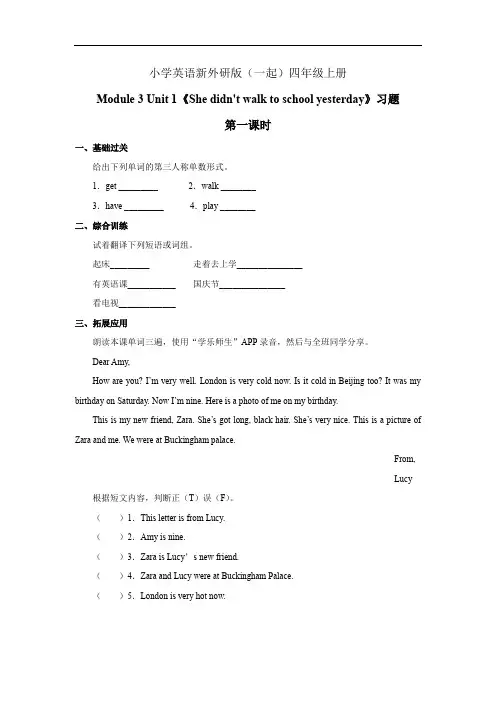
小学英语新外研版(一起)四年级上册Module 3 Unit 1《She didn't walk to school yesterday》习题第一课时一、基础过关给出下列单词的第三人称单数形式。
1.get _________ 2.walk ________3.have _________ 4.play ________二、综合训练试着翻译下列短语或词组。
起床_________ 走着去上学_______________有英语课___________ 国庆节_______________看电视_____________三、拓展应用朗读本课单词三遍,使用“学乐师生”APP录音,然后与全班同学分享。
Dear Amy,How are you? I’m very well. London is very cold now. Is it cold in Beijing too? It was my birthday on Saturday. Now I’m nine. Here is a photo of me on my birthday.This is my new friend, Zara. She’s got long, black hair. She’s very nice. This is a picture of Zara and me. We were at Buckingham palace.From,Lucy 根据短文内容,判断正(T)误(F)。
()1.This letter is from Lucy.()2.Amy is nine.()3.Zara is Lucy’s new friend.()4.Zara and Lucy were at Buckingham Palace.()5.London is very hot now.参考答案一、基础过关1.gets2.walks3.has4.plays二、综合训练get up walk to school have an English lesson National Day watch TV 三、拓展应用1.T2.T3.T4.T5.F。
2021-2022学年外研版(一起)四年级上册英语Module3 Unit2课件
2.What didn’t Daming do yesterday? (1) He didn’t ride his bike yesterday. (2)He didn’t play football in the park.
It was raining.
3.What did he do yesterday?
如有同伴遇到困难,小组其他成员帮忙纠正)
plays football in the park
rides his bike to the park play football in the park
ride his bike raining
plays ping-pong play ping-pong plays the drums play the drums ill
usually
yesterday
gets up at 7 on Mondays
didn’t get up at 7
walks to school
didn’t walk to school
has English
didn’t have it
watched TV and played with her toys
He stayed at home and cleaned all the rooms.
stay
play today
say
day way
3.What dቤተ መጻሕፍቲ ባይዱd he do yesterday?
He stayed at home and cleaned all the rooms.
stay at
school
Module3 Unit2 I didn’t play football.
小学英语新外研版(一起)四年级上册第三模块备课
小学英语新外研版(一起)四年级上册Module 3主题These ducks are very naughty题材内容围绕远处和附近的东西进行谈论。
妈妈带AMY和SAM去湖边玩,他们看到湖里有些船,SAM建议去划船。
在湖面上,他们发现了一些鸭子,他们开始喂鸭子。
一只淘气的鸭子竟然跳到了SAM的头上。
教学目标语言知识与技能功能看到远处或者附近的东西,如何表达来问。
语法特殊疑问句what are these? What are those? 的正确使用词汇听能在听录音的过程中从语句中辨别出单词:flower, dragon boat, duck, feed, bread ,these,those.说能在句子中正确使用单词:flower, dragon boat, duck, feed, bread ,these,those.。
读能在图片提示下,跟着录音在语句中正确朗读出单词: flower, dragon boat, duck, feed,bread ,these,those.写能写出单词:naughty paper boat dragon boat 。
任务学习what are these? What are those?;向同学询问周围的东西。
歌谣Chants: what are these? What are those?核心语句what are these? They’re …….. What are those? They’re …….文化意识知道端午节赛龙舟的知识。
重点用what are those/these…?”这个核心语句的正确问答。
难1.特殊疑问的正确应用。
点课4课时时。
小学英语外研新标准四年级上册(2022年新编)Module3英语教案
Unit 1 What are they doing?一、教材分析本课将继续学习现在进行时,重点是让学生能用现在进行时进行问答。
通过学习,学生将提高用英语进行交流的能力。
在复习已学的动词和动词词组的过程中,不断引申出更多动词短语的学习。
同时在操练已学句型的过程中,拓展出新句型What are they doing?及其应答语的学习。
Unitl课文重点转移到询问和讲述他人正在做的事情。
课文以听音选择的方式呈现句型学习,并在听音后针对答案进行讲述练习以巩固知识的掌握。
二、学生分析小学四年级的学生在经过一年的英语学习后已形成了良好的英语听说读写的习惯,同时初步具备了一定的听说能力,只要教师在教学中给予学生充分的展示机会和绝对的信任和鼓励, 那么每个学生的听说能力都会得到它发挥的平台。
三、Teaching aims(一)认知目标:1> 掌握动词或词组:look at, do taijiquan, row a dragon boat,play chess, drink soyamilk .2、掌握句型What are they doing?及相应回答:They,re(二)能力目标:能运用句型询问和描述他人正在做的事情。
(三)情感目标:培养学生多留心观察生活。
培养学生的学习兴趣。
四、Key points and difficult points.1、用现在进行时询问和描述他人正在做的事情。
2、动词短语和现在进行时的转换。
五、Teaching aids.1、PPTCards六、Teaching procedure。
Stepl: Warm-up1> GreetingT: Class begins.S:Stand up.T:Good morning, boys and girls .S:Good morning, Ms sunSit down please .2、Sing the song' Are you doing it too?I'm listening to music,I'm reading a book,I'm writing a letter,Come here and look.I'm playing football,I'm talking to you,I'm doing my homework,Are you doing it too?3、Play a game.展示三艘小船,每艘船后面藏着一幅有趣图片,让学生练习What is thedoing?is.复习上节课单词和短语。
外研版(一起)英语四年级上册Module3课件

gets get walks walk was
Group work!
What have you learnt from this class?
认识usually的朋友们。
always usually often sometimes seldom never
100% 0%
介绍搜集的节日。
plays ping-pong play ping-pong plays the drums play the drums ill
说一说时光轴的故事。
Let’s learn!
What have you learnt from this class?
必做作业: 1.复习M3自己认为不扎实的地方。 2.预习M4内容。 选做作业: 3.搜集一些带有ass/
如何描述过去没有发生的事情:
walk wplhaayt
She aI
school
主语+ didn’t+动词(短语)原形+其他.
……没有……
fobootrbinalgl!
didn’t diadyn!’t yesterday!
to
读一读,说一说。
Lingling usually gets up at 7 on Mondays. But she didn’t get up at 7 yesterday.
(小学一起)四年级上册
Module 3 Unit 1
She didn’t walk to school yesterday.
外研版小学四年级英语上册Module 3教案
Unit 1 What are they doing?【学情分析】The pupils of Grade 4 are so active that they like to do the actions. But they can't master too many words imediately. In this unit, there are lots of new words and phrases. So the teacher asked them to preview them. And the teacher designed many activites to draw their attention.【教学目标】1. Knowledge aimsa. Master the words “kid, interesting, people, boat, men, between, drink, clock, hungry”.(Because there are so many words in this unit, so I asked the pupils to preview the new words.)b. Know the phrases“do taijiquan, row a dragon boat, play chess, drink soya milk”.c.Ask and answer with”What are they doing? They are….”。
2. Ability aimsThe students can communicate with each other.3. Emotion aimsThe students love to communicate with others.【重点难点】1. New words and phrases.2. The PresentContinuous Tense.【教具准备】PPT课件、单词卡片、人物头像、CD-ROM【教学方法】情景教学、游戏、合作探究、任务型教学法【教学过程】Step 1: Warming up and revision1.Greeting. Classes begin. Good morning, boys and girls. How are you? I’m fine, too.2.Boys and girls. Let’s chant together, ok? Chant: two little black birds.(Two little black birds sitting on a hill, one named Jack and one named Jill, fly away Jack, fly away Jill, come back Jack and come back Jill.)3.You did a very good job. Boys, are you ready for the class? Girls, are you ready? Sit down, please.4.Ok, first let’s review.( Chant:Listen, listening. I’m listening to music. Write, write, writing. I’m writing a letter. Play, play, playing. I’m playing football. Talk, talk, talking. I’m talking to you. Ask and answer:What is he/she doing?)Step 2: New ConceptsLead in: What are they doing? What are the kids doing? Learn the new word: kid. Read one by one. Kids are equal to children.A.1.Let’ s watch and listen.2.This time, let’s follow.B.Look at the picture. Guess what it is. Bus Let’s get on the bus. We can see lots of interesting things. Interesting: play balloon.3.Let’s go! Look, there are lots of p eople in the park. People:three by three. What are they doing? They are doing taijiquan.4.Look! They are rowing a drgon boat. Boat:read quietly/loudly. Show me your fingure:boys spell, girls spell. Close your eyes, spell.5.Oh, look at them. This is a man, this is another man. They are men. Men:e prounce e. Ask anyone to spell and read. They are sitting between the trees. Boys/girls read. They are playing chess.6.Oh there are two girls. They are drinking soya milk. drink. Act and read. Ask the students to teach. Read: drink soya milk.C. Games:7.Now boys and girls, you should watch carefully. And quickly read the phrases.8.Well done. Are you tired. Let’s relax. Stand up, please. Act out the phrases. Sit down, please. Now I’ll ask some group come here to act.and you should answer me what they are doing?(The teacher give them some phrases on the paper.)10.You still want to play, yes? Now, guess what they are doing?D.11. We should return to our text. Now watch and listen carefully.Open your books, turn t o Page 14. Let’s read.12. Practice these dialogue in your group. After that I’ll ask you to show it.Step 3:SummaryWhat have we learned today?Chant together:What are you doing? They’re doing taijiquan. What are you doing? They’re rowing a dragon boat. What are you doing? They’re drinking soya milk. What are you doing? They’re playing chess.Step4: HomeworkOn your way home, you may meet lots of people. Try to say what are the people doing.Unit 2What's the elephant?【教学目标】a、知识目标:1.能听说认读单词:drawing pictures,jumping, singing, dancing, running,horse.2.能听懂、会说本课句型“What are they doing? They are…What is …doing ?She is… He is… It’s…”b、技能目标:培养学生听、说、做、读的能力。
外研社(三起)四年级英语上册教案:Module 3 Unit 2 What’s the elepha
外研社(三起)四年级英语上册教案:Module 3 Unit 2 What’sthe elephant doing Period 1本次课程将围绕四年级上册英语教材的第三模块第二单元展开教学,主要内容为学习一些动物的动作词,学生将通过听、说、读的方式掌握这些词汇。
教学目标本节课的教学目标主要包括以下方面:•学习掌握12个动物的动作词•能够问询和回答“动物在做什么”这个问题•结合图片或实物描述动物的动作•培养学生的英语听、说、读、写四方面的能力教学重点和难点教学重点:•学生能够听懂、理解和运用本节课学习的12个动物的动作词•学生能够通过提问和回答方式进行交际,并通过图片或实物描述动物的动作教学难点:•学生能够更准确地使用本节课所学动作词进行描述•学生能够通过视觉和听觉的信息进行语言的输入与输出教材与工具•教材:《外研社三年级英语上册》•工具:课件、黑板、音响、实物模型教学步骤上课铃响老师在学生到齐后,会让同学大声喊“Good morning”,并询问同学们今天过得怎样,引起学生的注意。
(1)导入•Step 1:开场自我介绍老师首先会介绍自己,然后通过自我介绍的形式,让学生们彼此认识。
•Step 2:唱一首儿歌《The Animals》老师播放儿歌《The Animals》,让学生们跟着歌词动作,学会单词和短语“monkey”,“elephant”,“parrot”,“snake”等。
(2)新授•Step 1:呈现和解释本课单词老师运用课件向学生呈现本课单词,通过连图、音、意等几方面解释其含义和发音规则。
同时老师鼓励学生跟着自己的发音模仿。
•Step 2:呈现图片,描述动物在做什么老师针对新授的词汇,通过图片或实物的形式进行描述,引导学生了解每个动物的体态、动作和习性。
同时鼓励学生模仿教师的描述,使用本节课所学词汇进行口头表述。
(3)训练•Step 1:听音辨词老师播放本单元的音频资料,让学生听音判断哪个动物在做什么。
新版外研版小学四年级英语上册教案全册
新版外研版小学四年级英语上册教案全册module1unit1gostraighton教学目标:1、让学生掌握turnleft\\turnright\\gostraighton。
2、学会用where's...?来问路。
3、在各种活动中培养学生学习英语的兴趣。
教学重点:1、会用where's...?去打探道路。
2、能听懂turnleft\\turnright\\gostraighton。
教学难点:left\\rignt\\gostraighton的正确发音。
t:hello!boysandgirls!nicetoseeyou!ss:hello!missgao!nicetoseeyou,too!t:i'm1.t:samwantstogotodaming'stheclassroom.canyoushowmewhere'stheschool\\park\\zoo \\kfc\\supermarket?(事先把几幅相应的图片贴在教室的各个角落)t:istheschoolonmyleft?(学生看不懂,用中文翻译一遍)(教学意图:以情境导入教学,并采用多媒体课件辅助,更易并使学生快速步入自学意境,以听指的方法去备考研习过的单词,既稳固了旧知,又1自然地引出了新知:leftright)3.teachingthetwowords:leftright(出具单词卡片)4.practicingthetwonewwords:a.guessingwhere'sthesweet.(猜对的学生,把那个糖果给他)b.踏步练习:left,right,(分组练习)t:let'sdosomeexercisesandwe'regoingto.thegroupwhichdoesbetterwillget10points.5.指定一名学生上来再做一组练习后,发出新指令:turnleft!(学生没有反应,不明白什么意思,教师用肢体语言表示其意)6.出示卡片:turn师带读7.贴出标志图:规则:每组选一名同学上台,听到教师指令,搞左转、右转,做错的同学出局下去,最后一名东站在台上的同学就是胜利者,可以为自己小组提10分后。
小学英语新外研版(一起)四年级上册M3教案
小学英语新外研版(一起)四年级上册《英语》(新标准)一起第七册M3Module 3 Unite 1 She didn’t walk to school yesterday.一、教学目标与要求:1、知识与能力目标:本模块主要讲授的是实义动词的一般过去式的否定形式“didn’t”的用法。
在第一单元中通过运用一般现在时对Lingling生活习惯的描述以及实义动词一般过去时的否定形式对于过去某一天没有发生的活动的描述来进行对比,帮助学生理解否定式的含义及用法。
在第二单元中通过阅读、歌曲及游戏等活动来进一步复习和巩固第一单元中所呈现的重点语言知识。
2、情感态度目标:以National Day为契机,培养学生热爱祖国、热爱家乡的美好情感。
二、教学重点及难点:能通过练习、运用等活动使学生能够掌握一般过去式及其实义动词一般过去式否定形式的用法是本模块的重点。
本模块涉及到的语法项目比较多,有一般现在时及其第三人称单数、一般过去式及实义动词的否定式。
使学生能正确的运用进行语言的交际是本模块的难点。
三、课前准备:录音机、磁带、单词卡片、VCD四、教学过程Step1 Warm—up1 I do you say.老师做动作,学生用”You _______yesterday.”来描述老师昨天做过的事情.2 Free talk:T: “When do you usually get up? /How do you usually go to school?”(复习usually 的用法)Step2 Presentation and practice:1指导学生询问老师的一些情况.老师就自己的情况做出回答,如:“I usually get up at 6.But I didn’t get up at 6 yesterday.”让学生初步了解“didn’t”的意思。
2、T:“lingling usually gets up at 6:30.But she didn’t get up at 6 :30yesterday,either.”可让学生猜一下没在6点半起床的原因。
外研版小学英语四年级上册第三模块课件(精品课件)
ppt课件,可编辑
Task
Draw ,ask and answer.
A: What are they doing? B: They’re playing football.
ppt课件,可编辑
第三课时
ppt课件,可编辑
Module 3 复习
ppt课件,可编辑
复习目标: • 1能听懂认读:row、 drink、 draw、
• 3、 乐于感知并积极尝试使用英语。
ppt课件,可编辑
学习指导:
• 1、自读课文,借助课文插图感知课文内容。 • 2、再次看课文,听录音,跟读模仿录音。 • 3、在情景中感知新知,模仿单词的发音,
学习新句型。 • 4、生自读单词,句型,进行操练。 • 5、开展合作学习,通过同桌、小组内互相
问答学习新知,小组长做好督促检查。
ppt课件,可编辑
They’re playing table
tennis.
ppt课件,可编辑
第二课时
ppt课件,可编辑
学习目标:
• 1、 我能正确认读单词: draw, jump, sing, dance 。
• 2、我能运用 What’s the elephant doing? 询问不明白 的情景,并进行说明。
ppt课件,可编辑
They’re drinking milk.
ppt课件,可编辑
monkey elephant horse
bird ppt课件,可编辑
tiger
• 2、小对子互读互评。 • 3、大组长带领组员以不同形式(开火车、两人小
对子、四人共同体等)熟练练读并运用单词。 • 4、小组分角色色操练课文,并熟练运用重点句型。 • 5、Do and say.(以小组为单位,进行我做动作,