
2012年12月大学英语四级考试真题与答案完整版
Part II Reading comprehension (skimming and scanning)Universities Branch OutAs never before in their long history, universities have become instruments of national competition as well as instruments of peace. They are the place of the scientific discoveries that move economies forward, and the primary means of educating the talent required to obtain and maintain competitive advantage. But at the same time, the opening of national borders to the flow of goods, services, information and especially people has made universities a powerful force for global integration, mutual understanding and geopolitical stability.In response to the same forces that have driven the world economy, universities have become more self-consciously global: seeking students from around the world who represent the entire range of cultures and values, sending their own students abroad to prepare them for global careers,offering course of study that address the challenges of an interconnected world and collaborative (合作的)research programs to advance science for the benefit of all humanity.Of the forces shaping higher education none is more sweeping than the movement across borders. Over the past three decades the number of students leaving home each year to study abroad has grown at an annual rate of 3.9 percent, from 800,000 in 1975 to 2.5 million in 2004.Most travel from one developed nation to another, but the flow from developing to developed countries is growing rapidly. The reverse flow, from developed to developing countries, is on the rise, too. Today foreign students earn 30 percent of the doctoral degrees awarded in the United States and 38 percent of those in the United Kingdom. And the number crossing borders for undergraduate study is growing as well, to 8 percent of the undergraduates at America‘s best institutions and 10 percent of all undergraduates in the U.K.In the United States,20 percent of the newly hired professors in science and engineering are foreign-born, and in China many newly hired faculty members at the top research universities received their graduate education abroad.Universities are also encouraging students to spend some of their undergraduate years in another country. In Europe, more than 140,000 students participate in the Erasmus program each year, taking courses for credit in one of 2,200 participating institutions across the continent. And in the United States, institutions are helping place students in the summer internships (实习)abroad to prepare them for global careers. Yale and Harvard have led the way, offering every undergraduate at least oneinternational study or internship opportunity—and providing the financial resources to make it possible.Globalization is also reshaping the way research is done. One new trend involves sourcing portions of a research program to another country. Yale professor and Howard Hughes Medical Institute investigator Tian Xu directs a research center focused on the genetics of human disease at Shanghai‘s Fudan University, in collaboration with faculty colleagues from both schools. The Shanghai center has 95 employees and graduate students working in a 4,300-square-meter laboratory seminars with scientists from both campuses. The arrangement benefits both countries; Xu’s Yale lab is more productive, thanks to t he lower costs of conducting research in China, and Chinese graduate students, postdoctors and faculty get on-the-job training from a world -class scientist and his U.S. team.As a result of its strength in science, the United States has consistently led the world in the commercialization of major new technologies, from the mainframe computer and the integrated circuit of the 1960s to the Internet infrastructure (基础设施)and applications software of the 1990s.the link between university-based science and industrial application is often indirect but sometimes highly visible: Silicon Valley was intentionally created by Stanford University, and Route 128 outside Boston has long housed companies spun off from MIT and Harvard. Around the world, governments have encouraged copying of this model, perhaps most successfully in Cambridge, England, where Microsoft and scores of other leading software and biotechnology companies have set up shop around the university.For all its success, the United States remains deeply hesitant about sustaining the research -university model. Most politicians recognize the link between investment in science and national economic strength, but support for research funding has been unsteady. The budget of the National Institutes of Health doubled between 1998 and 2003,but has risen more slowly than inflation since then. Support for the physical sciences and engineering barely kept pace with inflation during that same period. The attempt to make up lost ground is welcome, but the nation would be better served by steady, predictable increases in science funding at the rate of long-term GDP growth, which is on the order of inflation plus 3 percent per year.American politicians have great difficult recognizing that admitting more foreign students can greatly promote the national interest by increasing international understanding. Adjusted for inflation, public funding for international exchanges and foreign-language study is well below the levels of 40 years ago, in the wake ofSeptember 11,changes in the visa process caused a dramatic decline in the number of foreign students seeking admission to U.S. universities, and a corresponding surge in enrollments in Australia, Singapore and the U.K. Objections from American university and the business leaders led to improvements in the process and reversal of the decline, but the United States is still seen by many as unwelcoming to international students.Most Americans recognize that universities contribute to the nation‘s well-being through their scientific research, but many fear that foreign students threaten American competitiveness by taking their knowledge and skills back home. They fail to grasp that welcoming foreign students to the United States has two important positive effects: first, the very best of them stay in the States and—like immigrants throughout history—strengthen the nation; and second, foreign students who study in the United States become ambassadors for many of its most cherished (珍视)values when they return home. Or at least they understand them better. In America as elsewhere, few instruments of foreign policy are as effective in promoting peace and stability as welcoming international university students.1. From the first paragraph we know that present-day universities have become ________.A)more popularized than ever beforeB)in-service training organizationsC)a powerful force for global integrationD)more and more research-oriented2. Over the past decades, the enrollment of overseas students has increased ________.A)at an annual rate of 8 percentB)at an annual rate of 3.9 percentC)by 800,000D)by 2.5 million3. In the United States, how many of the newly hired professors in science and engineering are foreign-born?A)38% B)10% C)30% D)20%4. How do Yale and Harvard prepare their undergraduates for global careers?A)They give them chances for international study or internship.B)They arrange for them to participate in the Erasmus program.C)They offer them various courses in international politics.D)They organize a series of seminars on world economy.5. An example illustrating the general trend of universities ‘globalization is ________.A)Yale‘s establishing branch campuses throughout the worldB)Yale‘s student exchange program with E uropean institutionsC)Yale‘s helping Chinese universities to launch research projectsD)Yale‘s collaboration with Fudan University on genetic research.6. What do we learn about Silicon Valley from the passage?A)It is known to be the birthplace of Microsoft Company.B)It was intentionally created by Stanford University.C)It is where the Internet infrastructure was built up.D)It houses many companies spun off from MIT and Harvard.7. What is said about the U.S. federal funding for research?A)It has increased by 3 percent.B)It doubled between 1998 and 2003.C)It has been unsteady for years.D)It has been more than sufficient.8. The dramatic decline in the enrollment of foreign students in the U.S. after September 11 was caused by ________.9. Many Americans fear that American competitiveness may be threatened by foreign students who will ________.10. The policy of welcoming foreign students can benefit the U.S. in that the very best of them will stay and ________.PartⅢ Reading Comprehension (Skimming and Scanning)(15 minutes)Section A11.A) He has proved to be a better reader than the woman.B) He has difficulty understanding the book.C) He cannot get access to the assigned book.D) He cannot finish his assignment before the deadline.12.A) She will drive the man to the supermarket.B) The man should buy a car of his own.C) The man needn't go shopping every week.D) She can pick the man up at the grocery store.13.A) Get more food and drinks.B) Ask his friend to come over.C) Tidy up the place.D) Hold a party.14.A) The talks can be held any day except this Friday.B) He could change his schedule to meet John Smith.C) The first-round talks should start as soon as possible.D) The woman should contact John Smith first.15.A) He understands the woman's feelings.B) He has gone through a similar experience.C) The woman should have gone on the field trip.D) The teacher is just following the regulations.16.A) She will meet the man halfway.B) She will ask David to talk less.C) She is sorry the man will not come.D) She has to invite David to the party.17.A) Few students understand Prof. Johnson's lectures.B) Few students meet Prof. Jonson's requirements.C) Many students find Prof. Johnson's lectures boring.D) Many students have dropped Prof. Johnson's class.18.A) Check their computer files.B) Make some computations.C) Study a computer program.D) Assemble a computer.Questions 19 to 22 are based on the conversation you have just heard.19.A) It allows him to make a lot of friends.B) It requires him to work long hours.C) It enables him to apply theory to practice.D) It helps him understand people better.20.A) It is intellectually challenging.B) It requires him to do washing-up all the time.C) It exposes him to oily smoke all day long.D) It demands physical endurance and patience.21.A) In a hospital.B) At a coffee shop.C) At a laundry.D) In a hotel.22.A) Getting along well with colleagues.B) Paying attention to every detail.C) Planning everything in advance.D) Knowing the needs of customers.Questions 23 to 25 are based on the conversation you have just heard.23.A) The pocket money British children get.B) The annual inflation rate in Britain.C) The things British children spend money on.D) The rising cost of raising a child in Britain.24.A) It enables children to live better.B) It goes down during economic recession.C) It often rises higher than inflation.D) It has gone up 25% in the past decade.25.A) Save up for their future education.B) Pay for small personal things.C) Buy their own shoes and socks.D) Make donations when necessary. 来源:考试大-英语四级考试Section BPassage OneQuestions 26 to 29 are based on the conversation you have just heard.26.A) District managers.B) Regular customers.C) Sales directors.D) Senior clerks.27.A) The support provided by the regular clients.B) The initiative shown by the sales representatives.C) The urgency of implementing the company's plans.D) The important part played by district managers.28.A) Some of them were political-minded.B) Fifty percent of them were female.C) One third of them were senior managers.D) Most of them were rather conservative.29.A) He used too many quotations.B) He was not gender sensitive.C) He did not keep to the point.D) He spent too much time on details.Passage TwoQuestions 30 to 32 are based on the passage you have just heard.30.A) State your problem to the head waiter.B) Demand a discount on the dishes ordered.C) Ask to see the manager politely but firmly.D) Ask the name of the person waiting on you.31.A) You problem may not be understood correctly.B) You don't know if you are complaining at the right time.C) Your complaint may not reach the person in charge.D) You can't tell how the person on the line is reacting.32.A) Demand a prompt response.B) Provide all the details.C) Send it by express mail.D) Stick to the point.Passage ThreeQuestions 33 to 35 are based on the passage you have just heard.33.A) Fashion designerB) Architect.C) City planner.D) Engineer.34.A) Do some volunteer work.B) Get a well-paid part-time job.C) Work flexible hours.D) Go back to her previous post.35.A) Few baby-sitters can be considered trustworthy.B) It will add to the family's financial burden.C) A baby-sitter is no replacement for a mother.D) The children won't get along with a baby-sitter.Section CAlmost every child, on the first day he sets foot in a school building, is smarter, more (36)______, less afraid of what he doesn't know, better at finding and (37) ______ things out, more confident, resourceful (机敏的), persistent and (38) ______ than he will ever be again in his schooling – or, unless he is very (39) ______ and very lucky, for the rest of his life. Already, by paying close attention to and (40) ______ with the world and people around him, and without any school-type (41)______ instruction, he has done a task far more difficult, complicated and (42)______ than anything he will be asked to do in school, or than any of his teachers has done for years. He has solved the (43) ______ of language. He has discovered it – babies don't even know that language exists –and (44) ________________________________________________. He has done it by exploring, by experimenting, by developing his own model of the grammar of language, (45) ________________________________________________ until it does work. And while he has been doing this, he has been learning other things as well, (46) ________________________________________________, and many that are more complicated than the ones they do try to teach him.Part ⅣReading Comprehension(Reading in Depth)(25 minutes)Section AQuestions 47 to 56 are based on the following passage.If our society ever needed a reading renaissance(复兴), it's now. The National Endowment for the Arts released “Reading at Risk” last year, a study showing that adult reading47 have dropped 10 percentage points in the past decade, with the steepest drop among those 18 to 24. “Only one half of young people read a book of any kind in 2002. We set the bar almost on the ground. If you read one short story in a teen—ager magazine, that would have 48 ,” laments a director of research and analysis. He49 the loss of readers to the booming world of technology, which attracts would—be leisure readers to E—mail, IM chats, and video games and leaves them with no time to cope with a novel.“These new forms of media undoubtedly have some benefits,” says Steven Johnson, author of Everything Bad Is Good for You.Video games50 problem—solving skills; TV shows promote mental gymnastics by 51 viewers to follow complex story lines. But books offer experience that can't be gained from these other sources, from52 vocabulary to stretching the imagination. “If they're not reading at all,” says Johnson, “that's a huge problem.”In fact, fewer kids are reading for pleasure. According to data53 last week from the National Center for Educational Statistic's long—term trend assessment, the number of 17—year—olds who reported never or hardly ever reading for fun54 from 9 percent in 1984 to 19 percent in 2004. At the same time, the55 of 17—year—olds who read daily dropped from 31 to 22.This slow but steady retreat from books has not yet taken a toll on reading ability. Scores for the nation's youth have56 constant over the past two decades with an encouraging upswing among 9—year—olds. But given the strong apparent correlation between pleasure reading and reading skills, this means poorly for the future.A. percentB. remainedC. roseD. ratesE. percentageF. countedG. relievedH. presentI. BelievingJ. releasedK. forcing L. improve M. Styles N. building O. attributesSection BPassage OneQuestions 57 to 61 are based on the following passage.There is a new type of small advertisement becoming increasingly common in newspaper classified columns. It is sometimes placed among “situations vacant”, alth ough it does not offer anyone a job, and sometimes it appears among “situations wanted”, although it is not placed by someone looking for a job, either. What it does is to offer help in applying for a job.“Contact us before writing your application”, or “Make use of our long experience in preparing your curriculum vitae or job history”, is how it is usually expressed. The growth and apparent success of such a specialized service is, of course, a reflection on the current high levels of unemployment. It is also an indication of the growing importance of the curriculum vitae (or job history), with the suggestion that it may now qualify as an art form in its own right.There was a time when job seekers simply wrote letters of application. “Just put down your n ame, address, age and whether you have passed any exams”, was about the average level of advice offered to young people applying for their first jobs when I left school. The letter was really just for openers, it was explained, everything else could and should be saved for the interview. And in those days of full employment the technique worked. The letter proved that you could write and were available for work. Your eager face and intelligent replies did the rest.Later, as you moved up the ladder, something slightly more sophisticated was called for. The advice then was to put something in the letter which would distinguish you from the rest. It might be the aggressive approach. “Your search is over. I am the person you are looking for”, was a widely used trick that occasionally succeeded. Or it might be some special feature specially designed for the job interview.There is no doubt, however, that it is increasing number of applicants with university education at all points in the process of engaging staff that has led to the greater importance of the curriculum vitae.57. The new type of advertisement which is appearing in newspaper columns.A)informs job hunters of the opportunities availableB)promises to offer useful advice to those looking for employmentC)divides available jobs into various typesD)informs employers of the people available for work58. Nowadays a demand for this specialized type of service has been created because. A)there is a lack of jobs available for artistic peopleB)there are so many top level jobs availableC)there are so many people out of workD)the job history is considered to be a work of art59. In the past it was expected that first job hunters would.A)write an initial letter giving their life historyB)pass some exams before applying for a jobC)have no qualifications other than being able to read and writeD)keep any detailed information until they obtained an interview60. Later, as one went on to apply for more important jobs, one was advised to include in the letter.A)something that would distinguish one from other applicantsB)hinted information about the personality of the applicantC)one's advantages over others in applying for the jobD)an occasional trick with the aggressive approach61. The curriculum vitae has become such an important document because.A)there has been an increase in the number of jobs advertisedB)there has been an increase in the number of applicants with degreesC)jobs are becoming much more complicated nowadaysD)the other processes of applying for jobs are more complicatedPassage TwoQuestions 62 to 66 are based on the following passage.In cities with rent control, the city government sets the maximum rent that a landlord can charge for an apartment. Supporters of rent control argue that it protects people who are living in apartments. Their rent cannot increase; therefore, they are not in danger of losing their homes. However, the critics say that after a long time,rent control may have negative effects. Landlords know that they cannot increase their profits. Therefore, they invest in other businesses where they can increase their profits. They do not invest in new buildings which would also be rent—controlled. As a result, new apartments are not built. Many people who need apartments cannot find any. According to the critics, the end result of rent control is a shortage of apartments in the city.Some theorists argue that the minimum wage law can cause problems in the same way. The federal government sets the minimum that an employer must pay workers. The minimum helps people who generally look for unskilled, low—paying jobs. However, if the minimum is high, employers may hire fewer workers. They will replace workers with machinery. The price, which is the wage that employers must pay, increases. Therefore, other things being equal, the number of workers that employers want decreases. Thus, critics claim, an increase in the minimum wage may cause unemployment. Some poor people may find themselves without jobs instead of with jobs at the minimum wage.Supporters of the minimum wage say that it helps people keep their dignity. Because of the law, workers cannot sell their services for less than the minimum. Furthermore, employers cannot force workers to accept jobs at unfair wages. Economic theory predicts the results of economic decisions such as decisions about farm production, rent control, and the minimum wage. The predictions may be correct only if “other things are equal”. Economists do not agree on some of the predictio ns. They also do not agree on the value of different decisions. Some economists support a particular decision while others criticize it. Economists do agree, however, that there are no simple answers to economic questions.62. There is the possibility that setting maximum rent may.A)cause a shortage of apartmentsB)worry those who rent apartments as homesC)increase the profits of landlordsD)encourage landlords to invest in building apartment63. According to the critics, rent control.A)will always benefit those who rent apartmentsB)is unnecessaryC)will bring negative effects in the long runD)is necessary under all circumstances64. The problem of unemployment will arise.A)if the minimum wage is set too highB)if the minimum wage is set too lowC)if the workers are unskilledD)if the maximum wage is set65. The passage tells us.A)the relationship between supply and demandB)the possible results of government controlsC)the necessity of government controlD)the urgency of getting rid of government controls66. Which of the following statements is NOT true?A)The results of economic decisions can not always be predicted.B)Minimum wage can not always protect employees.C)Economic theory can predict the results of economic decisions if other factors are not changing.D)Economic decisions should not be based on economic theory.Part ⅤCloze (15 minutes)Rumor is the most ___67___way of spreading stories—by passing them on from mouth___68___mouth. But civilized countries in normal times have better ___69___ of news than rumor. They have radio, television, and newspapers. In times of stress and___70___, ___71___, rumor ___72__ and becomes widespread. At such ___73___ the different kinds of news are in___74___,the press, television, and radio versus the grapevine.Especially ___75___ rumors spread when war requires censorship(审查,检查) on many important matters. The customary news sources no longer ___76___ enough information. Since the people cannot learn ___77___ legitimate(合法的,正规的) channel s all ___78___ they are anxious to learn, they pick up “news”___79___they can and when this ___80___, rumor thrives.Rumors are often repeated ___81___ by those who do not believe the tales. There is a fascination about them. The reason is ___82___the cleverly designed rumor gives expression to something deep in the hearts of the victims—the fears, suspicions, forbidden hopes, or daydreams which they hesitate to___83___directly. Pessimistic(悲观的) rumors about defeat and disasters show that the people who repeat them are___84___and anxious. ___85___rumors about record production orpeace soon coming point to complacency(满足,自得) or confidence—and often to ___86___.67. A) primitive B) important C) impossible D) outstanding68. A) till B) to C) for D) by69. A) means B) ways C) sources D) resource70. A) confusion B) peace C) prosperity D) worried71. A) and B) however C) so D) therefore72. A) emerges B) immerge C) immerse D) immense73. A) time B) the times C) times D) the time74. A) compete B) competition C) common D)harmony75. A) do B) did C) are D) were76. A) give up B) give off C) give out D) send off77. A) through B) by C) in D) across78. A) what B) why C) which D) that79. A) wherever B) where C) whatever D) what80. A) happened B) would happen C) happens D) happen81. A) ever B) even C) forever D) much82. A) that B) what C) why D) how83. A) act B) voice C) behave D) do84. A) happy B) relieved C) crazy D) worried85. A) Bad B) Pessimistic C) Optimistic D) Good86. A) overconfidence B) overweight C) overconsiderate D) overproducePart ⅥTranslation (5 minutes)Direction:Complete the sentences on Answer Sheet 2 by translating into English the Chinese given in brackets.87.There are so many kinds of tape-recorders on sale that __________________________ (我都拿不定主意买哪一种).88. The light in the office is still on._________________________ (他忘记关了).89. His composition was so confusing that _____________________________ (我简直看不懂).90.As the saying goes, reading without reflecting is like __________________________ (吃饭不消化).91._______________________ (他的回答是这样) that he didn’t say yes and he didn’t say no.。
2012年12月英语四级真题及答案(卷3)
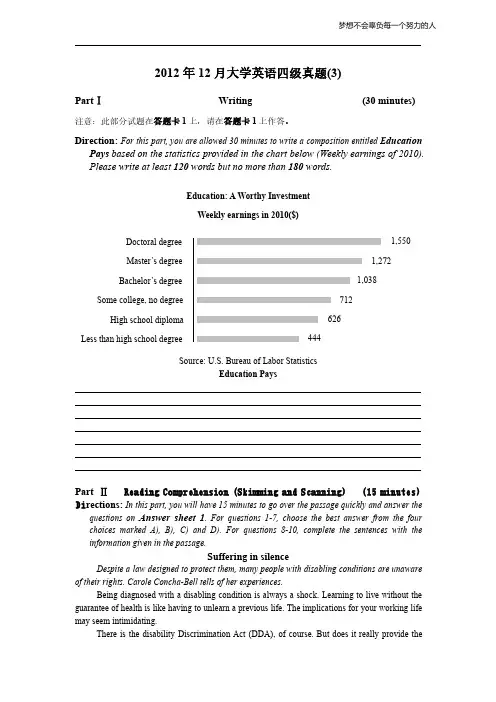
Doctoral degree1,5501,2721,038712626444Master’s degreeBachelor’s degreeSome college,no degreeHigh school diplomaLess than high school degree 2012年12月大学英语四级真题(3)Part ⅠWriting (30minutes)注意:此部分试题在答题卡1上,请在答题卡1上作答。
Direction:For this part,you are allowed 30minutes to write a composition entitled E ducation Pays based on the statistics provided in the chart below (Weekly earnings of 2010).Please write at least 120words but no more than 180words.Education:A Worthy InvestmentWeekly earnings in 2010($)Source:U.S.Bureau of Labor StatisticsEducation PaysPart ⅡReading Comprehension (Skimming and Scanning)(15minutes)Di rections:In this part,you will have 15minutes to go over the passage quickly and answer the questions on Answer sheet 1.For questions 1-7,choose the best answer from the four choices marked A),B),C)and D).For questions 8-10,complete the sentences with the information given in the passage.Suffering in silenceDespite a law designed to protect them,many people with disabling conditions are unaware of their rights.Carole Concha-Bell tells of her experiences.Being diagnosed with a disabling condition is always a shock.Learning to live without the guarantee of health is like having to unlearn a previous life.The implications for your working life may seem intimidating.There is the disability Discrimination Act (DDA),of course.But does it really provide theprotection in the workplace that parliament intended?Are employers merely paying lip service to the DDA?Or are they even aware of an employer’s legal duties and responsibilities?In my experience,it is the latter.I have received little support from employers to whom I have revealed my condition.This has often left me feeling at a disadvantage and wondering why I bothered doing so in the first place.I had been struggling with illness long before I was diagnosed.In practical terms the diagnosis did little to aid me.Of course,it enabled me to understand my body,my limitations and set me on a course to stabilize my symptoms.But it brought a new dilemma.Where I had previously struggled to work while ill,ignorant of why my body was misbehaving,I now had a name for my daily struggle:Lupus(狼疮).This is a chronic(慢性的),auto-immune disorder that can affect virtually any system in the body.It also leaves a huge,dark question hanging over my head when seeking employment:should I tell my employers I have a condition?It is a dilemma that continues to be a root cause of anxiety both for myself and for thousands of other UK employees.The rocky road to my unfortunate enlightenment about work and disability began just after graduation when I’d set my sights on a career in communications and landed my dream job with a respected public relations consultancy(咨询公司)in Bristol.But while I was learning the art of media relations,my body wasn’t quite making it in health terms.I often went to work with swollen limbs and fevers.At my first and last performance review,my boss was amazed that, despite my many capabilities,I hadn’t quite taken control of my responsibilities.A few months later,my contract wasn’t renewed and I plunged further into new depths of ill health.However,I was determined not to be beaten and returned to the interview trail.My next job was in publishing.But despite a shining performance at the interview,I felt like a fraud.How long would it be before I sank into ill health and depression again?The job was to end with a monumental bang when I became so poorly I could no longer function.A few feverish weeks in bed ended in a specialist appointment,where I was diagnosed with Lupus and rushed into hospital for fear that it may have attacked my internal organs.The next12months were filled with confusion.I had no idea about benefits,felt alienated (被视为另类)by the medical establishment and lived off my savings until I was broke.I realized I needed help from my family and moved to London.As soon as I felt better,I marched into a marketing recruitment consultancy and,within10 minutes,I had impressed the interviewer enough to be offered a job with the agency.We agreed on a decent salary and I told him had arthritis(关节炎)and would need to work a four-day week.Things went well at the start but soon the client meetings began to fall on my day off,and I rarely left the office on time.I began to slip both in health and professional terms.The10-hour days crashed around my head;no amount of make-up could disguise my ill health as I battled against the odds to prove to myself that I cold still make it in the business world.I often cried on the bus on the way back from work.Not long before my contract was due to be made permanent,I was called to the boss’s office and given the“talk”abut how my performance was slipping,how awful I looked.I felt too weak to fight back and agreed to leave.No attempts to offer adjustments to my job,such as being able to work from home,were ever made.I had a case for unfair dismissal under the DDA,but was ignorant of this at the time.An estimated10million people in UK,or17%of the population,qualify for disability statusunder the DDA.I have encountered a number of them:the liver-diseased boss;the co-worker with a heart condition;and my asthmatic(哮喘的)trainee-teacher friend.None had disclosed(透露) their conditions to employers,and all were feeling the strain of not doing so.To access your rights under the DDA and to request“reasonable adjustments”to your working conditions or your workplace requires disclosure.I had warned my former employer about my condition but it served little purpose.They were ignorant about their obligations to their disabled staff.However,there are plenty of forward-thinking organizations that have inclusive recruitment policies;are more likely to employ a worker with a disability;and are more aware of their legal duties.The public sector out-performs the private,but not always the voluntary,according to studies for the Disabilities Rights Commission.I decided to give the voluntary sector a go and was surprised to be offered flexible working conditions and other solutions to meet my needs as an employee.But given the choice,I would still prefer a career in the private sector,which for me is more dynamic,has more attractive salaries and offers better prospects than the voluntary or public sectors.Despite the advances of the DDA,there will always be an army of workers who will soldier on,maybe aware of their rights but choosing to remain silent for personal reasons.It is important, though,to recognize the significance of the act,the protection it affords and the obligations that employers have to us as employees and as human beings.注意:此部分试题请在答题卡1上作答。
2012年12月大学英语四级真题试卷(第2套)

2012年12月大学英语四级真题试卷(第2套)Part I Writing (30 minutes)1.For this part, you are allowed 30 minutes to write a short essay entitled Education Pays based on the statistics provided in the chart below (Unemployment rate in 2010). Please give a brief description of the chart first and then make comments on it. You should write at least 120 words but no more than 180 words.Education PaysPart II Reading Comprehension (Skimming and Scanning) (15 minutes) Directions: In this part, you will have 15 minutes to go over the passage quickly and answer the questions attached to the passage. For questions 1-7, mark:Y (for YES) if the statement agrees with the information given in the passage; N (for NO) if the statement contradicts the information given in the passage; NG (for NOT GIVEN) if the information is not given in the passage.Should Sugar Be Regulated like Alcohol and Tobacco?Sugar poses enough health risks that it should be considered a controlled substance just like alcohol and tobacco, argue a team of researchers from the University of California, San Francisco (UCSF).In an opinion piece called "The Toxic (毒性的) Truth About Sugar"published Feb. 1 in Nature, Robert Lustig, Laura Schmidt and Claire Brindis argue that it's wrong to consider sugar just " empty calories. " They write: " There is nothing empty about these calories. A growing body of scientific evidence is showing that fructose (果糖) can trigger processes that lead to liver toxicity and a host of other chronic diseases. A little is not a problem, but a lot kills—slowly. "Almost everyone's heard of—or personally experienced—the well-known sugar high, so perhaps the comparison between sugar and alcohol or tobacco shouldn't come as a surprise. But it's doubtful that Americans will look favorably upon regulating their favorite vice. We're a nation that's sweet on sugar: the average US adult downs 22 teaspoons of sugar a day, according to the American Heart Association, and surveys have found that teens swallow 34 teaspoons.To counter our consumption, the authors advocate taxing sugary foods and controlling sales to kids under 17. Already, 17% of US children and teens are obese (肥胖的), and across the world the sugar intake (摄入) has increased three times in the past 50 years. The increase has helped create a global obesity plague that contributes to 35 million annual deaths worldwide fromnoninfectious diseases including cancer, heart disease and diabetes. Linda Matzigkeit, a senior vice president at Children's Healthcare, said " We have to do something about this or our country is in danger. It's not good if your state has the second-highest obesity rate. Obese children turn into obese adults. "" There are good calories and bad calories, just as there are good fats and bad fats, good amino acids (氨基酸) and bad amino acids," Lustig, director of the Weight Assessment for Teen and Child Health program at UCSF, said in a statement. "But sugar is toxic beyond its calories. "The food industry tries to imply that " a calorie is a calorie," says Kelly Brownell, director of the Rudd Center for Food Policy and Obesity at Yale University. " But this and other research suggests there is something different about sugar," says Brownell.The UCSF report emphasizes the metabolic (新陈代谢的) effects of sugar. Excess sugar can alter metabolism, raise blood pressure, affect the signaling of hormones and damage the liver—outcomes that sound suspiciously similar to what can happen after a person drinks too much alcohol. Schmidt, co-chair of UCSF's Community Engagement and Health Policy program, noted on CNN: " When you think about it, this actually makes a lot of sense. Alcohol, after all, is simply made from sugar. Where does vodka come from? Sugar. "But there are also other areas of impact that researchers have investigated: the effect of sugar on the brain and how liquid calories are interpreted differently by the body than solids. Research has suggested that sugar activates the same reward pathways in the brain as traditional drugs of abuse like morphine or heroin. No one is claiming the effect of sugar is quite that strong, but, says Brownell, " it helps confirm what people tell you sometimes, that they hunger for sugar and have withdrawal symptoms when they stop eating it. "There's also something particularly tricky about sugary drinks. " When calories come in liquids, the body doesn't feel as full," says Brownell. " People are getting more of their calories than ever before from sugared drinks. "Other countries, including France, Greece and Denmark, impose soda taxes, and the concept is being considered in at least 20 US cities and states. Last summer, Philadelphia came close to passing a 2-cents-per-ounce soda tax. The Rudd Center has been a strong advocate of a more modest 1 -cent-per-ounce tax. But at least one study, from 2010, has raised doubts that soda taxes would result in significant weight loss: apparently people who are determined to eat—and drink—unhealthily will find ways to do it. Teens—no surprise—are good at finding ways to get the things they can't have, so state policies banning all sugar-sweetened drinks from public schools and providing only water, milk or 100% fruit juices haven't had the intended effect of steering kids away from drinking sugared drinks: the average teen consumes about 300 calories per day—that's nearly 15% of his daily calories—in sweetened drinks, and the food and drink industry is only too happy to feed this need.Ultimately, regulating sugar will prove particularly tricky because it goes beyond health concerns; sugar, for so many people, is love. A plate of cut-up vegetables just doesn't pack the same emotional punch as a tin of home-made chocolate chip cookies (饼干) , which is why I took my daughter out for a cupcake and not an apple as an after-school treat today. We don't do that regularly—it's the first time this school year, actually—and that's what made it special. As a society, could we ever reach the point where we'd think apples—not a cupcake—are something to get excited over? Says Brindis, one of the report's authors and director of UCSF's Philip R. Lee Institute for Health Policy Studies: " We recognize that there are cultural and celebratory aspectsof sugar. Changing these patterns is very complicated. "For inroads (进展) to be made, say the authors in their statement, people have to be better educated about the hazards of sugar and agree that something's got to change:Many of the interventions (干预) that have reduced alcohol and tobacco consumption can be models for addressing the sugar problem, such as imposing special sales taxes, controlling access, and tightening licensing requirements on vending machines (自动售货机) and snack-bars that sell high sugar products in schools and workplaces." We're not talking prohibition," Schmidt said. " We're not advocating a major imposition of the government into people's lives. We're talking about gentle ways to make sugar consumption slightly less convenient, thereby moving people away from the concentrated dose. What we want is to actually increase people's choices by making foods that aren't loaded with sugar comparatively easier and cheaper to get. "2.Why do some researchers think sugar should be considered "a controlled substance" ?A.It contains nothing but empty calories. B.It is as harmful as morphine and heroin. C.It works the same way as alcohol and tobacco in the human body. D.Excessive intake of sugar results in liver toxicity and various diseases,3.What might be Americans' attitude towards government regulation of sugar consumption? A.Ehusiastic. B.Indifferent. C.Disapproving. D.Supportive.4.What is a consequence of excessive sugar intake worldwide?A.It contributes to 35 million noninfectious disease-related deaths a year. B.It has increased the death toll nearly three times in the past 50 years. C.It contributes to the rise of prices of sugar and sugary foods. D.It has increased the global obesity rate to some 17 percent.5.The food industry tries to relieve the public worry about sugar intake by suggesting that______.A.sugar is no more than a source of energy B.sugar is not harmful like alcohol or tobacco C.the hazard of sugar to the body is exaggerated D.the consumption of sugar is easily controllable 6.According to Brownell, liquid sugar______.A.is especially attractive to young children B.is much easier and quicker to absorb than solid sugar C.effectively stimulates people's appetite D.increases your calorie intake without your knowing it7.What does the author think of the practice of imposing sugar taxes?A.It will harm the food and drink industry. B.It is unlikely to yield the intended effect. C.It is likely to alter people's eating habits. D.It can steer kids away from sugary foods. 8.Regulating sugar will prove tricky because______.A.people consume sugar in large quantities B.nothing has been found to replace sugar C.sugar may convey a sense of love D.many foods will become tasteless9.In order to reduce sugar consumption, education should be conducted to raise people's awareness of its______.10.To address the sugar problem, the author suggests that the licensing requirements on vending machines and snack-bars selling high sugar products be______.11. A gentle way to steer people away from sugar is to make inexpensive, low-sugar foods______.Part III Listening Comprehension (35 minutes)Section ADirections: In this section, you will hear 8 short conversations and 2 long conversations. At the end of each conversation, one or more questions will be asked about what was said. Both the conversation and the questions will be spoken only once. After each question there will be a pause. During the pause, you must read the four choices marked A, B, C and D, and decide which is the best answer.12.A.Find a shortcut to the park. B.Buy some roses from the market. C.Plant trees in the east end of town. D.Go to the park to enjoy the flowers.13.A.She has been invited to give a talk. B.She is going to meet the man at 9:30. C.She cannot attend the presentation. D.She cannot work because of her toothache.14.A.He is a very successful businessman. B.He has changed his business strategy. C.He is making plans to expand his operation. D.He was twenty when he took over the company. 15.A.She has every confidence in Susan. B.She has not read the news on the Net. C.She is a little bit surprised at the news. D.She is not as bright and diligent as Susan.16.A.It is more comfortable and convenient to take a bus. B.It is worth the money taking a train to Miami. C.It is not always cheaper going by bus. D.It is faster to go to Miami by train. 17.A.Antiques can improve their image. B.Preservation of antiques is important. C.The old furniture should be replaced. D.They should move into a new office.18.A.All roads were closed because of the flood. B.The man stayed at the lab the whole night. C.The man got home late due to the storm. D.The storm continued until midnight. 19.A.Many children feel bored when left alone. B.The woman's sons might enjoy team sports. C.The woman's kids can play soccer with his son. D.Children should play sports at least once a week.20.A.Make phone calls to promote sales. B.Arrange business negotiations. C.Handle complaints from customers. D.Take orders over the phone.21.A.They had different business strategies. B.Customers often mistook one for the other. C.Conflicts between them could not be properly solved. D.Customers' questions could not be answered on the same day.22.A.They each take a week. B.They like to spend it together. C.They have to take it by turns. D.They are given two weeks each.23.A.At a road crossing. B.Outside a police station. C.Near a school. D.In front of a kindergarten.24.A.He drove too fast to read it. B.He did not notice it. C.It says 45 miles an hour. D.It is not clearly visible.25.A.It should have been renewed two months ago. B.It actually belongs to somebody else. C.It is no longer valid. D.It is not genuine.26.A.He got a ticket. B.He was fined $35. C.He had his driver's license canceled. D.He had to do two weeks' community service.Section BDirections: In this section, you will hear 3 short passages. At the end of each passage, you will hear some questions. Both the passage and the questions will be spoken only once. After you hear a question, you must choose the best answer from the four choices marked A, B, C and D.27.A.A package of ideas formally presented. B.A short presentation clearly delivered. C.A natural and spontaneous style of speech. D.A clever use of visual aids in presentation.28.A.The skillful use of gestures and facial expressions. B.Differences in style between writing and speaking. C.Different preferences of audiences. D.The importance of preparation. 29.A.The differences between American and Asian cultures. B.The significance of cross-cultural communication. C.The increasing importance of public speaking. D.The key to becoming a good speaker.30.A.By comparing his performance with others'. B.By being repeatedly corrected by adults. C.By observing what their teachers do. D.By being given constant praise.31.A.The best students are usually smart by nature. B.It is only natural for children to make errors. C.Children cannot detect their own mistakes. D.All children should have equal opportunities.32.A.It is favorable to knowledge accumulation. B.It is beneficial to independent children. C.It is unhealthy to students' upbringing. D.It is unhelpful to students' learning. 33.A.They care more about an item's price than its use. B.They grab whatever they think is a good bargain. C.They become excited as if they had never been there. D.They behave as if their memories have failed totally.34.A.Those with a VIP card. B.Those with 15 items or less. C.Those needing assistance. D.Those paying in cash.35.A.Go back and pick up more items. B.Take out some unwanted purchases. C.Change the items they have picked up. D.Calculate the total cost of the groceries.36.A.It calls for carefulness. B.It requires tolerance. C.It needs a good knowledge of math. D.It involves communication skills.Section CDirections: In this section, you will hear a passage three times. When the passage is read for the first time, you should listen carefully for its general idea. When the passage is read for the second time, you are required to fill in the blanks numbered from 36 to 43 with the exact words you have just heard. For blanks numbered from 44 to 46 you are required to fill in the missing information. For these blanks, you can either use the exact words you have just heard or write down the main points in your own words. Finally, when the passage is read for the third time, you should check what you have written.Time is, for the average American, of utmost importance. To the【B1】______visitor, Americans seem to be more concerned with getting things【B2】______on time (according to a predetermined schedule) than they are with developing deep【B3】______relations. Schedules, for the American, are meant to be planned and then followed in the smallest【B4】______.It may seem to you that most Americans are completely【B5】______by the little machines they wear on their wrists, cutting their discussions off【B6】______to make it to their next appointment on time.Americans' language is filled with【B7】______ to time, giving a clear【B8】______of how much it is valued. Time is something to be "on," to be "kept," "filled," "saved," "wasted," "gained," "planned," "given," "made the most of," even "killed. "The international visitor soon learns that【B9】______.Time is so valued in America because by considering time to be important one can clearly achieve more than if one "wastes" time and doesn't keep busy. This philosophy has proven its worth.【B10】______. Many American proverbs (谚语) stress the value of guarding time, using it wisely and setting and working toward specific goals.【B11】______.38.【B2】39.【B3】40.【B4】41.【B5】42.【B6】43.【B7】44.【B8】45.【B9】46.【B10】47.【B11】Part IV Reading Comprehension (Reading in Depth) (25 minutes)Section ADirections: In this section, there is a passage with ten blanks. You are required to select one word for each blank from a list of choices given in a word bank following the passage. Read the passage through carefully before making your choices. Each choice in the bank is identified by a letter. Please mark the corresponding letter for each item with a single line through the center. You may not use any of the words in the bank more than once.When Carly Fiorina became Hewlett-Packard's first female chief executive officer, the existence of her househusband, Frank Fiorina, who had retired early from AT&T to support her career, was a mini-sensation (小轰动); now this arrangement isn't【S1】______at all. Seven of the 18 women who are【S2】______CEOs of Fortune 500 companies—including Xerox's Ursula Burns and PepsiCo's Indra Nooyi—have, or at some point have had, a stay-at-home husband. So do scores of【S3】______CEOs of smaller companies and women in other senior executive jobs.This role change is【S4】______more and more as women edge past men at work. Women now【S5】______a majority of jobs in the US, including 51.4 percent of managerial and professional【S6】______, according to US Census Bureau data. Some 23 percent of wives now earn more than their husbands. And this earnings trend is more dramatic among younger people. Women 30 and under make more money, on【S7】______, than their male counterparts (年龄相当的人) in many large cities in the US.During the recent【S8】______, three men lost their jobs for every woman. Many unemployed fathers have ended up caring for their children full-time while their wives are the【S9】______wage earners. The number of men in the US who【S10】______care for children under age five increased to 32 percent in 2010 from 19 percent in 1988, according to Census figures.A) appealing I) occupationsB) average J) occurringC) conflict K) positionsD) currently L) primaryE) elementary M) recessionF) ensure N) regularlyG) female O) unusualH) fill48.【S1】49.【S2】51.【S4】52.【S5】53.【S6】54.【S7】55.【S8】56.【S9】57.【S10】Section BDirections: There are 2 passages in this section. Each passage is followed by some questions or unfinished statements. For each of them there are four choices marked A, B, C and D. You should decide on the best choice.I've worked in the factories surrounding my hometown every summer since I graduated from high school, but making the transition (转变) between school and full-time blue-collar work during the break never gets any easier. For a student like me who considers any class before noon to be uncivilized, getting to a factory by 6 o'clock each morning is torture. My friends never seem to understand why I'm so relieved to be back at school or that my summer vacation has been anything but a vacation.There're few people as self-confident as a college student who has never been out in the real world. People my age always seem to overestimate the value of their time and knowledge. In fact, all the classes did not prepare me for my battles with the machine I ran in the plant, which would jam whenever I absent-mindedly put in a part backward or upside down.The most stressful thing about blue-collar life is knowing your job could disappear overnight. Issues like downsizing (裁员) and overseas relocation had always seemed distant to me until my co-workers told me that the unit I was working in would shut down within six months and move to Mexico, where people would work for 60 cents an hour.After working 12-hour shifts in a factory, the other options have become only too clear. When I'm back at the university, skipping classes and turning in lazy re-writes seems too irresponsible after seeing what I would be doing without school. All the advice and public-service announcements about the value of an education that used to sound stale now ring true.These lessons I'm learning, however valuable, are always tinged (带有) with a sense of guilt. Many people pass their lives in the places I briefly work, spending 30 years where I spend only two months at a time. "This job pays well, but it's hell on the body," said one co-worker. "Study hard and keep reading," she added.My experiences in the factories have inspired me to make the most of my college years before I enter the real world for good.58.How did the author look back on his summer days while at college?A.They brought him nothing but torture. B.They were no holiday for him at all. C.They were a relief from his hard work at school. D.They offered him a chance to know more people. 59.What does the author say about college students?A.They expect too much from the real world. B.They have little interest in blue-collar life. C.They think too highly of themselves. D.They are confident of their future.60.What, according to the author, is most frustrating for blue-collar workers?A.They do not get decent pay. B.They do not have job security. C.They have to work 12-hourshifts. D.They have to move from place to place.61.In what important way has the author's work experience changed him?A.He learned to be more practical. B.He acquired a sense of urgency. C.He came to respect blue-collar workers. D.He came to appreciate his college education.62.Why does the author feel somewhat guilty?A.He realizes there is a great divide between his life and that of blue-collar workers. B.He looks down upon the mechanical work at the assembly line. C.He has not done much to help his co-workers at the factory. D.He has stayed at school just for the purpose of escaping from the real world.Are people suffering from gadget (小器具) overload? Are they exhausted by the consumer equivalent of the brain fatigue—information overload—that is caused by constant updates of devices and online media?Underwriters Laboratories issued a report last week that found 48% of consumers " feel high-tech manufacturers bring new products to market faster than people need them. "There are two possible explanations. The first, obvious one is that the pace of innovation (创新) is too fast for consumers. The second, less obvious one is that, in fact, innovation is too slow. That is, the new offerings companies are pushing out the door every six months or so are me-too products or ones with just a couple of new features. Marketing schedules, not product innovation, are driving the corporate (公司的) train. Manufacturers in America valued " speed to market" more than in other countries, the report found.Sara Greenstein, Underwriters Laboratories' chief strategy officer, offered her interpretation of the survey results, " Innovation is too fast only if corners are cut. "For the high-tech sector, there are a few other interesting findings. Consumers are less concerned about safety in high-tech products than categories like fresh and processed food. But their top safety concerns are emissions and wireless radio waves. Many people, it seems, are uneasy living in a thickening cloud of radio waves from mobile phone towers and the gadgets they communicate with.A finding that was a bit surprising is that to consumers, the inner parts of high-tech devices do apparently matter. Some 55% of consumers, according to the report, said they are "more concerned about where high-tech components come from than where the product was assembled. "The report doesn't really say how that information would affect consumer buying decisions. It could be complicated. Manufacturing companies on average rely on more than 35 contract suppliers around the world to create a single product. That number would be higher for a smartphone or laptop.But maybe some sort of supply-chain labeling showing where parts come from in a product? "We're working on it," Ms. Greenstein said.63.What is the finding in Underwriters Laboratories' report about many consumers?A.They are exhausted by the information overload. B.They are tired of the constant updating of devices. C.They feel products are updated faster than needed. D.They have difficulty following high-tech innovations.64.What does the author mean by "me-too products"?A.Products with no substantial difference. B.Products tailored to individual users. C.Products everyone is eager to possess. D.Products companies compete to make.65.What do American businesses give priority to when marketing their products?A.The constant updating of their technology. B.The speed of putting them on the market. C.The quality of their new products. D.The pace of product innovation.66.What is the consumers' chief concern about high-tech products?A.User-friendliness. B.Product quality. C.Place of assembly. D.Radio emissions. 67.Why does the author suggest supply-chain labeling?A.It guarantees the safe shipping of products. B.It promotes the competitiveness of the supplier. C.Consumers care about where components are made. D.Consumers tend to buy products they are familiar with.Part V Cloze (15 minutes)Directions: There are 20 blanks in the following passage. For each blank there are four choices marked A, B, C and D. You should choose the ONE that best fits into the passage.Strong emotional bonds between mothers and infants increase children's willingness to explore the world—an effect that has been observed【C1】______the animal kingdom, in people, monkeys and even spiders. The more secure we are in our【C2】______to Mom, the more likely we are to try new things and take risks. Now researchers are discovering that this effect continues into adulthood. A【C3】______reminder of Mom's touch or the sound of her voice on the phone is【C4】______to change people's minds and moods,【C5】______their decision making in measurable ways.In a study【C6】______online in April in Psychological Science, undergraduate business students had to choose between safe bets and risky gambles—a bond with a guaranteed 4 percent yearly【C7】______or a riskier stock option, for example. In half the cases, the experimenters patted the students【C8】______on the back of the shoulder for about one second【C9】______providing verbal (口头的) instructions about the study. Both male and female students who were touched by a female experimenter were【C10】______more likely to choose the risky alternative【C11】______were those who had not been touched or were patted by male experimenters. The reassuring (宽慰的) touch of a woman may have induced early associations,【C12】______the same openness to exploration that is observed in young children of【C13】______mothers, explains Jonathan Levav, a business professor at Columbia University and lead author of the study.To further【C14】______that a woman's touch links feelings of security【C15】______risk taking, the researchers asked a【C16】______group of undergraduates to make financial decisions after a writing exercise. Half of them wrote about a time they felt secure and supported, whereas the【C17】______half wrote about feeling insecure and alone. Evoking (唤起) a【C18】______of insecurity made students in the latter group【C19】______receptive to the gentle shoulder pats from female experimenters and much more willing to take a risk—just as a child leaving for a field trip might steal one last reassuring hug【C20】______Mom before stepping on the bus.68.【C1】A.by B.up C.above D.acrossA.concern B.attachment C.treatment D.appeal70.【C3】A.bare B.unique C.mere D.just71.【C4】A.enough B.ready C.easy D.quick。
2012年12月英语四级考试听力真题及答案

C) Researchers having contributed greatly to psychology. D) Improvements on the classification of human behavior. 34. A) When you feel encouraged by the audience.
B) Working by oneself. C) Learning by doing. D) Using proven methods.
参考答案
26C 27D 28D 29B 30B
31D 32D 33D 34C 35B
Section C
Americans today have different eating habits than they had in the past. There is a wide (36) ______ of food available. They have a broader (37) ______ of nutrition (营养), so they buy more fresh fruit and (38) _______ than ever before. At the same time, Americans (39)______ increasing quantities of sweets and sodas.
B) When you try to figure out a confusing game. C) When you already know how to do something. D) When you complete with other people in a group. 35. A) Practicing constantly.
2012年12月英语四级真题及答案解析

2012年12月英语四级真题答案解析Part I Writing标准版:The above bar chart clearly shows us education pays in 2010. We see that one with higher education background earns more money weekly than those with lower ones. For instance, the college students with no degree get paid$712 per week whereas those with a Bachelor’s degree can earn $1038.Several reasons, in my opinion, can be identified to account for this phenomenon. To begin with, compared with those with comparatively lower education degree, people who have received higher education possess considerably wider knowledge, more remarkable learning and research ability, greater innovation and most of all, resourceful social network, all of which are essential to a high-income work. Also, the higher one’s education degree is, the bigger platform he will have to show his ability. For example, his college, university, or research institute will organize various job fairs for them to communicate face to face with employers.This phenomenon tells us that education is a worthy investment. Therefore, substantial education investment should be strengthened while we, as college students, should study harder to build our country and strive for a better life for ourselves.高分版:Education PaysJudging from the table, we can see that people’s income increases along with their education levels. Above all,the average college graduates earn much more than the typical high-school graduates.The fact revealed by these data is obvious: a degree does bring distinctive financial benefits to its holders. But is it true that a degree alone can ensure a bright future? I don’t think so because, on the one hand, the financial value of high education depends heavily on what skills graduates can gain from it instead of the degree itself. After all, an employer only pays for your ability and performance, not for your certificate. On the other hand, the most valuable bless high education brings to graduates is the ability to learn quickly and efficiently. People received more education tend to keep lifelong learning habits after their graduation, which would help them gain more opportunities in their career path.In conclusion, what accounts for education pays is not the degree alone, but the graduate’s ability and leaning habit.作文B:标准版:Education PaysThe above bar chart clearly shows us education pays in 2010. We see that unemployment rate of those with higher education background is much lower than those with lower education degree. For instance, the unemployment rate of college students with no degree is as high as 14.9% while that of those with doctoral degree is only 1.9%.The followingreason, in my opinion, is the most important one to account for this phenomenon. Compared with those with comparatively lower education degree, people who have received higher education possess considerably wider knowledge, more remarkable learning and research ability, greater innovation and most of all, resourceful social network, all of which make them more qualified and competent for their task. Thus, they are less likely to lose their jobs.This phenomenon tells us that education is a worthy investment. Therefore, education investment should be strengthened while we, as college students, should study harder to avoid unemployment.高分版:Education PaysAs is shown in the table, the unemployment rate decreases steadily as the education level increases. The fact revealed by the statistics is obvious: graduates with a degree are less likely to be unemployed.What has brought about this effect? I believe there are three main reasons. To begin with, the education level is still the top factor that employers would take into account when selecting job candidates. It is believed that people with a college degree tend to be more intelligent and qualified. In addition, as a result of good learning habit formed during college, job hunters with high education background are also more efficient in acquiring and processing job hunting information. Finally, college education equips graduates with specialized skills, leading to greater attachment to the company they are employed and higher possibility to be reemployed even if they leave their previous company.In conclusion, it is the qualifications, learning habit and specialized skills that high education equip a graduate that make one distinctive in labor market.【标准版点评】这次四级作文出了图表题,可能让大家有些意外,但是四六级考察图表作文已经并不是第一次,早在2002年的时候就已经出现过,是图表+提纲的形式,图表反应的是大学生使用计算机的情况。
2012年英语四级阅读真题及答案解析(12月).
2012年英语四级阅读真题及答案解析(12月)Part II (15 minutes)1、根据以下内容,回答1-11题。
The Magician The revolution that Steve Jobs led is only just beginning. When it came to putting on a show,nobody else in the computer industry,or any other industry for that matter,could match Steve Jobs.His product launches,at which he would stand alone on a black stage and produce as if by magic an“incredible”new electronic gadget(小器具)in front of an amazed crowd,were the peril,rmances of a master showman.All computers do is fetch and work with numbers,he once exp lained,but do it fast enough and “the results appear to be magic”.Mr.Jobs,who died recently aged 56,spenthis life packaging that magic into elegantly designed,easy-to-use products. The reaction to his death,with people leaving candles and flowers outside Apple stores and politicians singing praises on the internet,is proof that Mr.Jobs had become something much more significant than just a clever money-maker.He stood out in three ways-as a technologist,as a corporate(公司的)leader and as somebody who was able to make people love what had previously been impersonal,functional gadgets.Strangely,it is this last qualitythat may have the deepest effect on the way people live.The era of personal technology is in many ways just beginning. As a technologist,Mr.Jobs was different because he was not an engineer-and that was his great strength.Instead he was keenly interested in product design and aesthetics(关学),and in making advanced technology simple to use.He repeatedly took an existing but half-formed idea-the mouse-driven computer,the digital musicplayer,the smart phone,the tablet computer(平板电脑)-and showed the rest of the industry how to do it properly.Rival firms competed with each other to follow where he led. In the process he brought about great changes in computing,music,telecoms and the news businessthat were painful for existing firms but welcomed by millions of consumers.Within the wider business world,a man who liked to see himself as fl hippy(嬉皮士),permanently in rev(It against big companies,ended up being hailed by many of those corporate giants as one of the greatest chief executives of his time.That was partly due to his talents:showmanship,strategic vision,an astonishing attention to detailand,a dictatorial management style which many bosses must have envied,But most of all it was the extraordinary trajectory(轨迹)of his life.His fall from grace in the 1980s followed by his return to Apple in l 996 after a period in the wilderness,is an inspiration to any business sperson whose career has taken a turn for the worse.The way in which Mr.Jobs revived the failing company he had co—founded and turned it into the world’s biggest tech firm (bigger even thanBill Gates’sMicrosoft,the company that had outsmarted Apple so-dramatically in the l980s),sounds like something from a Hollywood movie. But what was perhaps most astonishing about Mr.Jobs was the absolute loyalty he managed to inspire in customers.Many Apple users feel themselves to be part of a community,with Mr.Jobs as its leader.And there was indeed a personal link.Apple’s products were designed to accord with the boss,s tastes and to meet his extremely high standards.Every iPhone or MacBook has his fingerprints all over it.H is great achievement was to combine an emotional spark with computer technology,and make the resulting product feel personal.And that is what put Mr.Jobs on the right side of history,as technological innovation(创新)has moved into consumer electronics over the past decade. As our special report in this issue(printed before Mr.Jobs’s death)explains,innovation used to spill over from military and corporate laboratories to the consumer market,but lately this process has gone into reverse.Many people’s homes now have more powerful,and more flexible,devices than their offices do;consumer gadgets and online services are smarter and easier to use than most companies’ systems.Familiar consumer products are being adopted by businesses,government and the armed forces.Companies are employing in.house versions of Facebook and creating their own“app stores”to deliver software to employees.Doctors use tablet computers for their work in hospitals.Meanwhile,the number of consumers hungry for such gadgets continues to swell.Apple’s products are now being snapped up in Delhi and Dalian just as in Dublin and Dallas. Mr.Jobs had a reputation as a control freak(怪人),and hiscritics complained that the products and systems he designed were closed and inflexible,in the name of greater ease of use.Yet he also empowered millions of people by giving them access to cutting-edge technology. His insistence onputting users first,and focusing on elegance and simplicity,has become deep。
2012年12月大学英语四级考试试题

2012年12月大学英语四级考试试题COLLEGE ENGLISH TEST—Band Four —Part II Listening Comprehension (30 minutes)Part II Listening Comprehension (30 minutes)Section ADirections:In this section, you will hear 8 short conversations and 2 long conversations. At the end of each conversation, one or more questions will be asked about what was said. Both the conversation and the questions will be spoken only once. After each question there will be a pause. During the pause, you must read the four choices marked A), B), C) and D), and decide which is the best answer. Then mark the corresponding letter on Answer Sheet 2 with a single line through the centre.1. A) She can count on the man for help.B) She can lend the man a sleeping bag.C) She has other plans for this weekend.D) She has got camping gear for rent.2. A) The man should keep his words.B) Karen can take her to the airport.C) Karen always supports her at work.D) She regrets asking the man for help.3. A) His trip to Hawaii has used up all his money.B) He usually checks his brakes before a trip.C) His trip to Hawaii was not enjoyable.D) He can’t afford to go traveling yet.4. A) There was nothing left except some pie.B) The woman is going to prepare the dinner.C) The man has to find something else to eat.D) Julie has been invited for dinner.5. A) Send Professor Smith a letter.B) Apply to three graduate schools.C) Present a new letter of reference.D) Submit no more than three letters.6. A) He is a professional gardener in town.B) He declines to join the gardening club.C) He prefers to keep his gardening skills to himself.D) He wishes to receive formal training in gardening.7.A) Many people do not appreciate modern art.B) The recent sculpture exhibit was not well organized.C) Modern art cannot express people’s true feelings.D) Sculpture is not a typical form of modern art.8.A) Bob cannot count on her vote.B) She will vote for another candidate.C) Bob does not have much chance to win.D) She knows the right person for the position.Questions 9 to 12 are based on the conversation you have just heard.9. A) Poor management of the hospital.B) The outdated medical testing procedures.C) Decisions made by the head technician.D) The health hazard at her work place.10. A) Cut down her workload.B) Repair the x-ray equipment.C) Transfer her to another department.D) Allow her to go on leave for two months.11.A) They are virtually impossible to enforce.B) Neither is applicable to the woman’s case.C) Their requirements may be difficult to meet.D) Both of them have been subject to criticism.12.A) Organize a mass strike.B) Try to help her get it back.C) Compensate for her loss.D) Find her a better paying job.Questions 13 to 15 are based on the conversation you have just heard.13.A) In the preparatory phase.B) In the concluding part.C) In stating your terms.D) In giving concessions.14.A) He uses lots of gestures to help make his points clear.B) He presents his arguments in a straightforward way.C) He responds readily to the other party’s proposals.D) He behaves in a way contrary to his real intention.15. A) Both can succeed depending on the specific situation.B) The honest type is more effective than the actor type.C) Both may fail when confronting experienced rivals.D) The actor type works better in tough negotiations.Section BPassage OneQuestions 16 to 19 are based on the passage you have just heard.16. A) The weight of the boxes moving across the stage.B) The number of times of repeating the process.C) The size of the objects shown.D) The shape of the cubes used.17. A) Girls seem to start reasoning earlier than boys.B) Girls tend to get excited more easily than boys.C) Boys enjoy playing with cubes more than girls.D) Boys pay more attention to moving objects than girls.18. A) It is a breakthrough in the study of the nerve system.B) Its findings are quite contrary to previous research.C) Its result helps understand babies’language ability.D) It may stimulate scientists to make further studies.19. A) They talk at an earlier age.B) Their bones mature earlier.C) They are better able to adapt to the surroundings.D) The two sides of their brain develop simultaneously.Passage TwoQuestions 20 to 22 are based on the passage you have just heard.20. A) The city’s general budget for the coming year.B) The blueprint for the development of the city.C) The controversy over the new office regulations.D) The new security plan for the municipal building.21. A) Whether the security checks were really necessary.B) Whether the security checks would create long queues at peak hours.C) How to cope with the huge crowds of visitors to the municipal building.D) How to train the newly recruited security guards.22. A) Confrontational. B) Straightforward. C) Ridiculous. D) Irrelevant.Passage ThreeQuestions 23 to 25 are based on the passage you have just heard.23. A) He considers himself a blessed man. C) He used to work as a miner in Nevada.B) He works hard to support his five kids. D) He once taught at a local high school.24. A) To be nearer to Zac’s school. C) To look after her grandchildren.B) To cut their living expenses. D) To help with the household chores.25. A) Skeptical. C) Indifferent. B) Realistic. D) OptimisticSection CDirections: In this section, you will hear a passage three times. When the passage is read for the first time, you should listen carefully for its general idea. When the passage is read for the second time, you are required to fill in the blanks with the exact words you have just heard. Finally, when the passage is read for the third time, you should check what you have written.Mountain climbing is becoming a popular sport, but it is also a (26) ____________ dangerous one. People can fall; they may also become ill. One of the most common dangers to climbers is altitude sickness, which can affect even very (27) ____________ climbers.Altitude sickness usually begins when a climber goes above 8,000 or 9,000 feet. The higher one climbs, the less oxygen there is in the air. When people don’t get enough oxygen, they often begin to (28) ____________. They may also feel (29) ____________. Besides these symptoms of altitude sickness, others such as headache and (30) ____________ may also occur. At heights of over 18,000 feet, people may be climbing in a (31) ____________ daze (恍惚). This state of mind can have an (32) ____________ effect on their judgment.A few (33) ____________ can help most climbers avoid altitude sickness. The first is not to go too high too fast. If you climb to 10,000 feet, stay at that height for a day or two. Your body needs to (34) ____________ a high altitude before you climb to an even higher one. Or if you do climb higher sooner, come back down to a lower height when you sleep. Also, drink plenty of liquids and avoid tobacco and alcohol. When you reach your top height, do light activities rather than sleep too much. You breathe less when you sleep, so you get less (35) ____________.。
2012年12月大学英语四级真题
2012年12月大学英语四级真题Section A11. A) He needs another week for the painting. B) The painting was completed just in time.C) The building won’t open until next week.D) His artistic work has been well received.12. A) Go camping. B) Decorate his house.C) Rent a tent. D) Organize a party.13. A) She talked with Mr. Wright on the phone. B) She is about to call Mr. Wright’s secretary.C) She will see Mr. Wright at lunch time. D) She failed to reach Mr. Wright.14. A) He is actually very hardworking. B) He has difficulty finishing his project.C) He needs to spend more time in the lab. D) He seldom tells the truth about himself.15. A) Rules restricting smoking. B) Ways to quit smoking.C) Smoker s’ health problems.D) Hazards of passive smoking.16. A) He is out of town all morning. B) He is tied up in family matters.C) He has been writing a report. D) He has got meetings to attend.17. A) He is not easy-going. B) He is the speakers’ boss.C) He is not at home this weekend. D) He seldom invites people to his home.18. A) Take a break. B) Refuel his car.C) Ask the way. D) Have a cup of coffee.Questions 19 to 21 are based on the conversation you havejust heard.19. A) They are as good as historical films. B) They give youngsters a thrill.C) They have greatly improved. D) They are better than comics on film.20. A) The effects were very good. B) The acting was just so-so.C) The plot was too complicated. D) The characters were lifelike.21. A) They triumphed ultimately over evil in the battle. B) They played the same role in War of the Worlds.C) They are popular figures among young people. D) They are two leading characters in the film.Questions 22 to 25 are based on the conversation you have just heard.22. A) It is scheduled on Thursday night. B) It is supposed to last nine weeks.C) It takes place once a week. D) It usually starts at six.23. A) To make good use of her spare time in the evening. B) To meet the requirements of her in-service training.C) T o improve her driving skills as quickly as possible. D) To get some basic knowledge about car maintenance.24. A) Participate in group discussions. B) Take turns to make presentations.C) Listen to the teacher’s explanation.D) Answer the teacher’s questions.25. A) Most of them are female. B) Some have a part-time job.C) They plan to buy a new car. D) A few of them are old chaps.Section BPassage OneQuestions 26 to 29 are based on thepassage you have just heard.26. A) She is not good at making friends. B) She is not well off.C) She enjoys company. D) She likes to go to concerts alone.27. A) Their similar social status. B) Their interdependence.C) Their common interest. D) Their identical character.28. A) Invite Pat to a live concert. B) Buy some gifts for Pat’s kids.C) Help take care of Pat’s kids.D) Pay for Pat’s season tickets.29. A) It can develop between people with a big difference in income.B) It can be maintained among people of different age groups.C) It cannot last long without similar family background.D) It cannot be sustained when friends move far apart.Passage TwoQuestions 30 to 32 are based on the passage you have just heard.30. A) Priority of students’ academic achievements.B) Equal education opportunities to all children.C) Social equality between teachers and students. D) Respect for students’ individuality.31. A) Efficient. B) Complicated.C) Lengthy. D) Democratic.32. A) T o help them acquire hands-on experience. B) To try to cut down its operational expenses.C) T o provide part-time jobs for needy students. D) T o enable them to learn to take responsibility.Passage ThreeQuestions 33 to 35 are based on the passage you have just heard.33. A) The best way to work through a finger maze. B) Individuals doing better in front of an audience.C) Researchers having contributed greatly to psychology.D) Improvements on the classification of human behavior.34. A) When you feel encouraged by the audience. B) When you try to figure out a confusing game.C) When you already know how to do something. D) When you complete with other people in a group.35. A) Practicing constantly. B) Working by oneself.C) Learning by doing. D) Using proven methods.Section CAmericans today have different eating habits than they had in the past. There is a wide (36) ______ of food available. They have a broader knowledge of nutrition (营养), so they buy more fresh fruit and (37) _______ than ever before. At the same time, Americans purchase increasing quantities of sweets and sodas. Statistics show that the way people live (38) ______ the way they eat. American lifestyles have changed. There are now (39) ______ people who live alone, single parents and children, and double-income families. These changing lifestyles are (40) ______ for the increasing number of people who must (41) ______ meals or sometimes simply go without them. Many Americans have less time than ever before to (42) ______. Partly as a consequence of this limited time, over half of all American homes now have microwave ovens. Moreover, Americans eat out nearly four times a week on average.It is easy to study the amounts and kinds of food that people consume.The United States Department of Agriculture and the food industry collect sales statistics and (43) ______. This information not only tells us what people are eating, but also tellsus about the changes in (44) ______and tastes. Red meat, which used to be the most popular choice for dinner, is no longer an American (45) ______. Instead, chicken, turkey and fish have become more popular. Sales of these foods have greatly increased in recent years.参考答案:11-15 BADAA 16-20 DBBCA21-25 DCDCA 26-30 BCDAC31-35 DDBCB36selection 37vegetables38 determines 39 growing number of 40 responsible 41 rush42 spend preparing food 43 keep accurate records 44 attitudes 45 favorite。
12月大学英语四级考试真题答案(3)
12月大学英语四级考试真题答案(3)12月大学英语四级考试真题答案(2012)Question 30 to 3230. What does the speaker say American audiences prefer?答案:D. A natural and spontaneous style of speech.31. What should one pay attention to when making an oral presentation?答案: B. Differences in style between writing and speaking.32. What does the speaker focus on in the talk?答案:A. The key to becoming a good speaker.点评:本篇文章重点分析了成为一名优秀的演讲者的关键因素。
欧洲人和亚洲人的演讲风格往往是趋于比较正式的,而美国人的演讲风格是自然、自发、生动地传递表达信息,这也正是听众所喜欢的方式。
同时,做口头报告时应注意写作和口语所要求的风格差异,有了这样的认识后,你才能在今后的演讲中运用简短贴近生活的言语表达自己的想法,形成自己的演讲风格,成为一名优秀的演讲者。
这篇文章相对简单,没有出现太难的生词,较容易理解。
整个内容就围绕一个主题展开,清晰明了,只要能抓住此主题线索,整篇文章的结构就一目了然了。
Passage 3A child learning to talk does not learn by being corrected all the time. If corrected too much, he will stop talking. He compares a thousand times a day the difference between language as he uses it and language as those around him use it. Bit by bit, he makes the necessary changes to make his language like other people’s. In the same way, kids learning to do all the other things they learn without adult teachers, to walk, run, climb, ride a bike, play games, compare their own performance with what more skilled people do, and slowly make the needed changes.But in school we never give a child a chance to detect his mistakes. We do it all for him. We act as if we thought he would never notice a mistake unless it was pointed out to him. Soon he becomes dependent on the expert. We should let him do it himself. Let him figure out, with the help of other children if he wants it, what this word says, what is the answer to that problem, whether this is a good way of saying or doing this or that.If right answers need to be given, as in mathematics or science, give him the answer book. Let him correct his own papers. Why should we teachers waste time on such tedious work? Our job should be to help the children when they tell us that they can’t find the way to get the right answer.Question 33 to 35 are based on the passage you have just heard.Q33 How does a child learn to do something according to the speaker?答案:D. By comparing his performance with others.Q34 What belief do teachers commonly hold according to the speaker?答案:C. Children cannot detect their own mistakes.Q35 What does the speaker imply about the current way of teaching?答案:A. It is unhelpful to students’ learning.点评:本篇文章主要论述要让孩子们学着自己判断事情。
2012年12月大学英语四级考试真题答案解析版范文
2012年12月大学英语四级考试真题答案解析Part I Writing标准版:The above bar chart clearly shows us education pays in 2010. We see that one with higher education background earns more money weekly than those with lower ones. For instance, the college students with no degree get paid$712 per week whereas those with a Bachelor’s degree can earn $1038.Several reasons, in my opinion, can be identified to account for this phenomenon. To begin with, compared with those with comparatively lower education degree, people who have received higher education possess considerably wider knowledge, more remarkable learning and research ability, greater innovation and most of all, resourceful social network, all of which are essential to a high-income work. Also, the higher one’s education degree is, the bigger platform he will have to show his ability. For example, his college, university, or research institute will organize various job fairs for them to communicate face to face with employers.This phenomenon tells us that education is a worthy investment. Therefore, substantial education investment should be strengthened while we, as college students, should study harder to build our country and strive for a better life for ourselves.高分版:Education PaysJudging from the table, we can see t hat people’s income increases along with their education levels. Above all,the average college graduates earn much more than the typical high-school graduates.The fact revealed by these data is obvious: a degree does bring distinctive financial benefits to its holders. But is it true that a degree alone can ensure a bright future? I don’t think so because, on the one hand, the financial value of high education depends heavily on what skills graduates can gain from it instead of the degree itself. After all, an employer only pays for your ability and performance, not for your certificate. On the other hand, the most valuable bless high education brings to graduates is the ability to learn quickly and efficiently. People received more education tend to keep lifelong learning habits after their graduation, which would help them gain more opportunities in their career path.In conclusion, what accounts for education pays is not the degree alone, but the graduate’s ability and leaning habit.作文B:标准版:Education PaysThe above bar chart clearly shows us education pays in 2010. We see that unemployment rate of those with higher education background is much lower than those with lower education degree. For instance, the unemployment rate of college students with no degree is as high as 14.9% while that of those with doctoral degree is only 1.9%.The followingreason, in my opinion, is the most important one to account for this phenomenon. Compared withthose with comparatively lower education degree, people who have received higher education possess considerably wider knowledge, more remarkable learning and research ability, greater innovation and most of all, resourceful social network, all of which make them more qualified and competent for their task. Thus, they are less likely to lose their jobs.This phenomenon tells us that education is a worthy investment. Therefore, education investment should be strengthened while we, as college students, should study harder to avoid unemployment.高分版:Education PaysAs is shown in the table, the unemployment rate decreases steadily as the education level increases. The fact revealed by the statistics is obvious: graduates with a degree are less likely to be unemployed.What has brought about this effect? I believe there are three main reasons. To begin with, the education level is still the top factor that employers would take into account when selecting job candidates. It is believed that people with a college degree tend to be more intelligent and qualified. In addition, as a result of good learning habit formed during college, job hunters with high education background are also more efficient in acquiring and processing job hunting information. Finally, college education equips graduates with specialized skills, leading to greater attachment to the company they are employed and higher possibility to be reemployed even if they leave their previous company.In conclusion, it is the qualifications, learning habit and specialized skills that high education equip a graduate that make one distinctive in labor market.【标准版点评】这次四级作文出了图表题,可能让大家有些意外,但是四六级考察图表作文已经并不是第一次,早在2002年的时候就已经出现过,是图表+提纲的形式,图表反应的是大学生使用计算机的情况。
2012年12月大学英语四级考试真题第一套(答案详解)
2012年12月大学英语四级考试真题第一套Part I Writing【标准版点评】这次四级作文出了图表题,可能让大家有些意外,但是四六级考察图表作文已经并不是第一次,早在2002年的时候就已经出现过,是图表+提纲的形式,图表反应的是大学生使用计算机的情况。
由于备考时大家只是关注近几年的题型,可能没有关注到以往考察过图表作文。
我们在备考作文的时候,一般会从以下几个方面着手准备,如何描述现象、如何分析原因、如何分析影响、如何给出解决措施、如何进行观点论战等。
其实,图表作文也是从这几个方面展开,只是将第一段的描述现象改为描述图表即可。
可见,无论是考察哪种作文题,我们都可以将它转化为我们熟悉的提纲式。
这次作文题目有两个版本。
题目都是Educational Pays(教育回报),一个版本的图表显示的是教育水平越高,收入越高,另一个版本的图表显示的是教育水平越高,失业率越低。
虽然图表描述的具体内容不同,但主题是一致的:教育是值得投资的。
写作思路也是一致的。
两篇范文都是采取三段式的描述方法。
第一段:描述图表。
先一句话引出图表总体内容The above bar chart clearly shows us … 然后具体描述现象We see that…。
最后用for instance引出一些具体数据来例证现象。
第二段:分析原因。
先写一个引出原因的句子,然后具体列举一到两个原因即可。
由于字数限制,原因不必列太多。
第三段:给出建议。
先是总结这个现象This phenomenon tells us that education is a worthy investment.(教育值得投资)。
然后是建议国家增大教育投资,以及个人要努力学习。
这种三段式的写作模式容易掌握,在考场中比较实用,建议大家仿写。
【高分版点评】本次四级作文围绕着同一个话题,education pay(教育回报),出现了两个版本,一个是教育和失业率的关系,另一个是教育和收入的关系。