
工业设计专业英语(第三版)何人可著
专业英语
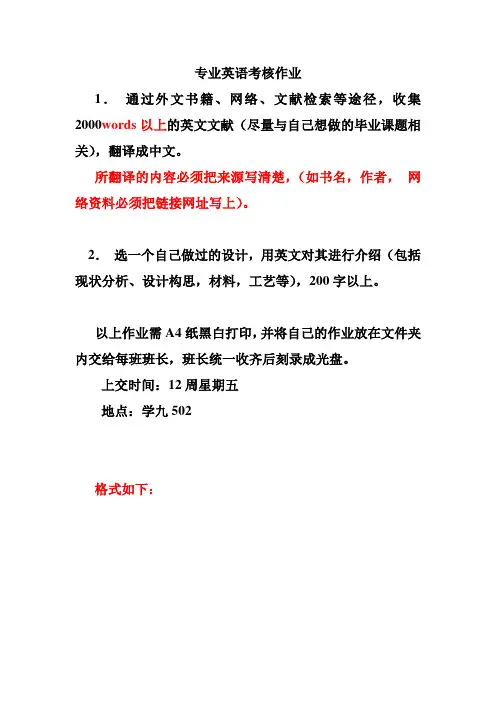
专业英语考核作业1.通过外文书籍、网络、文献检索等途径,收集2000words以上的英文文献(尽量与自己想做的毕业课题相关),翻译成中文。
所翻译的内容必须把来源写清楚,(如书名,作者,网络资料必须把链接网址写上)。
2.选一个自己做过的设计,用英文对其进行介绍(包括现状分析、设计构思,材料,工艺等),200字以上。
以上作业需A4纸黑白打印,并将自己的作业放在文件夹内交给每班班长,班长统一收齐后刻录成光盘。
上交时间:12周星期五地点:学九502格式如下:工业设计专业英语课程作业第一部分:外文翻译姓名:学号:班级:原文:Design for the ElderMartha Stewart文章来源于:(1)网络:/feature/current/articles1033.htm (2)期刊:《Living Magazine》2008(3):36-38(3)书籍:《工业设计专业英语》第2版55-60页作者:何人可The preference to “age in place”—that is to remain in one’s current home rather than relocate to new quarters, a senior community or, if need be, a care facility—takes on greater significance for interior designers when viewed in the light of other demographic trends:According the AARP study,77 percent of Americans age 45 and over(about 59 million)live in single—family residences and 86 percent of Americans age 55 and over(about 45 million)own their home.Between now and 2019,the 75 million baby boomers will turn55,an age at which they are likely to be caring for an aging relative and/or seriously planning for their retirement. In 2011, the first baby boomers will reach the traditional retirement age for 65.At 2025, baby boomers will comprise about 25 percent of the total U.S, population ranging in age from 61 to 79.The aging-in-place phenomenon will be a more dominant force during the first quarter of the 21st century. This will be a period when almost all communities will increase their older populations due to the aging of the huge baby-boom cohorts.Designers mentioned the following features, which enhance access, mobility and ease-of-use without detracting from appearance.Locate the master bedroom and bathroom on the ground floor.Create good traffic flow with few stop—ups or step—downs between rooms.Select furniture that is easy to move and to get in and out of.Reduce the amount of furniture to make it easier to get around.Use smaller kitchen appliances that are more lightweight and easier to grip.Eliminate soft padding under carpet. A hard commercial padding gives a more surefooted surface.Replace basement laundry rooms with smaller washers and dryers that fit into the bathroom or a utility closet.Install an elevator or stair lift.Employ color contrasts as an aid to visual acuity.In addition, the designers we interviewed made these suggestions.Chairs should have high seats and strong unpadded arms to make them easy to sit in and get up from.The quality and quantity of lighting in the design is especially important for persons with vision problems.Avoid installing whirlpools or spas if they are too difficult to get in and out of..Raise the level of toilet seats and place grab bars bear by.Use locks suitable for people with arthritic handsUse paddle handles on doors and faucets in place of knobs.Use rocker light switches.Install walk—in showers without curbs on the shower pan that can accommodate a wheel-chair.According to the National Safety Council (NSC), falls are one of the most common and dangerous health problems for the elderly. NSC reports that falls are the leading cause of injury-related death among those 75 years and older. Almost without exception, alls can be linked to some deficiency in the immediate environment, with improper or inadequate lighting being cited by NSC as the most common element. Other accident-causing culprits that designers should assess are slippery floor surfaces, improper piled or installed carpeting, throw or area rugs, steep or winding stairs, thresholds in doorways and showers, high tub sides, inadequate stair railings roll—away furniture and hard-to-reach areas that require stepping on a platform, such as a ladder.Designers we interviewed also mentioned the following safety measures:slip—resistant bathroom surfaces,increased ambient lighting levels and the use of a brighter color palette,short—pile carpets to prevent tripping,furniture with rounder corners,sensors or other devices that turn lights on automatically.Gain knowledge of the aging process, life stage needs and appropriate products.Help clients plan ahead; they may be young enough presently to overlook special needs later. Counsel them on the possibilities and how they can include features now that will prove more beneficial as they age.Understand the ergonomic needs of the frail or physically impaired.Assess special needs, such as diminished motor skills or mobility, infirmity, disability, a future live—in family member or caregiver.Research the changing needs of people as they age and of caregivers. For instance:Color perception is altered with aging. It is like looking through an amber colored filter. Thus, ambient and task lighting need to be increased. Color contrasts become more important. Color palettes need to adjust for “ambering out”.Upper—arm strength diminishes with age, affecting reach, agility and getting in and out of furniture and bathtubs.Cognitive impairments can affect memory and sense of orientation. Well-organized, easy—to—reach storage facilities and space plans, color-coding and affective use of color can assist recall and prevent injury.Focus on furniture with an eye toward mobility and agilityRemove unnecessary furniture, thereby creating more open space for easier mobility.Eliminate furniture that is too large, too deep, awkward or heavy to move around.Ensure furniture is properly scaled and of the correct firmness to aid in ase of movement. Appropriately scaled furniture will have an approximate seat depth of 20”, a seat height of 18”—20”and an arm height of 24”—25”.Consider furniture such as recliners or swivel chairs that assist mobility or provide additional comfort.Avoid furniture on wheels, which can easily roll away if someone leans against it.Select furniture with rounder edges to avoid bruises or injury from sharp corners.Increase light to aid diminished visionIncrease bulb wattage, if needed. Verify that selected lamps are rated to accommodate higher wattage, Avoid halogen style torchieres or other high heat lighting that could easily tip over and start a fire.Ensure that work areas, such as kitchen counters, sinks and stove tops, are adequately lit and that the lighting does not cast shadows.Arrange furniture and work areas to optimize the use of natural light.Consider floor lamps to increase ambient lighting, brighten dark corners or illuminate areas where table lamps are not feasible.Add remote controls to make it easier to turn lighting on and off.译文:为老年人而设计Martha Stewart对“安老有其所”这个话题,确切的说是留在他们目前的居住场所,而不是搬迁到新宿舍,或者高级社区,即使有需要,也要做好护理设施,当人口年龄趋势发生变化时(人口老龄化)室内设计师具有更重大的意义:根据美国退休人员协会的研究,美国人45岁以上(约5900万)人口中百分之七十七的,生活在单亲家庭的住宅,百分之八十五的55岁以上(约4500万)的美国人拥有自己的家。
工业工程专业英语(推荐5篇)

工业工程专业英语(推荐5篇)第一篇:工业工程专业英语二Real IE Value工业工程的真正价值1、On the other hand,today‟s IE has at his or her disposal more technology and tools than the IE of 30 years ago could have ever imagined.另一方面,现在的工业工程师可以使用许多30年前的同行想都不可能想到的技术和工具。
2、If a person loses sight of the total job and starts looking at the individual pieces,it comes out a little hairy.如果一个人不能对整项工作做全面把握而只是将注意力放在个别的方面,则结果将不会令人满意。
3、Problems associated with renaming IE departments to describe their particular function may have more to do with appearance than with the actual job being performed.将工业工程部重新命名以明确描述其具体职能,其间所出现的问题与其说与实际完成的工作有关倒不如说与问题的表象有关。
4、In fact,even though ABET accredits many IE and IET programs in the United States,there remains much variance and flexibility among each of the programs.【ABET是工程与技术鉴定委员会(the Accreditation Board for Engineering and T echnology)的简写。
南京理工大学(085507)工业设计工程(专业学位)
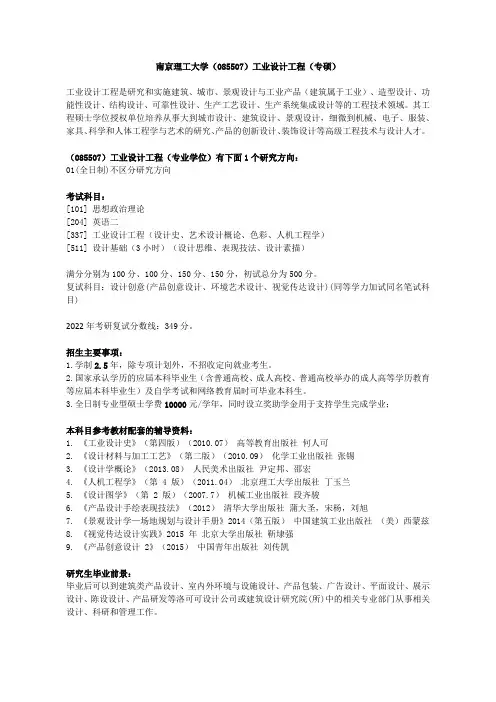
南京理工大学(085507)工业设计工程(专硕)工业设计工程是研究和实施建筑、城市、景观设计与工业产品(建筑属于工业)、造型设计、功能性设计、结构设计、可靠性设计、生产工艺设计、生产系统集成设计等的工程技术领域。
其工程硕士学位授权单位培养从事大到城市设计、建筑设计、景观设计,细微到机械、电子、服装、家具、科学和人体工程学与艺术的研究、产品的创新设计、装饰设计等高级工程技术与设计人才。
(085507)工业设计工程(专业学位)有下面1个研究方向:01(全日制)不区分研究方向考试科目:[101] 思想政治理论[204] 英语二[337] 工业设计工程(设计史、艺术设计概论、色彩、人机工程学)[511] 设计基础(3小时)(设计思维、表现技法、设计素描)满分分别为100分、100分、150分、150分,初试总分为500分。
复试科目:设计创意(产品创意设计、环境艺术设计、视觉传达设计)(同等学力加试同名笔试科目)2022年考研复试分数线:349分。
招生主要事项:1.学制2.5年,除专项计划外,不招收定向就业考生。
2.国家承认学历的应届本科毕业生(含普通高校、成人高校、普通高校举办的成人高等学历教育等应届本科毕业生)及自学考试和网络教育届时可毕业本科生。
3.全日制专业型硕士学费10000元/学年,同时设立奖助学金用于支持学生完成学业;本科目参考教材配套的辅导资料:1.《工业设计史》(第四版)(2010.07)高等教育出版社何人可2.《设计材料与加工工艺》(第二版)(2010.09)化学工业出版社张锡3.《设计学概论》(2013.08)人民美术出版社尹定邦、邵宏4.《人机工程学》(第 4 版)(2011.04)北京理工大学出版社丁玉兰5.《设计图学》(第 2 版)(2007.7)机械工业出版社段齐骏6.《产品设计手绘表现技法》(2012)清华大学出版社蒲大圣,宋杨,刘旭7.《景观设计学—场地规划与设计手册》2014(第五版)中国建筑工业出版社(美)西蒙兹8.《视觉传达设计实践》2015 年北京大学出版社靳埭强9.《产品创意设计 2》(2015)中国青年出版社刘传凯研究生毕业前景:毕业后可以到建筑类产品设计、室内外环境与设施设计、产品包装、广告设计、平面设计、展示设计、陈设设计、产品研发等洛可可设计公司或建筑设计研究院(所)中的相关专业部门从事相关设计、科研和管理工作。
工业设计专业教材
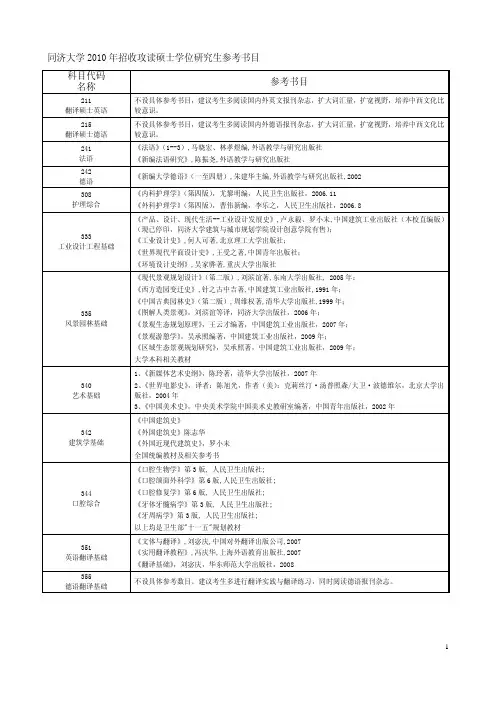
同济大学研究生入学考试参考书目
《城市工程系统规划》,戴慎志,中国建筑工业出版社,1999 《城市给水排水工程规划》,戴慎志,安徽科技出版社,1999 《城市基础设施规划手册》,戴慎志,中国建筑工业出版社,1982 《城市对外交通》,同济大学编,建工出版社,1982 《道路工程》,徐家钰,程家驹,同济大学出版社,1995 《城市道路交通规划设计规范》和讲解材料(GB50220-95),国家技术监督局,建设部 《城市道路与交通规划》(上),徐循初,汤宇卿,建工出版社,2005 《城市规划》、《城市规划学刊》,1995 年后有关论文
《中国文学史》,章培恒、骆玉明主编,复旦大学出版社; 《中国历代文学作品选》(六卷本),朱东润主编,上海古籍出版社
无
622 法学综合一
623 政治学原理
624 社会学理论
625 马克思主义基本原理概论
701 卫生综合
《法理学》(第二版),张文显主编,法侓出版社,2007; 《宪法》(第二版),周叶中主编,高等教育出版社,2005
《普通化学》(第 1 版),同济大学普通化学及无机化学教研室编,高等教育出版社,2004
《中国建筑史》 《外国建筑史》陈志华 《外国近现代建筑史》,罗小未 全国统编教材及相关参考书
《口腔生物学》第 3 版, 人民卫生出版社; 《口腔颌面外科学》第 6 版,人民卫生出版社; 《口腔修复学》第 6 版, 人民卫生出版社; 《牙体牙髓病学》第 3 版, 人民卫生出版社; 《牙周病学》第 3 版, 人民卫生出版社; 以上均是卫生部"十一五"规划教材
大学本科相关教材和主要参考书
参考书目
(1)《地理信息系统概论》(第二版,修订版),黄杏元、马劲松、汤勤编著,高等教育出版社,2002; (2)《地理信息系统教程》(第一版),胡鹏、黄杏元、华一新编著,武汉大学出版社,2002 1《材料力学》, 宋子康、蔡文安编,同济大学出版社,2001 2《结构力学》(上、下册),朱慈勉主编,高等教育出版社,2004 3《结构力学教程》(Ⅰ、Ⅱ部分),龙驭球、包世华主编,高等教育出版社,2000
工业设计专业英语资料
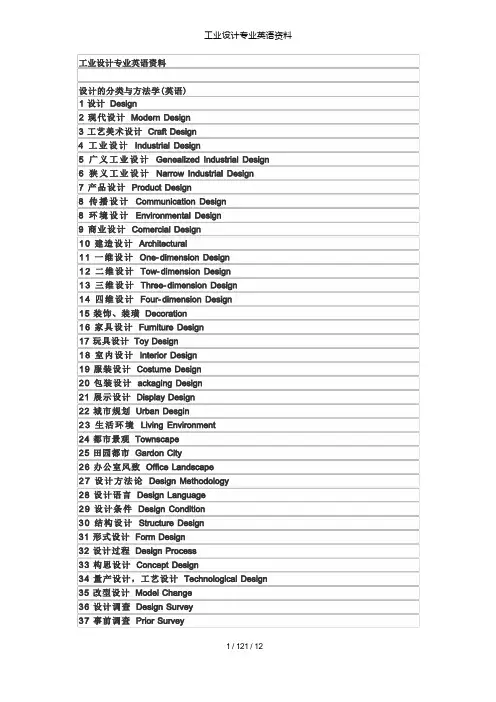
材料与加工成型技术(英)1 材料Material2 材料规划Material Planning3 材料评价Material Appraisal4 金属材料Metal Materials5 无机材料Inorganic Materials6 有机材料Organic Materials7 复合材料Composite Materials8 天然材料Natural Materials9 加工材料Processing Materials10 人造材料Artificial Materials11 黑色金属Ferrous Metal12 有色金属Nonferrous Metal13 轻金属材料Light Metal Materials14 辅助非铁金属材料Byplayer Nonferrous Metal Materials15 高熔点金属材料High Melting Point Metal Materials16 贵金属材料Precions Metal Materials17 辅助非铁金属材料Byplayer Nonferrous Metal Materials18 高熔点金属材料High Melting Point Metal Materials19 贵金属材料Precions Metal Materials20 陶瓷Ceramics21 水泥Cement22 搪瓷、珐琅Enamel23 玻璃Glass24 微晶玻璃Glass Ceramics25 钢化玻璃Tuflite Glass26 感光玻璃Photosensitive Glass27 纤维玻璃Glass Fiber28 耐热玻璃Hear Resisting Glass29 塑料Plastics30 通用塑料Wide Plastics31 工程塑料Engineering Plastics32 热塑性树脂Thermoplastic Resin33 热固性树脂Thermosetting Resin34 橡胶Rubber35 粘接剂Adhesives36 涂料Paints37 树脂Resin38 聚合物Polymer39 聚丙烯树脂Polypropylene40 聚乙烯树脂Polyethylene Resin41 聚苯乙烯树脂Polystyrene Resin42 聚氯乙烯树脂Polyvinyl Chloride Resin43 丙烯酸树脂Methyl Methacrylate Resin44 聚烯胺树脂,尼龙Polyamide Resin45 氟化乙烯树脂Polyfurol Resin46 聚缩醛树脂Polyacetal Resin47 聚碳酸脂树脂Polycarbonate Resin48 聚偏二氯乙烯树脂Polyvinylidene Resin49 聚醋酸乙烯脂树脂Polyvinyl Acetate Resin50 聚烯亚胺树脂Polyimide Resin51 酚醛树脂Phenolic Formaldehyde Resin52 尿素树脂Urea Formaldehyde Resin53 聚酯树脂Polyester Resin54 环痒树脂Epoxy Resin55 烯丙基树脂Allyl Resin56 硅树脂Silicone Resin57 聚氨酯树脂Polyurethane Resin58 密胺Melamine Formaldehyde Resin59 ABS 树脂Acrylonitrile Butadiene Styrene Redin60 感光树脂Photosensition Plastics61 纤维强化树脂Fiber Reinforced Plastic62 印刷油墨Printing Ink63 印刷用纸Printing Paper64 铜板纸Art Paper65 木材Wood66 竹材Bamboo67 树脂装饰板Decorative Sheet68 蜂窝机制板Honey Comb Core Panel69 胶合板Veneer70 曲木Bent Wood71 浸蜡纸Waxed Paper72 青铜Bronge73 薄壳结构Shell Construction74 技术Technic75 工具Tool76 金工Metal Work77 铸造Casting78 切削加工Cutting79 压力加工Plastic Working80 压力加工Plastic Working81 焊接Welding82 板金工Sheetmetal Woek83 马赛克Mosaic84 塑性成型Plastic Working85 灌浆成型Slip Casting86 挤出成型Sqeezing87 注压成型Injection Molding88 加压成型Pressing89 水压成型Cold Isostatic Pressing90 加压烧结法Hot Pressing91 HIP 成型Hot Isostatic Pressing92 压缩成型Compression Molding Pressing93 气压成型Blow Molding94 压延成型Calendering95 转送成型Transfer Molding96 雌雄成型Slash Molding97 铸塑成型Casting98 喷涂成型Spray Up99 层积成型Laminating100 FW 法Fillament Winding101 粘接与剥离Adhesion and Excoriation102 木材工艺Woodcraft103 竹材工艺Bamboo Work104 表面技术Surface Technology105 镀饰Plating106 涂饰Coating107 电化铝Alumite108 烫金Hot Stamping109 预制作Prefabrication110 预制住宅Prefabricated House111 悬臂梁Cantilever112 金属模具Mold113 型板造型Modeling of Teplate114 染料Dyestuff115 颜料Artist Color传播与传媒设计(英)1 传播Communication2 大众传播Mass Communication3 媒体Media4 大众传播媒体Mass Media5 视觉传播Visual Communication6 听觉传播Hearing Communication7 信息Information8 符号Sign9 视觉符号Visual Sign10 图形符号Graphic Symbol11 符号论Semiotic12 象征Symbol13 象征标志Symbol Mark14 音响设计Acoustic Design15 听觉设计Auditory Design16 听觉传播设计Auditory Communication Design17 图象设计Visual Communication Design18 视觉设计Visual Design19 视觉传播设计Visual Communication Design20 图形设计Graphic Design21 编辑设计Editorial Design22 版面设计Layout23 字体设计Lettering24 CI 设计Corporate Identity Design25 宣传Propaganda26 广告Advertising27 广告委托人Adveertiser28 广告代理业Advertising Agency29 广告媒体Advertising Media30 广告目的Avertising Objectives31 广告伦理Morality of Advertising32 广告法规Law of Advertising33 广告计划Advertising Planing34 广告效果Advertising Effect35 广告文案Advertising Copy36 广告摄影Advertising Photography37 说明广告Informative Advertising38 招贴画海报Poster39 招牌Sign-board40 小型宣传册Pamphlet41 大型宣传册Portfolio42 商品目录Catalogue43 企业商报House Organ44 户外广告Outdoor Advertising45 POP 广告Point of Purchase Advertising46 展示Display47 橱窗展示Window Display48 展示柜Cabinet49 博览会Exposition50 万国博览会World Exposition51 包装Packaging52 工业包装Industrial Packing53 标签Label54 企业形象Corporate Image55 企业色Company Color56 动画Animation57 插图Illustration58 书法Calligraphy59 印刷Initial60 设计费design fee61 标准standard62 注册商标registered trade mark设计美学与设计实验(英)1 美Beauty2 现实美Acture Beauty3 自然美Natural Beauty4 社会美Social Beauty5 艺术美Artisitc Beauty6 内容与形式Content and Form7 形式美Formal Beauty8 形式原理Principles and Form9 技术美Beauty of Technology10 机械美Beauty of Machine11 功能美Functional Beauty12 材料美Beauty of Material13 美学Aesthetics14 技术美学Technology Aesthetics15 设计美学Design Aesthetics16 生产美学PAroduction Aesthetics17 商品美学Commodity Aedthetics18 艺术Art19 造型艺术Plastic Arts20 表演艺术Performance Art21 语言艺术Linguistic Art22 综合艺术Synthetic Arts23 实用艺术Practical Art24 时间艺术Time Art25 空间艺术Spatial Art26 时空艺术Time and Spatial Art27 一维艺术One Dimantional28 二维艺术two Dimantional29 三维艺术Three Dimantional30 四维艺术Four Dimantional31 舞台艺术Stagecraft32 影视艺术Arts of Mmovie and Television33 环境艺术Environmental Art34 美术Fine Arts35 戏剧Drama36 文学Literature37 意匠Idea38 图案Pattern39 构思Conception40 构图Composition41 造型Formation42 再现Representation43 表现Expression44 构成Composition45 平面构成Tow Dimentional Composition46 立体构成Three Dimentional Composition47 色采构成Color Composition48 空间构成Composition of Space49 音响构成Composition and Sound50 多样与统一Unity of Multiplicity51 平衡Balance52 对称Symmetry53 调和、和声Harmony54 对照Contrast55 类似Similarity56 比例Proportion57 黄金分割Golden Section58 节奏Rhythm59 旋律Melody60 调子Tone61 变奏Variation62 纹样Pattern63 形态Form64 有机形态Organic Form65 抽象形态Abstract Form66 简化形态Simptified Form67 变形Deformation68 图学Graphics69 透视画法Perspective70 线透视Linear Perspective71 视点Eye on Picture Plane72 灭点Vanishing Point73 平行透视Parallel Persective74 成角透视Angular Perspective75 斜透视Obligue Perspective76 单点透视Single Paint Perdpective77 两点透视Tow-Point Perdpective78 三点透视Three-Point Perdpective79 鸟瞰图Bird's Eye View80 平面视图Ground Plain81 轴侧投影Axonometric Projection82 设计素描Design Sketch83 预想图Rendering84 模型Model85 黏土模型Clay Model86 石膏模型Plaster Model87 木制模型Wooden Model88 缩尺模型Scale Model89 原大模型Mock Up90 仿真模型Finished Model91 创造原形Prototype92 计算机图形学Computer Graphics93 框架模型Frame Model94 实体模型Solid Model95 计算机辅助设计COMPUTER AIDED DESIGN96 计算机辅助创造Computer Aided Manufacture97 计算机三维动画Computer Three Dimentional Animation98 计算机艺术Computer Arts99 计算机书法Computer Calligraphy100 计算机图象处理Computer Image Processing101 计算机音响构成Computer Sound Composition实验心理学与人机工程学1 人类工程学Human Engineering2 人机工程学Man-Machine Engineering3 工效学Ergonomice4 人因工程学Human Factors Engineering5 人因要素Human Factors6 人机系统Man-Machine System7 人体工程学Human Engineering8 人本位设计Human Sstandard Design9 实验心理学Experimental Psychology10 物理心理学Psychophysics11 感觉Sensation12 知觉Perception13 感觉阙限Threshold of Senssation14 心理量表Psychological Scaling15 视觉Visual Perception16 视觉通道Visual Pathway17 听觉Hearing Perception18 肤觉Skin Sensation19 视觉心理学Visual Psychology20 听觉心理学Hearing Psychology21 感光元Photoreceptor Cell22 明视、暗视、间视Phootopic Vision ,Scotopic Vision , Mesopic Vision23 光适应与暗适应Photopic Adaptation and Sscotopic Adaptation24 格式塔,完形Gestalt25 形状知觉Shape Perception26 轮廓Conotour27 主观轮廓Subjictive Contour28 图形与背景Figure and Ground29 图形与背景逆转Reversible Figure30 良好形状法则Prinzip der Guten Gestalt31 群化Grouping32 等质性法则Fsctor of Similarity33 伪装Camouflage34 形状的恒常性Shape Constancy35 大小的恒常性Size Constancy36 空间知觉Space Perception37 立体视Stereopsis38 运动知觉Movement Perception39 视错觉Optical Illusion40 残像After Image41 似动Apparent Movement42 视觉后效Aftereffects in Visuvl43 瀑布效应Waterfall Effect44 视线记录仪Eye Camera45 听觉刺激Auditory St。
工业设计专业英语PDF
Unit O n e Design Fundam entalLesson1 Color Dr awing(1)Markers and colored pencils are ideal for use during the design process as well as for final renderings or drawings.Since much rough drawing and sketch-work is done on thin tracing papers, brush media such as water-color and tempera are unusable,since they will buckle the paper. Makers dry quickly with no buckling and along with colored pencils,can be quickly used on almost any drawing surface.Neither extensive practice nor a high level of skill is necessary with these two color media, since methods are simple and direct.By becoming familiar with the methods you will probably speed your work considerably.For most designers this approach to color is faster and easier to handle than brush media and one with which most students and professionals are to some degree familiar.Many of the advantages and subtleties of water-color and other brush media are attainable with markers and colored pencils.The mingling and graded washes of watercolor and airbrush techniques can be imitated,as can the highlighting achieved with opaque brush media such as casein and tempera.Markers and colored pencils are readily available commercially and are probably the most widely used color media in professional design offices today—more so than the brush media of tempera and watercolor.A variety of marker brands is available at stores that specialize in art or drafting supplies. Choose a marker brand with a full range of colors so that a wide choice is possible.Each of the brands offers between100and200different colors,many of which are variations of a single hue.It pays to use a high-quality colored pencil for this kind drawing.A soft,waxy pencil is preferable to a hard,brittle type,as it produces a more brilliant deposit of color,a necessary characteristic for effecting lighted surfaces on tracing or toned print paper.Whether you are primarily involved with interiors,exteriors,or general color-work, black-line media in a variety of widths are necessary for texturing and outlining.Since technical pens often clog when used over waxy colored pencils,it is best to use felt-tipped and ordinary fountain pens.Of course,other types of line media that you find workable may be substituted for those suggested.The important point is to have a variety of line widths available.As with the line media mentioned above,you will also need a palette of gray markers and colored pencils(including black and white),regardless of the type of color-work you are engaged in.Warm-gray pencils and markers are slightly reddish,while cool and cold-gray markers and pencils are slightly bluish.It is recommended that you obtain both a warm-gray pencil series and a cool gray marker series.With this variety neutral grays and neutralized reductions of color intensity may be mixed when desired.Cool-gray markers also seem to represent exterior windows more believably.If your design work primarily encompasses natural materials and outdoor design as does that of a landscape architect a natural palette of markers and colored pencils is recommended.These colors can be used to draw plant materials,various kinds of woods,bricks,a variety of stone types, and other related materials.Lesson1 Color Dr awing(1)Colored pencil is applied over a marker“base”for any or all of the following reasons:to alter the color of the marker base,to make a surface appear illuminated,or to give the effect of subtle texture with line patterns.If an area of paper is covered with a transparent marker coating,the resultant color will be a blend of the paper color and the marker color.The marker color will appear most brilliant on white paper since a maximum amount of light will reflect from the paper’s surface through the marker coating to the viewer’s eye.On yellow tracing paper the color will appear lighter and more washed out and will change depending on the color of the surface.On toned paper the same marker coating will appear less brilliant,depending on the lightness or darkness of the tone,since less light will reflect from the paper’s surface.Colored pencils leave a semiopaque coating on the paper’s surface.When used very lightly,the paper will still show between the minute spots of pencil deposit,since the pencil has coated only the highest grain of the surfaces.The result is a visual mixture of paper and pencil.When used with more pressure,the pencil will eventually squash the grain and thoroughly coat paper,resulting in a solid,brilliant color.Note,however,that,even when applied with pressure, the resulting pencil color will be partially influenced by the color and tone of the paper beneath it.When light-colored pencils(such as White Flesh,and Light Violet)are used on toned papers,the resulting color seems to glow.This is because the lightness and brilliance of the colors appear even greater in contrast to the dull-toned surface.A similar phenomenon occurs when light-colored pencils are applied to yellow tracing paper and placed over a darker surface.An even greater apparent brilliance is created when the drawing is placed almost parallel to the direction of the light.The use of light-colored pencil over a toned or marker surface is an especially effective way of making a surface appear illuminated.From the above discussion,the effect of colored pencil applied over a marker base should be clear.Light reflects from the colored-pencil deposit,while the marker simultaneously shows through the minute particles.The result is a visual mixture of the two—a third color.The visual mix of separate colors is not new to color work.The neoimpressionist painters placed spots and lines of pure hue in close proximity to one another,thus forming medial mixtures when viewed from even a short distance.New Words1.rendering/rend ri/n.演出之方式;表现效果2.sketch-work/sket-w k/n.草图3.tempera/temp r/n.涂料加蛋黄以使色彩暗晦的画法4.buckle/b kl/n.扣子;弯曲;使变形5.subtlety/s tlti/n.精细;聪明;诡秘6.airbrush/br/n.喷笔7.mingling/mingli/adj.混和的8.casein/keisi n/n.酪蛋白Unit One Design Fundam ental9.drafting/dra fti/n.起草;草拟10.textile/tekstail/n.(织物的)密度;质地;结构11.clog/kl g/vi.阻碍12.felt-tipped/felt-tipt/adj.檀毛;笔尖的13.encompass/in k mp s/vt.围绕;包围14.palette/p lit/n.调色板15.blend/blend/v t.混和16.neoimpressionist/ni uim pre nist/n.新印象派主义者“neo-”前缀,意为“新”17.proximity/pr k simiti/n.接近;近似Phr ases and Expr essions1.tracing paper描图纸2.pay to use充分利用3.be applied to应用于NotesIf your design work primarily encompasses natural materials and outdoor design as does that of a landscape architect a natural palette of markers and colored pencils is recommended.如果你的设计作品主要包括自然材料和象建筑风景这类的户外设计,那么最好用自然色彩的马克笔和色铅来作画。
2 工业设计专业英语第三版 第二课 设计革命 采访对话
Design Revolution:An Interview with Emily Pilloton设计革命:对Emily Pilloton的采访By Allan Chochinov艾伦乔奇诺Allan Chochinov: Welcome Emily! We’re very excited about the new book of course, and wanted to start at the start.How did this project begin?欢迎艾米丽!当然,我们对新书感到非常兴奋,并想从头开始。
这个项目是如何开始的?Emily Pilloton:As has been the case with so much of Project H's growth,it was a story of serendipity.When I launched Project H in January of2008at the age of26,I had big plans,and wanted to push product design to a more humanitarian-driven industry.The idea of writing a book crossed my mind,though I had placed it on my things to do in the next ten years"list.About four months into Project H's existence,I had just returned from South Africa and Uganda,where we had been working on projects with Hippo Roller and the Kutamba AIDS Orphans School,and was giving a lecture during New York design week,at Metropolis’"Make Good and Prosper"confe rence at the ICFF(Figure2-2).艾米丽·皮尔洛顿:就像“H计划”的发展一样,这是一个充满意外的故事。
2020年山东科技大学硕士研究生招生初试部分参考书目
828
综合二
(民法学、刑法学)
①《民法》(第七版),魏振瀛主编,北京大学出版社、高等教育出版社,2017
②《刑法学》(总论部分)(第八版),高明暄、马克昌(执行主编赵秉志),北京大学出版社,2017
704
基础英语
①《高级英语》(修订版)(1-2)张汉熙,外语教学与研究出版社,2010
②《英语写作手册》丁往道,外语教学与研究出版社,2006
③《文体与翻译》刘宓庆,中国对外翻译出版公司,2007
④《大学思辨英语教程—精读(1-4)》孙有中主编,外语教学与研究出版社,2016
841
英语综合
①《语言学教程》(修订版)胡壮麟,北京大学出版社,2002
②《实用英语语言学教程》彭建武等,江苏大学出版社,2009;
③《英国文学史及选读(重排版)》(上、下册)吴伟仁,外语教学与研究出版社,2013
④《美国文学史及选读(重排版)》(上、下册)吴伟仁,外语教学与研究出版社,2013
241
法语
法语,《新大学法语》(1-3册),李治清,高等教育出版社,2011
242
韩语
韩语,《100学时韩国语1、2》,韩国延世大学韩国语学堂编著,世界图书出版公司,2013
821
电路(自动化)
①《电路》(五版)邱关源,罗先觉,高等教育出版社,2006
②《电路学习指导与典型题解》公茂法主编.修订版.北京航空航天版社.2013
825
化工原理
《化工原理》(第二版)夏清,贾绍义,天津大学出版社
822
物理化学
《物理化学简明教程》(第2版),邵谦等编,化学工业出版社,2015
工业设计专业英语翻译1
1、AALTO,ALVAR(1898——1976)Finish architect and designer. Aalto studied architecture at the Polytechnic in Helsinki from 1918 to 1921. He established himself as an architect in 1923,and his Sanatorium at Paimio (1929——1933)is a classic of International Modern architecture. At the same time he began to design plywood chairs,and in 1935 set up a firm,Artek,to market his simple and successful furniture. Some of his plywood is cantilevered like Bauhaus tubular steel,but clearly softer in finish. His furniture was successful in England and in America and prompted other experiments in that direction,notably by Jack Pritchard. From 1937 he designed glass for Iittala,using asymmetrical shapes and subtle curves. Though part of the International Modern movement,Aalto was always sensitive to brick as a material,and he was one of the gentler exponents Modern forms.阿尔瓦尔,阿尔托(1898——1976)芬兰建筑师和设计者。