
最新译林版6B英语 Unit 1 The lion and the mouse 重点词汇句型复习与整理
6下Unit 1 The lion and the mouse一、单词mouse 老鼠large 大的strong 强大的, 强壮的quietly 小声地, 安静地loudly 大声地net 网bite 咬sharp 锋利, 尖的ask 问soon 不久, 很快happily 开心地, 高兴地weak 弱的, 软弱的cheer 欢呼, 加油hit 打, 击ground 地面, 地上deep 深reach 够得着二、词组1. in the forest 在森林里2. very large 很大3. large and strong 又大又强壮4. one day 一天5. walk by 走过6. wake the lion up 吵醒狮子7. be angry 生气8. want to eat the mouse 想吃老鼠9. help you 帮助你10. some day 某一天11. say quietly 小声地说12. so small and weak 这么小而弱13. laugh loudly 大声地笑14. let the mouse go 让老鼠走15. the next day 第二天16. two men 两个男人17. catch the lion with a large net 用一张大网捉住狮子18. bite the net 咬网19. his sharp teeth 他锋利的牙齿20. get out 出去21. ask sadly 伤心地问22. just then 就在那时23. make a big hole 弄了个大洞24. in the net 在网里25. say happily 开心地说26. from then on 从那时起27. become friends 变成朋友28. get out from the net 从网里出来29. help sb. do sth. 帮助某人做某事30. a happy boy 一个开心/幸福的男孩31. talk excitedly 兴奋地交谈32. the sweet shop 糖果店33. want to buy 想要买34. a lollipop 一个棒棒糖35. Aesop’s Fables 伊索寓言36. find many animal stories 找到许多动物故事37. a Chinese idiom book 一本中国成语书38. play table tennis happily 开心地打乒乓39. be good at table tennis 擅长打乒乓40. cheer for them loudly 为他们大声地欢呼41. too excited 太兴奋42. hit the ball hard 用力打球43. find the ball 找到球44. find a hole in the ground 在地上找到一个洞45. in the hole 在洞里46. too deep 太深47. can’t reach it 够不着它48. have an idea 有一个主意49. bring some water quickly很快拿来一些水50. pour it into the hole 把它倒进洞里51. so many balls 这么多球52. go to a shopping centre 去购物中心53. see a small boy 看见一个小男孩54. on the floor 在地板上55. take him to an office 带他去办公室56. give him a sweet 给他一颗糖57. become happy 变得高兴58. like helping people 喜欢帮助人们59. make a study plan 制定一个学习计划60. read quietly 安静地看书61. a weak animal 一个弱小的动物62. a sharp knife 一把锋利的刀63. walk by 走过, 路过64. wake . . . up 吵醒, 叫醒65. some day 某一天66. the next day 第二天67. just then 就在那时68. get out 出来, 出去69. from then on 从那时起70. pour… into把…. . . 倒入三、重点句型1. One day, a mouse walked by and woke the lion up. 一天, 一只老鼠走过, 吵醒了狮子。
2. How can you help me? 你能怎样帮助我呢?3. Then, he let the mouse go. 然后, 他让老鼠走了。
4. The next day, two men caught the lion with a large net. 第二天, 两个人用一张大网抓住了狮子。
5. The lion bit the net with his sharp teeth, but that did not help.狮子用他锋利的牙齿咬那张网, 但是没有用。
6. Just then, the mouse saw the lion. 就在那时, 老鼠看见了狮子。
7. Soon, the mouse made a big hole in the net with his teeth. 很快, 老鼠用他的牙在网上弄了个大洞。
8. The lion got out. 狮子出来了。
9. From then on, the lion and the mouse became friends. 从那时起, 狮子和老鼠变成了朋友。
10. The lion could not get out from the net. 狮子从网里出不来。
11. The mouse helped the lion get out. 老鼠帮助狮子出来了。
12. The lion asked sadly. 狮子伤心地问。
13. The lion laughed loudly. 狮子大声地笑。
14. The mouse said quietly. 老鼠小声地说。
15. The mouse said happily. 老鼠高兴地说。
16. He’s a happy boy. He laughs happily. 他是一个开心的男孩。
他笑得很开心。
17. Here comes the lion. 狮子来了。
18. Who is it for? The boy over there. 它是给谁的? 那边的男孩。
19. What will he say? It doesn’t matter. 他将会说什么? 没关系。
20. Sam and Bobby are playing table tennis happily. 山姆和波比正在高兴地打乒乓。
21. You’re really good at table tennis. 你确实擅长打乒乓。
22. Billy and Willy cheer for them loudly. 比利和维利大声地为他们欢呼。
23. Sam is too excited and he hits the ball hard. 山姆太兴奋了, 他用力地打球。
24. He brings some water quickly and pours it into the hole. 他很快拿来了一些水, 把它倒进了洞里。
四、语法知识一、副词副词一般主要用来修饰动词、形容词和副词。
副词一般放在动词之后。
形容词变成副词的方法:1. 一般直接加ly 如: sad — sadly loud – loudly quiet – quietly2. 以y结尾的, 把y变i, 再加ly 如: happy – happily3. 特殊单词: good – well high – high fast – fast late – late early — early二、动词过去式的不规则变化say – said do – did bite – bit let – let wake – woke五、短文欣赏The fox and the craneThere was a fox in the forest. He was very bad.One day, he was eating a squirrel. Suddenly a bone stuck in his throat. “Oh, a bone is in my throat. ” He went to see a doctor, “Please help me. ”The doctor, Mr. Bear said, “Sorry! I can’t help you. The bone is inside. ”“What can I do?” The fox cried sadly.Just then, a crane came. The fox said to her. “Oh, dear crane. Please help me. A bone is in my throat. I will pay for your help. ”The crane thought a few minutes. She said, “OK. Let me have a try. ” She pulled out the bone. “Now I will go. You should pay me. Remember your words. ” She said happily.“Well. Pay you! I remember!” The fox said quickly. With the words, the fox bit off the crane’s neck and ate her up.crane [ kreɪn ]鹤squirrel [ ˈskwɪrəl] 松鼠suddenly [ ˈsʌdn li ] 忽然地stuck [ stʌk ] 刺(stick 的过去式) bone [ bəʊn ]骨头throat [ θrəʊt ] 咽喉inside [ ˌɪn'saɪd ] 里面的 pay [ peɪ ] for 为…付钱pull [ pʊl ] out 拔出remember [ rɪˈmembə ] 记住。
新译林 6B Unit 1Unit 1 The lion and the mouse ( Story

Q: Why did the lion let the mouse go? Q: What happened to the lion? Q: How did the mouse help the lion?
3. What do you learn from the story? • Sometimes, the strong can be weak. • 再高的人也 有屈身的时 候, • Sometimes, the weak can be strong. • 再矮的人也 有垫脚的时 候。 Everyone is
2.能听懂、会说、会读表示时间顺序的词组: the next day, just then, from then on。 难点: 1.能理解、读并复述故事。 2.能听懂、会说、会读表示时间顺序的词组: the next day, just then, from then on。
3.wake—woke, bite-- bit
Stnd strong lion, the small and weak mouse.
What is the story about?
First, we know who.
What else would you like to know about the story?
教学准备 PPT
教学步骤 教学活动
Step1: Pre-reading 1. T: Look! Can you guess what my hobby is? S: You like reading, I think. T: Yes. I like reading stories. Do you like stories? What stories do you know? S: The king’s new clothes… T: Today we are going to read another interesting story. Look at the picture. Can you tell me the name? S: The lion and the mouse Unit1 The lion and the mouse T: Look at the lion. What do you think of it? Teach: large strong heavy T: But what is the mouse like? Is it large?... Teach: small weak light
译林版,小学英语6BUnit1复习教案
译林版,小学英语6BUnit 1 复习教案一、教学内容1. Story time:复习故事情节,理解故事主题;2. Fun with language:复习与故事相关的词汇和句型;3. Task:通过实践活动,巩固所学知识。
二、教学目标1. 能够听懂、会说、会读、会写故事中的重点词汇和句型;2. 能够理解故事情节,把握故事主题,培养道德观念;3. 能够运用所学知识进行简单的口头表达和书面表达。
三、教学难点与重点1. 教学难点:故事中的一些生词和短语的理解与运用;2. 教学重点:故事情节的理解,词汇和句型的掌握。
四、教具与学具准备1. 教具:PPT、黑板、磁铁、卡片等;2. 学具:课本、练习本、彩色笔等。
五、教学过程1. 导入:通过展示故事图片,引导学生回忆故事情节,激发学习兴趣;2. 新课内容呈现:a. 复习故事情节,引导学生进行角色扮演;b. 复习词汇和句型,通过例句讲解和随堂练习,巩固知识;3. 课堂活动:a. 小组合作,完成Task部分;b. 个人展示,进行口头表达;六、板书设计1. 故事《The lion and the mouse》2. 重点词汇:big, small, strong, weak, help, laugh等;3. 重点句型:The lion is big and strong. The mouse is small and weak.等;4. Task部分:用思维导图展示故事情节。
七、作业设计1. 作业题目:根据故事情节,用英语写一篇短文;2. 答案示例:One day, a lion caught a mouse. The lion wanted to eat the mouse, but the mouse said, "Please don't eat me. If you let me go, I'll help you one day." The lion laughed and let the mouse go. Some time later, the lion got trapped in a net. The mouse heard the lion's roar and came to help. The mouse bit the net and set the lion free. The lion was very grateful to the mouse.八、课后反思及拓展延伸2. 拓展延伸:鼓励学生阅读其他寓言故事,提高英语阅读兴趣和水平。
(完整ppt)译林版牛津英语6B Unit1(1) the lion and the mouse
Words and Phrases
1. mouse 老鼠
复数:mice /mais/
2. large 大的
large常用来表示一个物体的宽度和数量,有广阔和众多的意思 近义词:big 反义词:small
Help! Help! Who can help me?
Thanks! Thanks! You’re really helpful!
Grammar time
adverbs
副词
The mouse said quietly.
So all the animals …
One day, a mouse walked by and woke the lion up. The lion was angry and wanted to eat the mouse.
laughed the lion
You are so small and
Read and feel
The mouse said quietly: The lion laughed loudly: The lion asked sadly: The lion said happily:
Wait! Wait! I can help you!
Ha! Ha! How can it be?
3. strong 强壮的
强风 strong wind 一个壮汉a strong man 反义词:weak 弱的
4. weak 软弱的
稀汤 weakke up 吵醒,叫醒
wake sb up/wake up sb
6BU1学霸笔记(易错易混知识点+经典例题)译林版三起

六下学霸笔记(易错易混知识点+经典例题)Unit 1 The lion and the mouse 班级__________ 姓名 ___________ 学号___________易错易混知识点1. one day/some day(1)one day一般在讲故事时经常会用到,表示的是过去的某一天。
例句:One day, a monkey met a lion.一天,一只猴子遇到了一只狮子。
One day, a mouse woke the lion up.一天,一只老鼠吵醒了狮子。
(2)some day通常指将来某一天。
例句:I can help you some day.将来某一会我会帮你。
I hope I can go to the moon some day.我希望将来某天能到月球上去。
2.wake up 叫醒(某人)(wake过去式:woke)(1) 如果后面跟人名,一般放在wake up后面。
例句:Wake up Mary. It’s time for school. 叫醒玛丽。
该上学了。
(2)如果用人称代词指代某人,一般放在wake up中间。
例句:I want to wake him up. But he is too tired. 我想叫醒他。
但他太累了。
(3)也可以直接说wake up。
例句:Wake up, please! It’s eight o’clock.醒醒。
已经8点了。
3.reallyreally为副词,意为“事实上,真正地,真实地;确实,的确”例句:I really don't want to see you again.我真的再也不想见到你了。
形容词形式:real,意为“真的;真实的;实际的”,用来修饰名词。
) They are real flowers. 它们是真的花。
4.be good atbe good at(doin) sth意为“擅长(做)某事"。
Unit1 The lion and the mouse cartoon(讲义) 英语六年级下册
7.Mr Brown poured the juice into the glass . (quick)8." Don't play football in the street." The policeman shouted at the children . (angry生气)9.I feel ( excite ) about the ( excite ) film.10.Ben is (quiet) in the library.11.【易错】The children laughed (excited).12.We should read in the library. ( quiet )13.Hit the volleyball (hard),please.14.Football is (excite). Everyone is (excite) when he is watching a football match.15.Jim walked __________(quiet) in the classroom.三、翻译1.那个男孩刚才打球打得用力了。
The boy ______ ______ ______ ______ just now.2.这只狮子很生气想要吃那只老鼠。
The lion was ________and _________ to eat the mouse.3.他很快弄来些水,并把它倒进了洞里。
He _______ some water ______ and _____it ______ the hole.4.吉姆乒乓球打得好吗?--Jim table tennis ?5.狮子用他锋利的牙齿咬了网The lion _____ _____ _____ _____his ______ ______.6.你真的善于打乒乓球。
You are _________ _______ _________ _________ table tennis.7.我太激动了。
译林牛津六年级下册-第1讲-6B U1 The lion and the mouse (精英教案)
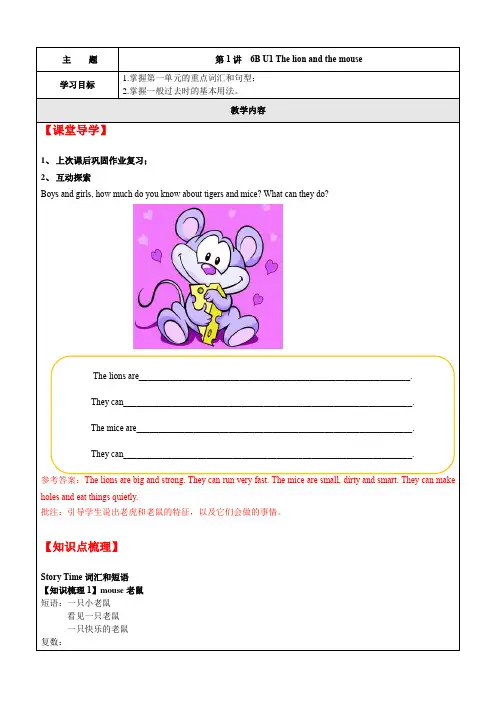
【课堂导学】1、上次课后巩固作业复习;2、互动探索Boys and girls, how much do you know about tigers and mice? What can they do?The lions are______________________________________________________________.They can__________________________________________________________________.The mice are_______________________________________________________________.They can__________________________________________________________________.参考答案:The lions are big and strong. They can run very fast. The mice are small, dirty and smart. They can make holes and eat things quietly.批注:引导学生说出老虎和老鼠的特征,以及它们会做的事情。
【知识点梳理】Story Time词汇和短语【知识梳理1】mouse老鼠短语:一只小老鼠____________________________看见一只老鼠_________________________一只快乐的老鼠__________________________复数:____________答案:a little mouse; see a mouse; a happy mouse; mice【例题精讲】例1. There are a lot of mice on the farm. 在农场上有很多老鼠。
译林版,小学英语6BUnit1复习教案
译林版,小学英语6BUnit 1 复习教案一、教学内容本节课复习译林版小学英语6B Unit 1《The lion and the mouse》的内容。
主要涉及章节为Story time和Fun time,详细内容包括:理解故事情节,掌握故事中的生词和短语,运用一般过去时描述故事发生的事情;复习和巩固一般过去时的用法,通过小组活动,运用目标语言进行交流。
二、教学目标1. 学生能够理解故事内容,并能复述故事情节。
2. 学生能够掌握故事中的生词和短语,如:lion, mouse, fierce, huge, trouble等。
3. 学生能够运用一般过去时描述故事发生的事情,提高语言表达能力。
三、教学难点与重点重点:故事内容的理解,生词和短语的掌握,一般过去时的运用。
难点:如何引导学生运用一般过去时进行描述,以及如何进行有效的课堂交流。
四、教具与学具准备教具:PPT,故事卡片,录音机学具:课本,练习册,彩色笔五、教学过程1. 导入:通过展示故事图片,引导学生回顾故事内容,激活学生已有的知识。
2. 故事复习:教师带领学生一起朗读故事,针对故事中的生词和短语进行讲解,帮助学生巩固记忆。
3. 例题讲解:针对一般过去时,给出例句,解释用法,引导学生进行模仿。
e.g. The lion was sleeping. The mouse woke him up.4. 随堂练习:让学生两人一组,运用一般过去时描述故事中发生的事情。
5. 小组活动:每组选择一个故事情节,用一般过去时进行描述,并进行展示。
六、板书设计1. 故事The lion and the mouse2. 生词和短语:lion, mouse, fierce, huge, trouble等3. 一般过去时的例句:The lion was sleeping. The mouse woke him up.七、作业设计1. 作业题目:请用一般过去时描述一下你昨天做的事情。
2024年译林版,小学英语6BUnit1复习教案
2024年译林版,小学英语6BUnit 1 复习教案一、教学内容1. Story time:理解故事内容,学习故事中的词汇和句型。
2. Fun with language:通过趣味活动,巩固和拓展故事中的词汇和句型。
3. Task:完成与故事相关的任务,提高学生的语言运用能力。
二、教学目标1. 能够听懂、会说、会读、会写故事中的重点词汇和句型。
2. 能够理解故事内容,并进行简单的角色扮演。
3. 能够运用所学知识完成课后作业和拓展活动,提高英语实际运用能力。
三、教学难点与重点1. 教学难点:故事中的人物关系和情节理解,词汇和句型的灵活运用。
2. 教学重点:故事中的重点词汇(如:lion、mouse、scared、kind、noise等)和句型(如:The lion was…,The mouse was…,If you…,I will…等)。
四、教具与学具准备1. 教师准备:故事课件、单词卡片、板书材料。
2. 学生准备:课本、练习本、彩色笔。
五、教学过程1. 导入:通过呈现故事图片,引导学生回顾故事内容,激发学习兴趣。
2. 故事回顾:教师带领学生朗读故事,让学生注意听懂故事内容和模仿语音语调。
3. 词汇和句型学习:通过单词卡片和例句,帮助学生复习和巩固故事中的重点词汇和句型。
4. 实践情景引入:创设情景,让学生进行角色扮演,运用所学词汇和句型进行对话。
5. 例题讲解:针对课后练习,进行讲解和示范。
6. 随堂练习:学生完成课后练习,巩固所学知识。
六、板书设计1. The lion and the mouse2. 重点词汇:lion、mouse、scared、kind、noise等。
3. 重点句型:The lion was…,The mouse was…,If you…,I will…等。
七、作业设计1. 作业题目:(1)抄写故事中的重点词汇和句型。
(2)根据故事内容,完成填空练习。
(3)运用所学知识,编写一个对话。
译林小学英语6B--UNIT1-the-lion-and-the-mouse教案
1.听力和笔试中的重难点及学生易错的题目
2.练习
3.评价订正
Step5. Homework
1.复习U1词汇和句型
2.整理、复习错题
教后记
六年级上册英语教学设计
课题
Unit1 The lion and the mouse
课型
复习
课时
8-6
备课时间
2015-2-28
授课时间
教学目标
复习本单元四会词组
重点难点
复习本单元四会词组
教具准备
PPT
教学过程
二次备课
Step 1 Revision
1. Greetings.
2.听写单词、词组。
1. in the forest在森林里2. walk by走过;路过3. wake up醒,醒来
4. wake sb up把某人叫醒5. be angry with sb对某人生气
Step 3:Presentation
Fun time
a.学生扩充故事并读一读
b.小组表演故事
Grammer time
1.复习五年级学过的副词
2.play games
学生快速说出形容词及副词
3.组词比赛
ask sadly
laugh loudly……
Culture time
学习this is Aesop’s Fables.
6. the next day第二天7. be angry at sth对某事生气
8. want to do sth想要做某事9. want sb to do sth要某人做某事
10. some day某一天11. say quietly小声地说
最新苏教版译林英语6B第一单元
6B Unit 1 The lion and the mouse 知识点一基础知识部分●词组:1. make a study plan 制定一个学习计划2.in the forest 在森林里3. large and strong大而且强壮4. walk by 走过5. wake the lion up吵醒了狮子6. so small and weak 如此小而弱7. one day 有一天8. some day 某一天9. help you 帮助你10. say quietly 悄悄地说11. cry/ask sadly 伤心地问/哭12. laugh loudly 大声笑13. say happily 开心地说14.let the mouse go放了老鼠15. the next day 第二天16. catch the lion with a large net 用一张大网抓住了狮子17. bite the net with his sharp teeth 用他锋利的牙齿咬网18. get out 出来19. just then 就在那时20. make a big hole in the net在网上弄出一个洞21. from then on 从那时起22. become friends 成为朋友23. want to buy a lollipop想要买根棒棒糖24.cheer for them loudly 大声地为他们加油25. play table tennis happily 开心地打乒乓.26. two men 两个人27. be good at table tennis 擅长打乒乓28. too excited 太激动了29. hit the ball hard 用力击球30. find the ball 找到球31. find a hole in the ground 在地上找到一个洞32. too deep 太深33. can’t reach it 够不到34. have an idea 有一个主意(想法)35. bring some water quickly 赶快拿来一些水36. pour the water into the hole 把水倒进洞里37. so many balls 这么多球38. look sad 看起来伤心39. take him to an office 把他带到一间办公室40. become happy 变得开心起来41. It doesn’t matter. 没关系。