
2013年12月大学英语四级考试真题答案解析2套
2013年12月大学英语四级考试真题答案解析(二) Part 1 writing (30 minutes) Directions: For this part, you are allowed 30 minutes to write a short essay based on the picture below. You should start your essay with a brief account of the increasing use of the mobile phone in people’s life and then explain the consequences of overusing it.You should write at least IW words but no more than 180 words.
People are crossing the street looking at their cell phones and using walking sticks in order to see. Part 2 Listening Comprehension (30 minutes) Section A Directions : In this section, you will hear 8 short conversations and 2 long conversations. At the end of each conversation, one or more questions will be asked about what was said. Both the conversation and the questions will be spoken only once. After each question there will be a pause. During the pause, you must read the four choices marked A), B), C) and D), and decide which the best answer is. Then mark the corresponding letter o" Answer Sheet 1 with a single line through the centre.
注意:此部分试题请在答题卡1上作答。 1. A) Go to a place he has visited. C) Consult a travel agent. B) Make her own arrangements. D) Join in a package tour. 2. A) They are on a long trip by car. C) They are used to getting up early. B) They are stuck in a traffic jam. D) They are tired of eating out at night. 3. A) He is a person difficult to deal with. C) He is unwilling to speak in public. B) He dislikes any formal gathering. D) He often keeps a distance from others. 4. A) Work in another department. C) Recruit graduate students. B) Pursue further education. D) Take an administrative job. 5. A) He would not be available to start the job in time. B) He is not quite qualified for the art director position. C) He would like to leave some more time for himself. D) He will get his application letter ready before May 1. 6. A) Cleaner. B) Mechanic. C) Porter. D) Salesman. 7. A) Request one or two roommates to do the cleaning. B) Help Laura with her term paper due this weekend. C) Get Laura to clean the apartment herself this time. D) Ask Laura to put off the cleaning until another week. 8. A) A problem caused by the construction. C) The building project they are working on, B) An accident that occurred on the bridge. D) The public transportation conditions, heard. Questions 9 to 11 are based on the conversation you have just 9. A) To look for a job as a salesperson. C) To place an order for some products. B) To have a talk with Miss Thompson. D) To complain about a faulty appliance. 10. A) The person in charge is not in the office. B) The supplies are out of stock for the moment. C) They failed to reach an agreement on the price. D) The company is re-cataloguing the items. 11. A) 0743, 12536 extension 15. B) 0734, 21653 extension 51. C) 0734, 38750 extension 15. D) 0743,62135 extension 51. Questions 12 to 15 are based on the conversation you have just heard. 12. A) Since he found a girlfriend. C) Since he began to exercise regularly. B) Since he took to heavy smoking. D) Since he started to live on his own. 13. A) He is getting too fat. C) He doesn't eat vegetables. B) He smokes too much. D) He doesn’t look well at all. 14. A) They are overweight for their age. C) They are still in their early twenties. B) They are respectful to their parents. D) They dislike doing physical exercise. 15. A) To quit smoking. C) To find a girlfriend. B) To reduce his weight. D) To follow her advice. Section B Directions : In this section, you will hear 3 short passages. At questions. Both the passage and the questions will be spoken only once. After you hear a question, must choose the best answer from the four choices marked A), B), C) and D). Then mark corresponding letter on Answer Sheet 1 with a single line through the centre.
注意:此部分试题请在答题卡1上作答。 Passage One Questions 16 to 19 are based on the passage you have just heard. 16. A) They have destroyed several small towns. B) They will soon spread to San Francisco. C) They have injured many residents. D) They are burning out of control. 17. A) They have been hospitalized. B) They have got skin problems. C) They were choked by the thick smoke. D) They were poisoned by the burning chemicals.
12月英语四级考试第2套真题试卷及答案

12月英语四级考试第2套真题试卷及答案大学英语四级考试涉及的语法知识点多、涉及面宽,对不少考生来说都是一个难题。
考生要多刷真题巩固练习考点内容,下面小编就跟大家聊聊关于12月英语四级考试第2套真题试卷及答案吧,希望能帮助到大家。
12月英语四级考试真题试卷(完整版第2套)Part I Writing (30 minutes)Directions: For this part, you are allowed 30 minutes to write a short easy on how to besthandle the relationship between teachers and students. You should write at least 120 words but no more than 180 words.________________________________________________________________ ________________________________________________________________________ ________________________________________________________________________ ________Part II Listening Comprehension (25 minutes)听力音频MP3文件,点击进入听力真题页面Section ADirections: In this section, you will hear three news reports. At the end of each newsreport, you will hear two or three questions. Both the news report and the questions willbe spoken only once. After you hear a question, you must choose the best answer fromthe four choices marked A), B), C) and D). Then mark the corresponding letter onAnswer Sheet 1 with a single line through the centre.Questions 1 and 2 are based on the news report you have just heard.1. A) It tries entertain its audience.B) It tries to look into the distance.C) It wants to catch people's attention.D) It has got one of its limbs injured.2. A) It was spotted by animal protection officials.B) It was filmed by a local television reporter.C) Its videos Were posted on social media.D) Its picture won a photography prize.Questions 3 and 4 are based on the news report you have just heard.3. A) The distance travelled.B) The incidence of road accidents.C) The spending on gas.D) The number of people travelling.4. A) Fewer people are commuting.B) Gas consumption is soaring.C) Job growth is slowing down.D) Rush-hour traffic is worsening.Questions 5 to 7 are based on the news report you have just heard.5. A) He told a stranger the sad story about himself.B) He helped a stranger to carry groceries to his car.C) He went up to a stranger and pulled at his sleeves.D) He washed a stranger's car in return for some food.6. A) He ordered a lot of food for his family.B) He gave him a job at his own company.C) He raised a large sum of money for him.D) He offered him a scholarship for college.7. A) He works hard to support his family.B) He is an excellent student at school.C) He is very good at making up stories.D) He has been disabled since boyhood.Section BDirections: In this section, you will hear two long conversations. At the end of eachconversation, you will hear four questions. Both the conversation and the questionswill be spoken only once. After you hear a question, you must choose the best answerfrom the four choices marked A), B), C) and D). Then mark the corresponding letter onAnswer Sheet 1 with a single line through the centre.Questions 8 to 11 are based on the conversation you have just heard.8. A) Attended an economics lecture.B) Taken a walk on Charles Street.C) Had a drink at Queen Victoria.D) Had dinner at a new restaurant.9. A) Treat a college friend to dinner.B) Make preparations for a seminar.C) Attend his brothers birthday party.D) Visit some of his high school friends.10. A) Gather statistics for his lecture.B) Throw a surprise birthday party.C) Meet with Jonathan's friends on the weekend.D) Join him in his brother's birthday celebration.11. A) By car.B) By train.C) By taxi.D) By bus.Questions 12 to 15 are based on the conversation you have just heard.12. A) Taking a vacation abroad.B) Reviewing for his last exam.C) Saving enough money for a rainy day.D) Finding a better way to earn money.13. A) Preparing for his final exams.B) Negotiating with his boss for a raise.C) Working part time as a waiter.D) Helping the woman with her courses.14. A) Finish her term paper.B) Save enough money.C) Learn a little bit of Spanish.D) Ask her parent's permission.15. A) He has rich sailing experience.B) He speaks Spanish fluently.C) He is also eager to go to Spain.D) He is easy to get along with.Section CDirections: In this section, you will hear three passages. At the end of each passage, you will hear three or four questions. Both the passage and the questions will be spokenonly once. After you hear a question, you must choose the best answer from the fourchoices marked A), B), C) and D). Then mark the corresponding letter on Answer Sheet 1 with a single line through the centre.Questions 16 to 18 are based on the passage you have just heard.16. A) She went to the same university as her mother.B) She worked as a nurse in the First World War.C) She won the Nobel Prize two times.D) She was also a Nobel Prize winner.17. A) She fought bravely in a series of military operations.B) She developed X-ray facilities for military hospitals.C) She helped to set up several military hospitals.D) She made donations to save wounded soldiers.18. A) Both died of blood cancer.B) Both fought in World War I.C) Both won military medals.D) Both married their assistants.Questions 19 to 21 are based on the passage you have just heard.19. A) They were the first settlers in Europe.B) They were the conquerors of Norway.C) They discovered Iceland in the ninth century.D) They settled on a small island north of England.20. A) It was some five hundred miles west of Norway.B) It was covered with green most time of the year.C) It was the Vikings' most important discovery.D) It was a rocky mass of land covered with ice.21. A) The Vikings' ocean explorations.B) The making of European nations.C) The Vikings' everyday life.D) The Europeans' Arctic discoveries.Questions 22 to 25 are based on the passage you have just heard.22. A) Work hard for a better life.B) Make mistakes now and then.C) Dream about the future.D) Save against a rainy day.23. A) Teach foreign languages for the rest of his life.B) Change what he has for his past imaginary world.C) Exchange his two-story house for a beach cottage.D) Dwell on the dreams he had dreamed when young.24. A) Criminal law.B) City planning.C) Oriental architecture.D) International business.25. A) Dream and make plans.B) Take things easy in life.C) Be content with what you have.D) Enjoy whatever you are doing.Part Ⅲ Reading Comprehension (40 minutes)Section ADirections: In this section, there is a passagewith ten blanks. You are required to select one word for each blank from a list of choicesgiven in a word bank following the passage. Read the passage through carefully beforemaking your choices. Each choice in the bank is identified by a letter. Please mark thecorresponding letter for each item on Answer Sheet 2 with a single line through thecentre. You may not use any of the words in the bank more than once.Technological changes brought dramatic new options to Americans living in the 1990s. During this decade new forms of entertainment, commerce, research, andcommunication became commonplace in the U.S. The driving force behind much ofthis change was a(n) 26 popularly known as the Internet.The Internet was developed during the 1970s by the Department of Defense. In the caseof an attack, military advisers suggested the 27 of being able to operate one computerfrom another terminal. In the early days, the Internet was used mainly by scientists tocommunicate with other scientists. The Internet28 under government control until1984.One early problem faced by Internet users was speed. Phone lines could only transmitinformation at a 29 rate. The development of fiber-optic (光纤) cables allowed for billionsof bits of information to be received every minute. Companies like Intel developed fastermicroprocessors, so personal computers could process the 30 signals at a more rapidrate.In the early 1990s, the World Wide Web was developed, in large part, for 31 purposes.Corporations created home pages where they could place text and graphics tosell products. Soon airline tickets, hotel 32 , and even cars and homes could bepurchased online. Universities 33 research data on the Internet, so students could find 34 information without leaving their dormitories. Companies soon discovered that workcould be done at home and 35 online, so a whole new class of telecommuters began toearn a living from home offices unshaven and wearing pajamas (睡衣).A) advantage B) commercial C) conservation D) equipped E) incoming F) innovationG) limited H) local I) maintained J) occupations K) posted L) remained M) reservationsN) submitted O) valuableSection BDirections: In this section, you are going to read a passage with ten statementsattached to it. Each statement contains information given in one of the paragraphs. Identify the paragraph from which the information is derived. You may choose aparagraph more than once. Each paragraph is marked with a letter. Answer the questionsby marking the corresponding letter on Answer Sheet 2.The Health Benefits of KnittingA) About 15 years ago, I was invited to join a knitting group.I agreed to give it a try.B) My mother had taught me to knit at 15, and I knitted in class throughout college andfor a few years thereafter. Then decades passed without my touching a knitting needle. But within two Mondays in the group, I was hooked, not only on knitting but also oncrocheting (钩织), and I was on my way to becoming a highly productive crafter.C) I've made countless baby blankets, sweaters, scarves, hats, caps for newborns. I takea knitting project with me everywhere, especially when I have to sit still and listen. As Idiscovered in college, when my hands are busy, my mind stays focused on the here andnow.D) It seems, too, that I'm part of a national renewal of interest in needle and otherhandicrafts (手工艺). The Craft Yarn Council reports that a third of women ages 25-35 now knit or crochet. Even men and schoolchildren are swelling the ranks, among themmy friend's three small grandsons. Last April, the council created a "Stitch Away Stress" campaign in honor of National Stress Awareness Month. Dr. Herbert Benson, a pioneerin mind/body medicine and author of The Relaxation Response, says that the repetitiveaction of needlework can induce a relaxed state like that associated with meditation(沉思) and yoga. Once you get beyond the initial learning curve, knitting and crochetingcan lower heart rate and blood pressure.E) But unlike meditation, craft activities result in tangible and often useful productsthat can enhance self-esteem. I keep photos of my singular accomplishments on mycellphone to boost my spirits when needed.F) Since the 1990s, the council has surveyed hundreds ofthousands of knitters andcrocheters, who routinely list stress relief and creative fulfillment as the activities'main benefits. Among them is the father of a prematurely born daughter who reportedthat during the baby's five weeks in the intensive care unit, "learning how to knit infanthats gave me a sense of purpose during a time that I felt very helpless. It's a hobbythat I've stuck with, and it continues to help me cope with stress at work, provide asense of order in hectic (忙乱的) days, and allow my brain time to solve problems."G) A recent email from the yarn (纺纱) company Red Heart titled "Health Benefits ofCrocheting and Knitting" prompted me to explore what else might be known about thehealth value of activities like knitting. My research revealed that the rewards go wellbeyond replacing stress and anxiety with the satisfaction of creation.H) For example, Karen Hayes, a life coach in Toronto, conducts knitting therapyprograms, including Knit to Quit to help smokers give up the habit, and Knit to Heal forpeople coping with health crises, like a cancer diagnosis or serious illness of a familymember. Schools and prisons with craft programs report that they have a calmingeffect and enhance social skills. And having to follow instructions on complex craftprojects can improve children's math skills.I) Some people find that craftwork helps them control their weight. Just as it'schallenging to smoke while knitting, when hands are holding needles and hooks, there'sless snacking and mindless eating out of boredom.J) I've found that my handiwork with yarn has helped my arthritic (患关节炎的) fingersremain more dexterous (灵巧的) as I age. A woman encouraged to try knitting andcrocheting afterdeveloping an autoimmune disease that caused a lot of hand painreported on the Craft Yarn Council site that her hands are now less stiff and painful.K) A 2009 University of British Columbia study of 38 women with an eating disorder whowere taught to knit found that learning the craft led to significant improvements. Seventy-four percent of the women said the activity lessened their fears and kept themfrom thinking about their problem.L) Betsan Corkhill, a wellness coach in Bath, England, and author of the book Knit forHealth & Wellness, established a website, Stitchlinks, to explore the value of whatshe calls therapeutic knitting. Among her respondents, 54 percent of those who wereclinically depressed said that knitting made them feel happy or very happy. In a studyof 60 self-selected people with persistent pain, Ms. Corkhill and colleagues reported thatknitting enabled them to redirect their focus, reducing their awareness of pain. Shesuggested that the brain can process just so much at once, and that activities likeknitting and crocheting make it harder for the brain to register pain signals. Perhapsmost exciting is research that suggests that crafts like knitting and crocheting may helpto keep off a decline in brain function with age. In a 2011 study, researchers led by Dr. Yonas Geda at the Mayo Clinic in Rochester interviewed a random (随机的) sample of1,321 people ages 70-89, most of whom were cognitively (在认知方面) normal, about thecognitive activities they engaged in late in life. The study, published in the Journal ofNeuropsychiatry & Clinical Neurosciences, found that those who engaged in craftslike knitting and crocheting had a diminished chance of developing mild cognitivedisorder and memory loss.M) Although it is possible that only people who arecognitively healthy would pursuesuch activities, those who read newspapers or magazines or played music did not showsimilar benefits. The researchers speculate that craft activities promote thedevelopment of nerve pathways in the brain that help to maintain cognitive health.N) In support of that suggestion, a 2014 study by Denise C. Park of the University ofTexas at Dallas and colleagues demonstrated that learning to knit or do digitalphotography enhanced memory function in older adults. Those who engaged inactivities that were not intellectually challenging, either in a social group or alone, did not show such improvements.O) Given that sustained social contacts have been shown to support health and a longlife, those wishing to maximize the health value of crafts might consider joining a groupof like-minded folks. I for one try not to miss a single weekly meeting of my knittinggroup.36. When the author was a college student, she found that knitting helped herconcentrate.37. Knitting can help people stay away from tobacco.38. Even men and children are now joining the army of knitters.39. Being a member of a crafts group enhances one's health and prolongs one's life.40. Knitting diverts people's attention from their pain.41. The author learnt to knit as a teenager, but it was not until she was much older thatshe became keenly interested.42. When people are knitting, they tend to eat fewer snacks.43. Survey findings show that knitting can help people relieve stress.44. According to a study, knitters and crocheters are lesslikely to suffer mild cognitivedamage.45. The products of knitting can increase one's sense of self-respect.Section CDirections: There are 2 passages in this section. Each passage is followed by somequestions or unfinished statements. For each of them there are four choices marked A), B), C) and D). You should decide on the best choice and mark the corresponding letter onAnswer Sheet 2 with a single line through the centre.Passage OneQuestions 46 and 50 are based on the following passage.Nobody really knows how big Lagos is. What's indisputable is that it's growing veryquickly. Between now and 2050, the urban population of Africa could triple. Yet cities insub-Saharan Africa are not getting richer the way cities in the rest of the world have. Most urban Africans live in slums (贫民窟); migrants are often not much better off thanthey were in the countryside. Why?The immediate problem is poverty. Most of Africa is urbanising at a lower level ofincome than other regions of the world did. That means there's little money around forinvestment that would make cities liveable and more productive. Without upgrades andnew capacity, bridges, roads and power systems are unable to cope with expandingpopulations. With the exception of South Africa, the only light rail metro system in sub-Saharan Africa is in Addis Ababa, Ethiopia. Traffic jam leads to expense andunpredictability, things that keep investors away.In other parts of the world, increasing agricultural productivity and industrialisationwent together. More productive farmers meant there was a surplus that could feedcities; in turn, that created a pool of labour for factories. But African cities aredifferent. They are too often built around consuming natural resources. Government isconcentrated in capitals, so is the money. Most urban Africans work for a smallminority of the rich, who tend to be involved in either cronyish (有裙带关系的) businesses or politics. Since African agriculture is still broadly unproductive, food isimported, consuming a portion of revenue.So what can be done? Though African countries are poor, not all African cities are. InLagos, foreign oil workers can pay as much as $65,000 per year in rent for a modestapartment in a safe part of town. If that income were better taxed, it might provide therevenue for better infrastructure. If city leaders were more accountable to their residents, they might favour projects designed to help them more. Yet even as new roads are built, new people arrive. When a city's population grows by 5% a year, it is difficult to keepup.46. What do we learn from the passage about cities in sub-Saharan Africa?A) They have more slums than other cities in the world.B) They are growing fast without becoming richer.C) They are as modernised as many cities elsewhere.D) They attract migrants who want to be better off.47. What does the author imply about urbanisation in other parts of the world?A) It benefited from the contribution of immigrants.B) It started when people's income was relatively high.C) It benefited from the accelerated rise in productivity.D) It started with the improvement of peopled livelihood.48. Why is sub-Saharan Africa unappealing to investors?A) It lacks adequate transport facilities.B) The living expenses there are too high.C) It is on the whole too densely populated.D) The local governments are corrupted.49. In what way does the author say African cities are different?A) They have attracted huge numbers of farm labourers.B) They still rely heavily on agricultural productivity.C) They have developed at the expense of nature.D) They depend far more on foreign investment.50. What might be a solution to the problems facing African cities?A) Lowering of apartment rent.B) Better education for residents.C) More rational overall planning.D) A more responsible government.Passage TwoQuestions 51 to 55 are based on the following passage.For the past several decades, it seems there's been a general consensus on how to getahead in America: Get a college education, find a reliable job, and buy your own home. But do Americans still believe in that path, and if they do, is it attainable?The most recent National Journal poll asked respondents about the American dream, what it takes to achieve their goals, and whether or not they felt a significant amount ofcontrol over their ability to be successful. Overwhelmingly, the results show that today, the idea of the American dream—and what it takes to achieve it—looks quite differentthan it did in the late 20th century.By and large, people felt that their actions and hard work—not outside forces—were thedeciding factor in how their lives turned out. But respondents had decidedly mixedfeelings aboutwhat actions make for a better life in the current economy.In the last seven years, Americans have grown more pessimistic about the power ofeducation to lead to success. Even though they see going to college as a fairly achievablegoal, a majority—52 percent—think that young people do not need a four-year collegeeducation in order to be successful.Miguel Maeda, 42, who has a master's degree and works in public health, was the first inhis family to go to college, which has allowed him to achieve a sense of financialstability his parents and grandparents never did.While some, like Maeda, emphasized the value of the degree rather than the educationitself, others still see college as a way to gain new perspectives and life experiences. Sixty-year-old Will Fendley, who had a successful career in the military and neverearned a college degree, thinks "personal drive" is far more important than just going tocollege. To Fendley, a sense of drive and purpose, as well as an effective high-schooleducation, and basic life skills, like balancing a checkbook, are the necessaryingredients for a successful life in America.51. It used to be commonly acknowledged that to succeed in America, one had to have .A) an advanced academic degreeB) an ambition to get aheadC) a firm belief in their dreamD) a sense of drive and purpose52. What is the finding of the latest National Journal poll concerning the Americandream?A) More and more Americans are finding it hard to realize.B) It remains alive among the majority of American people.C) Americans' idea of it has changed over the past fewdecades.D) An increasing number of young Americans are abandoning it.53. What do Americans now think of the role of college education in achieving success?A) It still remains open to debate.B) It has proved to be beyond doubt.C) It is no longer as important as it used to be.D) It is much better understood now than ever.54. How do some people view college education these days?A) It promotes gender equality.B) It needs to be strengthened.C) It adds to cultural diversity.D) It helps broaden their minds.55. What is one factor essential to success in America, according to Will Fendley?A) A desire to learn and to adapt.B) A strong sense of responsibility.C) A willingness to commit oneself.D) A clear aim and high motivation.Part IV Translation (30 minutes)Directions: For this part, you are allowed 30 minutes to translate a passage from Chineseinto English. You should write your answer onAnswer Sheet 2.华山位于华阴市,据西安120公里。
2013年12月大学英语四级真题(含答案)-1
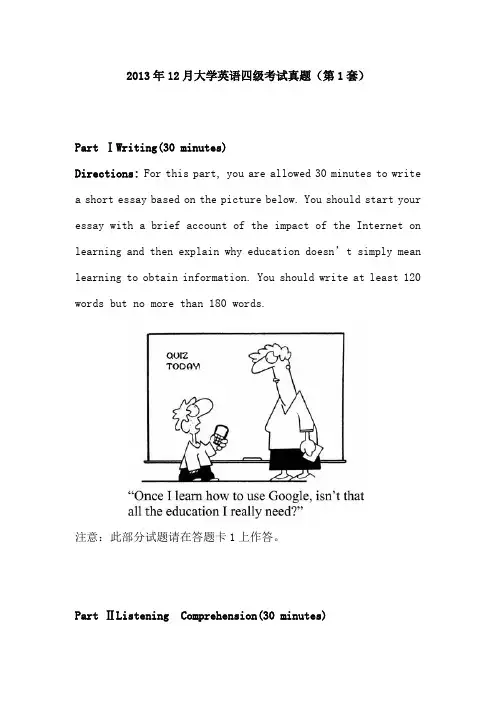
2013年12月大学英语四级考试真题(第1套)Part ⅠWriting(30 minutes)Directions: For this part, you are allowed 30 minutes to write a short essay based on the picture below. You should start your essay with a brief account of the impact of the Internet on learning and then explain why education doesn’t simply mean learning to obtain information. You should write at least 120 words but no more than 180 words.注意:此部分试题请在答题卡1上作答。
Part ⅡListening Comprehension(30 minutes)Section ADirections: In this section, you will hear 8 short conversations and 2 long conversations. At the end of each conversation, one or more questions will be asked about what was said. Both the conversation and the questions will be spoken only once. After each question there will be a pause. During the pause, you must read the four choices marked A), B), C) and D), and decide which is the best answer. Then mark the corresponding letter on Answer Sheet 1 with a single line through the centre.注意:此部分试题请在答题卡1上作答。
2013年12月大学英语四级(CET4)考试样卷(改革后新题型)

2013年12月大学英语四级(CET4)考试样卷Part I Writing (30 minutes)Directions:For this part, you are allowed 30 minutes to write an essay. You should start your essay with a brief description of the picture and then express your views on theimportance of learning basic skills. You should write at least 120 words but nomore than 180 words. Write your essay on Answer Sheet 1.注意:此部分试题请在答题卡1上作答。
PartII Listening Comprehension (30 minutes)Section ADirections:In this section, you will hear 8 short conversations and 2 long conversations. At the end of each conversation, one or more questions will be asked about whatwas said. Both the conversation and the questions will be spoken only once. Aftereach question there will be a pause. During the pause, you must read the fourchoices marked A), B), C) and D), and decide which is the best answer. Thenmark the corresponding letter on Answer Sheet 1 with a single line throughthe centre.注意:此部分试题请在答题卡1上作答。
[全]2013年12月大学英语四级考试真题及答案(汇总共三套)--第三套
![[全]2013年12月大学英语四级考试真题及答案(汇总共三套)--第三套](https://360docs-1393072327.cos.ap-beijing.myqcloud.com/060f73d304a1b0717ed5dd14.webp)
2013年12月大学英语四级考试真题(第3套)Part I Writing (30 minutes)Directions: For this part, you are allowed 30 minutes to write a short essay based on the picture below. You should start your essay with a brief account of the impact of the Internet on the way people communicate and then explain whether electronic communication can replace face-to-face contract. You should write at least 120 words but no more than 180 words._____________________________________________________________________________________________ _____________________________________________________________________________________________ _____________________________________________________________________________________________ _____________________________________________________________________________________________ _____________________________________________________________________________________________ _____________________________________________________________________________________________ _____________________________________________________________________________________________ _____________________________________________________________________________________________ _____________________________________________________________________________________________ _____________________________________________________________________________________________ _____________________________________________________________________________________________ __________________________________________________________________________________Part II Listening Comprehension (30 minutes) Section ADirections: In this section, you will hear 8 short conversations and 2 long conversations. At the end of each conversation, one or more questions will be asked about what was said. Both the conversation and thequestions will be spoken only once. After each question there will be a pause. During the pause, youmust read the four choices marked A), B), C) and D), and decide which is the best answer. Then mark thecorresponding letter on Answer Sheet 1 with a single line through the centre.1. A) Go to a place he has visited. C) Consult a travel agent.B) Make her own arrangements. D) Join in a package tour.2. A) They are on a long trip by car. C) They are used to getting up early.B) They are stuck in a traffic jam. D) They are tired of eating out at night.3. A) He is a person difficult to deal with. C) He is unwilling to speak in public.B) He dislikes any formal gathering. D) He often keeps a distance from others.4. A) Work in another department. C) Recruit graduate students.B) Pursue further education. D) Take an administrative job.5. A) He would not be available to start the job in time.B) He is not quite qualified for the art director position.C) He would like to leave some more time for himself.D) He will get his application letter ready before May 1.6. A) Cleaner. B) Mechanic. C) Porter. D) Salesman.7. A) Request one or two roommates to do the cleaning.B) Help Laura with her term paper due this weekend.C) Get Laura to clean the department herself this time.D) Ask Laura to put off the cleaning until another week.8. A) A problem caused by the construction. C) The building project they are working on.B) An accident that occurred on the bridge. D) The public transportation conditions.Questions 9 to 11 are based on the conversation you have just heard.9. A) To look a job as a salesperson. C) To place an order for some products.B) To have a talk with Miss Thompson. D) To complain about a faulty appliance.10. A) The person in charge is not in the office. C) They failed to reach an agreement on the price.B) The supplies are out of stock for the moment. D) The company is re-cataloguing the items.11. A) 0743, 12536 extension 15. C) 0734, 38750 extension 15.B) 0734, 21653 extension 51. D) 0743, 62135 extension 51.Questions 12 to 15 are based on the conversation you have just heard.12. A) Since he found a girlfriend. C) Since he began to exercise regularly.B) Since he took to heavy smoking. D) Since he started to live on his own.13. A) He is getting to fat. C) He doesn’t eat vegetables.B) He smokes too much. D) He doesn’t look well at all.14. A) They are overweight for their age. C) They are still in their early twenties.B) They are respectful to their parents. D) They dislike doing physical exercise.15. A) To quit smoking. C) To find a girlfriend.B) To reduce his weight. D) To follow her advice.Section BDirections: In this section, you will hear 3 short passages. At the end of each passage, you will hear some questions.Both the passage and the questions will be spoken only once. After you hear a question, you must choosethe best answer from the four choices marked A), B), C) and D). Then mark the corresponding letter onAnswer Sheet 1 with a single line through the centre.Passage OneQuestions 16 to 19 are based on the passage you have just heard.16. A) They have destroyed several small towns. C) They have injured many residents.B) They will soon spread to San Francisco. D) They are burning out of control.17. A) They have been hospitalized. C) They were choked by the thick smoke.B) They have got skin problems. D) They were poisoned by the burning chemicals.18. A) It failed because of a sudden rocket explosion.B) It has been re-scheduled for a midday takeoff.C) It has been canceled due to technical problems.D) It was delayed for eleven hours and thirty minutes.19. A) They made frequent long-distance calls to each other.B) They illegally used government computers in New Jersey.C) They were found to be smarter than computer specialists.D) They were arrested for stealing government information.Passage TwoQuestions 20 to 22 are based on the passage you have just heard.20. A) Peaceful. B) Considerate. C) Generous. D) Cooperative.21. A) Someone dumped the clothes left in the washer and dryer.B) Someone broke the washer and dryer by overloading them.C) Mindy Lance’s laundry blocked the way to the laundry room.D) Mindy Lance threatened to take revenge on her neighbors.22. A) Asking the neighborhood committee for help.B) Limiting the amount of laundry for each wash.C) Informing the building manager of the matter.D) Installing a few more washers and dryers.Passage ThreeQuestions 23 to 25 are based on the passage you have just heard.23. A) She is both a popular and a highly respected author.B) She is the most loved African novelist all times.C) She is the most influential author since the 1930’s.D) She is the first writer to focus on the fate of the slaves.24. A) The Book Critics Circle Award. C) The Pulitzer Prize for fiction.B) The Nobel Prize for literature. D) The National Book Award.25. A) She is a relative of Morrison’s. C) She is a skilled storyteller.B) She is a slave from Africa. D) She is a black woman.Section CDirections: In this section, you will hear a passage three times. When the passage is read for the first time, you should listen carefully for its general idea. When the passage is read for the second time, you arerequired to fill in the blanks with the exact words you have just heard. Finally, when the passage is readfor the third time, you should check what you have written.Many college students today own personal computers that cost anywhere from $1,000 to perhaps $5,000 or more. (26) ________, it is not uncommon for them to purchase (27) ________ costing another several hundred dollars. Twenty years ago, computers were (28) ________, but they were very large and extremely expensive. Few, if any, (29) ________ purchased computers for home use. Over the years, the price of the “guts” of a computer— its memory — has declined to less than a thousandth of the price per unit of memory that prevailed twenty years ago. This is the main reason why computers cost so much less today than they used to. Moreover, (30) ________ improvements have made it possible to (31) ________ memory circuitry that is small enough to fit into the portable personal computers that many of us own and use. (32) ________, as the price of computation has declined the average consumer and business have spent more on purchasing computers.(33) ________, improved agricultural technology, hybrid (杂交) seed, (34) ________ animal breeding, and so on have vastly increased the amount of output a typical farmer can produce. The prices of goods such as meats and grains have fallen sharply relative to the prices of most other goods and services. As agricultural prices have fallen, many households have decreased their total expense on food. Even though the (35) ________ of a product purchased generally increases when its price falls, total expenses on it may decline.Part III Reading Comprehension (40 minutes)Section ADirections:In this section, there is a passage with ten blanks. You are required to select one word for each blank from a list of choices given in a word bank following the passage. Read the passage through carefullybefore making your choices. Each choice in the bank is identified by a letter. Please mark thecorresponding letter for each item on Answer Sheet 2 with a single line through the centre. You maynot use any of the words in the bank more than once.Questions 36 to 45 are based on the following passage.To get a sense of how women have progressed in science, take a quick tour of the physics department at the University of California, Berkeley. This is a storied place, the 36 of some of the most important discoveries in modern science — starting with Ernest Lawrence’s invention of the cyclotron(回旋加速器) in 1931. A generation ago, female faces were 37 and, even today, visitors walking through the first floor of LeConte Hall will see a full corridor of exhibits 38 the many distinguished physicists who made history here, 39 all of them white males.But clime up to the third floor and you’ll see a 40 display. There, among the photos of current faculty members and students, are portraits of the 41 head of the department, Marjorie Shapiro, and four other women whose research 42 everything from the mechanics of the universe to the smallest particles of matter. A sixth woman was hired just two weeks ago. Although they’re still only about 10 percent of the physics faculty, women are clearly a presence here. And the real 43 may be in the smaller photos to the right: graduate and undergraduate students, about 20 percent of them female. Every year Berkeley sends its fresh female physics PhDs to the country’s top universities. That makes Shapiro optimistic, but also 44 . “I believe things are getting better,” she says, “but they’re not getting better as 45 as I would like.”Section BDirections: In this section, you are going to read a passage with ten statements attached to it. Each statement contains information given in one of the paragraphs. Identify the paragraph from which the information is derived. You may choose a paragraph more than once. Each paragraph is marked with a letter. Answer the questions by marking the corresponding letter on Answer Sheet 2.Is College a Worthy Investment?A) Why are we spending so much money on college? And why are we so unhappy about it? We all seem to agreethat a college education is wonderful, and yet strangely we worry when we see families investing so much in this supposedly essential good. Maybe it’s time to ask a question that seems almost sacrilegious (大不敬的): is all this investment in college education really worth it?B) The answer, I fear, is no. For an increasing number of kids, the extra time and money spent pursuing a collegediploma will leave them worse off than they were before they set foot on campus.C) For my entire adult life, a good education has been the most important thing for middle-class households. Myparents spent more educating my sister and me than they spent on their house, and they’re not the only ones…and, of course, for an increasing number of families, most of the cost of their house is actually the cost of living in a good school district. Questioning the value of a college education seems a bit like questioning the value of happiness, or fun.D) The average price of all goods and services has risen about 50 percent. But the price of a college education hasnearly doubled in that time. Is the education that today’s students are getting twice as good? Are new workers twice as smart? Have they become somehow massively more expensive to educate?E) Perhaps a bit. Richard Vedder, an Ohio University economics professor, says, “I look at the data, and I see collegecosts rising faster than inflation up to the mid-1980s by 1 percent a year. Now I see them rising 3 to 4 percent a year over inflation. What has happened? The federal government has started dropping money out of airplanes.”Aid has increased, subsidized(补贴的) loans have become available, and “the universities have gotten the money.” Economist Bryan Caplan, who is writing a book about education, agrees: “It’s a giant waste of resources that will continue as long as the subsidies continue.”F) Promotional literature for colleges and student loans often speaks of debt as an “investment in yourself.” But aninvestment is supposed to generate income to pay off the loans. More than half of all recent graduates are unemployed or in jobs that do not require a degree, and the amount of student-loan debt carried by households has increased more than five times since 1999. These graduates were told that a diploma was all they needed to succeed, but it won’t even get them out of the spare bedroom at Mom and Dad’s. For many, the most visible result of their four years is the loan payments, which now average hundreds of dollars a month on loan balances in the tens of thousands.G) It’s true about the money — sort of. College graduates now make 80 percent more than people who have only ahigh-school diploma, and though there are no precise estimates, the wage premium(高出的部分) for an outstanding school seems to be even higher. But that’s not true of every student. It’s very easy to spend four years majoring in English literature and come out no more employable than your were before you went in. Conversely, chemical engineers straight out of school can easily make almost four times the wages of an entry-level high-school graduate.H) James Heckman, the Nobel Prize-winning economist, has examined how the returns on education break down forindividuals with different backgrounds and levels of ability. “Even with these high prices, you’re still finding a high return for individuals who are bright and motivated,”he says. On the other hand, “if you’re not college ready, then the answer is no, it’s not with it.” Experts tend to agree that for the average student, college is still worth it today, but they also agree that the rapid increase in price is eating up more and more of the potential return. For borderline students, tuition (学费) rise can push those returns into negative territory.I) Everyone seems to agree that the government, and parents, should be rethinking how we invest in highereducation—and that employers need to rethink the increasing use of college degrees as crude screening tools for jobs that don’t really require college skills. “Employers seeing a surplus of college gradates and looking to fill jobs are just adding that requirement,” says Vedder. “In fact, a college degree becomes a job requirement for becoming a bar-tender.”J) We have started to see some change on the finance side. A law passed in 2007 allows many students to cap their loan payment at 10 percent of their income and forgives any balance after 25 years. But of course, that doesn’t control the cost of education; it just shifts it to taxpayers. It also encourages graduates to choose lower-paying careers, which reduces the financial return to education still further. “You’re subsidizing people to become priests and poets and so forth,” says Heckman. “You may think that’s a good thing, or you may not.” Either way it will be expensive for the government.K) What might be a lot cheaper is putting more kids to work. Caplan notes that work also builds valuable skills —probably more valuable for kids who don’t naturally love sitting in a classroom. Heckman agrees wholeheartedly: “People are different, and those abilities can be shaped. That’s what we’ve learned, and public policy should recognize that.”L) Heckman would like to see more apprenticeship-style (学徒式) programs, where kids can learn in the workplace —learn not just specific job skills, but the kind of “soft skills,” like getting to work on time and getting along with a team, that are crucial for career success. “It’s about having mentors (指导者) and having workplace-based education,” he says. “Time and again I’ve seen examples of this kind of program working.”M) Ah, but how do we get there from here? With better public policy, hopefully, but also by making better individual decisions. “ Historically markets have been to handle these things,” says Vedder, “and I think eventually markets will handle this one. If it doesn’t improve soon, people are going to wake up and ask, ‘why am I going to college?’”46. Caplan suggests that kids who don’t love school go to work.47. An increasing number of families spend more money on houses in a good school district.48. Subsidized loans to college students are a huge waste of money, according to one economist.49. More and more kids find they fare worse with a college diploma.50. For those who are not prepared for higher education, going to college is not worth it.51. Over the years the cost of a college education has increased almost by 100%.52. A law passed recently allows many students to pay no more than one tenth of their income for their college loans.53. Middle-class Americans have highly valued a good education.54. More kids should be encouraged to participate in programs where they can learn not only job skills but alsosocial skills.55. Over fifty percent of recent college graduates remain unemployed or unable to find a suitable job.Section CDirections:There are 2 passages in this section. Each passage is followed by some questions or unfinished statements. For each of them there are four choices marked A), B), C) and D). You should decide on the best choice and mark the corresponding letter on Answer Sheet 2 with a single line through the centre.Passage OneQuestions 56 to 60 are based on the following passage.A recent global survey of 2,000 high-net-worth individuals found about 60% were not planning on a traditional retirement. Among U.S. participants, 75% expected to continue working in some capacity even after stepping away from full-time jobs. “Many of these people made their wealth by doing something they’re passionate (有激情的) about,” says Daniel Egan, head of behavioral finance for Barclay s Wealth Americas. “Given the choice, they prefer to continue working.” Barclays calls these people “nevertirees”.Unlike many Americans compelled into early retirement by company restrictions, the average nevertiree often has no one forcing his hand. If 106-year-old investor Irving Kahn, head of his own family firm, wants to keep coming to work every day, who’s going to stop him? Seventy-eight-year-old Supreme Court Justice Ruth Bader Ginsburg’s job security is guaranteed in the Constitution.It may seem that these elderly people are trying to cheat death. In fact, they are. And it’s working. Howard Friedman, a professor at UC Riverside, found in his research that those who work hardest and are successful in their careers often live the longest lives. “People are generally being given bad advice to slow down, take it easy, stop worrying, and retire to Florida,” he says. He described one study participant, still working at the age of 100, who was recently disappointed to see his son retire.“We’re beginning to see a change in how people view retirement,”says George Leeson, co-director of the Institute of Population Ageing at Oxford. Where once retirement was seen as a brief reward after a long struggle through some miserable job, it is now akin (近似) to being cast aside. What Leeson terms “the Warren Buffett effect”is becoming more broadly appealing as individuals come to “view retirement as not simply being linked to economic productivity but also about contribution.”Observers are split on whether this is a wholly good thing. On the one hand, companies and financial firms can benefit from the wisdom of a resilient (坚韧的) chief. On the other, the new generation can find it more difficult to advance — an argument that typically holds little sway to a nevertiree.56. What do we learn about the so-called “nevertirees”?A) They are passionate about making a fortune.B) They have no choice but to continue working.C) They love what they do and choose not to retire.D) They will not retire unless they are compelled to.57. What do Irving Kahn and Ruth Bader Ginsburg have in common?A) Neither of them is subject to forced retirement.B) Neither of them desires reward for their work.C) Both cling to their positions despite opposition.D) Both are capable of coping with heavy workloads.58. What is the finding of Howard Friedman’s research?A) The harder you work, the bigger your fortune will be.B) The earlier you retire, the healthier you will be.C) Elderly people have to slow down to live longer.D) Working at an advanced age lengthens people’s life.59. What is the traditional view of retirement according to the passage?A) It means a burden to the younger generation.B) It is a symbol of a mature and civilized society.C) It is a compensation for one’s life-long hard work.D) It helps increase a nation’s economic productivity.60. What do critics say about “nevertirees”?A) They are an obstacle to a company’s development.B) They lack the creativity of the younger generation.C) They cannot work as efficiently as they used to.D) They prevent young people from getting ahead.Passage TwoQuestions 61 to 65 are based on the following passage.When we talk about Americans barely into adulthood who are saddled with unbearable levels of debt, the conversation is almost always about student loan debt. But there’s a growing body of evidence suggesting that today’s young adults are also drowning in credit-card debt —and that many of them will take this debt to their graves.More than 20% overspent their income by more than $100 every single month. Since they haven’t built up their credit histories yet, it’s a safe bet that these young adults are paying relatively high interest rates on the resulting credit card debt.Although many young people blame “socializing” as a barrier to saving money, most of them aren’t knocking back $20 drinks in trendy (时尚的) lounges. They’re struggling with much more daily financial demands.To a disturbingly large extent, the young and the broke are relying on credit cards to make it until their next payday. This obviously isn’t sustainable in the long run, and it’s going to put a huge drag on their spending power even after they reach their peak earning years, because they’ll still be paying interest on that bottle of orange juice or box of spaghetti (意式面条) they bought a decade earlier.A new study out of Ohio State University found that young adults are accumulating credit card debt at a more rapid rate than other age groups, and that they’re slower at paying it off. “If what we found continues to hold true, we may have more elderly people with substantial financial problems in the future,” warns Lucia Dunn, professor of economics at Ohio State. “If our findings persist, we may be faced with a financial crisis among elderly people who can’t pay off their credit cards.”Dunn says a lot of these young people are never going to get out from under their credit card debt. “Many people are borrowing on credit cards so heavily that payoff rates at these levels are not sufficient to recover their credit card debt by the end of their life, which could have loss implications for the credit card issuing banks.”61. What is the main idea of the first paragraph?A) Many young Americans will never be able to pay off their debts.B) Credit cards play an increasingly important role in college life.C) Credit cards are doing more harm than students loans.D) The American credit card system is under criticism.62. Why do young people have to pay a higher interest on their credit card debt?A) They tend to forget about the deadlines.B) They haven’t developed a credit history.C) They are often unable to pay back in time.D) They are inexperienced in managing money.63. What is said to be the consequence of young adults relying on credit cards to make ends meet?A) It will place an unnecessary burden on society.B) It will give them no motivation to work hard.C) It will exert psychological pressure on them.D) It will affect their future spending power.64. What will happen to young adults if their credit card debt keeps accumulating according to Lucia Dunn?A) They will have to pay an increasingly higher interest rate.B) They may experience a financial crisis in their old age.C) Their quality of life will be affected.D) Their credit cards may be cancelled.65. What does Lucia Dunn think might be a risk for the credit card issuing banks?A) They go bankrupt as a result of over-lending.B) They lose large numbers of their regular clients.C) Their clients leave their debts unpaid upon death.D) Their interest rates have to be reduced now and then.Part IV Translation (30 minutes)Directions:For this part, you are allowed 30 minutes to translate a passage from Chinese into English. You should write your answer on Answer Sheet 2.“要茶还是要咖啡?”是用餐人常被问到的问题。
2013年12月大学英语四级(CET4)考试样卷(改革后新题型)
2013年12月大学英语四级(CET4)考试样卷Part I Writing (30 minutes)Directions:For this part, you are allowed 30 minutes to write an essay. You should start your essay with a brief description of the picture and then express your views on theimportance of learning basic skills. You should write at least 120 words but nomore than 180 words. Write your essay on Answer Sheet 1.注意:此部分试题请在答题卡1上作答。
PartII Listening Comprehension (30 minutes)Section ADirections:In this section, you will hear 8 short conversations and 2 long conversations. At the end of each conversation, one or more questions will be asked about whatwas said. Both the conversation and the questions will be spoken only once. Aftereach question there will be a pause. During the pause, you must read the fourchoices marked A), B), C) and D), and decide which is the best answer. Thenmark the corresponding letter on Answer Sheet 1 with a single line throughthe centre.注意:此部分试题请在答题卡1上作答。
2013年12月英语四级听力真题及答案

听力2013年12月大学英语四级考试真题(第1套)Part II Listening Comprehension (30 minutes)Section ADirections:In this section, you will hear 8 short conversations and 2 long conversations. At the end of each conversation, one or more questions will be asked about what was said. Both the conversation and the questions will be spoken only once. After each question there will be a pause. During the pause, you must read the four choices marked A), B),C) and D), and decide which is the best answer。
Then mark the corresponding letter on Answer SheetI with a single line through the centre.1. A) The woman is now working in a kindergarten.B)The man will soon start a business of his own.C) The man would like to be a high school teacher.D)The woman is going to major in child education。
2. A) The furniture has to be rearranged。
B) The sound equipment has to be set up。
大学英语四级(2013年12月考试改革适用)模拟试卷315(题后含答案及解析)
大学英语四级(2013年12月考试改革适用)模拟试卷315(题后含答案及解析)题型有:1. Writing 2. Listening Comprehension 3. Reading Comprehension 4. TranslationPart I Writing1.For this part, you are allowed 30 minutes to write a letter of inquiry following the outline given below. You should write at least 120 words but no more than 180 words. Write your essay on Answer Sheet 1.假设你是刘梅,准备去美国留学。
现向申请学校写信,咨询相关事宜。
信件内容如下:1.自我介绍2.咨询相关事宜,如签证、学费、奖学金和语言考试等3.表示感谢,并希望早日得到答复正确答案: A Letter of InquiryDear Sir/Madam, I am a junior student majoring in Business Administration in South University. I am thinking about pursuing further study in your university. And I am wondering if you can help me with some issues regarding my application. Firstly, what kind of language test does your school require for a foreign student? Should I take TOEFL? Secondly, I am not sure how much the tuition fees would be for studying a postgraduate degree on business administration in your school. Is there any way that I can apply for scholarships? Thirdly, what kind of materials should I prepare for a student visa? Thank you for your attention. I am looking forward to hearing from you shortly. Best regards. Yours sincerely, Liu Mei解析:这是向申请学校咨询相关事宜的书信型写作。
大学英语四级(2013年12月考试改革适用)模拟试卷301(题后含答案及解析)
大学英语四级(2013年12月考试改革适用)模拟试卷301(题后含答案及解析)题型有:1. Writing 2. Listening Comprehension 3. Reading Comprehension 4. TranslationPart I Writing1.For this part, you are allowed 30 minutes to write a short essay on whether college students should open online shops. You should write at least 120 words but no more than 180 words.正确答案:Should College Students Open Online Shops? With the popularity of online trading, a growing number of college students are joining the trend of opening online shops. Opinions on whether college students should open online shops vary. For my part, I entirely approve of the practice. Firstly, opening online shops is a good opportunity for students to put the textbook knowledge into practice. In the preparation and operation stages, they are required to grasp relevant knowledge in order to make a profit, and thus their later studies will become more purposeful and efficient. Secondly, opening online shops gives the students on campus a chance to equip themselves with adequate skills such as interpersonal skills and problem-solving abilities, which cannot be learned from textbooks but are of great significance. Thirdly, if the online shop works well, students will earn a good income. In view of its marketing mode, even if the online shop fails, students will have nothing to lose. In any case, it’s noteworthy that the prerequisite for opening online shops is that college students have to ensure that their study will not be interfered with.Part II Listening ComprehensionSection A听力原文:The United States central bank has raised an important interest rate by one-fourth of 1 percent. The federal funds rate, a rate paid by banks for short-term loans, is now one-half of 1 percent. Janet Yellen, the first woman to lead the Federal Reserve System, spoke after the announcement. The decision was based on a few factors, Yellen said. Economic growth is expected to continue in the U.S. Another reason to increase interest rates, Yellen noted, was the low official rate of inflation. The central bank has said its target inflation rate is 2 percent. It says that rate would help support employment and keep prices stable. However, inflation currently is not at the target rate, but below 1 percent. The federal reserve chief also said the strong labor market provided another reason to raise rates. The U.S. economyis adding about 200,000 jobs each month.1 What is the news report mainly about?2 What do we learn about the target inflation rate set by the central bank?2.A.The U.S. central bank decides monetary policy.B.The U.S. central bank has raised an interest rate.C.The U.S. economic growth is expected to continue.D.The U.S. economy is adding about 200,000 jobs each year.正确答案:B解析:题目问新闻主旨。
大学英语四级(2013年12月考试改革适用)模拟试卷166(题后含答案及解析)
大学英语四级(2013年12月考试改革适用)模拟试卷166(题后含答案及解析)题型有:1. Writing 2. Listening Comprehension 3. Reading Comprehension 4. TranslationPart I Writing1.For this part, you are allowed SO minutes to write a short essay entitled Should Smoking Be Banned in Public Places? You should write at least 120 words but no more than 180 words following the outline given below. Write your essay on Answer Sheet 1.1.近年来越来越多的公共场所禁烟2.这项举措在受到拥护的同时也引发了争议3.我的看法Should Smoking Be Banned in Public Places?正确答案:Should Smoking Be Banned in Public Places? In recent years, smoking has been banned in many public places such as shops, restaurants, and even bus stops. This regulation has triggered much dispute. On the one hand, many welcome the ban since lots of illnesses and deaths are smoking-related, and this is a very sensible step to improve people’s health and living condition. On the other hand, however, smokers consider it is unfair to ban smoking. It is their right to smoke, and they are not committing any crime, so the government should not ban that. In my view, to ban smoking is a long term process, during which education rather than enforcement is more likely to be the key to the success. Banning smoking in the public areas is a policy that should be implemented step by step.解析:这篇作文要求考生结合社会现象论述自己的观点。
2013年12月大学英语四级真题(含答案)-1
2013年12月大学英语四级考试真题(第1套)Part ⅠWriting(30 minutes)Directions: For this part, you are allowed 30 minutes to write a short essay based on the picture below. You should start your essay with a brief account of the impact of the Internet on learning and then explain why education doesn’t simply mean learning to obtain information. You should write at least 120 words but no more than 180 words.注意:此部分试题请在答题卡1上作答。
Part ⅡListening Comprehension(30 minutes)Section ADirections: In this section, you will hear 8 short conversations and 2 long conversations. At the end of each conversation, one or more questions will be asked about what was said. Both the conversation and the questions will be spoken only once. After each question there will be a pause. During the pause, you must read the four choices marked A), B), C) and D), and decide which is the best answer. Then mark the corresponding letter on Answer Sheet 1 with a single line through the centre.注意:此部分试题请在答题卡1上作答。