
七年级英语下册 Unit 10 I’d like some noodles Section B(1a1d)学案 (新版)人教新目标版
1 Unit 10 I’d like some noodles. 第四课时:Section B 1a-1d
Teaching and Learning Goals: 一、功能Functions: 学会电话订餐。 二、词汇和常用表达Words and expressions: 词汇:dumpling,porridge,onion, fish ,pancake 句型:① I like dumplings, fish and orange juice. I don’t like onions, green tea or porridge ② I want to order some food. ③ -What kind of dumplings would you like? -I’d like meat and cabbage dumplings. 三、学习策略Strategies: 学会边听边做笔记,捕捉关键信息。 四、文化知识Culture: 合理安排饮食,均衡营养。 Teaching and learning steps: Preview Look at P58, first ask the Ss to put them into English orally, then let them write English down without looking at the textbooks. 1.肉 ______________ 2.水饺 __________ 3.粥 _____________ 4.绿茶 ___________ 5.橘汁 __________ 6.汤 ____________ 7.洋葱 __________ 8. 鱼 _________ 9. 小薄饼 ________ 10. 我喜欢水饺,鱼和橘汁。_____________________________________ 11. 我不喜欢洋葱,绿茶也不喜欢粥。_____________________________
Step1.Warming up and lead in:
T: This is a House of dumplings. There are many delicious food. Let’s see what they are. (设计意图:利用水饺店的图片设置情境,并以此贯穿始终。) Step2. Before listening Task 1. New words
Houseof Dumplings 2
T: Look! There are many delicious foods. What are they? S: They are …
dumplingsHouseof Dumplings Task 2. Pair work T: They are very popular in the dumpling house. The most delicious food is dumplings, there are three specials. Look! What are they? S: They are…
mutton and potato dumplingsSpecial 1
fishpancakesHouseof DumplingssoupporridgeHouseof Dumplings 3 chicken and onion dumplings
Special 2
beef and carrot dumplings.Special 3 S1: What kind of dumplings would you like? S2: I’d like… dumplings.
A:What kind of dumplingswould you like?B: I’d like…dumplings.
Special 1Special 2Special 3 Task 3. A guessing game. T: Many people come to the dumpling house, please guess what kind of food they would like. 4
T: What kind of food would he/she like? S: He/She would like… Task 4. Match the words with the pictures. T: There are many kinds of food on the table. What are they? Can you match the words with the pictures?
Task 5. Pair work 1.____ meat 5. ____ orange juice2. ____ dumplings 6. ____ soup3. ____ porridge 7. ____ onions4. ____ green tea 8. ____ fish9. ____ pancakes
1a. Match the words with the pictures. 5
T: Different people like different food. As for me, I like dumplings and orange juice. I don’t like onions or porridge. What about you? S: I like… and …I don’t like … or…
(设计意图:通过以上几个任务的设置, 在情境中练习了生词和目标句型。为后面的活动做好了语言铺垫。) Step3. While listening Task1. Listening for the general idea.(听大意) T: Now let’s listen to a conversation. It’s a call. Please listen and tell me what they are talking about. The general idea of the conversation is_______ A. a call about ordering food B. a call between friends C. a call about sports
T: This is an order form. If someone wants to order food, the waiter must fill in it. Let’s see what’s on it?
(设计意图:在听细节活动之前展示order form, 以便让学生熟悉表格,为接下来的任务做好铺垫。) Task 2. Listen and complete the food order form. T: Now, please listen to the tape and fill in the order form.( If necessary, play it twice.)
Ilikedumplings andorange juice. I don’t like onions orporridge. What about you?
I like…and…I don’t like…or…
Pair work:
ORDER FORM(订单)Address:(地址)_________________________.Telephone number: ________________.
Order:Dishes: ________________________________________Dumplings: ____________________________________Soup: ________________________________________Drinks: __________________________________________ 6
Task 3. Listen and complete the blanks. A: Hello, House of Dumplings. B: Hello! I want to ______ some food, please. A: Sure. B: I’d like chicken, fish and cabbage, please. A: Uh-huh. B: And _______ dumplings. A: What kind of dumplings would you like? B: Beef and ______dumplings, please. A: OK. What else? B: Umm … I’d like some ______, too. A: OK. What kind of soup would you like? B: _______ soup. A: OK. One tomato soup then. Would you like any drinks? B: One large green tea and two _____ orange juices. A: OK. What’s your address, please? B: 15 North _____. A: And what’s your telephone number? B: 398-2845. A: 398-2845? B: Yup. A: Thank you. That’ll be 65 yuan. Step4 After writing Task1. Retelling.
Task 2. Listen and complete the food order form.ORDER FORMAddress: _________________________.Telephone number: ________________.Order:Dishes: _________________, fish,_____________________Dumplings: 12 beef and ___________________dumplingsSoup: one ________________________________________Drinks: one large ________________ and _____________small __________________________ juices.
七年级英语I’dlikesomenoodles教案

一、教学目标:1. 知识目标:(1)能够听懂、会说、会读“I’d like some noodles”这个句子。
(2)能够理解并在适当的情境中使用“noodles, please, soup, rice, meat”等单词。
2. 能力目标:(1)能够用英语进行简单的点餐对话。
(2)能够用英语描述自己喜欢的食物。
3. 情感目标:培养学生的学习兴趣,提高他们的自信心和合作精神。
二、教学重点与难点:1. 教学重点:(1)能够正确地发音和拼写“noodles, please, soup, rice, meat”等单词。
(2)能够在适当的情境中运用“I’d like some noodles”这个句子。
2. 教学难点:(1)单词“noodles, please, soup, rice, meat”的发音和拼写。
(2)句型“I’d like some noodles”在实际情境中的应用。
三、教学方法:1. 情境教学法:通过模拟餐厅场景,让学生在实际情境中学习英语。
2. 交际法:引导学生进行角色扮演,提高他们的口语表达能力。
3. 任务型教学法:通过完成点餐任务,培养学生合作学习和解决问题的能力。
四、教学过程:1. 导入:教师展示一些食物图片,引导学生谈论他们喜欢的食物。
2. 新课内容:教师介绍单词“noodles, please, soup, rice, meat”的发音、拼写和用法。
3. 实践环节:学生分组进行角色扮演,模拟餐厅点餐场景。
4. 总结与拓展:教师引导学生总结本节课所学内容,并鼓励他们用英语描述自己喜欢的食物。
五、课后作业:1. 抄写单词“noodles, please, soup, rice, meat”,并掌握它们的发音。
2. 结合所学内容,用英语写一篇关于自己喜欢的食物的短文。
3. 预习下一节课的内容,准备进行课堂展示。
六、教学评价:1. 课堂表现:观察学生在课堂上的参与程度、发言积极性和合作精神。
人教版新目标七年级英语下册Unit10教案

—1—人教版新目标七年级英语下册Unit10教案Unit 10I’d like some noodles.Period 1 Ⅰ.Teaching Aims and Demands Knowledge Objects Key vocabulary. Ta rget language. 2. Ability Object Train 2. Ability Object Train students’students’students’ listening and speaking skills. listening and speaking skills.3. Moral Object Noodles are popular with people. They are trad itional Chinese food. Ⅱ. Teaching Key Points Key vocabulary, espe cially the names of food. Countable and uncountable nouns. Ⅲ. Teac hing Difficulties Train hing Difficulties Train students’students’students’ listening and speaking skills. listening and speaking skills. Ⅳ. Teac hing Methods Listening and speaking methods. Scene teaching methods Ⅴ. T eaching Aids A tape recorder . Ⅵ. Teaching Procedures Step Ⅰ. Warming-up and lead-in Oral speech.→ I like I like…I’…I’…I’d like some noodles. Step d like some noodles. Step Ⅱ. New words learning Step Ⅲ. Presentation (1a) 1. Write the letter after the name of the food. 2. Have students match the words with the foods on their 初一全科目课件教案习题汇总语文数学英语历史地理own. 3. Go over the answers. StepⅣ. Listening (1b) Listen and put a check before the noodles the m an ordered. StepⅤ. Pairwork(1c) Ask students to practice similar conversation s in pairs. Students take turns to be the customer and the noodles ma ker . StepⅥ. Summary and homework Remember the words and practice the target language.Period 2Ⅰ.Teaching Aims and Demands 1. Knowledge Objects Target language Ability Object Train Ability Object Train students’students’students’ listening and speaking skills. Train stude listening and speaking skills. Train stude nts’nts’ communicative competence. Moral Object Noodles are popular communicative competence. Moral Object Noodles are popular with people. They are traditional Chinese food. Ⅱ. Teaching Key Poi nts T h e t a r g e t l a n g u a g e u s e d f o r a s k f o r a n d g i v e p e r s o n a l information. Order food. Ⅲ. Teaching Difficulties Train Train students’students’students’ listening and speaking skills. Train listening and speaking skills. Train listening and speaking skills. Train students’students’students’ commu commu nicative competence. Ⅳ. Teaching Methods Listening and speaking methods. Scene teaching methods Ⅴ. T eaching Aids A tape recorder Ⅵ. Teaching Procedures Step Ⅰ. Warming-up and revision Oral speech and free talk. StepⅡ. Listening (2a 2b) 1. . Listening (2a 2b) 1. YY o u ’r e t o listen and check the names of the foods you hear on the tape. 2. Play the recording twice. Then che ck the answers. 3. P lay th e s ame record ing ag ain. Lis t en carefully and fill in the blanks. StepⅢ. Pairwork (2c,2d) 1. Work with a partner. One is a customer and t he other is a waiter. 2. Invite several pairs of students to act out the ir conversations in front of the class. 3.Have some students role-p lay the conversations in pairs,then explain it to the class. StepⅣ. Grammar Focus G u i d et h e s t u d e n t s t o m a k e s o m e s e n t e n c e s w i t h I ’d , H e ’d and and They’d.They’d.They’d. Step StepⅤ. Conversation practice (3a ,3b) 1. You are to match each question wi th an answer. 2. Get students to do the task in pairs. 3. Put students i nto pairs. One is working in a noodles h o u s e. T h e o t h e r i s t h e c u s t o m e r. G e t t h e p a i r s t o s t a r t t h e activity . Ste pⅥ. Summary and homework 1. S u m m a r yt h e t a r g e t l a n g u a g e w e ’v e l e a r n e d i n t h i s class. 2. Reread the conversa tion in 3a. try to recite it. 3. Write down the conversation in 3c.Period 3Ⅰ. T . Teaching Aims and Demands Knowledge Objects Key vocabulary eaching Aims and Demands Knowledge Objects Key vocabulary . T . Tar ar get language. 2. Ability Object Train get language. 2. Ability Object Train students’students’ listening and speaking skill s. Train s. Train students’students’students’ communicative competence. 3. Moral Object Every communicative competence. 3. Moral Object Every one should choose foods which are good for h is health. Ⅱ. T eachi ng Key Points Learn how to ask for and give personal information an d write down the information. Ⅲ. Teaching Difficulties Learn howto ask for and give personal information and write down the i nformation. Ⅳ. Teaching Methods Practicing methods. Scene teach ing methods Ⅴ. T eaching A ids A tape recorder Ⅵ. Teaching Procedures StepⅠ.Warming-up and lead-in Oral speech. Describe one .Warming-up and lead-in Oral speech. Describe one’’s preferenc es. StepⅡ. New words learning. Porridge onion fish pancake Step Ⅲ. Presentation (1a 1b) 1. Match the words with the pictures. Write the letter of the food on the blank line before its name.2. Circle the things you like in the picture. And make an “×”“×” nex nex t to the things you t to the things you don’t don’t don’t like. Step like. StepⅣ. Listening (1c,1d) 1. Listen carefully and circle in activity 1a th e words that you hear on the tape. 2. Play the same recording again. W Write down the rite down the rite down the customer’s customer’s customer’s address, telephone number and what he or address, telephone number and what he or ders. 3.Check the answers. StepⅤ. Pairwork (2a) 1. Put students into pairs. Ask questions abo ut what they door eat on their birthdays. 2. Invite more advanced students t o demonstrate how to do the activity o demonstrate how to do the activity. Step . StepⅥ.Summary and homework Remember the key words and target la nguage.Period 4Ⅰ. T . Teaching Aims and Demands Knowledge Objects Learn to read and eaching Aims and Demands Knowledge Objects Learn to read and write an ad for House of Dumplings. 2. Ability Object Train student s’s’ reading and writing skills. Train reading and writing skills. Train reading and writing skills. Train students’students’students’ integrating skills. 3. Moral integrating skills. 3. Moral Object Keep healthy. Ⅱ. Teaching Key Points Learn how to order fo od. Learn to write an ad for House of Dumplings. Ⅲ. T . Teaching Diffic eaching Diffic ulties Learn how to order food. Learn to write an ad for House of D umplings. Ⅳ. Teaching Methods reading and writing methods. Practi cing methods Ⅴ. T eaching A ids A tape recorder Ⅵ. Teaching Procedure s Step I. Warming-up and revision Oral speech and dictation. Step II.R eading and answering(2b,2c) Do 2b:Ask students to read the article and complete the c h a r t ,t h e n c h e c k t h e a n s w e r s.E x p l a i n t h e k e y p o i n t s t o the class. D o 2c :H a v e s t u d e n t s r e a d t h e a r t i c l e a g a i n a n d a n s w e r t h e questions,then check the answers. Step III. Reading (3a) Fill in the blank lines, usi ng words from the box. Get students to complete the paragraph on t heir own. Step IV . Writing (3b,3c) 1. W r i t e y o u r o w n a d. P l e a s e u s e t h e a d i n a c t i v i t y 3a a s a model. 2. Us e the sample version in activity 1c to demonstrate how to order a meal. 3.Have some students to read their ads to the class. Step V . P airwork Let students work in pairs to order meal. Students p ractice both roles. Step VI. Summary and homework Order food.Period 5Ⅰ. T . Teaching Aims and Demands Knowledge Objects Reaching Aims and Demands Knowledge Objects R e v i e w t h e n a me s o f f o o d s a n d d r i n k s , t h e t a rg e t l a n g u a g e used to order food, ask for and give personal information and design an ad.2. Ability Object Train 2. Ability Object Train students’students’students’ communicative competence.3. Moral communicative competence. 3. Moral Object Noodles, a kind of fast food, helps save a lot of time. And it ’s ’s delicious and rich in nutrient, thank the inventor. Ask your family delicious and rich in nutrient, thank the inventor. Ask your family members or classmates what they’d they’d like to eat. In this way, you like to eat. In this way, you will understand each other better. Ⅱ. Teaching Key Points Review all the key words and order food. Review to ask for and give person al information. Ⅲ. Teaching Difficulties Order food, design an ad fo r House of Dumplings. Ⅳ. Teaching Methods Practicing methods. Ⅴ. T eaching A ids Ⅵ. Teaching Procedures Step Ⅰ.W arming-up Step Ⅱ. Review the key vocabulary Give students several minutes to me morize the key vocabulary . Large, medium, noodles, beef, mutton, chic ken, cabbage, potatoes, tomatoes, dumplings, soup, green tea, orang e juice. StepⅢ. Self Checks1, 2 ,3 D oS e l f C h e c k 1. A s k s t u d e n t st o c h e c k a l l t h e w o r d s t h e y know. Write five new word s in their V ocab-builder. Do Self Check2. Ask students to complete th—7—e task,then h a v e s o me s t u d en ts r e a d th e 3 co n v e r s at io n s t o t h e c l as s i n pairs. D o S e l f C h e c k 3. A s k s t u d e n t s t o w r i t e a c o n v e r s a t i o n w i t h the help of the clues in pairs,t hen have some pairs read their conversations to the class. StepⅣ. Review the target language Make a conversation use the target la nguage. What kind of noodles would you like?→I’d I’d like beef noodles. What size bowl of noodles would you like? like beef noodles. What size bowl of noodles would you like?→I’d I’d like a small/medium/large bowl of noodles. like a small/medium/large bowl of noodles. like a small/medium/large bowl of noodles. What’s What’s What’s your address? your address? →My address is My address is ….….…. Get several pairs of students to act out their conv Get several pairs of students to act out their conv ersations. StepⅤ.Summary and homework Summary the language .Summary and homework Summary the language we’ve we’ve we’ve learned learned in this unit. Finish 3c as your homework.。
七年级英语下册 Unit 10 I’d like some noodles(第5课时)教案 (新版)人教新目标版
阅读训练与写作训练
教学方法
观察归纳模仿
教学准备
PPT,彩色粉笔
课前作业
预习课本P55内容
教学过程
教学环节
课堂合作交流
二次备课
(修改人:)
环
节一
Ⅰ. Warming- up and revision
1. Have a dictation of the new words and expressions.
2. Check the homework
Ⅱ. Presentation
1. Read the ads in3a. Fill in the blanks with the words in the box.
阅读指导:首先,明白方框里单词的意思;
其次,阅读这个小广告,了解其大意;
然后,认真读每一个句子,根据上下文及空格前后的关键词来确定空格处的意思。并确定应用哪个单词填空。
教学反思:
2. Self check 2.
1. Tell Ss they'll read some interesting jokes. Read the jokes below and fill in the
blanks with "there be" structure.
2.指导:这里是考查there be句型中的主谓一致原则及就近主语原则的知识。
最后,再通读一遍 广告内容,看短文是否通顺恰当。
2.学生们按老师所指导的方法,认真阅读短文,并用正确的单词填空。
3. Check the answers.
课中作业:
Check the answers and read the whole passag e.
人教版七年级英语下册第十单元教案

UNIT 10 I’d like some noodles.Section A 第1课时(1a〜1c)自主学习方案1.自学生词,并记住拼读及拼写。
2.预习课本找出重点短语及句子。
(见学案自学导练内容)3.读记后完成自学导练内容。
课堂导学方案Step1 情景导入Everyone has his own taste. So what kind of food do you like?What’s your favorite food?Do you like noodles?What kind of noodles do you like?Today we'l talk about the kinds of noodles.环节说明:就学生感兴趣的身边的话题导入新课,简洁明了,引人入胜。
Step 2完成教材1a—1c的任务1.学生认真观察1a图片中的食物,然后将词语与图片搭配,集体核对答案。
(2分钟)2,老师领读单词,并纠正发音。
(2分钟)3.学生认真听录音,标出顾客所点的面条,集体核对答案,完成课本上1b的听力任务。
(3分钟)4.两人一组练习1a中的对话,然后编新对话进行练习,并请一些学生表演出他们的对话。
(5分钟)参考案例:A:What would you like?B: I,m not sure yet. Are there any vegetables in the mutton noodles?A: Yes,there are some cabbages.B: OK,I’d like the mutton noodles.5.小结训练。
(2分钟)(1)一Would you like some beef?— C .A. Yes,I wouldB. No,I wouldn’tC.Yes, pleaseD. Thanks(2)There are B hamburgers in our restrant. Would you like ?A.some;someB. some;anyC.any; anyD. any;some环节说明:听说结合,第一时间向学生传达语言目标,通过结对对话练习和小结训练,使语言目标得以强化。
七年级英语I’dlikesomenoodles教案

七年级英语"I'd like some noodles" 教案教学目标:1. 让学生能够理解和使用日常英语中的食物词汇。
2. 培养学生进行简单的英语对话,提高他们的口语表达能力。
3. 帮助学生掌握情态动词"would like" 的用法。
教学内容:1. 食物词汇:noodles, rice, dumplings, chicken, vegetables, fruit.2. 情态动词:would like.3. 日常对话:ordering food, asking for permission.教学步骤:第一章:介绍食物词汇1.1 教师展示一系列食物图片,包括面条、米饭、饺子、鸡肉、蔬菜和水果。
1.2 学生尝试用中文说出这些食物的名字,教师用英语重复并解释。
1.3 学生跟随教师一起大声说出这些食物的名字,加强记忆。
第二章:学习情态动词"would like"2.1 教师解释情态动词"would like" 的用法,举例说明。
2.2 学生模仿教师说出几个简单的句子,如:"I'd like some noodles." 和"Could I have some vegetables, please?"。
2.3 学生进行小组活动,用"would like" 编写自己的句子,并互相练习说出口。
第三章:练习日常对话3.1 教师设置一个餐厅场景,学生扮演顾客和服务员的角色。
3.2 学生使用所学的食物词汇和情态动词"would like" 进行对话练习。
3.3 教师给予学生一些对话提示,如:"A: I'd like some noodles, please. B: Sure, I'll get that for you.",并鼓励学生自由发挥。
七年级英语下册(浙江专版 人教版)课件 Unit 10 第四课时 Section B (1a1d)
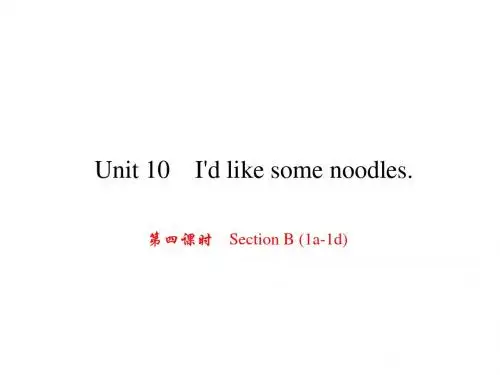
A.What kinds of soup are there in your restaurant? B.What would you like? C.What's your address? D.That's all. E.What's your telephone number?
Unit 10 I'd like some noodles.
第四课时 Section B (1a-1d)
►dumpling n.“饺子”,为可数名词,常用复数dumplings。 eg:I would like some dumplings.我想要一些饺子。 ►fish的用法 ①作不可数名词时,意为“鱼肉”。 eg:I'd like to eat some fish.我想吃一些鱼肉。 ②作可数名词时,指鱼的数量,复数形式为fish;指鱼的种类,复数形 式为fishes。 eg:I have five fish at home.我家里有五条鱼。 There are many kinds of fishes in the sea.大海里有很多种鱼。 ③作动词,意为“钓鱼”。 eg:go fishing 去钓鱼
三、从方框中选择适当的选项补全对话。 A:Hello,Brown Restaurant! B:Hello!I want to order some food. A:Sure.16.__B__ B:I'd like cabbages and a large bowl of tomato and egg noodles,please. A:OK.What else? B:17.__A__ A:There is chicken soup,tomato soup and vegetable soup. B:I'd like one vegetable soup.18.__D__ A:OK.That'll be 25 yuan.19.__C__ B:10 Park Road. A:20.__E__ B:291-7739. A:OK.
人教七年级英语下册Unit 10 I'd like some noodles Section B 课
1a. Match the words with the pictures.
1.__b__ meat 2. __g__ dumplings 3. __a__ porridge
4. __h__ green tea
5. __c__ orange juice
6. __e__ soup 7. __i__ onions
small_o__ra_n__g_e_ juices.
2b. Read the article about food traditions and complete the chart.
Birthday Food Around the World
__W_h_a_t__ would people like to eat on their birthday? The answer would be _d_if_fe_r_e_n_t in different countries. In many countries, people have __b_ir_th_d_a_y__c_a_k_e__ with candles. The number of candles is the person’s age. The _b_ir_t_h_d_a_y_p_e_r_s_o_nmust make a wish and b_l_o_w__o_u_t the candles. If he or she blows
out all the candles in one go, the wish will c_o__m_e__t_r_u_e. In the UK, people sometimes put a candy in the birthday cake. The child with the candy is lucky. In _C__h_in__a__, it isg_e_t_t_in__g_p__o_p_u_l_a_r to have cake on your birthday. But many people still eat very l_o_n_g__n_o_o_d__le_s__f_o_r_t_h_e_i_r_b_i_r_th__d_a_y. They never cut up the noodles because the long noodles are a symbol of long life. In some places, Chinese people also eat eggs on their birthday. They are a symbol of life and _g_o_o__d_l_u_c_k__. All of these birthday foods may be different, but the ideas are _t_h_e__s_a_m__e_. They bring good luck to the birthday person.
人教版七年级英语下册Unit 10第十单元Unit 10 教学设计
Teaching Plan for Unit 10 I’d like some noodlesTeaching aims: to learn to talk about food; to learn to take orders.Grammar: 1.Countable/Uncountable nouns2. What questions with would like and answers*Structure:1. What would you like?→I’d like some s oup.2. Would you like a large bowl?→Yes, please./ No, thanks.3. What kind of noodles would you like? →I’d like beef noodles, please.4. What size would you like? →I’d like a large bowl, please.*Vocabulary: Refer to the wordlist on P127-128Phrases: wo uld like, come with, take one’s order, one bowl of, green tea, orange juice, around the world, make a wish, blow out, in one go, get popular, come true, cut up, a symbol of, such as, bring good luck to*Writing: learn how to write an ad for your favorite restaurant.*Sentences for writing:①Welcome to our Sunny Fast Restaurant.②Would you like to try some special soup?③We have mutton and tomato soup for seven yuan a medium bowl.④Y ou can also try mutton and tomato soup for seven yuan a medium bowl.⑤ The tomato and egg rice is really delicious.Use the following words to write a paragraph (at least 80 words):like, try, different, also, delicious,*Passage to recite: P56 2dPeriod One: Section A P55-56Teaching procedures:Step 1. Lead in questions:Q1: Where is the boy? (In a noodle house.)Q2: What is he doing? (Ordering some food.)Step 2. P55 1a Match the words with the foods:Note some uncountable nouns: (meat) mutton, beef, chicken, cabbageCountable nouns: (vegetables) potatoes, tomatoes, carrotsWould you like…? →Yes, please./ No, thanks.Special questions:What kind/ size would you like? →I’d like… please.Step 4. Pair work: Look at the three menus on P55, ask and answer about your favorite noodles.操练would like句型eg. A: What would you like?B: I’m not su re yet. Are there any______ in the ______ noodles?A: Yes, there are some______.B: Ok, I’d like the _______noodles.Culture Note: Chinese food is one of the most popular kinds of international cuisines.Noodles and jiaozo are liked by people in different places. One of the most popular Chinese dishes in America is gongbao chicken.Step 5. P56 2a Listen and check the names of the foods you hear.Key: 1,2,4,5,6,7,82b Listen again. Complete the sentences.Boy: 1. I’d like a ______ bowl of noodles.2. I’d like ______, ________ and ________ noodles.Girl: 1. I’d like a ______ bowl.2. I’d like _______ and _______ noodles, please.Step 6. P56 2d Conversation1) Listen to the conversation and take notes2) Listen again and fill in the blanks.Waitress: Good afternoon. May I take your order?Sally:Yes. Are there any vegetables in the beef soup?Waitress: Yes. There are some tomatoes.Sally:OK. We’d like one bowl of beef soup.Waitress: Sure. What size would you like?Sally:Large, please.Tom:We’d also like gongbao chicken and some mapo tofu with rice.Waitress: OK.One large bowl of beef soup, one gongbao chicken, and one mapo tofu with rice. Tom:Yes, that’s right.Language points:● take one’s order● a bowl of soupone large bowl of beef soup● size : s mall ,medium, largee.g. What size would you like? - Large, please.● mapo tofu with rice3) Role-play the conversation in pairHomework:1.Copy new words and Grammar sentences2.Recite 2d ConversationPeriod Two: Section B P58-59Teaching procedures:Step 1 Review. Give Ss some pictures about different kinds of food and drinks. Draw special attention to some specific uncountable nouns.Step 2 Listening Practice.P58 1c Listen and complete the food order from.Step 3. Reading: Birthday Food Around the World1) Lead-in: P59 2a What do you do or eat on your birthday? Ask some Ss to talk about their birthdays.•Do you have a birthday party?•Do you eat birthday cakes / eggs?•Do you go to the movies?•Do you have a good time?2) Read the article about birthday food traditions and complete the chart. P59 2b① How can a person make his or her birthday wish come true?_______________________________________________② What do people in the UK sometimes put in a birthday cake?_______________________________________________③ Why do people never cut up birthday noodles in China?_______________________________________________④ Why do people eat special foods on their birthday?________________________________________________Useful expressions:● around the world / all over the world● the number of …..的数量● make a wish 许愿● blow out(the candles) 吹灭(蜡烛)● in one go 一下子;一口气● c ome true 实现;成真● cut up 切碎● a symbol of ( long life ) 一个(长寿)象征● get popular 变得受欢迎● bring good luck to 给…..带来好运Step 4. Summary & Homework1) Self check 32) A piece of written exercise for U103) Prepare for a quizPeriod Three: Writing P60 3a-3cTeaching proceduresStep 1. Revision and self check 1Sample : In the restaurantWaiter: May I take your order, please?Customer: Are there any vegetables in the egg rice?Waiter: Yes. There are some tomatoes.Customer: OK. Can we have two bowls of egg rice then?Waiter: Sure. What size would you like?Customer:Large, please. Thank you!Waiter: You’re welcomeStep3 3a Fill in the blanks in the ad with the words in the box.Would you like to eat ice-cream or pancakes?At our restaurant, we have some great _______.We have different _____ of fruit ice-cream, like ___________, banana or orange. Would you like a big _____ for four yuan or a small one for just two yuan? You can also ______ our delicious pancakes. They’re only five yuan.Step 4 3b Imagine you have a restaurant. Write the foods and their prices.Food PricesBeef carrot soup six yuan a medium bowlMutton tomato soup seven yuan a mediam bowlCabbage meat noodles eight yuan a large bowlDumplings ten yuan for twentyTomato egg rice four yuan a small bowlStep 5 Write an ad for your restaurant. These sentence structures may help you.One possible versionWelcome to Xinyue Fast Restaurant. Would you like soup? We have beef and carrot soup for only six yuan a medium bowl. We have mutton and tomato soup for seven yuan a medium bowl. Our tomato egg noodles are eight yuan a large bowl. You can try our dumplings. They’re ten yuan for twenty. The tomato and egg rice is really delicious.。