
人教版英语九年级全一册unit8导学案
1
Unit8 It must belong to Carla.
[trʌk] n. 卡车;货车
[ræbIt] n. 兔;野兔
[hu:z] adj. & pron. 谁的;(特)那个人的
[ətend] v. 出席;参加
[væljuəbl] a. 很有用的;宝贵的
[pink] adj. 粉红色的n. 粉红色
[piknik] n.野餐
[sʌmbədi] pron. 某人;重要人物
[enibədi] pron. 任何人
[nɔiz] n. 声音;噪音
[pəli:smən] n. 男警察
[wulf] n. 狼
[ləbɔrətri] n. 实验室
[kəut] n. 外套;外衣
[sli:pi] adj. 困倦的;瞌睡的
[pɔkit] n. 衣袋;口袋
[eiliən] n. 外星人
[sju:t;su:t] n. 西服;套装
[ikspres] v. 表示;表达
不但……,而且
[sə:(r)kl] n. 圆圈 v. 圈出
Britain [britn]
[risi:v] v. 接受;收到
[li:də (r)] n. 领导;领袖
[mIidsmə(r)] n.仲夏;中夏
[medikl] adj. 医疗的;医学的
[privent] v. 阻止;阻挠
[enə(r)dʒi] n. 精力;力量
[pəziʃn] n. 位置;地方
[beriəl] n. 埋葬;安葬
[ɔnə] v. (= honour) 尊重;表示敬意 n. 荣幸
[ænsestə(r)] n. 祖宗;祖先
[viktəri] n. 胜利;成功
[enəmi] n. 敌人;仇人
2
[piəriəd] n. 一段时间;时期
[mistri] n. 奥秘;神秘事物
Stonehenge [stəunhendʒ]
短语归纳
belong to listen to the rest of run out at first have no idea run after at the same time more than point out point to point at on the phone
have a picnic
attend a concert
pick up
run away
in the neighborhood
in the sky
not only...but also
keep healthy
take a shower
arrive in/at
be late for
用法总结
What’s wrong with...? keep sb. +adj.
There must be +主语+doing sth.
have fun doing sth. try to do sth.
one of the +形容词最高级+可数名词复数
see sb. doing sth. could be doing sth.
3
prevent sb. (from)doing sth.
noise voice sound
receive accept
prevent stop keep
prevent / stop / keep....from doing sth
词汇梳理
value名词,价值→valuable形容词,贵重的,很有用的
usual形容词,通常的→unusual形容词,不寻常的→usually副词,通常地
→unusually副词,不寻常地
sleep动词,睡觉→sleepy形容词,困倦的→asleep形容词,睡着的
suit动词,适合;名词,西服,套装→suitable形容词,合适的,适宜的
energy名词,力量,精力→energetic形容词,精力充沛的,充满活力的
书面表达。
你一定看过或听说过一些关于外星人的电影吧。“外星人”这种神秘的生物真的存
在吗?有些人认为外星人是不存在的,而有些人认为外星人是存在的。美国的一
位科学家甚至认为外星人已经在地球上了,它们正在因特网上学习人类文化呢。
请根据上面的文字材料写一篇80词左右的短文,可以适当发表自己的见解。
参考词汇:alien 外星人; mystery 秘密,神秘; describe 描述; some ... others ... 一
些……另一些……; learn about 了解
4
新版新目标九年级英语unit8导学案共25页

11、用道德的示范来造就一个人,显然比用法律来约束他更有价值。—— 希腊
12、法律是无私的,对谁都一视同仁。在每件事上,她的自由,因为好人不会去做法律不允许的事 情。——弗劳德
14、法律是为了保护无辜而制定的。——爱略特 15、像房子一样,法律和法律都是相互依存的。——伯克
41、学问是异常珍贵的东西,从任何源泉吸 收都不可耻。——阿卜·日·法拉兹
42、只有在人群中间,才能认识自 己。——德国
43、重复别人所说的话,只需要教育; 而要挑战别人所说的话,则需要头脑。—— 玛丽·佩蒂博恩·普尔
44、卓越的人一大优点是:在不利与艰 难的遭遇里百折不饶。——贝多芬
45、自己的饭量自己知道。——苏联
九年级英语Unit8-unit9导学案
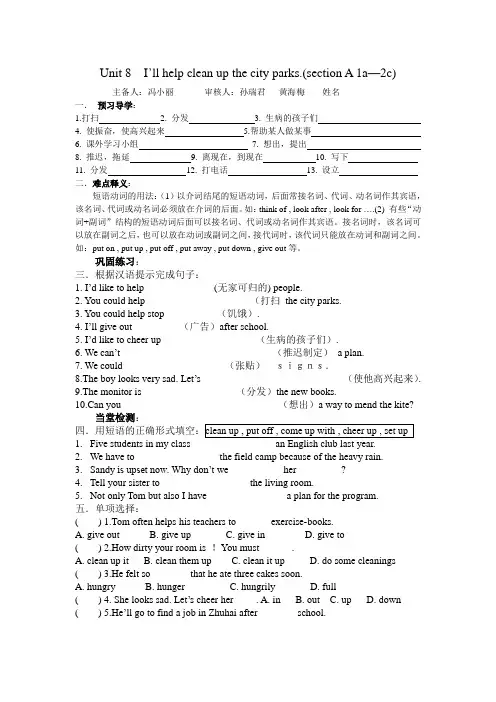
Unit 8 I’ll help clean up the city parks.(section A 1a—2c) 主备人:冯小丽审核人:孙瑞君黄海梅姓名__________一.预习导学:1.打扫2. 分发3. 生病的孩子们4. 使振奋,使高兴起来5.帮助某人做某事6. 课外学习小组7. 想出,提出8. 推迟,拖延9. 离现在,到现在10. 写下11. 分发12. 打电话13. 设立二.难点释义:短语动词的用法:(1)以介词结尾的短语动词,后面常接名词、代词、动名词作其宾语,该名词、代词或动名词必须放在介词的后面。
如:think of , look after , look for ….(2) 有些“动词+副词”结构的短语动词后面可以接名词、代词或动名词作其宾语。
接名词时,该名词可以放在副词之后,也可以放在动词或副词之间,接代词时,该代词只能放在动词和副词之间。
如:put on , put up , put off , put away , put down , give out等。
巩固练习:三.根据汉语提示完成句子:1. I’d like to help______________(无家可归的) people.2. You could help _________ ___________(打扫the city parks.3. You could help stop __________(饥饿).4. I’ll give out ________ (广告)after school.5. I’d like to cheer up _________ _________(生病的孩子们).6. We can’t _________ __________ __________(推迟制定)a plan.7. We could __________________(张贴)signs.8.The boy looks very sad. Let’s __________ _________ _________(使他高兴起来).9.The monitor is ________ __________(分发)the new books.10.Can you ________ _________ _____________(想出)a way to mend the kite?当堂检测:1.2.We have to ________________ the field camp because of the heavy rain.3.Sandy is upset now. Why don’t we __________ her_________?4.Tell your sister to _________________ the living room.5.Not only Tom but also I have _______________ a plan for the program.五.单项选择:( ) 1.Tom often helps his teachers to ______ exercise-books.A. give outB. give upC. give inD. give to( ) 2.How dirty your room is !You must ______.A. clean up itB. clean them upC. clean it upD. do some cleanings ( ) 3.He felt so _______ that he ate three cakes soon.A. hungryB. hungerC. hungrilyD. full( ) 4. She looks sad. Let’s cheer her ____. A. in B. out C. up D. down ( ) 5.He’ll go to find a job in Zhuhai after _______ school.A. leaveB. leavesC. he will leaveD.he leavesUnit 8 I’ll help clean up the city parks.(section A 3a—4)主备人:冯小丽审核人:孙瑞君黄海梅姓名__________一.预习导学:1.自愿花费时间做某事_____2.把…充分利用___3.计划做某事4. 一名职业歌手__5.着手去做某事6. 训练足球队___7.不但。
人教版九年级英语全册导学案(完美版)
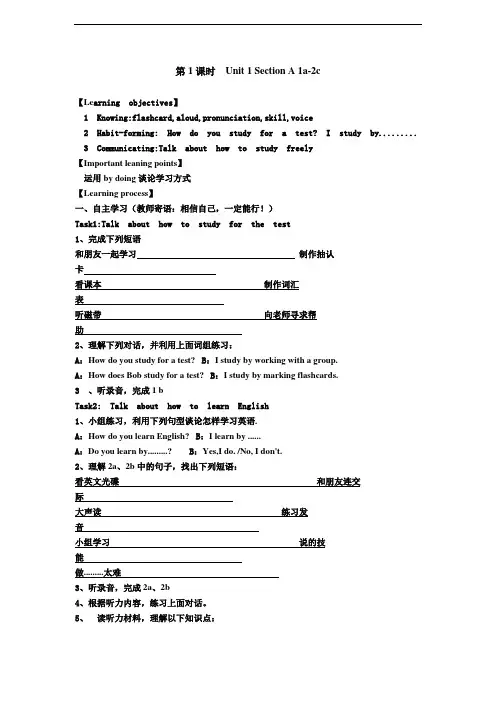
第1课时Unit 1 Section A 1a-2c【Le arning objectives】1 Knowing:flashcard,aloud,pronunciation,skill,voice2 Habit-forming: How do you study for a test? I study by.........3 Communicating:Talk about how to study freely【Important leaning points】运用by doing 谈论学习方式【Learning process】一、自主学习(教师寄语:相信自己,一定能行!)Task1:Talk about how to study for the test1、完成下列短语和朋友一起学习制作抽认卡看课本制作词汇表听磁带向老师寻求帮助2、理解下列对话,并利用上面词组练习:A:How do you study for a test? B:I study by working with a group.A:How does Bob study for a test? B:I study by marking flashcards.3 、听录音,完成1 bTask2: Talk about how to learn English1、小组练习,利用下列句型谈论怎样学习英语.A:How do you learn English? B:I learn by ......A:Do you learn by.........? B:Yes,I do. /No, I don't.2、理解2a、2b中的句子,找出下列短语:看英文光碟和朋友连交际大声读练习发音小组学习说的技能做.........太难3、听录音,完成2a、2b4、根据听力内容,练习上面对话。
5、读听力材料,理解以下知识点:the best way to learn EnglishWho has an idea?keep a diary in Englishlook up new words in a dicctionary二、Cooperration (教师寄语:学会合作,提高自我)根据听力材料,小组自由讨论如何学好英语?三、Summary根据下面的句子,总结by的用法和含义:1、I have to be in bed by 10 o'clock.2、There is a tree by the river.3、I go to work by bus.4、The boy is sent to the hospital by a kind man.5、You can learn English by working with friends.四、诊断评价(一)补全单词:1、It's a good way to read a2、The boy often l up the words in the dictionary.3、Do you have an i about weekend?4、K a diary helps to write English every day.5、The girl often learn by a the teacher for help.6、What about reading about to practise p?(二)补全短文:A:Tom,I know you (数学学的很好)last term.How do you learn math?B:I learnt it (通过做很多题) A:What else?B: (通过向老师寻求帮助)A:Did you learn ?(通过小组学习)B: Yes, i did. ( Lucy也是)【课后反思】(教师寄语:从不断反思中完善自己,提高自己)第2课时Unit 1 SectionA 3a-4【Learning objectives】1.Knowing: specific, memorize, grammar, differently, frustrate, frusratin g, quickly, add,not at all, excited, end up.2.Understanding:Be able to understand the meaning of the passage in 3 a.municating: ---How do you learn English?---I often write vocabular y lists.【Important points】1.Understanding:Be able to understand the meaning of the passage in 3 a.municating: ---How do you learn English?---I often write vocabular y lists.【Learning process】一、自主学习Task1学习第4部分短语,谈论自己如何学习英语。
【最新】人教版九年级英语Unit8教学案
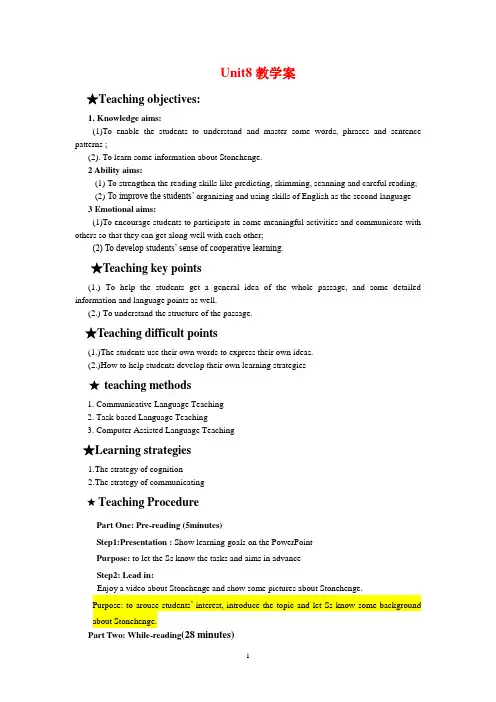
Unit8教学案★Teaching objectives:1.Knowledge aims:(1)To enable the students to understand and master some words, phrases and sentence patterns ;(2). To learn some information about Stonehenge.2 Ability aims:(1)To strengthen the reading skills like predicting, skimming, scanning and careful reading;(2)To improve the students’ organizing and using skills of English as the second language3 Emotional aims:(1)To encourage students to participate in some meaningful activities and communicate with others so that they can get along well with each other;(2) To develop students’ sense of cooperative learning.★Teaching key points(1.) To help the students get a general idea of the whole passage, and some detailed information and language points as well.(2.) To understand the structure of the passage.★Teaching difficult points(1.)The students use their own words to express their own ideas.(2.)How to help students develop their own learning strategies★ teaching methods1. Communicative Language Teaching2. Task-based Language Teaching3. Computer Assisted Language Teaching★Learning strategies1.The strategy of cognition2.The strategy of communicating★Teaching ProcedurePart One: Pre-reading (5minutes)Step1:Presentation : Show learning goals on the PowerPointPurpose: to let the Ss know the tasks and aims in advanceStep2: Lead in:Enjoy a video about Stonehenge and show some pictures about Stonehenge.Purpose: to arouse students’ interest, introduce the topic and let Ss know some background about Stonehenge.Part Two: While-reading(28 minutes)In While-reading , I adopt the top-down reading model. This step is divided into 3 parts:prediction, fast reading and careful reading.1)Prediction:If you are asked to write an article(文章)about a place, what will you write about it?Look at the title “Stonehenge--Can Anyone Explain Why It Is There ”.How do youunderstand the title?Purpose: to develop the habit of predicting before reading2) Fast reading Task 1:Skim to find out the main ideaTell the students: The theme(主题)of an article often comes in the first paragraph, usually atthe first or last sentence...Purpose: To help students develop the skill of skimming rapidly just to get a very generalimpression.Task2: Scan para2,3 to find out:1. How many ideas about what Stonehenge was used for are mentioned in the text? Task3Scan para4 to find out:1. How was Stonehenge built?2. Who built Stonehenge ?Task4:To get the structure of the passage:Purpose: To help students develop the skill of getting the structure of the passageStonehenge Where WhoWhen …3)Careful readingTask1: Read Part.1How many people visit Stonehenge every year? Why do so many people want to visit it?Task2:Read Part 2 carefully and describe the ideas.descriptionIdeas about what Stonehengewas used forHistorians believed...was...where...tried to...with the gods.Another popular idea is...might ...The.. were...in...,on...,the sun...intothe...Others believe...have...They think... while... "as you...,you...the...from ...Some think it might be...,or aplace to...ancestors.others think it was ...to... a...over...Purpose:To get the correct and useful information. Students should not only have a high speed of reading but also have a correct understanding of details.Task3: Read Part.3Do we build another Stonehenge? Why?What can we learn from ancient people?Purpose:To strengthen the moral education, which is to meet the needs of the New Curriculum Standards of English.4)Language appreciation :Translate:1. For many years, historians believe Stonehenge was a temple where ancient leaders tried to communicated with the gods.2. No one is sure what Stonehenge was used for, but most agree that the position of the stone must be for a special purpose.3. we do know they must have been hardworking--and great planners!Purpose:To let Ss accumulate some language points.Part three:Post-reading ( 10 minutes)Learning for use: Make a dialogue.假如你是一名导游,你和游客之间进行了有关Stonehenge的对话.Guide:Welcome to Stonehenge. I am honored tointroduce it to you.Visitor A: Could you tell me when it was built?Guide: ...Visitor B: ...Purpose:1.Enable the students to put the expressions in this passage into practice. It is a process of language output, which can help the renewal of the language. This exactly accords with the standard of high school curriculum, which advocates promoting students’thinking and expressing abilities in English. 2.Help Students form their own judgment . At the same time, students can learn to be cooperative.Part4: Question Time and homework( 2minutes)I’ll leave the last 2 minutes for the students to ask questions. It’s another chance for them to study autonomously.The homework : Add more information and finish your own mind map after class.Purpose: 1.According to the basic teaching theory from Robert Mills Gagné: “Every student is unique, every student wants to play a role in the class.” I have to try my best to make my class as lively and interesting as possible. Then all my students could find their positions in my lesson. Just as the movie says, “ Not one less”.2.Transfer the reading ability to writing ability.。
人教版九年级英语导学案
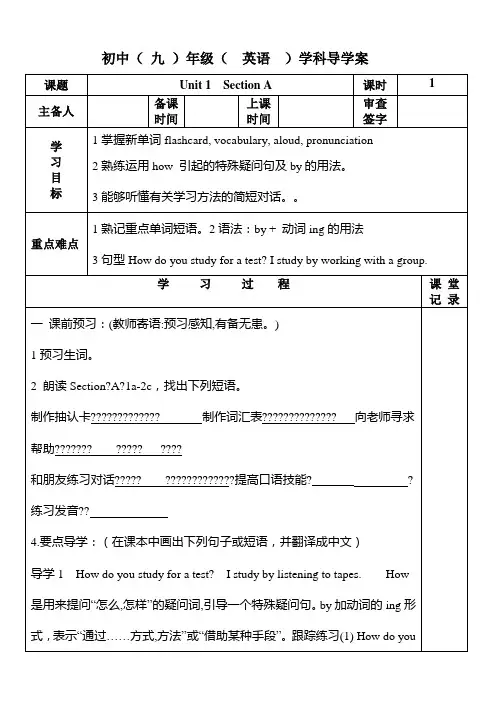
【跟踪训练】(1) Wangdan found _____easy to learn English. A. that B. it C. thisD. them(2) He found English very _______(easy).
9.I study English(通过制作)f1ashcards.
10.我们应该向老师请教。We ____ ____ the teacher____ ____.
11.这个问题太难了,我理解不了。It'shardmethis question.
This question ishardto.
12.朗读能提高你的口语。canyour spoken English.
【跟踪训练】:早晨跑步是保持身体健康的好方法。a good way to keep fit.
导学7 . He’sbeen learning Englishfor six years and really loves it.此句为现在完成进行时。其构成形式为“”。介词for与一段时间连用,常用于现在完成时和现在完成进行时的句子中。
frustrate v.使失望;使沮丧;使厌烦。frustrated表示“感到沮丧的”,常指“人”而言,在句中常作表语。frustrating表示“令人失望的;令人沮丧的”,常用来修饰物或事。
【跟踪训练】(1)她的话使我们失望。Her wordsus.
Unit8 It must belong to Carla教学设计
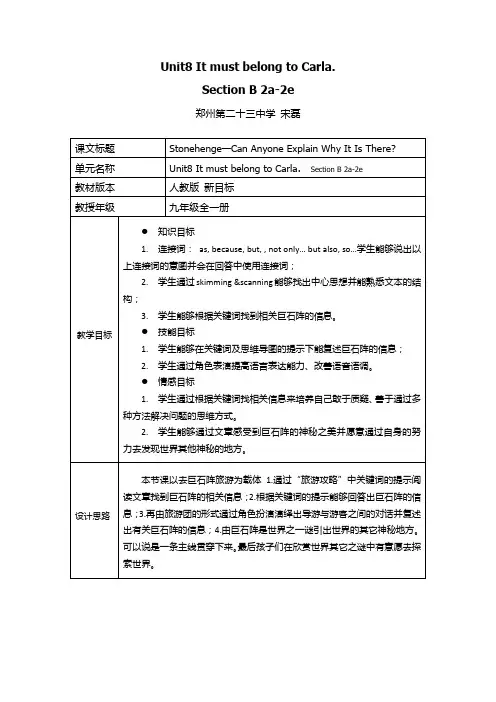
Unit8 It must belong to Carla.Section B 2a-2e郑州第二十三中学宋磊教学设计提问问题,学生回答。
Q: Where is Stonehenge?How many people visit Stonehenge everyyear?When do visitors especially go there? Why?How old is Stonehenge ?Who built Stonehenge?Can we build another Stonehenge? Why?对于文章重点内容有关巨石阵用途的猜测,以mind map 的形式带领学生识记。
(mind map 在blackboard design里面)Q:How many ideas(观点)are mentionedabout what Stonehenge was used for in the text?What are they?Step4. Post-reading1. 情境创设:In Stonehenge you meet yourfriends, you are invited to be their tour guide.2. 小组活动:角色扮演(role play )活动步骤:step1分配角色(assign the roles)step2 练习并表演(practice and actit out)3. Show time复述巨石阵的神秘及相关细节。
学法的指导,问题的设置有难有易,提高学生课堂的参与度。
通过提问问题,学生回答来了解文章细节。
学生小组合作讨论问题,完成任务,在学习的过程中相互启发、沟通,学会倾听,自主合作。
注重对话的完整性,为homework做铺垫。
培养学生的好奇心和勇于探索的精神,从。
人教版九年级英语全册导学案(完美版)
2、理解 2a、2b 中的句子,找出下列短语:
看英文光碟
和朋友连交际
大声读
练习发音
小组学习
说的技能
做.........太难
3、听录音,完成 2a、2b
4、根据听力内容,练习上面对话。
5、 读听力材料,理解以下知识点:
the best way to learn English
Who has an idea?
1、完成下列短语
和朋友一起学习
制作抽认卡
看课本
制作词汇表
听磁带
向老师寻求帮助
2、理解下列对话,并利用上面词组练习:
A:How do you study for a test? Bห้องสมุดไป่ตู้I study by working with a group.
A:How does Bob study for a test? B:I study by marking flashcards.
a fun way to do... mak mistakes in... municating: Role play the listening conversation 【Learning process】 一、自主学习 Task1: Talk about your problems in learning English. 1、读 1a 中的句子,正确译出下列短语的汉语意思.
keep a diary in English
look up new words in a dicctionary
二、Cooperration (教师寄语:学会合作,提高自我)
根据听力材料,小组自由讨论如何学好英语?
三、Summary
根据下面的句子,总结 by 的用法和含义:
新版新目标九年级英语unit8导学案共25页PPT
26、要使整个人生都过得舒适、愉快,这是不可能的,因为人类必须具备一种能应付逆境的态度。——卢梭
▪
27、只有把抱怨环境的心情,化为上进的力量,才是成功的保证。——罗曼·罗兰
▪
28、知之者不如好之者,好之者不如乐之者。——孔子
▪
29、勇猛、大胆和坚定的决心能够抵得上武器的精良。——达·芬奇
▪
30、意志是一个强壮的盲人,倚靠在明眼的跛子肩上。——叔本华
新版新目标九年级英语unit8导学案
1、 舟 遥 遥 以 轻飏, 风飘飘 而吹衣 。 2、 秋 菊 有 佳 色,裛 露掇其 英。 3、 日 月 掷 人 去,有 志不获 骋。 4、 未 言 心 相 醉,不 再接杯 酒。 5、 黄 发 垂 髫 ,并怡 然自乐 。Leabharlann ▪谢谢!25
人教版初中初三九年级英语第八单元unit8教材全解加课后练习附答案(8页)备课教案教学设计教学反思导学案
导学案教师: 学生: 年级:日期: 星期: 时段:课题第Unit8 It must belong to Carla考点分析:unit8核心语法之情态动词表示推测的用法学习目标与考点分析情态动词表推测的用法;表达某人的想法与观点学习重点学习方法学习内容与过程课文解读Section BStonehenge ---- Can Anyone Explain Why It Is There?Stonehenge, a rock circle, is not only one of Britain’s most famous historical places but also one of its greatest mysteries. Every year it receives more than 750,000 visitors. People like to go to this place especially in June as they want to see the sun rising on the longest day of the year.For many years, historians believed Stonehenge was a temple where ancient leaders tried to communicate with the gods. However, historian Paul Stoker thinks this can’t be true because Stonehenge was built so many centuries ago. “The leaders arrived in England much later,” he points out.Another popular idea is that Stonehenge might be a kind of calendar. The large stones were put together in a certain way. On midsummer’s morning, the sun shines directly into the center of the stones. Other people believe the stones have a medical purpose. They think the stones can prevent illness and keep people healthy. “As you walk there, you can feel the energy from your feet moving up your body,” said one visitor. No one is sure what Stonehenge was used for, but most agree that the position of the stones must be for a special purpose. Some think it might be a burial place, or a place to honor ancestors. Others think it was built to celebrate a victory over an enemy.Stonehenge was built slowly over a long period of time. Most historians believe it must be almost 5,000 years old. One of the greatest mysteries is how it was built because the stones are so big and heavy. In2001, a group of English volunteers tried to build another Stonehenge, but th ey couldn’t. “We don’t really know who built Stonehenge,” says Paul Stoker. “And perhaps we might never know, but we do know they must have been hardworking ---- and great planners!”要点详解1.Why do you think the man is running?本句由“疑问词+do you think+其他”构成的特殊疑问句。
九年级英语全册 Unit8_单元主题思维导图
单元整体话题篇
so, as, because, since, but, however, though, not only…but also, or, when, while
Linking words or phrases
Mysteries
Making inferences
Structures
must, might, could. can't
Talking about belongings
It must be hot outdoors. She might be in the laboratory. I wonder who it could be. It can't be Carla
A: Whose volleyball is this? B: It could be Carla's. Or it might belong to Linda.
How & Who
1.Be built slowly over a long period of time. 2. Historians: almost 5,000 years old. 3. Be made of big and heavy stones. 4. Don't know who. but do know, hard-working and great planners
A: Whose hair band is this? B: It must be Carla’s A: It could be Mei's hair band, Or it might belong to Linda. They both have long hair. B: It can't belong to a boy.