
2020年全国卷Ⅲ英语高考试题(含答案)
绝密★启用前2020年普通高等学校招生全国统一考试(全国卷III)英语注意事项:1.答卷前,考生务必将自己的姓名、准考证号填写在答题卡和试卷指定位置上。
2.回答选择题时,选出每小题答案后,用铅笔把答题卡上对应题目的答案标号涂黑。
如需改动,用橡皮擦干净后,再选涂其他答案标号。
回答非选择题时,将答案写在答题卡上,写在本试卷上无效。
3.考试结束后,将本试卷和答题卡一并交回。
第一部分听力(共两节,满分30分)做题时,先将答案标在试卷上。
录音内容结束后,你将有两分钟的时间将试卷上的答案转涂到答题卡上。
第一节(共5小题;每小题1.5分,满分7.5分)听下面5段对话。
每段对话后有一个小题,从题中所给的A、B、C三个选项中选出最佳选项。
听完每段对话后,你都有10秒钟的时间来回答有关小题和阅读下一小题。
每段对话仅读一遍。
例:How much is the shirt?A.£19.15.B.£9.18.C.£9.15.答案是C。
1.Where does the conversation probably take place?A.In a supermarket.B.In the post office.C.In the street.2.What did Carl do?A.He designed a medal.B.He fixed a TV set.C.He took a test.3.What does the man do?A.He’s a tailor.B.He’s a waiter.C.He’s a shop assistant.4.When will the flight arrive?A.At18:20.B.At18:35.C.At18:50.5.How can the man improve his article?A.By deleting unnecessary words.B.By adding a couple of points.C.By correcting grammar mistakes.第二节(共15小题;每小题1.5分,满分22.5分)听下面5段对话或独白。
每段对话或独白后有几个小题,从题中所给的A、B、C三个选项中选出最佳选项。
听每段对话或独白前,你将有时间阅读各个小题,每小题5秒钟;听完后,各小题将给出5秒钟的作答时间。
每段对话或独白读两遍。
听第6段材料,回答第6、7题。
6.What does Bill often do on Friday night?A.Visit his parents.B.Go to the movies.C.Walk along Broadway.7.Who watches musical plays most often?A.Bill.B.Aarah.C.Bill’s parents.听第7段材料,回答第8、9题。
8.Why does David want to speak to Mike?A.To invite him to a party.B.To discuss a schedule.C.To call off a meeting.9.What do we know about the speakers?A.They are colleagues.B.They are close friends.C.They’ve never met before.听第8段材料,回答第10至12题。
10.What kind of camera does the man want?A.A TV camera.B.A video camera.C.A movie camera.11.Which function is the man most interested in?A.Underwater filming.B.A large memory.C.Auto-focus.12.How much would the man pay for the second camera?A.950euros.B.650euros.C.470euros.听第9段材料,回答第13至16题。
13.Who is Clifford?A.A little girl.B.The man’s pet.C.A fictional character.14.Who suggested that Norman paint for children’s books?A.His wife.B.Elizabeth.C.A publisher.15.What is Norman’s story based on?A.A book.B.A painting.C.A young woman.16.What is it that shocked Norman?A.His unexpected success.B.His efforts made in vain.C.His editor’s disagreement.听第10段材料,回答第17至20题。
17.Who would like to make small talk according to the speaker?A.Relatives.B.Strangers.C.Visitors.18.Why do people have small talk?A.To express opinions.B.To avoid arguments.C.To show friendliness.19.Which of the following is a frequent topic in small talk?A.Politics.B.Movies.C.Salaries.20.What does the speaker recommend at the end of his lecture?A.Asking open-ended questions.B.Feeling free to change topics.C.Making small talk interesting.第二部分阅读理解(共两节,满分40分)第一节(共15小题;每小题2分,满分30分)阅读下列短文,从每题所给的A、B、C和D四个选项中,选出最佳选项。
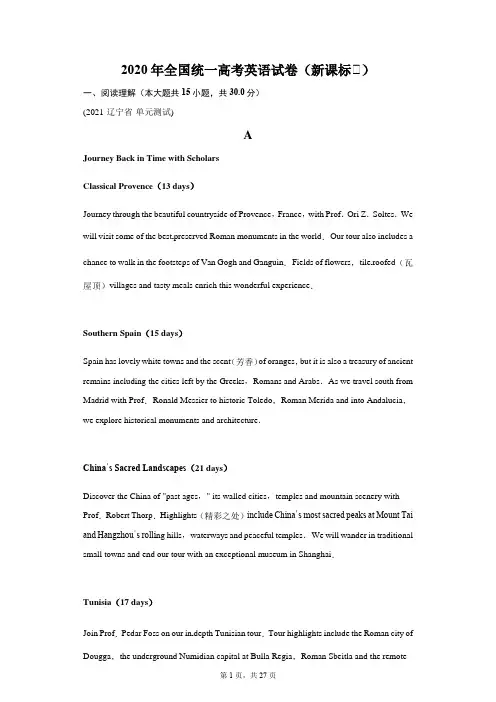
AJourney Back in Time with ScholarsClassical Provence(13days)Journey through the beautiful countryside of Provence,France,with Prof.Ori Z.Soltes.We will visit some of the best-preserved Roman monuments in the world.Our tour also includes a chance to walk in the footsteps of Van Gogh and Gauguin.Fields of flowers,tile-roofed(瓦屋顶)villages and tasty meals enrich this wonderful experience.Southern Spain(15days)Spain has lovely white towns and the scent(芳香)of oranges,but it is also a treasury of ancient remains including the cities left by the Greeks,Romans and Arabs.As we travel south from Madrid with Prof.Ronald Messier to historic Toledo,Roman Merida and into Andalucia,we explore historical monuments and architecture. China’s Sacred Landscapes(21days)Discover the China of“past ages,”its walled cities,temples and mountain scenery with Prof.Robert Thorp.Highlights(精彩之处)include China’s most sacred peaks at Mount Tai and Hangzbou’s rolling hills,waterways and peaceful temples.We will wander in traditional small towns and end our tour with an exceptional museum in Shanghai.Tunisia(17days)Join Prof.Pedar Foss on our in-depth Tunisian tour.Tour highlights include the Roman city of Dougga,the underground Numidian capital at Bulla Regia,Roman Sbeitla and the remote areas around Tataouine and Matmata, uique for underground cities.Our journey takes us to picturesque Berber villages and lovely beaches.21.What can visitors see in both Classical Provence and Southern Spain?A.Historical monuments.B.Fields of flowers.C.Van Gogh’s paintings.D.Greek buildings.22.Which country is Prof.Thorp most knowledgeable about?A.France.B.Spain.C.China.D.Tunisia.23.Which of the following highlights the Tunisian tour?A.White towns.B.Underground cities.C.Tile-roofed villages.D.Rolling hills.BWhen"Rise of the Planet of the Apes"was first shown to the public last month,a group of excited animal activists gathered on Hollywood Boulevard.But they weren’t there to throw red paint on fur-coat-wearing film stars. Instead,one activist,dressed in a full-body monkey suit,had arrived with a sign praising the filmmakers:"Thanks for not using real apes(猿)!"The creative team behind"Apes"used motion-capture(动作捕捉)technology to create digitalized animals, spending tens of millions of dollars on technology that records an actor’s performance and later processes it with computer graphics to create a final image(图像).In this case,one of a realistic-looking ape.Yet"Apes"is more exception than the rule.In fact,Hollywood has been hot on live animals lately.One nonprofit organization,which monitors the treatment or animals in filmed entertainment,is keeping tabs on more than2,000productions this year.Already,a number of films,including"Water for Elephants,""The Hangover Part Ⅱ"and"Zookeeper,"have drawn the anger of activists who say the creatures acting in them haven’t been treated properly.In some cases,it’s not so much the treatment of the animals on set in the studio that has activists worried;it’s the off-set training and living conditions that are raising concerns.And there are questions about the films made outside the States,which sometimes are not monitored as closely as productions filmed in the Sates.24.Why did the animal activists gather on Hollywood Boulevard?A.To see famous film stars.B.To oppose wearing fur coats.C.To raise money for animal protection.D.To express thanks to some filmmakers.25.What does paragraph2mainly talk about?A.The cost of making"Apes."B.The creation of digitalized apes.C.The publicity about“Apes."D.The performance of real apes.26.What does the underlined phrase"keeping tabs on"in paragraph3probably mean?A.Listing completely.B.Directing professionally.C.Promoting successfully.D.Watching carefully.27.What can we infer from the last paragraph about animal actors?A.They may be badly treated.B.They should take further training.C.They could be traded illegally.D.They would lose popularity.CWith the young unable to afford to leave home and the old at risk of isolation(孤独),more families are choosing to live together.The doorway to peace and quiet,for Nick Bright at least,leads straight to his mother-in-law,she lives on the ground floor,while he lives upstairs with his wife and their two daughters.Four years ago they all moved into a three-storey Victorian house in Bristol—one of a growing number of multigenerational families in the UK living together under the same roof.They share a front door and a washing machine,but Rita Whitehead has her own kitchen,bathroom,bedroom and living room on the ground floor.“We floated the idea to my mum of sharing a house,”says Kathryn Whitehead.Rita cuts in:“We spoke more with Nick because I think it’s a big thing for Nick to live with his mother-in-law.”And what does Nick think?“From my standpoint,it all seems to work very well.Would I recommend it?Yes, I think I would.”It’s hard to tell exactly how many people agree with him,but research indicates that the numbers have been rising for some time.Official reports suggest that the number of households with three generations living together had risen from325,000in2001to419,000in2013.Other varieties of multigenerational family are more common.Some people live with their elderly parents; many more adult children are returning to the family home,if they ever left.It is said that about20%of 25-34-year-olds live with their parents,compared with16%in1991.The total number of all multigenerationalhouseholds in Britain is thought to be about1.8million.Stories like that are more common in parts of the world where multigenerational living is more firmly rooted. In India,particularly outside cities,young women are expected to move in with their husband’s family when they get married.28.Who mainly uses the ground floor in the Victorian house in Bristol?A.Nick.B.Rita.C.KathrynD.The daughters.29.What is Nick’s attitude towards sharing the house with his mother-in-law?A.Positive.B.Carefree.C.Tolerant.D.Unwilling.30.What is the author’s statement about multigenerational family based on?A.Family traditions.B.Financial reports.C.Published statistics.D.Public opinions.31.What is the text mainly about?A.Lifestyles in different countries.B.Conflicts between generations.C.A housing problem in Britain.D.A rising trend of living in the UK.DWe are the products of evolution,and not just evolution that occurred billions of years ago.As scientists look deeper into our genes(基因),they are finding examples of human evolution in just the past few thousand years. People in Ethiopian highlands have adapted to living at high altitudes.Cattle-raising people in East Africa and northern Europe have gained a mutation(突变)that helps them digest milk as adults.On Thursday in an article published in Cell,a team of researchers reported a new kind of adaptation—not to air or to food,but to the ocean.A group of sea-dwelling people in Southeast Asia have evolved into better divers. The Bajau,as these people are known,number in the hundreds of thousands in Indonesia,Malaysia and the Philippines.They have traditionally lived on houseboats;in recent times,they’ve also built houses on stilts(支柱)in coastal waters.“They are simply a stranger to the land,"said Redney C.Jubilado,a University of Hawaii researcher who studies the Bajau.Dr.Jubilado first met the Bajau while growing up on Samal Island in the Philippines.They made a living as divers,spearfishing or harvesting shellfish."We were so amazed that they could stay underwater much longer than us local islanders,"Dr.Jubilado said.“I could see them actually walking under the sea."In201,Melissa Ilardo,then a graduate student in genetics at the University of Copenhagen,heard about the Bajau.She wondered if centuries of diving could have led to the evolution of physical characteristics that made the task easier for them.“It seemed like the perfect chance for natural selection to act on a population,"said Dr.Ilardo.She also said there were likely a number of other genes that help the Bajau dive.32.What does the author want to tell us by the examples in paragraph1?A.Environmental adaptation of cattle raisers.B.New knowledge of human evolution.C.Recent findings of human origin.D.Significance of food selection.33.Where do the Bajau build their houses?A.In valleys.B.Near rivers.C.On the beach.D.Off the coast.34.Why was the young Jubilado astonished at the Bajau?A.They could walk on stilts all day.B.They had a superb way of fishing.C.They could stay long underwater.D.They lived on both land and water.35.What can be a suitable title for the text?A.Bodies Remodeled for a Life at SeaB.Highlanders’Survival SkillsC.Basic Methods of Genetic ResearchD.The World’s Best Divers第二节(共5小题;每小题2分,满分10分)根据短文内容,从短文后的选项中选出能填入空白处的最佳选项。
2020年普通高等学校招生全国统一考试(新课标III卷)英语试题及答案

[绝密★启用前]2020年普通高等学校招生全国统一考试(新课标III卷)英语注意事项:1. 答卷前,考生务必将自己的姓名、准考证号填写在答题卡上。
2. 回答选择题时,选出每小题答案后,用铅笔把答题卡上对应题目的答案标号涂黑。
如需改动,用橡皮擦干净后,再选涂其他答案标号。
回答非选择题时,将答案写在答题卡上,写在本试卷上无效。
3. 考试结束后,将本试卷和答题卡一并交回。
第一部分听力(共两节,满分30分)做题时,先将答案标在试卷上。
录音内容结束后,你将有两分钟的时间将试卷上的答案转涂到答题卡上。
第一节(共5小题;每小题1.5分,满分7.5分)听下面5短对话,每段对话后有一个小题,从题中给的A、B、C三个选项中选出最佳选项。
听完每段对话后,你都有10秒钟的时间来回答有关小题和阅读下一小题。
每段对话仅读一遍。
例:How much is the shirt?A.£19.15.B.£9.18.C.£9.15.答案是C。
1.Where does the conversation probably take place?A .In a supermarket. B. In the post office. C. In the street.2.What did Carl do?A. He designed a medal.B. He fixed a TV set.C. He took a test.3.What does the man do?A. He is a tailor.B. He is a wait er.C. He’s a shop assistant.4. When will the flight arrive?A. At 18:20.B. At 18:35.C. At 18:50.5.How can the man improve his article?A. By deleting unnecessary words.B. By adding a couple of points.C. By correcting grammar mistakes.第二节(共15小题;每小题1.5分,满分22.5分)听下面5段对话或独白,每段对话或独白后有几个小题,从题中所给的A、B、C三个选项中选出最佳选项。
2020年普通高等学校招生全国统一考试:全国卷Ⅲ【英语】试题(含答案)

『2020年普高学校招生全国统一考试』『知己知彼·百战不殆』绝密★启用前2020年普通高等学校招生全国统一考试(全国卷III)英语注意事项:1. 答卷前,考生务必将自己的姓名、准考证号填写在答题卡和试卷指定位置上。
2. 回答选择题时,选出每小题答案后,用铅笔把答题卡上对应题目的答案标号涂黑。
如需改动,用橡皮擦干净后,再选涂其他答案标号。
回答非选择题时,将答案写在答题卡上,写在本试卷上无效。
3. 考试结束后,将本试卷和答题卡一并交回。
第一部分听力(共两节 ,满分30分)做题时 ,先将答案标在试卷上。
录音内容结束后 ,你将有两分钟的时间将试卷上的答案转涂到答题卡上。
第一节(共5小题;每小题1.5分,满分7.5分)听下面5段对话。
每段对话后有一个小题,从题中所给的A、B、C三个选项中选出最佳选项。
听完每段对话后,你都有10秒钟的时间来回答有关小题和阅读下一小题。
每段对话仅读一遍。
例:How much is the shirt?A. £19.15.B. £9.18.C. £9.15.答案是C。
1. Where does the conversation probably take place?A. In a supermarket.B. In the post office.C. In the street.2. What did Carl do?A. He designed a medal.B. He fixed a TV set.C. He took a test.3. What does the man do?A. He’s a tailor.B. He’s a waiter.C. He’s a shop assistan t.4. When will the flight arrive?A. At 18:20.B. At 18:35.C. At 18:50.5. How can the man improve his article?A. By deleting unnecessary words.B. By adding a couple of points.C. By correcting grammar mistakes.第二节(共15小题;每小题1.5分,满分22.5分)听下面5段对话或独白。
2020年全国统一高考英语试卷(新课标Ⅲ)(解析版)

A.Bill.B.Aarah.C.Bill’s parents.
[答案[6. B 7. B
[解析[
[原文[本题为听力题,解析略。
听下面一段较长对话,回答以下小题。
0
8.Why does David want to speak to Mike?
A.To invite him to a party.
B.To discuss a schedule.
2020年普通高等学校招生全国统一考试(全国卷III)
英语
注意事项:
1.答卷前,考生务必将自己的姓名、准考证号填写在答题卡和试卷指定位置上。
2.回答选择题时,选出每小题答案后,用铅笔把答题卡上对应题目的答案标号涂黑。如需改动,用橡皮擦干净后,再选涂其他答案标号。回答非选择题时,将答案写在答题卡上,写在本试卷上无效。
例:How much is the shirt?
A. £19.15. B. £9.18. C. £9.15.
答案是C。
1.[此处可播放相关音频,请去附件查看[
Where does the conversation probably take place?
A.In a supermarket.B.In the post office.C.In the street.
3.考试结束后,将本试卷和答题卡一并交回。
第一部分 听力(共两节,满分30分)
做题时,先将答案标在试卷上。录音内容结束后,你将有两分钟的时间将试卷上的答案转涂到答题卡上。
第一节(共5小题;每小题1.5分,满分7.5分)
听下面5段对话。每段对话后有一个小题,从题中所给的A、B、C三个选项中选出最佳选项。听完每段对话后,你都有10秒钟的时间来回答有关小题和阅读下一小题。每段对话仅读一遍。
2020年普通高等学校招生全国统一考试(新课标Ⅲ)真题 英语试题(解析版)

2020年普通高等学校招生全国统一考试(全国III卷)英语注意事项:1.答卷前,考生务必将自己的姓名、准考证号填写在答题卡和试卷指定位置上。
2.回答选择题时,选出每小题答案后,用铅笔把答题卡上对应题目的答案标号涂黑。
如需改动,用橡皮擦干净后,再选涂其他答案标号。
回答非选择题时,将答案写在答题卡上,写在本试卷上无效。
3.考试结束后,将本试卷和答题卡一并交回。
第一部分听力(共两节,满分30分)做题时,先将答案标在试卷上。
录音内容结束后,你将有两分钟的时间将试卷上的答案转涂到答题卡上。
第一节(共5小题;每小题1.5分,满分7.5分)听下面5段对话。
每段对话后有一个小题,从题中所给的A、B、C三个选项中选出最佳选项。
听完每段对话后,你都有10秒钟的时间来回答有关小题和阅读下一小题。
每段对话仅读一遍。
例:How much is the shirt?A. £19.15.B. £9.18.C. £9.15.答案是C。
1.Where does the conversation probably take place?A. In a supermarket.B. In the post office.C. In the street.【答案】C【原文】本题为听力题,解析略。
2.What did Carl do?A. He designed a medal.B. He fixed a TV set.C. He took a test.【答案】B【原文】本题为听力题。
解析略。
3.What does the man do?A. He’s a tailor.B. He’s a waiter.C. He’s a shop assistant.【答案】A【原文】本题为听力题,解析略。
4.When will the flight arrive?A. At 18:20.B. At 18:35.C. At 18:50.【答案】C【原文】本题为听力题,解析略。
2020年全国统一高考英语试卷(新课标Ⅲ)(附答案详解)
2020年全国统一高考英语试卷(新课标Ⅲ)一、阅读理解(本大题共15小题,共30.0分)(2021·辽宁省·单元测试)AJourney Back in Time with ScholarsClassical Provence(13 days)Journey through the beautiful countryside of Provence,France,with Prof.Ori Z.Soltes.We will visit some of the best﹣preserved Roman monuments in the world.Our tour also includes a chance to walk in the footsteps of Van Gogh and Ganguin.Fields of flowers,tile﹣roofed(瓦屋顶)villages and tasty meals enrich this wonderful experience.Southern Spain(15 days)Spain has lovely white towns and the scent(芳香)of oranges,but it is also a treasury of ancient remains including the cities left by the Greeks,Romans and Arabs.As we travel south from Madrid with Prof.Ronald Messier to historic Toledo,Roman Merida and into Andalucia,we explore historical monuments and architecture.Chinaˈs Sacred Landscapes(21 days)Discover the China of "past ages," its walled cities,temples and mountain scenery with Prof.Robert Thorp.Highlights(精彩之处)include Chinaˈs most sacred peaks at Mount Tai and Hangzhouˈs rolli ng hills,waterways and peaceful temples.We will wander in traditional small towns and end our tour with an exceptional museum in Shanghai.Tunisia(17 days)Join Prof.Pedar Foss on our in﹣depth Tunisian tour.Tour highlights include the Roman city of Dougga,the underground Numidian capital at Bulla Regia,Roman Sbeitla and the remoteareas around Tataouine and Matmata,unique for underground cities.Our journey takes us to picturesque Berber villages and lovely beaches.1.What can visitors see in both Classical Provence and Southern Spain?A. Historical monuments.B. Fields of flowers.C. Van Goghˈs paintings.D. Greek buildings.2.Which country is Prof.Thorp most knowledgeable about?A. France.B. Spain.C. China.D. Tunisia.3.Which of the following highlights the Tunisian tour?A. White towns.B. Underground cities.C. Tile-roofed villages.D. Rolling hills.(2021·安徽省合肥市·月考试卷)BWhen "Rise of the Planet of the Apes" was first shown to the public last month,a group of excited animal activists gathered on Hollywood Boulevard.But they werenˈt there to throw red paint on fur﹣coat﹣wearing film stars.Instead,one activist,dressed in a full﹣body monkey suit,had arrived with a sign praising the filmmakers:"Thanks for not using real apes(猿)!"The creative team behind "Apes" used motion﹣capture(动作捕捉)technology to create digitalized animals,spending tens of millions of dollars on technology that records an actorˈs performance and later processes it with computer graphics to create a final image(图象).In this case,one of a realistic﹣looking ape.Yet "Apes" is more exception than the rule.In fact,Hollywood has been hot on live animals lately.One nonprofit organization,which monitors the treatment of animals in filmed entertainment,is keeping tabs on more than 2,000 productions this year.Already,a number of films,including "Water for Elephants," "The Hangover Part Ⅱ" and "Zookeeper," have drawn the anger of activists who say the creatures acting in them havenˈt been treated properly.In some cases,itˈs not so much the treatment of the animals on set in the studio that has activists worried;itˈs the off-set training and living conditions that are raising concerns.And there are questions about the films made outside the States,which sometimes are not monitored as closely as productions filmed in the States.4.Why did the animal activists gather on Hollywood Boulevard?A. To see famous film stars.B. To oppose wearing fur coats.C. To raise money for animal protection.D. To express thanks to some filmmakers.5.What does paragraph 2 mainly talk about?A. The cost of making "Apes."B. The creation of digitalized apes.C. The publicity about "Apes."D. The performance of real apes.6.What does the underlined phrase "keeping tabs on" in paragraph 3 probably mean?A. Listing completely.B. Directing professionally.C. Promoting successfully.D. Watching carefully.7.What can we infer from the last paragraph about animal actors?A. They may be badly treated.B. They should take further training.C. They could be traded illegally.D. They would lose popularity.(2021·安徽省蚌埠市·单元测试)CWith the young unable to afford to leave home and the old at risk of isolation(孤独),more families are choosing to live together.The doorway to peace and quiet,for Nick Bright at least,leads straight to his mother-in-law:she lives on the ground floor,while he lives upstairs with his wife and their two daughters.Four years ago they all moved into a three-storey Victorian house in Bristol—one of a growing number of multigenerational families in the UK living together under the same roof.They share a front door and a washing machine,but Rita Whitehead has her own kitchen,bathroom,bedroom and living room on the ground floor."We floated the idea to my mum of sharing a house," says Kathryn Whitehead.Rita cuts in:"We spoke more with Nick because I think itˈs a big thing for Nick to live with his mother-in-law."And what does Nick think?"From my standpoint,it all seems to work very well.Would I recommend it?Yes,I think I would."Itˈs hard to tell exactly how many people agree with him,but research indicates that the numbers have been rising for some time.Official reports suggest that the number of households with three generations living together had risen from 325,000 in 2001 to 419,000 in 2013.Other varieties of multigenerational family are more common.Some people live with their elderly parents;many more adult children are returning to the family home,if they ever left.It is said that about 20% of 25﹣34-year-olds live with their parents,compared with 16% in 1991.The total number of all multigenerational households in Britain is thought to be about 1.8 million.Stories like that are more common in parts of the world,where multigenerational living is more firmly rooted.In India,particularly outside cities,young women are expected to move in with their husbandˈs family when they get married.8.Who mainly uses the ground floor in the Victorian house in Bristol?A. Nick.B. Rita.C. Kathryn.D. The daughters.9.What is Nickˈs attitude towards sharing the house with his mother-in-law?A. Positive.B. Carefree.C. Tolerant.D. Unwilling.10.What is the authorˈs statement about multigenerational family based on?A. Family traditions.B. Financial reports.C. Published statistics.D. Public opinions.11.What is the text mainly about?A. Lifestyles in different countries.B. Conflicts between generations.C. A housing problem in Britain.D. A rising trend of living in the UK.(2020·内蒙古自治区乌兰察布市·月考试卷)DWe are the products of evolution,and not just evolution that occurred billions of years ago.As scientists look deeper into our genes(基因),they are finding examples of human evolution in just the past few thousand years.People in Ethiopian highlands have adapted to living at high altitudes.Cattle-raising people in East Africa and northern Europe have gained a mutation (突变)that helps them digest milk as adults.On Thursday in an article published in Cell,a team of researchers reported a new kind of adaptation—not to air or to food,but to the ocean.A group of sea﹣dwelling people in Southeast Asia have evolved into better divers.The Bajau,as these people are known,number in the hundreds of thousands in Indonesia,Malaysia and the Philippines.They have traditionally lived on houseboats;in recent times,theyˈve also built houses on stilts(支柱)in coastal waters."They are simply a stranger to the land," said Rodney C.Jubilado,a University of Hawaii researcher who studies the Bajau.Dr.Jubilado first met the Bajau while growing up on Samal Island in the Philippines.They made a living as divers,spearfishing or harvesting shellfish."We were so amazed that they could stay underwater much longer than us local islanders," Dr.Jubilado said."I could see them actually walking under the sea."In 2015,Melissa Ilardo,then a graduate student in genetics at the University of Copenhagen,heard about the Bajau.She wondered if centuries of diving could have led to the evolution of physical characteristics that made the task easier for them."It seemed like the perfect chance for natural selection to act on a population," said Dr.Ilardo.She also said there were likelya number of other genes that help the Bajau dive.12.What does the author want to tell us by the examples in paragraph 1?A. Environmental adaptation of cattle raisers.B. New knowledge of human evolution.C. Recent findings of human origin.D. Significance of food selection.13.Where do the Bajau build their houses?A. In valleys.B. Near rivers.C. On the beach.D. Off the coast.14.Why was the young Jubilado astonished at the Bajau?A. They could walk on stilts all day.B. They had a superb way of fishing.C. They could stay long underwater.D. They lived on both land and water.15.What can be a suitable title for the text?A. Bodies Remodeled for a Life at SeaB. Highlandersˈ Survival SkillsC. Basic Methods of Genetic ResearchD. The Worldˈs Best Divers二、阅读七选五(本大题共5小题,共10.0分)(2020·山西省·单元测试) A housewarming party is a special party to be held when someone buys or moves into a new apartment or house.The person who bought the house or moved is the one who throws the party.The party is a chance for friends and family to congratulate the person on the new home.(1)And it is a good time to fill the new space with love and hopefully presents.(2)Some people register a list of things they want or need for their new home at a local store or stores.Some common things people will put on a gift registry include kitchen tools like knives and things like curtains Even if there isnˈt a registry,a good housewarming gift is something to decorate the new house with,like a piece of art or a plant.(3)This is often appreciated since at a housewarming there isnˈt a lot of food served.There are usually no planned activities like games at a housewarming party.The host or hostess of the party will,however,probably give all the guests a tour of their new home.Sometimes,because a housewarming party happens shortly after a person moves into their new home,people may be asked to help unpack boxes.(4)Housewarming parties get their name from the fact that a long time ago people would actually bring firewood to a new home as a gift.(5)Now most homes have central heating and donˈt use fires to keep warm.16. A. This isnˈt usual though.B. It is traditional to bring a gift to a housewarming party.C. You can also bring food or drinks to share with the other guests.D. If youˈre lucky enough to receive gifts,keep them in a safe place.E. It also gives people a chance to see what the new home looks like.F. The best housewarming parties encourage old friends to get together.G. This was so that the person could keep their home warm for the winter.17. A. This isnˈt usual though.B. It is traditional to bring a gift to a housewarming party.C. You can also bring food or drinks to share with the other guests.D. If youˈre lucky enough to receive gifts,keep them in a safe place.E. It also gives people a chance to see what the new home looks like.F. The best housewarming parties encourage old friends to get together.G. This was so that the person could keep their home warm for the winter.18. A. This isnˈt usual though.B. It is traditional to bring a gift to a housewarming party.C. You can also bring food or drinks to share with the other guests.D. If youˈre lucky enough to receive gifts,keep them in a safe place.E. It also gives people a chance to see what the new home looks like.F. The best housewarming parties encourage old friends to get together.G. This was so that the person could keep their home warm for the winter.19. A. This isnˈt usual though.B. It is traditional to bring a gift to a housewarming party.C. You can also bring food or drinks to share with the other guests.D. If youˈre lucky enough to receive gifts,keep them in a safe place.E. It also gives people a chance to see what the new home looks like.F. The best housewarming parties encourage old friends to get together.G. This was so that the person could keep their home warm for the winter.20. A. This isnˈt usual though.B. It is traditional to bring a gift to a housewarming party.C. You can also bring food or drinks to share with the other guests.D. If youˈre lucky enough to receive gifts,keep them in a safe place.E. It also gives people a chance to see what the new home looks like.F. The best housewarming parties encourage old friends to get together.G. This was so that the person could keep their home warm for the winter.三、完形填空(本大题共20小题,共30.0分)(2021·浙江省湖州市·单元测试) As a businesswoman,I care deeply about my customers.But like anyone for whom you feel affection,(21)can also drive you mad.Theyˈll come rushing in,(22)their handbagˈs been stolen.Theyˈll (23)that they left it in the changing room,create havoc(混乱)and then (24)it had been in their car all the time.Theyˈll have out h alf the (25)in the shop,and want the only style you donˈt have left in a (26)colour.I do know how upset the shop staff can get,but I try to persuade them to keep (27).I remember the first really(28)customer we had at Covent Garden.She was (29)absolutely everything,nothing was right and I was rather(30)thatshe became a "regular".After a while,she(31)for the way she behaved at the(32),beginning.She had split up with her husband the week before,was living in a flat(33)and since sheˈd found it too much to cope with (应对),sheˈd taken it out onpeople.That taught me a valuable(34)and I pass it on to the people who(35)in the market.Donˈt take it (36).If a customer is rude or difficult,just think"Maybe sheˈs had a r ow with her husband.Maybe her childˈs not(37)." Always water it down and donˈt let your ego(自我)get(38).If you do,you wonˈt be able to(39)it and the whole thing develops into an unpleasant scene and that (40)everyoneˈs day.21. A. shopkeepers B. customers C. salespersons D. receptionists22. A. saying B. pretending C. guessing D. replying23. A. agree B. promise C. imagine D. swear24. A. forget B. decide C. discover D. assume25. A. foods B. catalogues C. belongings D. goods26. A. particular B. different C. matching D. natural27. A. fighting B. smiling C. waiting D. changing28. A. generous B. polite C. careless D. difficult29. A. curious about B. displeased withC. patient withD. uncertain about30. A. relaxed B. delighted C. surprised D. embarrassed31. A. searched B. argued C. prayed D. apologized32. A. by chance B. by herself C. on purpose D. on duty33. A. rude B. such C. other D. lonely34. A. lesson B. trick C. skill D. trade35. A. work B. shop C. meet D. quarrel36. A. kindly B. secretly C. personally D. casually37. A. ready B. away C. up D. well38. A. out of sight B. in the wayC. behind the sceneD. above the law39. A. stress B. expect C. handle D. blame40. A. ruins B. makes C. starts D. saves四、语法填空(本大题共1小题,共15.0分)41.(2021·江苏省盐城市·单元测试) In ancient China lived an artist (1)paintings werealmost lifelike.The artistˈs reputation had made him proud.One day the emperor wanted to get his portrait(画像)done so he called all great artists to come and present their (2)(fine)work,so that he could choose the best.The artist was sure he would (3)(choose),but when he presented his masterpiece to the emperorˈs chief minister,the old man laughed.The wise old man told him to travel to the Li River ﹣perhaps he could learn a little from the greatest artist in the world.Filled with(4)(curious),the artist packed his bags and left.(5)he asked the villagers on the banks of the river where he could find the legendary (传奇的)artist,they smiled and(6)(point)down the river.The next morning he hired a boat and set out(7)(find)the well-known painter.As the small boat moved(8)(gentle)along the river he was left speechless by the mountains being silently reflected in thewater.He passed milky white waterfalls and mountains in many shades of blue.And when he saw the mists rising from the river and the soft clouds(9)(surround)the mountain tops,he was reduced to tears.The artist was finally humbled(谦卑)by the greatest artist (10)earth,Mother Nature.五、短文改错(本大题共1小题,共10.0分)42.(2020·山西省·单元测试) My mom is really concerning with the health of everyone inour families.In order to make surely all of us are in good health,and she makes specific plans for us.For example,every morning,my dad has to have the bowl of egg soup whileI had to eat an apple.My dad donˈt like the soup and I donˈt enjoy apples.I tell my momt hat if weˈre forced eat things,we may become ill.But he insists on us eating healthy food.Understanding her good intentions,I eat all the food what is provided by Mom with appreciation.六、书面表达(本大题共1小题,共25.0分)43.(2021·江苏省南通市·月考试卷)假定你是李华,你和同学根据英语课文改编了一个短剧。
2. 2020年全国III高考英语试题 答案及解析

绝密★启用前2020年普通高等学校招生全国统一考试英语(考试时间: 120分钟试卷满分: 150分)注意事项:1. 答卷前, 考生务必将自己的姓名、准考证号填写在答题卡上。
2. 回答选择题时, 选出每小题答案后, 用铅笔把答题卡上对应题目的答案标号涂黑。
如需改动, 用橡皮擦干净后, 再选涂其他答案标号。
回答非选择题时, 将答案写在答题卡上, 写在本试卷上无效。
3. 考试结束后, 将本试卷和答题卡一并交回。
第一部分听力(共两节, 满分30分)做题时, 先将答案标在试卷上, 录音结束后, 你将有两分钟的时间将试卷上的答案转涂到答题卡上。
第一节(共5小题, 每小题1.5分, 满分7.5分)听下面5段对话, 每段对话后有一个小题, 从题中所给的A、B、C三个选项中选出最佳答案。
听完每段对话后, 你都有10秒钟的时间来回答有关小题和阅读下一小题。
每段对话仅读一遍。
例: How much is the shirt?A. £19.15.B. £9.18.C. £9.15.答案是C。
1. Where does the conversation probably take place?A. In a supermarket.B. In the post office.C. In the street.答案:【C】解析: 短对话之考点三: 地点题2. What did Carl do?A. He designed a medal.B. He fixed a TV set.C. He took a test.答案:【B】解析: 短对话之考点五: 活动内容题3. What does the man do?A. He’s a tailor.B. He’s a waiter.C. He’s a shop assistant.答案:【A】解析: 短对话之考点四: 人际关系题4. When will the flight arrive?A. At 18:20.B. At 18:35.C. At 18:50.答案:【C】解析: 短对话之考点二: 时间题5. How can the man improve his article?A. By deleting unnecessary words.B. By adding a couple of points.C. By correcting grammar mistakes.答案:【A】解析: 短对话之考点八: 主旨大意题第二节(共15小题; 每小题1.5分, 满分22.5分)听下面5段对话或独白。
(精编)2020年高考英语试卷(全国Ⅲ卷)
(精编)2020年高考英语试卷(全国Ⅲ卷)一、阅读理解1.Journey Back in Time with ScholarsClassical Provence (13 days)Journey through the beautiful countryside of Provence, France, with Prof. Ori Z. Soltes. We will visit some of the best- preserved Roman monuments in the world. Our tour also includes a chance to walk in the footsteps of Van Gogh and Gauguin. Fields of flowers, tile roofed (瓦屋顶) villages and tasty meals enrich this wonderful experience.Southern Spain (15 days)Spain has lovely white towns and the scent (芳香) of oranges, but it is also a treasury of ancient remains including the cities left by the Greeks, Romans and Arabs. As we travel south from Madrid with Prof. Ronald Messier to historic Toledo, Roman Merida and into Andalucia, we explore historical monuments and architecture.China's Sacred Landscapes (21 days)Discover the China of“past ages," its walled cities, temples and mountain scenery with Prof. Robert Thorp. Highlights (精彩之处) include China's most sacred peaks at Mount Tai and Hangzhou's rolling hills, waterways and peaceful temples. We will wander in traditional small towns and end our tour with an exceptional museum in Shanghai.Tunisia (17 days)Join Prof. Pedar Foss on our in-depth Tunisian tour. Tour highlights include the Roman city of Dougga, the underground Numidian capital at Bulla Regia, Roman Sbeitla and the remote areas around Tataouine and Matmata, unique for underground cities. Our journey takes us to picturesque Berber villages and lovely beaches.(1)What can visitors see in both Classical Provence and Southern Spain?A.Historical monuments.B.Fields of flowers.C.Van Gogh's paintings.D.Greek buildings(2)Which country is Prof. Thorp most knowledgeable about?A.France.B.Spain.C.China.D.Tunisia.(3)Which of the following highlights the Tunisian tour?A.White towns.B.Underground cities.C.Tile-roofed villages.D.Rolling hills.【答案】ACB【考点】应用文阅读细节理解社会文化类阅读【解析】这是篇应用文,介绍了跟随一些学者们到法国、西班牙、中国和突尼斯去感受一下那里的物质文化遗产。
2020年全国高考英语真题III卷
绝密★启用前2020年普通高等学校招生全国统一考试英语注意事项:1.答卷前,考生务必将自己的姓名、准考证号填写在答题卡上。
2.回答选择题时,选出每小题答案后,用铅笔把答题卡上对应题目的答案标号涂黑。
如需改动,用橡皮擦干净后,再选涂其他答案标号。
回答非选择题时,将答案写在答题卡上,写在本试卷上无效。
3.考试结束后,将本试卷和答题卡一并交回。
第一部分听力(共两节,满分30分)做题时,先将答案标在试卷上。
录音内容结束后,你将有两分钟的时间将试卷上的答案转涂到答题卡上。
第一节(共5小题:每小题1.5分,满分7.5分)听下面5段对话。
每段对话后有一个小题,从题中所给的A、B、c三个选项中选出最佳选项,并标在试卷的相应位置。
听完每段对话后,你都有10秒钟的时间来回答有关小题和阅读下一小题。
每段对话仅读一遍。
例:How much is the shirt?A.£19.15B.£9.18C.£9.15.答案是C.1.Where does the conversation probably take place?A.In a supermarket.B.In the post office.C.In the street.2.What did Carl do?A.He designed a medal.B.He fixed a TV set.C.He took a test.3.What does the man do?A.He's a tailor.B.He's a waiter.C.He's a shop assistant.4.When will the flight arrive?A.At18:20.B.At18:35.C.At18:50.5.How can the man improve his article?A.By deleting unnecessary words.B.By adding a couple of points.C.By correcting grammar mistakes.第二节(共15小题:每小题1.5分,满分22.5分)听下面5段对话或独白。
【精校版】2020年英语高考试题(全国III卷)(含听力原文及答案)艾斯英语
绝密★启用前2020年普通高等学校招生全国统一考试(全国卷Ш)英语注意事项:1. 答卷前,考生务必将自己的姓名、准考证号填写在答题卡上。
2. 回答选择题时,选出每小题答案后,用铅笔把答题卡上对应题目的答案标号涂黑。
如需改动,用橡皮擦干净后,再选涂其他答案标号。
回答非选择题时,将答案写在答题卡上,写在本试卷上无效。
3. 考试结束后,将本试卷和答题卡一并交回。
第一部分听力(共两节,满分30分)做题时,先将答案标在试卷上。
录音内容结束后,你将有两分钟的时间将试卷上的答案转涂到答题卡上。
第一节(共5小题;每小题1.5分,满分7.5分)听下面5段对话。
每段对话后有一个小题,从题中所给的A、B、C三个选项中选出最佳选项,并标在试卷的相应位置。
听完每段对话后,你都有10 秒钟的时间来回答有关小题和阅读下一小题。
每段对话仅读一遍。
例:How much is the shirt?A. £19.15.B. £9.18.C. £9.15.答案是C。
1. Where does the conversation probably take place?A. In a supermarket.B. In the post office.C. In the street.2. What did Carl do?A. He designed a medal.B. He fixed a TV set.C. He took a test.3. What does the man do?A. He’s a tailor.B. He’s a waiter.C. He’s a shop assistant.4. When will the flight arrive?A. At 18:20.B. At 18:35.C. At 18:50.5. How can the man improve his article?A. By deleting unnecessary words.B. By adding a couple of points.C. By correcting grammar mistakes.第二节(共15小题;每小题1.5分,满分22.5分)听下面5段对话或独白。