
Unit 1 Topic 1 Section A 课件(仁爱版七年级上册)
仁爱版七年级英语上册Unit1教学指导案

仁爱版七年级英语上册Unit1教学指导案精⼼整理Unit1Topic1SectionA学习⽬标:1、从Aa-Gg的书写2、交际英语合作交流:1、Goodmorming.早上好。
此句为正式问候语,⽤于早晨⾄中午12点以前。
它的答语仍然⽤Goodmorming.2、Hi!喂!你好!Hello!也是“喂!你好!”的意思。
hi和hello英语中使⽤频率最⾼的⽇常⽤语之⼀,多⽤于同学、同时、熟⼈以及朋友之间相互打招呼,语⽓⽐较随便,意为“你好”。
3、—AreyouMichael?你是迈克尔吗?—Yes,Iam.是的,我是。
Areyou··年龄等问题,回答肯定的⽤Yes,4、—WelcometoChina!欢迎到中国来!—Thankyou!谢谢。
welcometo+地点名词欢迎到······来。
习题巩固:Ⅰ、按照四线格要求写出Aa-Gg。
Ⅱ、单项选择。
()1、—youLiPing?—Yes,I.A.Are;amB.I;()2、——A.Fine,thankyou.B.Thankyou()3、——A.Yes,I’m.()4、——A.Maria,hi.B.Kangkang,hi.C.Goodmorning.D.Hi,Michael.()5、——Thanks.A.Nicetomeetyou.B.Goodmorning.C.Yes,Iam.D.WelcometoBeijingRen’aiInternational(国际的)School!Ⅲ、从Ⅱ栏选出对应的答语。
ⅠⅡ()1.Goodmorning.A.Fine,thanks.()2.Hello!B.Nicetomeetyou,too.()3.Nicetomeetyou.C.No,Iamnot.()4.IamKangkang.AreyouMaria?D.Goodmorning.()5.Howareyou?E.Hi,Mr.Zhang.Unit1Topic1,SectionB 学习⽬标:1.字母的书写。
人教版七年级英语上册Unit 1 Section A (1a-2d)课件

While-listening
1b Listen and number the conversations [1-3].
2 A: What’s your name? 1 A: Good morning! 3 A: Hi. My name’s Gina.
B: Alan.
I’m Cindy.
B: I’m Jenny. Nice to
➢To learn to introduce yourself and greet people .
—What’s this/that? —It’s a/an…
cup
jacket
orange
map
ruler key
name n. nice adj. to meet v. too adv. your pron. Ms.
Thank you!
►雨水打在窗户上,发出嘀嗒,嘀嗒的声响。这天空好似一个大筛子, 正永不疲倦地把银币似的雨点洒向大地。远处,被笼罩在雨山之中的 大楼,如海市蜃楼般忽隐忽现,让人捉摸不透,还不时亮起一丝红灯, 给人片丝暖意。 ►七月盛夏,夏婆婆又开始炫耀她的手下——太阳公公的厉害。太阳 公公接到夏婆婆的命令,以最高的温度炙烤着大地,天热得发了狂, 地烤得发烫、直冒烟,像着了火似的,马上要和巧克力一样融化掉。 公路上的人寥寥无几,只有汽车在来回穿梭奔跑着。瓦蓝瓦蓝的天空 没有一丝云彩,一些似云非云、似雾非雾的灰气,低低地浮在空中, 使人觉得憋气不舒服。外面的花草树木被热得打不起精神来,耷拉着 脑袋。
______m__a_p_______ ______c_u__p_______ ______c_a__p_______
______b_o_o__k______ ______r_u_l_e_r______ ______c_l_o_c_k______ ____s_c_h__o_o_l_b_a__g__ ___b__a_s_k__e_t_b_a__ll__
仁爱英语七年级上册第二单元 unit 2 topic1 Section A 教学设计
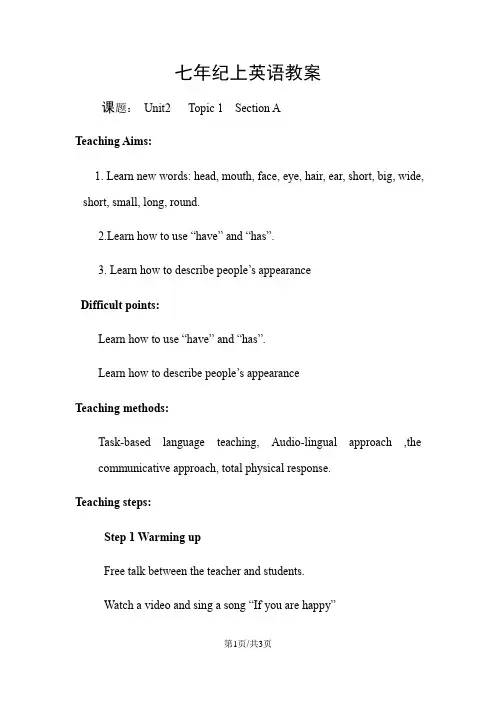
七年纪上英语教案课题:Unit2 Topic 1 Section ATeaching Aims:1. Learn new words: head, mouth, face, eye, hair, ear, short, big, wide, short, small, long, round.2.Learn how to use “have” and “has”.3. Learn how to describe people’s appearanceDifficult points:Learn how to use “have” and “has”.Learn how to describe people’s appearanceTeaching methods:Task-based language teaching, Audio-lingual approach ,the communicative approach, total physical response.Teaching steps:Step 1 Warming upFree talk between the teacher and students.Watch a video and sing a song “If you are happy”Lead-inFrom this video ,we can see many words of body, like hands, feet and eyes. Do you want to learn more about them?Step 2 Presentation1.Learn the new words(1) Learn the new words: listen to 2a carefully and follow ithead, mouth, face, eye, hair, ear, nose, big,wide, short, big, wide, short, small, long, round.Let’s play the game Bobby Says. In order to go over the name of body.(2)Learn the new words: long short, big ,small, wide, round.show pictures and learn adjectives.2 .Remember the new words by themselves. Pay attention to their spellings. Have a competition.Step 3 Consolidation(Ask a student to stand up)T: Who is she?Ss: She is...T: Look, everyone, what does she look like? She has long hair and a round face. What about you? What do you look like?Step 4 listen to the tape 2a and learn how to use have\hasFinish2b and check answersEnjoy an English song “she has, he has”Step 5: Listen and follow 1aListen to the tape and finish 1b.Finish 1c according to 1a and 1b.1. Ask students to follow to read2. Show to read in groups3. Act it out.Step 6: Practice. Ask the students to describe the people in the screen write it down Do reportPlay a guessing game。
最新科普(仁爱)版英语七年级下册Unit7 Topic1 SectionA【市级优质课一等奖课件】

Lin Dan Fujian 1983.10
Li Na Hubei 1982.2
Lin Shuhao the U.S.A. 1988.8
Talk about months.
February
March
April
May
June
1c Listen and read 12 months.
Ask and answer questions with the following structures.
A:When were you born? B: I was born in ______.
2a Read the first six years.
1900 1840 1904 1976 2000 2008
nineteen hundred eighteen forty nineteen o four nineteen seventy-six two thousand two thousand and eight
sound Word
/au/
count house mouth ...
ou
/u:/
group route through ...
/Λ/
country touch tough ...
Letter Sound
Word
ow
/əu/ /au/
grow brown
slow cow
window town
...
/əu/ down yellow touch grow
slow borrow enough row blow own
Summary
We learn:
New words: writer, July, March, April, May, June, August, September, October, November, December, January, thousand New phrases: be born in, a big fan New sentences: When was she born?/She was born in July, 1965.
Unit+7+Topic+3+Section+A课件2022-2023学年仁爱版英语七年级上册
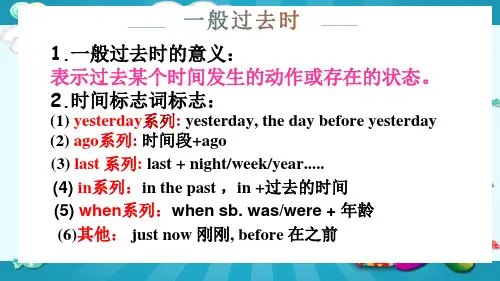
(5) when系列:when sb. was/were + 年龄
(6)其他: just now 刚刚, before 在之前
直去双改
1.play-- played
8.do/does-- did
2.look-- looked 3.miss-- missed 4.live-- lived
5. I studied in Zhangzhou in 1999.(改为否定句)
I _d__id__n_’_t _ ___s_t_u_d_y__ in Zhangzhou in 1999.
Unit 7 The Birthday Party
Topic 3
Everyone had a good time.
4. We all enjoyed __D____ at the party.
A. us B. our C. ours D. ourselves
5. Jack _B___ Chinese kung fu at New Year’s Party.
A. act B. performed C. Made D. played
3. He sang an English song in our class. (一般)
_D__i_d__ he _s_i_n__g_ an English song in our class?
4. My sister danced to disco at the music class.(对划线部分提问)
1. He does some cleaning every day. (用yesterday改写句子)
He _d_i_d__ some cleaning yesterday.
仁爱版七年级英语上册Unit 1 Topic 1 Welcome to China! Section B教案

Unit 1 Topic 1 Welcome to China! Section B一、P repare lesson before class.[预习提示]Ⅰ、写出本节两个元音字母Ⅱ、单选1、当两人初次见面时,你应该说:A.How are you? B.Who are you? C.How do you do?2、当你和陌生人相识后,你应该说:A.How do you do? B.Nice to meet you. C.Hello.3、早上你见到朋友应该说:A.Welcome B.Sit down, please. C.Good morning.Ⅲ、写出下列词完全形式。
1、I’m2、let’s3、what’s二、Teaching plant[教案]Ⅰ、Teaching Aims:教学目标1. The letters: Hh , Ii , Jj , Kk , Ll , Mm , Nn2. The sentences:(1)Let’s begin ! Stand up ,please !(2)Sit down , please ! Thank you !(3)This is …(4)How do you do ? How do you do ?Ⅱ、Language points [重点、难点]1、The letters.2、The sentences.3、字母按音素发音归类Ⅲ、Teaching periods.(1课时)Ⅳ、Teaching Procedure:教学过程:Step 1. RevisionA: Good morning . B: Good morning .A: I’m … Are you …?B: Yes ,I am ./No ,I’m not .A: Nice to meet you . B: Nice to meet you ,too .Step 2. Learn the new words .see , Miss , let , us , let’s =let us , begin stand up , stand up , please , class , sit down , mom , this , is , my , teacher , how , do .Step 3. Learn the sentences .1. Nice to see you . —Nice to see you , too .2. Let’s begin !3. Stand up , please .4. Sit down ,please !5. This is …6. How do you do ? —How do you do ?Step 4. Pratice the conversations:1. A: Good morning ,Miss Wang !B: Good morning ,Nice to see you .A: Nice to see you ,too .2. A: Let’s begin !B: Stand up ,please !A: Good morning ,class ! B: Good morning ,Miss Wang ! A: Sit down —please ! B: Thank you !3. A: Hi ,××! B: Hi , ××!A: How do you do ,this is××.How do you do ,this is××.B: Nice to meet you . C: Nice to meet you , too .4. A: Hello ,Mr Lee ! B: Hello , Maria !A: Mom ,this is my teacher ,Mr Lee .A: How do you do ? B: How do you do ?Step 5. Play the game .Stand up ! Sit down !Bobby says: “Stand up !”Bobby says “Sit down !”Step 6. Learn the letters .Hh , Ii , Jj , Kk , Ll , Mm , Nn .1. Read2. Write3. Revision : Aa—NnStep 7. Part 2b .Listen and circle the letters you hear .Step 8:Rolling out[拓展延伸]Hh[eit ]Jj [dЗi:]Kk[kei]Ii[i:]Ll[el]Mm [em]Nn[en]Step 9:Summary.[小结]Learn the new dialogue by designing situations.Step 10: Test [反馈测试]一、单项选择:( )1. How do you do ? __________ .A. How do you do ?B. Hello !C. How are you ?D.Good morning .( )2. This is __________ teacher Miss Han .A. youB. usC.myD. I ( )3. Are you Kangkang ? __________ .A. Yes ,I’m .B. Yes ,I am .C. No ,I am .D. No ,I’m .二、把下列短语和句子译成汉语1. Good morning ,Li Weiguo .2. Stand up ,please .3. Hello ,Sun Yan .4. How do you do ?5. This is my mom .三、目前我们共学了14个字母,请读一读并做下列习题1.一笔写成的大写字母有:2.一笔写成的小写字母有:3.两笔写成的小写字母有:4.三笔写成的大写字母有:5.两笔写成的大写字母有:Step 9.板书:Section BStand up ,please . How do you do ?Sit down ,please . This is …Aa Bb Cc Dd Ee Ff GgHh Ii Jj Kk Ll Mm Nn。
仁爱版七年级英语上Unit4Topic1SectionA教学设计
3.能够理解并运用目标句型进行点餐、询问、回答等日常交际,如:“What would you like to eat/drink?”、“How much is it?”、“Here is your bill.”等。
2.学生在英语听说方面有一定的基础,但实际运用能力仍有待提高。特别是在面对真实场景时,部分学生可能表现出紧张、胆怯的情绪,影响交流效果。
3.学生在小组活动中,合作意识较强,但分工和协调能力有待提高。教师需在活动中关注学生的参与度,引导他们学会倾听、尊重他人意见。
4.学生对英语学习的兴趣和动机存在差异,部分学生对课堂活动充满热情,积极参与;而另一部分学生可能较为内向,需要教师激发学习兴趣,提高课堂参与度。
-结合口语练习,让学生在听后进行模仿和角色扮演,实现听力和口语能力的双重提升。
3.口语交际:学生在实际对话中能够流利地使用英语进行点餐、询问和回答。
-教学设想:创建模拟餐厅环境,鼓励学生大胆开口,通过角色扮演和小组讨论,提高口语表达能力。
-教师提供示范,引导学生注意语音语调,模仿真实交际情境,增强口语的自然度和流畅性。
5.培养学生的责任感,通过角色扮演,体会服务行业的辛勤付出,学会感恩和尊重劳动者。
二、学情分析
七年级学生经过前一阶段的学习,已具备一定的英语基础,对英语学习有了一定的兴趣和热情。在此基础上,他们对本章节的学习有以下特点:
1.学生对餐厅场景较为熟悉,能够较快地理解和掌握相关的词汇和句型,但部分学生可能在发音和口语表达方面存在困难,需要教师关注和指导。
仁爱版八年级英语上册 Unit 1 Topic 3 Section A 课件(共28张PPT)
I believe
We learn ♥Expressions of taking part in sports meet:
join in,be in ,take part in、800-meter race ♥ The use of “will”.
TThhee lohnigghjujmumpp
cycling
swimming
basketball
football
running
the long jump the high jump
tennis
A:Which sport do you like best? B:I like… best. A:Why? B:Because …
Li Ming
school sports meet Yu Ting
1.校运动会__sc_h_o_o_l _s_po_r_t_s_m_eet 2.参加 t_a_k_e_p__a_r_t in = j_o_in__i_n_ = __b_e__i_n__
3.男子八百米赛 t_h_e__b_o_y_s’_8_0_0__-m__e_ter race
巧学妙记 一般将来时
一般将来时用法口诀:
一般将来时,将要发生事 谓语不一般,will加动原(动词原形) 要变疑问句,will提前面 否定句,也不难,will后面not添
中奖啦
2分
1
2
1分
1分
4
5
2分 3 3分 6
There will be our school sports meet next month.
最新仁爱版英语七年级(下册)Unit7-Topic1-SectionA课件
/Λ/
count group country
Word house route
touch
mouth through tough
...
...
...
3a. Listen and read the sounds and words aloud.
Letter
ow
p ph
Sound /əu/ /au/ /p/ /f/
Section A
1Tch.eWnoarskkinanpdaiarsn.sLwisetreqnuaensdtiorenasdw1it2h mthoensthtrsu.ctures
on page 56.
A:When were you born ? B:I was born in______.
Read the first six years .
new phrases: be born in, a big fan new sentences:
When was she born? She was born in July, 1965.
We can: express 12 months in English.
read different years in English. learn the past simple tense with “was/were.”
Word
grow brown
slow cow
window town
...
...
help party pencil ...
elephant photo physics ...
3b. Listen and circle the words with the sound /au/ or /əu/.
仁爱英语教材七年级上册Unit1 Topic2 SectionA教案
4. —Excuse me, are you…? England
—Yes, I am./ No, I’m not.
5.—Who are they?
—They are Maria and Jane.
Step6Production
1.Let students use the sentences “What’s your name? Where are you from? Are you…? Who are they? They’re … Where are they from? They are from …” to make up a short conversation in groups (1min) and choose two groups toshow their conversations;
2.Show the pictures of 1b and explain the cultural background of these pictures;
Play the tape again and choose one student to check the answers;
Then show the listeningmaterial and play the tape.
教学用具
幻灯片;词卡
教学重点
正确使用表示询问姓名、国籍等的表达方式;
正确使用人称代词:you, they,形容词性物主代词:my, your;
正确使用Be动词am, is, are的一般现在时在不同情况下形式上的不同变化;
掌握缩写形式I’m = I am, they’re = they are, what’s = what is, aren’t = are not, isn’t = is not;