
小学英语沪教版六年级上册Unit 5 Animals in danger 教案
1
小学英语沪教版六年级上册
Module 2 Relationships
Unit 5 Animals in danger 教案
一、教学目标
1. 认知目标:学习掌握新词汇:thousand,hundred,wild,way,die,learn,send,掌握句
型:In the past, there were …, but now there are ….,以及过去式与现在时的区别。
2. 能力目标:能运用所学句型与同学谈论濒临灭绝的野生动物。
3. 情感目标:让学生通过对课文内容的学习掌握,增强学习的信心,调动学生的学习兴趣。
二、教学重难点
1. 重点
能运用所学句型与同学谈论濒临灭绝的野生动物。
2. 难点
句型:In the past, there were …, but now there are ….,以及过去式与现在时的区别的理解掌
握。
三、教学用具
多媒体教学设备、单词卡片、图片。
四、教学设计
Step 1 warming
1. 师生互相问好,教师询问大家喜欢去动物园吗?最喜欢的动物是什么呢?是否了解这些
动物呢?
2. 教师向学生们说说自己最喜欢的动物以及此种动物的一些特点与现状。
Step 2 Revision and Presentation
1. 教师告诉学生我们这节课就要学学如何用英语表达一些动物的生存现状,了解一些濒临
灭绝动物的现状。
2. 教师请学生谈谈自己最喜欢的动物。
3. 教师出示单词卡片进行新单词教学,带读并配合肢体动作让同学们印象深刻。
4. 教师播放课文内容录音,请同学们认真听一遍,争取做到理解内容。
2
Step 3 Practice
1. 分小组讨论练习,两人一组,相互介绍一些动物的生存现状。
A: My favourite animal is panda, in the past, there were many pandas, but now there are only
about one thousand six hundred pandas in the wild.
B: My favourite animal is blue whale, in the past, there were many blue whales, but now there are
only about ten thousand in the wild.
2. Let’s learn and sing a song: All animals bright and beautiful.
Step 4 Summary
教师根据本课时所学内容进行回忆总结,并请同学们谈谈本节课印象最深刻的环节。
Step 5 Homework
1. 学生抄写本课所学单词,一个五遍。
2.用所学句型与父母或朋友进行交谈,并向父母朋友宣传保护濒危动物的重要性。
上教版六年级英语上册Unit5Animalsindanger第五单元第一课时教学设计

◊文化意识目标让学生感受中西方文化的的相同和不同,加深对中外文化的理解,逐步形成跨文化意识。
教学重点及难点◊教学重点1、能正确地理解、运用词汇和词组wild, hundred, thousand, in the past, indange;2、能运用There be句型的一般过去时和一般现在时描述濒危动物今昔数量的变化;◊教学难点正确使用一般过去时和一般现在时对事物的今昔变化进行综合描述。
___________教学基本策略及设计思路 __________________________ 本课教学设计关注了英语学科的工具性和人文性双重性质, 秉着面向全体学生、关注差异的原则,结合单元整体设计的理念,整体设计了目标,充分挖掘了教材内容,再构了文本,并充分考虑语言学习的渐进性和特殊性,关注学生的参与、体验和感知,努力创设真实的情境和真实的语用任务,让学生在用英语描述事物的过程中理解和运用语言。
同时优化了评价方式,也为学生提供了更多的交流平台和展示机会,以培养其综合语言运用能力。
在本课的教学过程中,采用了以下策略:导入策略---- 通过Brainstorming活动让学生说出自己对wild animal的认知,从而引出本课主题,关注了语言学习的实践性和应用性;认知策略一一借助图片、视频等多种手段增强学生对新知的感知,帮助学生感受濒危动物数量的减少和我们肩负保护动物的使命;技能策略-- 通过WatCh and think. Read and answer. Look, listen and circle. Read and match. Look and say. Thi nk and write.等一系列的活动关注了对学生听、说、读、写能力以及综合运用语言能力的培养;交际策略一一学生在师生、生生、小组互动中,学习倾听、参与活动,互相配合,表达自己的观点;分层策略一一本课在一些活动的的设计上充分考虑了学生的学习兴趣、学习能力以及学习方法等多方面的不同,并给予一定的帮助和提示,为每个学生提供适合的教育;写作策略一一通过对语言框架的梳理,引导学生从口头表达向书面表达过度。
沪教牛津版六年级上册英语Unit5第1课时教学课件

ten thousand in the wild.
第十六页,共三十页。
Learn and say
These animals are in danger. Do you want to help them? What can we do to
In the past, there were many pandas.
在过去有很多熊猫。
用于描述在过去某地存在某人或某物。
be动词的形式由其后面的名词决定。
例 There was a big tree here three years ago.
三年前这里有一棵大树。
第二十一页,共三十页。
知识拓展
bee
第四页,共三十页。
课堂导入
What animals页,共三十页。
课堂导入
What animals do you know?
tortoise
第六页,共三十页。
课堂导入
What animals do you know?
dog
第七页,共三十页。
课堂导入
pandas in the wild.
第十四页,共三十页。
Learn and say
In the past, there were many South China tigers, but now there are only about thirty in
the wild.
第十五页,共三十页。
Learn and say
例 There are thousands of fish in the lake.
沪教牛津版深圳用英语六年级上册Unit 5 Animals in danger Period 1课件

You help me, I remember you.
• 1.如何记忆hundred和 thousand这两个单词和其用 法?
• 2.如何用There be句型来对比 In the past, t过her去e w和as/现we在re.存.. 在no的w t事her物e i?s/are...
• 3.How can we protect the animals?
We need clean water!
1.Why are the animals in danger? 2.What can we do to help?
(Find out the problems)
(Ways to deal with the problems)
Watch Think
1.Why are wild animals in danger?
now there are thousnads
_n_o_/_n_o__t_a_n_y___ rubbish, of tons of rubbish.
Think
Pair
Share
But
__________, there were ______________gorillas. They lived happily.
What can it do:climb trees ( )
play chess
()
read books
()
count numbers ( )
Can you count like me?
You can try!
one two three four five six seven eight nine ten
do to help?(optional)
牛津上海版(三起)六年级上册英语 Module 2 Unit 5 Animals in danger【第一课时】教学设计

Introduce the new friend to Ss. Thenget on the internet. Ask Ss to try to answer the questions.【What is WAP? What do people do in WAP?】
变化;
◇教学难点
正确使用一般过去时和一般现在时对事物的今昔变化进行综合描述。
教学基本策略及设计思路
本课教学设计关注了英语学科的工具性和人文性双重性质,秉着面向全体学
生、关注差异的原则,结合单元整体设计的理念,整体设计了目标,充分挖掘了教材内容,再构了文本,并充分考虑语言学习的渐进性和特殊性,关注学生的参与、体验和感知,努力创设真实的情境和真实的语用任务,让学生在用英语描述事物的过程中理解和运用语言。同时优化了评价方式,也为学生提供了更多的交流平台和展示机会,以培养其综合语言运用能力。
学情分析
对于六年级学生来说,他们已经具有相当的英语基础,学习能力较强,能通过教师的讲解和小组学习,基本掌握本课核心语言,并能较为流利地用英语表达自己的观点。大多数学生保持着学习英语的兴趣,能认真听讲,积极发言。所以本课教学的关键在于继续激发学生学习英语的兴趣,调动学生学习英语的积极性,把了解学生的兴趣、动机作为突破点,分析学生已有的知识水平和能力水平,从学生的心理特点、认知规律和生活经验出发,并根据教材提供的主题进行设计,进行文本再构,引导学生积极思考和积极发言,从而创造以学生为中心的课堂学习氛围,全面培养学生听、说、读、写及综合运用语言的能力。
II.
Presentation
&Learning
1. Watch and think
Show some photos of
六年级英语Unit5 Animals in danger part 5教学设计 要玉静
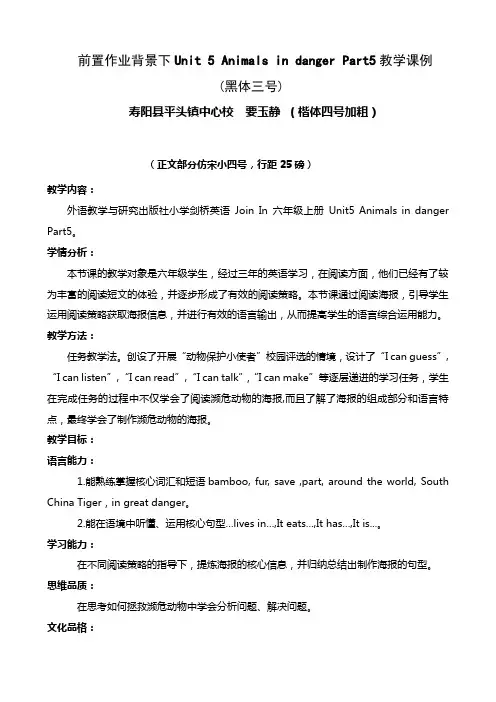
前置作业背景下Unit 5 Animals in danger Part5教学课例(黑体三号)寿阳县平头镇中心校要玉静(楷体四号加粗)(正文部分仿宋小四号,行距25磅)教学内容:外语教学与研究出版社小学剑桥英语Join In 六年级上册Unit5 Animals in danger Part5。
学情分析:本节课的教学对象是六年级学生,经过三年的英语学习,在阅读方面,他们已经有了较为丰富的阅读短文的体验,并逐步形成了有效的阅读策略。
本节课通过阅读海报,引导学生运用阅读策略获取海报信息,并进行有效的语言输出,从而提高学生的语言综合运用能力。
教学方法:任务教学法。
创设了开展“动物保护小使者”校园评选的情境,设计了“I can guess”,“I can listen”,“I can read”,“I can talk”,“I can make”等逐层递进的学习任务,学生在完成任务的过程中不仅学会了阅读濒危动物的海报,而且了解了海报的组成部分和语言特点,最终学会了制作濒危动物的海报。
教学目标:语言能力:1.能熟练掌握核心词汇和短语bamboo, fur, save ,part, around the world, South China Tiger,in great danger。
2.能在语境中听懂、运用核心句型…lives in…,It eats…,It has…,It is...。
学习能力:在不同阅读策略的指导下,提炼海报的核心信息,并归纳总结出制作海报的句型。
思维品质:在思考如何拯救濒危动物中学会分析问题、解决问题。
文化品格:通过阅读和制作海报,体验爱护动物的情感,并落实在实际行动中。
教学重点:1.能听懂,读懂有关panda 和the South China Tiger 的海报。
2.了解濒危动物的生活习性和生存状态,激发学生热爱动物的情感和自觉保护动物的意识。
教学难点:通过阅读策略提取核心信息,理解海报要表达的内容,最后正确制作濒危动物的海报。
沪教牛津版深圳用英语六年级上册Unit 5 Animals in danger Period 2课件
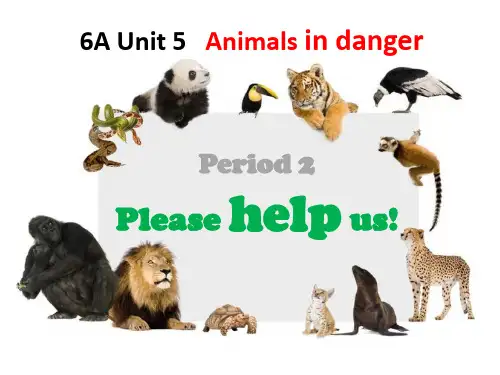
Period 2
Please help us!
/u/, /u/, /u/ We/u’r/e, i/nud/,a/nug/er! We areHenloptusso!good!
If you could.
Woo-hoo! I can help you!
red panda More of care.
Conserve the animals in danger. For a better world.
In the past, there were many red pandas, but now, there are only about 10,000 in the wild.
conserve their habitat
The giant panda is China’s national symbol and treasure.
They live in a few
and
in central China.
They like eating bamboos the most. They can eat grasses and meat in
We can help the animals in danger!
•Tell others •Make a handbook •Make a speech
• Group work: Choose an animal in danger.
And tell your group member about it.
Name: blue whale
Habitat:forests /mountains /ocean
沪教版英语六年级上册Unit 5《Animals in danger》ppt课件 (2)
Listen,read and guess:
It has got four legs. It eats grass. It lives on a farm.
It gives us milk.
cow
People ride it.
horse
Look and say:
bee
honey
... gives us...
化学课件:/kejian/huaxue/ 生物课件:/kejian/she ngwu/
地理课件:/kejian/dili/
历史课件:/kejian/lish i/
What’s your favourite animal?
smaller than... 小于...
The cat is smaller than the dog.
Listen,read and guess:
It has got four legs. It eats grass. It's smaller than a sheep. Foxes like to eat it.
polar
lion
bear
ห้องสมุดไป่ตู้
It is a very big animal. It lives in Africa and Asia.
Its fur is white. It lives in Arctic.
It is smaller than a tiger. It lives in Africa and Asia.
Oceania
Pacific Ocean
South America
Antarctica
Animals in the Arctic
沪教版英语六年级上册Module 2 Unit 5 Animals in danger课件3
Steller’s sea cows(大海牛) lived near the shore. They liked swimming in cold sea water. They were black.
We must stop killing these animals for food, for their skin, or just for sport.
二、教学重难点
1. 重点 能运用所学句型与同学谈论濒临灭绝的野生动物。 2. 难点 句型:In the past, there were …, but now there are ….,以及过去式与现在 时的区别的理解掌握。
Talk about an animal:
This animal is in danger. In the past, there were … But now there are … They live … They have/had … We can … to save them.
What can we do to save the animals in danger?
Homework
1. Find an animal that is in danger and talk or write about it.
2. Finish Workbook pages 27 and 29.
一、教学目标
1. 认知目标:学习掌握新词汇:thousand,hundred,wild,way,die, learn,send,掌握句型:In the past, there were …, but now there are …., 以及过去式与现在时的区别。 2. 能力目标:能运用所学句型与同学谈论濒临灭绝的野生动物。 3. 情感目标:让学生通过对课文内容的学习掌握,增强学习的信心,调 动学生的学习兴趣。
最新沪教版英语六年级上module 2 unit 5 animals in danger 课件.ppt
In the past, there were many pandas, but now there are only about one thousand six hundred pandas in the wind.
In the past, there were many South China tigers, but now there are only about one thirty in the wind.
谢谢聆听!
ቤተ መጻሕፍቲ ባይዱ
In the past, there were many blue whales, but now there are only about ten thousand in the wind.
We cannot see some kinds of wild animals now.
Aurochs(欧洲野牛)lived in Europe. They were big and heavy. They looked like cows.
These animals lost their homes because people cut down trees in the forests. We must help save the trees and forests.
Talk about an animal:
This animal is in danger. In the past, there were … But now there are … They live … They have/had … We can … to save them.
What can we do to save the animals in danger?
六年级英语上册Unit5《Animalsindanger》教案牛津上海版(深圳用)(最新整理)
六年级英语上册Unit 5《Animals in danger》教案牛津上海版(深圳用)编辑整理:尊敬的读者朋友们:这里是精品文档编辑中心,本文档内容是由我和我的同事精心编辑整理后发布的,发布之前我们对文中内容进行仔细校对,但是难免会有疏漏的地方,但是任然希望(六年级英语上册Unit 5《Animals in danger》教案牛津上海版(深圳用))的内容能够给您的工作和学习带来便利。
同时也真诚的希望收到您的建议和反馈,这将是我们进步的源泉,前进的动力。
本文可编辑可修改,如果觉得对您有帮助请收藏以便随时查阅,最后祝您生活愉快业绩进步,以下为六年级英语上册Unit 5《Animals in danger》教案牛津上海版(深圳用)的全部内容。
Module 2 Unit 5 Animals in danger教案一、教学目标1. 认知目标:学习掌握新词汇:thousand,hundred,wild,way,die,learn,send,掌握句型:In the past,there were …, but now there are ….,以及过去式与现在时的区别。
2. 能力目标:能运用所学句型与同学谈论濒临灭绝的野生动物。
3. 情感目标:让学生通过对课文内容的学习掌握,增强学习的信心,调动学生的学习兴趣.二、教学重难点1。
重点能运用所学句型与同学谈论濒临灭绝的野生动物.2。
难点句型:In the past,there were …, but now there are …。
,以及过去式与现在时的区别的理解掌握三、教学用具多媒体教学设备、单词卡片、图片。
四、教学设计Step 1 warming1. 师生互相问好,教师询问大家喜欢去动物园吗?最喜欢的动物是什么呢?是否了解这些动物呢?2. 教师向学生们说说自己最喜欢的动物以及此种动物的一些特点与现状.Step 2 Revision and Presentation1. 教师告诉学生我们这节课就要学学如何用英语表达一些动物的生存现状,了解一些濒临灭绝动物的现状。