
(完整版)化学品安全技术说明书(MSDS)中英文对照及翻译完整版
Material Safety Data Sheet化学品安全技术说明书SECTION 1: PRODUCT AND COMPANY IDENTIFICATION化学品及企业标识PRODUCT NAME:产品名CAS NO.:SUPPLIER:供应商:企业应急电话:Emergency TelephoneSECTION 2: Hazards identification危险性概述无毒:2.1 Classification of the substance or mixture物质分类Not a hazardous substance or mixture according to Regulation (EC) No 1272/2008据(EC) No 1272/2008规定不属于有害物质This substance is not classified as dangerous according to Directive 67/548/EEC.根据67/548/EEC号文件此物质不属于危险品2.2 Label elements标记要素The product does not need to be labelled in accordance with EC directives or respective national laws.此产品不需要按照欧共体法则或各国法规进行特殊标签2.3 Other hazards – none其他危害有毒:In-taking Pathways: drug abuse, skin or eyes contact侵入途径:吸入、皮肤、眼、误服Health hazards健康危害Eye contact: May cause eye irritation, redness, tearing or blurred vision眼接触:可引起眼睛刺激、发红、流泪、视力模糊。
Skin contact:If you touch it, it will cause skin stimulated, dermatitis, continued touch can cause skin degrease。
皮肤接触:可引起皮肤刺激、皮炎、持续接触可引起皮肤皲裂和脱脂。
Inhaling: If accidental poisoning, it will cause gastrointestinal stimulated, nausea, vomiting, diarrhea. 误服:可引起胃肠道刺激、恶心、呕吐、腹泻。
其他翻译:Hazard statement(s) 危险申明Harmful if swallowed. 吞咽有害。
Causes skin irritation. 造成皮肤刺激。
May cause an allergic skin reaction. 可能导致皮肤过敏反应。
Causes serious eye irritation. 造成严重眼刺激。
May cause respiratory irritation. 可能引起呼吸道刺激。
May cause damage to organs through prolonged or repeated exposure. 长期或重复接触可能会对器官造成伤害。
Precautionary statement(s) 警告申明Avoid breathing dust/smoke/gas/vapor/mist. 不要吸入粉尘/ 烟/ 气体/ 烟雾/ 蒸汽/ 喷雾。
SECTION 3: Composition/information on ingredients成分/组成信息3.1 Substances物质Formula :分子式Molecular Weight : 142,04 g/mol分子量CAS-No. :EC-No. :No components need to be disclosed according to the applicable regulations.补充:主要组份Main components纯品Pure chemicals; 混合物mixtureSECTION 4: First aid measures急救措施4.1 Description of first aid measures必要的急救措施描述General advice一般建议Consult a physician. Show this safety data sheet to the doctor in attendance.请教医生。
向到现场的医生出示此安全技术说明书。
If inhaled吸入If breathed in, move person into fresh air. If you feel that it is difficult to breath, please offer oxygen. If not breathing, give artificial respiration. Consult a physician.如果吸入,请将患者移到新鲜空气处。
如呼吸困难,给输氧。
如呼吸停止,进行人工呼吸。
请教医生。
In case of skin contact皮肤接触Wash off with soap and plenty of water. Consult a physician.用肥皂和大量的水冲洗。
请教医生。
Immediately take off the clothes, flow of water washing using the soap or special detergent.立即脱去污染的衣着,用大量流动清水和肥皂水或专用洗涤剂冲洗。
In case of eye contact眼睛接触Flush eyes with water as a precaution.用水冲洗眼睛作为预防措施。
You should rinse the eyes for 15 minutes if it splashes in. If the eyes are still very afflictive, please seek medical attention.用流动清水冲洗15分钟,如仍感刺激,就医。
If swallowed食入Never give anything by mouth to an unconscious person. Rinse mouth with water. Consult a physician.切勿给失去知觉者通过口喂任何东西。
用水漱口。
请教医生。
饮足量温水,催吐,就医。
Please drink enough water to spit if you accident drink it, or else consult a physician.4.2 Most important symptoms and effects, both acute and delayed主要症状和影响,急性和迟发效应The most important known symptoms and effects are described in the labelling (see section 2.2) and/or in section 11最主要的症状和影响见标签或11部分。
4.3 Indication of any immediate medical attention and special treatment needed及时的医疗处理和所需的特殊处理的说明和指示no data available无数据资料SECTION 5: Firefighting measures消防措施5.1 Extinguishing media灭火介质Suitable extinguishing media灭火方法及灭火剂Use extinguishing measures that are appropriate to local circumstances and the surrounding environment.根据当时情况和周围环境采用适合的灭火措施。
5.2 Special hazards arising from the substance or mixture源于此物质或混合物的特别的危害Sulphur oxides, Sodium oxides硫氧化物, 氧化钠5.3 Advice for firefighters给消防员的建议Wear self-contained breathing apparatus for fire-fighting if necessary.如必要的话,戴自给式呼吸器去救火。
5.4 Further information进一步信息The product itself does not burn.此物质本身不燃烧。
SECTION 6: Accidental release measures泄露应急处理6.1 Personal precautions, protective equipment and emergency procedures作业人员防护措施、防护装备和应急处置程序Avoid dust formation. Avoid breathing vapours, mist or gas. Ensure adequate ventilation. For personal protection see section 8.避免粉尘生成。
避免吸入蒸汽、烟雾或气体。
保证充分的通风。
个人防护措施详见第8部分。
6.2 Environmental precautions环境保护措施Prevent further leakage or spillage if safe to do so. Do not let product enter drains. Discharge into the environment must be avoided.如能确保安全,可采取措施防止进一步的泄漏或溢出。
不要让产品进入下水道。
一定要避免排放到周围环境中。
To undertake ventilated, eliminate the leakage area fire to avoid breathing vapor, foam cover large spills to reduce steam hazards.对泄漏区进行通风,排除火种以避免吸入蒸汽,大量泄漏用泡沫覆盖,降低蒸汽危害或其它类似物质吸收。
MSDS化学品安全技术说明书
MSDS化学品安全技术说明书(Material Safety Data Sheet)目录4-氨基安替比林化学品安全技术说明书..................................................... 错误!未定义书签。
乙二胺四乙酸二钠化学品安全技术说明书................................................ 错误!未定义书签。
N,N-二甲基甲酰胺化学品安全技术说明书. (1)氨溶液化学品安全技术说明书 (5)1-苯基-3-甲基-5-吡唑啉酮化学品安全技术说明书 (9)丙酮化学品安全技术说明书 (12)次氯酸钠溶液化学品安全技术说明书 (16)碘化钾化学品安全技术说明书 (20)2,2`-二苯基羰二肼化学品安全技术说明书 (23)高氯酸化学品安全技术说明书 (26)酸性铬黑T 化学品安全技术说明书 (30)过硫酸钾化学品安全技术说明书 (33)甲基橙化学品安全技术说明书 (37)甲基红化学品安全技术说明书 (41)酒石酸锑钾化学品安全技术说明书 (44)抗坏血酸化学品安全技术说明书 (47)可溶性淀粉化学品安全技术说明书 (50)邻苯二甲酸氢钾化学品安全技术说明书 (53)磷酸化学品安全技术说明书 (56)磷酸二氢钾化学品安全技术说明书 (60)磷酸氢二钠化学品安全技术说明书 (63)硫代硫酸钠化学品安全技术说明书 (66)硫酸化学品安全技术说明书 (69)硫酸铵化学品安全技术说明书 (73)硫酸锌化学品安全技术说明书 (77)硫酸亚铁铵化学品安全技术说明书 (81)硫酸银化学品安全技术说明书 (84)氯胺T 化学品安全技术说明书 (87)氯化铵化学品安全技术说明书 (90)氯化钡化学品安全技术说明书 (94)氯化钾化学品安全技术说明书 (98)钼酸铵化学品安全技术说明书 (101)硼酸化学品安全技术说明书 (104)氢氧化钠化学品安全技术说明书 (108)三乙醇胺化学品安全技术说明书 (112)水杨酸化学品安全技术说明书 (116)四氯化碳化学品安全技术说明书 (119)四硼酸钠化学品安全技术说明书 (123)碳酸钙化学品安全技术说明书 (126)铁氰化钾化学品安全技术说明书 (129)硫酸钠化学品安全技术说明书 (133)碳酸钠化学品安全技术说明书 (137)乙醇化学品安全技术说明书 (141)硝酸化学品安全技术说明书 (145)硝酸锌化学品安全技术说明书 (149)硝酸银化学品安全技术说明书 (153)溴百里酚蓝化学品安全技术说明书 (157)亚硝基铁氰化钠化学品安全技术说明书 (160)盐酸化学品安全技术说明书 (163)氧化镁化学品安全技术说明书 (167)乙酸钠化学品安全技术说明书 (171)乙酸锌化学品安全技术说明书 (174)异烟酸化学品安全技术说明书 (177)重铬酸钾化学品安全技术说明书 (180)乙炔化学品安全技术说明书 (184)氮化学品安全技术说明书 (188)碘酸钾化学品安全技术说明书 (192)氯化钠化学品安全技术说明书 (196)汽油化学品安全技术说明书 (199)碘化学品安全技术说明书 (203)溴酸钾化学品安全技术说明书 (206)氰化钾化学品安全技术说明书 (209)N,N-二甲基甲酰胺化学品安全技术说明书第一部分:化学品名称化学品中文名称:N,N-二甲基甲酰胺化学品俗名:甲酰二甲胺化学品英文名称:N,N-dimethylformamide英文名称:DMF技术说明书编码:224CAS No.:68-12-2第二部分:成分/组成信息第三部分:危险性概述危险性类别:侵入途径:健康危害:急性中毒:主要有眼和上呼吸道刺激症状、头痛、焦虑、恶心、呕吐、腹痛、便秘等。
危险化学品安全技术说明书(MSDS)

危险化学品MSDS手册01.丙酮 (3)02.异丙醇 (5)03.硫酸 (7)04.乙酸 (9)05.盐酸 (11)06.乙醇 (13)07.甲醇 (15)08.氨水 (17)09.氢氧化钠 (19)10.浓硫酸 (21)11.甲醛 (24)12.高锰酸钾 (26)13.二甲苯 (28)14.正丁醇 (32)15.苦味酸 (34)16.TEMED (36)17.叠氮化钠 (37)18二甲基亚砜 (38)19.磷酸二氢钠 (40)20.氯化钠 (42)21.氯化钾 (43)22.氯化铵 (44)23.无水硫酸钠 (45)24.过氧化氢 (46)25酸氢二钠 (47)26.苯酚红 (49)27.蔗糖 (52)表1丙酮表2异丙醇表3硫酸表4乙酸表5盐酸表6乙醇表7甲醇表8氨水表9氢氧化钠表10浓硫酸表11甲醛表12高锰酸钾表13 二甲苯表14 正丁醇表15苦味酸表16 TEMEDTEMED,中文名为四甲基乙二胺,是一种无色透明的液体,有微腥臭味,在分子生物学中,可以用于配制SDS-PAGE胶。
TEMED可以催化APS产生自由基,从而加速聚丙烯酰胺凝胶的聚合,可作为一种促凝剂使用。
TEMED即N,N,N',N'-Tetramethylethylenediamine,中文名:N,N,N',N'-四甲基乙二胺。
分子式:(CH3)2NCH2CH2N(CH3)2,分子量为116.20。
外观:无色透明液体。
气味:微腥臭味。
熔点:-55℃沸点:120-122℃密度:0.775g/ml(20℃)用途:多用于生物分子实验室当中,用于配制SDS-PAGE胶。
TEMED可以催化APS产生自由基,从而加速丙烯酰胺凝胶的聚合,可作为一种促凝剂使用。
保存条件4℃保存。
遮光保存。
一般用棕色瓶子储存。
注意事项易燃,有腐蚀性,具强神经毒性,请勿大量吸入。
易挥发,使用后请盖紧瓶盖。
为了您的安全和健康,请穿实验服并戴一次性手套,戴口罩操作。
(完整版)化学品安全技术说明书大全MSDS
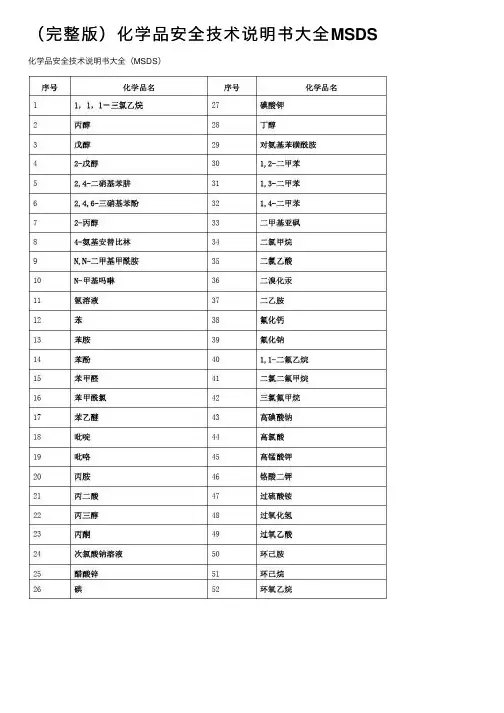
(完整版)化学品安全技术说明书⼤全MSDS 化学品安全技术说明书⼤全(MSDS)1,1,1-三氯⼄烷化学品安全技术说明书第⼀部分:化学品名称化学品中⽂名称: 1,1,1-三氯⼄烷化学品英⽂名称: 1,1,1-trichloroethane 中⽂名称2:甲基氯仿英⽂名称2: methyl chloroform技术说明书编码: 612CAS No.: 71-55-6分⼦式: C2H3Cl3分⼦量: 133.42第⼆部分:成分/组成信息有害物成分含量 CAS No.1,1,1-三氯⼄烷≥95.0% 71-55-6第三部分:危险性概述危险性类别:侵⼊途径:健康危害:急性中毒主要损害中枢神经系统。
轻者表现为头痛、眩晕、步态蹒跚、共济失调、嗜睡等;重者可出现抽搐,甚⾄昏迷。
可引起⼼律不齐。
对⽪肤有轻度脱脂和刺激作⽤。
环境危害:燃爆危险:本品可燃,有毒,具刺激性。
-第四部分:急救措施⽪肤接触:脱去污染的⾐着,⽤肥皂⽔和清⽔彻底冲洗⽪肤。
眼睛接触:提起眼睑,⽤流动清⽔或⽣理盐⽔冲洗。
就医。
吸⼊:迅速脱离现场⾄空⽓新鲜处。
保持呼吸道通畅。
如呼吸困难,给输氧。
如呼吸停⽌,⽴即进⾏⼈⼯呼吸。
就医。
⾷⼊:饮⾜量温⽔,催吐。
就医。
第五部分:消防措施危险特性:遇明⽕、⾼热能燃烧,并产⽣剧毒的光⽓和氯化氢烟雾。
与碱⾦属和碱⼟⾦属能发⽣强烈反应。
与活性⾦属粉末(如镁、铝等)能发⽣反应, 引起分解。
有害燃烧产物:⼀氧化碳、⼆氧化碳、氯化氢、光⽓。
灭⽕⽅法:消防⼈员须佩戴防毒⾯具、穿全⾝消防服,在上风向灭⽕。
喷⽔保持⽕场容器冷却,直⾄灭⽕结束。
灭⽕剂:雾状⽔、泡沫、⼆氧化碳、砂⼟。
第六部分:泄漏应急处理应急处理:迅速撤离泄漏污染区⼈员⾄安全区,并进⾏隔离,严格限制出⼊。
切断⽕源。
建议应急处理⼈员戴⾃给正压式呼吸器,穿防毒服。
从上风处进⼊现场。
尽可能切断泄漏源。
防⽌流⼊下⽔道、排洪沟等限制性空间。
⼩量泄漏:⽤砂⼟或其它不燃材料吸附或吸收。
化学品安全技术说明书(MSDS)
化学品安全技术说明书(MSDS)体各部位。
主要症状:对眼、鼻、皮肤等方面有刺激性之影响;或有头晕、不舒服之感。
第四部分:急救措施吸入:移走污染源,将患者送至通风良好较阴凉处休息,以毛布保暖,或送医检查诊断。
皮肤接触:以清水及肥皂洗净;若刺激感持续,需反复冲洗,严重者,立即就医。
眼睛接触:以清水冲洗,若刺激感持续,需反复冲洗,严重者立即送医检查诊断。
食入:催吐并立即送医检查诊断。
最重要症状及危害效应:身体有极度不适,需尽速至医院作检查诊断。
对急救人员之防护:一般防护设备及化学安全护目镜或防护面罩。
对医师之指示:患者之状况以及告之暴露途径,时间及地点。
第五部分:消防措施处如有泄漏需以吸湿干布、木屑或砂土等处理,避免流入水沟、下水道等会污染水质之处,并通知相关单位,尽速处理。
储存:储存在原本之封闭桶子内及固定位置,避免高温储存(室温条件即可)。
避免储存接近电源、火源之场所。
第八部分:接触控制/个体防护中国MAC(mg/m3):未制定标准前苏联MAC(mg/m3):未制定标准TLVTN:未制定标准TLVWN:未制定标准监测方法:沸点(℃):无资料相对密度(水=1):1.01 (g/cm3,15℃) 相对蒸气密度(空气=1):无资料饱和蒸气压(kPa):无资料燃烧热(kJ/mol):无资料临界温度(℃):无资料临界压力(MPa):无资料辛醇/水分配系数的对数值:无资料闪点(℃):76引燃温度(℃):248爆炸上限%(V/V):无资料爆炸下限%(V/V):无资料溶解性:第十二部分:生态学资料生态毒理毒性:生物降解性:非生物降解性:生物富集或生物积累性:其它有害作用:无资料。
第十三部分:废弃处置废弃物性质:废弃处置方法:处置前应参阅国家和地方有关法规。
建议用焚烧法处置。
废弃注意事项:装卸等方面均作了相应规定。
第十六部分:其他信息参考文献:填表部门:数据审核单位:修改说明:其他信息:切削液切削液切削液。
化学品安全技术说明书-MSDS
化学品安全技术说明书(MSDS)为化学物质及其制品提供了有关安全、健康和环境保护方面的各种信息,并能提供有关化学品的基本知识、防护措施和应急行动等方面的资料。
说明书目录第一部分化学品名称第九部分理化特性第二部分成分/组成信息第十部分稳定性和反应活性第三部分危险性概述第十一部分毒理学资料第四部分急救措施第十二部分生态学资料第五部分消防措施第十三部分废弃处置第六部分泄漏应急处理第十四部分运输信息第七部分操作处置与储存第十五部分法规信息第八部分接触控制/个体防护五硫化二磷化学品安全技术说明书第一部分:化学品名称化学品中文名称:五硫化二磷化学品英文名称: phosphorus pentasulfide中文名称2:五硫化磷英文名称2:技术说明书编码: 502 CAS No.: 1314-80-3分子式: P2S5 分子量: 222.27第二部分:成分/组成信息有害物成分含量 CAS No. 五硫化二磷 1314-80-3第三部分:危险性概述危险性类别:侵入途径:健康危害:对眼、呼吸道及皮肤有刺激性。
环境危害:燃爆危险:本品遇湿易燃,具刺激性。
第四部分:急救措施皮肤接触:脱去污染的衣着,用肥皂水和清水彻底冲洗皮肤。
眼睛接触:提起眼睑,用流动清水或生理盐水冲洗。
就医。
吸入:迅速脱离现场至空气新鲜处。
保持呼吸道通畅。
如呼吸困难,给输氧。
如呼吸停止,立即进行人工呼吸。
就医。
食入:饮足量温水,催吐。
就医。
第五部分:消防措施危险特性:遇明火、高热、摩擦、撞击有引起燃烧的危险。
受热分解,放出磷、硫的氧化物等毒性气体。
燃烧时放出有毒的刺激性烟雾。
与潮湿空气接触会发热以至燃烧。
与大多数氧化剂如氯酸盐、硝酸盐、高氯酸盐或高猛酸盐等组成敏感度极高的爆炸性混合物。
遇水或潮湿空气分解成有腐蚀和刺激作用的磷酸及硫化氢气体。
有害燃烧产物:氧化磷、磷烷、硫化氢、氧化硫。
灭火方法:消防人员必须穿全身防火防毒服,在上风向灭火。
灭火剂:二氧化碳、干粉、砂土。
(完整版)化学品安全技术说明书大全MSDS
(完整版)化学品安全技术说明书大全MSDS嘿,伙计们!今天我要给大家讲讲一个非常有趣的话题——化学品安全技术说明书(MSDS)!这可不是什么高大上的东西,而是我们在日常生活中经常会遇到的一种“神秘”的文件。
这个MSDS到底是个啥东西呢?别着急,让我慢慢道来。
我们要知道MSDS是“Material Safety Data Sheet”的缩写,直译过来就是“材料安全数据表”。
它是一种用来记录化学品的物理性质、化学性质、毒性、燃爆性等信息的文件。
想象一下,你在超市里买回来一瓶洗发水,回家打开盖子,突然发现一股刺鼻的气味扑面而来,这时候你就可以拿出你的手机,打开MSDS软件,输入洗发水的品牌和型号,然后就可以了解到这瓶洗发水到底有没有毒,是不是易燃易爆等等。
是不是觉得很神奇?MSDS里面都有哪些内容呢?别急,让我给你一一道来。
我们可以看到一张表格,上面列出了这个化学品的基本信息,比如名称、分子式、外观、密度等等。
我们会看到一些关于这个化学品的物理性质和化学性质的数据,比如熔点、沸点、导电性、酸碱性等等。
我们还会看到这个化学品的毒性和危害信息,比如短期和长期接触会对身体造成什么影响,是否有致癌性等等。
我们还会看到这个化学品的燃爆性和稳定性信息,比如它的闪点、自燃点、爆炸极限等等。
有了这些信息,我们在使用这个化学品的时候就能更加安全了。
比如我们在实验室里做实验的时候,要先看看这个化学品的MSDS,了解一下它的危险性,然后再戴上手套、护目镜等防护用品,确保自己的安全。
又比如我们在装修房子的时候,要看看墙漆的MSDS,了解一下它是否含有有害物质,这样才能保证我们的家人不会因为吸入有害气体而生病。
当然了,MSDS并不是万能的。
有些化学品可能没有写进MSDS里,或者写了但是不够详细。
这时候我们就要靠自己的经验去判断了。
比如我们在做饭的时候,要用到一些食用油。
我们可以看一下油瓶上的标签,看看它是否标明了是植物油还是动物油。
氯化钠MSDS化学品安全技术说明书(中文)
氯化钠化学品安全技术说明书MSDS第一部分 化学品名称纯品■混合物□化学品名称:氯化钠化学品英文名称: sodium chloride化学品分子式:NaCl分子量:58.43第二部分成分/组成信息有害物成分含量CAS号氯化钠99.5 % 7647-14-5第三部分危险性概述危险性类别:侵入途径:吸入、食入、经皮吸收。
健康危害:无资料。
环境危害:无资料。
燃爆危险:几乎不燃。
第四部分急救措施皮肤接触:脱去被污染的衣着,用清水彻底冲洗。
眼睛接触:立即提起眼睑,用大量流动清水冲洗至少10分钟。
吸入:迅速脱离现场至空气新鲜处。
如感到不适,食大量入:如感不适,就医。
第五部分消防措施危险特性:几乎不燃。
有害燃烧产物:灭火方法及灭火剂:根据周围环境选择合适的灭火器。
灭火注意事项:防止化学品进入地表水和地下水。
第六部分泄漏应急处理个人防护:一般不需要特殊防护。
环境保护措施:化学品未经处理不允许向环境排放。
清洁/吸收措施:采用安全的方法将泄漏物收集回收或运至废物处理场所处理,根据化学品性质进一步处置。
清理污染区,洗液排入废水处理池。
第七部分操作处置与储存操作注意事项:无特殊要求。
储存注意事项:干燥,密封。
按常温储存。
第八部分接触控制/个体防护最高容许浓度:中国MAC(mg/m3):无资料。
监测方法:工程控制:密闭操作,局部排风。
提供安全淋浴和洗眼设备。
呼吸系统防护:一般不需要特别防护。
眼睛防护:一般不需要特别防护。
身体防护:穿防化学品工作服。
手防护:戴防化学品手套。
其他防护:工作现场禁止吸烟、进食和饮水。
第九部分理化特性外观与性状:无色无味固体pH值:4.5-7.0 (100 g/l H2O,20 °C)熔点:801 休积密度:~ 1140 kg/m3沸点:1461 (1013 hPa) 密度: 2.17 g/cm3(20 °C)燃点:无资料闪点:无资料爆炸限度:上限:无资料下限:无资料热分解:> 500 °C溶解性:水358 g/l (20 °C)乙醇0.51 g/l (25 °C)第十部分稳定性和反应活性稳定性:稳定避免接触条件:禁忌物:碱性金属危险分解产物:无资料聚合危害:不能发生第十一部分毒理学资料急性毒性:LD50 (oral, rat): 3000 mg/kg.LD50 (dermal, rabbit): >10000 mg/kg.其他资料:吸入后:无中毒症状。
苯酚溶液-化学品安全技术说明书中文MSDS16个部分完整版
化学品安全技术说明书修订日期:SDS编号:产品名称:版本:苯酚第一部分化学品及企业标识化学品中文名:苯酚化学品英文名:phenol;carbolic acid供应商名称:########化工有限公司供应商地址:#####路###号###室供应商电话:4571-5858####邮编:###248供应商传真:4571-5858####电子邮件地址:####*************供应商应急咨询电话:4571-5858####化学事故应急咨询专线:4571-5858####产品推荐及限制用途:用于生产酚醛树脂、双酚A、己内酰胺、苯胺、烷基酚等。
在石油炼制工业中用作润滑油精制的选择性抽提溶剂,也用于塑料和医药工业。
第二部分危险性概述紧急情况概述:吞咽会中毒,皮肤接触会中毒,吸入会中毒,造成严重的皮肤灼伤和眼损伤。
GHS危险性类别:急性毒性-经口-类别3*;急性毒性-经皮-类别3*;急性毒性-吸入-类别3*;皮肤腐蚀/刺激-类别1B;严重眼损伤/眼刺激-类别1;生殖细胞致突变性-类别2;特异性靶器官毒性-反复接触-类别2*;危害水生环境-急性危害-类别2;危害水生环境-长期危害-类别2标签要素:象形图:警示词:危险危险信息:H314:造成严重的皮肤灼伤和眼损伤H311:皮肤接触会中毒H331:吸入会中毒H373:长时间或反复接触(如果可确证无其他接触途径引起该危害,说明接触途径)可能对器官造成伤害(如果已经知道,说明所受损害的器官)H411:对水生生物有毒并具有长期持续影响H341:怀疑可造成遗传性缺陷(如果最终证明没有其他接触途径会产生这一危害时,应说明其接触途径)防范说明:预防措施:P260:不要吸入粉尘/烟/气体/烟雾/蒸气/喷雾。
P264:作业后彻底清洗……。
P280:戴防护面具。
P261:避免吸入粉尘/烟/气体/烟雾/蒸气/喷雾。
P271:只能在室外或通风良好之处使用。
P270:使用本产品时不要进食、饮水或吸烟。
化学品安全技术说明MSDS亚硫酸氢钠中英文对照版本样本
5.3.5 Sodium Bisulfite1) Chemical Product and Company IdentificationMSDS Name: Sodium Sulfite, AnhydrousCatalog Numbers: S80195, 1MSS44-20, 1MSS4420, BP355 500, BP355-500, BP355500, S430 10, S430 3, S430 500, S430-10, S430-3, S430-500, S43010, S4303, S430500, S447 3, S447 500, S447-3, S447-500, S4473, S447500Synonyms: Sulfurous acid, disodium salt2) Composition, Information on IngredientsHazard Symbols: XNRisk Phrases: 22 36/37/383) Hazards IdentificationEMERGENCY OVERVIEWAppearance: white. Air sensitive. Moisture sensitive. Warning! Causes eye and skin irritation. May cause digestive tract irritation. Causes respiratory tract irritation. May be harmful if swallowed.Target Organs: Central nervous system.Potential Health EffectsEye: Causes eye irritation. May cause chemical conjunctivitis.Skin: Causes skin irritation.Ingestion: May cause gastrointestinal irritation with nausea, vomitingand diarrhea. May be harmful if swallowed.Inhalation: Causes respiratory tract irritation. Can produce delayed pulmonary edema.Chronic: Effects may be delayed.4) First Aid MeasuresEyes: Flush eyes with plenty of water for at least 15 minutes, occasionally lifting the upper and lower eyelids. Get medical aid. Skin: Get medical aid. Flush skin with plenty of soap and water for at least 15 minutes while removing contaminated clothing and shoes. Wash clothing before reuse.Ingestion: If victim is conscious and alert, give 2-4 cupfuls of milk or water. Never give anything by mouth to an unconscious person. Get medical aid immediately.Inhalation: Remove from exposure to fresh air immediately. If not breathing, give artificial respiration. If breathing is difficult, give oxygen. Get medical aid.Notes to Physician: Treat symptomatically and supportively.5) Fire Fighting MeasuresGeneral Information: As in any fire, wear a self-contained breathing apparatus in pressure-demand, MSHA/NIOSH (approved or equivalent), and full protective gear. During a fire, irritating and highly toxic gases may be generated by thermal decomposition or combustion. Wearappropriate protective clothing to prevent contact with skin and eyes. Wear a self-contained breathing apparatus (SCBA) to prevent contact with thermal decomposition products.Extinguishing Media:Substance is noncombustible; use agent most appropriate to extinguish surrounding fire. Do NOT get water inside containers. Use water spray, dry chemical, carbon dioxide, or appropriate foam.6) Accidental Release MeasuresGeneral Information: Use proper personal protective equipment as indicated in Section 8.Spills/Leaks: Vacuum or sweep up material and place into a suitable disposal container. Clean up spills immediately, observing precautions in the Protective Equipment section. Avoid generating dusty conditions. Provide ventilation. Place under an inert atmosphere. Do not get water inside containers.7) Handling and StorageHandling: Wash thoroughly after handling. Use with adequate ventilation. Minimize dust generation and accumulation. Avoid contact with eyes, skin, and clothing. Keep container tightly closed. Avoid ingestion and inhalation. Handle under an inert atmosphere. Store protected from air. Do not allow contact with water. Wash clothing before reuse. Keep from contact with moist air and steam.Storage: Store in a tightly closed container. Keep from contact with oxidizing materials. Store in a cool, dry, well-ventilated area away from incompatible substances. Keep away from strong acids. Do not expose to air. Store protected from moisture. Store under an inert atmosphere.8) Exposure Controls, Personal ProtectionEngineering Controls: Facilities storing or utilizing this material should be equipped with an eyewash facility and a safety shower. Use adequate ventilation to keep airborne concentrations low.Exposure LimitsOSHA Vacated PELs: Sodium sulfite, Anhydrous: No OSHA Vacated PELs are listed for this chemical.Personal Protective EquipmentEyes: Wear appropriate protective eyeglasses or chemical safety goggles as described by OSHA's eye and face protection regulations in 29 CFR 1910.133 or European Standard EN166.Skin: Wear appropriate protective gloves to prevent skin exposure. Clothing: Wear appropriate protective clothing to prevent skin exposure.Respirators: A respiratory protection program that meets OSHA's 29 CFR §1910.134 and ANSI Z88.2 requirements or European Standard EN 149 must be followed whenever workplace conditions warrant arespirator's use. Follow the OSHA respirator regulations found in 29CFR 1910.134 or European Standard EN 149. Always use a NIOSH or European Standard EN 149 approved respirator when necessary.9) Physical and Chemical PropertiesPhysical State: SolidAppearance: whiteOdor: odorlesspH: Not available.Vapor Pressure: Not available.Vapor Density: Not available.Evaporation Rate: Not available.Viscosity: Not available.Boiling Point: Not available.Freezing/Melting Point: Not available.Autoignition Temperature: Not available.Flash Point: Not available.Decomposition Temperature: > 500 deg CNFPA Rating: (estimated) Health: 2; Flammability: 0; Reactivity: 0 Explosion Limits, Lower: Not available.Upper: Not available.Solubility: 23 g/100 mL water (20° C)Specific Gravity/Density: 2.6330g/cm3Molecular Formula: Na2O3SMolecular Weight: 126.0410) Stability and ReactivityChemical Stability: Stable at room temperature in closed containers under normal storage and handling conditions.Conditions to Avoid: Incompatible materials, dust generation, moisture, exposure to air, excess heat.Incompatibilities with Other Materials: Strong oxidizing agents, acids, organics, moisture, air, combustible materials.Hazardous Decomposition Products: Oxides of sulfur.Hazardous Polymerization: Has not been reported.11) Toxicological InformationRTECS#:CAS# 7757-83-7: WE2150000LD50/LC50:CAS# 7757-83-7:Oral, mouse: LD50 = 820 mg/kg;Carcinogenicity:CAS# 7757-83-7: Not listed by ACGIH, IARC, NIOSH, NTP, or OSHA.Epidemiology: No information available.Teratogenicity: No information available.Reproductive Effects: No information available.Neurotoxicity: No information available.Mutagenicity: No information available.Other Studies: No data available.12) Ecological InformationEcotoxicity: No data available. No information available. Environmental: No information found.Physical: No information found.Other: No information available.13) Disposal ConsiderationsChemical waste generators must determine whether a discarded chemical is classified as a hazardous waste. US EPA guidelines for the classification determination are listed in 40 CFR Parts 261.3. Additionally, waste generators must consult state and local hazardous waste regulations to ensure complete and accurate classification. RCRA P-Series: None listed.RCRA U-Series: None listed.14) Transport Information15) Regulatory InformationUS FEDERALTSCACAS# 7757-83-7 is listed on the TSCA inventory.Health & Safety Reporting ListNone of the chemicals are on the Health & Safety Reporting List. Chemical Test RulesNone of the chemicals in this product are under a Chemical Test Rule. Section 12bNone of the chemicals are listed under TSCA Section 12b.TSCA Significant New Use RuleNone of the chemicals in this material have a SNUR under TSCA. SARASection 302 (RQ)None of the chemicals in this material have an RQ.Section 302 (TPQ)None of the chemicals in this product have a TPQ.SARA CodesCAS # 7757-83-7: acute.Section 313No chemicals are reportable under Section 313.Clean Air Act:This material does not contain any hazardous air pollutants. This material does not contain any Class 1 Ozone depletors. This material does not contain any Class 2 Ozone depletors.Clean Water Act:None of the chemicals in this product are listed as Hazardous Substances under the CWA. None of the chemicals in this product are listed as Priority Pollutants under the CWA. None of the chemicals in this product are listed as Toxic Pollutants under the CWA.OSHA:None of the chemicals in this product are considered highly hazardous by OSHA.STATECAS# 7757-83-7 is not present on state lists from CA, PA, MN, MA, FL, or NJ.California No Significant Risk Level: None of the chemicals in this product are listed. European/International RegulationsEuropean Labeling in Accordance with EC DirectivesHazard Symbols:XNRisk Phrases:R 22 Harmful if swallowed.R 36/37/38 Irritating to eyes, respiratory systemand skin.Safety Phrases:S 24/25 Avoid contact with skin and eyes.WGK (Water Danger/Protection)CAS# 7757-83-7: 1CanadaCAS# 7757-83-7 is listed on Canada's DSL List. CAS# 7757-83-7 is listed on Canada's DSL List.This product has a WHMIS classification of D2B.CAS# 7757-83-7 is not listed on Canada's Ingredient Disclosure List. Exposure Limits16) Additional InformationMSDS Creation Date: 7/15/1999Revision #1 Date: 8/02/The information above is believed to be accurate and represents the best information currently available to us. However, we make no warranty of merchantability or any other warranty, express or implied, with respect to such information, and we assume no liability resulting from its use. Users should make their own investigations to determine the suitability of the information for their particular purposes. In no event shall Fisher be liable for any claims, losses, or damages of any third party or for lost profits or any special, indirect, incidental, consequential or exemplarydamages, howsoever arising, even if Fisher has been advised of the possibility of such damages.5.3.5亚硫酸氢钠1) 化学品名称化学品中文名称: 亚硫酸氢钠化学品英文名称: sodium bisulfite中文名称2: 酸式亚硫酸钠英文名称2: hydrogen sulfite sodium分子式: NaHSO3分子量: 104.062) 成分、组成信息3) 危险性概述健康危害: 对皮肤、眼、呼吸道有刺激性, 可引起过敏反应。
化学品安全技术说明书-MSDS
化学品安全技术说明书(MSDS )为化学物质及其制品提供了有关安全、健 康和环境保护方面的各种信息, 并能提供有关化学品的基本知识、 防护措施和应 急行动等方面的资料。
说明书目录第一部分 化学品名称 第二部分 成分 /组成信息 第三部分 危险性概述 第四部分 急救措施 第五部分 消防措施 第六部分 泄漏应急处理 第七部分 操作处置与储存 第八部分 接触控制 /个体防护第九部分 理化特性第十部分 稳定性和反应活性 第十一部分 毒理学资料 第十二部分 生态学资料 第十三部分 废弃处置 第十四部分 运输信息 第十五部分 法规信息五硫化二磷化学品安全技术说明书第一部分:化学品名称 化学品中文名称: 五硫化二磷 中文名称 2:五硫化磷技术说明书编码: 502 分子式: P 2S 5 第二部分:成分 / 组成信息 有害物成分 含量 CAS No. 第三部分:危险性概述 危险性类别: 健康危害: 对眼、呼吸道及皮肤有刺激性。
燃爆危险: 本品遇湿易燃,具刺激性。
第四部分:急救措施 皮肤接触 眼睛接触 吸入: 化学品英文名称: phosphorus pentasulfide英文名称 2:CAS No. : 1314-80-3分子量: 222.27 五硫化二磷 1314-80-3侵入途径: 环境危害:立即进行人工呼吸。
就医。
食入: 饮足量温水,催吐。
就医。
第五部分:消防措施危险特性: 遇明火、高热、摩擦、撞击有引起燃烧的危险。
受热分解,放出磷、硫的氧化 物等毒性气体。
燃烧时放出有毒的刺激性烟雾。
与潮湿空气接触会发热以至燃烧。
与大多数 氧化剂如氯酸盐、 硝酸盐、 高氯酸盐或高猛酸盐等组成敏感度极高的爆炸性混合物。
遇水或 潮湿空气分解成有腐蚀和刺激作用的磷酸及硫化氢气体。
有害燃烧产物: 氧化磷、磷烷、硫化氢、氧化硫。
灭火方法: 消防人员必须穿全身防火防毒服,在上风向灭火。
灭火剂:二氧化碳、干粉、 砂土。