
2019-2020学年高中英语 Unit2 Sailing the oceans教案 新人教版选修9.doc
2019-2020学年高中英语 Unit2 Sailing the oceans教案 新人教版选修9
(一)教学目标:
1、知识目标
(1).理解并记住Reading部分本单元的单词和短语。
(2).理解并掌握整个故事的情节,并能填写summary.
2、能力目标
(1)充分发挥学生的主体地位,调动学生思维的积极性,提高综合语言的运用能力
(2)通过对学生说读写的训练,增大学生的语言输入,增强其语言输出能力。
3、情感、态度、价值观目标
学生分析布莱船长在40多天的航程中所采用的航海技术以及所表现出的领导才能。同时,又适时地对他们进行情感教育:在任何困难面前绝不畏惧,不抛弃,不放弃。
(二)教学重点与难点:
读写说均为本节课的重点,写和说部分应为难点,需加大指导和练习。
(三)教学用具:多媒体英语课件。
(四)教学设计
教师活动 学生活动 设计意图
Teaching procedures:
Lead-in:
通过歌曲Sailing导入,让学生在轻松愉悦的音乐下近入新课的学习之中。促使学生积极主动地进入学习状态。
Comprehension
Step I Please Skim the passage and get the main
idea.
Step II. Scan the passage: True or False.
1. I was forced to join Captain Bligh in the
small boat.
2. After the crew took over the ship “Bounty”,
师生以你问我答的形式互动进入话题
学生通过skim和scan表层理解和深层理解相结合,小组讨论及展示
老师借助歌曲Sailing和问题调动学生的学习兴趣,快速进入学习。
。
Captain Bligh was allowed to take with him a
chart , a compass and a quadrant.
3. It was very difficult for us to get a correct
reading from the quadrant as the boat moved
constantly during the course.
4. Captain Bligh used a system called “dead
reckoning” and he knew there was land directly
southwest of their original position.
5. Captain Bligh was as weak as the rest of us
but he was determined not to give up.
6. Captain Bligh kept us busy and tried to take
our minds off our stomachs and thirst all the
way.
7. We finally escaped the jaws of death and
arrived in Timor over fifty days after being set
loose in our small boat.
Step III. Group work: further reading.
When captain Blight returned home he was honored
as a hero. Discuss in groups whether he should
receive a special medal or not.
Step IV. Affective education
After learning the text, as senior three
students, what can we learn from Captain Blight
in our life?
Step V. Summary:
I am _____ to have sailed with Captain Bligh on his journey of
over40 days through about
4,000 miles in an open boat ______the
.
小组讨论分组展示讨论结果
‘
训练学生阅读理解的答题技巧。
通过讨论提高理解能力和语言表达能力
Pacific Ocean in 1789.
In the beginning, on our ________(depart),
some of the crew took _____the ship and the
captain ___________(deposit) into a small boat.
Thus we were caught _____a dilemma. We decided
to stick with him _______thick and thin though
we seemed to face _____uncertain death.
During the long and tough journey, we
encountered many unexpected hardships. Despite
_____(lack) of food and water, he kept us
_______(occupy) and cheerful to take our minds
____ troubles. All the way he taught us how to
cope _______various situations. Finally they
arrived at Timor __________(success) and they
were honored as _______(hero).
The story shows that one man’s spirit and
his determination should not ________ (defeat)
by circumstances.
Complex sentences(分析并翻译1-2个长难句)
Challenge yourself!---Grammar Filling
1. I’m proud to have sailed with Captain Blight
____his journey of over 40 days _________about
4,000miles ____an open small boat _______ the
Pacific Ocean.
2. On our _________(depart) from Tahiti, some
crew took _____the ship. And those of us on board
____________(catch) in a dilemma.
3. As you can see from the map we kept _____a
straight course pretty well. Summary作为评价性理解。同时对学生进行情感教育。
三个学生到黑板前写出自己的答案,其他同学一起核对
情感教育在本节课中尤为突出 4. The captain kept us busy________ (read) the
tables to work out our position .
5. It was the extreme lack of water that was hard
to cope with ______________ (psychology)
6.He kept us busy and tried to take our minds
__________(stomach).
Post-reading:综合性的语言知识运用
最新人教版高三英语选修9-Unit-2---Sailing-the-oceans全单元教案
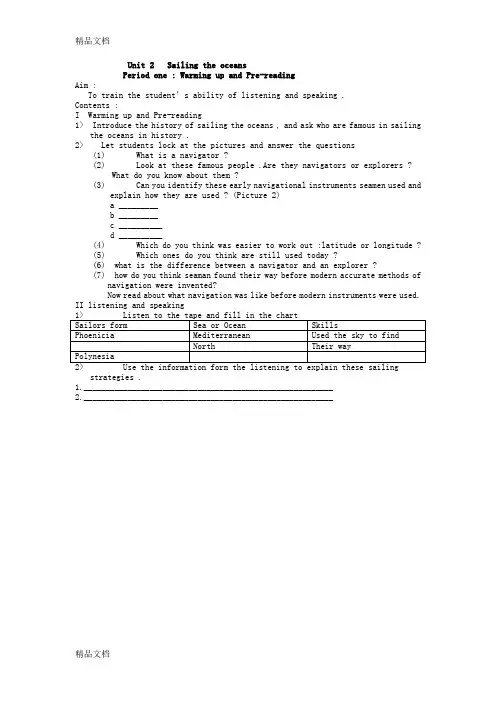
精品文档
精品文档 Unit 2 Sailing the oceans
Period one : Warming up and Pre-reading
Aim :
To train the student’s ability of listening and speaking .
Contents :
I Warming up and Pre-reading
1> Introduce the history of sailing the oceans , and ask who are famous in sailing
the oceans in history .
2> Let students lock at the pictures and answer the questions
(1) What is a navigator ?
(2) Look at these famous people .Are they navigators or explorers ?
What do you know about them ?
(3) Can you identify these early navigational instruments seamen used and
explain how they are used ? (Picture 2)
a _________
b _________
c __________
d __________
(4) Which do you think was easier to work out :latitude or longitude ?
(5) Which ones do you think are still used today ?
(6) what is the difference between a navigator and an explorer ?
最新-高中英语 Unit2《Sailing the oceans》教案(2)

英语:Unit2《Sailing the oceans》教案(2)(新人教版选修9)
Part One: Teaching Design
Period 1: A sample lesson plan for reading
(SAILING THE OCEANS)
Aims
To help students read about sailing the oceans
To help students learn about the predicate
Procedures
■Warming up by leaning about navigator
What is a navigator?
A navigator is the person onboard a ship responsible for the
navigation of the vessel. On aircraft, the position may also
be referred to as a flight officer. The navigator's responsibilities include
planning the journey, advising the captain (or pilot) while en route, and ensuring
that hazards or obstacles are avoided.
What is exploration?
Exploration is the act of searching or traveling for the purpose of discovery, e.g.
of unknown regions, including space (space exploration), or oil, gas, coal, ores,
water (also known as prospecting), or information.
高中英语课件高三新课标选修9课件学案Unit 2 Sailing the oceans 教案

Unit 2 Sailing the oceans
I. 单元教学目标
技能目标Goals
Talk about early navigation
Talk about discovery and exploration of an unknown land
Learn about some famous navigators and explorers
Learn to express the cause and effect
Learn to use the Predicate
Write a report about a navigator or an adventurous story
Ⅱ.目标语言
词
汇 voyage mercy encyclopedia alongside exploration minimum celestial pole
equator horizon overhead seaweed nowhere offshore accelerate outward tide
secure log knot nautical magnetic random awkward reference precise
simplify portable shortcoming update tendency reliable swoop parcel peck
cliff expedition compulsory survival incident departure crew deposit dilemma
drawback dusk routine reckon reckoning starvation psychology
psychologically tension gradual gradually foresee thirst tear hardship jaw
2019-2020年高中英语Unit2Sailingtheoceans--Learningabout

1 / 4 2019-2020年高中英语Unit2Sailingtheoceans--LearningaboutLanguage
Part One: Teaching Design
Period 2: A sample lesson plan for Learning about Language
(The Predicate )
Aims
To help students revise the Predicate
To help students discover and learn to use some useful words and expressions
To help students discover and learn to use some useful structures
Procedures
I. Warming up by reading aloud the text
Reading aloud is great for practicing pronunciation, intonation, fluency and linking. I find it's often
best to let you the students read aloud, just so that you can improve on your English.
Now go to page 12 to read aloud the text to the recording.
II. Discovering useful words and expressions
Learning how to build a better vocabulary can be a pleasurable and profitable investment of both
your time and effort. At least fifteen minutes a day of concentrated study on a regular basis can
2019-2020年高中英语Unit2Sailingtheoceans--LearningaboutLanguage
2019-2020年高中英语Unit2Sailingtheoceans--LearningaboutLanguage
Part One: Teaching Design
Period 2: A sample lesson plan for Learning about Language
(The Predicate )
Aims
To help students revise the Predicate
To help students discover and learn to use some useful words and expressions
To help students discover and learn to use some useful structures
Procedures
I. Warming up by reading aloud the text
Reading aloud is great for practicing pronunciation, intonation, fluency and linking. I find it's often
best to let you the students read aloud, just so that you can improve on your English.
Now go to page 12 to read aloud the text to the recording.
II. Discovering useful words and expressions
Learning how to build a better vocabulary can be a pleasurable and profitable investment of both
your time and effort. At least fifteen minutes a day of concentrated study on a regular basis can
新人教版英语高三Module 9《Unit 2 Sailing the oceans》word教案
▁▂▃▄▅▆▇█▉▊▋▌精诚凝聚 =^_^= 成就梦想 ▁▂▃▄▅▆▇█▉▊▋▌
▃ ▄ ▅ ▆ ▇ █ █ ■ ▓点亮心灯 ~~~///(^v^)\\\~~~ 照亮人生 ▃ ▄ ▅ ▆ ▇ █ █ ■ ▓ Unit 2 Sailing the oceans
Part Two: Teaching Resources
Section 3: Words and expressions from Unit 2
Sailing the oceans
mercy
noun (pl. -ies)
1. [U] a kind or forgiving attitude towards sb that you have the power to harm or right to punish
humanity: to ask / beg / plead for mercy They showed no mercy to their hostages. God have
mercy on us. The troops are on a mercy mission (= a journey to help people) in the war zone. 2.
[C, usually sing.] (informal) an event or a situation to be grateful for, usually because it stops sth
unpleasant: It’s a mercy she wasn’t seriously hurt. His death was a mercy (= because he was in
great pain.
at the mercy of sb/sth not able to stop sb/sth harming you because they have power or control over
[高中英语]高中英语 unit 2 sailing the oceans单元学案 新人教版选修9
Unit 2 Sailing the oceans
Part One: Teaching Design
Period 1: A sample lesson plan for reading
(SAILING THE OCEANS)
Aims
To help students read about sailing the oceans
To help students learn about the predicate
Procedures
■Warming up by leaning about navigator
What is a navigator?
A navigator is the person onboard a ship responsible for the navigation of the vessel. On aircraft,
the position may also be referred to as a flight officer. The navigator's responsibilities include
planning the journey, advising the captain (or pilot) while en route, and ensuring that hazards
or obstacles are avoided.
What is exploration?
Exploration is the act of searching or traveling for the purpose of discovery, e.g. of unknown
regions, including space (space exploration), or oil, gas, coal, ores, water (also known as
2019-2020年高中英语Unit2Sailingtheoceans(1)
可编辑修改
精选文档 2019-2020年高中英语Unit2Sailingtheoceans(1)
I. 单元教学目标
技能目标 Ability Goals
Talk about early navigation
Talk about discovery and exploration of an unknown land
Learn about some famous navigators and explorers
Learn to express the cause and effect
Learn to use the Predicate
Write a report about a navigator or an adventurous story
Ⅱ.目标语言
a. 词汇:voyage mercy encyclopedia alongside exploration minimum celestial pole equator horizon overhead
seaweed nowhere offshore accelerate outward tide secure log knot nautical magnetic random awkward reference
precise simplify portable shorting update tendency reliable swoop parcel peck cliff expedition pulsory survival
incident departure crew deposit dilemma drawback dusk routine reckon reckoning starvation psychology
psychologically tension gradual gradually foresee thirst tear hardship jaw background roar
2019-2020年高中英语Unit2SailingtheoceansLearningaboutLanguage
2019-2020年高中英语Unit2SailingtheoceansLearningaboutLanguage
Part One: Teaching Design
Period 2: A sample lesson plan for Learning about Language
(The Predicate )
Aims
To help students revise the Predicate
To help students discover and learn to use some useful words and expressions
To help students discover and learn to use some useful structures
Procedures
I. Warming up by reading aloud the text
Reading aloud is great for practicing pronunciation, intonation, fluency and linking. I find it's often best to let you
the students read aloud, just so that you can improve on your English.
Now go to page 12 to read aloud the text to the recording.
II. Discovering useful words and expressions
Learning how to build a better vocabulary can be a pleasurable and profitable investment of both your time and
effort. At least fifteen minutes a day of concentrated study on a regular basis can bring about a rapid improvement
英语高三选修九新人教版Unit2:教案
英语24字整体教学法
1 英语高三选修九新人教版Unit2:教案
Unit2《Sailing the oceans》教案(2)(新人教版选修9)
Part One: Teaching Design
Period 1: A sample lesson plan for reading
(SAILING THE OCEANS)
Aims
To help students read about sailing the oceans
To help students learn about the predicate
Procedures
■Warming up by leaning about navigator
What is a navigator?
A navigator is the person onboard a ship responsible for the navigation of the vessel. On aircraft,
the position may also be referred to as a flight officer. The navigator's responsibilities include
planning the journey, advising the captain (or pilot) while en route, and ensuring that hazards or
obstacles are avoided.
What is exploration?
Exploration is the act of searching or traveling for the purpose of discovery, e.g. of unknown
regions, including space (space exploration), or oil, gas, coal, ores, water (also known as