
2020年上海版牛津英语6B六年级基础语法复习整理
精品资料 形容词比较级最高级 规则变化
A. 单音节和不可拆双音节形容词 1.以e结尾+r / st huge-huger/hugest large- larger- largest safe- safer- safest
2.辅音字母+y结尾:去y + ier / iest heavy-heavier-heaviest dirty- dirtier- dirtiest happy-happier-happiest early-earlier-earliest friendly-friendlier-friendliest angry-angrier-angriest healthy-healthier-healthiest easy-easier-easiest
3.重读闭音节,以一个元音字母加一个辅音字母结尾:双写辅音字母+ er,est big-bigger- biggest fat- fatter- fattest thin- thinner- thinnest hot- hotter- hottest wet- wetter- wettest red- redder- reddest
4.直接+ er/est
strong young old short clever new great tall high cheap poor rich small slow fast light
B. 部分双音节形容词, 多音节形容词 famous- more famous- the most famous modern – more modern – the most modern careful- more careful- the most careful beautiful-more beautiful-the most beautiful expensive – more expensive (less expensive)- the most expensive interesting- more interesting- the most interesting 精品资料 不规则变化 good/well-better –best bad/badly/ill-worse-worst little-less-least + u. n. (few-fewer-fewest) + c. n. many/much-more –most far-farther-farthest (距离) far-further-furthest(程度)
程度副词much用来修饰形容词比较级 cheap(便宜的),cheaper(更便宜) much cheaper(便宜得多), good better much better much faster much taller much more beautiful
fast faster tall taller beautiful more beautiful
too, very, quite, so, as…as,not as /so…as, less …修饰形容词原级 very/quite tall(很高), too tall(太高) so tall(如此高) as tall as(与某人一样高) not as tall as /not so tall as(不如某人高)= less tall
注意事项: 1、形容词最高级前必须加the;副词最高级前可加the,也可不加the e.g. the biggest cities;draw (the) best 2、much可修饰比较级:……得多 e.g. much taller ……高得多 3、原级标志:very非常;too太;quite相当;(not)as+原级+as (不)像……一样;less+原级 不如……;so如此(共五个) 精品资料 时态填空 (一) 常用固定词组: A型. doing like doing/ love doing/ enjoy doing 喜欢做某事 hate doing 讨厌做某事 finish doing 完成做某事 practise doing 练习作某事 start doing / begin doing 开始做某事 What about doing…? / How about doing…? 做某事怎么样? be good at doing 善于做某事 be poor at doing 不善于做某事 Sb. spend(s) some time doing sth. 某人花时间做某事 remember doing 记住做过某事 forget doing 忘记做过某事 see sb. doing 看见某人正在做 by doing 通过做某事 by not doing通过不做某事 stop doing 停止做某事 instead of doing 而不是做某事 go doing
B型. to do would like to do / want to do 想要做某事 forget to do 忘记要做某事 remember to do 记得要做某事 have/has to do不得不做某事 had to do不得不做某事 will have to do 将不得不做某事 plan to do 计划做某事 One's job is / was to do... 某人的工作是做某事 like to do/love to do 喜欢做某事 start to do / begin to do 开始做某事 need to do 需要做某事 don’t need to do/ don’t have to do 不需要做某事 learn to do 学习做某事 promise to do / promise not to do 保证做某事/保证不做某事 tell sb. to do / tell sb. not to do 告诉某人做某事/告诉某人不做某事 ask sb. to do / ask sb. not to do 叫某人做某事/叫某人不做某事 It takes/took sb. some time to do sth.某人花时间做某事 It’s time to do sth. 做某事的时间到了
C型. do Let sb. do 让某人做 help sb. (to) do 帮助某人做 Why not do...? 为何不做......? would rather do / would rather not do 宁愿做/宁愿不做 精品资料 had better do / had better not do 最好做/最好不做 精品资料
can do 能做 may do 可以做 must do 必须做 will do 将要做 would do 想要做 shall do 应该做 should do 应该做 can't do 不能做 may not do 不可以做 mustn't do 不准做 won't do 将不做 wouldn't do 将不做 shan't do 将不做 shouldn't do 不应该做 needn’t do 不需要做
(二) 五种常见时态: 现在进行时 公式:am/is/are +doing (现在分词) 时间状语: now 现在 listen 听 look 看 these days 最近 eg. Look, they are planting trees.
一般现在时(助动词do/does) 公式:V. / V.+s/es/ies (动词原形或动词第三人称单数) 时间状语: always 一直 usually 经常 often 常常 sometimes 有时候 once a week 每周一次 four times a day 一天四次 every year 每年 How often 多久一次 e.g. I usually take an underground to school. He often takes a bus home.
一般过去时 (助动词did) 公式:V. +d/ed/ied或不规则(动词过去式) 精品资料 时间状语: yesterday 昨天 yesterday evening 昨天晚上 ten years ago 十年前 last week 上个星期 in the past 在过去 just now 刚才 e.g. Ten years ago, he moved to Japan. I sent a letter just now.
4. 一般将来时(助动词will/shall) 公式:am/is/are going to +V. , will /shall +V. 时间状语: tomorrow 明天 next week 下个星期 this weekend 这个星期 in the future 在将来 Soon 很快,不久 in 15 years’ time 在15年后 How soon 多久以后 e.g. I will fly to America tomorrow.
现在完成时(助动词have/has) 公式:have/has +done (过去分词) 时间状语: already 已经 yet 尚 never 从未 ever 曾经 just 刚才 once 一次 before 在......之前 for 6 years 6年 how long 多久 e.g. I haven’t read this newspaper yet. Mary has already packed her things.
Unit3语法知识点讲解牛津上海版英语六年级下册

6BU3 语法知识点讲解I.词性转换:sad—sadder—saddest sadly ( adv. )celebrate—celebrationadvice “劝告, 忠告” (un)advise (v.) advise sb. to do sth.a piece of advice 一条建议some advice 一些建议give advice to sb. 想某人提出建议=give somebody advicetake sb’s advice /follow his advice 采纳某人的建议II.语法:1. the fifth day of the fifth lunar month 在阴历五月初五solar 太阳的连接时间的介词:in: duration用于年,月,季节前/ in the morning / afternoon / evening / in the century on: on Wednesday / on New Year’s Day / on a cold morning / a hot day /on the evening of February 2nd. / on a fine night /on Sunday night / etc.On a rainy eveningat: time point at 7 o’clock) / at noon (midday) / night / midnight on a clear midnight 不加介词:this / that / one + 时间(morning / Sunday morning / spring)2.His job was to give advice to the king. 他的工作是给国王出谋划策。
be +to do, 不定式做表语,类似的主语有one’s wish, hope, ambition, plan, job + is + to do sth.e.g. His plan is to clean the room. 他的任务是打扫房间。
牛津英语沪教版6b词性转换归纳.docx
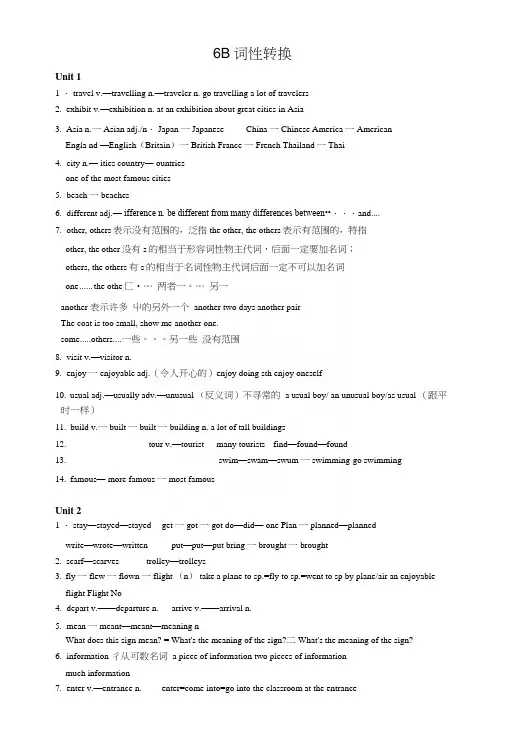
6B词性转换Unit 11 ・ travel v.—travelling n.—traveler n. go travelling a lot of travelers2.exhibit v.—exhibition n. at an exhibition about great cities in Asia n.一Asian adj./n・ Japan一Japanese China一Chinese America一AmericanEngla nd —English(Britain)一British France一French Thailand一Thai4.city n.— ities country― ountriesone of the most famous cities5.beach一beaches6.different adj.—ifference n. be different from many differences between••・・・and....7.other, others表示没有范围的,泛指the other, the others表示有范围的,特指other, the other没有s的相当于形容词性物主代词,后面一定要加名词;others, the others有s的相当于名词性物主代词后面一定不可以加名词one ...... the othe匚•… 两者一。
… 另一another 表示许多屮的另外一个another two days another pairThe coat is too small, show me another one.some.....others....一些。
另一些没有范围8.visit v.—visitor n.9.enjoy一enjoyable adj.(令人开心的)enjoy doing sth enjoy oneselfual adj.—usually adv.—unusual (反义词)不寻常的a usual boy/ an unusual boy/as usual (跟平时一样)11.build v.一built一built一building n. a lot of tall buildings12. tour v.—tourist many tourists find—found—found13. swim—swam—swum一swimming go swimming14.famous— more famous一most famousUnit 21 ・ stay—stayed—stayed get一got一got do—did— one Plan一planned—plannedwrite—wrote—written put—put—put bring一brought一brought2.scarf—scarves trolley—trolleys3.fly一flew一flown一flight (n) take a plane to sp.=fly to sp.=went to sp by plane/air an enjoyableflight Flight No4.depart v.——departure n. arrive v.——arrival n.5.mean一meant—meant—meaning nWhat does this sign mean? = What's the meaning of the sign?二What's the meaning of the sign?rmation 彳从可数名词a piece of information two pieces of informationmuch information7.enter v.—entrance n. enter=come into=go into the classroom at the entranceexit v.—exit n・exit=go out the classroom at the exit8.busy adj.一business n.—businessman n. —businesswoman n. be busy doing sth=be busywith sthOn business (做生意)一business hours(工作吋间)go on a business tripUnit 31 .celebrate v.一celebration n・ celebrate my twelfth birthday to celebrate the Dragon Boat Festival2.something pron.—否定句中anything—否定no thingI would like to know something about the Festivals I would not know anything about the Festival.I would know nothing about the Festival.3.die n— ead adj.— eath n. die— ied一died have/has/been dead for3.take-took-taken take one's advice=listen to sb. give-gave-given give onHs advice4.advice n.(不可数名词)-advise v. A piece of advice two pieces of advice5.salt n.-salty adj. need a little salt a salty rice dumpling6.with prep.-without without having breakfast二without breakfastsalty rice dumplings with meat sweet rice dumplings without beanste a. -later adv. two days laterS.danger n. — dangerous adj・ Be in danger Will be in danger A dangerous driver9.lose- lost- lost Lose a battle Lost a battle 否定:didn't lose a battleLose one's life=die10-send- sent- sent send sb. sth.=send sth. to sb.II・sandwich n. 一sandwiches12.photo・ photosUnit four1・ health n.-healthy adj. 一healthier - healthiest - unhealthy2.health problem be healthier than be as healthy asbe less healthy than = be not as/so healthy askeep healthy = stay healthyhe is healthier than I.=I am less healthy than he. = I am not as /so healthy as he.3.sing v. - sang 一sung - singer 一song4.dance v・一dancer n.5.run v. 一ran 一run 一runner6.real adj. — really adv. True adj. 一truly adv. Really= truly Really/truly sorry7.swim- swam-swum-swimmer enjoy swimming8.collect v.- collection n. enjoy collecting stamps/a collection of stamps9.fly v.- flew - flown - flight n. fly kites an enjoyable flight10.head n.-headache n. have a headache11 • tooth n.-teeth pl.-toothache have toothache12.have a stomachache have a bad cold have a fever have a sore throat have a cough13.little- few- fewest much- more- most many- more- most14.suggest v. 一suggestion n.Unit 51 ・change v・/n. 一changeable adj. change a lot=have a great change changeable weather2.possible adj.-possibly adv. possibly=maybe=perhaps my possible future3.weigh v.-weighed 一weighed-weight n.-heavy adj. the same weight as=as heavy asHow much do you weigh?= What's your weight?=How heavy are you? heavy-heavier-heaviest rain heavily=a heavy rain(—场大雨,雨是不可数名词)4.high adj.-height n.tall adj.(人的身高用tall) as tall as=the same height as taller than before5.final adj.-finally adv. finally=in the end=at last final exam6.beautiful 一more beautiful -the most beautiful dance beautifully7.bake v.-baker n.=bakery n. work in the bakeryA baker bakes bread and cakes・ A baker^s job is to bake bread and cakes.8.report v.=reporter n. report the news write reports9.slim adj. — slimmer-slimmest thin-thiner-thinnestfat-fatter - fattest strong - stronger 一strongest10.agree -disagree v . agree with sth agree to do sth11 • suggest v. 一suggestion n.12. glass n.-glasses n. a pair of glass two pair of glasses wear glass with glassUnit 71 .Travel v. travelling n. -traveler n.二visitor二touristWhat will travelling in garden city be like in 10 years9 time ?=How will travelling in garden city be in 10 years9 time ?(动名词作主语)Travelling in shanghai has changed a lot.(动名词做主语谓语动词要用单数)2.air-conditioned adj. -air-conditioner n.There were no air-conditioned buses.=There were not any air-conditioned buses •3.Collect v.-collection n. collect shells /stamps / coins/ collect money from the passengers4.both-neither all 一none both and=not only ・•・but alsoneither ・・.nor either ...or (或者。
语法知识点汇总(知识清单)牛津上海版(试用本)英语六年级下册
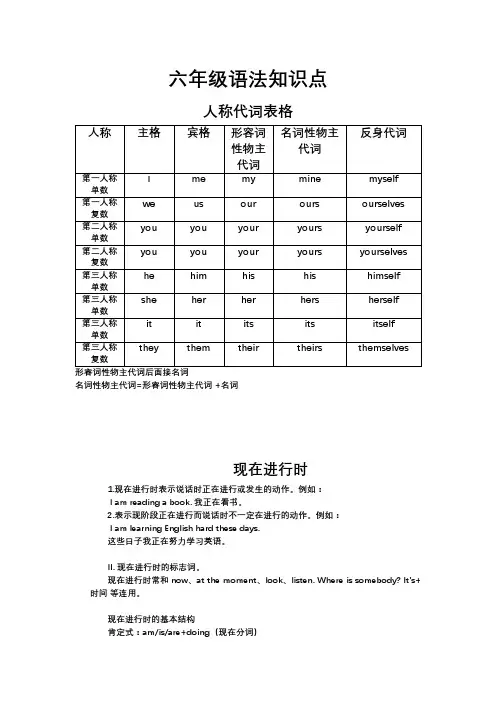
六年级语法知识点人称代词表格名词性物主代词=形容词性物主代词 +名词现在进行时1.现在进行时表示说话时正在进行或发生的动作。
例如:I am reading a book. 我正在看书。
2.表示现阶段正在进行而说话时不一定在进行的动作。
例如:I am learning English hard these days.这些日子我正在努力学习英语。
II. 现在进行时的标志词。
现在进行时常和now、at the moment、look、listen. Where is somebody? It’s+时间 等连用。
现在进行时的基本结构肯定式:am/is/are+doing(现在分词)They’re having a meeting now. 他们现在正在开会。
否定式:am/is/are not +doing(现在分词)They aren\'t having a meeting now. 他们现在没有在开会。
一般疑问式:Am/Is/Are + 主语 +doing(现在分词)+ 其他Are they having a meeting now? 他们现在正在开会吗?特殊疑问式:特殊疑问词+一般疑问式What are they doing now? 他们现在正在做什么?现在分词(doing)的变化规则1. 一般情况下,在动词词尾加ing。
go——goingplay——playingknow——knowing2. 以不发音的字母e结尾动词,先去e再加ing。
make——makingarrive——arrivinge——ing3. 以重读闭音节结尾,且动词词尾只有一个辅音字母时,先双写这个辅音字母,再加ing。
run——runningstop——stoppingswim——swimmingrun——runningput——puttingsit——sittingbegin——beginningplan——planningcut——cuttingget——gettingshop——shoppingchat——chattingregret——regrettingdig——digging4. 以ie结尾,先将ie改成y,再加ing。
牛津上海版英语六年级上册Unit6知识点及语法点

U6一、必会词组1. travel v./ n. 行走,旅行【知识拓展】travel—traveled—traveled—traveling或者travel—travelled—travelled—travelling注意过去式、过去分词及现在分词,l可以双写,也可以不双写。
travel与tour都可以表示旅游,对应的游客分别为travel(l)er和tourist。
go travelling 去旅游2. ferry n. (1)渡船(2)渡口v.(用船或飞机等)运送(货物)(通常指短程的或定期的)【知识拓展】by ferry 乘船3. advertisement n. 广告【知识拓展】advertise v.为……做广告4. board n. 栏;板【知识拓展】abroad adv. 在国外,到国外。
broad adj. 宽广的。
形象记忆board这个单词:首尾bd两个字母想象成船头和船尾,中间oar是一个单词,意思是“桨”,所以board有“甲板,上船”的意思。
5. a few 几个。
a few只能修饰可数名词复数形式,与之对应的是a little, 只能修饰不可数名词。
练习:I.Read and complete the sentences.(根据给出的首字母,完成句子。
)1. I have been to Jing’an T .It's in the centre of Shanghai.2. My father’s office is far away from home. He goes to work by l r every morning because it is fast.3. Mum likes going to some department s at weekends.4. We live in a new h e . It's large and beautiful.keys: 1.Temple 2.1ight rail 3.stores 4.housing estate 【乘坐交通方式表达】乘坐交通工具的表达:by bus/by car/by underground/by bike/by plane/by ferry /on foot乘公共汽车/乘小汽车/乘地铁/骑自行车/乘飞机/乘轮渡/步行。
上海牛津版英语六年级第一学期6A期末总结复习知识点总结计划

上海牛津版英语六年级第一学期6A 期末复习知识点总结频度副词频度副词always 、 sometimes、 usually 、 never发问How often?例: How often do you go swimming? — Twice a week.地点系动词 be 以后She is always kind.行为动词以前She always helps other people.错误She is always helps other people. (× ) 一句话中不可以同时出现两个动词。
差别how often问“频次次数 +时间范围”How often do you exercise? — Twice a week.how many times问”次数” How many times have you been there?副词副词表示动作特点或性状特点 ,一般用来形容或修饰形容词、动词、其余副词和句子。
用法修饰形容词: He looks very happy.修饰动词: The old lady is walking slowly now.修饰句子: Luckily, he got the first prize.次数副词一次 once, 两次 twice, 三次及以上 : 数字 +times介词介词又叫前置词 ,往常位于名词以前。
分为时间介词、地址介词、方式介词、原由介词、数目介词等用法With ** (与 ** 一同)例:I’ll go there with JIM.With 接人称代词时 ,要用宾格。
With me/him/her/it/us /them表示详细的某一层楼用on+序数词 +floor 。
On the ground floor, on the first floor.表示详细的某一天用介词on。
On Sunday, On Sunday morning, On the Open Day.the one on the left/right ,the one in the middle =the left/right/middle one.地址、方向表述near 离 ** 近直接接地址far ( away) from 离 ** (很)远I live near school. He lives far away from school.Arrive in 抵达 +大地方 (国家、城市等 )arrive in ShanghaiArrive at 抵达 +小地方(车站、学校等)arrive at the airportget to 抵达 +某地get to school. 抵达那边”只好说 get therereach 抵达 +某地reach schoolLeave 走开 +某地He will leave Shanghai.方向词:方向词east / west / north / south / north-east / north-west / south-east / south-westAB 两地不相邻 A is north B.Beijing is north Nanjing.AB 两地接壤 A is on the north of B.Heilongjiang is on the north of Jilin..A 包含 B,B 属于 A B is in the north of A.Beijing is in the north of China.代词one 用来指代一个人或事物 ,而 ones 用来指代一些人或事物。
上海牛津版6B期末复习基础题讲解学习
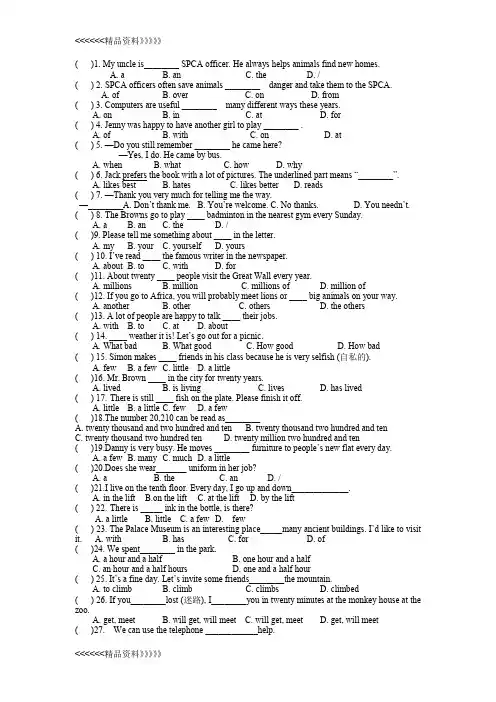
( )1. My uncle is________ SPCA officer. He always helps animals find new homes.A. aB. anC. theD. /( ) 2. SPCA officers often save animals ________ danger and take them to the SPCA.A. ofB. overC. onD. from( ) 3. Computers are useful ________ many different ways these years.A. onB. inC. atD. for( ) 4. Jenny was happy to have another girl to play ________ .A. ofB. withC. onD. at( ) 5. —Do you still remember ________ he came here?—Yes, I do. He came by bus.A. whenB. whatC. howD. why( ) 6. Jack prefers the book with a lot of pictures. The underlined part means “________”.A. likes bestB. hatesC. likes betterD. reads( ) 7. —Thank you very much for telling me the way.—________A. Don’t thank me. B. You’re welcome. C. No thanks. D. You needn’t. ( ) 8. The Browns go to play ____ badminton in the nearest gym every Sunday.A. aB. anC. theD. /( )9. Please tell me something about ____ in the letter.A. myB. yourC. yourselfD. yours( ) 10. I’ve read ____ the famous writer in the newspaper.A. aboutB. toC. withD. for( )11. About twenty ____ people visit the Great Wall every year.A. millionsB. millionC. millions ofD. million of( )12. If you go to Africa, you will probably meet lions or ____ big animals on your way.A. anotherB. otherC. othersD. the others( )13. A lot of people are happy to talk ____ their jobs.A. withB. toC. atD. about( ) 14. ____ weather it is! Let’s go out for a picnic.A. What badB. What goodC. How goodD. How bad( ) 15. Simon makes ____ friends in his class because he is very selfish (自私的).A. fewB. a fewC. littleD. a little( )16. Mr. Brown ____ in the city for twenty years.A. livedB. is livingC. livesD. has lived( ) 17. There is still ____ fish on the plate. Please finish it off.A. littleB. a littleC. fewD. a few( )18.The number 20,210 can be read as________A. twenty thousand and two hundred and tenB. twenty thousand two hundred and tenC. twenty thousand two hundred tenD. twenty million two hundred and ten( )19.Danny is very busy. He moves ________ furniture to people’s new flat every day.A. a fewB. manyC. muchD. a little( )20.Does she wear_______ uniform in her job?A. aB. theC. anD. /( )21.I live on the tenth floor. Every day, I go up and down_____________.A. in the liftB.on the liftC. at the liftD. by the lift( ) 22. There is _____ ink in the bottle, is there?A. a littleB. littleC. a fewD. few( ) 23. The Palace Museum is an interestin g place_____many ancient buildings. I’d like to visit it. A. with B. has C. for D. of( )24. We spent________ in the park.A. a hour and a halfB. one hour and a halfC. an hour and a half hoursD. one and a half hour( ) 25. It’s a fine day. Let’s invite some friends________the mountain.A. to climbB. climbC. climbsD. climbed( ) 26. If you________lost (迷路), I________you in twenty minutes at the monkey house at the zoo.A. get, meetB. will get, will meetC. will get, meetD. get, will meet( )27. We can use the telephone ____________help.A. toB. forC. withD. in( )28. This sign tells us ________ right..A. turnB.to turnC. turnsD. turning ( )29. ________ important information it is!A. WhatB. What aC. What anD. How ( )30. Now it’s my __________. I can’t miss it.A. turnB. turnsC. orderD. orders ( )31. I really can’t decide ______to choose for my son because they are all nice.A.whereB.howC.whatD.which ( )32. The policeman warned the boys________ football in the street.A. not to playB. not playC. didn’t playD. don’t play ( )33. During the holidays, some people went to the zoo;__________ went to the park.A. otherB. othersC. the otherD. the others( )34. You should follow the rules to keep yourself __________.A.safetyB.safeC.saveD.safely( )35. You _____take an umbrella with you because it’s fine.A.can’tB.may notC.mustn’tD.needn’t ( )36. Don’t ________ the radio. Grandpa is sleeping.A. turn onB. turn offC. turn overD. turn down ( )37. ---Must I finish my homework before I play video games,Mum?---I’m afraid you __________.A.mustB.mustn’tC.canD. can’t( )38. After he heard the news, he looked___________.A.angrilyB.angryC.angerD.angrier( )39. ________Ben _______Kitty are interested in science.A.Neither …norB.Not only…but alsoC.Both… andD.Either…or( )40. Shanghai has two big zoos. One is Shanghai Zoo. _______ is Shanghai Wild Animals Park.A.OtherB.AnohterC.The otherD.Others( )41. I’d like a flat ________ 3 bedrooms, 2 bathrooms and a large sitting room.A.hasB.withC. ofD.in( )42. _______ television is not good for your eyes..A.Too manyB.So manyC.Too muchD. So much( )43. _______ a windy morning, we moved into our new home.A.InB.OnC.OfD.At( )44. Show us ______ your bought yesterday.A.whereB.whyC.whenD.what( ) 45. Nanjing is __________of Beijing.A. in the southB.in southC.to the southD.to south( )46. I will ask my classmates __________ me with the lessons.A.helpingB. to helpC.helpD. helps( )47. _________ delicious the roast duck is!A.How aB. HowC. WhatD. What a( )48. The old man ___________much money.A.needB. needs toC. needn’t.D. doesn’t need( )49. Have you ever visited the Summer Palace_____________?A.beforeB. agoC. alreadyD. Then1. Most of the students in this class are______________. (foreign)2. We will go to __________ and have a wonderful holiday there. (British)3. We turned to the left and there were two _____________ in front of us. (build)4. Every year, lots of ____________ from all over the world visit the Great Wall. (visit)5. The sun and beach can make a holiday__________________. (wonder)6. The police caught the two ___________ in the country last week. (thief)7. Some children helped the old man cross the road____________ . (safe)8. Don’t be____________ to animals. W e should protect them. (kind)9. The library is usually ___________ with students at the weekend. (crowd)10. The _____________ flag has a red maple leaf in the centre. (Canada)11. Mary is a new student and her ___________ is American. (national)12. His _____________ to the little dog made us angry. (cruel)13. I usually have some sushi when I go to a ____________ restaurant. (Japan)14. Do you know any places of _____________ in Shanghai? (interesting)15. The police rushed into the building and_______________ the little boy. (safe)16. Some_______________ will visit our school next Monday. (Canada)17. Dogs are so helpful that they can help us find the_______________people. (miss)18.Many people from around the world live in this _______________(nation) city----- Shanghai.19. I have met some _______________(America)friends since I came to New York.20.How many ________________(India) live and work in Shanghai?21.We call people from Britain ________________(Britain).22.Which food do you prefer,____________(Japan) food or ____________(Australia)food?23. There are a lot of new_________________(company) near our school.24. The Qingming Festival has already become a ______________holiday in China. (nation)25. Tony would like to be a travel__________________when he grows up. (agency)26.Do you know the ____________(direct) of Shanghai Museum?27. They often chat with each other _____________(noisy).28. The doctor saved hundreds of people’s ___________________(life).29.To have a walk in the forest is quite ______________(excite).30. What’s the __________(mean)of the word?31. We can get ___________(use) information here.32. Tom’s dream is to be a great basketball ____________(play) like Yao Ming.33. That sign tells us to stop here. It’s an _____________ (instruct) sign.34. ___________(lucky), he missed the bus and was late for the meeting.35. What’s wrong? Why are you so __________ (silence)36. There was a strong typhoon, but the pilot landed the plane___________(safe)37.My uncle used to ___________(smoking ) when he was young.38. Don’t make a __________(noisy)in the reading room.39. The boys are ______________(excite) when they are watching the basketball match.40. Let me introduce my new _____________ (neighbourhood) Tom to you.41.I think living in the countryside is very ____________________(please).42. Have you moved to a new___________________(neighbor)?43.Most of the people like the ______________(peace)life.1. His mother teaches English in No. 1 Middle School. (改为一般疑问句)_________ his mother __________ English in No. 1 Middle School?2. The girl behind the tree is my best friend. (对划线部分提问)___________ ____________ is your best friend?3. Could you please give me that bag? (同义句改写)Could you please__________that bag ____________me?4. Mrs. Green has lived in this small village for about twenty years. (对划线部分提问)_________ ________has Mrs. Green lived in this small village?5. They decided to go by plane because it is much faster. (同义句改写)They decided to________ a___________ because it is much faster.6. We go to see our grandparents four times every month. (对划线部分提问)_________ __________ do you go to see your grandparents every month?7. Jim has to take care of his little sister after school. (同义句改写)Jim has to _______ __________his little sister after school.8. Do you want to go shopping with us tomorrow? (同义句改写)__________ you ___________ to go shopping with us tomorrow?9. My penfriend will send me some beautiful stamps. (同义句改写)My penfriend will __________ some beautiful stamps __________ me.10. Please give him some money to buy the ice cream. (改为否定句)Please ___________ ____________ him any money to buy the ice cream.11. There are some bananas and oranges in the basket. (改为否定句)There _______ any bananas _________ oranges in the basket.12. Most children like hamburgers better than hot dogs. (同义句改写)Most children __________ hamburgers ________ hot dogs.13. Garden City is a crowded city.(对划线部分提问)________ _________ ______ city is Garden City?14. We call people from Canada Canadians. .(对划线部分提问)_________ _________ we call people from Canada?15.He has lived in the USA for about two months. (对划线部分提问)________ _________ _________ he lived in the USA?16.What’s your nationality?(保持句意相同)_________ do you come _________?17. Her father will come back in a few weeks. (对划线部分提问)________ __________ will her father come back?18. We call people from Canada Canadians.([对划线部分提问)_________ ________ we call people from Canada?19. Henry is a postman (保持句意相同)Henry’s job is ______ _________ letters and parcels.20.Please don’t eat in the classroom. And don’t drink in the classroom. (保持句意相同) We _________ eat________ drink in the classroom.21.She picked up the rubbish to keep the ground clean. (对划线部分提问)___________ _______ she __________ up the rubbish?22.It’s a direction sign.(对划线部分提问)_________ ________ ________ sign is it?23. At school we have rules to keep us safe. (对划线部分提问)_______ ________ we have rules at school?24. Don’t run on the road.( 保持句意相同)_________ _________ run on the road.25.I missed the early bus this morning. ( 保持句意相同)I _______ _________ the early bus this morning.26.You can only wash these clothes by hand.(对划线部分提问)_________ ________ I wash these clothes?27.Can you tell me when I will visit my old teacher? ( 保持句意相同)Can you tell me _________ __________ visit my old teacher?28. Put the sofa opposite the TV set.(改为否定句)__________ __________ the sofa opposite the TV set.29. I’d like a flat with a big balcony and three bedrooms.(对划线部分提问)_________ _________ __________ flat would you like ?30. It took him over six hours to finish reading the story. (保持句意相同)He ________ over six hours ________ _________ the story.31.The new watch cost him 160 yuan. (改为否定句)The new watch ________ _________ him 160 yuan.32.The life in the city center is pleasant. (对划线部分提问)_________ _________ the life in the city center?33. Laura has the guitar lesson once a month. (对划线部分提问)________ _________ ___________ Laura _____________ the guitar lesson??34. He’s read all the books .(反义疑问句)He’s read all the books,_________ __________?35.There are few books on the shelf. (反义疑问句)There are few books on the shelf, ________ _________?36.We are going to get to the Exhibition Center by ferry. (对划线部分提问)_________ _________ you going to get to the Exhibition Center r?37. Jack swan across the river last night. (对划线部分提问)_______ _____ Jack _________ across the river?38. It took them one hour to do the housework.(保持句意相同)They _________ one hour ___________ the housework.39.Tom’s heard that his parents want to buy a new house.(改为否定句) Tom_______ __________ that his parents want to buy a new house. 40.He read this newspaper yesterday.(改为否定句)He _______ _________this newspaper yesterday.41. She took care of those old people when she was free.(保持句意相同) She ________ ________ those old people when she was free.42.It’s fun to have a party by the sea. (改为感叹句)______ _______ it is to have a party by the sea!43.What’s your father’s job?(保持句意相同)What ________your father _________?。
20202021学年牛津上海版六年级下册语法连词讲解及提升练习(有答案)
20202021学年牛津上海版六年级下册语法连词讲解及提升练习(有答案)___牛津版6B语法-连词讲解及提升练习并列连词:连接两个或两个以上地位平等的词、短语或分句。
but 但是,可是,而,却 and 和,同,与,又,并且, 然后 but的用法:表转折关系【辨析】:however(然而,但是)表示转折,用作副词,不可连接句子,置于第二句的句首、句末或句中。
要特别注意标点的使用。
e.g. She felt ill. She went to work, however, and tried to con ___ntrate. Ali ___ is a good student.However, she has one shorting. The position is all right. There is room for improvement, however. 1. “但是,可是”(相当于yet; however;); e.g. She cut her knee badly, but didn't cry. I'd love to go to the theatre tonight, but I'm too busy. He was tired but happy after the long walk. 2. 用于表示歉意的话语之后,表示谢绝或不赞成;e.g. Excuse me, but could you ___ me where the post offi ___ is? I’m sorry, but I have another appointment tonight. 3. “而; 却”(相当于on the contrary 相反地);e. g. You've bought the wrong shirt. It's not the red one I wanted but the blue one. Tom wentto the ___, but his brother didn't. 4. 含“but”的习惯搭配: ①“not... but...”意为“不是...而是...”,连接两个并列的名词、形容词、副词、短语或分句等; Bamboo is not a tree, but a kind of grass. He failed not because he isn't clever but because he didn't work hard. ② have no choi___ but to do ... 除了...,别无选择 / do/does/did nothing but do... 除了...,别无他事可做③ not only ...but also ...意为“不但...而且...;既...又...”,连接两个并列成分【考例】 --- Would you like to e to dinner tonight? --- I'd like to, ___ I'm too busy. A. and B. so C. as D. but [答案]D。
初中英语 牛津上海版六年级下册语法-条件状语从句+时间状语从句讲解及提升练习(有答案)
上海牛津版6B语法-条件状语从句+时间状语从句讲解及提升练习一、条件状语从句if 假如; 如果; 倘若; 要是I.unless如果不…就…;除非…否则…II. if的用法①if(如果)e.g. If it doesn’t rain, we will go to the park next Sunday.If you ask him, he will help you.②if(是否)引导宾语从句:时态需根据具体情况而定e.g. He asked whether/if we wanted a drink.He didn't know whether/if we should write or phone.III. unless 的用法e.g. You'll fail in French unless you work harder.Unless England improve their game , they're going to lose the match.练习:I. Multiple Choices 选择最佳答案1.If it _______ fine tomorrow, I will go hiking with you.A. isB. wasC. will beD. being2.I like summer best among the four seasons, __________ I can enjoy the long summervacation.A. butB. becauseC. soD. Though3.You can't learn English well ____________ you practice more.A.ifB. becauseC. unlessD. after4.Don't let such a thing happen again, ________ you will lose your job!A. andB. butC. orD. so5.—Do you know if he________ to play football with us?—I think he will come if he _________ free tomorrow.A. comes; isB. comes; will beC. will come; isD. will come; will be6.______ you improve your writing, you’ll lose marks in the exam.A. BeforeB. BecauseC. UnlessD. if7.Online games are very interesting, ________we can’t spend too much time on it.A. andB. orC. soD. but8.You will stay healthy ________ you do more exercise, such as running and walking.A. beforeB. ifC. thoughD. until9.Try your best, ____________ you will make great progress in your English study.A.butB. ifC. orD. and10.I don’t know if his uncle __________.I think he __________if it doesn’t rain.A. will come; comesB. will come; will comeC. comes; comesD. comes; will comeII. Sentence Rewriting 改写句子1. Work harder, or you'll not succeed in your new job. (保持句意基本不变)________ ________ work harder, you'll not succeed in your new job. Unless you 2. I shall leave the restaurant if the waiter doesn’t come soon. (保持句意基本不变)I shall leave the restaurant ________ the waiter ________ soon. unless…comes3. Unless you clean your teeth regularly, you will get toothache. (保持句意不变)________ you clean your teeth regularly, you will get toothache. If… don’t 4.If you don't clean your teeth regularly, you will get toothache. (保持句意基本不变)You________ get toothache________ you clean your teeth regularly. will…unless5. You will be unhealthy if you don't do exercise regularly. (保持句意基本不变)Y ou will be unhealthy________ you ________ exercise regularly. unless…do二、时间状语从句when 当…的时候I. 从属连词: 连接两个或两个以上的分句。
上海版牛津英语6A期末复习语法题
上海版牛津英语6A期末复习语法题期末复习疑问词意义经典例句what 问事物,职业,等What’s in the box?What day is it today?What’s the date today?what time 问时间What time is it?when 问时间When will you get home?why 问原因Why were you late?where 问地点Where is Peter?who 问谁Who is he?whose 问谁的Whose bag is it?which 问哪一个Which is your boy?how 问方式,健康,天气How do you go to school?how old 问年龄How old are you?how long 问长度或时间段How long have you lived here?how often 问频率How often do you do the exercise?how soon 问多久以后How soon will you come here? how many/how much 问数量或价格How many students are there in the class?How much is the watch?how far 问距离How far is it from your home toschool?习题练习:1. Joe's father plays badminton(羽毛球) every weekend.2. The laptop(笔记本电脑) is on the table.3. My mother is a nurse in the hospital.4. He gets up at 6:30 in the morning.5. Li Lei goes to work on foot.6. It is about 20 kilometers from my home to the town.7. I have lived in Hang Zhou for 20 years.8. I’m lo oking for my watch.9. The train will start in three minutes.10. Alice has the violin lesson twice a week.11. The building with green wall is the post office.12. He didn’t come because he was ill.注意事项:由于特殊疑问词孩子们从小学就已经开始接触,对于最基本的what/how/where等并不感到陌生,出题的难度一般也不会很大。
沪教版牛津英语六(上)语法点
纵看牛津六年级第一学期的课文,重点语法主要分为以下几点:1.特殊疑问句(wh-与how的用法)2.情态动词的基本使用3.一般将来时态/一般过去时态/现在完成时态4.形容词、副词的比较级和最高级(than与as…as…的用法)一.特殊疑问词归纳疑问词意义经典例句what 问事物,职业,姓名等What’s in the box?What day is it today?What’s the date today?what time 问时间What time is it?when 问时间When will you get home?why 问原因Why were you late?where 问地点Where is Peter?who 问谁Who is he?whose 问谁的Whose bag is it?which 问哪一个Which is your boy?how 问方式,健康,天气How do you go to school?how ol d 问年龄How ol d are you?how long 问长度或时间段How long have you lived here?how often 问频率How often do you d o the exercise?how soon 问多久以后How soon will you come here? how many/how much 问数量或价格How many stud ents are there inthe class?How much is the watch?how far 问距离How far is it from your home toschool?习题练习:1. Joe's father plays badminton(羽毛球) every weekend.2. The laptop(笔记本电脑) is on the table.3. My mother is a nurse in the hospital.4. He gets up at 6:30 in the morning.5. Li Lei goes to work on foot.6. It is about 20 kilometers from my home to the town.7. I have lived in Hang Zhou for 20 years.8. I’m looking for my watch.9. The train will start in three minutes.10. Alice has the violin lesson twice a week.11. The building with green wall is the post office.12. He didn’t come because he was ill.注意事项:由于特殊疑问词孩子们从小学就已经开始接触,对于最基本的what/how/where等并不感到陌生,出题的难度一般也不会很大。