
人教版(新目标)七年级英语上unit4 where's my backpack
新目标初中英语七年级上册Unit 4 Where’s my backpack课件
Fill in the blanks:
Tommy’s room
This is Tommy’s room. His math book ________________. is on the dresser His ruler is under the bed His notebook _______________. _____________. is on the bed His CDs _________ are on the bookcase _________.And his video tape is on the table It is a messy (乱) _____________. room.
Group work:
If you are Tommy, what do you think your room should be? Please decorate Tommy’s room with your group members, then show your design. (假如你是Tommy,你觉得你的房间应该是怎样 的?请和组员一起装扮Tommy的房间然后秀出你 们的设计。)
Listening
2a book notebook
Listen and circle the things Tommy wants from his room.(请圈出Tommy想要的东西)
pen
pencil
CDSΒιβλιοθήκη rulervideo tape
computer game
math book
2b
Listen again and write down where the things are.(再听一遍写出这些 物品的位置)
2021年七年级英语上册 Unit 4《Where’s my backpack》教案 人教新目标版
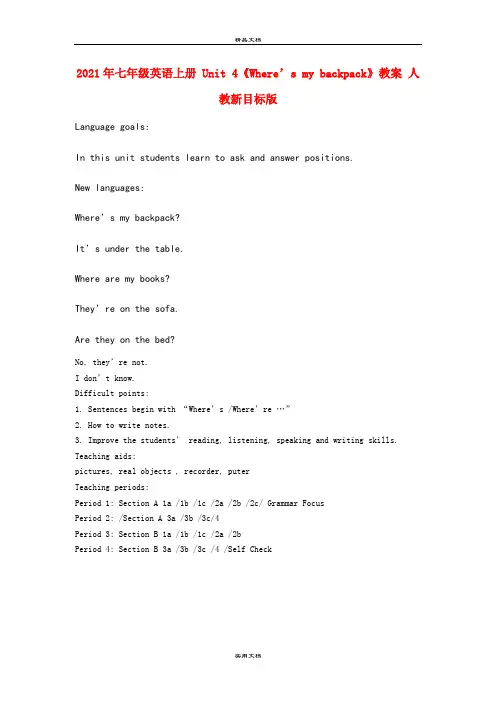
2021年七年级英语上册 Unit 4《Where’s my backpack》教案人教新目标版Language goals:In this unit students learn to ask and answer positions.New languages:Wher e’s my backpack?It’s under the table.Where are my books?They’re on the sofa.Are they on the bed?No, they’re not.I don’t know.Difficult points:1. Sentences begin with “Where’s /Where’re …”2. How to write notes.3. Improve the students’ reading, listening, speaking and writing skills. Teaching aids:pictures, real objects , recorder, puterTeaching periods:Period 1: Section A 1a /1b /1c /2a /2b /2c/ Grammar FocusPeriod 2: /Section A 3a /3b /3c/4Period 3: Section B 1a /1b /1c /2a /2bPeriod 4: Section B 3a /3b /3c /4 /Self CheckPeriod 1Teaching aims:1. Learn the words on page19 and page20.2. Use target languages:Wher e’s my backpack?It’s under the table.Where are my books?They’re on the sofa.3. Train the listening and speaking skills.Teaching procedure:Step 1 Revision1. Have a dictation of words in last class.2. Free talk (make conversations in pairs).Step 2 PresentationShow students some real objects or pictures (table, bed, dresser, sofa, chair, books, keys, backpack …), have students try to say them in English. Step 3 Section A 1aThis activity introduces the key words of this unit.1. Focus students on the words (table, bed, dresser, sofa, chair, books, keys,backpack …), say each one in English, and ask students to repeat.2. Say, Look at the picture. Have students find the objects in the picture.3. Then ask the students to match the words and objects in the picture bywriting the letter of the object on the blank after the word.Step 4 Section A 1bThis activity gives students practice in recognizing specific vocabulary words in spoken conversation.(1) Have students read the words in 1a as they look at the objects.(2) Play the recording for the first time. Students only listen.(3) Play the recording for the second time. This time say, Now listen again,and number the things in the picture when you hear them.(4) Check the answers.Step 5 Section A 1cThis activity provides guided oral practice using the target language.(1) Ask two students to read the conversations in 1c.(2) Have students work in pairs and practice the conversation.(3) Say, Now make conversations using the words in the box.Demonstrate a conversation with a student.(4) Students work in pairs to make conversations.(5) Let several pairs e to the front of the class and act out theirconversations.Step 6 Section A 2aThis activity gives students practice in recognizing specific vocabulary words in spoken conversations.1. Point to the things in the pictures. Have students say their names in English.2. Play the recording for the first time. Students only listen.3. Play the recording a second time. This time students number the things1-6 when they hear them in the conversation.4. Check the answers.Step 7 Section A 2bThis activity provides guided practice using the key words.(1) Have one student read the number and say the name of each item in 2a.(2) Ask students to look at the picture carefully.Say, Now you’ll write these numbers on the picture in 2b.(3) Play the recording the first time. Students look at the picture as they listen.(4) Play the recording a second time.This time students listen and write the numbers.(5) Check the answers.Step 8 Section A 2cThis activity provides guided oral practice using the target language.(1) Call attention to the picture in 2b.Point to the baseball in the picture and ask the students:Is the baseball on the sofa? Have the students answer No, it isn’t.It’s under the chair.(2) Say, Now work in pairs and ask where the things are. As students work,move around the classroom, monitoring the conversations and offeringassistance if necessary.(3) Have several pairs of students present their conversations to the class. Step 9 Grammar FocusAsk the students to work in pairs to say the questions and answers.Step 10 Conclusion(1) Learn and master the vocabulary words.(2) Master the target languages.Wher e’s my backpack?It’s under the table.Where are my books?They’re on the sofa.Step 11 Homework(1) Learn the vocabulary words by heart.(2) Practice the conversations in Grammar Focus.(3) Make up a conversation.Period 2Teaching aims:1. Memorize the words: don’t, know, bag2. Use the sentences: Are they on the bed? I don’t know.3. Train speaking skills.Teaching procedure:Step 1 Revision1. Show some pictures (table, bed, dresser, sofa, chair, books, keys,backpack …) to the students. Have them say them in English and try tospell them.2. Ask students to make conversations:Where’s …?It’s …Where’re …They’re …Step 2 PresentationThis activity practices the key words.Put some books on the desk. Ask the students, “Where are my books? Are they under the desk? Help the students answer, “No, they’re not."Give more exercise like that.Step 3 Section A 3aThis activity provides guided reading practice using the target language.(1) Call attention to the picture on the left. Have two students read theconversation. If necessary, explain the meaning of the sentences.(2) Ask students to practice the conversation.Move around the room checking on their work.(3) Read the four lines of the conversation on the right of the picture tostudents. Say, The four sentences are in the wrong order. Now put themin the right order to make a plete dialogue.As students work, move aroundthe room and check their progress.(4) Check the answers. Have one student read the plete message.Step 4 Section A 3bThis activity provides guided oral practice using the target language.Have students practice the conversations in 3a.Take turns to ask and answer the questions.Step 5 Section A 3cThis activity provides guided oral practice using the target language.(1) Call attention to the three pictures. Have students look at the picturesand discuss where the key, baseball and pencils are.(2) Read the sample dialogues and ask students to repeat.Take the firs picture as an example.Demonstrate the conversation with a student:Where’re the keys?They’re on the table.Say: Now work in pairs to ask and answer about the three pictures.Ask three pairs to present their conversations to the class.Step 6 Section A 4This activity provides guided oral practice using the target language.(1) Read the instruction to the class.Take one object as an example. Demonstrate it with a student.(2) Have students work in pairs. One student in each pair looks at page 19and the other looks at the picture on the right. Take turns asking andanswering the questions in class.Step 7 Conclusion(1) Learn the words in this class.(2) Grasp the target languages:Are they on the bed?No, they’re not.Step 8 Homework(1) Memorize the words.(2) Act out the dialogues in activity 3a.(3) Prepare next lesson.Period 3Teaching aims:1. Learn the vocabulary words.2. Talk about positions of objects.3. Train the listening and speaking skills.Teaching procedure:Step 1 Daily talkPut a book or some books on/in /under the desk. Ask students to makeconversations about it/them. Use the sentences:Where’s …It’s …Where’re …They’re …Step 2 Section B 1aThis activity provides a view of key words.(1) Read the words and phrases in the box and ask students to repeat them.(2) Have students find these things in the picture.(3) Focus attention on the example answer.Then ask students to match the words and objects in the picture.(4) Check the answers.Step 3 Section B 1bThis activity practices the key words.(1) Say, Now look at Tommy’s room. I’ll give you three minutes, try toremember as many items as you can.(2) Ask students to close their books and write down the names of as manyitems as they can remember.(3) Ask how many words each student wrote. Have the student who wrote themost words write his/her words on the board and cheer for him/her.(4) Have students open their books and see what words students may havemissed.Step 4 Section B 1cThis activity provides guided oral practice using the target language.1. Ask one student closes his/her book and ask, “Where’s the puter game?”If he/she gives the right answer, say, “That’s right.”If he/she givesthe wrong answer, say, “That’s wrong.” And ask the question again.2. Have students work in pairs. Say: One asks with your book open, and theother answers with your book closed.3. Ask several pairs to perform their conversations for the class.Step 5 Section B 2aThis activity gives students practice in recognizing specific vocabulary wordsin spoken conversation.(1) Call attention to the words and phrases in the box.Say each one and have students repeat it.(2) Say, Now listen and circle the things Tommy wants from his room.Play the recording the first time, students only listen.(3) Play the recording a second time.This time students circle the things that Tommy wants from his room. Step 6 Section B 2bThis activity gives students listening and writing practice using the target language.(1) Say: Where are Tommy’s things? Do you know?Let’s listen and write notes like the example.(2) Play the recording, students listen and write sentences.(3) Check the answers.Step 7 Homework(1) Remember the words in this lesson.(2) Read the sentences in activity2b.(3) Do some preparing.Period 4Teaching aims:1. Memorize the words and phrases on page23 and page24.2. Learn to write notes.3. Train reading and writing skills.Teaching procedure:Step 1 Revision1. Have a dictation of the words and phrases in last class.2. Read the sentences in activity 2b.Step 2 Section B 3aThis activity gives students practice in understanding the prepositions and reading and writing the vocabulary words.1. Call attention to the note. Have students read it by themselves.2. Ask the students if they have any questions about the note.If necessary, explain some difficult sentences.3. Ask students to look at the picture carefully. Say, Some things are missingin the picture. Can you draw them in the right place according to the note?4. Check the answers.Step 3 Section B 3bThis activity provides guided writing practice using the target language.(1) Call attention to the picture. Have students name the items in the pictureand tell where they are.(2) Read the beginning of the note on the right to the class. Say, Now fillin the blanks according to the picture.(3) Check the answer.(4) Students practice reading the noteStep 4 Section B 3cThis activity gives students writing practice.1. Have students read the notes in 3a and 3b again.2. Say, You left four things in your room.Write a note to a friend askingfor them. You must say where they are.3. Ask students to write their notes. As they work, the teacher goes aroundthe room and offer help if needed.4. Have several students read their passages to the class.Step 5 Section B 4 GroupworkThis activity gives students practice illustrating the key words from this lesson.1. Say, If you have your own room, What would you like to put in it? And wherewould you like to put them? Draw your ideal room and describe it to your classmates.2. Ask some students to present their passages to the class.27979 6D4B 测25215 627F 承40843 9F8B 龋T337717 9355 鍕_K24407 5F57 彗29318 7286 犆37271 9197 醗 35847 8C07 谇26470 6766 杦。
人教版新目标英语七年级上册Unit 4 Where′s my backpack Section B -课件
Mom: Math book? Where’s your math book?
Tommy: Oh, it’s on the dresser. And I need my ruler. It’s under the bed. And my notebook.
Mom: Where’s your notebook? Tommy: Uh, I don’t know. Oh…yeah,
The math book is on the dresser. The ruler is under the bed. The notebook is on the bed. The CDs are on the bookcase. The video tape is on the table.
Tapescript
2a Listen and circle the things Tommy wants from his room.
book
pen
pencil
CDs
ruler
notebook video tape
computer game math book
2b Listen again. Where are Tommy’s things?
Mom : Hello. Tommy: Hi, Mom. I need some
things for class this afternoon. Can you bring them to school for me, please? Mom: Sure. Tommy: I need my math book…
Unit 4 Where’s my backpack? Section B Period 1
新目标初中英语七年级上册Unit4《Where’smybackpack》教案
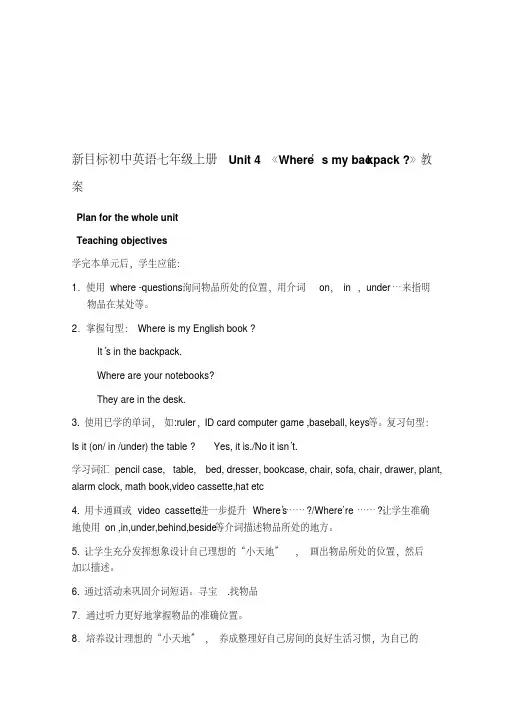
新目标初中英语七年级上册Unit 4 《Where’s my bac kpack ?》教案Plan for the whole unitTeaching objectives学完本单元后,学生应能:1.使用where -questions询问物品所处的位置,用介词on,in ,under …来指明物品在某处等。
2.掌握句型:Where is my English book ?It’s in the backpack.Where are your notebooks?They are in the desk.3. 使用已学的单词,如:ruler,ID card computer game ,baseball, keys 等。
复习句型:Is it (on/ in /under) the table ? Yes, it is./No it isn’t.学习词汇pencil case, table, bed, dresser, bookcase, chair, sofa, chair, drawer, plant, alarm clock, math book,video cassette,hat etc4. 用卡通画或video cassette进一步提升Where’s……?/Where’re ……?让学生准确地使用on ,in,under,behind,beside等介词描述物品所处的地方。
5. 让学生充分发挥想象设计自己理想的“小天地”,画出物品所处的位置,然后加以描述。
6. 通过活动来巩固介词短语。
寻宝.找物品7.通过听力更好地掌握物品的准确位置。
8.培养设计理想的“小天地”,养成整理好自己房间的良好生活习惯,为自己的学习营造舒适的环境。
Plan for every periodPeriod 1 Section A 1a,1b,1c→(链接课件)Teaching aims学完本课后,学生应能:1. 掌握生词。
新编文档-人教版新目标英语七年级上册《Unit 4 Where′s my backpack Section B 》课件-精品文档
it’s on the bed. And my CDs. They’re on the bookcase. Mom: OK. Tommy: And the video tape. It’s on the table. I need to take it back to the store after school. Mom: OK. I’ll meet you at twelve o’clock.
Mom : Hello. Tommy: Hi, Mom. I need some
things for class this afternoon. Can you bring them to school for me, please? Mom: Sure. Tommy: I need my math book…
1.math book__b__ 2. alarm clock__d__
3. CD__a_
4. computer game___e_
5. video tape__f__ 6. hat__c___
Tommy’s room
Look at Tommy’s room for two minutes. Write down all the things you remember.
Mom: Math book? Where’s your math book?
Tommy: Oh, it’s on the dresser. And I need my ruler. It’s under the bed. And my notebook.
Mom: Where’s your notebook? Tommy: Uh, I don’t know. Oh…yeah,
The math book is on the dresser. The ruler is under the bed. The notebook is on the bed. The CDs are on the bookcase. The video tape is on the table.
新目标初中英语七年级上册Unit 4 Where’s my backpack教案

Unit 4 Where’s my backpack?教案Section B 1a—2b【教材分析】本单元主要是谈论物品所在地。
在第一单元我们接触到了what 引导的特殊疑问句和介词in, 第二单元接触到了名词的复数。
本单元开始正式学习where引导的特殊疑问句,名词的复数和介词in, on,under。
为以后特殊疑问句,名词的复数和介词的继续学习奠定了坚实的基础。
它在本册书中乃至整个初中阶段占有极其重要的位置,起着一个承上启下的作用。
本课为本单元的第三课时,在SectionA部分学生已经能基本使用目标句型表述物品的位置,这一课以Tommy为主线,通过各种活动使学生进一步巩固对物品位置的描述,尤其是房间里的物品,同时也为下一课时学生读写能力奠定基础。
【学情分析】七年级的学生好奇心强,有初生牛犊不怕虎的热情和积极性。
但学生的近景性动机较强,注意力不能持久,所以我尽量通过各种活动给他们提供一个愉悦而宽松的学习情境。
【教学目标】通过本课的学习,使学生能够较熟练运用所学的英语知识描述房间物品的位置。
1.语言知识目标:(1)掌握本课的重点词汇。
(2)能准确表达物品的位置。
2.情感态度目标:促使学生了解和关心自己和他人的家居环境,热爱自己的家,养成良好的生活习惯。
从完成任务的过程中,学会互相合作,互相帮助,互相提高的社会交际意识。
【教学重点】1.重点单词、词组:math book ,alarm clock, video tape , CD, hat, computergame, need sth for…, bring…to …, take… to…2.重点句型:where’s the..?Is it in /on/under…?He/She has…3.话题:Talk about where things are【教学难点】如何准确地表达物品的位置。
教学步骤Unit4 Where’s my backpack?Class_____________ Name____________ 1. Listen again and write down where the things are.(再听一遍写出这些物品的位置)2.If you are Tommy, what do you think your room should be? Please decorateTommy ’s room with your group members, then show your design. (假如你是Tommy ,你觉得你的房间应该是怎样的?请和组员一起装扮Tommy 的房间然后秀出你们的设计。