
Unit 10 Sweet September
SWEET SEPTEMBER
Hal Borland
It is Summer’s Completion, Autumn’s Prelude.
1. September is more than a month, really; it is a season, an achievement in itself. It begins
with August’s leftovers and it ends with October’s preparations, but along the way it achieves
special satisfactions. After summer’s heat and haste, the year consolidates itself. Deliberate
September — in its own time and tempo — begins to sum up another summer.
2. With September comes a sense of autumn. It creeps in on a misty dawn and vanishes in the
hot afternoon. It tiptoes through the treetops, rouging a few leaves, then rides a tuft of
thistledown across the valley and away. It sits on a hilltop and hoots like an October owl in the
dusk. It plays tag with the wind. September is a changeling, busy as a squirrel in a hickory tree,
idle as a languid brook. It is summer’s ripeness and richness fulfilled.
3. Some of the rarest days of the year come in the September season — days when it is
comfortably cool but pulsing with life, when the sky is clear and clean, the air crisp, the wind free
of dust. Meadows still smell of hay and the sweetness of cut grass. September flowers are less
varied than those of May but so abundant that they make September another flowery month.
Goldenrod comes by mid-August, but rises to a peak of golden abundance in early September.
Late thistles make spectacular purple accents. And asters blossom everywhere, along the
roadsides, in meadows, on the hilltops, even in city lots, ranging in color from pure white through
all degrees of lavender to the royal New England purple.
4. We think of spring as the miracle time, when opening bud and new leaf proclaim the
persistence of life. But September is abiding, and preparations are completed for another year,
another generation. The acorn ripens and the hickory nut matures. The plant commits its future
to the seed and the root. The insect stows tomorrow in the egg and the pupa. The surge is almost
over and life begins to relax.
5. The green prime is passing. The trees begin to proclaim the change. Soon the leaves will be
discarded, the grass will be sere. But the miracle of life persists, the mysterious germ of growth
and renewal that is the seed itself.
6. This is a gossamer season. Dawn shimmers with spider filaments, proof that late hatches of
spiderlings have the instinct to travel. On such gossamer strands tiny spiders have traveled into
the Arctic and almost to the summits of the Himalayas. Soon milkweed pods will open, with their
silver floss.
7. This is the season of the harvest moon. With reasonably clear skies it will be a moonlit week,
for the harvest moon is not hasty; it comes early and stays late. There was a time when the busy
farmer could return to the fields after supper and continue his harvest by moonlight. There’s still
harvesting to be done, but much of it now centers on the kitchen rather than the barns. The last
bountiful yield comes from the garden, the last sweet corn, the tomatoes, the root vegetables.
The canning, the preserving, the freezing, the kitchen harvest in all its variety, reaches its peak.
8. First frost comes in the night, a clear, scant-starred night when the moon is near its fullness.
It comes without a whisper, quiet as thistledown, brushing the corner of a hillside garden. Dawn
comes and you see its path — the glistening leaf, the gleaming stem, the limp, blackening garden
vine.
9. Another night or two the frost walks the valleys in the moonlight. Then it goes back beyond
the northern hills to wait a little longer, and the golden mildness of early autumn comforts the
land. A faint anise smell is on the air, goldenrod scent. The mist swirls and September shines
through the deep-blue sky of September.
10. To warm-blooded creatures, the crisp, cool nights of September are invigorating. But
cold-blooded insects are at the mercy of the sun and now their clocks run down. The cicada is
stilled. The chorus of the cricket and katydid diminishes. When they rasp at all it is with the
deliberate tempo of a fiddler drawing a worn bow across fraying strings.
11. Now come the hoarding days. Mice have been harvesting and stowing seeds for weeks. The
chipmunk lines his winter bedroom, and squirrels hide the nut trees’ bounty. The woodchucks,
gorging on grass and clover and fruit, lay up their harvest in body fat under their own skins.
12. The flickers begin to gather for migration. All summer these big woodpeckers were
resolutely individual, busy with family life and wanting no company. Now they are gregarious,
with time for tribal gossip and community play. The warblers and swallows have already formed
外研社小学英语四年级上册教案三篇
1 / 10
外研社小学英语四年级上册教案三篇
篇一 《se*enteen.eighteen..》
课习题累型:
新授
教学目的:
⑴基础目的
(1)学生能听、说和认读thirteen、fourteen、fifteen、sixteen、se*enteen、eighteen、nineteen、twenty八个数字单词,并做到发音正确、标准。
(2)帮助学生在学习新知识的过程中复习旧知识,并能结合已学句型“How many……can you see ?/ Do you ha*e?/ I can see……/ I
ha*e……/等句型进行答复、替换和运用。
⑵拓展目的
(1)将单词教学融入句型及对话教学之中,鼓舞学生在实际情景中得当地运用已学句型。
(2)培养学生的注意力和观察力,开展学生的发散思维,激发学生的学习兴趣,培养学生的协作精神。
教学重点:
掌握八个新授数字单词,并能结合已学知识在实际情景中运用。
教学难点:
thirteen、 fifteen、 eighteen、 twenty的发音。
教学准备:
录音机和磁带,老师自己准备的一幅彩图画,数字单词卡片,在讲台上放15本书,一个盒子,18支铅笔,一个篮球。
学生剖析:
本单元授课对象是农村中小学四年级学生。经过一年多的学习,对英语保持着浓重的兴趣 。在上册对1—12的数字的英语学习后,他们期待后面更大数字的学习。所以这一单元,特别是数字词汇的学习,他们会学得主动而轻松。因为老师对学习的了解,本单元就该更关注后进生,给他们更多的时机表现自己,激发他们的学习积极性,让所有学生自然地同步前进,并为接下去的学习打好基础。
教学过程:
一、Warm-up/Re*ision(热身、复习)
⑴E*eryday English(每日英语)
七年级英语(上册)教材梳理完整版

七年级英语(上册)教材梳理完整版
本页仅作为文档页封面,使用时可以删除
This document is for reference only-rar21year.March
英语七年级上册教材梳理
Starter unit1 Good morning!
I. 词汇
1 good (铅笔芯)硬黑
5.CD
9.evening
14.am
II 句型:
1、Good morning!
2、Hello=hi!
3、Good afternoon!
4、Good evening!
5、Good night!
6、Nice to meet you.
7、How to you do
10、How are you I'm fine./Fine./I'm OK. you/How about you)
11 — Are you fine? — Yes, I am.
— Is she(he) fine? — Yes, she (he) is.
— Are your parents fine? — No, they are not very well.
III 语法
1 如何表达问候
Starters unit2 What’s this in English?
I. 词汇
1 in English 4. This
5.orange 8. NBA
9.spell
II 句型 1、——What’s this in English
——It’s an /a +可数名词的单数. /It's +不可数名词
(注意:what’s = what is; it’s = it is)
人教版九年级英语 Unit 10 单元试卷(含听力音频)
精品文档 用心整理
资料来源于网络 仅供免费交流使用 Unit 10 听力
限时:20分钟 满分:20分
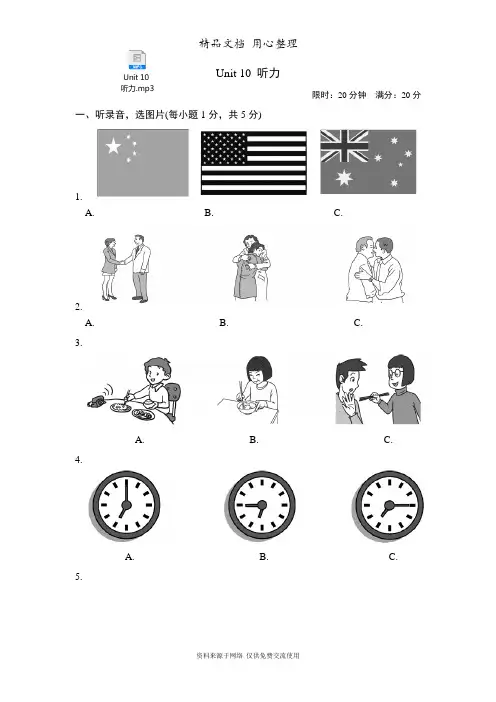
一、听录音,选图片(每小题1分,共5分)
1.
A. B. C.
2.
A. B. C.
3.
A. B. C.
4.
A. B. C. 5. Unit 10
听力.mp3精品文档 用心整理
资料来源于网络 仅供免费交流使用
A. B. C.
二、听对话和问题,选择正确的答案(每小题1分,共5分)
6. A. Shake hands. B. Bow. C. Kiss.
7. A. Some flowers.
B. A basketball.
C. A box of chocolate.
8. A. Table manners. B. Some sayings. C. Food.
9. A. fish B. beef C. chicken
10. A. China. B. South Korea. C. Canada.
三、听两段长对话,选择正确答案(每小题1分,共5分)
听第一段对话,回答11-12小题
11. What happened to John?
A. He had an easy exam.
B. He may fail an exam.
C. He lost interest in study.
12. What's the girl's advice for him?
人教版英语四年级上册书上翻译
Unit 1 This is my new friend.单元一 这是我的新朋友。
Lesson 1第一课1.Just speak请讲话
Hi,Gao Wei! Hi,Peter!喂,高魏!喂,彼得! Nice to see you again!很高兴又见到你!
This is my new friend.这是我的新朋友。 Hi!I'm Jim.I'm from America.喂!我是吉姆。我来自美国。
Nice to meet you.很高兴见到你。 Hi,Gao Wei! Hi,Peter!喂,高魏!喂,彼得!
Nice to see you again!很高兴又见到你! This is my new friend.这是我的新朋友。
Hi!I'm Jim.I'm from America.喂!我是吉姆。我来自美国。 Nice to meet you.很高兴见到你。
2.Just read and write请读并写出来
China中国 America 美国 England英格兰
Lesson 2第二课
1.Just speak请讲话
Hi!I'm Jim.I'm from America.喂!我是吉姆。我来自美国。
I'm Rani.I'm from Singapore.我是王妃。我来自新加坡。 Where are you from?你来自哪里?
I'm from Beijing,China.我来自中国的北京。 I'm from Shanghai.我来自上海。
We're good friends!Yeah!我们是好朋友!是! Hi!I'm Jim.I'm from America.喂!我是吉姆。我来美国。
I'm Rani.I'm from Singapore.我是王妃。我来自新加坡。 Where are you from?你来自哪里?
五年级下册英语单词表1到6单元
五年级下册英语单词表1到6单元
人教版五年级下册英语单词表(1 - 6单元)
Unit 1.
1. eat breakfast [iːt ˈbrekfəst]:动词短语,吃早饭。
2. have…class [hæv klɑːs]:动词短语,上……课。
3. play sports [pleɪ spɔːts]:动词短语,进行体育运动。
4. exercise [ˈeksəsaɪz]:名词,活动;运动;(这里也可作动词,锻炼)
5. do morning exercises [duː ˈmɔːnɪŋ ˈeksəsaɪzɪz]:动词短语,做早操。
6. eat dinner [iːt ˈdɪnə(r)]:动词短语,吃晚饭。
7. clean my room [kliːn maɪ ruːm]:动词短语,打扫我的房间。
8. go for a walk [ɡəʊ fɔː(r) ə wɔːk]:动词短语,散步。
9. go shopping [ɡəʊ ˈʃɒpɪŋ]:动词短语,去买东西;购物。
10. take [teɪk]:动词,学习;上(课)
11. dancing class [ˈdɑːnsɪŋ klɑːs]:名词短语,舞蹈课。
12. when [wen]:副词,什么时候;何时。
13. after [ˈɑːftə(r)]:介词,在(时间)后。
14. start [stɑːt]:动词,开始。
15. usually [ˈjuːʒuəli]:副词,通常地;惯常地。 16. Spain [speɪn]:名词,西班牙。
17. late [leɪt]:形容词,晚;迟。
18. a.m. [ˌeɪ ˈem]:上午。
19. p.m. [ˌpiː ˈem]:下午。
20. why [waɪ]:副词,为什么?
21. shop [ʃɒp]:动词,购物;名词,商店。
22. work [wɜːk]:动词,工作;名词,工作。
北师大版六年级英语上册基础知识梳理
北师大版六年级英语上册基础知识梳理
1 / 17 六年级英语上册基础知识梳理
Unit 1 Space
第一关:重点单词
课本P86 Unit 1的所有单词。
第二关:重点词组
1 in a spaceship 在宇宙飞船里 10 in my dream 在我的梦里
2 in space 在太空 11 Ann’s dream Ann的梦
3 on Mars 在火星上 12 last night 昨天夜间
4 on the moon 在月球上 13 last month 上个月
5 have a great/good time 玩的开心 14 last Saturday 上周六
6 have an English class 上一节英语课 15 an astronaut 一个宇航员
7 have classes 上课 16 at the swimming
pool 在游泳池
8 have a dream 做了个梦 17 yesterday afternoon 昨天下午
9 swimming pool 游泳池
第三关:重点句型
1.Where were you yesterday? 昨天你/你们在哪儿?
I was/We were in a spaceship.我/我们在宇宙飞船里。
2.Where was he/she yesterday? 昨天他/她在哪儿?
He/She was in a spaceship? 他/她在宇宙飞船里。
had a dream. 做了个梦。
3.I/ You/He/She/We/They had an English class.上一节英语课。
我/你他/她/他们 had a great time.玩得很开心。
4.There were no trees. 没有树。
5.There was no air/water.没有水/空气。 北师大版六年级英语上册基础知识梳理
2019秋 5上英语 期中复习宝典 学生版
12019秋期中复习宝典
五年级上册英语
一、单元知识点总结+配套练习
Unit1......................................................................................................................2
Unit2......................................................................................................................5
Unit3......................................................................................................................8
Unit4....................................................................................................................10
Unit5....................................................................................................................13
Unit6....................................................................................................................15
二、期中考试模拟卷
期中模拟试卷.......................................................................................................182Unit1Myfuture
人教PEP小学五年级下册英语单元测试卷含答案(全册)
Unit1综合检测卷
时间:80分钟满分:100分
I.看图,补全短语。(8分)
1. 2.
do morningeat
3. 4.
sportsclean my
Ⅱ.选出不同类的一项。(8分)
()1. A. breakfastB.lunch C. eggplant
( )2. A. mommyB.SaturdayC.Sunday
()3.A.oftenB.alwaysC.weekend
()4.A.fatherB.mumC. friend
Ⅲ.选择填空。(20分)
( )1. -do you get up?
-I usually get up at 6:30.
A. WhatB. WhenC. How
( )2. Put twoon the desk.
A.clock B.o'clockC. clocks
( )3. My mum last night.
A.workB.worksC.worked ( )4. You need a robot you.
A.helpB. to help C. helping
( )5. I live onisland.
A.a B. an C.some
( )6. I often go shoppingmy mother on the weekend.
A.forB. on C. with
( )7. Robin onlyhis room on Fridays.
A.cleanB. cleansC.cleaning
( )8. I alwaysa dancing class on Sundays.
A.goB.playC. take
湘鲁版六年级英语上册重点语句[推荐]
湘鲁版六年级英语上册重点语句[推荐]
第一篇:湘鲁版六年级英语上册重点语句[推荐]
Unit 1 John has two aunts 约翰有两个阿姨
Unit 2 Harry finds the way 哈利找路 Unit 3 What does your
uncle do?你的叔叔是干什么的?
Unit 4 It is like an English pancake 它像英式煎饼
Unit 5 I prefer western food.我更喜欢西餐
Unit 6 I hurt my knee 我的膝盖受伤了 Unit 7 I am ill today 我今天生病了 Unit 8 It is upstairs 在楼上
Unit 9 I'm good at sports 我擅长运动 Unit 10 Do you enjoy
playing tennis? 你喜欢打网球吗?
Unit 11 When is your birthday? 你什么时候生日?
Unit 12 What's your favourite month? 你最喜欢的月份是什么?
重点词组与句子
Unit 1 John has two aunts 1.John has two aunts.约翰有两个阿姨。2.They are coming to visit us next week.他们下周要来拜访我们。
3.I have two sisters.我有2个姐妹。4.Who are they ? 他们是谁?
5.They are Aunt Maggie and Aunt Lucy.他们是麦吉阿姨和露西阿姨。
6.Who is Cousin Harry ?谁是哈利表弟? 7.He is Aunt Lucy’s
son.他是露西阿姨的儿子。
8.They are from the UK.他们来自英国 9.She has got curly
人教版七年级英语上册知识点总结及习题+句型转换专项训练
人教版七年级英语上册
知识点总结及习题+句型转换专项训练
人教版七年级英语上册知识点总结及习题
Start Unit 1 Good morning!
1、Good morning! 早上好!Good afternoon!下午好!Good evening!晚上好!其回答都是其本身。
2、Nice to meet you !回答是:Nice to meet you !或Nice to meet you ,too!
3、How do you do?答语仍然是:How do you do?
4、How are you?答语是:Fine./I'm fine./I'm OK.Thanks.And you?
5、动词be的一般现在时态:
我(I)用 am ,你(you)用 are, is连着他(he)她(she)它(it)。
单数名词用 is,复数名词全部都用are。
变否定,很简单,在be后把not加。
变一般疑问句,把be提句首,句末问号莫丢弃。
变特殊疑问句,特殊疑问词加上一般疑问句。
Start Unit 2 What's this in English?
1、this“这,这个”指示代词,用来指代距离较近的单个的人或物。反义是that,用来指代距离比较远的单个的人或物。this的复数是these;that的复数是 those。
含有this/that把this/that提句首,其肯定回答是:Yes,it is.否定回答是:No,it isn't.
含有these/those把these/those提句首,其肯定回答是:Yes,they are.否定回答是:No,they aren't.
2、in+语言\声音\方式,“用......语言(声音、方式)” 例如:in English“用英语”
3、a+辅音音素开头的单词或字母(读音)
an+元音音素开头的单词或字母(读音)