
牛津译林版《My day》英语PPT课件(10篇)
牛津译林版七年级英语上册:unit4myday单元测试题
敬请各位同仁批评指正
金戈铁骑制作
7A Unit 4单元测试
第一部分 选择题部分 (65分)
一、听力部分(25分)
1、根据你所听到的内容,选择正确的选项。(本大题共10分,每小题1分)
( ) 1. A. / eɪ / B. / ɪə / C. / aɪ /
( ) 2. A. / u: / B. / ju: / C. / ʊ /
( ) 3. A. / wɜ:ld / B. / wɜ:k / C. / wɜ:d /
( ) 4. A. twenty B. twelve C. twice
( ) 5. A. month B. mouth C. mice
( ) 6. A. beside B. between C. behind
( ) 7. A. 7:40 a.m. B. 7:14 a.m. C. 7:40 p.m.
( ) 8. A. our bags B. our balls C. our books
( ) 9. A. thirteen boys B. thirty boys C. thirty-three boys
( )10. A. 83768545 B. 83718545 C. 83768554
2、根据你所听到的内容,选择正确的图片。(本大题共5分,每小题1分)
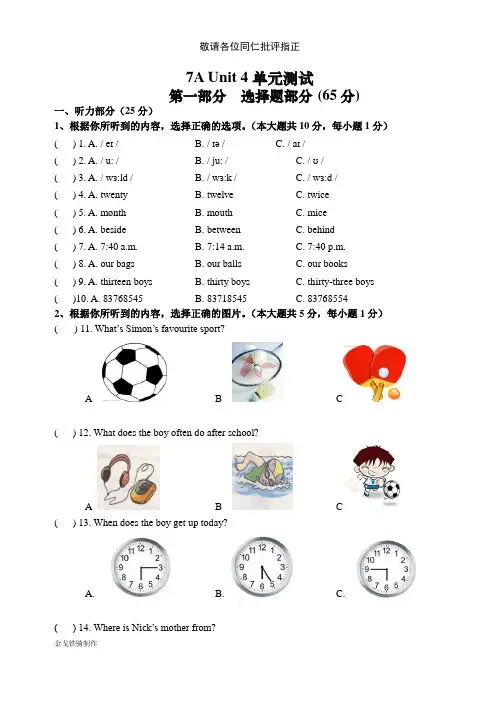
( ) 11. What’s Simon’s favourite sport?
A B C
( ) 12. What does the boy often do after school?
七年级英语上册《Unit 4 My day》检测题(含详解)(新版)牛津译林版
Unit 4 My day检测题
(时间:60分钟;满分:100分)
一、听力部分(每小题1分,满分20分)
第一部分 听对话,回答问题
本部分共有10个小题,每小题你将听到一段对话,每段对话读两遍。在听每段对话前,你将有5秒钟的时间阅读题目;听完后,你仍有5秒钟的答题时间。
1. When does Alice get up every day?
A. At 6:30. B. At 7:00. C. At 7:30.
2. Does Tom do morning exercises?
A. Yes, he does.
B. No, he doesn’t.
C. He runs in the morning.
3. How many lessons does Millie have every day?
A. 4. B. 3. C. 7.
4. What day is it today?
A. Friday. B. Saturday. C. Sunday.
5. Where are they?
A. At home. B. At school. C. On the street.
6. What does the girl do after supper?
A. Do her homework. B. Watch TV. C. Go for a walk.
7. Where are they going?
A. They are going to school.
高考英语一轮复习模块.Fitforlife(讲)(含解析)牛津译林版-课件

...
...
Unit 2 Fit for life
一、重点词汇
熟记以下单词
chew v. 咀嚼,嚼碎;咬,啃applaud v. 鼓掌;称赞,赞许
circulatev. 循环;传播,散布;传递,传阅needle. n.针,针头;指针
operating theatre n.手术室 life-saving adj. 救命的,救
生的
cupboard n. 橱柜;食物柜;衣柜 counter n. 柜台;计数器;反
驳
tablet n. 药片;丸;牌,匾,碑 best-selling adj. 畅销的
vital adj. 对⋯⋯极重要的,必不可少的 heart attack n. 心脏病发作
surgeon n. 外科医师 blood sugar n. 血糖
abnormal adj. 不正常的,反常的 mass production n. 批量生产
symptom n. 病症;征兆 outcome n. 结果,后果
dull adj. 钝的,不锋利的;迟钝的 pressure point n. 压觉点、止血点
sword n. 剑,刀 stainless steel n. 不锈钢
sharp adj. 锋利的;急剧的;灵敏的 complex adj. 复杂的,难懂的
pulse n. 脉,脉搏;脉冲 heartbeat n. 心跳
wrist n. 手腕,腕关节 organ n. 器官;管风琴,风琴
alcoholic n.酒鬼theory n.理论,学说
acid n.酸,酸性物质adj.酸的,酸性的,酸味的,尖酸的
potential n.可能性,潜在性;潜力,潜能adj.潜在的,可能的
词性(词形)变化
sickness n.疾病;恶心,呕吐→sick adj.生病的;恶心的,呕吐的
bleed v.流血,失血→ blood n.血
译林版(2023)必修第三册Unit 1 Nature in the balance Reading

第 1 页 共 16 页 译林版(2023)必修第三册Unit 1 Nature in
the balance Reading Workbook 课件(共57张PPT)
(共57张PPT)
牛津译林版高中英语必修三课件
Unit 1 Nature in the balance
Workbook
Exploring language
A. Fill in the blanks with proper words. The first letter of some words has
been given. P57
1. — What has contributed greatly to local e________ development
—Tourism.
2. —What has an impact on all l______ things
—The sun.
conomic
iving
3. —Do we have to move these plants into the greenhouse
—Yes. They cannot s______ in very cold conditions.
4. —What is recycling
— It is the p_______ of turning used things into things which can be 第 2 页 共 16 页 used again.
5 —Did the company make a ______ on the project last year
—No. It lost a lot of money.
urvive
rocess
profit
6. —How big is your school’s swimming pool
—It’s 25 metres in _______ and 8 metres in width.
小学英语牛津译林版(一起)二年级上册Unit7Let’scleanup

Unit 7 Let’s clean up
单元分析:
本单元的话题是“家务劳动”,单元教学重点是祈使句Clean
the …,please.的和巩固学过的动作类单词和短语的基础上,引出本单元的祈使句。可以利用教室中的物品和场景创设情境,指导学生操练句型Clean the …,please.在词汇教学时,教师可以呈现家居生活的照片,并结合教室内的实物,让学生在真实的情境下理解这些词汇,并熟练运用动词clean与这些物品类词汇组成的动词短语。引导学生认识到,家庭中每位成员都有义务承担力所能及的家务劳动,鼓励他们主动帮父母分担家务活。
教学目标:
1. 能听懂、会说、认读tabair, desk, door, window, clean up, clean, phew 等这些单词,发音正确。
2. 能听懂、会说、会读Lelean up! Clean the table/ desk/ chair… please等
3. 能听懂 并简单用以上句型进行对话。
4. 培养学生热爱劳动之情并激发学生的英语学习兴趣。
教学重点:
1.学生能听懂、会说、认读本单元单词发音正确。
2 .学生能听懂,会说Let’ s clean up! Clean the table/ desk/ chair… please 等
教学难点:
1.学生能听懂、会说、认读本单元单词发音正确。
2. 学生能听懂,会说We Lclean up! Clean the table/ desk/ chair… please等
课时安排:
三课时
Unit 7 Let’s clean up(Period 1)
课标陈述:
1. 能看图识词。
2. 能根据图片理解课文内容。
3. 能根据教师的简单指令完成动作。
教学目标:
1、能听懂、会说table, chair, desk, door, window, clean up, clean,发音准确。
牛津译林版英语4下unit4

金戈铁骑整理制作
金戈铁骑整理制作
小学英语学习材料
金戈铁骑 整理制作
Unit 4 Drawing in the park
教学内容 Story time 课型 新授
教学目标 1. 能听懂、会说、会读、会写单词park, draw, flower, them, boat, river,
lake.
2. 能听懂、会说、会读单词drawing, easy, difficult, try, hill.
3. 能听懂、会说、会读句型What can you see ...? I can see ... Good idea!
4. 能够理解课文内容。
5. 能够用本课所学词句描述公园的风景。
教学重点
难 点 1. 能听懂、会说、会读、会写单词park, draw, flower, them, boat, river,
lake.
2. 能听懂、会说、会读句型What can you see over there? I can see ...
3. 正确读出单词drawing, easy, difficult, try, hill的读音。
教学资源 多媒体课件、录音机
教 学 过 程 二次备课
导 入 Step 1 Free talk and warm-up
(1) Free talk
(2) Warm-up:Enjoy the song.
(3) Lead-in
T: I have some pictures for you. What can you see in the
picture? S: I can see ...
T: This robot is Billy.
导 学 Step 2 Presentation
(1) Learn the new words.
T: Billy likes drawing in the park.
八年级英语下Unit5第一课时课件教案(牛津译林版)
精品教案设计资料
八年级英语下Unit5第一课时课件教案(牛津译林版)
Unit 5 Good manners Comic strip & Welcome to the unit
欏垰
I. Teaching aims and learning objectives By the end of the lesson, students should be
able to: 1. know different kinds of knowledge about manners; 2. talk about how to
act politely in public; II. Teaching contents 1. New words and phrases: manners, eh,
politely, litter, tap, run, pick, obey, queue, turn, cut in (on sb./sth.), drop litter
everywhere, leave the tap running, obey traffic rules, queue for your turn 2. New
structures: We should/shouldn鈥檛 鈥?We can/can鈥檛 鈥?Don鈥檛/Always
鈥?You are old enough to learn about manners. You鈥檙e never too old to learn. III.
Focus of the lesson and predicted area of difficulty To talk about how to act politely
in public in English. IV. Teaching procedures Welcome to the unit Step 1 Lead-in
牛津译林版八年级英语下册Unit5
Unit 5 Good manners
Integrated skills & Study skills
设计说明
首先,通过图片复习前面所学的公共礼仪,并通过展示公共社会标志导入新课,教授新词,同时了解公共社会标识所表达的意思。然后通过A1、A2的听力练习和A3完成短文了解公共标识及标识所在场所。针对Speak
up部分,先进行听力练习,再进行读说练习,学会用英语谈论公共标识。通过谚语“When in Rome, do as the Romans do. ”过渡到Study skills课节,通过了解英语谚语,学会在正确的语境中使用英语谚语。最后,针对这一课时里的知识点进行讲解和练习。
教学目标
通过本课节的教学,让学生达成以下目标:
1.知识目标
掌握词汇: public, explain, warn, parking, litter, successful, sometime, risk,
pain, practice, candle, keep sb from sth, soon after
2.能力目标
(1) 通过听录音,了解不同公共标志的功能。能从录音中获取信息,完成一篇报告;
(2) 学会用英语劝导别人不做某事;
(3) 了解英语谚语,学会在正确的语境中使用英语谚语。
3.情感目标
通过了解不同公共标志的功能,培养学生形成良好的社会公德。
重点难点
1.重点:了解不同公共标志的功能;
获取录音中的信息,完成一篇报告;
学会用英语劝导别人不做某事。
2.难点:了解英语谚语,学会在正确的语境中使用英语谚语。
教学准备
PPT 课件;相关图片;配套磁带或光盘。
授课时数
1课时
教学过程
Step 1 Lead-in
Discuss the right and wrong things to do in public places according to the 教学反思 pictures.
英语选修Ⅵ牛津译林Unit4全程教学课件12(共37张)Project
Unit 4 Helping people around the world
What is MSF?
Medecins Sans Frontieres (MSF) is an
international medical humanitarian
organisation that provides emergency medical
assistance to populations in danger. MSF
currently works in more than 80 countries for
victims of armed conflicts, epidemics, and
natural and man-made disasters ・
Austria
Medecins Sans Frontieres
International Structure
Operational Cent res (Project management heacjquarters)
Support sections (funding^ human resources, communications, technical ^upport) Charter
Medecins Sans Frontieres is a private
international organisation. Most of its
members are doctors and health workers,
but many other support professions
contribute to MSF's smooth functioning.Where do we work?
Every year, about 3,000 MSF volunteers from all
over the world are sent to more than 80 countries to
牛津译林版英语九上Unit5《Artworld》(Task)说课稿
牛津译林版英语九上Unit 5《Art world》(Task)说课稿
一. 教材分析
牛津译林版英语九上Unit 5《Art world》主要介绍了西方的艺术世界,包括绘画、音乐、舞蹈等。本课内容丰富,贴近学生的生活,能够激发学生对艺术的热爱和追求。通过学习本课,学生可以提高自己的英语语言能力,了解西方的艺术文化,拓宽自己的视野。
二. 学情分析
九年级的学生已经具备了一定的英语基础,对于一些基本的语言知识和技能已经有所掌握。然而,他们的英语听说读写能力还有一定的局限性,需要通过大量的练习和运用来提高。此外,由于年龄和生活经验的限制,学生对于西方的艺术文化可能了解不多,需要通过本课的学习来丰富他们的知识储备。
三. 说教学目标
1. 知识目标:学生能够掌握本课的生词和短语,理解课文的主要内容和结构,了解西方的艺术世界。
2. 能力目标:学生能够运用所学的词汇和句型进行口头和书面的表达,提高自己的英语听说读写能力。
3. 情感目标:学生能够对艺术产生浓厚的兴趣,培养自己的艺术修养,拓宽自己的视野。
四. 说教学重难点
1. 教学重点:学生能够掌握本课的生词和短语,理解课文的主要内容和结构,能够运用所学的词汇和句型进行口头和书面的表达。
2. 教学难点:学生对于一些艺术术语和西方艺术家的了解不多,需要通过查阅资料和教师的讲解来解决。
五. 说教学方法与手段
1. 教学方法:采用任务型教学法,让学生在完成任务的过程中,自然地学习和运用所学的知识。
2. 教学手段:利用多媒体课件和网络资源,为学生提供丰富的学习材料和信息,激发学生的学习兴趣。
六. 说教学过程
1. Pre-reading:教师通过提问,引导学生谈论自己喜欢的艺术形式,激发学生对艺术的热情。 2. While-reading:教师引导学生阅读课文,通过查找信息、回答问题等方式,理解课文的主要内容和结构。
3. Post-reading:教师学生进行小组讨论,让学生运用所学的词汇和句型,介绍自己喜欢的艺术家或艺术作品。