
2015年考研【英语一】真题及参考答案详解
达济工作室【孙骏】整理编写“2015年考研《英语二》完整真题”由达济工作室在考后第一时间得知并发布,供各位考生参考。
更多2015考研答案、2015考研真题等信息,请关注达济工作室平台!达济工作室预祝大家考研成功!2015年考研【英语一】真题及答案详解【2015年12月28日达济工作室】(1/20)(2/20)(3/20)(4/20)(5/20)(6/20)(7/20)(8/20)(9/20)2015年考研【英语一】参考答案详解第一题完形填空参考答案解析1、A what本句的句意是:这就是加利福尼亚大学和耶鲁大学在美国国家科学院报告上联合发表的研究成果。
第一个空考察表语从句的引导词。
2、B concluded本句的句意是:这就是加利福尼亚大学和耶鲁大学在美国国家科学院报告上联合发表的研究成果。
第二个空为针对从句谓语进行的词义考察。
3、D on本句前半句的句意是:这项研究是一个基于1932个独特个体的基因组广谱分析。
考察Conduct on词组,进行。
从句意为:它对成对儿的非亲缘朋友和陌生人进行比较。
4、C compared比较,根据上下文及后一句的same知道,比较为最佳。
5、C samples词义题,样本,C为最佳选项。
6、A insignificant词义题,1%,以及后面的not so转折,判断,A insignificant不显著,为最佳选项。
7、C know句意为:一些人虽然并不认识他们第四代的表亲,但他们选择的朋友却和这些亲戚颇有相似之处。
8、D resemble词义题,和上一个空形成转折。
9、B also上下文逻辑题,发现了,还发现了。
Also为最佳选项。
10、D Perhaps结合上下文:这一现象很难解释,后面接原因,原因“可能”是……最符合文章大意。
11、B to介词题,意为:就像这个科研团队所发现的,这个因素不仅把我们带到详细的环境中来,更有一些深层次的影响。
12、D drive词义题,根据上下文,对我们产生影响,驱使我们……drive为最佳选项。
13、B rather than逻辑题,基因上相似的,功能上相似的,二者对立不能同时存在,rather than不是…而是最符合。
14、C benefits跟“功能”搭配,选个褒义词,带来好处的,最佳。
15、A faster词义题,根据后半句解释,这就是为什么“picked pace”加速,这里只能选faster,一些比另外一些进化得更快,符合文意。
16、D understand词义题,这个研究可以帮助我们理解一个事实。
17、B contributory本句意为:社会环境是最主要的一个因素。
Contributory贡献,最佳。
18、A tendency结合文章主旨,选择基因相似的人做朋友是普遍现象,tendency趋势倾向最符合。
19、C ethnic同义替换,基因背景相似,种族的,民族的,最符合。
20、A see本句意为:尽管所有的研究对象都取自欧洲血统,研究者也花心思确保了所有(用于比对的)朋友和陌生人也源自该血统中的同一支系。
第二题完形填空参考答案解析Part A Text1解析:21D ended his reign in embarrassment此题属于细节题。
根据关键词King Juan Carlos of Spain定位到第一段第一和第二句。
But embarrassing scandals…have forced him to eat his words and stand down.此处stand down译为放弃席位。
因此D ended his reign in embarrassment是原文内容的同义替换。
22A owing to their undoubted and respectable status此题属于细节题。
根据关键词定位到第三段第一句it is this apparent…that explains…as heads of state。
和第三句But unlike their absolutist…most royal families have survived because they allow voters to avoid the difficult search for...respected public figure.绝大多数皇室家族使得选民避免了寻找受人尊敬的公众人物的麻烦。
因此A owing to their undoubted and respectable status是原文内容的同义替换。
23B the role of the nobility in modern democracies此题属于细节题。
根据关键词定位到第四段最后一句话…it is bizarre that wealthy aristocratic families should still be the symbolic heart of modern democratic states奇怪的是有钱的贵族家庭仍然处于现代民主国家的核心地位。
因此B the role of the nobility in modern democracies是原文内容的同义替换。
24B fails to change his lifestyle as advised此题属于细节题。
根据关键词”have most of fear”定位到第六段,Charles定位到最后一段的地二句Charles后面who引导定语从句who has both an expensive taste of lifestyle and…world因此B fails to change his lifestyle as advised是原文内容的同义替换。
25C Carlos,a Lesson for All European Monarchs此题属于全文主旨题。
着眼全文,通篇都在围绕monarchs展开。
第一段由Carlos引出当今君主制面临的危机。
因此Carlos,a Lesson for All European Monarchs是全文内容的精确概括。
Text226答案B check suspects’phone contents without being authorized解析:细节题。
根据自然段定位原则,定位到首段。
根据题干关键词supreme court,whether精确定位到第一段最后一句whether police can search the contents of a mobile phone….,与选项进行对应,即为B在不授权的情况下检查嫌疑人的电话信息。
注意A选项应是search contents。
27答案C disapproval解析:态度题。
根据题干California’s argument定位到第二段最后一句及第三段首句,这些句子中提到hard…recklessly modest…等负向词,表达的是负面态度。
看选项属于负面的就是disapproval。
A容忍,B冷漠是典型错误,D粗心。
28答案A getting into one’s residence解析:细节题。
题干问:作者认为搜索电话薄就相当于什么?根据段落界定原则定位到第四段转折处,提到But exploring one’s smart phone is more like entering his or her home。
与选项对应,A中的residence对应home,是原文的同意替换。
注意D选项不是作者的观点,不能将文中人物观点当作作者观点。
29答案D citizens’privacy is not effective protected解析:细节题。
根据题干定位到5段和6段,题干问作者最关注的是什么,即是相应段落的段落中心。
因此,该题表面是细节题,实质为段落核心。
5段首句为中心句提到,应采取措施保护数据隐私;6段又继续陈述原则的不恰当之处。
根据这些内容,对应答案D市民隐私未能得到有效保护。
30答案B New technology requires reinterpretation of the Constitution解析:例证题。
题干问的是引用Orin Kerr的目的是什么,即Orin Kerr是论据,其目的是论点。
论点往往在论据的前面,所以要找例子前面的一句话,即New,disruptive technology sometimes demands novel applications of the Constitution’s protections。
与选项对应,就是B new technology是原词复现,require等同于demands,reinterpretation of the Constitution同义替换applications of the Constitution’s protections。
Text331.答案B journals are strengthening their statistical checks段落推断题考查的是段落中心句,定位在首段首句The journal Science is adding an extra source atPeer-review process,editor-in-chief Marcia McNott announced today.《科学》杂志将要对同行评审过程增加额外的资源。
与选项B同意替换。
32.答案C marked词义句意题根据所猜短语flagged up所在句子的句意,手稿将被flagged up以供杂志编辑、现有的编辑评审委员会或外部同行审查。
比较四个选项,只有C marked被标记,符合题意。
33.答案D set an example for other journals观点细节题定位在四段末句This impact will not only be through the publications in Science itself,but hopefully through a larger group of publishing places that may want to model their approach after Science.这不仅对于《科学》杂志本身的出版有影响,还有希望影响其它的出版社,这些出版社想继《科学》杂志之后树立自己的典型形象。
选项D是这句话的概括总结。
34.答案D has room for further improvement观点细节题定位在末段末句,Vaux says that Science’s idea to pass some papers to statisticians“has some merit,but a weakness is that..。
2015考研英语(1)真题及答案

Section 1 Use of EnglishDirections:Read the following text. Choose the best word(s) for each numbered blank and mark [A], [B], [C] or [D] on ANSWER SHEET 1. (10 points)Though not biologically related, friends are as "related" as fourth cousins, sharing about 1% of genes. That is 1 a study published from the University of California and Yale University in the Proceedings of the National Academy of Sciences, has 2 .The study is a genome-wide analysis conducted 3 1932 unique subjectswhich 4 pairs of unrelated friends and unrelated strangers. The same people were used in both 5 .While 1% may seem 6 , it is not so to a geneticist. As James Fowler, professor of medical genetics at UC San Diego, says, "Most people do not even 7 their fourth cousins but somehow manage to select as friends the people who 8 our kin."The study 9 found that the genes for smell were something shared in friends but not genes for immunity. Why this similarity in olfactory genes is difficult to explain, for now. 10 Perhaps, as the team suggests, it draws us to similar environments but there is more 11 it. There could be many mechanisms working in tandem that 12 us in choosing genetically similarfriends 13 than "functional kinship" of being friends with 14 !One of the remarkable findings of the study was that the similar genes seem to be evolving 15 than other genes. Studying this could help 16 why human evolution picked pace in the last 30,000 years, with social environment being a major 17 factor.The findings do not simply corroborate people's 18 to befriend those of similar 19 backgrounds, say the researchers. Though all the subjects were drawn from a population of European extraction, care was taken to 20 that all subjects, friends and strangers were taken from the same population. The team also controlled the data to check ancestry of subjects.Section II Reading Comprehension1、What2、Concluded3、On4、Compared5、Samples6、Insignificant7、Know8、Resemble9、Also10、Perhaps11、To12、Drive13、Ratherthan14、Benefits15、Faster16、understand17、Contributory18、Tendency19、Ethnic20、seePart ADirections:Read the following four texts. Answer the questions below each text by choosing [A], [B], [C] or [D]. Mark your answers on ANSWER SHEET 1. (40 points)TEXT 1King Juan Carlos of Spain once insisted"kings don't abdicate, they die in their sleep." But embarrassing scandals and the popularity of the republicans left in the recent Euro-elections have forced him to eat his words and stand down. So, does the Spanish crisis suggest that monarchy is seeing its last days? Does that mean the writing is on the wall for all European royals, with their magnificent uniforms and majestic lifestyles?The Spanish case provides arguments both for and against monarchy. When public opinion is particularly polarized, as it was following the end of the France regime, monarchs can rise above "mere" polities and "embody" a spirit of national unity.It is this apparent transcendence of polities that explains monarchy's continuing popularity as heads of state. And so, the Middle East expected, Europe is the most monarch-infested region in the world, with 10 kingdoms (not counting Vatican City and Andorra). But unlike their absolutist counterparts in the Gulf and Asia, most royal families have survived because they allow voters to avoid the difficult search for a non-controversial but respected public figure.Even so, kings and queens undoubtedly have a downside. Symbolic of national unity as they claim to be, their very history-and sometimes the way they behavetoday-embodies outdated and indefensible privileges and inequalities. At a time when Thomas Piketty and other economists are warming of rising inequality and the increasing power of inherited wealth, it is bizarre that wealthy aristocratic families should still be the symbolic heart of modern democratic states.The most successful monarchies strive to abandon or hide their old aristocratic ways. Princes and princesses have day-jobs and ride bicycles, not horses (or helicopters). Even so, these are wealthy families who party with the international 1%, and media intrusiveness makes it increasingly difficult to maintain the right image.While Europe's monarchies will no doubt be smart enough to survive for some time to come, it is the British royals who have most to fear from the Spanish example.It is only the Queen who has preserved the monarchy's reputation with her rather ordinary (if well-heeled) granny style. The danger will come with Charles, who has both an expensive taste of lifestyle and a pretty hierarchical view of the world. He has failed to understand that monarchies have largely survived because they provide a service-as non-controversial and non-political heads of state. Charlesought to know that as English history shows, it is kings, not republicans, who are the monarchy's worst enemies.21. According to the first two paragraphs, King Juan Carlos of Spain[A]eased his relationship with his rivals.[B]used to enjoy high public support.[C]was unpopular among European royals.[D]ended his reign in embarrassment.22. Monarchs are kept as head of state in Europe mostly[A]to give voters more public figures to look up to.[B]to achieve a balance between tradition and reality.[C]owing to their undoubted and respectable status.[D]due to their everlasting political embodiment.23. Which of the following is shown to be odd, according to Paragraph 4?[A] The role of the nobility in modern democracies.[B] Aristocrats' excessive reliance on inherited wealth.[C] The simple lifestyle of the aristocratic families.[D] The nobility's adherence to their privileges.24. The British royals "have most to fear" because Charles[A]takes a tough line on political issues.[B]fails to change his lifestyle as advised.[C]takes republicans as his potential allies.[D]fails to adapt himself to his future role.25. Which of the following is the best title of the text?[A]Carlos, Glory and Disgrace Combined[B]Charles, Anxious to Succeed to the Throne[C]Charles, Slow to React to the Coming Threats[D]Carlos, a Lesson for All European Monarchs21.Dended his reign in embarrassment.22. C owing to the undoubted and respectable status23. A the role of the nobility in modern democracy24. B fails to change his lifestyle as advised.25. D Carlos, a lesson for all MonarchiesTEXT 2Just how much does the Constitution protect your digital data? The Supreme Court will now consider whether police can search the contents of a mobile phone without a warrant if the phone is on or around a person during an arrest.California has asked the justices to refrain from a sweeping ruling, particularly one that upsets the old assumptions that authorities may search through the possessions of suspects at the time of their arrest. It is hard, the state argues, for judges to assess the implications of new and rapidly changing technologies.The court would be recklessly modest if it followed California's advice. Enough of the implications are discernable, even obvious, so that the justice can and should provide updated guidelines to police, lawyers and defendants.They should start by discarding California's lame argument that exploring the contents of a smartphone- a vast storehouse of digital information is similar to say, going through a suspect's purse .The court has ruled that police don't violate the Fourth Amendment when they go through the wallet or pocketbook, of an arrestee without a warrant. But exploring one's smartphone is more like entering his or her home. A smartphone may contain an arrestee's reading history, financial history, medical history and comprehensive records of recent correspondence. The development of "cloud computing." meanwhile, has made that exploration so much the easier.But the justices should not swallow California's argument whole. New, disruptive technology sometimes demands novel applications of the Constitution's protections.Orin Kerr, a law professor, compares the explosion and accessibility of digital information in the 21st century with the establishment of automobile use as a digital necessity of life in the 20th: The justices had to specify novel rules for the new personal domain of the passenger car then; they must sort out how the Fourth Amendment applies to digital information now.26. The Supreme court, will work out whether, during an arrest, it is legitimate to[A] search for suspects' mobile phones without a warrant.[B] check suspects' phone contents without being authorized.[C] prevent suspects from deleting their phone contents.[D] prohibit suspects from using their mobile phones.27. The author's attitude toward California's argument is one of[A] tolerance.[B] indifference.[C] disapproval.[D] cautiousness.28. The author believes that exploring one's phone content is comparable to[A] getting into one's residence.[B] handing one's historical records.[C] scanning one's correspondences.[D] going through one's wallet.29. In Paragraph 5 and 6, the author shows his concern that[A] principles are hard to be clearly expressed.[B] the court is giving police less room for action.[C] phones are used to store sensitive information.[D] citizens' privacy is not effective protected.30.Orin Kerr's comparison is quoted to indicate that(A)the Constitution should be implemented flexibly.(B)New technology requires reinterpretation of the Constitution.(C)California's argument violates principles of the Constitution.(D)Principles of the Constitution should never be altered.26. Bcheck suspect's phone contents without being authorized.27.Cdisapproval28.A getting into one's residence29. D citizens' privacy is not effectively protected30.B new technology requires reinterpretation of the constitutionText 3The journal Science is adding an extra source at Peer-review process,editor-in-chief Marcia McNott announced today. The Follows similar efforts from other journals, after widespread concern that Mistakes in data analysis are contributing to the Published research findings."Readers must have confidence in the conclusions published in our journal,"writes McNutt in an editorial. Working with the American Statistical Association, the Journal has appointed seven experts to a statistics board of reviewing Manuscript will be flagged up for additional scrutiny by the Journal's editors, or by its existing Board of Reviewing Editors or by outside peer The SBoRE panel will then find external statisticians to review theseAsked whether any particular papers had impelled the change, McNutt said,"The creation of the'statistics board'was motivated by concerns broadly with the application of statistics and data analysis in scientific research and is part of Science's overall drive to increase reproducibility in the research we publish."Giovanni Parmigiani,a biostatistician at the Harvard School of Public Health, a member of the SBoRE group, says he expects the board to "play primarily on advisoryrole." He agreed to join because he "found the foresight behind the establishment of the SBoRE to be novel, unique and likely to have a lasting impact. This impact will not only be through the publications in Science itself, but hopefully through a larger group of publishing places that may want to model their approach after Science."John Ioannidis, a physician who studies research methodology, says that the policy is "a most welcome step forward"and "long overdue,""Most journals are weak in statistical review,and this damages the quality of what they publish. I think that, for the majority of scientific papers nowadays, statistical review is more essential than expert review,"he says. But he noted that biomedical journals such as Annals of Internal Medicine, the Journal of the American Medical Association and The Lancet pay strong attention to statistical review.Professional scientists are expected to know how to analyze data, but statistical errors are alarmingly common in published research,according to David Vaux,a cell biologist. Researchers should improve their standards, he wrote in 2012,but journals should also take a tougher line,"engaging reviewers who are statistically literate and editors who can verify the process."Vaux says that Science's idea to pass some papers to statisticians "has some merit,but a weakness is that it relies on the board of reviewing editors to identify'the papers that need scrutiny'in the first place."31. It can be learned from Paragraph I that[A] Science intends to simplify its peer-review process.[B]journals are strengthening their statistical checks.[C]few journals are blamed for mistakes in data analysis.[D]lack of data analysis is common in research projects.32. The phrase "flagged up "(Para.2)is the closest in meaning to[A]found.[B]revised.[C]marked[D]stored33. Giovanni Parmigiani believes that the establishment of the SBoRE may[A]pose a threat to all its peers[B]meet with strong opposition[C]increase Science's circulation.[D]set an example for other journals34. David Vaux holds that what Science is doing nowA. adds to researchers' worklosd.B. diminishes the role of reviewers.C. has room for further improvement.D. is to fail in the foreseeable future.35. Which of the following is the best title of the text?A. Science Joins Push to Screen Statistics in PapersB. Professional Statisticians Deserve More RespectC. Data Analysis Finds Its Way onto Editors' DesksD. Statisticians Are Coming Back with Science31.B journals are strengthening their statistical checks32.B marked33. D set an example for other journals34. C has room for further improvement35.A science joins Push to screen statistics in papersText4Two years ago. Rupert Murdoch's daughter, spoke at the "unsettling dearth of integrity across so many of our collapsed, she argued, because of a collectiveacceptance that the mechanism"in society should be profit and the market we the people who create the society we want, not profit."Driving her point home, she continued"It's increasingly absence of purpose,of a moral language with in government, could become one of the most dangerous goals for capitalism and freedom." This same absence of moral purpose was wounding companies, such as International, she thought, making it more likely that it would fore had with widespread illegal telephone hacking.As the hacking trial concludes-finding guilty one ex-editor of the News of the World, Andy Coulson, for conspiring to hack phones, and finding the predecessor, Rebekah Brooks, innocent of the same charge-the wide dearth of integrity still stands. Journalists are known to have hacked the phones of up to 5,500 people. This is hacking on an industrial scale, as was acknowledged by Glenn Mulcaire, the man hired by the News of the World in 2001 to be the point person for phone hacking. Others await trial. This long story still unfolds.In many respects, the dearth of moral purpose frames not only the fact of such widespread phone hacking but the terms on which the trial took place. One of the astonishing revelations was how little Rebekah Brooks knew of what went on in her newsroom, how little she thought to ask and the fact that she never inquired how the stories arrived. The core of her successful defence was that she knew nothing.In today's world, it has become normal that well-paid executives should not be accountable for what happens in the organizations that they run. Perhaps we should not be so surprised. For a generation, the collective doctrine has been that the sorting mechanism of society should be profit. The words that have mattered are efficiency, flexibility, shareholder value, business-friendly, wealth generation, sales, impact and, in newspapers, circulation. Words degraded to the margin have been justice, fairness, tolerance, proportionality and accountability.The purpose of editing the News of the World was not to promote reader understanding, to be fair in what was written or to betray any common humanity. It was to ruin lives in the quest for circulation and impact. Ms Brooks may or may not have had suspicions about how her journalists got their stories, but she asked no questions, gave no instructions-nor received traceable, recorded answers.36. Accordign to the first two paragraphs, Elisabeth was upset by(A) the consequences of the current sorting mechanism.(B) companies' financial loss due to immoral practices(C) governmental ineffectiveness on moral issues.(D) the wide misuse of integrity among institutions.37. It can be inferred from Paragraph 3 that(A) Glenn Mulcaire may deny phone hacking as a crime.(B) more journalists may be found guilty of phone hacking.(C) Andy Coulson should be held innocent of the charge.(D) phone hacking will be accepted on certain occasions.38. The author believes that Rebekah Brooks's defence(A) revealed a cunning personality.(B) centered on trivial issues.(C) was hardly convincing.(D) was part of a conspiracy.39. The author holds that the current collective doctrine shows(A) generally distorted values.(B) unfair wealth distribution.(C) a marginalized lifestyle.(D) a rigid moral code.40 Which of the following is suggested in the last paragraph?(A) The quality of writings is of primary importance.(B) Common humanity is central to news reporting.(C) Moral awareness matters in editing a newspaper.(D) Journalists need stricter industrial regulations.36. A the consequences of the current sorting mechanism37. Bmore journalists may be found guilty of phone hacking38. C was hardly convincing39. A generally distorted values40. C moral awareness matters in editing a newspaperPart BDirections:In the following text, some sentences have been removed. For Questions 41-45, choose the most suitable one from the list A- G to fit into each of numbered blanks. There are two extra choices, which do not fit in any of the blanks. Mark your answers on ANSWER SHEET. (10 points)How does your reading proceed? Clearly you try to comprehend, in the sense of identifying meanings for individual words and working out relationships between them, drawing on your implicit knowledge of English grammar.(41)______________ You begin to infer a context for the text, for instance, by making decisions about what kind of speech event is involved.Who is making the utterance, to whom, when and where.The ways of reading indicated here are without doubt kinds of comprehension. But they show comprehension to consist not just of passive assimilation but of active engagement in inference and problem-solving. You infer information you feel the writer has invited you to grasp by presenting you with specific evidence and clues.(42)_________________Conceived in this way, comprehension will not follow exactly the same track for each reader. What is in question is not the retrieval of an absolute, fixed or "true" meaning that can be read off and checked for accuracy, or some timeless relation of the text to theworld.(43)___________Such background material inevitably reflects who we are.(44)________________________This doesn't, however, make interpretation merely relative or even pointless. Precisely because readers from different historical periods, places and social experiences produce different but overlapping readings of the same words on thepage-including for texts that engage with fundamental human concerns-debates about texts can play an important role in social discussion of beliefs and values.How we read a given text also depends to some extent on our particular interest in reading it.(45)_______________________Such dimensions of reading suggest-as others introduced later in the book will also do-that we bring an implicit(often unacknowledged)agenda to any act of reading. It doesn't then necessarily follow that one kind of reading is fuller, more advanced or more worthwhile than another. Ideally, different minds of reading inform each other, and act as useful reference points for and counterbalances to one another. Together, they make up the reading component of your overall literacy, or relationship to your surrounding textual environment.[A] Are we studying that text and trying to respond in a way that fulfills the requirement of a given course? Reading it simply for pleasure? Skimming it for information? Ways of reading on a train or in bed are likely to differ considerably from reading in a seminar room.[B] Factors such as the place and period in which we are reading, our gender, ethnicity, age and social class will encourage us towards certain interpretations but at the same time obscure or even close off others.[C] If you are unfamiliar with words or idioms, you guess at their meaning, using clues presented in the context. On the assumption that they will become relevant later, you make a mental note of discourse entities as well as possible links between them.[D] In effect, you try to reconstruct the likely meanings or effects that any given sentence, image or reference might have had: These might be the ones the author intended.[E] You make further inferences, for instance, about how the text may be significant to you, or about its validity-inferences that form the basis of a personal response for which the author will inevitably be far less responsible.[F] In plays, novels and narrative poems, characters speak as constructs created by the author, not necessarily as mouthpieces for the author's own thoughts.[G] Rather, we ascribe meanings to texts on the basis of interaction between what we might call textual and contextual material:between kinds of organization or patterning we perceive in a text's formal structures(so especially its languagestructures) and various kinds of background, social knowledge, belief and attitude that we bring to the text.41.C 42.E 43.G 44.B 45.APart CDirections:Read the following text carefully and then translate the underlined sentences into Chinese. Your translation should be written neatly on the ANSWER SHEET. (10 points)Within the span of a hundred years, in the seventeenth and early eighteenth centuries, a tide of emigration-one the great folk wanderings of history-swept from Europe to America. (46) This movement, driven by powerful and diverse motivations, built a nation out of a wilderness and, by its nature, shaped the character and destiny of an uncharted continent.(47) The United States is the product of two principal forces-the immigration of European peoples with their varied ideas,customs and national characteristics and the impact of a new country which modified these traits. Of necessity, colonial America was a projection of Europe. Across the Atlantic came successive groups of Englishmen, Frenchmen, Germans, Scots, Irishmen, Dutchmen, Swedes, and many others who attempted to transplant their habits and traditions to the new world. (48) But the force of geographic conditions peculiar to America, the interplay of the varied national groups upon one another, and the sheer difficulty of maintaining old-world ways in a raw, new continent caused significant changes. These changes were gradual and at first scarcely visible. But the result was a new social pattern which, although it resembled European society in many ways, had a character that was distinctly American.(49) The first shiploads of immigrants bound for the territory which is now the United States crossed the Atlantic more than a hundred years after the15th-and-16th-century explorations of North America. In the meantime, thriving Spanish colonies had been established in Mexico, the West Indies, and South America. These travelers to North America came in small, unmercifully overcrowded craft. During their six-to twelve-week voyage, they survived on barely enough food allotted to them. Many of the ships were lost in storms, many passengers died of disease,and infants rarely survived the journey. Sometimes storms blew the vessels far off their course, and often calm brought unbearably long delay.To the anxious travelers the sight of the American shore brought almost inexpressible relief. Said one recorder of events, "The air at twelve leagues' distance smelt as sweet as a new-blown garden." Thecolonists' first glimpse of the new land was a sight of dense woods.(50)The virgin forest with its richness and variety of trees was a real treasure-house which extended from Maine all the way down to Georgia. Here was abundant fuel and lumber. Here was the raw material of houses and furniture, ships and potash, dyes and naval stores.46)在多种强大的动机驱动下,这次运动在一片荒野上建起了一个国家,其本身塑造了一个未知大陆的性格和命运。
2015年考研英语一真题及答案(精校版)
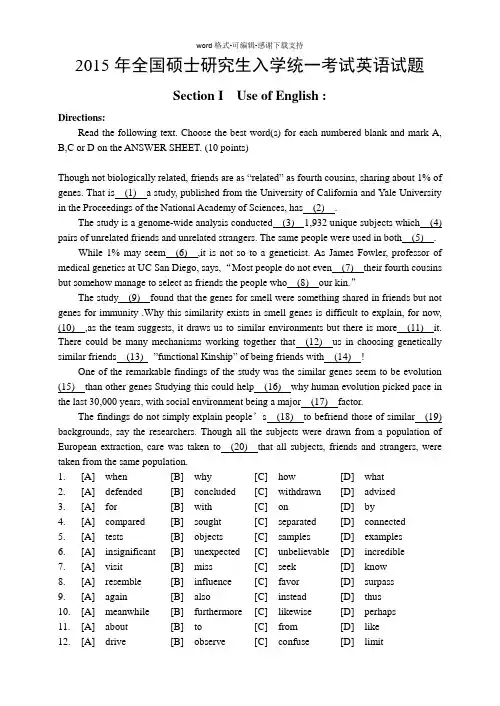
2015年全国硕士研究生入学统一考试英语试题Section I Use of English :Directions:Read the following text. Choose the best word(s) for each numbered blank and mark A, B,C or D on the ANSWER SHEET. (10 points)Though not biologically related, friends are as “related” as fourth cousins, sharing about 1% of genes. That is (1) a study, published from the University of California and Yale University in the Proceedings of the National Academy of Sciences, has (2) .The study is a genome-wide analysis conducted (3) 1,932 unique subjects which (4) pairs of unrelated friends and unrelated strangers. The same people were used in both (5) .While 1% may seem (6) ,it is not so to a geneticist. As James Fowler, professor of medical genetics at UC San Diego, says, “Most people do not even (7) their fourth cousins but somehow manage to select as friends the people who (8) our kin.”The study (9) found that the genes for smell were something shared in friends but not genes for immunity .Why this similarity exists in smell genes is difficult to explain, for now, (10) ,as the team suggests, it draws us to similar environments but there is more (11) it. There could be many mechanisms working together that (12) us in choosing genetically similar friends (13) ”functional Kinship” of being friends with(14) !One of the remarkable findings of the study was the similar genes seem to be evolution (15) than other genes Studying this could help (16) why human evolution picked pace in the last 30,000 years, with social environment being a major (17) factor.The findings do not simply explain people’s (18) to befriend those of similar (19) backgrounds, say the researchers. Though all the subjects were drawn from a population of European extraction, care was taken to (20) that all subjects, friends and strangers, were taken from the same population.1. [A] when [B] why [C] how [D] what2. [A] defended [B] concluded [C] withdrawn [D] advised3. [A] for [B] with [C] on [D] by4. [A] compared [B] sought [C] separated [D] connected5. [A] tests [B] objects [C] samples [D] examples6. [A] insignificant [B] unexpected [C] unbelievable [D] incredible7. [A] visit [B] miss [C] seek [D] know8. [A] resemble [B] influence [C] favor [D] surpass9. [A] again [B] also [C] instead [D] thus10. [A] meanwhile [B] furthermore [C] likewise [D] perhaps11. [A] about [B] to [C] from [D] like12. [A] drive [B] observe [C] confuse [D] limit13. [A] According to [B] rather than [C] regardless of [D] along with14. [A] chances [B] responses [C] missions [D] benefits15. [A] later [B] slower [C] faster [D] earlier16. [A] forecast [B] remember [C] understand [D] express17. [A] unpredictable [B] contributory [C] controllable [D] disruptive18. [A] endeavor [B] decision [C] arrangement [D] tendency19. [A] political [B] religious [C] ethnic [D] economic20. [A] see [B] show [C] prove [D] tellSection II Reading ComprehensionPart ADirections:Read the following four texts. Answer the questions below each text by choosing A, B, C or D. Mark your answers on ANSWER SHEET. (40 points)Text 1King Juan Carlos of Spain once insisted “kings don’t abdicate, they dare in their sleep.” But embarrassing scandals and the popularity of the republican left in the recent Euro-elections have forced him to eat his words and stand down. So, does the Spanish crisis suggest that monarchy is seeing its last days? Does that mean the writing is on the wall for all European royals, with their magnificent uniforms and majestic lifestyle?The Spanish case provides arguments both for and against monarchy. When public opinion is particularly polarised, as it was following the end of the Franco regime, monarchs can rise above “mere” politics and “embody” a spirit of national unity.It is this apparent transcendence of politics that explains monarchs’ continuing popularity polarized. And also, the Middle East excepted, Europe is the most monarch-infested region in the world, with 10 kingdoms (not counting Vatican City and Andorra). But unlike their absolutist counterparts in the Gulf and Asia, most royal families have survived because they allow voters to avoid the difficult search for a non-controversial but respected public figure.Even so, kings and queens undoubtedly have a downside. Symbolic of national unity as they claim to be, their very history—and sometimes the way they behave today –embodies outdated and indefensible privileges and inequalities. At a time when Thomas Piketty and other economists are warning of rising inequality and the increasing power of inherited wealth, it is bizarre that wealthy aristocratic families should still be the symbolic heart of modern democratic states.The most successful monarchies strive to abandon or hide their old aristocratic ways. Princes and princesses have day-jobs and ride bicycles, not horses (or helicopters). Even so, these are wealthy families who party with the international 1%, and media intrusiveness makesit increasingly difficult to maintain the right image.While Europe’s mona rchies will no doubt be smart enough to survive for some time to come, it is the British royals who have most to fear from the Spanish example.It is only the Queen who has preserved the monarchy’s reputation with her rather ordinary (if well-heeled) granny style. The danger will come with Charles, who has both an expensive taste of lifestyle and a pretty hierarchical view of the world. He has failed to understand that monarchies have largely survived because they provide a service – as non-controversial and non-political heads of state. Charles ought to know that as English history shows, it is kings, not republicans, who are the monarchy’s worst enemies.21. According to the first two Paragraphs, King Juan Carlos of Spain[A] used turn enjoy high public support[B] was unpopular among European royals[C] cased his relationship with his rivals[D]ended his reign in embarrassment22. Monarchs are kept as heads of state in Europe mostly[A] owing to their undoubted and respectable status[B] to achieve a balance between tradition and reality[C] to give voter more public figures to look up to[D]due to their everlasting political embodiment23. Which of the following is shown to be odd, according to Paragraph 4?[A] Aristocrats’ excessive reliance on inherited wealth[B] The role of the nobility in modern democracies[C] The simple lifestyle of the aristocratic families[D]The nobility’s adherence to their privileges24. The British royals “have most to fear” because Charles[A] takes a rough line on political issues[B] fails to change his lifestyle as advised[C] takes republicans as his potential allies[D] fails to adapt himself to his future role25. Which of the following is the best title of the text?[A] Carlos, Glory and Disgrace Combined[B] Charles, Anxious to Succeed to the Throne[C] Carlos, a Lesson for All European Monarchs[D]Charles, Slow to React to the Coming ThreatsText 2Just how much does the Constitution protect your digital data? The Supreme Court will now consider whether police can search the contents of a mobile phone without a warrant if the phone is on or around a person during an arrest.California has asked the justices to refrain from a sweeping ruling particularly one that upsets the old assumption that authorities may search through the possessions of suspects at the time of their arrest. It is hard, the state argues, for judges to assess the implications of new and rapidly changing technologies.The court would be recklessly modest if it followed California’s advice. Enough of the implications are discernable, even obvious, so that the justices can and should provide updated guidelines to police, lawyers and defendants.They should start by discar ding California’s lame argument that exploring the contents of a smart phone — a vast storehouse of digital information — is similar to, say, rifling through a suspect’s purse. The court has ruled that police don’t violate the Fourth Amendment when they si ft through the wallet or pocketbook of an arrestee without a warrant. But exploring one’s smart phone is more like entering his or her home. A smart phone may contain an arrestee’s reading history, financial history, medical history and comprehensive records of recent correspondence. The development of “cloud computing,” meanwhile, has made that exploration so much the easier.Americans should take steps to protect their digital privacy. But keeping sensitive information on these devices is increasingly a requirement of normal life. Citizens still have a right to expect private documents to remain private and protected by the Constitution’s prohibition on unreasonable searches.As so often is the case, stating that principle doesn’t ease the challenge of lin e-drawing. In many cases, it would not be overly onerous for authorities to obtain a warrant to search through phone contents. They could still invalidate Fourth Amendment protections when facing severe, urgent circumstances, and they could take reasonable measures to ensure that phone data are not erased or altered while a warrant is pending. The court, though, may want to allow room for police to cite situations where they are entitled to more freedom.But the justices should not swallow California’s argu ment whole. New, disruptive technology sometimes demands novel applications of the Constitution’s protections. Orin Kerr, a law professor, compares the explosion and accessibility of digital information in the 21st century with the establishment of automobile use as a virtual necessity of life in the 20th: The justices had to specify novel rules for the new personal domain of the passenger car then; they must sort out how the Fourth Amendment applies to digital information now.26. The Supreme Court will work out whether, during an arrest, it is legitimate to[A] prevent suspects from deleting their phone contents.[B] search for suspects’ mobile phones without a warrant.[C] check suspects’ phone contents without being authorized.[D]prohibit suspects from using their mobile phones.27. The author’s attitude toward California’s argument is one of[A] disapproval.[B] indifference.[C] tolerance.[D]cautiousness.28. The author believes that exploring one’s phone contents is comparable to[A] getting into one’s residence.[B] handling one’s historical records.[C] scanning one’s correspondences.[D] going through one’s wallet.29. In Paragraph 5 and 6, the author shows his concern that[A] principles are hard to be clearly expressed.[B] the court is giving police less room for action.[C] citizens’ privacy is not effectively protected.[D] phones are used to store sensitive information.30. Orin Kerr’s comparison is quoted to indicate that[A] the Constitution should be implemented flexibly.[B] new technology requires reinterpretation of the Constitution.[C]California’s argument violates principles of the Constitution.[D]principles of the Constitution should never be alteredText 3The journal Science is adding an extra round of statistical checks to its peer-review process, editor-in-chief Marcia McNutt announced today. The policy follows similar efforts from other journals, after widespread concern that basic mistakes in data analysis are contributing to the irreproducibility of many published research findings.“Readers must have confidence in the conclusions published in our journal,” writes McNutt in an editorial. Working with the American Statistical Association, the journal has appointed seven experts to a statistics board of reviewing editors(SBoRE). Manuscript will be flagged up for additional scrutiny by the journal’s internal editors, or by its existing Board of Reviewing Editors or by outside peer reviewers. The SBoRE panel will then find external statisticians to review these manuscripts.Asked whether any particular papers had impelled the change, McNutt said: “The creation of the ‘statistics board’ was motivated by concerns broadly with the application of statistics and data analysis in scientific research and is part of Science’s overall drive to increase reproducibility in the research we publish.”Giovanni Parmigiani, a biostatistician at the Harvard School of Public Health, a member of the SBoRE group. He says he expects the board to “play primarily an advisory role.” He agreed to join because he “found the foresight behind the establishment of the SBoRE to be novel, unique and likely to have a lasting impact. This impact will not only be through the publications in Science itself, but hopefully through a larger group of publishing places that may want to model their approach after Science.”John Ioannidis, a physician who studies research methodology, says that the policy is “amost welcome step forward” and “long overdue.” “Most jour nals are weak in statistical review, and this damages the quality of what they publish. I think that, for the majority of scientific papers nowadays, statistical review is more essential than expert review,” he says. But he noted that biomedical journals such as Annals of Internal Medicine, the Journal of the American Medical Association and The Lancet pay strong attention to statistical review.Professional scientists are expected to know how to analyze data, but statistical errors are alarmingly common in published research, according to David Vaux, a cell biologist. Researchers should improve their standards, he wrote in 2012, but journals should also take a tougher line, “engaging reviewers who are statistically literate and editors who can verify the pr ocess”. Vaux says that Science’s idea to pass some papers to statisticians “has some merit, but a weakness is that it relies on the board of reviewing editors to identify ‘the papers that need scrutiny’ in the first place”.31. It can be learned from Paragraph 1 that[A] Science intends to simplify their peer-review process.[B] journals are strengthening their statistical checks.[C] few journals are blamed for mistakes in data analysis.[D] lack of data analysis is common in research projects.32. The phrase “flagged up” (Para. 2) is the closest in meaning to[A] found.[B] marked.[C] revised.[D] stored.33. Giovanni Parmigiani believes that the establishment of the SBoRE may[A] pose a threat to all its peers.[B] meet with strong opposition.[C] increase Science’s circulation.[D]set an example for other journals.34. David Vaux holds that what Science is doing now[A] adds to researchers’ workload.[B] diminishes the role of reviewers.[C] has room for further improvement.[D]is to fail in the foreseeable future35. Which of the following is the best title of the text?[A] Science Joins Push to Screen Statistics in Papers.[B] Professional Statisticians Deserve More Respect[C] Data Analysis Finds Its Way onto Editors’ Desks[D] Statisticians Are Coming Back with ScienceText 4Two years ago, Rupert Murdoch’s daughter ,Elisabeth ,spoke of the “unsettling dearth of integrity across so many of our institutions” Integrity had collapsed, she argued, because of a c ollective acceptance that the only “sorting mechanism ”in society should be profit and the market .But “it’s us ,human beings ,we the people who create the society we want ,not profit ”.Driving her point home, she continued: “It’s increasingly apparent that the absence of purpose, of a moral language within government, media or business could become one of the most dangerous foals for capitalism and freedom.” This same absence of moral purpose was wounding companies such as News International ,shield thought ,making it more likely that it would lose its way as it had with widespread illegal telephone hacking .As the hacking trial concludes –finding guilty ones-editor of the News of the World, Andy Coulson, for conspiring to hack phones ,and finding his predecessor, Rebekah Brooks, innocent of the same charge –the winder issue of dearth of integrity still standstill, Journalists are known to have hacked the phones of up to 5,500 people .This is hacking on an industrial scale ,as was acknowledged by Glenn Mulcaire, the man hired by the News of the World in 2001 to be the point person for phone hacking. Others await trial. This long story still unfolds.In many respects, the dearth of moral purpose frames not only the fact of such widespread phone hacking but the terms on which the trial took place .One of the astonishing revelations was how little Rebekah Brooks knew of what went on in her newsroom, wow little she thought to ask and the fact that she never inquired wow the stories arrived. The core of her successful defence was that she knew nothing.In today’s world, title has become normal that well—paid executives should not be accountable for what happens in the organizations that they run perhaps we should not be so surprised. For a generation, the collective doctrine has been that the sorting mechanism of society should be profit. The words that have mattered are efficiency, flexibility, shareholder value, business–friendly, wealth generation, sales, impact and, in newspapers, circulation. Words degraded to the margin have been justice fairness, tolerance, proportionality and accountability.The purpose of editing the News of the World was not to promote reader understanding to be fair in what was written or to betray any common humanity. It was to ruin lives in the quest for circulation and impact. Ms Brooks may or may not have had suspicions about how her journalists got their stories, but she asked no questions, gave no instructions—nor received traceable, recorded answers.36. According to the first two paragraphs, Elisabeth was upset by[A] the consequences of the current sorting mechanism[B] companies’ financial loss due to immoral practices.[C] governmental ineffectiveness on moral issues.[D]the wide misuse of integrity among institutions.37. It can be inferred from Paragraph 3 that[A] Glem Mulcaire may deny phone hacking as a crime[B] more journalists may be found guilty of phone hacking.[C] Andy Coulson should be held innocent of the charge.[D] phone hacking will be accepted on certain occasions.38. The author believes the Rebekah Books’s deference[A] revealed a cunning personality[B] centered on trivial issues[C] was hardly convincing[D] was part of a conspiracy39. The author holds that the current collective doctrine shows[A] generally distorted values[B] unfair wealth distribution[C] a marginalized lifestyle[D] a rigid moral cote40. Which of the following is suggested in the last paragraph?[A] The quality of writing is of primary importance.[B] Common humanity is central news reporting.[C] Moral awareness matters in exciting a newspaper.[D] Journalists need stricter industrial regulations.Part BDirections:In the following text, some sentences have been removed. For Questions 41-45, choose the most suitable one from the fist A-G to fit into each of the numbered blanks. Mark your answers on ANSWER SHEET. (10 points)How does your reading proceed? Clearly you try to comprehend, in the sense of identifying meanings for individual words and working out relationships between them, drawing on your explicit knowledge of English grammar (41) you begin to infer a context for the text, for instance, by making decisions about what kind of speech event is involved: who is making the utterance, to whom, when and where.The ways of reading indicated here are without doubt kinds of of comprehension. But they show comprehension to consist not just passive assimilation but of active engagement inference and problem-solving. You infer information you feel the writer has invited you to grasp by presenting you with specific evidence and cues (42)Conceived in this way, comprehension will not follow exactly the same track for each reader. What is in question is not the retrieval of an absolute, f ixed or “true” meaning that can be read off and clocked for accuracy, or some timeless relation of the text to the world. (43) Such background material inevitably reflects who we are, (44) This doesn’t, however, make interpretation merely relative or even pointless. Precisely because readers from different historical periods, places and social experiences produce different but overlapping readings ofthe same words on the page-including for texts that engage with fundamental human concerns-debates about texts can play an important role in social discussion of beliefs and values.How we read a given text also depends to some extent on our particular interest in reading it. (45) such dimensions of read suggest-as others introduced later in the book will also do-that we bring an implicit (often unacknowledged) agenda to any act of reading. It doesn’t then necessarily follow that one kind of reading is fuller, more advanced or more worthwhile than another. Ideally, different kinds of reading inform each other, and act as useful reference points for and counterbalances to one another. Together, they make up the reading component of your overall literacy or relationship to your surrounding textual environment.[A] Are we studying that text and trying to respond in a way that fulfils the requirement of a given course? Reading it simply for pleasure? Skimming it for information? Ways of reading on a train or in bed are likely to differ considerably from reading in a seminar room.[B] Factors such as the place and period in which we are reading, our gender ethnicity, age and social class will encourage us towards certain interpretation but at the same time obscure or even close off others.[C] If you are unfamiliar with words or idioms, you guess at their meaning, using clues presented in the contest. On the assumption that they will become relevant later, you make a mental note of discourse entities as well as possible links between them.[D]In effect, you try to reconstruct the likely meanings or effects that any given sentence, image or reference might have had: These might be the ones the author intended.[E]You make further inferences, for instance, about how the test may be significant to you, or about its validity—inferences that form the basis of a personal response for which the author will inevitably be far less responsible.[F]In plays,novels and narrative poems, characters speak as constructs created by the author, not necessarily as mouthpieces for the author’s own thoughts.[G]Rather, we ascribe meanings to test on the basis of interaction between what we might call textual and contextual material: between kinds of organization or patterning we perceive in a text’s formal structures (so especially its language structures) and various kinds of background, social knowledge, belief and attitude that we bring to the text.Section III TranslationDirections:Read the following text carefully and then translate the underlined segments into Chinese. Your translation should be written clearly on ANSWER SHEET. (10 points)Within the span of a hundred years, in the seventeenth and early eighteenth centuries, a tide of emigration—one of the great folk wanderings of history—swept from Europe toAmerica. 46) This movement, driven by powerful and diverse motivations, built a nation out of a wilderness and, by its nature, shaped the character and destiny of an uncharted continent.47) The United States is the product of two principal forces-the immigration of European peoples with their varied ideas, customs, and national characteristics and the impact of a new country which modified these traits. Of necessity, colonial America was a projection of Europe. Across the Atlantic came successive groups of Englishmen, Frenchmen, Germans, Scots, Irishmen, Dutchmen, Swedes, and many others who attempted to transplant their habits and traditions to the new world.48) But, the force of geographic conditions peculiar to America, the interplay of the varied national groups upon one another, and the sheer difficulty of maintaining old-world ways in a raw, new continent caused significant changes. These changes were gradual and at first scarcely visible. But the result was a new social pattern which, although it resembled European society in many ways, had a character that was distinctly American.49) The first shiploads of immigrants bound for the territory which is now the United States crossed the Atlantic more than a hundred years after the 15th- and 16th-century explorations of North America. In the meantime, thriving Spanish colonies had been established in Mexico, the West Indies, and South America. These travelers to North America came in small, unmercifully overcrowded craft. During their six- to twelve-week voyage, they subsisted on barely enough food allotted to them. Many of the ship were lost in storms, many passengers died of disease, and infants rarely survived the journey. Sometimes storms blew the vessels far off their course, and often calm brought unbearably long delay.“To the anxious travelers the sight of the American shore brought almost inexpressible relief.” said one recorder of events, “The air at twelve leagues’ distance smelt as sweet as a new-blown garden.” The colonists’ first glimpse of the new land was a sight of dense woods.50) The virgin forest with its richness and variety of trees was a veritable real treasure-house which extended from Maine all the way down to Georgia. Here was abundant fuel and lumber. Here was the raw material of houses and furniture, ships and potash, dyes and naval stores.Section IV WritingPart A51. Directions:You are going to host a club reading session. Write an email of about 100 words recommending a book to the club members.You should state reasons for your recommendation.You should write neatly on the ANSWER SHEET.Do not sign your own name at the end of the letter. Use Li Ming instead.Do not write the address. (10 points)Part B52. Directions:Write an essay of 160-200 words based on the following drawing. In your essay you should1) describe the drawing briefly2) explain its intended meaning, and3) give your commentsYou should write neatly on ANSWER SHEET. (20 points)手机时代的聚会参考答案及详细解析I cloze1. [A] when [B] why [C] how [D] what【答案】[D] what【解析】该题考查的是语法知识。
2015-2016年考研英语(一)真题附答案
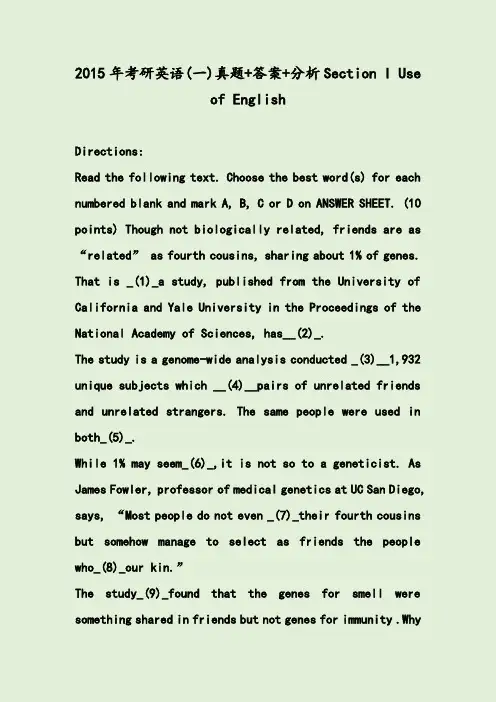
2015年考研英语(一)真题+答案+分析Section I Useof EnglishDirections:Read the following text. Choose the best word(s) for each numbered blank and mark A, B, C or D on ANSWER SHEET. (10 points) Though not biologically related, friends are as “related” as fourth cousins, sharing about 1% of genes. That is _(1)_a study, published from the University of California and Yale University in the Proceedings of the National Academy of Sciences, has__(2)_.The study is a genome-wide analysis conducted _(3)__1,932 unique subjects which __(4)__pairs of unrelated friends and unrelated strangers. The same people were used in both_(5)_.While 1% may seem_(6)_,it is not so to a geneticist. As James Fowler, professor of medical genetics at UC San Diego, says, “Most people do not even _(7)_their fourth cousins but somehow manage to select as friends the people who_(8)_our kin.”The study_(9)_found that the genes for smell were something shared in friends but not genes for immunity .Whythis similarity exists in smell genes is difficult to explain, for now,_(10)_,as the team suggests, it draws us to similar environments but there is more_(11)_it. There could be many mechanisms working together that _(12)_us in choosing genetically similar friends_(13)_”functional Kinship” of being friends with_(14)_!One of the remarkable findings of the study was the similar genes seem to be evolution_(15)_than other genes Studying this could help_(16)_why human evolution picked pace in the last 30,000 years, with social environment being a major_(17)_factor.The findings do not simply explain people’s_(18)_to befriend those of similar_(19)_backgrounds, say the researchers. Though all the subjects were drawn from a population of European extraction, care was taken to_(20)_that all subjects, friends and strangers, were taken from the same population.1. [A] when [B] why [C] how [D] what2. [A] defended [B] concluded [C] withdrawn [D] advised3. [A] for [B] with [C] on [D] by4. [A] compared [B] sought [C] separated [D] connected5. [A] tests [B] objects [C]samples [D] examples6. [A] insignificant [B] unexpected [C]unbelievable [D] incredible7. [A] visit [B] miss [C] seek [D] know8. [A] resemble [B] influence [C] favor [D] surpass9. [A] again [B] also [C] instead [D] thus10. [A] Meanwhile [B] Furthermore [C] Likewise [D] Perhaps11. [A] about [B] to [C]from [D]like12. [A] drive [B] observe [C] confuse [D]limit13. [A] according to [B] rather than [C] regardless of [D] along with14. [A] chances [B]responses [C]missions [D]benefits15. [A] later [B]slower [C] faster [D] earlier16. [A]forecast [B]remember [C]understand [D]express17. [A] unpredictable [B]contributory [C] controllable [D] disruptive18. [A] endeavor [B]decision [C]arrangement [D] tendency19. [A] political [B] religious [C] ethnic [D] economic20. [A] see [B] show [C] prove [D] tellSection II Reading ComprehensionSection II Reading ComprehensionPart ADirections:Read the following four texts. Answer the questions below each text by choosing A, B, C or D. Mark your answers on ANSWER SHEET.(40 points)Text 1King Juan Carlos of Spain once insisted “kings don’t abdicate, they dare in their sleep.” But embarrassing scandals and the popularity of the republican left in the recent Euro-elections have forced him to eat his words and stand down. So, does the Spanish crisis suggest that monarchy is seeing its last days? Does that mean the writing is on the wall for all European royals, with their magnificent uniforms and majestic lifestyle?The Spanish case provides arguments both for and against monarchy. When public opinion is particularly polarised, as it was following the end of the Franco regime, monarchs can rise above “mere” politics and “embody” a spirit of national unity.It is this apparent transcendence of politics that explains monarchs’ continuing popularity polarized. And also, the Middle East excepted, Europe is the most monarch-infested region in the world, with 10 kingdoms(not counting Vatican City and Andorra). But unlike their absolutist counterparts in the Gulf and Asia, most royal families have survived because they allow voters to avoid the difficult search for a non-controversial but respected public figure.Even so, kings and queens undoubtedly have a downside. Symbolic of national unity as they claim to be, their very history—and sometimes the way they behave today –embodies outdated and indefensible privileges and inequalities. At a time when Thomas Piketty and other economists are warning of rising inequality and the increasing power of inherited wealth, it is bizarre that wealthy aristocratic families should still be the symbolic heart of modern democratic states.The most successful monarchies strive to abandon or hide their old aristocratic ways. Princes and princesses have day-jobs and ride bicycles, not horses (or helicopters). Even so, these are wealthy families who party with the international 1%, and media intrusiveness makes it increasingly difficult to maintain the right image.Wh ile Europe’s monarchies will no doubt be smart enough to survive for some time to come, it is the British royalswho have most to fear from the Spanish example.It is only the Queen who has preserved the monarchy’s reputation with her rather ordinary (if well-heeled) granny style. The danger will come with Charles, who has both an expensive taste of lifestyle and a pretty hierarchical view of the world. He has failed to understand that monarchies have largely survived because they provide a service – as non-controversial and non-political heads of state. Charles ought to know that as English history shows, it is kings, not republicans, who are the monarchy’s worst enemies.21. According to the first two Paragraphs, King Juan Carlos of Spain[A] used turn enjoy high public support[B] was unpopular among European royals[C] cased his relationship with his rivals[D]ended his reign in embarrassment22. Monarchs are kept as heads of state in Europe mostly[A] owing to their undoubted and respectable status[B] to achieve a balance between tradition and reality[C] to give voter more public figures to look up to[D]due to their everlasting political embodiment23. Which of the following is shown to be odd, according to Paragraph 4?[A] Ar istocrats’ excessive reliance on inherited wealth[B] The role of the nobility in modern democracies[C] The simple lifestyle of the aristocratic families[D]The nobility’s adherence to their privileges24. The British royals “have most to fear” be cause Charles[A] takes a rough line on political issues[B] fails to change his lifestyle as advised[C] takes republicans as his potential allies[D] fails to adapt himself to his future role25. Which of the following is the best title of the text?[A] Carlos, Glory and Disgrace Combined[B] Charles, Anxious to Succeed to the Throne[C] Carlos, a Lesson for All European Monarchs[D]Charles, Slow to React to the Coming ThreatsTEXT 2Just how much does the Constitution protect your digital data? The Supreme Cpurt will now consider whether police can search the contents of a mobile phone without a warrant if the phone is on or around a person during an arrest.California has asked the justices to refrain from a sweeping ruling, particularly one that upsets the old assumptions that authorities may search through the possessions of suspects at the time of their arrest. It is hard, the state argues, for judges to assess the implications of new and rapidly changing technologies. The court would be recklessly modest if it followed California’s advice. Enough of the implications are discernable, even obvious, so that the justice can and should provide updated guidelines to police, lawyers and defendants.They should start by discarding California’s lame argument that exploring the contents of a smartphone- a vast storehouse of digital information is similar to say, going through a suspect’s purse .The court has ruled that police don't violate the Fourth Amendment when they go through the wallet or porcketbook, of an arrestee without a warrant. But exploring one’s smartphone is more like entering his or her home. A smartphone may contain an arrestee’s reading history ,financial history, medi cal history and comprehensive records of recent correspondence. The development of “cloud computing.” meanwhile, has madethat exploration so much the easier.But the justices should not swallow California’s argument whole. New, disruptive technology sometimes demands novel applications of the Constitution’s protections. Orin Kerr, a law professor, compares the explosion and accessibility of digital information in the 21st century with the establishment of automobile use as a digital necessity of life in the 20th: The justices hadto specify novel rules for the new personal domain of the passenger car then; they must sort out how the Fourth Amendment applies to digital information now.26. The Supreme court, will work out whether, during an arrest, it is legitimate to[A] search for suspects’ mobile phones without a warrant.[B] check suspects’phone contents without being authorized.[C] prevent suspects from deleting their phone contents.[D] prohibit suspects from using their mobile phones.27. The author’s attitude toward California’s argument is one of[A] tolerance.[B] indifference.[C] disapproval.[D] cautiousness.28. The author believes that exploring one’s phone content is comparable toA] getting into one’s residence.[B] handing one’s historical records.[C] scanning one’s correspondences.[D] going through one’s wallet.29. In Paragraph 5 and 6, the author shows his concern that[A] principles are hard to be clearly expressed.[B] the court is giving police less room for action.[C] phones are used to store sensitive information.[D] citizens’ privacy is not effective protected. Kerr’s comparison is quoted to indicate that(A)the Constitution should be implemented flexibly.(B)New technology requires reinterpretation of the Constitution.(C)California’s argument violates principles of the Constitution.(D)Principles of the Constitution should never be altered. Text 3The journal Science is adding an extra round of statistical checks to its peer-review process, editor-in-chief Marcia McNutt announced today. The policy follows similar efforts from other journals, after widespread concern that basic mistakes in data analysis are contributing to the irreproducibility of many published research findings. “Readers must have confidence in the conclusions published in our journal,” writes McNutt in an editorial. Working with the American Statistical Association, the journal has appointed seven experts to a statistics board of reviewing editors (SBoRE). Manu will be flagged up for additional scrutiny by the journal’s internal editors, or by its existing Board of Reviewing Editors or by outside peer reviewers. The SBoRE panel will then find external statisticians to review these manus.Asked whether any particular papers had impelled the change, McNutt said: “The creation of the ‘statistics board’was motivated by concerns broadly with the application of statistics and data analysis in scientific research and is part of Science’s overall drive to increase reproducibility in the research we publish.”Giovanni Parmigiani, a biostatistician at the HarvardSchool of Public Health, a member of the SBoRE group, says he expects the board to “play primarily an advisory role.”He agreed to join because he “f ound the foresight behind the establishment of the SBoRE to be novel, unique and likely to have a lasting impact. This impact will not??be through the publications in Science itself, but hopefully through a larger group of publishing places that may want t o model their approach after Science.”31、It can be learned from Paragraph I that[A] Science intends to simplify its peer-review process.[B]journals are strengthening their statistical checks.[C]few journals are blamed for mistakes in data analysis.[D]lack of data analysis is common in research projects.32、The phrase “flagged up ”is the closest in meaning to[A]found.[B]revised.[C]marked[D]stored3、Giovanni Parmigiani believes that the establishment of the SBoRE may[A]pose a threat to all its peers[B]meet with strong opposition[C]increase Science’s circulation.[D]set an example for other journals34、David Vaux holds that what Science is doing nowA. adds to researchers’ worklosd.B. diminishes the role of reviewers.C. has room for further improvement.D. is to fail in the foreseeable future.35. Which of the following is the best title of the text?A. Science Joins Push to Screen Statistics in PapersB. Professional Statisticians Deserve More RespectC. Data Analysis Finds Its Way onto Editors’ DesksD. Statisticians Are Coming Back with ScienceText 4Two years ago, Rupert Murdoch’s daughter, Elisabeth, spoke of the “unsettling dearth of integrity across so many of our institutions”. Integrity had collapsed, she argued, because of a collective acceptance that the only “sorting mechanism” in society shou ld be profit and the market. But “it’s us, human beings, we the people who create the society we want, not profit”.Driving her point home, she continued: “It’s increasingly apparent that the absence of purpose, of a moral language within government, media or business could become one of the most dangerous goals for capitalism and freedom.” This same absence of moral purpose was wounding companies such as News International, she thought, making it more likely that it would lose its way as it had with widespread illegal telephone hacking.As the hacking trial concludes—finding guilty one ex-editor of the News of the World, Andy Coulson, for conspiring to hack phones, and finding his predecessor, Rebekah Brooks, innocent of the same charge—the wider issue of dearth of integrity still stands. Journalists are known to have hacked the phones of up to 5,500 people. This is hacking on an industrial scale, as was acknowledged by GlennMulcaire, the man hired by the News of the World in 2001 to be the point person for phone hacking. Others await trial. This saga still unfolds.In many respects, the dearth of moral purpose frames not only the fact of such widespread phone hacking but the terms on which the trial took place. One of the astonishingrevelations was how little Rebekah Brooks knew of what went on in her newsroom, how little she thought to ask and the fact that she never inquired how the stories arrived. The core of her successful defence was that she knew nothing. In today’s world, it has become norma l that well-paid executives should not be accountable for what happens in the organisations that they run. Perhaps we should not be so surprised. For a generation, the collective doctrine has been that the sorting mechanism of society should be profit. The words that have mattered are efficiency, flexibility, shareholder value, business-friendly, wealth generation, sales, impact and, in newspapers, circulation. Words degraded to the margin have been justice, fairness, tolerance, proportionality and accountability.The purpose of editing the News of the World was not to promote reader understanding, to be fair in what was written or to betrayy common humanity. It was to ruin lives in the quest for circulation and impact. Ms Brooks may or may not have had suspicions about how her journalists got their stories, but she asked no questions, gave no instructions—nor received traceable, recorded answers.36. Accordign to the first two paragraphs, Elisabeth was upset by(A) the consequences of the current sorting mechanism.(B) companies’ financial loss due to immoral practices(C) governmental ineffectiveness on moral issues.(D) the wide misuse of integrity among institutions.37. It can be inferred from Paragraph 3 that(A) Glenn Mulcaire may deny phone hacking as a crime.(B) more journalists may be found guilty of phone hacking.(C) Andy Coulson should be held innocent of the charge.(D) phone hacking will be accepted on certain occasions.38. The author believes that Rebekah Brooks’s de fence(A) revealed a cunning personality.(B) centered on trivial issues.(C) was hardly convincing.(D) was part of a conspiracy.39. The author holds that the current collective doctrine shows(A) generally distorted values.(B) unfair wealth distribution.(C) a marginalized lifestyle.(D) a rigid moral code.40 Which of the following is suggested in the last paragraph?(A) The quality of writings is of primary importance.(B) Common humanity is central to news reporting.(C) Moral awareness matters in editing a newspaper.(D) Journalists need stricter industrial regulations. Part BDirections:In the following text, some sentences have been removed. For Questions 41-45, choose the most suitable one from the fist A-G to fit into each of the numbered blanks. Mark your answers on ANSWER SHEET. (10 points)How does your reading proceed? Clearly you try to comprehend, in the sense of identifying meanings for individual words and working out relationships between them, drawing on your explicit knowledge of English grammar (41) ______you begin to infer a context for the text, for instance, by making decisions about what kind of speech event is involved: who is making the utterance, to whom, when and where.The ways of reading indicated here are without doubt kinds of of comprehension. But they show comprehension toconsist not just passive assimilation but of active engagement inference and problem-solving. You infer information you feel the writer has invited you to grasp by presenting you with specific evidence and cues (42) _______Conceived in this way, comprehension will not follow exactly the same track for each reader. What is in question is not the retrieval of an absolute, fixed or “true”meaning that can be readoff and clocked for accuracy, or some timeless relation of the text to the world. (43) _______Such background material inevitably reflects who we are, (44) _______This doesn’t, however, make interpretation merely relative or even pointless. Precisely because readers from different historical periods, places and social experiences produce different but overlapping readings of the same words on the page-including for texts that engage with fundamental human concerns-debates about texts can play an important role in social discussion of beliefs and values.How we read a given text also depends to some extent on our particular interest in reading it. (45)_______suchdimensions of read suggest-as others introduced later in the book will alsodo-that we bring an implicit (often unacknowledged) agenda to any act of reading. It doesn’t then necessarily follow that one kind of reading is fuller, more advanced or more worthwhile than another. Ideally, different kinds of reading inform each other, and act as useful reference points for and counterbalances to one another. Together, they make up the reading component of your overall literacy or relationship to your surrounding textual environment.[A] Are we studying that text and trying to respond in a way that fulfils the requirement of a given course? Reading it simply for pleasure? Skimming it for information? Ways of reading on a train or in bed are likely to differ considerably from reading in a seminar room.[B] Factors such as the place and period in which we are reading, our gender ethnicity, age and social class will encourage us towards certain interpretation but at the same time obscure or even close off others.[C] If you are unfamiliar with words or idioms, you guess at their meaning, using clues presented in the contest. On the assumption that they will become relevant later,you make a mental note of discourse entities as well as possible links between them.[D]In effect, you try to reconstruct the likely meanings or effects that any given sentence, image or reference might have had: These might be the ones the author intended.[E]You make further inferences, for instance, about how the test may be significant to you, or about its validity —inferences that form the basis of a personal response for which the author will inevitably be far less responsible.[F]In plays,novels and narrative poems, characters speak as constructs created by the author, not necessarily as mouthpieces for the author’s own thoughts.[G]Rather, we ascribe meanings to test on the basis of interaction between what we might call textual and contextual material: between kinds of organization or patterning we perceive in a text’s formal structures (so especially its language structures) and various kinds of background, social knowledge, belief and attitude that we bring to the text.Section III TranslationDirections:Read the following text carefully and then translate the underlined segments into Chinese. Your translation should be written clearly on ANSWER SHEET. (10 points)Within the span of a hundred years, in the seventeenth and early eighteenth centuries, a tide of emigration—one of the great folk wanderings of history—swept from Europe to America. 46) This movement, driven by powerful and diverse motivations, built a nationout of a wilderness and, by its nature, shaped the character and destiny of an uncharted continent.47) The United States is the product of two principal forces-the immigration of European peoples with their varied ideas, customs, and national characteristics and the impact of a new country which modified these traits. Of necessity, colonial America was a projection of Europe. Across the Atlantic came successive groups of Englishmen, Frenchmen, Germans, Scots, Irishmen, Dutchmen, Swedes, and many others who attempted to transplant their habits and traditions to the new world.48) But, the force of geographic conditions peculiar to America, the interplay of the varied national groups uponone another, and the sheer difficulty of maintaining old-world ways in a raw, new continent caused significant changes. These changes were gradual and at first scarcely visible. But the result was a new social pattern which, although it resembled European society in many ways, hada character that was distinctly American.49) The first shiploads of immigrants bound for the territory which is now the United States crossed the Atlantic more than a hundred years after the 15th- and 16th-century explorations of North America. In the meantime, thriving Spanish colonies had been established in Mexico, the West Indies, and South America. These travelers to North America came in small, unmercifully overcrowded craft. During their six- to twelve-week voyage, they subsisted on barely enough food allotted to them. Many of the ship were lost in storms, many passengers died of disease, and infants rarely survived the journey. Sometimes storms blew the vessels far off their course, and often calm brought unbearably long delay.“To the anxious travelers the sight of the American shore brought almost inexpressible relief.” said one recorderof events, “The air at twelve leagues’ distance smelt as sweet as a new-blown garden.” The colonists’ first glimpse of the new land was a sight of dense woods. 50) The virgin forest with its richness and variety of trees was a veritable real treasure-house which extended from Maine all the way down to Georgia. Here was abundant fuel and lumber. Here was the raw material of houses and furniture, ships and potash, dyes and naval stores. Section IV WritingPart A51. Directions:You are going to host a club reading session. Write an email of about 100 words recommending a book to the club members. You should state reasons for your recommendation.You should write neatly on the ANSWER SHEET.Do not sign your own name at the end of the letter. Use Li Ming instead.Do not write the address. (10 points)Part B52. Directions:Write an essay of 160-200 words based on the following drawing. In your essay you should1) describe the drawing briefly2) explain its intended meaning, and3) give your commentsYou should write neatly on ANSWER SHEET. (20 points)一.Close test1、What2、Concluded3、On4、Compared5、Samples6、Insignificant7、Know8、Resemble9、Also10、Perhaps11、To12、Drive13、Ratherthan14、Benefits15、Faster16、understand17、Contributory18、Tendency19、Ethnic20、seeII Reading comprehensionPart AText 121. C ended his regin in embarrassment22. A owing to their undoubted and respectable status23. C the role of the nobility in modern democracy24. D fails to adapt himsself to his future role25. B Carlos, a lesson for all European MonarchiesText 226. B check suspect's phone contents without being authorized. disapprovalgetting into one's residence29. D citizens' privacy is not effectively protected new technology requires reinterpretation of the constitution Text 3journals are strengthening their statistical checks marked33. D set an example for other journals34. C has room for further improvementscience joins Push to screen statistics in papersText 436. A the consequences of the current sorting mechanism37. B more journalists may be found guilty of phone hacking38. C was hardly convincing39. A generally distorted values40. C moral awareness matters in editing a newspaper Part Bif you are unfamiliar...you make further inferences...Rather ,we ascribe meanings to...factors such as...are we studying that ...Part C46)在多种强大的动机驱动下,这次运动在一片荒野上建起了一个国家,其本身塑造了一个未知大陆的性格和命运。
2015年考研英语一真题详解
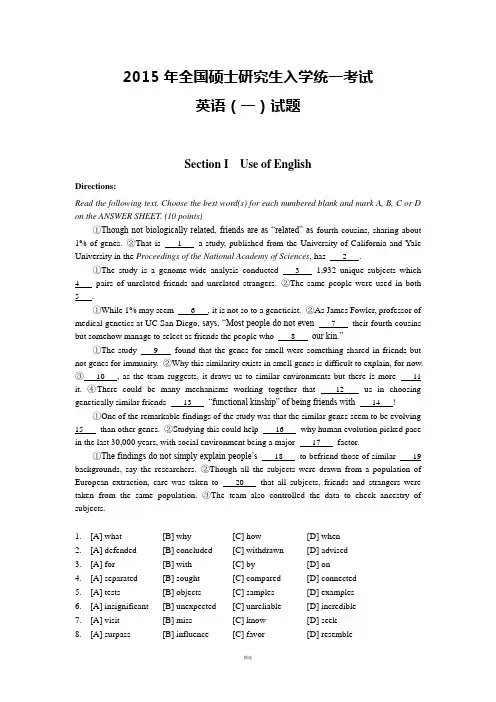
2015年全国硕士研究生入学统一考试英语(一)试题Section I Use of EnglishDirections:Read the following text. Choose the best word(s) for each numbered blank and mark A, B, C or D on the ANSWER SHEET. (10 points)①Though not biologically related, friends are as “related” as fourth cousins, sharing about 1% of genes. ②That is 1 a study, published from the University of California and Yale University in the Proceedings of the National Academy of Sciences, has 2 .①The study is a genome-wide analysis conducted 3 1,932 unique subjects which4 pairs of unrelated friends and unrelated strangers. ②The same people were used in both5 .①While 1% may seem 6 , it is not so to a geneticist. ②As James Fowler, professor of medical genetics at UC San Diego, says, “Most people do not even 7 their fourth cousins but somehow manage to select as friends the people who 8 our kin.”①The study 9 found that the genes for smell were something shared in friends but not genes for immunity. ②Why this similarity exists in smell genes is difficult to explain, for now.③10 , as the team suggests, it draws us to similar environments but there is more 11 it. ④There could be many mechanisms working together that 12 us in choosing genetically similar friends 13 “functional kinship” of being friends with 14 !①One of the remarkable findings of the study was that the similar genes seem to be evolving15 than other genes. ②Studying this could help 16 why human evolution picked pace in the last 30,000 years, with social environment being a major 17 factor.①The findings do not simply explain people’s 18 to befriend those of similar 19 backgrounds, say the researchers. ②Though all the subjects were drawn from a population of European extraction, care was taken to 20 that all subjects, friends and strangers were taken from the same population. ③The team also controlled the data to check ancestry of subjects.1. [A] what [B] why [C] how [D] when2. [A] defended [B] concluded [C] withdrawn [D] advised3. [A] for [B] with [C] by [D] on4. [A] separated [B] sought [C] compared [D] connected5. [A] tests [B] objects [C] samples [D] examples6. [A] insignificant [B] unexpected [C] unreliable [D] incredible7. [A] visit [B] miss [C] know [D] seek8. [A] surpass [B] influence [C] favor [D] resemble9. [A] again [B] also [C] instead [D] thus10. [A] Meanwhile [B] Furthermore [C] Likewise [D] Perhaps11. [A] about [B] to [C] from [D] like12. [A] limit [B] observe [C] confuse [D] drive13. [A] according to [B] rather than [C] regardless of [D] along with14. [A] chances [B] responses [C] benefits [D] missions15. [A] faster [B] slower [C] later [D] earlier16. [A] forecast [B] remember [C] express [D] understand17. [A] unpredictable [B] contributory [C] controllable [D] disruptive18. [A] tendency [B] decision [C] arrangement [D] endeavor19. [A] political [B] religious [C] ethnic [D] economic20. [A] see [B] show [C] prove [D] tellSection ⅡReading ComprehensionPart ADirections:Read the following four texts. Answer the questions after each text by choosing A, B, C or D. Mark your answers on ANSWER SHEET 1. (40 points)Text 1①King Juan Carlos of Spain once insisted “kings don’t abdicate, they die in their sleep.” ②But embarrassing scandals and the popularity of the republican left in the recent Euro-elections have forced him to eat his words and stand down. ③So, does the Spanish crisis suggest that monarchy is seeing its last days? ④Does that mean the writing is on the wall for all European royals, with their magnificent uniforms and majestic lifestyles?①The Spanish case provides arguments both for and against monarchy. ②When public opinion is particularly polarised, as it was following the end of the Franco regime, monarchs can rise above “mere” politics and “embody” a spirit of national unity.①It is this apparent transcendence of politics that explains monarchs’ continuing popularity as heads of states. ②And so, the Middle East excepted, Europe is the most monarch-infested region in the world, with 10 kingdoms (not counting Vatican City and Andorra). ③But unlike their absolutist counterparts in the Gulf and Asia, most royal families have survived because they allow voters to avoid the difficult search for a non-controversial but respected public figure.①Even so, kings and queens undoubtedly have a downside. ②Symbolic of national unity as they claim to be, their very history—and sometimes the way they behave today—embodies outdated and indefensible privileges and inequalities. ③At a time when Thomas Piketty and other economists are warning of rising inequality and the increasing power of inherited wealth, it is bizarre that wealthy aristocratic families should still be the symbolic heart of modern democratic states.①The most successful monarchies strive to abandon or hide their old aristocratic ways. ②Princes and princesses have day-jobs and ride bicycles, not horses (or helicopters). ③Even so,these are wealthy families who party with the international 1%, and media intrusiveness makes it increasingly difficult to maintain the right image.While Europe’s monarchies will no doubt be smart enough to strive for some time to come, it is the British royals who have most to fear from the Spanish example.①It is only the Queen who has preserved the monarchy’s reputation with her rather ordinary (if well-heeled) granny style. ②The danger will come with Charles, who has both an expensive taste of lifestyle and a pretty hierarchical view of the world. ③He has failed to understand that monarchies have largely survived because they provide a service—as non-controversial and non-political heads of state. ④Charles ought to know that as English history shows, it is kings, not republicans, who are the monarchy’s worst enemies.21. According to the first two paragraphs, King Juan Carlos of Spain _______.[A] used to enjoy high public support[B] was unpopular among European royals[C] eased his relationship with his rivals[D] ended his reign in embarrassment22. Monarchs are kept as heads of state in Europe mostly _______.[A] owing to their undoubted and respectable status[B] to achieve a balance between tradition and reality[C] to give voters more public figures to look up to[D] due to their everlasting political embodiment23. Which of the following is shown to be odd, according to Paragraph 4?[A] Aristocrats’ excessive reliance on inherited wealth.[B] The role of the nobility in modern democracies.[C] The simple lifestyle of the aristocratic families.[D] The nobility’s adherence to their privileges.24. The British royals “have most to fear” because Charles _______.[A] takes a tough line on political issues[B] fails to change his lifestyle as advised[C] takes republicans as his potential allies[D] fails to adapt himself to his future role25. Which of the following is the best title of the text?[A] Carlos, Glory and Disgrace Combined[B] Charles, Anxious to Succeed to the Throne[C] Carlos, a Lesson for All European Monarchs[D] Charles, Slow to React to the Coming ThreatsText 2①Just how much does the Constitution protect your digital data? ②The Supreme Court will now consider whether police can search the contents of a mobile phone without a warrant if the phone is on or around a person during an arrest.①California has asked the justices to refrain from a sweeping ruling, particularly one that upsets the old assumptions that authorities may search through the possessions of suspects at the time of their arrest. ②It is hard, the state argues, for judges to assess the implications of new and rapidly changing technologies.①The court would be recklessly modest if it followed California’s advice. ②Enough of the implications are discernable, even obvious, so that the justices can and should provide updated guidelines to police, lawyers and defendants.①They should start by discarding California’s lame argument that exploring the contents of a smart phone—a vast storehouse of digital information—is similar to, say, rifling through a suspect’s purse. ②The court has ruled that police don’t violate the Fourth Amendment when they go through the wallet or pocketbook of an arrestee without a warrant. ③But exploring one’s smartphone is more like entering his or her home. ④A smartphone may contain an arrestee’s reading history, financial history, medical history and comprehensive records of recent correspondence. ⑤The development of “cloud computing,” meanwhile, has made that exploration so much the easier.①Americans should take steps to protect their digital privacy. ②But keeping sensitive information on these devices is increasingly a requirement of normal life. ③Citizens still have a right to expec t private documents to remain private and protected by the Constitution’s prohibition on unreasonable searches.①As so often is the case, stating that principle doesn’t ease the challenge of line-drawing. ②In many cases, it would not be overly onerous for authorities to obtain a warrant to search through phone contents. ③They could still invalidate Fourth Amendment protections when facing severe, urgent circumstances, and they could take reasonable measures to ensure that phone data are not erased or altered while a warrant is pending. ④The court, though, may want to allow room for police to cite situations where they are entitled to more freedom.①But the justices should not swallow California’s argument whole. ②New, disruptive technology sometimes demands novel applications of the Constitution’s protections. ③Orin Kerr, a law professor, compares the explosion and accessibility of digital information in the 21st century with the establishment of automobile use as a virtual necessity of life in the 20th: The justices had to specify novel rules for the new personal domain of the passenger car then; they must sort out how the Fourth Amendment applies to digital information now.26. The Supreme Court will work out whether, during an arrest, it is legitimate to_______.[A] prevent suspects from deleting their phone contents[B] search for suspects’ mobile phones without a warrant[C] check suspects’ phone contents without being authorized[D]prohibit suspects from using their mobile phones27. The author’s attitude toward California’s argument is one of_______.[A] disapproval[B] indifference[C] tolerance[D]cautiousness28. The author believes that exploring one’s phone contents is comparable to_______.[A] get ting into one’s residence[B] handling one’s historical records[C] scanning one’s correspondences[D] going through one’s wallet29. In Paragraphs 5 and 6, the author shows his concern that_______.[A] principles are hard to be clearly expressed[B] the court is giving police less room for action[C] citizens’ privacy is not effectively protected[D] phones are used to store sensitive information30. Orin Kerr’s comparison is quoted to indicate that_______.[A] the Constitution should be implemented flexibly[B] new technology requires reinterpretation of the Constitution[C]California’s argument violates principles of the Constitution[D]principles of the Constitution should never be alteredText 3①The journal Science is adding an extra round of statistical checks to its peer-review process, editor-in-chief Marcia McNutt announced today. ②The policy follows similar efforts from other journals, after widespread concern that basic mistakes in data analysis are contributing to the irreproducibility of many published research findings.①“Readers must have confidence in the conclusions published in our journal,” writes McNutt in an editorial. ②Working with the American Statistical Association, the journal has appointed seven experts to a statistics board of reviewing editors (SBoRE).③Manuscript will be flagged up for additional scrutiny by the journal’s internal editors, or by its existing Board of Reviewing Editors or by outside peer reviewers. ④The SBoRE panel will then find external statisticians to review these manuscripts.①Asked whether any particular papers had impelled the change, McNutt said: “The creation of the ‘statistics board’ was motivated b y concerns broadly with the application of statistics and data analysis in scientific research and is part of Science’s overall drive to increase reproducibility in the research we publish.”①Giovanni Parmigiani, a biostatistician at the Harvard School of Public Health, is a member of the SBoRE group. ②He says he expects the board to “play primarily an advisory role.”③He agreed to join because he “found the foresight behind the establishment of the SBoRE to be n ovel, unique and likely to have a lasting impact. ④This impact will not only be through the publications in Science itself, but hopefully through a larger group of publishing places that may want to model their approach after Science.”①John Ioannidis, a physician who studies research methodology, says that the policy is “a most welcome step forward” and “long overdue.”②“Most journals are weak in statistical review, and this damages the quality of what they publish. ③I think that, for the majority of scientific papers nowadays, statistical review is more essential than expert review,” he says. ④But he noted that biomedical journals such as Annals of Internal Medicine, the Journal of the American Medical Association and The Lancet pay strong attention to statistical review.①Professional scientists are expected to know how to analyze data, but statistical errors are alarmingly common in published research, according to David Vaux, a cell biologist. ②Researchers should improve their standards, he wrote in 2012, but journals should also take a tougher line, “engaging reviewers who are statistically literate and editors who can verify the process”. ③Vaux says that Science’s idea to pass some papers to statisticians “has some merit, but a weakness is that it relies on the board of reviewing editors to identify ‘the papers that need scrutiny’ in the first place”.31. It can be learned from Paragraph 1 that _______.[A] Science intends to simplify its peer-review process[B] journals are strengthening their statistical checks[C] few journals are blamed for mistakes in data analysis[D] lack of data analysis is common in research projects32. The p hrase “flagged up” (Para. 2) is the closest in meaning to_______.[A] found[B] marked[C] revised[D] stored33. Giovanni Parmigiani believes that the establishment of the SBoRE may _______.[A] pose a threat to all its peers[B] meet with strong opposition[C] increase Science’s circulation[D] set an example for other journals34. David Vaux holds that what Science is doing now _______.[A] adds to researchers’ workload[B] diminishes the role of reviewers[C] has room for further improvement[D] is to fail in the foreseeable future35. Which of the following is the best title of the text?[A] Science Joins Push to Screen Statistics in Papers[B] Professional Statisticians Deserve More Respect[C] Data Analysis Finds Its Way onto Editors’ Desks[D] Statisticians Are Coming Back with ScienceText 4①Two years ago, Rupert Murdoch’s daughter, Elisabeth, spoke of the “unsettling dearth of integrity across so many of our institutions”. ②Integrity had collapsed, she argued, because of a collective acceptance that the only “sorting mechanism” in society should be profit and the market.③But “it’s us, human beings, we the people who create the society we want, not profit”.①Driving her point home, she continued: “It’s increasingly apparent that the absence of purpose, of a moral language within government, media or business could become one of the most dangerous goals for capitalism and freedom.” ②This same absence of moral purpose waswounding companies such as News International, she thought, making it more likely that it would lose its way as it had with widespread illegal telephone hacking .①As the hacking trial concludes—finding guilty one ex-editor of the News of the World, Andy Coulson, for conspiring to hack phones, and finding his predecessor, Rebekah Brooks, innocent of the same charge—the wider issue of dearth of integrity still stand. ②Journalists are known to have hacked the phones of up to 5,500 people. ③This is hacking on an industrial scale, as was acknowledged by Glenn Mulcaire, the man hired by the News of the World in 2001 to be the point person for phone hacking. ④Others await trial. ⑤This long story still unfolds.①In many respects, the dearth of moral purpose frames not only the fact of such widespread phone hacking but the terms on which the trial took place. ②One of the astonishing revelations was how little Rebekah Brooks knew of what went on in her newsroom, how little she thought to ask and the fact that she never inquired how the stories arrived. ③The core of her successful defence was that she knew nothing.①In today’s world, it h as become normal that well-paid executives should not be accountable for what happens in the organizations that they run. ②Perhaps we should not be so surprised. ③For a generation, the collective doctrine has been that the sorting mechanism of society should be profit. ④The words that have mattered are efficiency, flexibility, shareholder value, business-friendly, wealth generation, sales, impact and, in newspapers, circulation. ⑤Words degraded to the margin have been justice, fairness, tolerance, proportionality and accountability.①The purpose of editing the News of the World was not to promote reader understanding, to be fair in what was written or to betray any common humanity. ②It was to ruin lives in the quest for circulation and impact. ③Ms Brooks may or may not have had suspicions about how her journalists got their stories, but she asked no questions, gave no instructions—nor received traceable, recorded answers.36. According to the first two paragraphs, Elisabeth was upset by_______.[A] the consequences of the current sorting mechanism[B] companies’ financial loss due to immoral practices[C] governmental ineffectiveness on moral issues[D]the wide misuse of integrity among institutions37. It can be inferred from Paragraph 3 that_______.[A] Glem Mulcaire may deny phone hacking as a crime[B] more journalists may be found guilty of phone hacking[C] Andy Coulson should be held innocent of the charge[D] phone hacking will be accepted on certain occasions38. The author believes the Rebekah Books’s defence_______.[A] revealed a cunning personality[B] centered on trivial issues[C] was hardly convincing[D] was part of a conspiracy39. The author holds that the current collective doctrine shows_______.[A] generally distorted values[B] unfair wealth distribution[C] a marginalized lifestyle[D] a rigid moral code40. Which of the following is suggested in the last paragraph?[A] The quality of writing is of primary importance.[B] Common humanity is central in news reporting.[C] Moral awareness matters in editing a newspaper.[D] Journalists need stricter industrial regulations.Part BDirections:In the following article, some sentences have been removed. For Questions 41-45, choose the most suitable one from the list A-G to fit into each of the numbered blanks. There are two extra choices, which do not fit in any of the blanks. Mark your answers on the ANSWER SHEET. (10 points) How does your reading proceed? Clearly you try to comprehend, in the sense of identifying meanings for individual words and working out relationships between them, drawing on your implicit knowledge of English grammar. (41) ______________________________ You begin to infer a context for the text, for instance, by making decisions about what kind of speech event is involved: Who is making the utterance, to whom, when and where?The ways of reading indicated here are without doubt kinds of comprehension. But they show comprehension to consist not just of passive assimilation but of active engagement in inference and problem-solving. You infer information you feel the writer has invited you to grasp by presenting you with specific evidence and clues. (42) ______________________________ Conceived in this way, comprehension will not follow exactly the same track for each reader. What is in question is not the retrieval of an absolute, fixed or “true” meaning that can be read off and checked for accuracy, or some timeless relation of the text to the world. (43) ______________ Such background material inevitably reflects who we are. (44) _____________________ This doesn’t, however, make interpretation merely relative or even pointless. Precisely because readers from different historical periods, places and social experiences produce different but overlapping readings of the same words on the page—including for texts that engage with fundamental human concerns—debates about texts can play an important role in social discussion of beliefs and values.How we read a given text also depends to some extent on our particular interest in reading it.(45)____________________ Such dimensions of reading suggest—as others introduced later in the book will also do—that we bring an implicit (often unacknowledged) agenda to any act of reading. It doesn’t then necessarily follow that one kind of reading is fuller, more advanced or more worthwhile than another. Ideally, different kinds of reading inform each other, and act as useful reference points for and counterbalances to one another. Together, they make up the reading component of your overall literacy, or relationship to your surrounding textual environment.[A] Are we studying that text and trying to respond in a way that fulfils the requirement of a givencourse? Reading it simply for pleasure? Skimming it for information? Ways of reading on atrain or in bed are likely to differ considerably from reading in a seminar room.[B] Factors such as the place and period in which we are reading, our gender, ethnicity, age andsocial class will encourage us towards certain interpretations but at the same time obscure or even close off others.[C] If you are unfamiliar with words or idioms, you guess at their meaning, using clues presentedin the context. On the assumption that they will become relevant later, you make a mental note of discourse entities as well as possible links between them.[D] In effect, you try to reconstruct the likely meanings or effects that any given sentence, imageor reference might have had: These might be the ones the author intended.[E] You make further inferences, for instance, about how the text may be significant to you, orabout its validity—inferences that form the basis of a personal response for which the author will inevitably be far less responsible.[F] In plays, novels and narrative poems, characters speak as constructs created by the author, notnecessarily as mouthpieces for the author’s own thoughts.[G] Rather, we ascribe meanings to texts on the basis of interaction between what we might calltextual and contextual material: between kinds of organization or patterning we perceive in a text’s formal structures (so especially its language structures) and various kinds of background, social knowledge, belief and attitude that we bring to the text.Part CDirections:Read the following text carefully and then translate the underlined segments into Chinese. Your translation should be written clearly on the ANSWER SHEET. (10 points)Within the span of a hundred years, in the seventeenth and early eighteenth centuries, a tide of emigration—one of the great folk wanderings of history—swept from Europe to America. (46) This movement, driven by powerful and diverse motivations, built a nation out of a wilderness and, by its nature, shaped the character and destiny of an uncharted continent.(47) The United States is the product of two principal forces—the immigration of European peoples with their varied ideas, customs, and national characteristics and the impact of a new country which modified these traits. Of necessity, colonial America was a projection of Europe. Across the Atlantic came successive groups of Englishmen, Frenchmen, Germans, Scots, Irishmen, Dutchmen, Swedes, and many others who attempted to transplant their habits and traditions to the new world. (48) But the force of geographic conditions peculiar to America, the interplay of the varied national groups upon one another, and the sheer difficulty of maintaining old-world ways in a raw, new continent caused significant changes. These changes were gradual and at first scarcely visible. But the result was a new social pattern which, although it resembled European society in many ways, had a character that was distinctly American.(49)The first shiploads of immigrants bound for the territory which is now the United States crossed the Atlantic more than a hundred years after the 15th-and-16th-century explorations of North America. In the meantime, thriving Spanish colonies had been established in Mexico, the West Indies, and South America. These travelers to North America came in small, unmercifully overcrowded craft. During their six- to twelve-week voyage, they survived on barely enough foodallotted to them. Many of the ships were lost in storms, many passengers died of disease, and infants rarely survived the journey. Sometimes storms blew the vessels far off their course, and often calm brought unbearably long delay.To the anxious travelers the sight of the American shore brought almost inexpressible relief. Said one recorder of events, “The air at twelve leagues’ distance smelt as sweet as a new-blown garden.” The colonists’ first glimpse of the new land was a sight of dense woods. (50)The virgin forest with its richness and variety of trees was a real treasure-house which extended from Maine all the way down to Georgia. Here was abundant fuel and lumber. Here was the raw material of houses and furniture, ships and potash, dyes and naval stores.Section III WritingPart A51. Directions:You are going to host a club reading session. Write an email of about 100 words recommending a book to the club members.You should state reasons for your recommendation.You should write neatly on the ANSWER SHEET.Do not sign your own name at the end of the letter. Use “Li Ming” instead.Do not write the address (10 points)Part B52. Directions:Write an essay of 160-200 words based on the following picture. In your essay, you should1) describe the picture briefly,2) interpret its intended meaning, and3) give your comments.You should write neatly on the ANSWER SHEET. (20 points)2015年试题精读透析2015年试题精读透析Section ⅠUse of English文章大意本文介绍了加州大学和耶鲁大学的一项最新研究。
2015考研英语一真题答案
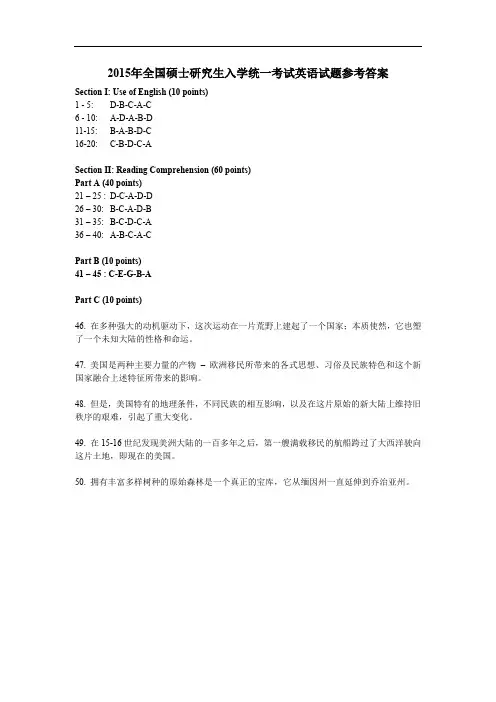
2015年全国硕士研究生入学统一考试英语试题参考答案
Section I: Use of English (10 points)
1 - 5: D-B-C-A-C
6 - 10: A-D-A-B-D
11-15: B-A-B-D-C
16-20: C-B-D-C-A
Section II: Reading Comprehension (60 points)
Part A (40 points)
21 – 25 : D-C-A-D-D
26 – 30: B-C-A-D-B
31 – 35: B-C-D-C-A
36 – 40: A-B-C-A-C
Part B (10 points)
41 – 45 : C-E-G-B-A
Part C (10 points)
46. 在多种强大的动机驱动下,这次运动在一片荒野上建起了一个国家;本质使然,它也塑了一个未知大陆的性格和命运。
47. 美国是两种主要力量的产物–欧洲移民所带来的各式思想、习俗及民族特色和这个新国家融合上述特征所带来的影响。
48. 但是,美国特有的地理条件,不同民族的相互影响,以及在这片原始的新大陆上维持旧秩序的艰难,引起了重大变化。
49. 在15-16世纪发现美洲大陆的一百多年之后,第一艘满载移民的航船跨过了大西洋驶向这片土地,即现在的美国。
50. 拥有丰富多样树种的原始森林是一个真正的宝库,它从缅因州一直延伸到乔治亚州。
2015年考研英语一真题与解析
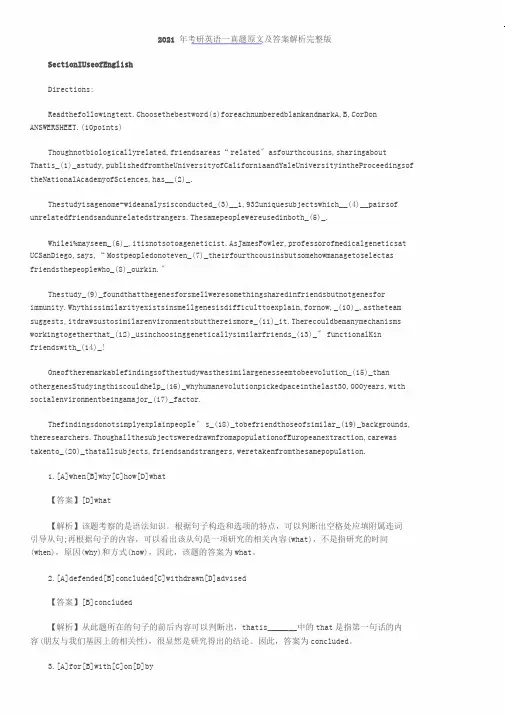
2021 年考研英语一真题原文及答案解析完整版SectionIUseofEnglishDirections:Readthefollowingtext.Choosethebestword(s)foreachnumberedblankandmarkA,B,CorDon ANSWERSHEET.(10points)Thoughnotbiologicallyrelated,friendsareas“related〞asfourthcousins,sharingaboutThatis_(1)_astudy,publishedfromtheUniversityofCaliforniaandYaleUniversityintheProceedingsof theNationalAcademyofSciences,has__(2)_.Thestudyisagenome-wideanalysisconducted_(3)__1,932uniquesubjectswhich__(4)__pairsof unrelatedfriendsandunrelatedstrangers.Thesamepeoplewereusedinboth_(5)_.While1%mayseem_(6)_,itisnotsotoageneticist.AsJamesFowler,professorofmedicalgeneticsat UCSanDiego,says,“Mostpeopledonoteven_(7)_theirfourthcousinsbutsomehowmanagetoselectas friendsthepeoplewho_(8)_ourkin.〞Thestudy_(9)_foundthatthegenesforsmellweresomethingsharedinfriendsbutnotgenesfor immunity.Whythissimilarityexistsinsmellgenesisdifficulttoexplain,fornow,_(10)_,astheteam suggests,itdrawsustosimilarenvironmentsbutthereismore_(11)_it.Therecouldbemanymechanisms workingtogetherthat_(12)_usinchoosinggeneticallysimilarfriends_(13)_〞functionalKin friendswith_(14)_!Oneoftheremarkablefindingsofthestudywasthesimilargenesseemtobeevolution_(15)_than othergenesStudyingthiscouldhelp_(16)_whyhumanevolutionpickedpaceinthelast30,000years,with socialenvironmentbeingamajor_(17)_factor.Thefindingsdonotsimplyexplainpeople’s_(18)_tobefriendthoseofsimilar_(19)_backgrounds, theresearchers.ThoughallthesubjectsweredrawnfromapopulationofEuropeanextraction,carewas takento_(20)_thatallsubjects,friendsandstrangers,weretakenfromthesamepopulation.1.[A]when[B]why[C]how[D]what【答案】[D]what【解析】该题考察的是语法知识。
2015年考研英语一真题及答案
2015年考研英语一真题及答案Section I Use of EnglishDirections:Read the following text. Choose the best word(s) for each numbered blank and mark A, B, C or D on ANSWER SHEET 1. (10 points) Though not biologically related, friends are as “related” as fourth cou sins, sharing about 1% of genes. That is_ (1)_a study, published from the University of California and Yale University in the Proceedings of the National Academy of Sciences, has_(2)_.The study is a genome-wide analysis conducted_(3)_1,932 unique subjects which_(4)_pairs of unrelated friends and unrelated strangers. The same people were used in both_(5)_.While 1% may seem_(6)_,it is not so to a geneticist. As James Fowler, professor of medical genetics at UC San Diego, says, “Most people do not even _(7)_their fourth cousins but somehow manage to select as friends the people who_(8)_our kin.”The study_(9)_found that the genes for smell were something shared in friends but not genes for immunity .Why this similarity exists in smell genes is difficult to explain, for now,_(10)_,as the team suggests, it draws us to similar environments but there is more_(11)_it. There could be many mechanisms working together that _(12)_us in choosing genetically similar friends_(13)_”functional Kinship” of being friends with_(14)_!One of the remarkable findings of the study was the similar genes seem to be evolution_(15)_than other genes Studying this could help_(16)_why human evolution picked pace in the last 30,000 years ,with social environment being a major _(17)_factor .The findings do not simply explain people’s_(18)_to befriend those of similar _(19)_backgrounds, say the researchers. Though all the subjects were drawn from a population of European extraction, care was taken to_(20)_that all subjects, friends and strangers, were taken from the same population.1. [A] when [B] why [C] how [D] what2. [A] defended [B] concluded [C] withdrawn [D] advised3. [A] for [B] with [C] on [D] by4. [A] compared [B] sought [C] separated [D] connected5. [A] tests [B] objects [C]samples [D] examples6. [A] insignificant [B] unexpected [C]unbelievable [D] incredible7. [A] visit [B] miss [C] seek [D] know8. [A] resemble [B] influence [C] favor [D] surpass9. [A] again [B] also [C] instead [D] thus10. [A] Meanwhile [B] Furthermore [C] Likewise [D] Perhaps11. [A] about [B] to [C]from [D]like12. [A] drive [B] observe [C] confuse [D]limit13. [A] according to [B] rather than [C] regardless of [D] along with14. [A] chances [B]responses [C]missions [D]benefits15. [A] later [B]slower [C] faster [D] earlier16. [A]forecast [B]remember [C]understand [D]express17. [A] unpredictable [B]contributory [C] controllable [D] disruptive18. [A] endeavor [B]decision [C]arrangement [D] tendency19. [A] political [B] religious [C] ethnic [D] economic20. [A] see [B] show [C] prove [D] tellSection ⅡReading ComprehensionPart ADirections: Read the following four texts. Answer the questions below each text by choosing A, B, C or D. Mark your answers on ANSWER SHEET 1. (40points)Text 1King Juan Carlos of Spain once insisted “kings don’t abdicate, they dare in their sleep.” But embarrass ing scandals and the popularity of the republican left in the recent Euro-elections have forced him to eat his words and stand down. So, does the Spanish crisis suggest that monarchy is seeing its last days? Does that mean the writing is on the wall for all European royals, with their magnificent uniforms and majestic lifestyle?The Spanish case provides arguments both for and against monarchy. When public opinion is particularly polarised, as it was following the end of the Franco regime, monarchs can ri se above “mere” politics and “embody” a spirit of national unity.It is this apparent transcendence of politics that explains monarchs’ continuing popularity polarized. And also, the Middle East excepted, Europe is the most monarch-infested region in the world, with 10 kingdoms (not counting Vatican City and Andorra). But unlike their absolutist counterparts in the Gulf and Asia, most royal families have survived because they allow voters to avoid the difficult search for a non-controversial but respected public figure.Even so, kings and queens undoubtedly have a downside. Symbolic of national unity as they claim to be, their very history—and sometimes the way they behave today –embodies outdated and indefensible privileges and inequalities. At a time when Thomas Piketty and other economists are warning of rising inequality and the increasing power of inherited wealth, it is bizarre that wealthy aristocratic families should still be the symbolic heart of modern democratic states.The most successful monarchies strive to abandon or hide their old aristocratic ways. Princes and princesses have day-jobs and ride bicycles, not horses (or helicopters). Even so, these are wealthy families who party with the international 1%, and media intrusiveness makes it increasingly difficult to maintain the right image.While Europe’s monarchies will no doubt be smart enough to survive for some time to come, it is the British royals who have most to fear from the Spanish example.It is only the Queen who has preserve d the monarchy’s reputation with her rather ordinary (if well-heeled) granny style. The danger will come with Charles, who has both an expensive taste of lifestyle and a pretty hierarchical view of the world. He has failed to understand that monarchies have largely survived because they provide a service – as non-controversial and non-political heads of state. Charles ought to know that as English history shows, it is kings, not republicans, who are the monarchy’s worst enemies.21. According to the first two Paragraphs, King Juan Carlos of Spain[A] used turn enjoy high public support[B] was unpopular among European royals[C] cased his relationship with his rivals[D] ended his reign in embarrassment22. Monarchs are kept as heads of state in Europe mostly[A] owing to their undoubted and respectable status[B] to achieve a balance between tradition and reality[C] to give voter more public figures to look up to[D] due to their everlasting political embodiment23. Which of the following is shown to be odd, according to Paragraph 4?[A] Aristocrats’ excessive reliance on inherited wealth[B] The role of the nobility in modern democracies[C] The simple lifestyle of the aristocratic families[D] The nobility’s adherence to their privi leges24. The British royals “have most to fear” because Charles[A] takes a rough line on political issues[B] fails to change his lifestyle as advised[C] takes republicans as his potential allies[D] fails to adapt himself to his future role25. Which of the following is the best title of the text?[A] Carlos, Glory and Disgrace Combined[B] Charles, Anxious to Succeed to the Throne[C] Carlos, a Lesson for All European Monarchs[D]Charles, Slow to React to the Coming ThreatsText 2Just how much does the Constitution protect your digital data? The Supreme Court will now consider whether police can search the contents of a mobile phone without a warrant if the phone is on or around a person during an arrest.California has asked the justices to refrain from a sweeping ruling particularly one that upsets the old assumption that authorities may search through the possessions of suspects at the time of their arrest. It is hard, the state argues, for judges to assess the implications of new and rapidly changing technologies.The court would be recklessly modest if it followed California’s advice. Enough of the implications are discernable, even obvious, so that the justices can and should provide updated guidelines to police, lawyers and defendants.They should start by discarding California’s lame argument that exploring the contents of a smart phone — a vast storehouse of digital information — is similar to, say, rifling through a suspect’s purse. The court has ruled that police don’t violate th e Fourth Amendment when they sift through the wallet or pocketbook of an arrestee without a warrant. But exploring one’s smart phone is more like entering his or her home. A smart phone may contain an arrestee’s reading history, financial history, medical history and comprehensive records of recent correspondence. The development of “cloud computing,” meanwhile, has made that exploration so much the easier.Americans should take steps to protect their digital privacy. But keeping sensitive information on these devices is increasingly a requirement of normal life. Citizens still have a right to expect private documents to remain private and protected by the Constitution’s prohibition on unreasonable searches.As so often is the case, stating that principle do esn’t ease the challenge of line-drawing. In many cases, it would not be overly onerous for authorities to obtain a warrant to search through phone contents. They could still invalidate Fourth Amendment protections when facing severe, urgent circumstances, and they could take reasonable measures to ensure that phone data are not erased or altered while a warrant is pending. The court, though, may want to allow room for police to cite situations where they are entitled to more freedom.But the justices shoul d not swallow California’s argument whole. New, disruptive technology sometimes demands novel applications of the Constitution’s protections. Orin Kerr, a law professor, compares the explosion and accessibility of digital information in the 21st century with the establishment of automobile use as a virtual necessity of life in the 20th: The justices had to specify novel rules for the new personal domain of the passenger car then; they must sort out how the Fourth Amendment applies to digital information now.26. The Supreme Court will work out whether, during an arrest, it is legitimate to[A] prevent suspects from deleting their phone contents.[B] search for suspects’ mobile phones without a warrant.[C] check suspects’ phone contents without being a uthorized.[D]prohibit suspects from using their mobile phones.27. The author’s attitude toward California’s argument is one of[A] disapproval.[B] indifference.[C] tolerance.[D]cautiousness.28. The author believes that exploring one’s phone content s is comparable to[A] getting into one’s residence.[B] handling one’s historical records.[C] scanning one’s correspondences.[D] going through one’s wallet.29. In Paragraph 5 and 6, the author shows his concern that[A] principles are hard to be clearly expressed.[B] the court is giving police less room for action.[C] citizens’ privacy is not effectively protected.[D] phones are used to store sensitive information.30. Orin Kerr’s comparison is quoted to indicate that[A] the Constitution should be implemented flexibly.[B] new technology requires reinterpretation of the Constitution.[C] California’s argument violates principles of the Constitution.[D] principles of the Constitution should never be alteredText 3The journal Science is adding an extra round of statistical checks to its peer-review process, editor-in-chief Marcia McNutt announced today. The policy follows similar efforts from other journals, after widespread concern that basic mistakes in data analysis are contributing to the irreproducibility of many published research findings.“Readers must have confidence in the conclusions published in our journal,” writes McNutt in an editorial. Working with the American Statistical Association, the journal has appointed seven experts to a statistics board of reviewing editors(SBoRE). Manuscript will be flagged up for additional scrutiny by the journal’s internal editors, or by its existing Board of Reviewing Editors or by outside peer reviewers. The SBoRE panel will then find external statisticians to review these manuscripts.Asked whether any particular papers had impelled the change, McNutt said: “The creation of the ‘statistics board’ was motivated by concerns broadly with the application of statistics and data analysis i n scientific research and is part of Science’s overall drive to increase reproducibility in the research we publish.”Giovanni Parmigiani, a biostatistician at the Harvard School of Public Health, a member of the SBoRE group. He says he expects the boa rd to “play primarily an advisory role.” He agreed to join because he “found the foresight behind the establishment of the SBoRE to be novel, unique and likely to have a lasting impact. This impact will not only be through the publications in Science itself, but hopefully through a larger group of publishing places that may want to model their approach after Science.”John Ioannidis, a physician who studies research methodology, says that the policy is “a most welcome step forward” and “long overdue.” “Most journals are weak in statistical review, and this damages the quality of what they publish. I think that, for the majority of scientific papers nowadays, statistical review is more essential than expert review,” he says. But he noted that biomedical journ als such as Annals of Internal Medicine, the Journal of the American Medical Association and The Lancet pay strong attention to statistical review.Professional scientists are expected to know how to analyze data, but statistical errors are alarmingly common in published research, according to David Vaux, a cell biologist. Researchers should improve their standards, he wrote in 2012, but journalsshould also take a tougher line, “engaging reviewers who are statistically literate and editors who can veri fy the process”. Vaux says that Science’s idea to pass some papers to statisticians “has some merit, but a weakness is that it relies on the board of reviewing editors to identify ‘the papers that need scrutiny’ in the first place”.31. It can be learned from Paragraph 1 that[A] Science intends to simplify their peer-review process.[B] journals are strengthening their statistical checks.[C] few journals are blamed for mistakes in data analysis.[D] lack of data analysis is common in research projects.32. The phrase “flagged up” (Para. 2) is the closest in meaning to[A] found.[B] marked.[C] revised.[D] stored.33. Giovanni Parmigiani believes that the establishment of the SBoRE may[A] pose a threat to all its peers.[B] meet with strong opposition.[C] increase Science’s circulation.[D] set an example for other journals.34. David Vaux holds that what Science is doing now[A] adds to researchers’ workload.[B] diminishes the role of reviewers.[C] has room for further improvement.[D] is to fail in the foreseeable future35. Which of the following is the best title of the text?[A] Science Joins Push to Screen Statistics in Papers.[B] Professional Statisticians Deserve More Respect[C] Data Analysis Finds Its Way onto Ed itors’ Desks[D] Statisticians Are Coming Back with ScienceText 4Two years ago, Rupert Murdoch’s daughter ,Elisabeth ,spoke of the “unsettling dearth of integrity across so many of our institutions” Integrity had collapsed, she argued, because of a coll ective acceptance that the only “sorting mechanism ”in society should be profit and the market .But “it’s us ,human beings ,we the people who create the society we want ,not profit ”.Driving her point home, she continued: “It’s increasingly apparent that the absence of purpose, of a moral language within government, media or business could become one of the most dangerous foals for capitalism and freedom.” This same absence of moral purpose was wounding companies such as News International , shield thought ,making it more likely that it would lose its way as it had with widespread illegal telephone hacking .As the hacking trial concludes –finding guilty ones-editor of the News of the World, Andy Coulson, for conspiring to hack phones ,and finding his predecessor,Rebekah Brooks, innocent of the same charge –the winder issue of dearth of integrity still standstill, Journalists are known to have hacked the phones of up to 5,500 people .This is hacking on an industrial scale ,as was acknowledged by Glenn Mulcaire, the man hired by the News of the World in 2001 to be the point person for phone hacking. Others await trial. This long story still unfolds.In many respects, the dearth of moral purpose frames not only the fact of such widespread phone hacking but the terms on which the trial took place .One of the astonishing revelations was how little Rebekah Brooks knew of what went on in her newsroom, wow little she thought to ask and the fact that she never inquired wow the stories arrived. The core of her successful defence was that she knew nothing.In today’s world, title has become normal that well—paid executives should not be accountable for what happens in the organizations that they run perhaps we should not be so surprised. For a generation, the collective doctrine has been that the sorting mechanism of society should be profit. The words that have mattered are efficiency, flexibility, shareholder value, business–friendly, wealth generation, sales, impact and, in newspapers, circulation. Words degraded to the margin have been justice fairness, tolerance, proportionality and accountability.The purpose of editing the News of the World was not to promote reader understanding to be fair in what was written or to betray any common humanity. It was to ruin lives in the quest for circulation and impact. Ms Brooks may or may not have had suspicions about how her journalists got their stories, but she asked no questions, gave no instructions—nor received traceable, recorded answers.36. According to the first two paragraphs, Elisabeth was upset by[A] the consequences of the current sorting mechanism[B] companies’ financial loss due to immoral practices.[C] governmental ineffectiveness on moral issues.[D] the wide misuse of integrity among institutions.37. It can be inferred from Paragraph 3 that[A] Glem Mulcaire may deny phone hacking as a crime[B] more journalists may be found guilty of phone hacking.[C] Andy Coulson should be held innocent of the charge.[D] phone hacking will be accepted on certain occasions.38. The author believes the Rebekah Books’s deference[A] revealed a cunning personality[B] centered on trivial issues[C] was hardly convincing[D] was part of a conspiracy39. The author holds that the current collective doctrine shows[A] generally distorted values[B] unfair wealth distribution[C] a marginalized lifestyle[D] a rigid moral cote40. Which of the following is suggested in the last paragraph?[A] The quality of writing is of primary importance.[B] Common humanity is central news reporting.[C] Moral awareness matters in exciting a newspaper.[D] Journalists need stricter industrial regulations.Part BDirections: In the following text, some sentences have been removed. For Questions 41-45, choose the most suitable one from the fist A-G to fitinto each of the numbered blanks. Mark your answers on ANSWERSHEET. (10 points)How does your reading proceed? Clearly you try to comprehend, in the sense of identifying meanings for individual words and working out relationships between them, drawing on your explicit knowledge of English grammar (41) ______you begin to infer a context for the text, for instance, by making decisions about what kind of speech event is involved: who is making the utterance, to whom, when and where.The ways of reading indicated here are without doubt kinds of of comprehension. But they show comprehension to consist not just passive assimilation but of active engagement inference and problem-solving. You infer information you feel the writer has invited you to grasp by presenting you with specific evidence and cues (42) _______Conceived in this way, comprehension will not follow exactly the same track for each reader. What is in question is not the retrieval of an absolute, fixed or “true” meaning that can be read off and clocked for accuracy, or some timeless relation of the text to the world. (43) _______Such background material inevitably reflects who we are, (44) _______This doesn’t, however, make interpretation merely relative or even poi ntless. Precisely because readers from different historical periods, places and social experiences produce different but overlapping readings of the same words on the page-including for texts that engage with fundamental human concerns-debates about texts can play an important role in social discussion of beliefs and values.How we read a given text also depends to some extent on our particular interest in reading it. (45)_______such dimensions of read suggest-as others introduced later in the book will also do-that we bring an implicit (often unacknowledged) agenda to any act of reading. It doesn’t then necessarily follow that one kind of reading is fuller, more advanced or more worthwhile than another. Ideally, different kinds of reading inform each other, and act as useful reference points for and counterbalances to one another. Together, they make up the reading component of your overall literacy or relationship to your surrounding textual environment.[A] Are we studying that text and trying to respond in a way that fulfils the requirement of a given course? Reading it simply for pleasure? Skimming it for information? Ways of reading on a train or in bed are likely to differ considerably from reading in a seminar room.[B] Factors such as the place and period in which we are reading, our genderethnicity, age and social class will encourage us towards certain interpretation but at the same time obscure or even close off others.[C] If you are unfamiliar with words or idioms, you guess at their meaning, using clues presented in the contest. On the assumption that they will become relevant later, you make a mental note of discourse entities as well as possible links between them.[D] In effect, you try to reconstruct the likely meanings or effects that any given sentence, image or reference might have had: These might be the ones the author intended.[E] You make further inferences, for instance, about how the test may be significant to you, or about its validity—inferences that form the basis of a personal response for which the author will inevitably be far less responsible.[F] In plays,novels and narrative poems, characters speak as constructs created by the author, not necessarily as mouthpieces for the author’s own thoughts.[G] Rather, we ascribe meanings to test on the basis of interaction between what we might call textual and contextual material: between kinds of organization or patterning we perceive in a text’s formal structures (so especially its language structures) and various kinds of background, social knowledge, belief and attitude that we bring to the text.Section III TranslationDirections: Read the following text carefully and then translate the underlined segments into Chinese. Your translation should be written clearly onANSWER SHEET. (10 points)Within the span of a hundred years, in the seventeenth and early eighteenth centuries, a tide of emigration—one of the great folk wanderings of history—swept from Europe to America. 46) This movement, driven by powerful and diverse motivations, built a nation out of a wilderness and, by its nature, shaped the character and destiny of an uncharted continent.47) The United States is the product of two principal forces-the immigration of European peoples with their varied ideas, customs, and national characteristics and the impact of a new country which modified these traits. Of necessity, colonial America was a projection of Europe. Across the Atlantic came successive groups of Englishmen, Frenchmen, Germans, Scots, Irishmen, Dutchmen, Swedes, and many others who attempted to transplant their habits and traditions to the new world.48) But, the force of geographic conditions peculiar to America, the interplay of the varied national groups upon one another, and the sheer difficulty of maintaining old-world ways in a raw, new continent caused significant changes. These changes were gradual and at first scarcely visible. But the result was a new social pattern which, although it resembled European society in many ways, had a character that was distinctly American.49) The first shiploads of immigrants bound for the territory which is now the United States crossed the Atlantic more than a hundred years after the 15th- and16th-century explorations of North America. In the meantime, thriving Spanish colonies had been established in Mexico, the West Indies, and South America. These travelers to North America came in small, unmercifully overcrowded craft. During their six- to twelve-week voyage, they subsisted on barely enough food allotted to them. Many of the ship were lost in storms, many passengers died of disease, and infants rarely survived the journey. Sometimes storms blew the vessels far off their course, and often calm brought unbearably long delay.“To the anxious travelers the sight of the American shore brought almost inexpressible relief.” said one recorder of events, “The air at twelve leagues’ distance smelt as sweet as a new-blown garden.” The colonists’ first glimpse of the new land was a sight of dense woods. 50) The virgin forest with its richness and variety of trees was a veritable real treasure-house which extended from Maine all the way down to Georgia. Here was abundant fuel and lumber. Here was the raw material of houses and furniture, ships and potash, dyes and naval stores.Section IV WritingPart ADirections: You are going to host a club reading session. Write an email of about 100 words recommending a book to the club members.You should state reasons for your recommendation.You should write neatly on the ANSWER SHEET.Do not sign your own name at the end of the letter. Use Li Minginstead.Do not write the address. (10 points)Part BDirections: Write an essay of 160-200 words based on the following drawing. In your essay you should1) describe the drawing briefly2) explain its intended meaning, and3) give your commentsYou should write neatly on ANSWER SHEET. (20 points)手机时代的聚会【参考答案】【1-5】DBCAC 【6-10】ADABD 【11-15】BABDC 【16-20】CBDCA 【21-25】DABBC 【26-30】CAACB 【31-35】BBDCA 【36-40】ABCAC 【41-45】CEGBA【翻译参考译文】46.在多种强大的动机驱动下,这次(移民)运动在一片荒野上建立了一个国家,并且就本质而言,塑造了一个未知大陆的性格和命运。
2015年考研英语一真题及答案
2015年全国硕士研究生入学统一考试英语(一)试题Section I Use of EnglishDirections:Read the following text. Choose the best word(s)for each numbered blank and mark A, B, C or D on the ANSWER SHEET。
(10 points)①Though not biologically related, friends are as “related” as fourth cousins,sharing about 1% of genes。
②That is 1 a study,published from the University of California and Yale University in the Proceedings of the National Academy of Sciences, has 2 。
①The study is a genome—wide analysis conducted 3 1,932 unique subjects which4 pairs of unrelated friends and unrelated strangers. ②The same people were used in both5 。
①While 1%may seem 6 , it is not so to a geneticist。
②As James Fowler, professor of medical genetics at UC San Diego, says,“Most people do not even 7 their fourth cousins but somehow manage to select as friends the people who 8 our kin。
2015年考研英语一真题详解
2015年全国硕士研究生入学统一考试英语(一)试题Section I?? Use of EnglishDirections:Read the following text. Choose the best word(s) for each numbered blank and mark A, B, C or D on the ANSWER SHEET. (10 points)①Though not biologically related, friends are as “related” as fourth cousins, sharing about 1% of genes. ②That is 1 a study, published from the University of California and Yale University in the Proceedings of the National Academy of Sciences, has 2 .①The study is a genome-wide analysis conducted 3 1,932 unique subjects which 4 pairs of unrelated friends and unrelated strangers.②The same people were used in both 5 .①While 1% may seem 6 , it is not so to a geneticist. ②As James Fowler, professor of medical genetics at UC San Diego, says, “Most people do not even 7 their fourth cousins but somehow manage to select as friends the people who 8 our kin.”①The study 9 found that the genes for smell were something shared in friends but not genes for immunity. ②Why this similarity exists in smell genes is difficult to explain, for now. ③ 10 , as the team suggests, it draws us to similar environments but there is more 11 it. ④Therecould be many mechanisms working together that 12 us in choosing genetically similar friends 13 “functional kinship” of being friends with 14 !①One of the remarkable findings of the study was that the similar genes seem to be evolving 15 than other genes. ②Studying this could help 16 why human evolution picked pace in the last 30,000 years, with social environment being a major 17 factor.①The findings do not simply explain people’s 18 to befriend thoseof similar 19 backgrounds, say the researchers. ②Though all the subjects were drawn from a population of European extraction, care was takento 20 that all subjects, friends and strangers were taken from the same population. ③The team also controlled the data to check ancestry of subjects.1. [A] what [B] why [C] how [D] when2. [A] defended [B] concluded [C] withdrawn [D] advised3. [A] for [B] with [C] by [D] on4. [A] separated [B] sought [C] compared [D] connected5. [A] tests [B] objects [C] samples [D] examples6. [A] insignificant [B] unexpected [C] unreliable [D]incredible7. [A] visit [B] miss [C] know [D] seek8. [A] surpass [B] influence [C] favor [D] resemble9. [A] again [B] also [C] instead [D] thus10. [A] Meanwhile [B] Furthermore [C] Likewise [D] Perhaps11. [A] about [B] to [C] from [D] like12. [A] limit [B] observe [C] confuse [D] drive13. [A] according to [B] rather than [C] regardless of [D] along with14. [A] chances [B] responses [C] benefits [D] missions15. [A] faster [B] slower [C] later [D] earlier16. [A] forecast [B] remember [C] express [D] understand17. [A] unpredictable [B] contributory [C] controllable [D] disruptive18. [A] tendency [B] decision [C] arrangement [D] endeavor19. [A] political [B] religious [C] ethnic [D] economic20. [A] see [B] show [C] prove [D] tellSection Ⅱ Reading ComprehensionPart ADirections:Read the following four texts. Answer the questions after each text by choosing A, B, C or D. Mark your answers on ANSWER SHEET 1. (40 points)Text 1①King Juan Carlos of Spain once insisted “kings don’t abdicate, they die in their sleep.” ②But embarrassing scandals and the popularity of the republican left in the recent Euro-elections have forced him to eat his words and stand down. ③So, does the Spanish crisis suggest that monarchy is seeing its last days? ④Does that mean the writing is on the wall for all European royals, with their magnificent uniforms and majestic lifestyles?①The Spanish case provides arguments both for and against monarchy. ②When public opinion is particularly polarised, as it was following the end of the Franco regime, monarchs can rise above “mere” politics and “embody” a spirit of national unity.①It is this apparent transcendence of politics that explains monarchs’ continuing popularity as heads of states. ②And so, the Middle East excepted, Europe is the most monarch-infested region in the world, with 10 kingdoms (not counting Vatican City and Andorra). ③But unlike their absolutist counterparts in the Gulf and Asia, most royal families have survived because they allow voters to avoid the difficult search for a non-controversial but respected public figure.①Even so, kings and queens undoubtedly have a downside. ②Symbolic of national unity as they claim to be, their very history—and sometimes the way they behave today—embodies outdated and indefensible privileges and inequalities. ③At a time when Thomas Piketty and other economists are warning of rising inequality and the increasing power of inherited wealth, it is bizarre that wealthy aristocratic families should still be the symbolic heart of modern democratic states.①The most successful monarchies strive to abandon or hide their old aristocratic ways. ②Princes and princesses have day-jobs and ride bicycles, not horses (or helicopters). ③Even so, these are wealthy families who party with the international 1%, and media intrusiveness makes it increasingly difficult to maintain the right image.While Europe’s monarchies will no doubt be smart enough to strive for some time to come, it is the British royals who have most to fear from the Spanish example.①It is only the Queen who has preserved the monarchy’s reputation with her rather ordinary (if well-heeled) granny style. ②The danger will come with Charles, who has both an expensive taste of lifestyle and a pretty hierarchical view of the world. ③He has failed to understand that monarchies have largely survived because they provide a service—as non-controversial and non-political heads of state. ④Charles ought to know that as English history show s, it is kings, not republicans, who are the monarchy’s worst enemies.21. According to the first two paragraphs, King Juan Carlos of Spain _______.[A] used to enjoy high public support[B] was unpopular among European royals[C] eased his relationship with his rivals[D] ended his reign in embarrassment22. Monarchs are kept as heads of state in Europe mostly _______.[A] owing to their undoubted and respectable status[B] to achieve a balance between tradition and reality[C] to give voters more public figures to look up to[D] due to their everlasting political embodiment23. Which of the following is shown to be odd, according to Paragraph 4?[A] Aristocrats’ excessive reliance on inherited wealth.[B] The role of the nobility in modern democracies.[C] The simple lifestyle of the aristocratic families.[D] The nobility’s adherence to their privileges.24. The British royals “have most to fear” because Charles _______.[A] takes a tough line on political issues[B] fails to change his lifestyle as advised[C] takes republicans as his potential allies[D] fails to adapt himself to his future role25. Which of the following is the best title of the text?[A] Carlos, Glory and Disgrace Combined[B] Charles, Anxious to Succeed to the Throne[C] Carlos, a Lesson for All European Monarchs[D] Charles, Slow to React to the Coming ThreatsText 2①Just how much does the Constitution protect your digital data? ②The Supreme Court will now consider whether police can search the contents of a mobile phone without a warrant if the phone is on or around a person during an arrest.①California has asked the justices to refrain from a sweeping ruling, particularly one that upsets the old assumptions that authorities may search through the possessions of suspects at the time of their arrest. ②It is hard, the state argues, for judges to assess the implications of new and rapidly changing technologies.①The court would be recklessly modest if it followed California’s advice.②Enough of the implications are discernable, even obvious, so that the justices can and should provide updated guidelines to police, lawyers and defendants.①They should start by discarding Cal ifornia’s lame argument that exploring the contents of a smart phone—a vast storehouse of digital information—is similar to, say, rifling through a suspect’s purse. ②The court has ruled that police don’t violate the Fourth Amendment when they go through the wallet or pocketbook of an arrestee without a warrant. ③But exploring one’s smartphone is more like entering his or her home. ④A smartphone may contain an arrestee’s reading history, financial history, medical history and comprehensive records of recent correspondence. ⑤The development of “cloud computing,” meanwhile, has made that exploration so much the easier.①Americans should take steps to protect their digital privacy. ②But keeping sensitive information on these devices is increasingly a requirement of normal life. ③Citizens still have a right to expect private documents to remain private and protected by the Constitution’s prohibition on unreasonable searches.①As so often is the case, stating that principle doesn’t ease the challenge of line-drawing. ②In many cases, it would not be overly onerous for authorities to obtain a warrant to search through phone contents. ③They could still invalidate Fourth Amendment protections when facing severe, urgent circumstances, and they could take reasonable measures to ensure thatphone data are not erased or altered while a warrant is pending. ④The court, though, may want to allow room for police to cite situations where they are entitled to more freedom.①But the justices should not swallow California’s argument whole. ②New, disruptive technology sometimes demands novel applications of the Constitution’s protections. ③Orin Kerr, a law professor, compares the explosion and accessibility of digital information in the 21st century with the establishment of automobile use as a virtual necessity of life in the 20th: The justices had to specify novel rules for the new personal domain of the passenger car then; they must sort out how the Fourth Amendment applies to digital information now.26. The Supreme Court will work out whether, during an arrest, it is legitimate to_______.[A] prevent suspects from deleting their phone contents[B] search for suspects’ mobile phones without a warrant[C] check suspects’ phone contents without being authorized[D]prohibit suspects from using their mobile phones27. The author’s attitude toward California’s argument is one of_______.[A] disapproval[B] indifference[C] tolerance[D]cautiousness28. The author believes that exploring one’s phone contents is comparable to_______.[A] getting into one’s residence[B] handling one’s historical records[C] scanning one’s correspondences[D] going through one’s wallet29. In Paragraphs 5 and 6, the author shows his concern that_______.[A] principles are hard to be clearly expressed[B] the court is giving police less room for action[C] citizens’ privacy is not effe ctively protected[D] phones are used to store sensitive information30. Orin Kerr’s comparison is quoted to indicate that_______.[A] the Constitution should be implemented flexibly[B] new technology requires reinterpretation of the Constitution[C]Cal ifornia’s argument violates principles of the Constitution[D]principles of the Constitution should never be alteredText 3①The journal Science is adding an extra round of statistical checks to its peer-review process, editor-in-chief Marcia McNutt announced today. ②The policy follows similar efforts from other journals, after widespread concern that basic mistakes in data analysis are contributing to the irreproducibility of many published research findings.①“Readers must have confidence in the conclusions published in our journal,” writes McNutt in an editorial. ②Working with the American Statistical Association, the journal has appointed seven experts to a statistics board of reviewing editors (SBoRE).③ Manuscript will be flagged up for additional scrutiny by the journal’s internal editors, or by its existing Board of Reviewing Editors or by outside peer reviewers. ④The SBoRE panel will then find external statisticians to review these manuscripts.①Asked whether any particular papers had impelled the change, McNutt said: “The creation of the ‘statistics board’ was motivated by concerns broadly with the application of statistics and data analysis in scientific research and is part of Science’s overall drive to increase reproducibility in the research we publish.”①Giovanni Parmigiani, a biostatistician at the Harvard School of Public Health, is a member of the SBoRE group. ②He says he expects the board to “play primarily an advisory role.”③He agreed to join because he “foundthe foresight behind the establishment of the SBoRE to be novel, unique and likely to have a lasting impact. ④This impact will not only be through the publications in Science itself, but hopefully through a larger group of publishing places that may want to model their approach after Science.”①John Ioannidis, a physician who studies research methodology, says that the policy is “a most welcome step forward” and “long overdue.”②“Most journals are weak in statistical review, and this damages the quality of what they publish. ③I think that, for the majority of scientific papers nowadays, statistical review is more essential than ex pert review,” he says. ④ But he noted that biomedical journals such as Annals of Internal Medicine, the Journal of the American Medical Association and The Lancet pay strong attention to statistical review.①Professional scientists are expected to know how to analyze data, but statistical errors are alarmingly common in published research, according to David Vaux, a cell biologist. ②Researchers should improve their standards, he wrote in 2012, but journals should also take a tougher line, “engaging reviewers who are statistically literate and editors who can verify the process”. ③Vaux says that Science’s idea to pass some papers to statisticians “has some merit, but a weakness is that it relies on t he board of reviewing editors to identify ‘the papers that need scrutiny’ in the first place”.31. It can be learned from Paragraph 1 that _______.[A] Science intends to simplify its peer-review process[B] journals are strengthening their statistical checks[C] few journals are blamed for mistakes in data analysis[D] lack of data analysis is common in research projects32. The phrase “flagged up” (Para. 2) is the closest in meaning to_______.[A] found[B] marked[C] revised[D] stored33. Giovanni Parmigiani believes that the establishment of the SBoRE may _______.[A] pose a threat to all its peers[B] meet with strong opposition[C] increase Science’s circulation[D] set an example for other journals34. David Vaux holds that what Science is doing now _______.[A] adds to researchers’ workload[B] diminishes the role of reviewers[C] has room for further improvement[D] is to fail in the foreseeable future35. Which of the following is the best title of the text?[A] Science Joins Push to Screen Statistics in Papers[B] Professional Statisticians Deserve More Respect[C] Data Analysis Finds Its Way onto Editors’ Desks[D] Statisticians Are Coming Back with ScienceText 4①Two years ago, Rupert Murdoch’s daughter, Elisabeth, spoke of the “unsettling dearth of integrity across so many of our institutions”. ②Integrity had collapsed, she argued, because of a collective acceptance that the only “sorting mechanism” in society should be profit and the market.③But “it’s us, human beings, we the people who create the society we want, not profit”.①Driving her point home, she continued: “It’s increasingly apparent that the absence of purpose, of a moral language within government, media or business could become one of the most dangerous goals for capitalism and freedom.” ②This same absence of moral purpose was wounding companies suchas News International, she thought, making it more likely that it would lose its way as it had with widespread illegal telephone hacking .①As the hacking trial concludes—finding guilty one ex-editor of the News of the World, Andy Coulson, for conspiring to hack phones, and finding his predecessor, Rebekah Brooks, innocent of the same charge—the wider issue of dearth of integrity still stand. ②Journalists are known to have hacked the phones of up to 5,500 people. ③This is hacking on an industrial scale, as was acknowledged by Glenn Mulcaire, the man hired by the News of the World in 2001 to be the point person for phone hacking. ④Others await trial. ⑤This long story still unfolds.①In many respects, the dearth of moral purpose frames not only the fact of such widespread phone hacking but the terms on which the trial took place.②One of the astonishing revelations was how little Rebekah Brooks knew of what went on in her newsroom, how little she thought to ask and the fact that she never inquired how the stories arrived. ③The core of her successful defence was that she knew nothing.①In today’s world, it has become normal that well-paid executives should not be accountable for what happens in the organizations that they run. ②Perhaps we should not be so surprised. ③For a generation, the collective doctrine has been that the sorting mechanism of society should be profit.④The words that have mattered are efficiency, flexibility, shareholder value, business-friendly, wealth generation, sales, impact and, in newspapers, circulation. ⑤Words degraded to the margin have been justice, fairness,tolerance, proportionality and accountability.①The purpose of editing the News of the World was not to promote reader understanding, to be fair in what was written or to betray any common humanity.②It was to ruin lives in the quest for circulation and impact. ③Ms Brooks may or may not have had suspicions about how her journalists got their stories, but she asked no questions, gave no instructions—nor received traceable, recorded answers.36. According to the first two paragraphs, Elisabeth was upset by_______.[A] the consequences of the current sorting mechanism[B] companies’ financial loss due to immoral practices[C] governmental ineffectiveness on moral issues[D]the wide misuse of integrity among institutions37. It can be inferred from Paragraph 3 that_______.[A] Glem Mulcaire may deny phone hacking as a crime[B] more journalists may be found guilty of phone hacking[C] Andy Coulson should be held innocent of the charge[D] phone hacking will be accepted on certain occasions38. The author believes the Rebekah Books’s defence_______.[A] revealed a cunning personality[B] centered on trivial issues[C] was hardly convincing[D] was part of a conspiracy39. The author holds that the current collective doctrine shows_______.[A] generally distorted values[B] unfair wealth distribution[C] a marginalized lifestyle[D] a rigid moral code40. Which of the following is suggested in the last paragraph?[A] The quality of writing is of primary importance.[B] Common humanity is central in news reporting.[C] Moral awareness matters in editing a newspaper.[D] Journalists need stricter industrial regulations.Part BDirections:In the following article, some sentences have been removed. For Questions41-45, choose the most suitable one from the list A-G to fit into each of the numbered blanks. There are two extra choices, which do not fit in any of the blanks. Mark your answers on the ANSWER SHEET. (10 points)How does your reading proceed? Clearly you try to comprehend, in the sense of identifying meanings for individual words and working out relationships between them, drawing on your implicit knowledge of English grammar. (41) ______________________________ You begin to infer a context for the text, for instance, by making decisions about what kind of speech event is involved: Who is making the utterance, to whom, when and where?The ways of reading indicated here are without doubt kinds of comprehension. But they show comprehension to consist not just of passive assimilation but of active engagement in inference and problem-solving. You infer information you feel the writer has invited you to grasp by presenting you with specific evidence and clues. (42) ______________________________Conceived in this way, comprehension will not follow exactly the same track for each reader. What is in question is not the retrieval of an absolute, fixed or “true” meaning that can be read off and ch ecked for accuracy, or some timeless relation of the text to the world. (43) ______________Such background material inevitably reflects who we are. (44) _____________________ This doesn’t, however, make interpretation merely relative or even pointless. Precisely because readers from different historical periods, places and social experiences produce different butoverlapping readings of the same words on the page—including for texts that engage with fundamental human concerns—debates about texts can play an important role in social discussion of beliefs and values.How we read a given text also depends to some extent on our particular interest in reading it. (45)____________________ Such dimensions of reading suggest—as others introduced later in the book will also do—that we bring an implicit (often unacknowledged) agenda to any act of reading. It doesn’t then necessarily follow that one kind of reading is fuller, more advanced or more worthwhile than another. Ideally, different kinds of reading inform each other, and act as useful reference points for and counterbalances to one another. Together, they make up the reading component of your overall literacy, or relationship to your surrounding textual environment.[A] Are we studying that text and trying to respond in a way that fulfilsthe requirement of a given course? Reading it simply for pleasure? Skimming it for information? Ways of reading on a train or in bed are likely to differ considerably from reading in a seminar room.[B] Factors such as the place and period in which we are reading, our gender,ethnicity, age and social class will encourage us towards certain interpretations but at the same time obscure or even close off others.[C] If you are unfamiliar with words or idioms, you guess at their meaning,using clues presented in the context. On the assumption that they will become relevant later, you make a mental note of discourse entities as wellas possible links between them.[D] In effect, you try to reconstruct the likely meanings or effects thatany given sentence, image or reference might have had: These might be the ones the author intended.[E] You make further inferences, for instance, about how the text may besignificant to you, or about its validity—inferences that form the basis of a personal response for which the author will inevitably be far less responsible.[F] In plays, novels and narrative poems, characters speak as constructscreated by the author, not necessarily as mouthpieces for the author’s own thoughts.[G] Rather, we ascribe meanings to texts on the basis of interactionbetween what we might call textual and contextual material: between kinds of organization or patterning we perceive in a text’s formal structures (so especially its language structures) and various kinds of background, social knowledge, belief and attitude that we bring to the text.Part CDirections:Read the following text carefully and then translate the underlined segments into Chinese. Your translation should be written clearly on the ANSWER SHEET.(10 points)Within the span of a hundred years, in the seventeenth and early eighteenth centuries, a tide of emigration—one of the great folk wanderings of history—swept from Europe to America. (46) This movement, driven by powerful and diverse motivations, built a nation out of a wilderness and, by its nature, shaped the character and destiny of an uncharted continent.(47) The United States is the product of two principal forces—the immigration of European peoples with their varied ideas, customs, and national characteristics and the impact of a new country which modified these traits. Of necessity, colonial America was a projection of Europe. Across the Atlantic came successive groups of Englishmen, Frenchmen, Germans, Scots, Irishmen, Dutchmen, Swedes, and many others who attempted to transplant their habits and traditions to the new world. (48) But the force of geographic conditions peculiar to America, the interplay of the varied national groups upon one another, and the sheer difficulty of maintaining old-world ways in a raw, new continent caused significant changes. These changes were gradual and at first scarcely visible. But the result was a new social pattern which, although it resembled European society in many ways, had a character that was distinctly American.(49)The first shiploads of immigrants bound for the territory which is now the United States crossed the Atlantic more than a hundred years after the 15th-and-16th-century explorations of North America. In the meantime, thriving Spanish colonies had been established in Mexico, the West Indies, and South America. These travelers to North America came in small,unmercifully overcrowded craft. During their six- to twelve-week voyage, they survived on barely enough food allotted to them. Many of the ships were lost in storms, many passengers died of disease, and infants rarely survived the journey. Sometimes storms blew the vessels far off their course, and often calm brought unbearably long delay.To the anxious travelers the sight of the American shore brought almost inexpressible relief. Said one recorder of events, “The air at twelve leagues’ distance smelt as sweet as a new-blown garden.” The colonists’ first glimpse of the new land was a sight of dense woods. (50)The virgin forest with its richness and variety of trees was a real treasure-house which extended from Maine all the way down to Georgia. Here was abundant fuel and lumber. Here was the raw material of houses and furniture, ships and potash, dyes and naval stores.Section III?WritingPart A51.?Directions:You are going to host a club reading session. Write an email of about 100 words recommending a book to the club members.You should state reasons for your recommendation.You should write neatly on the ANSWER SHEET.Do not sign your own name at the end of the letter. Use “Li Ming” instead. Do not write the address (10 points)Part B52. Directions:Write an essay of 160-200 words based on the following picture. In your essay, you should1) describe the picture briefly,2) interpret its intended meaning, and3) give your comments.You should write neatly on the ANSWER SHEET. (20 points)2015年试题精读透析自我评估Section ISection II Section III总分Part A Part B Part C Part A Part B2015年试题精读透析Section Ⅰ Use of English主题朋友之间的基因存在相似性题材科普知识来源International BusinessTimes 难度/词数★/289题目DNA of Friendship: Study Finds We are Genetically Linked to Our Friends(2014.6)《友情DNA:研究发现我们在基因上与朋友存在联系》文章大意本文介绍了加州大学和耶鲁大学的一项最新研究。
2015年考研英语一真题答案(完整版)
2015年考研英语一真题答案(完整版)Section 1 Use of EnglishDirections:Read the following text. Choose the best word(s) for each numbered blank and mark [A], [B], [C] or [D] on ANSWER SHEET 1. (10 points) Though not biologically related, friends are as "related" as fourth cousins, sharing about 1% of genes. That is 1 a study published from the University of California and Yale University in the Proceedings of the National Academy of Sciences, has 2 .The study is a genome-wide analysis conducted 3 1932 unique subjects which 4 pairs of unrelated friends and unrelated strangers. The same people were used in both 5 .While 1% may seem 6 , it is not so to a geneticist. As James Fowler, professor of medical genetics at UC San Diego, says, "Most people do not even 7 their fourth cousins but somehow manage to select as friends the people who 8 our kin."The study 9 found that the genes for smell were something shared in friends but not genes for immunity. Why this similarity in olfactory genes is difficult to explain, for now. 10 Perhaps, as the team suggests, it draws us to similar environments but there ismore 11 it. There could be many mechanisms working in tandem that 12 us in choosing genetically similarfriends 13 than "functional kinship" of being friendswith 14 !One of the remarkable findings of the study was that the similar genes seem to be evolving 15 than other genes. Studying this could help 16 why human evolution picked pace in the last 30,000 years, with social environment being a major 17 factor.The findings do not simply corroborate people's 18 to befriend those of similar 19 backgrounds, say the researchers. Though all the subjects were drawn from a population of European extraction, care was taken to 20 that all subjects, friends and strangers were taken from the same population. The team also controlled the data to check ancestry of subjects.Sec1、What2、Concluded3、On4、Compared5、Samples6、Insignificant7、Know8、Resemble9、Also10、Perhaps11、To12、Drive13、Ratherthan14、Benefits15、Faster16、understand17、Contributory18、Tendency19、Ethnic20、seeRead the following four texts. Answer the questions below each text by choosing [A], [B], [C] or [D]. Mark your answers on ANSWER SHEET 1.TEXT 1King Juan Carlos of Spain once insisted"kings don't abdicate, they die in their sleep." But embarrassing scandals and the popularity of the republicans left in the recent Euro-elections have forced him to eat his words and stand down. So, does the Spanish crisis suggest that monarchy is seeing its last days? Does that mean the writing is on the wall for all European royals, with their magnificent uniforms and majestic lifestyles?The Spanish case provides arguments both for and against monarchy. When public opinion is particularly polarized, as it was following the end of the France regime, monarchs can rise above "mere" polities and "embody" a spirit of national unity.It is this apparent transcendence of polities that explains monarchy's continuing popularity as heads of state. And so, the Middle East expected, Europe is the most monarch-infested region in the world, with 10 kingdoms (not counting Vatican City and Andorra). But unlike their absolutist counterparts in the Gulf and Asia, most royal families have survived because they allow voters to avoid the difficult search for a non-controversial but respected public figure.Even so, kings and queens undoubtedly have a downside. Symbolic of national unity as they claim to be, their very history-and sometimes the way they behave today-embodies outdated and indefensible privileges and inequalities. At a time when Thomas Piketty and other economists are warming of rising inequality and the increasing power of inherited wealth, it is bizarre that wealthy aristocratic families should still be the symbolic heart of modern democratic states.The most successful monarchies strive to abandon or hide their old aristocratic ways. Princes and princesses have day-jobs and ride bicycles, not horses (or helicopters). Even so, these are wealthy families who party with the international 1%, and media intrusiveness makes it increasingly difficult to maintain the right image.While Europe's monarchies will no doubt be smart enough to survive for some time to come, it is the British royals who have most to fear from the Spanish example.It is only the Queen who has preserved the monarchy's reputation with her rather ordinary (if well-heeled) granny style. The danger will come with Charles, who has both an expensive taste of lifestyle and a pretty hierarchical view of the world. He has failed to understand that monarchies have largely survived because they provide a service-asnon-controversial and non-political heads of state. Charles ought to know that as English history shows, it is kings, not republicans, who are the monarchy's worst enemies.21. According to the first two paragraphs, King Juan Carlos of Spain[A]eased his relationship with his rivals.[B]used to enjoy high public support.[C]was unpopular among European royals.[D]ended his reign in embarrassment.22. Monarchs are kept as head of state in Europe mostly[A]to give voters more public figures to look up to.[B]to achieve a balance between tradition and reality.[C]owing to their undoubted and respectable status.[D]due to their everlasting political embodiment.23. Which of the following is shown to be odd, according to Paragraph 4?[A] The role of the nobility in modern democracies.[B] Aristocrats' excessive reliance on inherited wealth.[C] The simple lifestyle of the aristocratic families.[D] The nobility's adherence to their privileges.24. The British royals "have most to fear" because Charles[A]takes a tough line on political issues.[B]fails to change his lifestyle as advised.[C]takes republicans as his potential allies.[D]fails to adapt himself to his future role.25. Which of the following is the best title of the text?[A]Carlos, Glory and Disgrace Combined[B]Charles, Anxious to Succeed to the Throne[C]Charles, Slow to React to the Coming Threats[D]Carlos, a Lesson for All European Monarchs21.Dended his reign in embarrassment.22. C owing to the undoubted and respectable status23. A the role of the nobility in modern democracy24. B fails to change his lifestyle as advised.25. D Carlos, a lesson for all MonarchiesTEXT 1King Juan Carlos of Spain once insisted"kings don't abdicate, they die in their sleep." But embarrassing scandals and the popularity of the republicans left in the recent Euro-elections have forced him to eat his words and stand down. So, does the Spanish crisis suggest that monarchy is seeing its last days? Does that mean the writing is on the wall for all European royals, with their magnificent uniforms and majestic lifestyles?The Spanish case provides arguments both for and against monarchy. When public opinion is particularly polarized, as it was following theend of the France regime, monarchs can rise above "mere" polities and "embody" a spirit of national unity.It is this apparent transcendence of polities that explains monarchy's continuing popularity as heads of state. And so, the Middle East expected, Europe is the most monarch-infested region in the world, with 10 kingdoms (not counting Vatican City and Andorra). But unlike their absolutist counterparts in the Gulf and Asia, most royal families have survived because they allow voters to avoid the difficult search for a non-controversial but respected public figure.Even so, kings and queens undoubtedly have a downside. Symbolic of national unity as they claim to be, their very history-and sometimes the way they behave today-embodies outdated and indefensible privileges and inequalities. At a time when Thomas Piketty and other economists are warming of rising inequality and the increasing power of inherited wealth, it is bizarre that wealthy aristocratic families should still be the symbolic heart of modern democratic states.The most successful monarchies strive to abandon or hide their old aristocratic ways. Princes and princesses have day-jobs and ride bicycles, not horses (or helicopters). Even so, these are wealthy families who party with the international 1%, and media intrusiveness makes it increasingly difficult to maintain the right image.While Europe's monarchies will no doubt be smart enough to survive for some time to come, it is the British royals who have most to fear from the Spanish example.It is only the Queen who has preserved the monarchy's reputation with her rather ordinary (if well-heeled) granny style. The danger will come with Charles, who has both an expensive taste of lifestyle and a pretty hierarchical view of the world. He has failed to understand that monarchies have largely survived because they provide a service-asnon-controversial and non-political heads of state. Charles ought to know that as English history shows, it is kings, not republicans, who are the monarchy's worst enemies.21. According to the first two paragraphs, King Juan Carlos of Spain[A]eased his relationship with his rivals.[B]used to enjoy high public support.[C]was unpopular among European royals.[D]ended his reign in embarrassment.22. Monarchs are kept as head of state in Europe mostly[A]to give voters more public figures to look up to.[B]to achieve a balance between tradition and reality.[C]owing to their undoubted and respectable status.[D]due to their everlasting political embodiment.23. Which of the following is shown to be odd, according to Paragraph 4?[A] The role of the nobility in modern democracies.[B] Aristocrats' excessive reliance on inherited wealth.[C] The simple lifestyle of the aristocratic families.[D] The nobility's adherence to their privileges.24. The British royals "have most to fear" because Charles[A]takes a tough line on political issues.[B]fails to change his lifestyle as advised.[C]takes republicans as his potential allies.[D]fails to adapt himself to his future role.25. Which of the following is the best title of the text?[A]Carlos, Glory and Disgrace Combined[B]Charles, Anxious to Succeed to the Throne[C]Charles, Slow to React to the Coming Threats[D]Carlos, a Lesson for All European Monarchs21.Dended his reign in embarrassment.22. C owing to the undoubted and respectable status23. A the role of the nobility in modern democracy24. B fails to change his lifestyle as advised.25. D Carlos, a lesson for all MonarchiesText 3The journal Science is adding an extra source at Peer-review process, editor-in-chief Marcia McNott announced today. The Follows similar efforts from other journals, after widespread concern that Mistakes in data analysis are contributing to the Published research findings."Readers must have confidence in the conclusions published in our journal,"writes McNutt in an editorial. Working with theAmerican Statistical Association, the Journal has appointed seven experts to a statistics board of reviewing Manuscript will be flagged up for additional scrutiny by the Journal's editors, or by its existing Board of Reviewing Editors or by outside peer The SBoRE panel will then find external statisticians to review theseAsked whether any particular papers had impelled the change, McNutt said,"The creation of the'statistics board'was motivated by concerns broadly with the application of statistics and data analysis in scientific research and is part of Science's overall drive to increase reproducibility in the research we publish."Giovanni Parmigiani,a biostatistician at the Harvard School of Public Health, a member of the SBoRE group, says he expects the board to "play primarily on advisory role." He agreed to join because he "found the foresight behind the establishment of the SBoRE to be novel, unique and likely to have a lasting impact. This impact will not only be through the publications in Science itself, but hopefully through a larger group of publishing places that may want to model their approach after Science."John Ioannidis, a physician who studies research methodology, says that the policy is "a most welcome step forward"and "long overdue,""Most journals are weak in statistical review,and this damages the quality of what they publish. I think that, for the majority of scientific papers nowadays, statistical review is more essential than expert review,"he says. But he noted that biomedical journals such as Annals of Internal Medicine, the Journal of the American Medical Association and The Lancet pay strong attention to statistical review.Professional scientists are expected to know how to analyze data, but statistical errors are alarmingly common in published research,according to David Vaux,a cell biologist. Researchers should improve their standards, he wrote in 2012,but journals should also take a tougher line,"engaging reviewers who are statistically literate and editors who can verify the process."Vaux says that Science's idea to pass some papers to statisticians "has some merit,but a weakness is that it relies on the board of reviewing editors to identify'the papers that need scrutiny'in the first place."31. It can be learned from Paragraph I that[A] Science intends to simplify its peer-review process.[B]journals are strengthening their statistical checks.[C]few journals are blamed for mistakes in data analysis.[D]lack of data analysis is common in research projects.32. The phrase "flagged up "(Para.2)is the closest in meaning to[A]found.[B]revised.[C]marked[D]stored33. Giovanni Parmigiani believes that the establishment of the SBoRE may[A]pose a threat to all its peers[B]meet with strong opposition[C]increase Science's circulation.[D]set an example for other journals34. David Vaux holds that what Science is doing nowA. adds to researchers' worklosd.B. diminishes the role of reviewers.C. has room for further improvement.D. is to fail in the foreseeable future.35. Which of the following is the best title of the text?A. Science Joins Push to Screen Statistics in PapersB. Professional Statisticians Deserve More RespectC. Data Analysis Finds Its Way onto Editors' DesksD. Statisticians Are Coming Back with Science31.B journals are strengthening their statistical checks32.B marked33. D set an example for other journals34. C has room for further improvement35.A science joins Push to screen statistics in papersText4Two years ago. Rupert Murdoch's daughter, spoke at the "unsettling dearth of integrity across so many of our collapsed, she argued, because of a collective acceptance that the mechanism"in society should be profit and the market we the people who create the society we want, not profit."Driving her point home, she continued"It's increasingly absence of purpose,of a moral language with in government, could become one of the most dangerous goals for capitalism and freedom." This same absence of moral purpose was wounding companies, such as International, she thought,making it more likely that it would fore had with widespread illegal telephone hacking.As the hacking trial concludes-finding guilty one ex-editor of the News of the World, Andy Coulson, for conspiring to hack phones, and finding the predecessor, Rebekah Brooks, innocent of the same charge-the wide dearth of integrity still stands. Journalists are known to have hacked the phones of up to 5,500 people. This is hacking on an industrial scale, as was acknowledged by Glenn Mulcaire, the man hired by the News of the World in 2001 to be the point person for phone hacking. Others await trial. This long story still unfolds.In many respects, the dearth of moral purpose frames not only the fact of such widespread phone hacking but the terms on which the trial took place. One of the astonishing revelations was how little Rebekah Brooks knew of what went on in her newsroom, how little she thought to ask and the fact that she never inquired how the stories arrived. The core of her successful defence was that she knew nothing.In today's world, it has become normal that well-paid executives should not be accountable for what happens in the organizations that they run. Perhaps we should not be so surprised. For a generation, the collective doctrine has been that the sorting mechanism of society should be profit. The words that have mattered are efficiency, flexibility, shareholder value, business-friendly, wealth generation, sales, impact and, in newspapers, circulation. Words degraded to the margin have been justice, fairness, tolerance, proportionality and accountability.The purpose of editing the News of the World was not to promote reader understanding, to be fair in what was written or to betray any common humanity. It was to ruin lives in the quest for circulation and impact. Ms Brooks may or may not have had suspicions about how her journalistsgot their stories, but she asked no questions, gave no instructions-nor received traceable, recorded answers.36. Accordign to the first two paragraphs, Elisabeth was upset by(A) the consequences of the current sorting mechanism.(B) companies' financial loss due to immoral practices(C) governmental ineffectiveness on moral issues.(D) the wide misuse of integrity among institutions.37. It can be inferred from Paragraph 3 that(A) Glenn Mulcaire may deny phone hacking as a crime.(B) more journalists may be found guilty of phone hacking.(C) Andy Coulson should be held innocent of the charge.(D) phone hacking will be accepted on certain occasions.38. The author believes that Rebekah Brooks's defence(A) revealed a cunning personality.(B) centered on trivial issues.(C) was hardly convincing.(D) was part of a conspiracy.39. The author holds that the current collective doctrine shows(A) generally distorted values.(B) unfair wealth distribution.(C) a marginalized lifestyle.(D) a rigid moral code.40 Which of the following is suggested in the last paragraph?(A) The quality of writings is of primary importance.(B) Common humanity is central to news reporting.(C) Moral awareness matters in editing a newspaper.(D) Journalists need stricter industrial regulations.36. A the consequences of the current sorting mechanism37. Bmore journalists may be found guilty of phone hacking38. C was hardly convincing39. A generally distorted values40. C moral awareness matters in editing a newspaperPart BDirections:In the following text, some sentences have been removed. For Questions 41-45, choose the most suitable one from the list A- G to fit into each of numbered blanks. There are two extra choices, which do not fit in any of the blanks. Mark your answers on ANSWER SHEET. (10 points) How does your reading proceed? Clearly you try to comprehend, in the sense of identifying meanings for individual words and working out relationships between them, drawing on your implicit knowledge of English grammar.(41)______________ You begin to infer a context for the text, for instance, by making decisions about what kind of speech event is involved.Who is making the utterance, to whom, when and where.The ways of reading indicated here are without doubt kinds of comprehension. But they show comprehension to consist not just of passive assimilation but of active engagement in inference and problem-solving. You infer information you feel the writer has invited you to grasp by presenting you with specific evidence and clues.(42)_________________ Conceived in this way, comprehension will not follow exactly the same track for each reader. What is in question is not the retrieval of an absolute, fixed or "true" meaning that can be read off and checked for accuracy, or some timeless relation of the text totheworld.(43)___________Such background material inevitably reflects who we are.(44)________________________This doesn't, however, make interpretation merely relative or even pointless. Precisely because readers from different historical periods,places and social experiences produce different but overlapping readings of the same words on the page-including for texts that engage with fundamental human concerns-debates about texts can play an important role in social discussion of beliefs and values.How we read a given text also depends to some extent on our particular interest in reading it.(45)_______________________Such dimensions of reading suggest-as others introduced later in the book will also do-that we bring an implicit(often unacknowledged)agenda to any act of reading. It doesn't then necessarily follow that one kind of reading is fuller, more advanced or more worthwhile than another. Ideally, different minds of reading inform each other, and act as useful reference points for and counterbalances to one another. Together, they make up the reading component of your overall literacy, or relationship to your surrounding textual environment.[A] Are we studying that text and trying to respond in a way that fulfills the requirement of a given course? Reading it simply for pleasure? Skimming it for information? Ways of reading on a train or in bed are likely to differ considerably from reading in a seminar room.[B] Factors such as the place and period in which we are reading, our gender, ethnicity, age and social class will encourage us towards certain interpretations but at the same time obscure or even close off others.[C] If you are unfamiliar with words or idioms, you guess at their meaning, using clues presented in the context. On the assumption that they will become relevant later, you make a mental note of discourse entities as well as possible links between them.[D] In effect, you try to reconstruct the likely meanings or effects that any given sentence, image or reference might have had: These might be the ones the author intended.[E] You make further inferences, for instance, about how the text may be significant to you, or about its validity-inferences that form the basis of a personal response for which the author will inevitably be far less responsible.[F] In plays, novels and narrative poems, characters speak as constructs created by the author, not necessarily as mouthpieces for the author's own thoughts.[G] Rather, we ascribe meanings to texts on the basis of interaction between what we might call textual and contextual material:between kinds of organization or patterning we perceive in a text's formal structures(so especially its language structures) and various kinds of background, social knowledge, belief and attitude that we bring to the text.41.C 42.E 43.G 44.B 45.APart CDirections:Read the following text carefully and then translate the underlined sentences into Chinese. Your translation should be written neatly on the ANSWER SHEET. (10 points)Within the span of a hundred years, in the seventeenth and early eighteenth centuries, a tide of emigration-one the great folk wanderings of history-swept from Europe to America. (46) This movement, driven by powerful and diverse motivations, built a nation out of a wilderness and, by its nature, shaped the character and destiny of an uncharted continent.(47) The United States is the product of two principal forces-the immigration of European peoples with their varied ideas,customs and national characteristics and the impact of a new country which modified these traits. Of necessity, colonial America was a projection of Europe. Across the Atlantic came successive groups of Englishmen, Frenchmen, Germans, Scots, Irishmen, Dutchmen, Swedes, and many others who attemptedto transplant their habits and traditions to the new world. (48) But the force of geographic conditions peculiar to America, the interplay of the varied national groups upon one another, and the sheer difficulty of maintaining old-world ways in a raw, new continent caused significant changes. These changes were gradual and at first scarcely visible. But the result was a new social pattern which, although it resembled European society in many ways, had a character that was distinctly American.(49) The first shiploads of immigrants bound for the territory which is now the United States crossed the Atlantic more than a hundred years after the 15th-and-16th-century explorations of North America. In the meantime, thriving Spanish colonies had been established in Mexico, the West Indies, and South America. These travelers to North America came in small, unmercifully overcrowded craft. During their six-to twelve-week voyage, they survived on barely enough food allotted to them. Many of the ships were lost in storms, many passengers died of disease, and infants rarely survived the journey. Sometimes storms blew the vessels far off their course, and often calm brought unbearably long delay.To the anxious travelers the sight of the American shore brought almost inexpressible relief. Said one recorder of events, "The air at twelve leagues' distance smelt as sweet as a new-blown garden." Thecolonists' first glimpse of the new land was a sight of dense woods.(50)The virgin forest with its richness and variety of trees was a real treasure-house which extended from Maine all the way down to Georgia. Here was abundant fuel and lumber. Here was the raw material of houses and furniture, ships and potash, dyes and naval stores.46)在多种强大的动机驱动下,这次运动在一片荒野上建起了一个国家,其本身塑造了一个未知大陆的性格和命运。