
外研版六年级英语下册module 6 unit 2
我们做了一个宇宙飞船。 它是绿色和白色的……
What’s your spaceship like? Can you draw it?
Summary
Failure is the mother of success. 失败乃成功之母。
Grammar
句中没有be动词的一般过去时的句子,通常借助助动词
do的过去式did。
否定句:didn’t+动词原形。
一般疑问句:在句首加did,句中的动词过去式变回原形。 特例殊:疑I问bo句ug:ht疑yo问u词a p+rdeisde+n主t.语+动词原形。
I didn’t buy you a present.
3.能够完成根据图片填空的活动,听唱歌曲。 4.能够和同伴一起完成猜谜游戏。
New words
brought bring back model taikonaut first national
(bring的过去式)拿来,带来 带回 模型 (中国的)太空人,宇航员 最初(的),第一次(的) 国家的,民族的
Did you buy me a pencil? ——No, I didn’t./Yes, I did.
6 Do, write and say.
Make a spaceship and write about it. Then tell the class about it.
做一个宇宙飞船并写下来。然后向你的同学介绍它。
Make your conversations with your partner..
Role play
I bought you a present.
No, I didn’t.
Did you buy me a model of
spaceship?
Yes, I bought you a book.
Did you buy me a book?
然后她做了什么?
她把母鸡放“T进ha了nk篮yo子u里!” 。or
“Have
a
nice
day!”
她把篮子挂在了自行车上。
然后就走了。
Watch the video and chant.
5 Say and guess.
What is the present?
Role play
Use “I bought you …” “Did you buy me …”? “No.”/“Yes, I bought you…”
3 Read and complete.
1. The earth goes around the _______su__n_. spaceship
2. You travel to space in a ___________.
book
3. She bought an interesting ___________.
Look, listen and say
Who are they? What are they doing? 他们是谁?他们在做什么?
Listening
Read the dialogue
And brought back our presents.
而且给我们带 回了礼物。
Look at our spaceship. It took us to the earth.
present
sun
national
spaceship
book
4.Shenzhou V took the _____n_a_ti_o_n_afllag of China into space. 5.Simon gave Daming a birthday _______p_r_e_s_e_n.t
present
发射时间:2003年10月15日09时整 飞行员:杨利伟 发射地点:酒泉卫星发射中心 着陆地点:内蒙古四子王旗主着陆场 飞行时间/圈数:21小时/14圈 搭载物品:除了中国飞天第一人杨利伟外,“神舟”五号 载人飞船返回舱内还搭载有一面具有特殊意义的中国国 旗、一面北京2008年奥运会会徽旗、一面联合国国旗、 人民币主币票样、中国首次载人航天飞行纪念邮票、中
我妹妹说:“请给我买一只篮子。” 因此我给她买了一只篮子。
And what did she do then?
She put the hen in the basket.
She hung the basket on the bike.
Then she went away.
And she didn't n say,
Do you know the series of the Shenzhou spaceship? 你知道神舟系列宇宙飞船吗? Now, let’s talk about it. 现在让我们一起来讨论它。
The name of the spaceship is Shenzhou V . 这艘宇宙飞船的名字是神舟五号。
Module 6
Unit 2 The name of the spaceship is外研S版hen六z年h级o下u册V.
Learning goals
1.能够听录音跟读课文,理解本单元新词汇在具体语 境中的运用。能够读懂语段,理解语段的意思。 2
2.了解本单元的主题神舟五号,课外多收集关于神舟 系列飞船的资料。
看看我们的飞船。它带
Watch the video and read again
点击图片看视频
Listen and read. Listen
Let’s read
Daming and Simon made a model of a Chinese spaceship. The name of the spaceship itshSehneanmzehoofu…V….的名字
Daming and Simon made a paper spaceship together. 大明和西蒙一起做了一个纸质
Lead in
Are you interested in space travel? 你对太空旅行感兴趣吗?
How much do you know about space travel? 你对太空旅行知道多少?
sun
national
spaceship
book
4 Listen and say. Then chant.
My sister said, “Please buy me a hen. ” So I bought her a hen. My sister said, “Please buy me a basket. ” So I bought her a basket. My sister said, “Please b我uy妹m妹e a说b:icy“cl请e.”给我买一只母鸡。” So I bought her a bicycle因. 此我给她买了一只母鸡。
拓展: in the name of 代表;以……的名义
大明和西蒙做了一个中国宇宙飞船的模型。 这艘宇宙飞船的名字是神舟五号。
In 2003, it took a Chinese taikonaut into space for the first time. It took the national flag of China and在so2m00e3s年ee,ds它to首o.次携中国太空人进入太空。
(bring的过去式)
bring back 带回
拿来,带来
She brought back many presents for us.她给我
们带回了很多礼物。
(模型)
(中国的)太空人,宇航员
最初(的),第一次(的)
国家的;民族的
种子
Review
It was Daming’s birthday yesterday. 昨天是大明的生日。
它也带上去了中国的国旗和一些种子。
Watch the video and read again
点击图片看视频
“神舟”五号飞S船h是e在n无z人hou V
飞船的基础上研制的我国第1艘 载人飞船,乘有1名航天员—— 杨利伟,在轨道运行了1天。整 个飞行期间为航天员提供必要的 生活和工作条件,同时将航天员 的生理数据、电视图像发送地面,并确保航天员安全返 回。 此次飞行标志着中国成为继美国、俄罗斯之后第三
外研版六英语Module 2《Unit 1 When are we going to eat?》教案
外研版六年级下册英语Module 2《Unit 1 When are we going to eat?》教案一、教材分析:本教材是外研版六年级下册 Module 2《Unit 1 When are we going to eat?》,主要包括两个对话:活动一和活动二。
通过这两个对话,学生将学习如何运用一般将来时态表达将来的活动,并学会用句型"When are we going to...?" 来询问时间并进行回答。
同时,学生还将通过对话了解和体会大自然的美丽,培养对待动物的正确看法。
二、教学目标:1. 语言知识目标:能够听、说、读并理解活动一和活动二的对话。
能够运用 "be going to + 动词原形" 来表达一般将来时态。
能够用句型 "When are we going to...?" 来询问时间并进行回答。
能够正确朗读活动二的对话。
2. 思维能力目标:能够对语篇信息进行分析。
能够体会提问的技巧。
3. 学习能力目标:能够通过教学活动调动学生的积极性,在教师创设的情境中大胆尝试用英语进行交流。
4. 文化意识目标:能够体会大自然的美丽,培养正确对待动物的看法。
三、教学重难点教学重点:能够用一般将来时态的句型来提问并能够回答对活动二对话的理解和认读。
教学难点:对一般将来时态句子的正确运用。
四、学情分析:学生是六年级学生,已经学习了一些基础的英语知识,包括一般现在时态和一些基本的句型。
他们对于时间的表达和询问可能还不够熟练,对于一般将来时态的句子运用也需要进行深入的学习和训练。
在兴趣方面,学生对于大自然和动物可能有一定的好奇和兴趣,可以通过这些主题引发他们的学习兴趣。
五、教学过程:Step 1: Lead-inShow pictures of different activities such as eating, playing, and reading on the board or using a multimedia tool. Ask students to name the activities they see. Encourage them to use complete sentences, such as "I see someone eating."Elicit the question "What are you going to do?" and explain that we can use this question to ask about future plans. Write the question on the board.Teacher: What activities do you see in the pictures? Let's describe them using complete sentences. For example, "I see someone eating."Student 1: I see children playing soccer.Student 2: I see a girl reading a book....Step 2: PresentationPresent the dialogue for Activity 1 on the board or using a multimedia tool. Read the dialogue aloud and ask students to listen and follow along.Play the audio recording of the dialogue and ask students to listen and repeat after the audio.Explain any new vocabulary or expressions in the dialogue, and write them on the board.Divide the class into pairs and ask them to practice the dialogue together, taking turns playing the roles of the characters.Teacher: Now, let's listen to a conversation between Amy and Mike. Pay attention and follow along in your books.[Read the dialogue aloud]Teacher: Great! Now, let's listen to the audio and repeat after it.[Play the audio recording]Teacher: In the dialogue, Amy and Mike are talking about their plans. Can you tell me what they want to do? What did Amy invite Mike to do?Student 1: Amy invited Mike to eat ice cream.Teacher: That's right! Amy invited Mike to eat ice cream. What did Mike say?Student 2: Mike said he was going to play soccer....Step 3: PracticeIntroduce the dialogue for Activity 2. Read the dialogue aloud and ask students to listen and follow along.Play the audio recording of the dialogue and ask students to listen and repeat after it.Ask comprehension questions about the dialogue to ensure students understand the content.Model and practice the question "When are we going to...?" and appropriate answers using the dialogue as examples.Divide the class into pairs or small groups and ask them to role-play the dialogue, taking turns asking and answering questions about the activities.Teacher: Now, let's move on to Activity 2. Listen to aconversation between Lucy and Ben. Pay attention to their plans and the time they mention.[Read the dialogue aloud]Teacher: Let's listen to the audio and repeat after it.[Play the audio recording]Teacher: Good job! Now, let's check your understanding. When is Lucy going to visit her grandparents?Student 1: Lucy is going to visit her grandparents on Saturday.Teacher: Excellent! Now, using the dialogue as an example, let's practice asking and answering questions using "When are we going to...?"Student 2: When are we going to play video games?Teacher: We are going to play video games on Sunday afternoon....Step 4: Grammar ExplanationIntroduce the concept of "be going to + verb" to express future actions.Write examples on the board and explain the structure and usage of the future tense.Provide additional examples and encourage students tocreate their own sentences using the future tense.Teacher: Now, let's focus on the grammar. We use "be going to + verb" to talk about future actions. The form is "am/is/are + going to + base verb." For example, "I am going to eat ice cream."[Write the example on the board]Teacher: Can you give me more examples using "be going to + verb"?Student 1: She is going to read a book.Student 2: We are going to play soccer....Step 5: Guided PracticeGive students a worksheet or handout with sentences in the present tense. Ask them to rewrite the sentences using the future tense.Circulate around the class, providing assistance and feedback as needed.Teacher: Now, let's practice using the future tense. I will give you a worksheet with sentences in the present tense. Your task is to rewrite the sentences using the future tense. For example, "I eat breakfast" should be rewritten as "I am going to eat breakfast."[Give out the worksheets]Teacher: Work individually and let me know if you have any questions.Step 6: Independent PracticeDistribute worksheets or handouts with a set of questions asking about future plans.Instruct students to write their answers using the future tense.Collect the worksheets and provide feedback on their use of the future tense.Teacher: Now, I will give you a worksheet with questions about future plans. Your task is to answer the questions using the future tense. For example, "When are you going to visit your grandparents?"[Hand out the worksheets]Teacher: Take your time to complete the worksheet. When you're done, please pass them to me, and I will provide feedback on your use of the future tense.Step 7: ClosureReview the key points of the lesson, including the use of "be going to + verb" and the question "When are we going to...?"Summarize the main learning objectives and ask students ifthey feel more confident using the future tense.Teacher: Before we finish, let's quickly review what we've learned today. Can someone tell me when we use "be going to + verb"?Student 1: We use "be going to + verb" to talk about future actions or plans.Teacher: Exactly! And how do we form the future tense using "be going to"?Student 2: We use "am/is/are + going to + base verb" to form the future tense.Teacher: Great job, everyone! Today, we practiced asking and answering questions about future plans using "When are we going to...?" I hope you feel more confident using the future tense now. Keep up the good work!六、板书设计:Module 2: Unit 1 When are we going to eat?Key Vocabulary:eatplayreadGrammar:be going to + verbQuestion:When are we going to...?七、教学反思:本节课通过引入不同的活动图片,激发了学生对于未来计划的兴趣。
完整版)外研版六年级英语下册全册教案
完整版)外研版六年级英语下册全册教案T:I am great,thank you.2、ReviewT:Do you XXX class?Ss:Yes,XXX.T:That's right.Today,we are going to learn how to order food in a fast food restaurant.Are you ready?Ss:Yes!二)n(约15分钟)1、Introduce the new wordsT:Today,we are going to learn some new words.First,let's look at this picture.(show the picture of a hamburger and a cola) What is this?Ss:It'XXX.T:Yes,that's right.Can you say "hamburger" and "cola"?Ss:(repeat after XXX) XXX.T:Good job!What about this coin?(show a picture of a coin)Ss:It's a cent.T:Yes,that's right.Can you say "cent"?Ss:(repeat after XXX) Cent.T:Great!Now,let's learn the word "dollar".(show a picture of a dollar bill)Ss:It'XXX.T:Yes,that's right.Can you say "dollar"?Ss:(XXX) Dollar.T:Excellent!Finally,let's learn the word "enjoy".(show a picture of XXX)Ss:XXX.T:Yes,that's right.Can you say "enjoy"?Ss:(repeat after XXX) XXX.2、Practice the new wordsT:Now,let's practice using these new words.I will say a word,and you repeat after me.(say the words "hamburger","cola","cent","dollar",and "enjoy" one by one,and have the students repeat after you)3、Introduce the XXXT:Now that we know the new words,let's learn some key XXX food in a fast food restaurant.First,let's look at this sentence:What do you want?Ss:What do you want?T:Good job!Now,let's look at this XXX:I want a hot dog,please.Ss:I want a hot dog,please.T:Excellent!Finally,let's look at this sentence:How much is it?Ss:How much is it?T:Great!Now,let'XXX say a sentence,and you repeat after me.(say the sentences "What do you want?","I want a hot dog,please.",and "How much is it?" one by one,and have the students repeat after you)三)Practice(约15分钟)1、Role playT:Now,let's practice ordering food in a fast food restaurant.I will be the cashier,and you will be the customers.You can order anything you like from the menu on the wall.(show the menu) Remember to use the key XXX's start!2、Group nT:Now,XXX.I will give each group a menu,and you need to order as many items as possible using the key sentences we just learned.The group that orders the most items correctly wins!Are you ready?Ss:Yes!四)n(约10分钟)1、Make a menuT:Now,let's make our own menu for a fast food restaurant.You can draw pictures of the food and drinks,and write the names and XXX,we can use our menu to order food from each other.2、Order from the menuT:Now,let's use our menu to order food from each other.Remember to use the key XXX's start!五)Summary(约2分钟)T:Today,we learned how to order food in a fast food restaurant.We learned some new words,such as "hamburger","cola","dollar","cent",and "enjoy".XXX sentences,suchas "What do you want?","I want a hot dog,please.",and "How much is it?".Did you have fun today?Ss:Yes!六)Homework(约2分钟)1、Review the new words and key XXX.2、XXX.XXX: Hi。
(外研版三起)六年级英语下册Module2Unit2教案
(外研版三起)六年级英语下册Module 2 Unit 2 教案一、教学内容本节课为外研版六年级英语下册Module 2 Unit 2的内容,主题为“Hobbies”。
本节课将围绕个人爱好展开,学习如何用英语表达自己的兴趣爱好,以及如何询问他人的爱好。
二、教学目标1. 知识与技能:学生能够掌握本节课的生词和短语,如“collect, stamps, coins, grow, flowers, vegetables”等;能够用英语描述自己的兴趣爱好;能够询问他人的爱好并作出回答。
2. 过程与方法:通过小组合作、角色扮演等活动,提高学生的英语口语表达能力;通过听力练习,提高学生的英语听力理解能力。
3. 情感态度价值观:培养学生对英语学习的兴趣,激发学生学习英语的热情;培养学生尊重他人、关心他人的良好品质。
三、教学难点1. 生词和短语的理解与运用。
2. 如何用英语描述自己的兴趣爱好。
3. 如何询问他人的爱好并作出回答。
四、教具学具准备1. 教具:多媒体课件、录音机、磁带。
2. 学具:英语课本、练习册、笔。
五、教学过程2. 新课呈现:通过多媒体课件展示本节课的生词和短语,引导学生跟读并模仿。
3. 操练:通过小组合作、角色扮演等活动,让学生练习用英语描述自己的兴趣爱好,以及询问他人的爱好并作出回答。
4. 巩固:通过听力练习,巩固学生对本节课内容的理解。
6. 作业布置:布置相关的练习题,巩固学生的学习成果。
六、板书设计1. Module 2 Unit 2 Hobbies2. 生词和短语:collect, stamps, coins, grow, flowers, vegetables3. 句型: What do you collect? I collect stamps/coins.Do you grow flowers/vegetables? Yes, I do./No,I don't.七、作业设计1. 完成练习册的相关练习题。
外研版英语六年级下册《Module2UnitWhenarewegoingtoeat》教案
外研版英语六年级下册《Module2Unit When are we going to eat》教案一、教学目标1.通过本课的学习使学生掌握外研版英语六年级下册《Module2Unit When are we going to eat》的相关内容;2.通过听说读写等各种教学活动提高学生英语综合运用能力;3.通过巩固所学知识,使学生们能够在日常生活和学习中灵活运用所学英语知识。
二、教学重点1.能够理解本课文的含义,并准确使用所学的词汇和句型;2.能够通过各种语言活动,培养学生的语言能力和交流能力。
三、教学难点1.能够在不同场合正确运用所学的英语;2.能够灵活运用所学内容进行创造性思维。
四、教学方法1.以学生为中心的教学法;2.听说读写相结合的综合教学法;3.情景教学法。
五、教学过程1. 学习课文1.师生一起朗读课文;2.学生自己朗读课文。
2. 听力练习1.播放录音,师生一起跟读课文;2.短文听力练习;3.情景听力练习。
3. 词汇练习1.课文中的生词、短语进行归纳;2.课文中的单词进行单词拼写和词形转换。
4. 语法练习1.掌握句子结构,进行句型操练。
5. 阅读练习1.阅读和理解课文;2.阅读短文,进行语言理解和鉴赏。
6. 书写练习1.练习写出课文中的生词和短语;2.小作文练习。
六、教学评价1.练习听说读写的能力;2.认真分析每个学生在学习中的表现和进步;3.从学生的表现上得出相应的结论,为教学调整提出建议和方案。
七、练习题1. 看图说话根据给出的图片进行描述:1.I am eating breakfast.2.I am going to school.3.I am playing basketball with my friends.2. 短文填空Hello, I am Tom. I am ____ years old. I am a student. I go to school from Monday to Friday. I usually have breakfast at seven ____. I have lunch at ____ twelve o’clock. I go home at five o’clock inthe afternoon. I usually play ____ with my friends in the playground.3. 小作文给你一张你周末安排的日程表,写一篇50-100字的小短文,介绍你的周末安排。
六年级上册英语-Module 6 Unit 2 I've got a stamp from Chin

六年级上册英语-Module 6 Unit 2 I’ve got a stamp fromChina.外研版(三起)本篇文章主要介绍的是六年级上册英语外研版-Module 6 Unit 2的内容。
这个单元主要介绍了收集邮票这一主题,孩子们通过学习,可以更好地了解到收集邮票的乐趣与意义。
课文内容这个单元的主题是“我有一张来自中国的邮票”,主要是讲述了孩子们在收集邮票中的经历。
教材中介绍了邮票的样子以及来自不同国家的邮票,同时还介绍了邮票的主题,其中不乏动物、名人、音乐等。
在学习邮票的同时,孩子们还可以通过这个单元学习一些国家的发展历程和文化习俗。
在教材中还有一些与邮票收藏相关的词汇,例如邮局、邮递员等。
学习目标通过本单元的学习,学生可以:1.学习和了解邮票收藏的乐趣和意义;2.学习识别不同的邮票和邮票的来源国家;3.学习邮票的主题,以及不同的发展历程和文化习俗;4.通过学习与邮票收藏相关的词汇,增加词汇量。
练习内容在学习了本单元的内容之后,教材中还有一些练习题,帮助学生更好地掌握所学知识。
这些练习题包括选出正确的词语组合、填写单词、说出来自不同国家的邮票等等。
通过这些练习,学生可以巩固所学的知识,并且提高英语的听、说、读、写的能力。
词汇表以下是本单元中出现的一些词汇:•stamp:邮票•collect:收集•post office:邮局•postage stamp:邮票•envelope:信封•letter:信件•mail:邮寄•air mail:航空邮件•postcard:明信片总结在学习了本单元的内容之后,学生可以更好地了解到邮票收藏的乐趣与意义,同时也了解了一些国家的发展历程和文化习俗。
通过学习与邮票收藏相关的词汇,可能还会增加学生的词汇量。
学生通过解答教材中的练习题,可以巩固所学的知识,并提高英语的听、说、读、写能力。
外研版(三起)-英语-六年级下册--外研版三起Module 1 Unit 2教材同步讲解
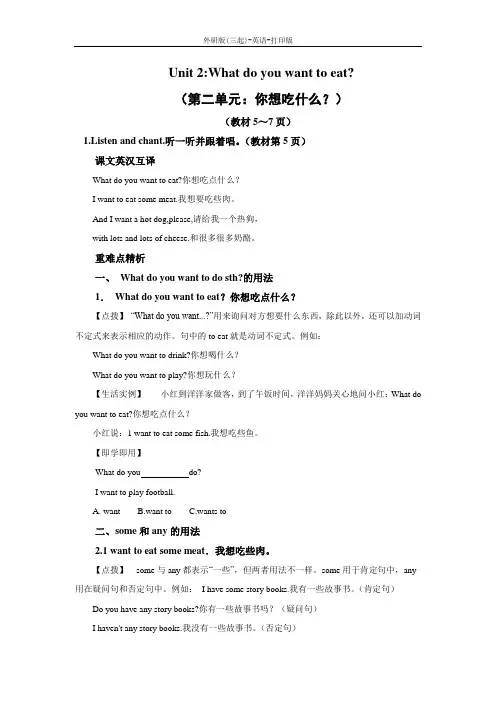
Unit 2:What do you want to eat?(第二单元:你想吃什么?)(教材5~7页)1.Listen and chant.听一听并跟着唱。
(教材第5页)课文英汉互译What do you want to eat?你想吃点什么?I want to eat some meat.我想要吃些肉。
And I want a hot dog,please,请给我一个热狗,with lots and lots of cheese.和很多很多奶酪。
重难点精析一、What do you want to do sth?的用法1.What do you want to eat?你想吃点什么?【点拨】“What do you want...?”用来询问对方想要什么东西,除此以外,还可以加动词不定式来表示相应的动作。
句中的to eat就是动词不定式。
例如:What do you want to drink?你想喝什么?What do you want to play?你想玩什么?【生活实例】小红到洋洋家做客,到了午饭时间,洋洋妈妈关心地问小红:What do you want to eat?你想吃点什么?小红说:1 want to eat some fish.我想吃些鱼。
【即学即用】-What do you do?-I want to play football.A. wantB.want toC.wants to二、some和any的用法2.1 want to eat some meat.我想吃些肉。
【点拨】some与any都表示“一些”,但两者用法不一样。
some用于肯定句中,any 用在疑问句和否定句中。
例如:I have some story books.我有一些故事书。
(肯定句)Do you have any story books?你有一些故事书吗?(疑问句)I haven't any story books.我没有一些故事书。
外研版六下Module2 Unit2 It will snow in Harbin
It will be snowy in Harbin . It will snow in Harbin .
明天将会下雪。
Do you want to be a weather reporter?
listen and read
将会温暖晴朗
What will the weather be like in Harbin ? --- lt will snow in Harbin . What will the weather be like in Beijing ? --- lt will rain in Beijing . What will the weather be like in Xi’an ? --- lt will be cold and windy in Xi'an . What will the weather be like in Sanya ? --- It will be warm and sunny in Sanya.
Listen and repeat.
Let's look at the weather tomorrow.lt will snow in Harbin . lt will rain in Beijing . lt will be cold and windy in Xi'an and it will be warm and sunny in Sanya.
kāīāı
开火车了
Let’s try
S1:lt will be hot on Friday. S2: It won't be sunny in Hangzhou. S3: lt will be rainy on Monday . S4: It won't be windy in Shenyang.
外研版英语六年级下册module2单元课件全套
module 2
外研版·英语·六年级下册
Module 2 Unit 1 When are we going to eat?
第一课时
第二课时
第一课时
用学过的动词或者动词短语描述图中的动作。
playplpcraleowyfaamalybydtpafcrkuasohutikotbneTetorbtsVobgakallmll es
New expressions.
What’s the weather like? It’s going to rain soon.
Because There are some dark clouds in the sky. 云
New words.
cloud y cloudy
cloud (名词)云 cloudy (形容词)多云的
New words.
duck 鸭子
u
bus 公共汽车
jump 跳
New words.
There are some ducks on the pond.
pond 水池,池塘
New words.
late r later
late (形容词)迟的,晚的 later (副词)后来,以后
New words.
Work in pairs.
A: What are you going to do? B: I am going to…
Practise. 单项选择。
( C ) 1. I ______ going to play football tomorrow.
A. is
B. are C. am
( B ) 2. Let's_____ breakfast. It's seven o'clock now. A. has B. have C. having
外研版六年级英语下册When are we going to eat课件
3. 半点的表达方法; half past + _____(几点) Eg:
half past seven
half past ten
half past five six o’clock half past seven three o’clock
—Look at the ducks!
—They’re eating our sandwiches!
补重充点学语习法
一般将来时
基本结构:主语 + be going to+ 动词原形.
be going to是将来时的一种,用来表 示按计划或打算做某事。动词be(am, is, are)要随着句中主语人称和数的变 化而变化。
Homework
1. 能独立完整地朗读对话。 2. 完成配套教辅相应的练习。
Module 2 Unit 1 When are we going to eat?
Learning goals
✓ 能够掌握单词: duck, like。 ✓ 能够运用句型:
1. I am going to get up and have breakfast. 2. —When are we going to eat?
补重充点学句习型
问答打算做某事的时间 —When+be动词+主语+going to+动词原形+其他? —主语+be going to+动词原形+时间.
be动词的选择要与主语一致。 回答时也可直接说时间。
Example
—When are you going to eat? —At twelve o’clock.
外研版六年级下册英语Module 3 Unit 1和Unit 2一课一练课课练含答案
Module 3 Unit 1 The sun is shining.一、根据句意和首字母提示完成单词。
1. Daming is in America. He m his parents in China.2. My uncle is s an email to his pen friend now.3. These ducks look h .They are eating our picnic.4. The family h a picnic in the park last week.5. It is f and the sun is shining.二、英汉词组互译。
1. have a very funny day2.寄一些照片3. miss everyone in China4.在星期六5. look at some ducks三、选择填空。
()1. Daming and Simon had a very day on Saturday.A. interestingB. interestedC. interest()2. ——How are you? ——A. It's fine.B. I'm fine.C. It's OK!()3. Look! Damimg is Lingling some photos.A. sendB. sentC. sending()4. I miss everyone in China. Please write _me soon.A. ofB. toC. in()5. Last Saturday, we a picnic in the park.A. haveB. havingC. had四、根据句意,选择单词的适当形式填空。
1. In this photo, the sun is (shine / shining).2. Look at (this/ these )photos. We are in the park.3. In this photo, it is ( starting to/ starting) rain.4. And just ( look at/ look) this photo. The birds are singing in the tree.5. In this photo, the ducks (is/ are) eating our sandwiches.五、阅读短文,选择正确的答案。