
外研版七年级下册英语教案设计Module9 Unit1
外研版七年级下册英语教案设计Module9 Unit1
1 / 3
Module 9 Unit1 Unit 1 He left school and began work at the age of twelve.
一、教学目标
【知识目标】
正确使用下列单词和词: January, February, March, April, May, June, July, August,
September, October, November, December, writer, find out, real, at the age of, newspaper,
exact, date, become v. ( became ), in the 1860s.
【能力目标】
1) To understand conversations about life in the past.
2) To understand and be able to ask questions with “did”.
3) To learn months of the year.
【情感目标】Train the speaking and listening abilities.
二、教学重点
To understand conversations about life in the past.
三、教学难点
To understand and be able to ask questions with “did”
四、教学资源
互动教学系统,点读笔,PPT
五、教学过程
教学环节 教学活动具体描述 教学资源
(一)
热身导入 师生互相问候 游戏热身 利用PPT展示图片,教师鼓励学生观察图片,快速说出图中内容
PPT第2-4页
【设计意图】课前利用观察图片快速说出内容的游戏吸引学生的注意力, 同时引入月份表达法。
(二)
新知呈现
1. 通过图片和单词做搭配,初步理解单词和短语的意思。月份和节日季节搭配,为对话做词汇上的准备 PPT第5-7页
2. What festival can you think of? PPT第8-11页
外研版七年级下册英语教案设计Module9 Unit1
2 / 3
3. 听并且跟读课文后,回答相关问题,初步了解对话内容。 PPT第13页
4. 通过深入学习对话内容,进一步解决对话中的难点。 PPT第14-15页
【设计意图】使学生深入理解对话内容
(三)
课文学习
介绍课文背景并提出观看动画的任务:总结对话中提到的关于马克吐温的时间事件 PPT第16页
播放M9U1活动3动画。第一遍观看,要求学生选择课文中出现的介绍马克吐温;第二遍观看,要求学生复述年代和发生的事情。 M9U1活动3动
画
PPT第17-18页
继续展示新图片,让学生熟悉一些不规则动词过去式 PPT第19页
【设计意图】操练已学知识
(四)
拓展运用
Pronunciation and speaking PPT第20、21
页
归纳重点短语,一般过去时 PPT第22-28页
【设计意图】适机的归纳,帮助学生整理,建立新旧知识的学习框架,能为学生展开有意义的对话交流搭建脚手架。搭建语言学习的最终目的是能实现表达和交流。为学生提供学习一般过去式,鼓励学生把所学知识进行综合运用。
(五)
布置作业
To act out the conversation on page 54. PPT第29页
【设计意图】 课后作业既延续本课关于To act out the
conversation on page 54.又给学生一个拓展的空间,鼓励孩子们大胆的拓展。
(六)
板书设计
Module 9 Unit1 He left school and began work at the age of twelve. find out at the age of in the 1860s as well What did he do? He was born … Did he stay…?
外研版七年级下册英语教案设计Module9 Unit1
3 / 3
When did he begin …?
外研版英语七年级下册:Module 9 Unit 1 He left school and bega
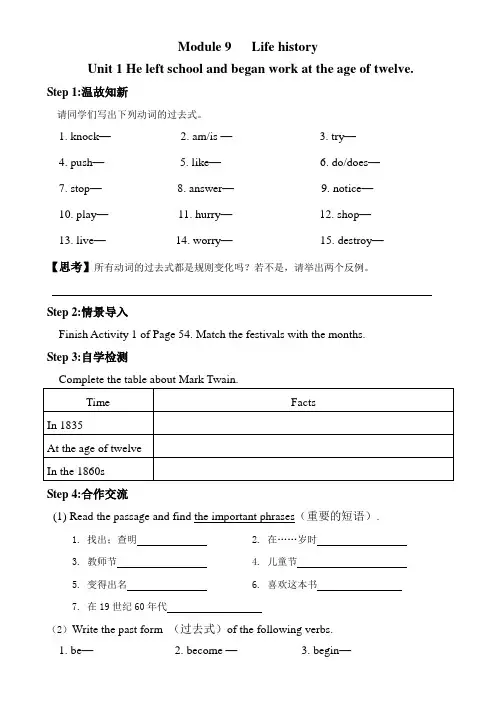
Module 9 Life historyUnit 1 He left school and began work at the age of twelve. Step 1:温故知新请同学们写出下列动词的过去式。
1. knock—2. am/is —3. try—4. push—5. like—6. do/does—7. stop—8. answer—9. notice—10. play—11. hurry—12. shop—13. live—14. worry—15. destroy—【思考】所有动词的过去式都是规则变化吗?若不是,请举出两个反例。
Step 2:情景导入Finish Activity 1 of Page 54. Match the festivals with the months.Step 3:自学检测Step 4:合作交流(1) Read the passage and find the important phrases(重要的短语).1. 找出;查明2. 在……岁时3. 教师节4. 儿童节5. 变得出名6. 喜欢这本书7. 在19世纪60年代(2)Write the past form (过去式)of the following verbs.1. be—2. become —3. begin—4.do—5. get—6. go—7. know—8. leave—9. read—10. take—11. write—Step 5:当堂检测I. 根据汉语提示完成句子。
1. I was born in (八月).2. I don’t know his (确切的)address.3. Is she a (真正的)singer?4. Lu Xun was a famous (作家).5. I like reading (报纸).II. 单项选择。
1. He stayed at home and TV yesterday.A. watchedB. sawC. lookedD. looked at2. ——Did you ride a bike to school when you were 12?——.A . Yes, I did. B. Yes, I am. C. Yes, I didn’t. D. Yes, I do.3. ——Betty in a hospital in the past?——Yes , she did.A. Did, workedB. Did, worksC. Does, workD. Did, work4. He often football last year.A. playsB. playedC. playingD. to play5. People call June 1st .A. Childrens’ DayB. Child’s DayC. Children’s DayD. Children Day。
外研版英语七年级下册Module9 Unit1参考学案
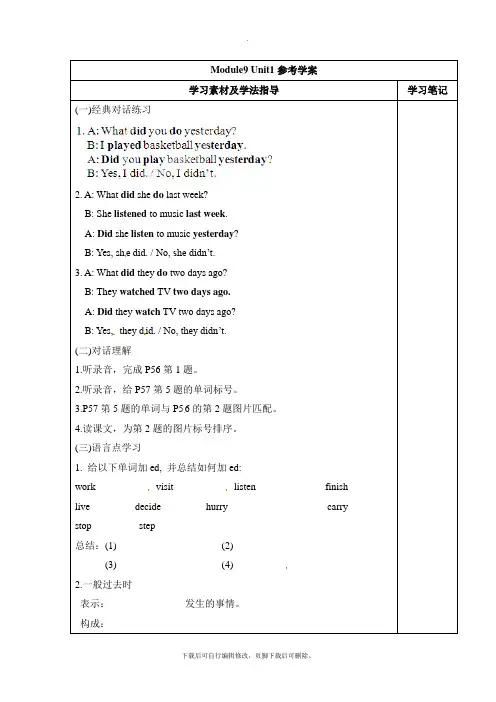
Module9 Unit1参考学案学习素材及学法指导学习笔记(一)经典对话练习2. A: What did she do last week?B: She listened to music last week.A: Did she listen to music yesterday?B: Yes, sh e did. / No, she didn’t.3. A: What did they do two days ago?B: They watched TV two days ago.A: Did they watch TV two days ago?B: Yes,they d id. / No, they didn’t.(二)对话理解1.听录音,完成P56第1题。
2.听录音,给P57第5题的单词标号。
3.P57第5题的单词与P56的第2题图片匹配。
4.读课文,为第2题的图片标号排序。
(三)语言点学习1. 给以下单词加ed, 并总结如何加ed:work_________visit_________listen_________ finish_________live_________decide_________hurry_________ carry_________stop_________ step__________总结:(1) ____________________ (2) ____________________(3) ____________________ (4) ____________________2.一般过去时表示:_______________发生的事情。
构成:_______________标志词:_____________________________________________3.句型转换I played basketball yesterday.I _______ ________ basketball yesterday. (否认句)_______ you _______ basketball yesterday? (一般疑问句)Yes, I _______. / No, I _____ . (肯定、否认答复)______ ______ you _______yesterday? (对划线局部提问)(四)词汇积累读对话,并在对话中找出以下短语和句子。
外研版英语七年级下册:Module 9 Unit 1 He left school and bega

Post-listening grandfatherwent toAmerica inOctober1941.There is afamousAmerican,listen and getwho it is.Listen MarkTwain’s lifehistory.1.Lead studentstointroduce MarkTwain.2.When we talkabout one’s lifehistory, weuse...3.Do you knowMark Twain?Let me test you.Can you saysome questionsfor me to test?2.Listen again.3.Listen again and check theiranswers.Post-listening1.Describe mark twain using theform.2.Find out past form of irregularverbs in the dialogue.3.Ask and answer questionsabout Mark Twain.描述马克吐温的细节信息。
通过填表形式帮助学生系统梳理马克吐温的主要信息。
用陈述句形式梳理马克吐温的人生经历及其主要信息。
不规则动词的过去式对学生来说是一个难点,此活动即是为了强化这一内容而设计。
流程及内容教师活动学生活动设计意图Post-listening 4. Show 4. Work in pairs. Ask and answerquestions about MoYan or 输出部分,检测学生。
外研版七年级英语下册导学案 Module 9 Unit 1

Module9Unit 1He left school and began work at the age of twelve.
课型:Listening and Vocabulary
主备人
完成时间
议课时间
共案发放时间
上课时间
审核人
第周
第周
第周
第周
班级:
姓名:
小组:
学
习
目
标
1. Key vocabulary: March, April, May, June, July, August, September, October, November, December, writer, real, exact, newspaper, date, become
4)Mark Twain became very famous in the 1960s and began his stories.
5)Mark Twain went to Europe and China.
2、作者简介:
Time
Facts
In 1835
At the age of twelve
In the 1860s
一、英语报,第30期,第三版, Unit 1, 第一大题
根据句意及汉语提示,写出正确的单词。
1. My sister was born on ______ (11月) 16, 2000.
2. --- Can you tell me the ______ (准确的) time if the meeting?
--- Yes, of course.
3. We went to Beijing and had fun there last ______ (8月).
外研版七年级英语下Module9 Unit1课件(共33张PPT)

1 Was Mark Twain his real name? 2 Did Betty read Tom Sawyer? 3 Did Mark Twain leave school at 16? 4 Did Mark Twain become a newspaper writer? 5 Did Mark Twain come to China?
2)表示在过去一段时间内,经常性或习惯性的动 作。 When I was a child, I often played football in the street. Whenever the Browns went during their visit, they were given a warm welcome.
3. My mother played the piano when she was young. 一般疑问句: Did your mother play the piano when she was youn ______________________________________ 肯定回答: Yes, she did. ________________________________________ 否定回答: No, she didn’t. ________________________________________ 4. I went to the bookstore yesterday. 一般疑问句: Did you go to the bookstore yesterday? ______________________________________ 肯定回答: Yes, I did. ________________________________________ 否定回答: No, I didn’t. ________________________________________
外研版七年级英语下Module9 Unit1课件(共33张PPT)
Christmas National Day Children’s Day New Year’s Day Labour Day Spring Festival
July August September October November December
丹尼尔10岁时就会游泳了。
3 Listen and Read. Now complete the table about Mark Twain.
Time Facts
In 1835 At the age of 12
In the 1860s
He was born in Missouri. He left school and began work. He took the name Mark Twain and became very famous.
3 Listen and Read
Betty: What are you reading? Tony: Tom Sawyer, by the famous American writer, Mark Twain. I’m writing about him fir my English class. Betty: I read Tom Sawyer. Very good! Hey, we can find out him on the Internet. Tony: Yes! …. OK. Look at this! His real name was Samuel Clemens and he was born in 1835 in Missouri. He left school and began work at the age of twelve.
七年级下册英语课件-Module 9 Unit 1 外研版
B: Did he stay in Missouri? T: No, he went to New York, and other cities. B: When did he begin his stories? T: I don’t know the exact date. But he took the name Mark Twain and became very famous in the 1860s. He went to Europe as well. But he didn’t come to China. B: Yes, I knew that. Enjoy the book. T: Yes, it’s good.
Listen and choose the best answer.
1. Where was Mark Twain from? A. England. B. America. C. China. 2. When was Mark Twain b. In 1855. 3. When did Mark Twain become famous? A. In the 1840s. B. In the 1850s. C. In the 1860s.
Now talk about when the festivals are.
Spring Festival is in January or February. … Teacher’s Day — September Women’s Day — March 小组练习: Christmas — December National Day — October Children’s Day — June New Year’s Day — January
新目标英语七年级Module 9 Story time Unit 1 Once upon a time …公开课教案附教学反思
MODULE 9 TEACHING PLANContent:Module 9 Story time [Junior 1, New standard English] Unit 1 Once upon a time …一教学内容及学情分析:本节课以童话故事金凤花姑娘和三只小熊为题材,展开听说训练,目的培养学生参与用英语讲故事的能力。
通过操练,使学生在掌握语言结构的同时,既学习语言知识,感悟语言功能,又能欣赏到美丽的童话故事。
这也符合初一学生的年龄特点。
二教学目标:1情感目标:通过用英语讲童话故事,激发学生学习英语的兴趣。
2语言知识目标:根据学生实际,把下列几项定为本节课的目标(1)词汇及短语:会正确使用下列词汇短语once, decide, ride, golden, pick, notice, hurry, knock, nobody, push, enter, count, bowl, hungry, once upon a time, go for a ride学会规则动词的过去式的发音3语言技能目标:能听懂故事中主要人物及大意。
能用所学短语及动词的过去式讲故事。
4 文化意识了解外国童话故事,培养跨文化意识。
5学习策略通过听说活动解决问题。
三教学重难点:重点:能听懂故事中主要人物及大意。
理解动词的一般过去时句子的用法,能根据图片复述故事。
难点:学会描述一个完整的故事或一件事情。
四教学方法:根据以上目标,用童话故事的情节吸引学生导入新课。
以听金凤花姑娘的故事来引出一系列问题,让学生带着问题听故事,通过解决一系列问题达到运用目标词汇和短语用一般过去时讲故事的目的(黄丽燕2003)。
为实现以上目标设计了几个活动。
巩固目标1.加入写的练习。
为把目标落到实处,我在教学中加入写的练习。
就课文内容做重点词汇过去式填空练习。
2.拓展练习。
给图片讲白雪公主的故事。
达到培优的目的。
五教学用具多媒体随堂练习卷花篮小纸杯纸花六教材处理由于我校实行导学案教学,单词和词汇及动词过去式已经在预习案中做过处理,在预习卷中我们就课文内容设置了一些问题,这些问题在预习中已基本解决。
外研版七年级英语下册Module9 Unit1学案-新版
3.句型转换
I playedbasketballyesterday.
I _______ ________ basketball yesterday. (否定句)
_______ you _______ basketball yesterday? (一般疑问句)
( ) 4. Why do many children watch TV only on Saturday or Sunday evening? Because ______
A. TV is not good B. they don't like watching TV
C. they have no time D. they want to play football
总结:(1) ____________________ (2) ____________________
(3) ____________________ (4) __________ __________
2.一般过去时
表示:_______________发生的事情。
构成:_______________
( )5. Children can study better and more easily on TV because ______
学习反思
Module9 Unit1学案
学习素材及学法指导
学习笔记
(一)经典对话练习
2. A: Whatdidshedolast week?
B: Shelistenedto musiclast week.
A:Didshelistento musicyesterday?
Module+9Unit1知识点+课件++2022-2023学年外研版英语七年级下册
(4)Some books are for children, and C are for women. A.the other B.the others C.others D.other (5)She buys four pens, a ruler and D school things. A.the other B.the others C.others D.other
9.I’m standing on the Great Wall of China and talking to you.我正站 在中国的长城上和你说话。 ◆该句是现在进行时,表示现在正在发生或进行的动作,或当前一段时 间内正在发生的事情。常见的现在进行时的标志词有look,listen, now, at the moment等。其谓语动词为“be+v.⁃ing(现在分词)”,其中be动词 有am, is, are三种形式。动词⁃ing形式的变化规则如下表:
in the garden.
(20)写出下列动词的现在分词(v.-ing)形式。
buy buying .
call calling .
drink drinking . drive driving .
eat eating .
enjoy enjoying .
go going . lie lying .
have having . shop shopping .
6.Daming is having lunch and lying in the sun.大明正 躺在太阳底下吃午餐。 ◆lie意为“躺,卧,平放”,是不及物动词,其现在分词为 lying。如: (13)Look!An old man is lying on the ground.看! 有个老人正躺在地上。 ◆in the sun意为“在阳光下”。如: Don’t read in the sun.不要在太阳底下看书。