
人教版PEP六年级英语上册期中复习资料
期中复习知识点 重点单词和短语
四会单词: Unit 1Science科学, museum博物馆,post office邮局, bookstore书店,cinema电影院,hospital 医院,crossing十字路口,turn left 左拐,turn right右拐,go straight=walk straight直走,buy买, next to紧挨着/与……相邻,far from(离……远),near在……附近,behind(在……后面), in front of(在……前面) Unit 2 on foot步行,by bus =take a bus 乘公交车,by bike骑自行车,by plane,乘飞机,by taxi,
乘出租车,by ship,乘船 ,by subway 乘地铁,by train乘火车,slow down 慢下来,stop 停, wait等, Unit 3, visit one’s grandparents 看望祖(或外祖)父母 see a film 看电影take a trip 去旅行go to the supermarket 去超市this morning今天早上 this afternoon今天下午 this evening今天晚上 tonight在今晚 tomorrow明天 next week 下周dictionary 字(词)典comic book(儿童的)连环画册 word book 单词书postcard 明信片 三会单词Unit 1 send 邮寄between…and… 在……和……之间, London Eye伦敦银,Thames 泰晤士河,finally终于,portion(食物的)一份,tasty美味的,stomach胃,astray走错方向 (p80) [Better to ask the way than go astray.问路总比迷路好。] Unit 2 by ferry乘轮渡,Hooray!好极了!pay attention to注意 ,cross the road横穿马路 ,traffic
lights交通信号灯,at home在家 , missed(miss的过去式)想念 , different,不同 ,chopsticks,筷子(复数),cross穿过,look right向右看,same 相同的,door门, look at朝……看 play with和……一起玩 , British 英国的,double-decker双层公共汽车, same相同的, airplane 飞机(p70)course(赛马比赛的)跑道(p80)[Horses for courses.知人善任。] Unit 3,1、my weekend plan 我的周末计划 2 nature park 自然公园 3 look for 寻找 4 have an art lesson 上美术课 5 draw some picture 画一些画 6 Sounds 听起来 7 Have a good time 祝你开心 8 have to 不得不 后跟动词原形 9 do my homework 做我的家庭作业 10 go ice—skating 去滑冰 11 make a snowman 堆雪人 12 go for a picnic 去野餐 13 be going to = will 将要 (后跟动词原形)与表示将来的时间连用(tomorrow, tonight, next week, this morning,…) Be 动词包括:am ,is , are 口诀:I 用 am ,you 用 are ,is 跟着 he ,she ,it . we 和they 都 用 are 单数用is , 复数用 are 14 about 关于 15 space travel: 太空旅行 16 lots of 许多 后跟可数名词的复数和不可数名词 lots of books lots of water 17 why not :为什么不?后跟动词原形 18 let’s = let us 让我们 后跟动词原形 19 what about …?: 怎么样? 后跟动词ing 形式 what about reading (read) a comic book? 20 on + 星期几 :在星期几 21 half price 半价 22 family 家人 (复数) 做主语时:be 动词用are 23 get together 聚会 24 make mooncakes 做月饼 25 tell stories 讲故事 tell a story 讲一个故事 26 read a poem 朗读诗歌 27 how to swim 怎么游泳 28 learn to swim 学会游泳 29 learn by doing 在实践中学习 30 without 没有(介词) 后跟动词ing 形式 31 swimming pool 游泳池 32 try 尝试 33 easy 容易的 34 remember 记住35 soldier 军人(p70)36 think 思考 (p80)37speak说,讲(p80)【Think today and speak tomorrow.三思而后行。】 按要求写单词: Unit 1hot(反义词)cold,cool(反义词)warm,too(同音词)to/two ,can not(缩写)can’t, right(反义词)left/wrong ,buy(同音词)by/bye sea(同音词)see, first(基数词)one ,four(序数词)fourth ,did (原形)do /does,three(序数词)third ,give(过去式)gave Unit 2 go (反义词)come, foot(复数)feet, child(复数)children ,early(反义词)late,slow
(反义词)fast ,go (过去式)went,do(过去式) did ,do(第三人称单数) does。go(第三人称单数) goes。 重点句型分析
Unit 1 1.Where is the museum shop? 博物馆的商店在哪儿?
此问句是由特殊疑问词where 引导的一个特殊疑问句, where意为“在哪里,到哪里”,用来询问地点, 放在句子的开头。询问“某人或某物在哪里”的基本句型是:“ Where +is/are+ 主语?”,where is 后接名词或代词的单数形式,where are 后接名词或代词的复数形式。表示地点的词:museum博物馆, post office邮局, bookstore书店, cinema电影院, hospital医院restaurant餐馆bank银行bus stop公交车站lake湖library图书馆zoo动物园school学校park公园garden花园hotel旅馆 2. It’s near the door.在大门附近。 此句中near是表示位置的介词,意为“旁边,附近” , 其同义句是:It’s next to the door.它在门的旁边。表示位置的短语:next to the bookstore挨着书店near the hospital在医院附近near the post office在邮局附近over there 在那边on Dongfang Street在东方大街上in front of the school在学校前面 3.How can we get there? 我们怎么到那儿? 此句用来询问“怎样去某地”,后面直接跟地点。回答时,可以用“ Turn left, turn right, go straight.”等句来回答。 同义句: 1.Can you tell me the way to+地点? 2.Where is the +地点? 3.Which is the way to +地点 4. Turn left at the bookstore. Then turn right at the hospital. 到书店左转。然后到医院右转。 此句是指路的句型。常用到的句型有:turn left, 向左转turn right, 向右转go straight直着走。同时表示在某处的介词用at. 5. Is the Thames far from here? No, it isn’t.泰晤士河离这里远吗?不,不远。 此句是个be动词开头的一般疑问句, 其回答要用Yes.或No. 句中的far from意为“离……远”。反义词组为next to. Unit 2
1. How do you come to school?你(们)怎么来学校的? 此问句是由特殊疑问词how引导的特殊疑问句, 用于询问对方的出行方式。 回答时要根据具体情况作答。 表示地点的词:Germany德国 Munich慕尼黑 England英国 Australia澳大利亚 school学校 the park 公园the cinema电影院 the hospital医院 the post office邮局 the bus stop公共汽车站 home家 1. Usually, I come on foot.=Usually, I walk.通常情况下,我步行来。 此句是对出行方式的回答句。 其中usually意为“通常”, 表示频率很大, on foot意为“步行”。 一般用by表示出行方式。 By后面一定要直接加交通工具的单数形式, 只有“小脚丫”foot与on 搭配, “步行”用on foot表示。 2. I must pay attention to the traffic lights.我必须注意交通信号灯。 must是情态动词,意为“必须”后面跟动词原形。 动作词组:wear a helmet戴头盔 pay attention to the traffic lights注意交通信号灯 look right向右看 4. Don’t go at the red light! 别闯红灯! 此句是Don’t开头的否定祈使句, don’t后面跟动词原形。意为“不要做某事”。 动作词组:run跑 go at the red light闯红灯 touch the door触摸门 5 We must look right before crossing the road.我们在横穿马路前必须看看右边。 此句中must是情态动词, 意为“必须”后面跟动词原形, 在此句中before是一个介词, 而介词后面跟动词-ing形式。 6. So many pictures of bikes. 如此多的自行车照片。 pictures of bikes 自行车的照片 ......of........ ……的……例如:the door of classroom .教室的门 7. In the USA ,people on bikes must wear one.在美国骑自行车的人必须带头盔。 Unit 3 1 what are you going to do? 你打算做什么? 2 When are you going ? 你打算什么时候去? 3 Where are you going ? 你打算去哪里? 4 Who are you going with? 谁和你一起去? 5 How are you going to shanghai ? 你怎么去上海? What (什么) 对事情和物 提问 ; Who(谁 ) 对人 提问 When (什么时候)对时间 提问 ; Where (哪儿) 对地点 提问; How(多么)对身体状况和交通方式提问
新人教版PEP小学英语六年级总复习资料(全册)
新人教版PEP小学英语六年级总复习资料(全册)New n PEP Primary School English Grade 6 Review MaterialsI。
Antonymsbig --- smallblack --- XXXfree --- busyhot --- XXXsame --- differentcool --- warmtall --- shortlong --- shortyoung --- oldhere --- therebefore --- afternew --- oldII。
Word n1.CountriesChina。
America。
Australia。
Japan。
England。
Canada。
France2.nalitiesChinese。
American。
Australian。
Japanese。
English。
Canadian。
FrenchnguagesChinese。
Japanese。
English。
French4.SubjectsChinese。
Maths。
English。
Art。
Music。
P.E。
History。
Science5.Days of the WeekSunday。
Monday。
XXX。
XXX。
XXX。
Friday。
Saturday6.SeasonsSpring。
Summer。
XXX。
Winter7.MonthsJanuary。
February。
March。
April。
May。
June。
July。
August。
September。
October。
November。
XXX8.FestivalsSpring Festival。
Dragon Boat Festival。
Mid-Autumn Festival。
New Year's Day。
nal Day。
Children's Day。
Easter。
Halloween。
Christmas.1.植物和水果在我们的生活中,植物和水果是不可或缺的。
六年级英语上册 人教PEP版 期中复习 单词专题 (三)
四会词汇
5.evening ['iːvnɪŋ] 晚上; 傍晚 考点:① 复数:evenings②this evening今天晚上 ;in the evening在晚上 易错:字母e/ng的发音。 巧记:e-ven-ing
四会词汇
6.tonight [tə'naɪt] 今晚 考点:主要用作为副词、名词,作副词时译 为“在今晚,今夜”,作名词时译为“今晚,今 夜”。 易错:字母o的发音,字母i /gh的发音 巧计:to-n-igh-t
Practice
Guess what place it is.
hospital
Practice
Guess what place it is.
cinema
Practice
Guess what place it is.
museum
Practice
Guess what place it is.
post office
四会词汇
lesson ['les(ə)n]课 space [speɪs] 太空 travel ['træv(ə)l] (尤指长途)旅行 half [hɑːf] 一半 复数:halves price [praɪs] 价格
四会词汇
Mid - Autumn Festival中秋节 together [tə'geðə] 一起 get together mooncake ['mu:nkeɪk] 月饼 poem ['pəʊɪm] 诗 moon [muːn] 月亮
a.
b.
c.
d.
Exercises 四、按要求写单词。
we 宾格 us
poem 汉译英 诗
新PEP小学英语六年级上册复习资料
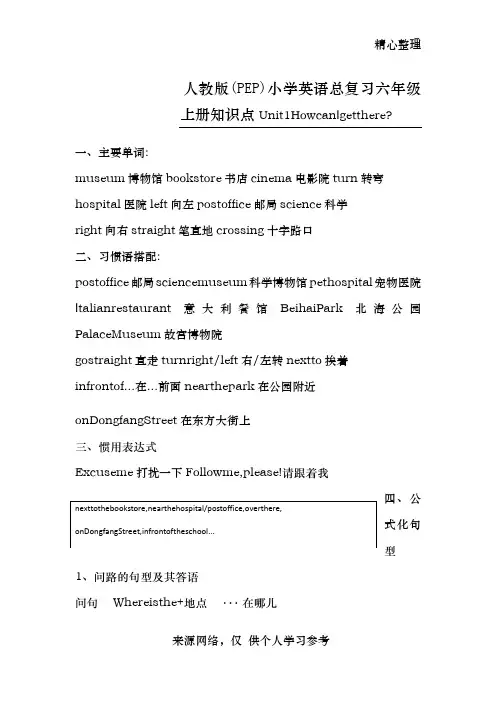
精心整理人教版(PEP)小学英语总复习六年级上册知识点Unit1Howcan I getthere? 一、主要单词:museum 博物馆bookstore 书店cinema 电影院turn 转弯:sciencemuseum talianrestaurantExcuseme 打扰一下 1Whereisthe+nexttothebookstore,nearthehospital/postoffice,overthere,I t’s+表示地点的词语。
它···。
2Howcan+主语+get(to)+the+Canyoutellmethewayto+Whereis+Whichisthewayto+Turn+方向+表示地点的介词短语。
atthecinemaatthecornernearthepostoffice...Whereisthecinema,please?I t’snexttothehospital.它与医院相邻。
Turnleftatthecinema,thengostraight.I t’sontheleft.在电影院向1、Whereisthemuseumshop?博物馆商店在哪里?I t’snearthedoor.他在门附近。
2、Whereisthepostoffice?邮局在哪里?I t’snexttothemuseum.它与博物馆相邻。
3、Whereistherestaurant?餐馆在哪里?I t’snexttothetheparkonDongfangStreet.它与东方街上的公园相邻。
Unit2Waystogotoschoolby乘bus公共汽车onfoot步行plane飞机taxi出租车ship subway地铁train火车slow慢的stop停下always usually通常often经常sometimes有时候never从来不,永不Wait Hooray I see.绿灯行Stopataredlight红灯停Waitatayellowlight1Howdoyoucome(to)+2、如何用must某人+must++.···必须···。
【范文】新版pep六年级英语上册期中复习资料
新版pep六年级英语上册期中复习资料本资料为woRD文档,请点击下载地址下载全文下载地址Unit1.want(todo)想要干某事Iwanttobeadoctoroneday.=I’mgoingtobeascienceteacheroneday.2.send寄sendane-mail3.gave原形:give提供;交给go过去式went4.first基数词:one5.find找到同义短语lookfor寻找6.have(第三人称单数:has)compass指南针GPS全球(卫星)定位系统Palacemuseum故宫博物院nextto与……相邻反义短语:farfrom远离overthere在哪儿反义短语:nearhere这儿附近infrontof在……的前面(反义词:behind)threelargeportion三大份oneday有朝一日anItalianrestaurant一家意大利餐馆anewfeature一个新特点sohungry(=veryhungry)很饿onDongFangStreet在东方街道上LondonEye伦敦眼Thames泰晤士河.问路的句子(询问去电影院的路):Excuseme.HowcanIgettothecinema?Excuseme.whereisthecinema?Excuseme.canyoutellmethewaytothecinema?Excuseme.whichisthewaytothecinema?Excuseme.Isthereacinemanearhere?2.感叹句:whatagreatmuseum!whataninterestingfilm!3.Therebe结构:Thereis/are…?一般疑问句:Isthere…?yes,thereis.No,thereisn’t.Arethere…?yes,thereare.No,therearen’t.4.some和any一般情况下,some用于肯定句中,any用于否定句和一般疑问句中Therearesomebooksintheschoolbag.否定句:Therearen’tanybooksintheschoolbag一般疑问句:Arethereanybooksintheschoolbag?邀请,请求时,用some。
人教PEP六年级英语上册六年级上册期中复习课件

A. post office
B. know C. excuse
(B) 3. —______ —It’s next to the library.
A. Is there a bookstore? B. Where is the bookstore?
C. How do you go to the bookstore?
go straight
Unit1
(A) 1. Turn left ______ the cinema, then go straight. It’s
______ the left.
A. at; on
B. on; on C. at; of
(A) 2. —Where is the ________? —It’s near the science museum.
C. by plane
(B) 4. My mother often goes to work ______ subway.
A. ___ can I get to the zoo? —By bus.
A. What
B. How
C. How old
答案
Unit3
答案
(C) 4. Which picture means “crossing”?
A.
B.
Unit1
C.
( B) 5. —You are in a car. Which can’t help you find a place?
—___________
A. map
B. compass
C. GPS
答案
Unit2
Unit3
—What are you going to do today? —I’m going to …
人教版(PEP)小学英语六年级上学期期中复习:单词拼写

- 1 - 人教版(PEP)小学英语六年级上学期期中复习:单词拼写 一、单词拼写(词汇运用)(共20题;共24分) 1.Turn left at the ________.
2.She goes to the park ________ ________. 3.—How do you come to school? —I come to school on f________.
4.There is a science m________ beside my school. 5.Go s________ and you can see the zoo. 6.If you want to see a film, you can go to the ________. - 2 -
7.You can buy books in the ________. 8.There are many ________ books. (imocc) 9.Where are you going this ________? (viegnen) 10.________(通常),I come________(乘火车). 11.I go to Shanghai by p________
12.I want to buy a storybook in the b________ 13.Today I go to the supermarket on f________. 14.We must pay attention to the ________(交通灯). 15.Please k________ the desk c________.
16.The pet hospital is next to the ________.
17.If you don't know the word , you can look it up in a d________ . 18.The girl is e________ l________.
六年级上册英语PEP版期中复习
选出每组划线部分发音不同的单词,将其序号 填入括号内。10% ( ) 1. A: bag B: same C: jacket D: cap ( )2 .A: see B: tea C: tree D: pen ( )3. A: bike B: kite C: sit D: five ( ) 4. A: let B: pen C: bee D: desk ( ) 5. A: dog B: so C: hot D: box
6.你想问同伴周末打算做什么,该怎么 说: A.Where are you going? B.How do you get there? C.What you going to do this weekend? 7.---Is there a cinema near here? --- B A.Yes,it is. B.Yes there is. C.Yes,it does. 8.---I often go to school ( B) bike. A.in B.by C.on 9.My father is doctor.He works in a( B ). A.School B.hospital C. bank 10.---Where are you from?---I’m from ( A) . A.China B.English C. American
How do you go to …?
the park
the zoo the cinema
Army: How do you go to the U.S.A? John: I go to the U.S.A by plane, because it is very far.