
外研版九年级英语上册Module 10 知识点
Module 10 知识点
一, according to ,后接名词或代词,表示根据某学说,某书刊,某文件,某人所说的话
例:Everything went according to the plan .
According to my watch ,it’s five o’clock now .
不是什么事都能按照老规矩办
Not everything can be done ________ ______ the old ways .
二, 1, keep sb/sth away :使。。。。离开
Would you keep that dog away ,please ?
2, keep away from 远离,避免接近
You have to keep away from all sweets .
You must keep away from the dog .
他父亲给了他一些远离香烟的建议
His father gave him some advice on ______ ______from cigarettes .
三, cut sth off sth
例:She cut off a small piece of bread and gave it to me .
He cut the branches off the trunk .他把树干上的树枝都剪掉了
四brush sth from sth :把某物从某物上刷掉
例:He brushed the dirt off his jacket .他拂去了他夹克上的灰尘
Brush off :“被刷掉”
Don’t worry about that mark .It will brush off .不要为那块污渍担心,他会被刷掉的
The mud will brush off when it dries .泥巴干了会被刷掉
我怎样才能把墙上的颜色刷掉呢
How can I _____ ______ ______ ______the walls ?
五, at the time :当时 ,多用在开头或末尾,句子常用一般过去时
At that time 在那时,可用于一般过去时和一般将来时
At this time ,此时此刻,句子常用一般现在时
六, be surprised at :对。。。感到惊讶
例:I was surprised at what he said .
Be surprised to do sth :对做某事感到惊讶
I am surprised to hear you say that .
七, in one’s own way :用某人自己的方式
He has the right to live in his own way .他有权按照自己的方式生活
我用自己的方法学习英语
I learn English _____ _____ ______ ______.
八, that 引导的定语从句
That 引导定语从句时,可以指物也可以指人,在定语从句中作主语或宾语,作宾语可省略
注意:that 前不能有介词,that 不能引导非限定性定语从句
1, that 指人,在定语从句中充当主语,可换为who
例:He is the kind man that often helps others .
2, that 指人,在定语从句中充当宾语,可换为who ,whom 也可省略
The man (that )my father talked with was my English teacher .
3,that 指物,在定语从句中充当主语,可换为which
The building that is being built is our teaching building
4, that 指物,在定语从句中充当宾语,可换为which ,也可省略
外研版初中英语九年级上册单词表
外研版初中英语九年级上册单词表Revised by BETTY on December 25,2020外研社九年级英语单词表Module 1man-made [mnmed] adj. 人造的natural[ntrl] adj. 大自然的wonder [wnd] n. 奇观,奇迹discussion[dskn] n. 讨论,商讨eastern[i:stn] adj. 在东边的,来自东边的 though[e?] conj. 虽然,但是loud [la?d] adj. (声音)响亮的wow[wa]int. 呀,哇(用于表示惊讶或赞叹) opinion[pnjn] n. 看法,主张in one's opinion 按某人的意见,据某人看来more than 超过electricity[lektrsti] n. 电millions of 大量的,无数的below[bl]prep. 在下面,在…以下shine (shone /shined, shone/shined)[an] v. 照耀sign [sa?n] n. 迹象,标志,招牌silent [salnt] adj. 寂静的silver[slv] adj. 银灰色的,银制的 sky[ska]n. 天,天空grey [ɡre] adj. 灰色的,(天气)阴沉的 go through 穿过beside[bsad] prep. 在…旁边,在…附近 reply[rpla] v. 回答,答复clear [kl]v. (烟雾等)开始消失fall away 突然向下倾斜stream[stri:m] n. 小河,小溪nearly [nli] adv. 几乎,差不多on top of 在…上面,盖住canyon [knjn] n. 峡谷remain[rmen] v. 逗留,留下by[ba]prep. 在…旁边,靠近Module 2found[fa?nd] v. 创立,创建since then 从那以后flag [fl?g] n. 旗,旗帜until[ntl] prep.&conj. 直到…为止off[f] adv. 不上课,休息,不工作all kinds of 各种各样的vacation[vken] n. 假期,假日take a vacation 去度假season[si:zn] n. 度假旺季,节期kid[k?d] n. 小孩have fun 玩得高兴,有乐趣band[b?nd] n. 乐队UK [ju:'ke]英国as soon as 一…就…fourth[f:θ] num. 第四sixth [s?ksθ] num. 第六seventh[sevnθ] num. 第七eighth[e?tθ] num. 第八ninth[na?nθ] num. 第九tenth[tenθ] num. 第十twelfth[twelfθ] num. 第十二twentieth['twent?θ] num. 第二十among[m] prep. 在…之中speech[spi:t]n. 演说,讲演pioneer[pan] n. 开拓者,先驱者grow[gr]v. 种植,栽培(植物)corn [k:n] n. 谷物,玉米following[fl] adj. 接着的,接下来的lay (laid, laid)[le]v. 摆放(餐桌) lay the table 摆放餐桌over[v] adj. 完了的,结束的dish[d]n. 盘,碟parade[pred] n. (庆祝)游行ourselves [ɑ:selvz] pron. 我们自己Module 3including[nklu:d] prep. 包含,包括 medal [medl] n. 奖牌,奖章attend [tend] v. 上(学),出席,参加(事件或活动)abroad[br:d] adv. 在国外,到国外 once again 再一次doctor[dkt] n. 博士degree[d?gri:] n. 课程,学位whatever[wtev] pron无论什么,不管什么give up 放弃(努力)amazing [mez] adj. 惊人的,极好的will [will] n. 意志,决心victory[vktri] n. 成功,胜利simply[smpli] adv. 实在,的确Canadian[knedjn] adj. 加拿大的,加拿大人的sick [s?k] adj. (感觉)不适的,生病的soldier[sld] n. 军人,士兵treat[tri:t] v. 医治,治疗war [w:] n. 战争wound[wa?nd] n. 伤,伤口die for 为…而死wounded[wu:ndd] adj. 受伤的realise['rlaz] v. 了解,意识到dying[da] adj. 垂死的,即将死亡的care [ke] n. 照顾,照料take care of 照顾,护理tool [tu:l] n. 工具,器械invention[nvenn] n. 发明,发明物at that time 那时候on one's own 独自一人useful [ju:sfl] adj. 有用的,有益的rest[rest] v. 休息,睡眠himself [hmself] pron. 他自己manage [mnd] v. 做成,(尤指)设法完成operation [pren] n. 手术continue [kntnju: ] v. (使)继续die of 死于Canada['knd] n. 加拿大Module 4platform [pltf:m] n. (供上下火车用的)月台,站台meeting[mi:t] n. 会议,集会miss [m?s] v. 未出席,未出现shut (shut, shut) [t] v. 关上,合上lock[l?k] v. 锁,锁住simple [smpl] adj. 简单的,容易的anybody [anybody] pron. 任何人clock[kl?k] n. 钟,时钟ring (rang, rung) [r] v. 鸣响,发出铃声passenger [psnd] n. 乘客,旅客address[dres] n. 地址text [tekst] n. 文本,正文text message 短信couple [kpl] n. 一对,两个a couple of 两个actually [ktuli] adv. 事实上manage[mnd] v. 管理,支配unhappy [nhpi] adj. 不高兴的turn off 关掉,关闭(设备)order[:d] n. 命令,指示be worried about 担心business[bzns] n. 工作on business 出差sofa[sf] n. (长)沙发snack[sn?k] n. 点心,小吃midnight [mdnat] n. 午夜,子夜wake up 醒,醒来hand in 提交,上交empty[empti] adj. 空的unable[nebl] adj. 不能做某事的all day long 整天burn (burned /burnt, burned/burnt) [b:n] v. (使)烧焦,(使)烤糊cup [k?p] n. 杯子,一杯饮料task [tɑ:sk] n. 任务,工作Module 5upstairs [pstez] adj.&adv. 位于楼上的;往楼上,在楼上exhibition[eksbn] n. 展览,展览会rule[ru?l] n. 规则,法则against the rules 违反规定in trouble 遇上麻烦,处于困境tail[te?l] n. 尾,尾巴rope[r?p] n. 粗绳,绳索entry[entri] n. 进入权,进入许可No entry 禁止入内no good 不合适的,不方便的no wonder 难怪,不足不奇missing[ms] adj. 找不到的,失踪的downstairs[danstez] adj.&adv. 位于楼下的;往楼下,在楼下punish[pn] v. 惩罚,惩处communications[kmju:nken] n. [复数]通信physics [fzks] n. 物理学chemistry ['kemstr] n. 化学dig (dug, dug)[d?g] v. 挖掘,掘(洞)coal [k?l] n. 煤energe[endi] n. 能量,能源X-ray[eksrei] n. X射线,X光experiment [kspermnt] n. 实验sand[s?nd] n. 沙,沙子control[kntrl] v. 操作,操纵truck[tr?k] n. 卡车,货车wheel [wi:l] n. 轮子,车轮compare … with … 比较……与……of all ages 所有年龄段的whole[h?l] adj. 全部的;整个的Module 6deal [di:l] n. 协议exam[gzm] n. 考试fail[fe?l] v. 未能及格,未能达到guitar[g?tɑ:] n.吉他intrument[nstrmnt] n. 乐器,仪器musical[mju:zkl] adj. 音乐的habit[hbt] n. 习惯get into the habit of 养成……的习惯schoolwork[sku:lw:k] n. 学生课业,功课volunteer[vlnt] n. 志愿者necessary[nessri] adj. 必要的,必需的shame[em] n. 可惜,遗憾instead[nsted] adv. 代替,而不是instead of 而不是community[kmju:nti] n. 社区,社会knowledge[nld] n. 知识,学识point[p?nt] n. (试图表达的)观点,看法consider[knsd] v. 考虑,斟酌last word 最后一句话,最终决定come round 拜访(某人的家)reason[ri:zn] n. 原因,理由try out 试用,试angry[gri] adj. 愤怒的,生气的no longer 不再be angry with sb 生某人的气repair[rpe] n. &v. 修理,修补truth[tru:θ] n. 事实,真相least pron. 最少,最小at least 至少,起码honest [nst] adj. 诚实的,老实的apologize[pldaz] v. 认错,道歉bill[b?l] n. 账单,账款pocket money 零用钱Module 7discuss[dsks] v. 讨论,谈论thinker[θk] n. 思想家wise[wa?z] adj. 有判断力的,明智的review [r?vju:] n. 评论(文章)influence [nfluns] v. 影响,作用于sense[sens] n. 道理,意义,合理性make sense 易理解,合情理,有意义by the way 顺便提一下(用于在交谈中插入新话题、题外话或评论) suppose[spz] v. 猜想,推测,相信,认为well-known['wel'n?n] adj. 众所周知的,着名的adventure[dvent] n. 冒险(经历) get into trouble 遇上麻烦run away 逃走,逃跑escape[skep] v. 逃离,逃脱cave[ke?v] n. 洞穴dead adj. 死的,去世的for a time 一小段时间,一度,一时neighbour['neb] n. 邻居funeral[fju:nrl] n. 葬礼surprised[sprazd] adj. 惊奇的,惊讶的alive[lav] adj. 活着的southern[sen] adj. 南方的state [ste?t] n. 州,邦pay for 为……付出代价action[kn] n. 举止,行为,情节everyday[evride] adj. 日常的,普通的dialogue['dalɡ] n. 对话Module 8stand for 是…的缩写,代表memory[memri] n. 记忆,回忆point[p?nt] n. 比分decision[dsn] n. 决定excuse [kskju:s] n. (辩解的)理由,借口noon [nu:n] n. 中午,正午seat[si:t] n. 座椅,座位no way 决不,不可能fair[fe]adj. 公平的,合理的kick[k?k] v. 踢mad[m?d] adj. 生气的,恼火的sportsman[sp:tsmn] n. 运动员high jump 跳高ability['blt] n. 能力hurdling [h:dli] n. 跨栏赛跑sportswoman[sprtswmn] n. 女运动员race[re?s] n. 赛跑,比赛record[rek:d] v. &n. 记录;最佳记录method[meθd] n. 方法,办法hurdles[h:dlz] n. 跨栏赛跑Japan[dpn] n. 日本break[bre?k] v. 打破(纪录),打碎sportsperson[sp:tsp:sn] n. 运动员Asian [en] adj. 亚洲的,亚洲人的suffer[sf] v. 患有(疾病等),经受suffer from … 受(某种病痛)折磨,因…而受苦first place 第一名,冠军stop sb. (from) doing sth. 阻止某人做某事courage [krd] n. 勇气,胆量pride [pra?d] n. 自豪感,骄傲take pride in 感到自豪Module 9borrow[br] v. 借入,借来put up 张贴,公布website [websat] n. 网站mail[me?l] n. 邮件,信件textbook[tekstbk] n. 教科书,课本mainly [menli] adv. 大部分地,主要地thousands of 好几千,成千上万page[ped] n. 页,一页(纸)electronic[lektrnk] adj. 电子的technology[teknldi] n. 科技,技术powerful[pafl] adj. 有影响力的,能控制他人的memory[memri] n. 存储器,存储量full[f?l] adj. 満的,充满的fix[f?ks] v. 修补,挽救instructions[instrknz] n.[复数]说明书lend[lend] v. (把某物)借出,借给(某人)properly[prpli] adv. 合适地,正确地look through 快速阅读,浏览printing[prnt] n. 印刷at a time 每次,一次by hand 用手,靠手做development[dvelpmnt] n. 发展,进步trade[tre?d] n. 买卖,交易result[rzlt] v. (因…而)产生,发生spread (spread, spread) v. 扩展,蔓延,传播in a way 从某一角度,从某一点上看,在某种程度上compare … to … 把…比作introduction[ntrdkn] n. 引进,采用,推行amount[mant] n. 量,数量store[st:] v. 存储,储藏varied[verid] adj. 各种各样的,各不相同的form[f:m] n. 种类,类型,形态,存在形式connection[knekn] n. 电话连接,计算机网络连接single[sgl] adj. 仅一个的,单个的direction[drkn] n. 方向replace[rples] v. 替换,取代wait and see 等等看,等着瞧Module 10here we go 我们为说看看central[sentrl] adj. 中心的,在中间的according to 根据,按照,据…所说magical[mdkl] adj. 神奇的,迷人的height[ha?t] n. 高度,身高sailing boat 帆船northeast ['n:θ'i:st] adj. 在东北的sheep [i:p] n. 羊,绵羊hat [h?t] n. 帽子keep (kept, kept) [ki:p] v. 使保持(某种状态),记录,存储(信息) keep sb. /sth. away (使)避开,(使)不靠近fly[fla]n. 苍蝇scissors[szz] n. [复数]剪刀cut sth. off sth. 把某物从某物上剪掉wool[w?l] n. 羊毛diary[dari] n. 日记,日记簿keep a diary 写日记hate [he?t] v. 憎恨,讨厌ant [nt] n. 蚂蚁brush[br]v. (用刷子)刷brush sth. off sth. 把某物从某物上刷掉at the time 那时,在那段时间be surprised at 对……感到惊奇period [prid] n. 阶段,时期spirit [sprt] n. 精灵,神灵,精神relationship[rlenp] n. 关系relative[reltv] n. 亲戚ham[h?m] n. 火腿salad['sld] n. 色拉grape[gre?p] n. 葡萄surf [s:f ]v. 冲浪kangaroo[kgru: ] n. 袋鼠riding[rad] n. 骑马(运动)lazy[lezi] adj. 懒惰的,懒散的ride[ra?d] n. 骑马,乘车Module 11bet (bet, bet) [bet] v. 打赌,下赌注you bet 的确,当然,一定the thing is 答案是,问题是general [denrl] adj. 整体的,普遍的standard[stndd] n. 标准,水准feeling[fi:l] n. 感觉,直觉看法difficulty[dfklti] n. 困难,困境subject[sbdkt] n. 主题add[d] v. 添加recently[ri:sntli] adv. 最近,近来menu[ri:sntli] n. 菜单be in with a chance 有可能,有机会tonight [tnat] adv. (在)今晚,(在)今夜read out 朗读,宣读winner [wn] n. 获胜者compared with (与…)相比even though 即使,尽管rush[r]v. 冲,奔blouse[bla?z] n. 女衬衫skirt[sk:t] n. 裙子protect sth. against sth. 保护…,使…..不受singer[s] n. 歌手,歌唱家congratulations [kngrtj'lenz]n. [复数]祝贺headmaster [hedmɑ:st] n. 男校长present[preznt] v. 授予,呈递Module 12factory [fktri] n. 制造厂,工厂pollute[p?lu:t] v. 污染recycle [ri:sakl] v. 回收利用,再使用(废品)waste[we?st] n. 废料,废弃物enemy[enmi] n. 敌人,仇人crop[kr?p] n. 庄稼,作物kill [k?l] v. 杀死,弄死oil [l] n. 石油less[les] adj. &n. 较少的,较小的;较少数,较少量hopeless[hpls] adj. 无望的china[tan] n. 瓷,瓷器divide[dvad] v. 分开plastic [plstk] n. &adj. 塑料(的) policy[plsi] n. 政策,方针reuse[ri:ju:z] v. 再次使用,重复利用bottle[btl] n. 瓶throw away 扔掉,丢弃repeat[r?pi:t] v. 重说,重新做reduce[r?dju:s] v. 减少,减低,缩小cloth[kl?θ] n. 布,布料ton[t?n] n. 吨tons of 许多,很多rubber['rb] n. 橡胶recycling[ri:'sakl] n. 回收利用rapid[rpd] adj. 快速的,迅速的step[step] n. 步骤,措施grandson [grnsn] n. (外)孙子granddaughter[grnd:t] n. (外)孙女。
外研版九年级英语上册Module 10 培优测试卷含答案
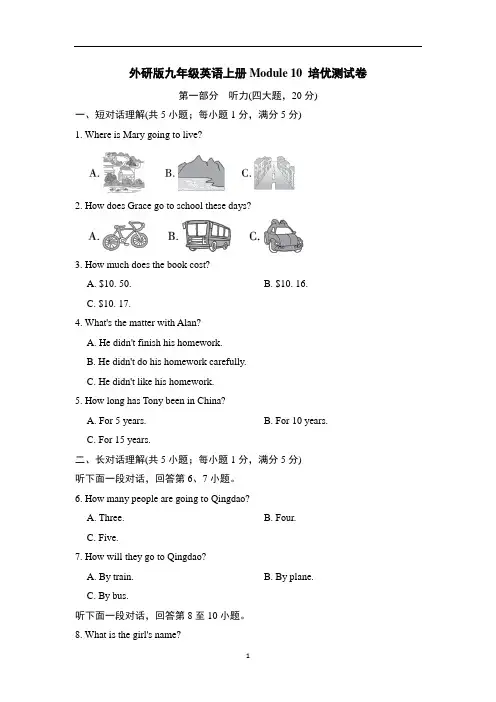
外研版九年级英语上册Module 10 培优测试卷第一部分听力(四大题,20分)一、短对话理解(共5小题;每小题1分,满分5分)1. Where is Mary going to live?2. How does Grace go to school these days?3. How much does the book cost?A. $10. 50.B. $10. 16.C. $10. 17.4. What's the matter with Alan?A. He didn't finish his homework.B. He didn't do his homework carefully.C. He didn't like his homework.5. How long has Tony been in China?A. For 5 years.B. For 10 years.C. For 15 years.二、长对话理解(共5小题;每小题1分,满分5分)听下面一段对话,回答第6、7小题。
6. How many people are going to Qingdao?A. Three.B. Four.C. Five.7. How will they go to Qingdao?A. By train.B. By plane.C. By bus.听下面一段对话,回答第8至10小题。
8. What is the girl's name?A. Julie.B. Alice.C. Jane.9. When did the man move to China?A. Half a month ago.B. Three months ago.C. Five years ago.10. What is the girl studying?A. Biology.B. Physics.C. Computer programming.三、短文理解(共5小题;每小题1分,满分5分)11. How many countries has Mark lived in?A. One.B. Two.C. Three.12. Where did Mark grow up?A. In England.B. In Singapore.C. In China.13. When did Mark move to Singapore?A. At the age of 20.B. At the age of 21.C. At the age of 22.14. How long did Mark stay in Singapore?A. For ten years.B. For nine years.C. For eight years.15. What does Mark think of staying in Hangzhou?A. Tiring.B. Boring.C. Interesting.四、信息转换(共5小题;每小题1分,满分5分)第二部分语言知识运用(三大题,35分)五、单项填空(共10小题;每小题1分,满分10分)21. Trust is always an important part of any healthy ____. Don't you think so?A. relationshipB. situationC. suggestionD. advantage22. Books have such ____ power that they make people wiser and stronger.A. necessaryB. variedC. modernD. magical23. —Along the sides of the road we can see a number of ____. They are walkingslowly.—No wonder the traffic is slow.A. horseB. camelC. sheepD. fish24. Books are made____ paper while paper is mainly made____ wood.A. of;ofB. from;fromC. of;fromD. from;of25. —Everyone ____ the rapid growth of AI, especially the announcement ofChatGPT.—Yes. What big progress the AI technology has made!A. is afraid ofB. is surprised atC. is popular withD. is famous for26. ____ Chinese history, sky lanterns were first used by Zhuge Kongming.A. According toB. In factC. As soon asD. As far as I know27. Jimmy would not get up for breakfast, ____his dad had already tried to pullhim from his bed several times.A. althoughB. becauseC. ifD. until28. —Gloria, could you give back my book today? I really need it now. After all, you____ it for a month.—Oh, sorry, I forgot. I'll go home and get it now.A. keepB. keptC. will keepD. have kept29. This is the best film ____ has been shown this year.A. thatB. whichC. whoD. when30. —I wonder if you can look after yourself well when I'm away.—____. I'm not a child any longer.A. With pleasureB. I'm afraid notC. I hope notD. Don't worry六、完形填空(共20小题;每小题1分,满分20分)AChina is a great country with more than 5,000 years of history. There are many places of interest. They attract(吸引) millions of tourists from all over the world every year.Many mountains,such as Mount Tai,Mount Emei,Mount Hua are very famous. People like going to Mount Tai to __31__ the sun rise.There are many rivers in China. The Yangtze River is the longest one and the second __32__ one is the Yellow River. They are the __33__ of Chinese culture because Chinese ancestors (祖先) were born in the areas. __34__ the rivers in China,there are also a great number of lakes. One of the most famous lakes is the West Lake.Have you heard of the story about Xu Xian and White Snake?It is said that the story __35__ on the West Lake. The West Lake is the best place that I have ever visited. It lies in Hangzhou,Zhejiang Province. The scenery is so attractive that visitors often lose __36__ in it. The West Lake has become famous __37__ not only its special scenery but also some beautiful poems. The great poets Bai Juyi and Su Dongpo __38__ some famous poems about it. __39__ the surrounding(周边) area of the West Lake is the home of the famous Dragon Well Tea. The tea is good for people's health.Have you ever been to the West Lake?If not,look for a __40__ to go to the fantastic place!31. A. bring B. watchC. askD. help32. A. shortest B. highestC. longestD. widest33. A. lights B. traditionsC. backgroundsD. birthplaces34. A. Thanks to B. Welcome toC. Compared toD. Next to35. A. finished B. mentionedC. returnedD. happened36. A. itself B. ourselvesC. themselvesD. himself37. A. for B. asC. withD. in38. A. gave B. wroteC. madeD. expected39. A. So B. ButC. AndD. Or40. A. way B. projectC. strangerD. chanceBGwondo was a trainer of dogs. He would go out every day with his dogs, to__41__ them how to catch animals so that all his tribe (部落) could eat.Wherever Gwondo went,his tribe could see him away in the distance__42__his white hair would shine in the sunlight. The __43__ would say to their children,“See, there is Gwondo and his dogs, searching for__44__for us all. ” Gwondo went out hunting every day and always came back with much food. And all were very happy.Now Gwondo grew__45__and as all humans did, one day he died. The tribe felt sad and cried many days and many nights until one day the elders called to their children,“You have cried enough for Gwondo. Now it is time to__46__ living. Go down to the beach and be happy. ”The children ran down to the beach and looked out to the sea. __47__,they all looked at each other,then turned and ran back to their elders,__48__,“Come quickly. Gwondo, he is back with us. He is out in the sea. ” The elders hurried to the beach and said,“Yes! It is Gwondo back! He is now a dolphin and lives in the sea. ”Now whenever you see a group of dolphins in the sea, look for the big old dolphin. You will know him because he has a large white fin on __49__ back. He is Gwondo and he is training the young dolphins to chase(追逐)__50__close to the beach so that his tribe can catch them.Gwondo is known to all the tribes on the east coast of Australia. They call him their sea dog.41. A. ask B. teachC. studyD. advise42. A. before B. unlessC. becauseD. although43. A. elders B. guardsC. teachersD. visitors44. A. food B. waterC. oilD. salt45. A. tall B. oldC. thinD. strong46. A. depend on B. give upC. think aboutD. look after47. A. Finally B. HoweverC. AnywayD. Suddenly48. A. explaining B. warningC. answeringD. calling49. A. its B. hisC. herD. my50. A. sheep B. fishC. dogsD. dolphins七、补全对话(有两项多余)(共5小题;每小题1分,满分5分)(W: Winnie C: Charlie)W: Hello, this is Winnie. Is that Charlie speaking?C: Speaking.W: I want to go to London. So I want to know the weather there. 51. ________C: Sure!Now it's February,and it is cold. It's a bad month of the year.W: Oh,I think it's as cold as that in Weihai,China.C: 52. ________W: Then when is the best time to visit London?C: 53. ________ There are trees,grass and flowers everywhere. It's never too hot or too cold.W: I heard that it's often foggy(有雾的).C: 54. ________ Our government has tried to protect the environment.W: 55. ________ I heard that you often talk about the weather when you meet each other.C: Yes. Probably because the weather changes from time to time.D. What does the weather reporter say?E. But it's a little warmer than that in Weihai.F. You are right. But it isn't serious.G. It's in spring.第三部分阅读(两节,40分)八、阅读理解(共20小题;每小题2分,满分40分)第一节:AWhen you travel in England, you can't miss the visit toWindsor Castle, the family home to British kings and queens forover 1,000 years.Opening hours◆1 Mar. ~31 Oct. (Monday~Sunday 09: 30~17: 15)◆1 Nov. ~28 Feb. (Monday~Sunday 09: 45~16: 15)PricesAdult ticket: £21. 20Family ticket(2 adults & 3 children between 5 and 17 years old ): £54. 70Senior/College student ticket: £19. 30Under 17 years old /The disabled: £12. 30Closing datesThe castle will be closed on the following dates:◆17&18 Jun.◆12 Oct.Top tips:◆Buy your ticket on the Internet before you arrive to save some time.◆If you want to see the Changing of the Guard Ceremony, get to the castle grounds at 11: 00. During the summer it happens every day, if the weather is good.56. When does the castle close on October 1?A. At 09: 30.B. At 17: 15.C. At 09: 45.D. At 16: 15.57. They should pay at least ____ if Mr and Mrs Green bring their three children(allbetween 5 and 17 years old)to visit the castle.A. £79. 30B. £67C. £57. 40D. £54. 7058. The Changing of the Guard Ceremony might not take place in summer if ____.A. the weather is badB. the castle is being repairedC. there are no visitorsD. the queen doesn't live thereBThinking of where to travel next? Check out these popular destinations (目的地) and pick your favourite one.New Zealand New Zealand is beautiful no matter what time of the year you visit it. The best time to visit New Zealand is any time you like. The weather here is fine all year round. New Zealanders speak English. And there are also many famous adventure activities and exciting sports for you to choose.South Africa If you ask children what their favourite animal is, lions and giraffes must be on the top ten list. Then ask them if they'd like to see them for real! With beautiful beaches, great weather and all those favourite wild animals, you'll also find South Africa can be well worth visiting.Ireland If you want to escape from the large crowds of Europe but still enjoy amazing food, history, road trips and nature, Ireland is the best place for you. It provides visitors with a very relaxing environment. Warning: you may have to give way to sheep on the road!Portugal If you are looking for a cheap destination that has a lot of places of interest and activities, Portugal is the place to go. Portugal was recently named as the best European destination at the World Travel Awards. Portugal is also one of the safest destinations in Europe and is becoming very popular with travelers. The busiest season is from June to September.59. What in South Africa may attract children most?A. The wild animals.B. The good weather.C. The natural beauty.D. The delicious food.60. People who enjoy relaxing travel will go to ____.A. New ZealandB. South AfricaC. IrelandD. Portugal61. What can we learn from the last paragraph?A. Tourists will not feel crowded in July.B. Portugal provides a safe world for visitors.C. There are only a few places of interest in Portugal.D. Portugal is named as the best destination in the world.62. The passage is probably from a ____.A. storybookB. novelC. dictionaryD. magazineCChengdu is a wonderful place for visitors to taste deliciousfood, experience culture and have fun. Here are the top fourthings to do in the city.Learn about Du FuDu Fu was one of the greatest poets(诗人)in the Tang Dynasty. When he lived in Chengdu, he wrote more than 240 poems. It's great to spend an afternoon sitting in a quiet coffee shop to read his poems.Visit Chengdu's beautiful parksChengdu is a beautiful city with over 1, 500 parks. In People's Park, you can drink tea, go boating and watch people dance, sing and do exercise. In Guixi Park, you can enjoy coffee and get something to eat. Also, Jiangtan Park is a great place for exercise.Pay a visit to Kuanzhai AlleyKuanzhai Alley in Chengdu is a good place for visitors. Here, you can eat delicious Sichuan food, drink tea and experience Chengdu's old traditions. This placeis home to many old buildings from the Qing Dynasty and it's full of people all the time.See, hear and experience Sichuan OperaSichuan is home to Sichuan Opera. It has entertained(娱乐)visitors in Chengdu since the late Ming Dynasty. There are many fantastic shows all over the city.63. How may Kuanzhai Alley be according to the passage?A. Very modern.B. Very quiet.C. Very small.D. Very crowded.64. What can people do in both People's Park and Jiangtan Park?A. Take exercise.B. See some ancient buildings.C. Drink coffee.D. Go boating.65. What can we learn from the passage?A. There are fewer than 1,500 parks in Chengdu.B. Du Fu wrote 240 poems all his life.C. We can drink tea in Guixi Park.D. We can experience Chengdu's culture in Kuanzhai Alley.DWhile living in China,I have learned many new things about vegetables. Although lots of vegetables here are not new to me, the way they are cooked is quite different.I always ate potatoes when I was in Australia, but as soon as I tried the potato cooked in the Chinese way, I felt like I was eating a new kind of vegetable which was much more delicious. Another special thing about Chinese vegetables is the kinds. In China,there are different kinds of green, tasty vegetables. What's more,some vegetables have good meanings in Chinese culture. Stepping inside a Chinese person's home,you may find paintings of different vegetables. For example, the gourd(葫芦)has many different cultural meanings,including happiness,health and having alarge family,just because of its shape and pronunciation.You could say that for Chinese people,vegetables stand for much more than just a healthy eating way. They mean delicious food and a good and happy life.Chinese people don't just love cooking delicious vegetable dishes. They also love planting vegetables. Chinese people have grown vegetables in their houses for centuries. Now,they have also grown them in the Antarctic(南极), and even in space!Here is why.66. Why did the writer think the potato was like a new kind in China?A. Because of the place where it grew.B. Because of the good meanings in Chinese.C. Because of the cooking methods in China.D. Because of its shape and pronunciation in Chinese.67. How does the writer like Chinese vegetables?A. Special.B. Cheap.C. Expensive.D. Terrible.68. What is the best title of this passage?A. The Love for Planting VegetablesB. Eating Habits in Chinese FamiliesC. Going Crazy about Chinese VegetablesD. Different Kinds of Chinese Vegetables69. What will the writer talk about in the next paragraph?A. The importance of eating green vegetables.B. The advantages of planting vegetables in space.C. The methods in cooking tasty vegetable dishes.D. The reasons why the Chinese like planting vegetables.EHow did people tell the time before clocks were invented?At first, the ancient people looked up at the sun and could tell it was the middle of the day when the sun was directly overhead in the sky. They also knew when it was morning or evening.Later, the Egyptians used sticks. These sticks measured (测量) time during the day. The sun shone on the tall stick and the stick made a shadow (阴影). As the sun moved across the sky, the position (位置) of the shadow changed. This would let people tell what time it was.Over time, the Chinese first used sundials instead of shadow sticks. The sundial has a type of shadow stick on it. As the sun shines on it, a shadow appears on the numbers. Each number stands for an hour of the day. But sundials don't work at night or on a cloudy day! There are no shadows unless the sun is out.Water clocks used water to measure time at night. Water dripped (滴落) slowly from one bowl into another. The level of the water in the bowls showed the time.People also used sandglasses. You may have seen one. Some games still use sandglasses. The sand falls from the top of the sandglasses to the bottom. It measures short amounts of the time. The more sand falls, the more time has passed. When the sand has finished falling, you have to turn the sandglasses over.70. Which picture can be a “sundial”?71. Sundials can be used to tell the time when it is ____.A. sunnyB. rainyC. cloudyD. snowy72. What's the main idea of the passage?A. Something about sundials.B. How to tell the time by looking at the sun.C. How to tell the time in the past.D. Some inventions in China.第二节:阅读下面的短文,并用英语回答问题(请注意每小题后面的词数要求)。
外研版九年级英语单词表
外研版九年级英语上册单词表Module 11.wonder /ˈwʌndə(r)/ n. 奇迹;奇观v. 想知道;对……好奇2.band /bænd/ n. 乐队3.review /rɪˈvjuː/ n. 评论;回顾;复习4.ancient /ˈeɪnʃənt/ adj. 古代的;古老的position /ˌkɒmpəˈzɪʃn/ n. 作文;作曲6.grade /ɡreɪd/ n. 成绩;年级;等级7.pyramid /ˈpɪrəmɪd/ n. 金字塔8.pupil /ˈpjuːpl/ n. 学生;(尤指)小学生9.meeting /ˈmiːtɪŋ/ n. 会议;集会10.listen up 注意听11.call /kɔːl/ v. 叫做;称为;打电话n. 电话;通话12.natural /ˈnætʃrəl/ adj. 大自然的;自然的13.wonder of the world 世界奇观14.discussion /dɪˈskʌʃn/ n. 讨论;商讨15.eastern /ˈiːstən/ adj. 在东边的;来自东边的16.though /ðəʊ/ conj. 虽然;但是;然而17.loud /laʊd/ adj.(声音)响亮的18.opinion /əˈpɪnjən/ n. 看法;主张;观点19.in one's opinion 按某人的意见;据某人看来20.more than 超过;多于21.electricity /ɪˌlekˈtrɪsəti/ n. 电Module 21.found /faʊnd/ v. 创建;创办2.since then 从那以后3.flag /flæɡ/ n. 旗;旗帜4.until /ənˈtɪl/ prep. & conj. 直到……为止5.off /ɒf/ adv. 不上课;休息;不工作6.all kinds of 各种各样的7.vacation /vəˈkeɪʃn/ n. 假期;假日8.take a vacation 去度假9.season /ˈsiːzn/ n. 度假旺季;节期10.kid /kɪd/ n. 小孩;年轻人11.have fun 玩得高兴;有乐趣12.band /bænd/ n. 乐队 /ˌjuː ˈkeɪ/ 英国14.as soon as 一……就……15.fourth /fɔːθ/ num. 第四16.sixth /sɪksθ/ num. 第六17.seventh /ˈsevnθ/ num. 第七18.eighth /eɪtθ/ num. 第八19.ninth /naɪnθ/ num. 第九20.tenth /tenθ/ num. 第十21.twelfth /twelfθ/ num. 第十二22.twentieth /ˈtwentiəθ/ num. 第二十23.among /əˈmʌŋ/ prep. 在……之中24.speech /spiːtʃ/ n. 演说;讲演25.pioneer /ˌpaɪəˈnɪə(r)/ n. 开拓者;先驱者26.grow /ɡrəʊ/ v. 种植;栽培(植物)27.corn /kɔːn/ n. 谷物;玉米28.following /ˈfɒləʊɪŋ/ adj. 接着的;接下来的y /leɪ/ v.(laid, laid)摆放;放置30.table /ˈteɪbl/ n. 餐桌;桌子y the table 摆放餐桌32.over /ˈəʊvə(r)/ prep. 完了的;结束的33.dish /dɪʃ/ n. 盘;碟Module 31.including /ɪnˈkluːdɪŋ/ prep. 包括;包含2.medal /ˈmedl/ n. 奖牌;奖章3.attend /əˈtend/ v. 上(学);出席;参加(事件或活动)4.abroad /əˈbrɔːd/ adv. 在国外;到国外5.once again 再一次6.doctor /ˈdɒktə(r)/ n. 博士7.degree /dɪˈɡriː/ n. 课程;学位8.whatever /wɒtˈevə(r)/ pron. 无论什么;不管什么9.give up 放弃(努力)10.amazing /əˈmeɪzɪŋ/ adj. 惊人的;极好的11.will /wɪl/ n. 意志;决心12.victory /ˈvɪktəri/ n. 成功;胜利13.simply /ˈsɪmpli/ adv. 实在;的确14.Canadian /kəˈneɪdiən/ adj. 加拿大的;加拿大人的n. 加拿大人15.sick /sɪk/ adj.(感觉)不适的;生病的16.soldier /ˈsəʊldʒə(r)/ n. 军人;士兵17.treat /triːt/ v. 医治;治疗18.war /wɔː(r)/ n. 战争19.wound /wuːnd/ n. 伤;伤口20.die for 为……而死21.wounded /ˈwuːndɪd/ adj. 受伤的22.realise /ˈriːəlaɪz/ v. 了解;意识到23.care /keə(r)/ n. 照顾;照料24.take care of 照顾;护理25.tool /tuːl/ n. 工具;器械26.invention /ɪnˈvenʃn/ n. 发明;发明物27.at that time 那时候28.on one's own 独自一人eful /ˈjuːsfl/ adj. 有用的;有益的30.rest /rest/ v. 休息;睡眠n. 休息;剩余部分Module 41.platform /ˈplætfɔːm/ n.(供上下火车用的)月台;站台2.meeting /ˈmiːtɪŋ/ n. 会议;集会3.miss /mɪs/ v. 未出席;未出现;错过;思念4.shut /ʃʌt/ v.(shut, shut)关闭;关上5.lock /lɒk/ v. 锁;锁住6.simple /ˈsɪmpl/ adj. 简单的;容易的7.anybody /ˈenibɒdi/ pron. 任何人8.clock /klɒk/ n. 钟;时钟9.ring /rɪŋ/ v.(rang, rung)鸣响;发出铃声10.passenger /ˈpæsɪndʒə(r)/ n. 乘客;旅客11.address /əˈdres/ n. 地址12.text /tekst/ n. 文本;正文13.text message 短信14.couple /ˈkʌpl/ n. 一对;两个15.a couple of 两个16.actually /ˈæktʃuəli/ adv. 事实上17.manage /ˈmænɪdʒ/ v. 管理;支配18.unhappy /ʌnˈhæpi/ adj. 不高兴的19.turn off 关掉;关闭(设备)20.order /ˈɔːdə(r)/ n. 命令;指示21.be worried about 担心22.business /ˈbɪznəs/ n. 工作23.on business 出差24.sofa /ˈsəʊfə/ n. 沙发25.snack /snæk/ n. 点心;小吃26.midnight /ˈmɪdnaɪt/ n. 午夜;子夜Module 51.upstairs /ˌʌpˈsteəz/ adv. 位于楼上的;往楼上;在楼上adj. 楼上的2.exhibition /ˌeksɪˈbɪʃn/ n. 展览;展览会3.rule /ruːl/ n. 规则;法则4.against the rules 违反规定5.in trouble 遇上麻烦;处于困境6.tail /teɪl/ n. 尾;尾巴7.rope /rəʊp/ n. 粗绳;绳索8.entry /ˈentri/ n. 进入权;进入许可9.No entry 禁止入内10.no good 不合适的;不方便的11.no wonder 难怪;不足为奇12.missing /ˈmɪsɪŋ/ adj. 找不到的;失踪的13.downstairs /ˌdaʊnˈsteəz/ adv. 位于楼下的;往楼下;在楼下adj. 楼下的14.punish /ˈpʌnɪʃ/ v. 惩罚;惩处munications /kəˌmjuːnɪˈkeɪʃnz/ n. [复数]通信16.physics /ˈfɪzɪks/ n. 物理学17.chemistry /ˈkemɪstri/ n. 化学18.dig /dɪɡ/ v.(dug, dug)挖掘;掘(洞)19.coal /kəʊl/ n. 煤20.energy /ˈenədʒi/ n. 能量;能源21.X-ray /ˈeks reɪ/ n. X 光;X 射线22.experiment /ɪkˈsperɪmənt/ n. 实验23.sand /sænd/ n. 沙;沙子Module 61.invitation /ˌɪnvɪˈteɪʃn/ n. 邀请;请柬2.calendar /ˈkælɪndə(r)/ n. 日历;历书3.balloon /bəˈluːn/ n. 气球4.paint /peɪnt/ v. 绘画5.heat /hiːt/ v. 使变热;给……加热n. 高温;热度6.knife /naɪf/ n.(pl. knives)餐刀;刀具7.fork /fɔːk/ n. 餐叉8.spoon /spuːn/ n. 匙;勺子9.cheeseburger /ˈtʃiːzbɜːɡə(r)/ n. 干酪汉堡包10.Italian /ɪˈtæliən/ adj. 意大利的;意大利语的;意大利人的n. 意大利语;意大利人11.Western /ˈwestən/ adj. 西方的12.serve /sɜːv/ v.(为……)端上(食物和饮料);接待,服务13.similar /ˈsɪmələ(r)/ adj. 相似的14.wing /wɪŋ/ n. 翅膀;翼dy /ˈleɪdi/ n. 女士;夫人;小姐16.gentleman /ˈdʒentlmən/ n. 先生;男士17.help yourself 随便做(或用)吧;请自便18.cross /krɒs/ adj. 生气的19.be cross with sb. 生某人的气20.rude /ruːd/ adj. 粗鲁的;无礼的21.stare /steə(r)/ v. 盯着看;凝视;注视22.nothing /ˈnʌθɪŋ/ pron. 没有什么;没有东西23.polite /pəˈlaɪt/ adj. 有礼貌的;客气的24.shake hands 握手Module 71.discussion /dɪˈskʌʃn/ n. 讨论;谈论2.patient /ˈpeɪʃnt/ adj. 有耐心的;能忍耐的n. 病人3.afford /əˈfɔːd/ v. 买得起;付得起4.invite /ɪnˈvaɪt/ v. 邀请5.lonely /ˈləʊnli/ adj. 孤独的;寂寞的6.afraid /əˈfreɪd/ adj. 害怕的;担心的7.be afraid of 害怕……8.still /stɪl/ adj. 平静的;安静的;寂静的9.friendly /ˈfrendli/ adj. 友好的10.kind /kaɪnd/ adj. 亲切的;和蔼的;善良的11.funny /ˈfʌni/ adj. 有趣的;可笑的12.smart /smɑːt/ adj. 聪明的;机灵的13.lively /ˈlaɪvli/ adj. 活泼的;充满生气的14.handsome /ˈhænsəm/ adj. 英俊的15.beautiful /ˈbjuːtɪfl/ adj. 美丽的;漂亮的16.lovely /ˈlʌvli/ adj. 可爱的;令人愉快的17.talk to 和……交谈18.talk with 和……交谈19.smile at 对……微笑ugh at 嘲笑21.make friends with 和……交朋友22.think of 想起;想到23.think about 考虑Module 81.sportswoman /ˈspɔːtswʊmən/ n.(尤指职业的)女运动员n /ˈeɪʃn/ adj. 亚洲的;亚洲人的n. 亚洲人3.suffer /ˈsʌfə(r)/ v. 患有(疾病等);经受4.first place 第一名;冠军5.suffer from 受(某种病痛)折磨;因……而受苦6.courage /ˈkʌrɪdʒ/ n. 勇气;胆量7.pride /praɪd/ n. 自豪感;骄傲8.let...down 使失望9.coach /kəʊtʃ/ n. 教练10.kick /kɪk/ v. 踢11.be mad at sb. 生某人的气12.at first 起初;开始时13.be pleased with 对……满意14.pass /pɑːs/ v.(体育比赛中)传球;传递15.chance /tʃɑːns/ n. 可能性;机会16.have a chance of doing sth. 有机会做某事17.lose heart 丧失信心18.try one's best 尽某人最大的努力19.believe in 信任;信赖20.fault /fɔːlt/ n. 错误;过失Module 91.have a look at 看……一眼2.electronic /ɪˌlekˈtrɒnɪk/ adj. 电子的3.wonder /ˈwʌndə(r)/ v. 感到惊奇;想知道n. 奇迹;奇观4.memory /ˈmeməri/ n. 存储器;存储量5.full /fʊl/ adj. 满的;充满的6.fix /fɪks/ v. 修补;挽救7.instructions /ɪnˈstrʌkʃənz/ n. [复数]说明书8.lend /lend/ v.(把某物)借出;借给(某人)9.properly /ˈprɒpəli/ adv. 合适地;正确地10.look through 快速阅读;浏览11.by hand 用手;靠手做12.printing /ˈprɪntɪŋ/ n. 印刷13.at a time 每次;一次14.by the way 顺便提一下pare...to... 把……比作……pare...with... 把……与……相比17.spread /spred/ v.(spread, spread)传播;蔓延;扩展18.introduction /ˌɪntrəˈdʌkʃn/ n. 引进;采用;推行19.single /ˈsɪŋɡl/ adj. 仅一个的;单个的20.direction /dəˈrekʃn/ n. 方向Module 101.Australia /ɒˈstreɪliə/ n. 澳大利亚2.Australian /ɒˈstreɪliən/ adj. 澳大利亚的;澳大利亚人的n. 澳大利亚人3.opposite /ˈɒpəzɪt/ prep. 在……对面;与……相对nguage /ˈlæŋɡwɪdʒ/ n. 语言5.when /wen/ conj. 当……的时候6.although /ɔːlˈðəʊ/ conj. 虽然;尽管7.be different from 与……不同8.fill /fɪl/ v. 填满;填充9.fill in 填写;填充10.trade /treɪd/ n. 贸易;交易v. 做买卖;从事贸易11.centre /ˈsentə(r)/ n.(=center)中心12.according to 根据;按照13.keep to 沿着……走14.on the left/right 在。
外研版九年级上册英语教案
外研版九年级上册英语教案外研版九年级上册英语教案导语:教案是教师为顺利而有效地开展教学活动,根据课程标准,教学大纲和教科书要求及学生的实际情况,以课时或课题为单位,对教学内容、教学步骤、教学方法等进行的具体设计。
下面是由小编整理的关于外研版九年级上册英语教案。
欢迎阅读!外研版九年级英语上册 Module 10 Unit 1教案设计的基本理念:依托外研版九年级新教材第十模块,根据新课标的崭新理念,以培养学生自主、合作、探究精神,突出培养学生的综合英语语言运用能力为指导思想而设计。
课型:Listening and speaking教学内容分析:1.单元教材内容贴近学生生活,主要涉及运动训练、健康饮食以及身体健康等,易于学生接受。
同时,前面几个模块已对定语从句进行了学习,已有一定基础,对培养学生发散思维和锻炼口语有着积极的作用。
2.教材内容的前几个模块一直都在学习定语从句which ,that, who的用法,经过前几个单元的铺垫,本单元whose引导的定语从句教学就不是难点。
学生分析:1.已处于九年级上学期,经过初中阶段两年多的'系统学习,已具有一定的认知水平和对英语语言的运用水平。
2.学生的主动思考与口语水平不高。
所以在这一单元的学习中,可能很多学生的参与性较差,所以应该采取有效的措施,提高学生开口的安全感,引导学生积极参与学习过程,实实在在地提高教学的实效性。
教学目标:1.正确使用下列单词和词组:ache ,exercise ,weight, give up ,interest.Behave, persuade ,ban, educate等。
2.掌握并运用下列词组: give up, need to do,bump into等。
3.掌握whose 引导的定语从句并灵活运用。
教学策略:1. 开放式教学策略。
以有限的课堂为载体,带学生进入广阔的知识天地。
2. 兴趣激发策略。
有了兴趣,学生才会有了参与的欲望,才能点燃他们的思维火花。
外研版九年级英语上册Module 10 学情评估试卷 附答案
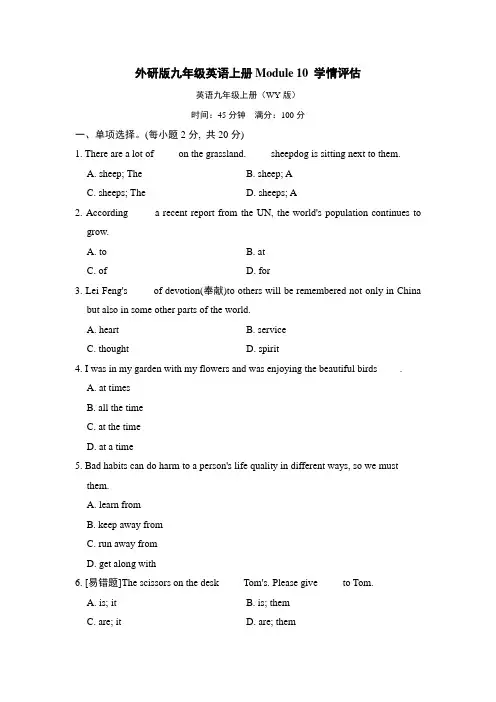
外研版九年级英语上册Module 10 学情评估英语九年级上册(WY版)时间:45分钟满分:100分一、单项选择。
(每小题2分, 共20分)1. There are a lot of ____ on the grassland. ____ sheepdog is sitting next to them.A. sheep; TheB. sheep; AC. sheeps; TheD. sheeps; A2. According ____ a recent report from the UN, the world's population continues togrow.A. toB. atC. ofD. for3. Lei Feng's ____ of devotion(奉献)to others will be remembered not only in Chinabut also in some other parts of the world.A. heartB. serviceC. thoughtD. spirit4. I was in my garden with my flowers and was enjoying the beautiful birds ____.A. at timesB. all the timeC. at the timeD. at a time5. Bad habits can do harm to a person's life quality in different ways, so we must ____them.A. learn fromB. keep away fromC. run away fromD. get along with6. [易错题]The scissors on the desk ____ Tom's. Please give ____ to Tom.A. is; itB. is; themC. are; itD. are; them7. [易错题]—____ the height of the building?—It's 420. 5 metres.A. How isB. How muchC. What isD. How tall8. I'm looking for the CD ____ I bought yesterday.A. thatB. whoC. whoseD. when9. ____ she is very young, she can take care of herself.A. IfB. UnlessC. AlthoughD. Since10. —Does Daming know what to wear in such cold weather?—____. He's old enough to take care of himself.A. No wayB. No matterC. Don't worryD. No idea二、完形填空。
外研版九年级上册英语课文原文与翻译

外研版九上Module 1 Unit 1课文Activity 3 Listen and read. 听与读。
Tony: Let's call Wonders of the World and join in the discussion. I think natural wonders are more interesting than manmade ones. And I think the Giant's Causeway is tne most fantastic natural wonder.托尼:我们给《世界奇观》节目打电话,加入讨论吧。
我认为自然奇观比人造奇观更有趣。
我认为巨人之路是最神奇的自然景观。
Lingling: Hmm, I've never seen it, so I'm not sure I agree with you. Why do you like it,Tony? 玲玲:嗯,我从未见过它,因此我不能确定我同意你的意见。
托尼,你为什么喜欢它?Tony:Well,I visited the Giant's Causeway two years ago. It's huge. There are about 40,000 rocks,most ot them with six sides. It runs for several hundred metres on the eastern coast of Northern Ireland.托尼:哦,我两年前参观过巨人之路。
它巨大无比,大约有40 000块岩石,大部分岩石有六个面。
它位于北爱尔兰东海岸,绵延数百米。
Lingling:That sounds great, though I think Victoria Falls in Africa is even more fantastic. It's about 1,700 metres wide and 100 metres high. You can hear the loud noise a few kilometres away.玲玲:听起来很棒,但我认为非洲的维多利亚瀑布更壮观。
英语外研版九年级上册 Module 10 Unit 1---3随堂测试题含答案
Unit 1Ⅰ. 根据语境及所给首字母提示补全所缺单词。
1. I h_______ washing the dishes but I have to do it.2. Mrs Black is cutting some paper with a pair of s_______.3. Today Ben looks very funny. His head is big but he wears a small h_______.4. Shanghai is a m_______ city. It is amazing!5. At last she chose a sweater made of w_______ to keep warm.Ⅱ. 根据语境用括号内所给单词的适当形式填空。
1. Wuhan is a large city in _______(centre) China.2. _______(ant) can smell things as well as dogs.3. Tigers and _______(sheep) are my favourite animals.4. This building has the same _______(high) as that tower.5. Do you know how _______(fly) spend winter?Ⅲ. 根据括号内的要求完成下列各题,每空一词(含缩略形式)。
1. We visited him while we were there. (改为一般疑问句)________ you ________ him while you were there?2. Put up the picture on the wall. (改为否定句)________ ________ up the picture on the wall.3. She took this photo in Beijing. (对划线部分提问)________ ________ she ________ this photo?4. They want to leave here because it's too noisy. (对划线部分提问)________ ________ they ________ to leave here?5. That man is from the US. (改为同义句)That man ________ ________ the US.6. Australia is well-known for the Great Barrier Reef. (改为同义句) Australia ________ ________ ________ the Great Barrier Reef.7. He uses a computer to look for information. (改为被动语态)A computer ________ ________ by him to look for information.Ⅳ. 根据汉语意思完成英语句子,每空词数不限。
外研版九年级上册M1知识点整理
3. natural adj. 大自然的 e.g.Magnetism is a natural phenomenon. 磁力是一种自然现象。 Our motherland flows with natural resources. 我们祖国蕴藏着丰富的天然资源。 拓展:nature n. 大自然 naturally adv.大自然地 Man-made人造的 e.g.We enjoyed the beauty of nature. 我们欣赏大自然的美。
agree on
指协商后“在某方面取得一 致意见”,主语须是协调的 双方或多方。
黄冈教育
21.More than超过,多余 He was more than 70 years old. More ```than比···多;与其说···不如说··· Writing is more important than speaking. 写比说更加重要 He is more kind than honest. 与其说他诚实,不如说他友善。
黄冈教育
4. wonder n. 奇观;奇迹
e.g.Colour television is really a wonder. 彩色电视真是一个奇迹。
They come to see the natural wonder. 他们来参观这一天然奇观。
拓展:wonder还用作动词,意为“觉得奇怪,惊奇”, “想知道”。
e.g.I wonder at his rudeness. 我对他的粗鲁感到奇怪。
The teacher wonders why James is always late for school.
老师想知道为什么James上学总是迟到。
黄冈教育
Module 8 Unit 1 外研版英语九年级上册知识点详解
外研版九(上)Module 8 Sports life知识点详解Unit 1 Daming wasn’t chosen for the team last time.★(A3).【知识点再现】Hi, Tony, you look tired. 你好, 托尼! 你看起来很累。
【知识点1】look tired意为“看起来累”。
look用着系动词,意为“看起来”,其后常接形容词作表语。
类似系动词还有:taste/sound/smell/feel/seem/become/get / turn...+adj.(形容词)。
如:She looked a little tired. 她看起来有点疲倦。
You look beautiful in this green dress. 你穿这条绿裙子看起来很漂亮。
★(A3).【知识点再现】Who are you playing against? 你们和哪个队比赛?【知识点2】play against...意为“与……比赛/对抗”。
against是介词,意为“与……相反/相对;反对;违背”,通常与be连用,短语be against意为“反对”。
其反义词为be for意为“赞成”。
如:Our team played against Class Three. 我们队与三班进行了比赛。
The soldiers fought against the enemies fiercely. 战士们与敌人激烈战斗。
Are you against or for this plan? 你是反对还是赞成这个计划?★(A3).【知识点再现】What does HAS stand for? HAS代表什么?【知识点3】【辨析】stand for与represent的用法辨析:①stand for意为“代表,象征,是……的缩写,意味着”,多指抽象物体,是指用字母、数字或符号来表示一个单词,名字或是某个概念的缩写形式,其同义词为be short for或represent。
外研版九年级上册英语单词表(含音标)
physics
[ˈfɪzɪks]
n.物理学
2
exhibition
[ˌeksɪˈbɪʃn]
n.展览,展览会
17
chemistry
['kemɪstrɪ]
n.化学
3
rule
[ruːl]
n.规则,法则
18
dig(dug)
[dɪg]
v.挖掘,掘(洞)
4
againsttherules
违反规定
19
coal
[kəʊl]
['twentɪəθ]
num.第二十
6
allkindsof
各种各样的
23
among
[əˈmʌŋ]
prep.在…之中
7
vacation
[vəˈkeɪʃn]
n假期,假日
24
speech
[spi:tʃ]
n.演说,讲演
8
takeavacation
去度假
25
pioneer
[paɪəˈnɪə]
n.开拓者,先驱者
rest
[rest]
v.休息,睡眠
13
simply
[ˈsɪmpli]
adv.实在,的确
32
himself
[hɪmˈself]
pron.他自己
14
Canadian
[kəˈneɪdjən]
adj.加拿大的,加拿大人的
33
manage
[ˈmænɪdʒ]
v.做成,(尤指)设法完成
15
sick
[sɪk]
adj.(感觉)不适的,生病的
28
handin
提交,上交