
大学英语语法-虚拟语气
虚拟语气1. I wish (that可省略,下同)I knew the answer to the question.我希望知道这个答案。
(事实上是不知道)2. He wishes he hadn't lost the chance.他真希望没有失去机会。
(其实已失去)3. You wished she would arrive the next day.(would + arrive)你希望她第二天会到。
(事实上她还没到)Subjunctive Mood作为专门表达假设意义和其他非事实意义的动词形式,仅是古英语遗留下来的残余。
它仅有两个形式,即be型虚拟式和were型虚拟式。
Be型虚拟]-----be型虚拟式是以动词原形表示的,不管主语是什么人称,动词一律用原形,如动词为被动态,则助动词be也用原形。
其主要用法如下:1)用于表命令、决定、建议、坚持等词语之后的that分句中这一用法又分三种情况:a)用在decide,decree,demand,insist,move,order,prefer,propose,recommend,request,req uire,suggest,vote等动词之后的that分句中.(宾语从句)在expect, believe, think, suspect等动词的否定或疑问形式后的宾语从句中,我们经常用“should+动词原形(或完成形式)”,表示惊奇,怀疑,不满等。
He ordered that all the books be sent at once.He ordered that all the books be sent at once.we propose that somebody neutral take the chair.She insisted that she go to the south for her holiday.b)用在advisable,appropriate,desirable,essential,fitting,imperative,important,impossibl e,necessary,obligatory,proper等形容词之后的that分句中。
(主语从句)It is essential that all the facts be examined first.It was appropriate that thisi tax be abolished.I thousht it advisable that an armed guard stand in readiness.c)用在decision,decree,demand,instruction,order,requirement,resolution等名词之后的that分句中。
The board has given instructions that the agent fly to Boston.We were faced with the demand that this tax be abolished.Their decision was that the school remain closed.在这一用法中be型虚拟式能与“should+不定式”交替使用,也能与to-不定式交替使用。
He ordered that the books be sent at once .= He ordered that the books should be sent at onc.= He ordered that the books to be sent at once.2)用于由if,though等引导的分句中.be型虚拟式能用于由if,though,whatever,lest,so long as lest, for fear that, in caseso that, in order that 等引导的分句中表推测、让步、防备等含义。
If he be found guilty,Jonh shall have the right of appeal.Though everyone desert you, I will not.Quitly we sat on the river bank lest the fish swim away.上述用法现在只限于书面体,在非正式语体中通常用动词陈述式或者用should/may+不定式。
Whatever hisdefense maybe,we can’t tolerate this disloyalty.3)用于某些公式化语句中be型虚拟式用于某些公式化语句中可表祝愿、诅咒、禁止等意义。
Long live the People's Republic of China!God bless you!God damn you!So be it.(但愿如此吧)Were型虚拟]-----Were 型虚拟语气只有一种形式,即无论主语是什么人称,动词一律用were,如I were,you were ,如果动词为进行体或被动态,其助动词也一律用were,如I were going,you were going,I were sent ,you were sent1)用于某些状语从句如if , if only, as if , as though, though引导的条件状语和让步状语从句,表示非真是的条件或让步。
If I were you, I should wait till next week.If only I were not so nervous.He behaves as though he were better than us.2)用于某些名词性从句如wish, would rather, suppose,imagine 之后的that—分句中,表示一种臆想的(通常是不可能发生的事)I wish it were spring all the year round.I’d rather I were not at the site of the accident.Suppose the earth were flat.上述were型虚拟式在第一三人称单数主语之后可为was 所取代。
If it was to rain,the game would be put off.If only I was not so nervous.但是,在if I were you 这一分句中,通常不用was 。
另外在某些倒装句结构中只用were,不用was。
Were I to do it =(if I were to do it),I should rely on you.还有在as it were(作so to speak 解,即“宛如””好比”)结构中也只用were,不用wasHe is my best friend,my second felf ,as it were.假设意义表示法综述1)用动词的过去时形式表示假设意义a) It is (high ,about )time thatIt is time that we went (或should go) to bed.It’s about time that we put an end to this controversy.b) I would rather / would sooner / would as soon / would just as soon (that)you / he / theyI’d sooner she left the heavy end of the work to someone else.c) if onlyIf only I knew what you wanted.If only he had arrived in time,he would not have been punished.d) as if, as thoughIt seems as if it were spring. 现在好像是春天似的。
She appeared as if she had known nothing about it. 她看上去对此一无所知。
as if, as though 结构中如果不表示假设意义,就不必用过去时时态。
It looks as if it is going to rain.e) I wish(that)I wish I remembered the address.I wish 与I hope 都表示“希望”但I hope 并不表示假设意义其后很少用过去时时态。
I hope you are ready.用情态助动词过去时时态表示假设意义最常见于条件句和含蓄条件句a)用于条件句(若if 省略要用到装)If she were younger, she would do it.去If:Were she younger, she would do it. (把动词were移到主语she的前面)If he had tried it, he could have done it.去If:Had he tried it, he could have done it.(把had移到主语he的前面)Were I a bird, I could fly freely.如果虚拟条件句中有were, had或should时,把它们放在if的位置上;但是如果条件句中没有were, had或should不能用倒装。
如:Should it rain tomorrow, what should we do? 要是明天下雨的话,我们怎么办呢?Were I you, I would have asked him for some advice.要是我是你的话,我就向他请教了。
在“开放式条件句”(open conditional clause)和让步状语从句中若should是被省略了的。
在这种情况下,如果if省略,动词be与主语的位置要倒装。
如:If any person be guilty of a crime, the court shall have the right to appeal. (任何人犯罪,法院有权起诉。
)Be any person guilty of a crime, the court shall have the right to appeal. Whether she be right or wrong, she will have my unanswering support. (不管她对与错,我都会支持她)Be she right or wrong, she will have my unanswering support.注意:有时虚拟条件句并没来if 从句表示出来,而是用介词短语(otherwise, or, without, but for)、上下文或其它方式来表示。
精品语法结构:虚拟语气

精品语法结构:虚拟语气虚拟语气是一种用来表达假设、愿望、建议、命令、推测等含义的语法结构。
在英语中,虚拟语气通常通过使用特定的动词形式来表示。
下面是一些常见的虚拟语气语法结构:1. 虚拟条件句:- If I were you, I would do it differently.(若我是你,我会做得不同。
)- If I had studied harder, I could have passed the exam.(若我学得更刻苦,我本可以通过考试。
)2. 虚拟情态动词:- I wish I could speak fluent French.(但事实上我不会。
)- If only I had known about the sale earlier, I would have bought more.(但事实上我并不知情。
)- It is essential that she be here on time.(但事实上她可能不会来。
)3. 虚拟动词不定式:- I want you to be more careful.(表示建议)- He asked that I take the book back.(表示请求或命令)4. 虚拟动词过去式:- I suggested that they go to the beach.(表示建议)- It is about time that she left.(表示必要性)5. 虚拟名词从句:- I have no idea what he would do if he were in my shoes.(表示假设)- I doubt that she knows the answer.(表示怀疑)6. 超过虚拟语气:- He talks as if he were the boss.(他说话的口气好像他是老板。
)- She acts as though she had won the lottery.(她的行为好像她中了彩票一样。
大学英语语法--虚拟语气33页PPT

60、生活的道路一旦选定,就要勇敢地 走到底 ,决不 回头。 ——左
Байду номын сангаас
大学英语语法--虚拟语气
21、静念园林好,人间良可辞。 22、步步寻往迹,有处特依依。 23、望云惭高鸟,临木愧游鱼。 24、结庐在人境,而无车马喧;问君 何能尔 ?心远 地自偏 。 25、人生归有道,衣食固其端。
56、书不仅是生活,而且是现在、过 去和未 来文化 生活的 源泉。 ——库 法耶夫 57、生命不可能有两次,但许多人连一 次也不 善于度 过。— —吕凯 特 58、问渠哪得清如许,为有源头活水来 。—— 朱熹 59、我的努力求学没有得到别的好处, 只不过 是愈来 愈发觉 自己的 无知。 ——笛 卡儿
大学英语语法--虚拟语气33页PPT

谢谢
11、越是没有本领的就越加自命不凡。——邓拓 12、越是无能的人,越喜欢挑剔别人的错儿。——爱尔兰 13、知人者智,自知者明。胜人者有力,自胜者强。——老子 14、意志坚强的人能把世界放在手中像泥块一样任意揉捏。——歌德 15、最具挑战性的挑战莫过于提升自我。——迈克尔·F·斯特利
大学英语语法--虚拟语气
41、实际上,我们想要ቤተ መጻሕፍቲ ባይዱ不是针对犯 罪的法 律,而 是针对 疯狂的 法律。 ——马 克·吐温 42、法律的力量应当跟随着公民,就 像影子 跟随着 身体一 样。— —贝卡 利亚 43、法律和制度必须跟上人类思想进 步。— —杰弗 逊 44、人类受制于法律,法律受制于情 理。— —托·富 勒
英语语法:虚拟语气归纳整理
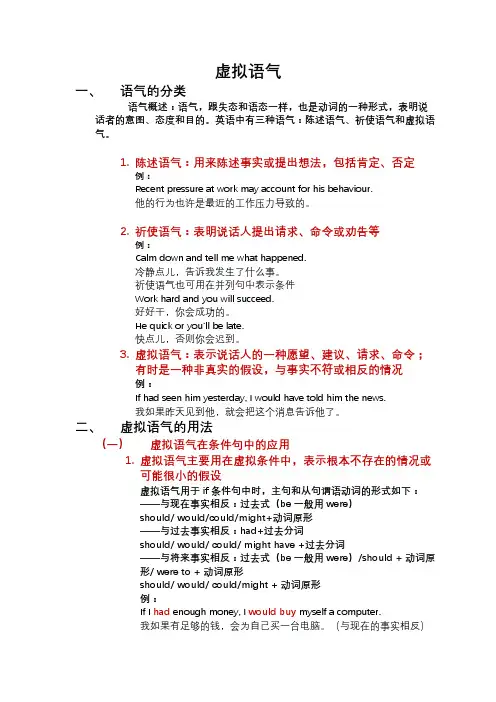
虚拟语气一、语气的分类语气概述:语气,跟失态和语态一样,也是动词的一种形式,表明说话者的意图、态度和目的。
英语中有三种语气:陈述语气、祈使语气和虚拟语气。
1.陈述语气:用来陈述事实或提出想法,包括肯定、否定例:Recent pressure at work may account for his behaviour.他的行为也许是最近的工作压力导致的。
2.祈使语气:表明说话人提出请求、命令或劝告等例:Calm down and tell me what happened.冷静点儿,告诉我发生了什么事。
祈使语气也可用在并列句中表示条件Work hard and you will succeed.好好干,你会成功的。
H e quick or you’ll be late.快点儿,否则你会迟到。
3.虚拟语气:表示说话人的一种愿望、建议、请求、命令;有时是一种非真实的假设,与事实不符或相反的情况例:If had seen him yesterday, I would have told him the news.我如果昨天见到他,就会把这个消息告诉他了。
二、虚拟语气的用法(一)虚拟语气在条件句中的应用1.虚拟语气主要用在虚拟条件中,表示根本不存在的情况或可能很小的假设虚拟语气用于if条件句中时,主句和从句谓语动词的形式如下:——与现在事实相反:过去式(be一般用were)should/ would/could/might+动词原形——与过去事实相反:had+过去分词should/ would/ could/ might have +过去分词——与将来事实相反:过去式(be一般用were)/should + 动词原形/ were to + 动词原形should/ would/ could/might + 动词原形例:If I had enough money, I would buy myself a computer.我如果有足够的钱,会为自己买一台电脑。
大学英语四级语法精要:虚拟语气-时间条件句
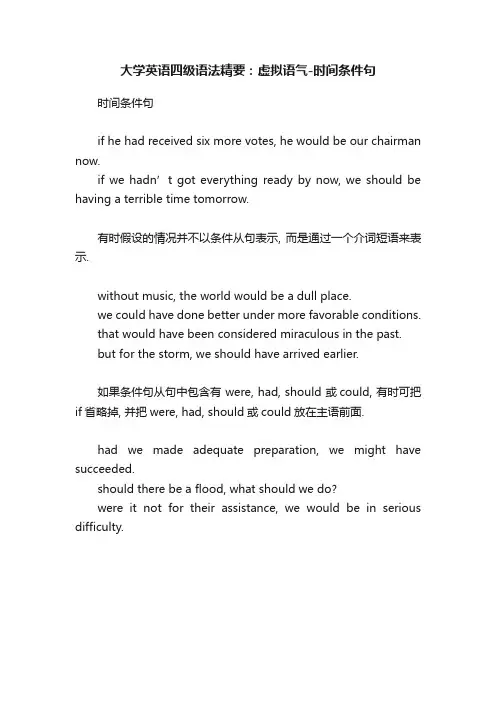
without music, the world would be a dull place.
we could have done better under more favorable conditions.
that would have been considered miraculous in the past.
should there be a flood, what should we do?
were it not for their assistance, we would be in serious difficulty.
but for the storm, we should have arrived earlier.
如果条件句从句中包含有 were, had, should 或could, 有时可把if省略掉, 并把were, had, should或could放在主语前面.
had we made adequate preparation, we might have succeeded.
有时假设的情况并不以条件从句表示而是通过一个介词短语来表示
大学英语四级语法精要:虚拟语气-时间条件句
时间条件句
if he had ould be our chairman now.
if we hadn’t got everything ready by now, we should be having a terrible time tomorrow.
英语语法——虚拟语气
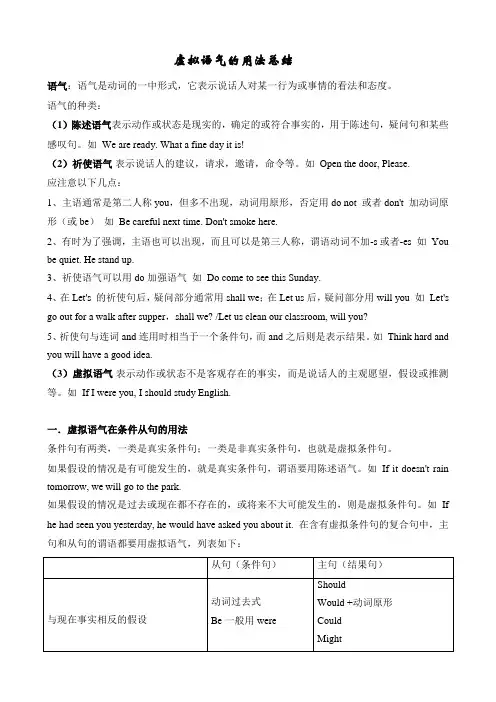
虚拟语气的用法总结语气:语气是动词的一中形式,它表示说话人对某一行为或事情的看法和态度。
语气的种类:(1)陈述语气表示动作或状态是现实的,确定的或符合事实的,用于陈述句,疑问句和某些感叹句。
如We are ready. What a fine day it is!(2)祈使语气表示说话人的建议,请求,邀请,命令等。
如Open the door, Please.应注意以下几点:1、主语通常是第二人称you,但多不出现,动词用原形,否定用do not 或者don't 加动词原形(或be)如Be careful next time. Don't smoke here.2、有时为了强调,主语也可以出现,而且可以是第三人称,谓语动词不加-s或者-es 如You be quiet. He stand up.3、祈使语气可以用do加强语气如Do come to see this Sunday.4、在Let's 的祈使句后,疑问部分通常用shall we;在Let us后,疑问部分用will you 如Let's go out for a walk after supper,shall we? /Let us clean our classroom, will you?5、祈使句与连词and连用时相当于一个条件句,而and之后则是表示结果。
如Think hard and you will have a good idea.(3)虚拟语气表示动作或状态不是客观存在的事实,而是说话人的主观愿望,假设或推测等。
如If I were you, I should study English.一.虚拟语气在条件从句的用法条件句有两类,一类是真实条件句;一类是非真实条件句,也就是虚拟条件句。
如果假设的情况是有可能发生的,就是真实条件句,谓语要用陈述语气。
如If it doesn't rain tomorrow, we will go to the park.如果假设的情况是过去或现在都不存在的,或将来不大可能发生的,则是虚拟条件句。
英语语法—虚拟语气(最全)
虚拟语气1.虚拟语气的概念虚拟语气把动作当作一种只存在于讲话人想象中的“假设”或“推测”,而不是当作客观现实中的真实事件。
它表达的是建议、不满、怀疑、忧虑、推测、假设、想象、祝愿等。
2.虚拟语气用于非真实条件句英语中的条件句有两种:真实条件句和非真实条件句。
真实条件句实现的可能性非常大,常用if, unless, as long as, so long as, once等引导,谓语动词常用陈述语气;非真实条件句常表示不能实现或纯假象的情况,谓语动词要用虚拟语气。
非真实条件句包括虚拟条件句、推测条件句、错综时间条件句。
①虚拟条件句、推测条件句虚拟条件句可分为两类:一类是叙述与现在事实相反的情况,一类是叙述与过去事实相反的情况。
另外,还有一类用于推测将来的情况,也称作推测条件句。
从句中提出一种与客观现实不相符或根本不可能存在的条件,主句会产生一种不可能获得的结果。
句中的虚拟语气根据不同的时间有3种不同的形式:I would lend him the money if he asked me.他要是问我,我愿意借钱给他。
(意愿)If he had time, he should do it.要是有时间,他愿意做那件事。
(意愿)He could move the big stone if he should try.努力的话,他能搬动那块大石头。
(能力)If he forgot to come, you could go instead.他要是忘了没来,你可要替他来。
(许诺)A.与现在事实相反If I had enough money, I would buy a computer.如果我有足够的钱,我将买一台电脑。
(实际上没有) Were I you I would refuse.如果我是你我会拒绝。
(我不是你)注:从句有时可用If it were not for这种句型,表示“若不是……”。
It it weren’t for your help, we would be in serious trouble.若不是你帮忙,我们会遇到大麻烦。
大学英语语法之虚拟语气
一、虚拟语气•虚拟语气(Subjunctive Mood)用来表示说话人的愿望、请求、意图、建议、怀疑、设想等未能或不可能成为事实的情况,以及在说话人看来实现可能性很小的情况。
由于虚拟语气是动词的一种特殊表现形式,因而动词的变化形式体现出虚拟语气所包含的不同含义。
1.虚拟语气用于非真实条件句时的构成如下表所述:(见1,4,6,7,10,11,13,16,25,26,30,31,33,34,35题)[注意]1). 在非真实条件句中,有时从句的动词所表示的动作和主句的动词所表示的动作并不同时发生,这样的条件句中使用的虚拟式称为混合虚拟式。
其构成视具体情况而定。
例如:If I had taken my raincoat when I came out this morning, I would not be wet now.If I were you, I wouldn’t have missed the film last night.2). 引导非真实条件从句的连词if在正式文体中有时可以省去, were, had had, should等非行为动词这时应提到从句句首。
例如:If I were you, I wouldn’t feel sorry.→Were I you, I wouldn’t feel sorry.2. 有些句子从表层结构上看无if引导的非真实条件句,但从深层意思上看是存在的。
这种情况下主句动词仍需用虚拟式。
这类句子中常出现without(如果没有),but for(要不是),otherwise(否则),but that (若不,后接一从句)If it had not been for sb./ sth. (与过去事实相反,若不是),If it were not for sth./sb. (与现在事实相反,若不是)等词或词组。
(见12,14,28,29题)例如:But for your help, they couldn’t have succeeded.She wasn’t feeling well. Otherwise, she wouldn’t have left the meeting soearly.3. (见2,3,9,15,24,27,32题)1)在It is + 形容词+ that 从句的句型中,that引导的主语从句中的谓语动词采用should + 动词原形形式,其中should 常省略。
虚拟语气考点
虚拟语气是英语语法中的一个重要考点,主要涉及以下几个方面:1. 虚拟条件句:表示与事实相反或不太可能实现的情况。
例如:If I were you, I would study harder.(如果我是你,我会更努力学习。
)2. 虚拟愿望句:表示与现实相反的愿望。
例如:I wish I were taller.(我希望我更高一些。
)3. 虚拟建议句:表示对现在或将来的建议。
例如:It is suggested that he be sent to study abroad.(建议派他去国外学习。
)4. 虚拟祈使句:表示一种委婉的请求或命令。
例如:If I were you, I would take the job.(如果我是你,我会接受这份工作。
)5. 虚拟倒装句:在部分虚拟条件句中,为了强调,将谓语动词提前到主语之前。
例如:Had I known about it earlier, I would have helped you.(如果我之前知道这件事,我会帮助你的。
)6. 虚拟语气在宾语从句、定语从句和状语从句中的应用。
例如:He insisted that she be present at the meeting.(他坚持要求她参加会议。
)7. 虚拟语气在特殊句型中的应用,如“it is (high) time that...”等。
例如:It is high time that he apologized to her.(他应该向她道歉了。
)8. 虚拟语气在不同时态中的应用,如过去完成时、过去将来时等。
例如:If he had studied harder, he would have passed the exam.(如果他当时学得更努力,他就会通过考试了。
)。
英语虚拟语气语法总结
英语虚拟语气语法总结虚拟语气(Subjunctive Mood)是英语中一种特殊的语气形式,用来表达非真实情况、假设情况、愿望、建议等。
虚拟语气需要根据上下文来区分,采用特定的动词形式。
以下是对英语虚拟语气的语法总结:一、假设与虚拟条件:1. 表示假设情况时,使用"if"引导从句,主句使用虚拟语气。
- If I were you, I would study harder.(如果我是你,我会更努力学习。
)- If you had told me earlier, I could have helped you.(如果你早告诉我,我本可以帮你。
)2. 当表示与现实相反的情况时,主句使用过去时的虚拟语气,从句使用过去完成时的虚拟语气。
- He wishes he were taller.(他希望自己长得更高。
)- I wish I hadn't eaten so much.(我希望我没吃那么多。
)3. 在嵌入式虚拟语气中,主句使用过去时的虚拟语气,从句使用过去完成时的虚拟语气。
- She suggested that he have a rest.(她建议他休息一下。
)- It is important that he be on time.(他准时到达很重要。
)二、愿望与建议:1. 表示愿望时,使用"would like"或"hope",后接宾语从句。
- I would like you to come to my party.(我希望你来参加我的派对。
)- She hopes that the weather will be good tomorrow.(她希望明天天气会好。
)2. 表示建议时,使用"should"或"would rather"等,后接宾语从句。
- I suggest that you see a doctor.(我建议你去看医生。