
冀教版英语七年级下册《Lesson 11 Food in China》教案
Lesson 11 Food in China 教案
教学目标:1.words: online, especially, treasure, end, product, worth, taste, true,
once
重难点:Know about Chinese foods
【教学过程】
一、词汇学习
1. The soup t______ delicious. Would you like some?
2. Mr. Zhang gave us a short talk at the e______ of the meeting.
3. There are a lot of t_______ in the Palace Museum.
4. Danny always goes o______ to talk with his friends on QQ.
5. Is this answer t______ or false, Li Hong?
二、听力训练
课本 P27 Let’s Do It. Part 1.
三、任务阅读
课本 P27 Let’s Do It. Part 2.
四、课文讲解
五、短语汇总
六、课文诵读
1、听读课文;2、诵读课文。
七、处理Let’s Do It 练习。
八、笔头操练
【作 业】1、预习下一课;2、复习本课。
七年级英语下册Unit1教案冀教版 教案
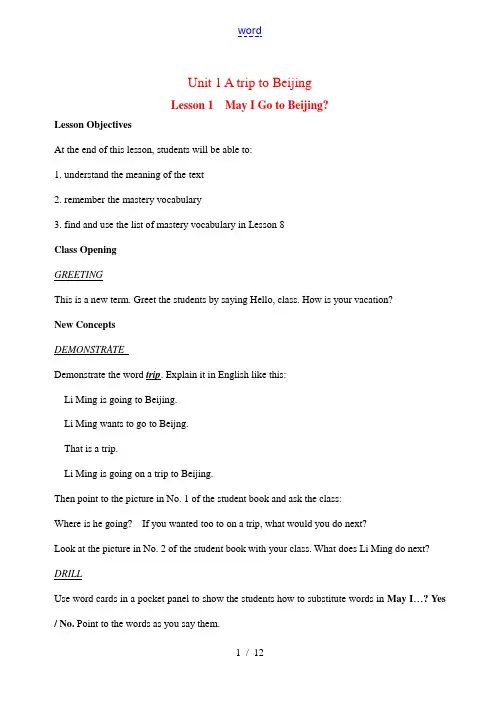
Unit 1 A trip to BeijingLesson 1 May I Go to Beijing?Lesson ObjectivesAt the end of this lesson, students will be able to:1. understand the meaning of the text2. remember the mastery vocabulary3. find and use the list of mastery vocabulary in Lesson 8Class OpeningGREETINGThis is a new term. Greet the students by saying Hello, class. How is your vacation?New ConceptsDEMONSTRATEDemonstrate the word trip. Explain it in English like this:Li Ming is going to Beijing.Li Ming wants to go to Beijng.That is a trip.Li Ming is going on a trip to Beijing.Then point to the picture in No. 1 of the student book and ask the class:Where is he going? If you wanted too to on a trip, what would you do next?Look at the picture in No. 2 of the student book with your class. What does Li Ming do next? DRILLUse word cards in a pocket panel to show the students how to substitute words in May I…? Yes / No. Point to the words as you say them.STUDENT BOOK L1Play the tape of the text in the student book. Ask the students to listen carefully as they follow along in their student books.PLAY “MOTHER, MAY I”Play it in a simple form, with numbers and big or little steps. You could also play variation 1 of the game with phrases such as read a book, sing a song, write a story, draw a picture and eat an apple. If you do this, brainstorm possible phrases before you start the game.ACTIVITY BOOKFinish Exercise 2.Class ClosingRetrospect of the lessonLesson 2 May I Invite Danny and Jenny?Lesson ObjectivesAt the end of this lesson, students will be able to:1. understand the meaning of the text2. get familiar with the oral vocabularyClass OpeningGREETINGRemember to greet the students with phrases they have learned.PLAY “MOTHER, MAY I?”This is a good game to review May I…? Yes/ No, you may / may not.New ConceptsDEMONSTRATERole-play e and go with students in the class. Use gestures to make your meaning clear. For example, ask individual students to e and then go.Lead the class through a dialogue such as this:Teacher: I want to go on a trip to Beijing!(Pick up your suitcase, point ahead and start walking.) Here I go! (Stop and point to a student.) You e, too. You e with me. (Start walking again, with the student.) Let’s go.PRACTICEPlay “The Trip Game.” Refer to the “Games” section at the back of this guide. DEMONSTRATENote that this lesson uses leave and arrive.The students know most of the words in the sentences that use leave and arrive. Can they guess what the words mean? Remember to praise any student who tries to answer.STUDENT BOOK L2Play the tape of the text in the student book. They follow the text in their book and pay special attention to e on our trip and go on a trip.ACTIVITY BOOKFinish Exercise 2.PRACTICEDiscuss the story in the student book. What does Li Ming want? (He want s Danny and Jenny to e.)How does Mrs. Li talk to Mrs. Smith? (On the telephone.) where is Mrs. Smith? (In Canada.) Can Jenny e on the trip? Can Danny e?Class ClosingRetrospect of the lessonLesson 3 How Far Is Beijing?Lesson ObjectivesAt the end of this lesson, students will be able to:1. understand the meaning of the text2. remember the mastery vocabulary3. find and use the list of mastery vocabulary in Lesson 8Class OpeningGREETINGPLAY “THE TRIP GAME”Play variation 2 of the game.New ConceptsDEMONSTRATENumbers are very regular in English. Once you know how to count to 100, you can count to 1000. Teach them how to read the numbers between 100 and 1000.E.g. 101: one hundred and one426: four hundred and twenty-six917: nine hundred and seventeenDemonstrate about with examples. Draw two quick stick people on the blackboard, a very tall boy and very short girl. Draw a tape measure beside each with an exact height marker off(such as 1.8 metres and 1.2 metres ) Lead a dialogue such as:Teacher: (Point to ech stick person in turn.) He is one-point-eight metres tall. How tall is she? Class: One point two metres tall.Teacher: Yes, he is one point eight etres tall and she is one point two metres tall. He is about two metres tall and she is about one metre tall.PRACTICECall out any number and ask the students in any row to count sequentially from that number. Stop and start the game several times with different numbers and different rows of students. DEMONSTRATE1. Explain from…to…. Write the names of cities in China on the blackboard. Write the distances from our city to these cities on the blackboard. Work these out before class and use exact numbers. Then lead the dialogue like this:—How far is…? Or How far is it from…to …? It’s about…—About …kilometers.2. Teach near and far. Lead a dialogue like this:—(Standing next to the volunteer.) He / She is near. (Take the volunteer to a far corner of the room and walk back to my original position. Point to the volunteer.) Is he / she near or far?—Far.ACTIVITY BOOKFinish Exercise 3.Class ClosingRetrospect of the lessonLesson 4 How Can We Go to Beijing?Lesson ObjectivesAt the end of this lesson, students will be able to:1. understand the meaning of the text2. remember the mastery vocabulary3. understand and sing the song “A plane is fast. A bus is slow.”Class OpeningGREETINGPLAY “SPELL IT”Play“Spell it”to revew modes of transportation the students have mastered (bicycle, car, cab, truck). See the directions for this game in “Games” at the back of this guide. Leave the words onthe blackboard. Then ask for volunteers to draw pictures to match the words.New ConceptsDEMONSTRATETeach: airplane, train, fast, faster, slow, slowerDemonstrate fast and slow by talking fast and slowly, or walking fast and slowly, as you make up appropriate sentences.Demonstrate faster than and slower than with two balls of the same size, but different colours. Roll them at different speeds. Construct a sentence that describes their relative speed. As for volunteers to roll the balls and each construct a correct sentence that describes the relative speed of their ball.Demonstrate train and airplane with your large vocabulary cards. Then lead a dialogue such as: —(Hold up a vocabulary card.)What’s this?— A train/ An airplane.—Is a train faster than an airplane? (Use gestures to make your meaning clear.)—No…—No! A train is slower than an airplane. Is an airplane faster than a train?—Yes.—Yes, an airplane is…—…faster than a train.Note that plane is short of airplane.STUDENT BOOK L4Review the story so far. Li Ming wants to go on a trip to Beijing. His mother is ing. Jenny and Danny are ing, too. Look at the pictures in No. 1 of the student book. What’s it about? DEMONSTRATELet’s take…Show the meaning of take first by doing some actions and at the same time holding your word cards of transportation vehicles. And then ask your students to join in your actions, and say: Let’s take a bicycle or Let’s take a bus.STUDENT BOOK L4Teach “The Trip Song” in No. 3 of the student book with the tape.Then sing the song.ACTIVITY BOOKFinish Exercise 2.Class ClosingRetrospect of the lessonLesson 5 Leaving and ArrivingLesson ObjectivesAt the end of this lesson, students will be able to:1. understand the meaning of the text2. remember the mastery vocabulary3. understand and learn “The leave arrive chant”Class OpeningGREETINGPLAY “WHAT DAY IS IT?” AND SING “THE TRIP SONG”New ConceptsDEMONSTRATEarrive, leaveDraw a circle at each end of the blackboard. Label one circle with the name of your home city. Label the other with the name of another city. Ask for a volunteer. You and the volunteer stand next to your home city. Lead the dialogue such as this:—Please go to…(the other circle)—(start walking to the other circle.)—Goodbye. He/ She is leaving… Please e to…(the first circle.) Now, he/she is arriving in STUDENT BOOK L 5Play the tape.PRACTICEDivide the class into small groups: Ask each group to plan a trip to Beijing the way Li Ming planned a trip in the student book.DEMONSTRATEStudy the course plan of your students. Find out what classes they have on Monday, Tuesday,Wednesday, Thursday, Friday, Saturday and Sunday.CHANTTeach “The leave arrive Chant”ACTIVITY BOOKFinish Exercise 2.Class ClosingRetrospect of the lessonLesson 6 Li Ming Packs His SuitcaseLesson ObjectivesAt the end of this lesson, students will be able to:1. understand the meaning of the text2. remember the mastery vocabulary3. understand and chant “The This That”Class OpeningGREETINGREVIEW “NEAR”AND”F AR”Review near and far. Ask two volunteers to stand on close to you and one in a far corner of the room. Lead a dialogue such as:—(Indicate the volunteer close to you.)…is near. (Point to the other volunteers and talk to first volunteer.) Is…near or far?—…is far.(Repeat with other volunteers and eventually allow students to lead the dialogue.) DRILLReview regular plurals with an object-prompt drill..You show a book, and say “I have a book.” Then you add another book and say, “Now I have two books.” and so on.New ConceptsDEMONSTRATEThis, that, these, thoseUse objects around the room and model the following structures:Teacher: (Hold up one object.) The …is near. This is near. (Point to an object far away) The…is far. That is far. (Hold up two objects.) The…s are near. These are near. (Point to two objects far away.) The …s are far. Those are far.Remind the students about some special plurals in English. Brainstorm a chart like this on the blackboard.This, that ——these, those;sweater——sweaters;pencil——pencils; pant——pants DRILLUse word cards in a pocket panel to show the students how to substitute words in the phrase I like this/that/these/those…(colour or other adjective)them.DEMONSTRATEPacking my / your / his / her suitcaseDo this with a real suitcase and real clothes. Use demonstrative pronouns to make choices anbout the clothes you pack.STUDENT BOOK L6Review the story so far. Jenny, Danny and Li Ming are going on a trip to Beijing. Look at the pictures in the student book with the class. What is Li Ming doing in this lesson? What is Jenny doing?Jenny and Li Ming use the words a pair of. The students have heard these words before. Does anyone remember what they mean?Play the tape.PRACTICE IN P AIRSDivide the class into pairs. Ask each pair of students to make up a dialogue about packing a suitcase. One student packs and one student helps. They can use their flashcards for clothes to prompt conversation about clothing choices, or they can draw and cut out clothes on paper. They can use a pencil case as a pretend suitcase for packing the clothes.Yes, please / No, thanks.Do you like this/ that/ these/ those…?A pair ofHow many…do you have?DEMONSTRATEClothes, jacketTeach jacket with the real clothes.CHANTTeach “The This Tat Chant” in No. 2 of the student ook.ACTIVITY BOOKFinish Exercise 1.Class ClosingRetrospect of the lessonLesson 7 Buying Train TicketLesson ObjectivesAt the end of this lesson, students will be able to:1. understand the meaning of the text2. remember the mastery vocabulary3. find and use the list of mastery vocabulary in Lesson 8Class OpeningGREETINGCHANT “THE LEAVE ARRIVE CHANT”TELL THE TIMEReview how to read time. Draw clocks on the blackboard and ask the class to recite the time. New ConceptsDEMONSTRATEJump / run / walk from…to…Sit down. Stand up.Act out jump, run and walk. Then do these actions from one object to another. Ask for avolunteer to do the actions from one object to another with you . Then ask for volunteers to do them without you. But as you direct, sometimes change your directions while your volunteers are still moving between objects.PLAY “TIC-TAC-TOE”Play “Tic-Tac-Toe” Give the students directions such as those below. Note that, in English, you can say from…to… or to…from… Both are correct. The students must listen carefully to the construction of each sentence you say.Please walk to the clock from the door.Please don’t run from the chair to the window.Please jump.PRACTICEPlay “Mother, May I?” with sit, stand and other vocabulary from this unit.ACTIVITY BOOKFinish Exercise 2.Class ClosingRetrospect of the lesson。
冀教版英语七年级下册教案 Lesson 1 A Trip to China
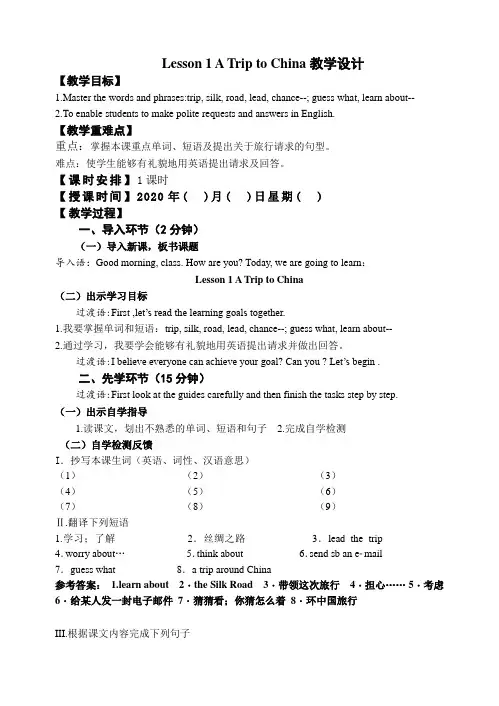
Lesson 1 A Trip to China教学设计【教学目标】1.Master the words and phrases:trip, silk, road, lead, chance--; guess what, learn about--2.To enable students to make polite requests and answers in English.【教学重难点】重点:掌握本课重点单词、短语及提出关于旅行请求的句型。
难点:使学生能够有礼貌地用英语提出请求及回答。
【课时安排】1课时【授课时间】2020年( )月( )日星期( )【教学过程】一、导入环节(2分钟)(一)导入新课,板书课题导入语:Good morning, class. How are you? Today, we are going to learn:Lesson 1 A Trip to China(二)出示学习目标过渡语:First ,let’s read the learning goals together.1.我要掌握单词和短语:trip, silk, road, lead, chance--; guess what, learn about--2.通过学习,我要学会能够有礼貌地用英语提出请求并做出回答。
过渡语:I believe everyone can achieve your goal? Can you ? Let’s begin .二、先学环节(15分钟)过渡语:First look at the guides carefully and then finish the tasks step by step.(一)出示自学指导1.读课文,划出不熟悉的单词、短语和句子2.完成自学检测(二)自学检测反馈I.抄写本课生词(英语、词性、汉语意思)(1)____________________(2)_____________________(3)__________________ (4)____________________(5)_____________________(6)__________________ (7)____________________(8)_____________________(9)__________________ Ⅱ.翻译下列短语1.学习;了解____________ 2.丝绸之路____________ 3.lead the trip____________ 4.worry about…____________5.think about___________6.send sb an email____________ 7.guess what____________8.a trip around China____________参考答案:1.learn about2.the Silk Road 3.带领这次旅行4.担心……5.考虑6.给某人发一封电子邮件7.猜猜看;你猜怎么着8.环中国旅行III.根据课文内容完成下列句子1.这个月我们在学校学习有关丝绸之路的知识。
冀教版七年级英语下册教案
冀教版七年级英语下册教学工作计划本学期的教学重点是围绕教学大纲,努力调动学生的学习积极性,引导他们热爱学习,表现为他们自觉学习的行为,认真完成教学工作。
现将本学期担任的初一英语课教学工作计划如下:一、指导思想:在本学期的英语教学中,坚持以下理念的应用:1、要面向全体学生,关注每个学生的情感,激发他们学习英语的兴趣,帮助他们建立学习的成就感和自信心,培养创新精神;2、整体设计目标,体现灵活开放,目标设计以学生技能,语言知识,情感态度,学习策略和文化意识的发展为基础;3、突出学生主体,尊重个体差异;4、采用活动途径,倡导体验参与,即采用任务型的教学模式,让学生在老师的指导下通过感知、体验、实践、参与和合作等方式,实现任务的目标,感受成功;5、注重过程评价,促进学生发展,建立能激励学生学习兴趣和自主学习能力发展的评价体系。
总之,让学生在使用英语中学习英语,让学生成为Good User而不仅仅是Learner。
让英语成为学生学习生活中最实用的工具而非累赘,让他们在使用和学习英语的过程中,体味到轻松和成功的快乐,而不是无尽的担忧和恐惧。
二、学生基本情况分析:本届七年级新生和以往初一学生相比在英语基础方面很薄弱,由于在小学英语课并未受到足够的重视,他们在写的技能方面基本上没有得到过训练,连音标和字母的拼读都没有掌握好。
经过上学期努力,年段学生的基础知识得到了加强,学习态度也有所好转。
但是学生整体的惰性还是很强,自觉性很差。
另外,学生在情感态度,学习策略方面还存在诸多需要进一步解决的问题。
例如:很多学生不能明确学习英语的目的,没有真正认识到学习英语的目的在于交流;有些同学在学习中缺乏小组合作意识;大多数同学没有养成良好的学习习惯,不能做好课前预习课后复习,学习没有计划性和策略性;不善于发现和总结语言规律,不注意知识的巩固和积累。
三、奋斗目标:钻研新课标,提高教学水平,真正做到教学相长,努力达到学校规定的教学指标。
初中英语冀教版│七下│Unit 3 Lesson 18 Teaching in China教案
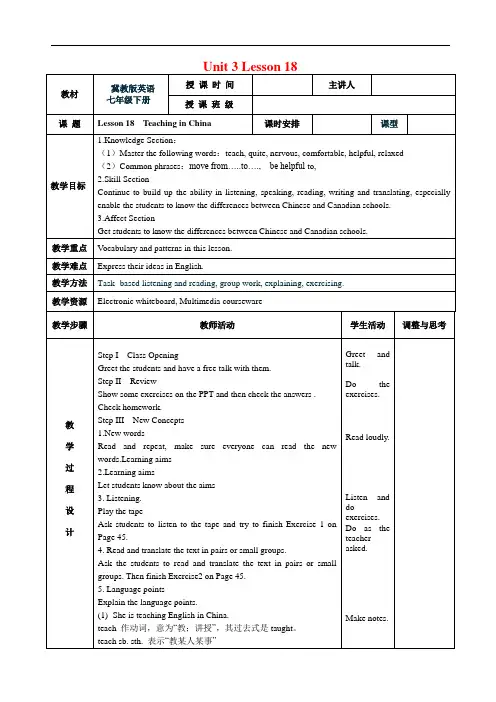
Get students to know the differences between Chinese and Canadian schools.
教学重点
Vocabulary and patterns in this lesson.
教学难点
Express their ideas in English.
quite作副词,意为“非常;十分”,与形容词或副词连用。
(3)be helpful to对…….有帮助
e.g: My teacher is very helpful to me.
(4) move from…..to…..从……搬到/移动……
e.g: They move from classroom to classroom.
板
书
设
计
Lesson 18 Teaching inChina
(1)teach sb. sth.
e.g:Miss Li teaches us painting.
teach sb. (how) to do sth.
e.g:George taught him how to ride a horse.
(2)be helpful to e.g: My teacher is very helpful to me.
Ask students to listen to the tape and try to finish Exercise 1 on Page 45.
4. Read and translate the text in pairs or small groups.
Ask the students to read and translate the text in pairs or small groups. Then finish Exercise2 on Page 45.
冀教版七年级英语下册教案Unit 1 第1课时

Unit 1 A Trip to the Silk Road 单元目标第一课时Lesson 1 A Trip to China 课时目标自主学习一、根据句意及汉语提示写出单词。
1.She led(带路)me into the drawing-room.2.Jenny's father and mother read the note(便笺).3.I had to give him a chance(机会).4.He sent (寄)me a note to thank me for the dinner.5.We won the game.What good news(消息)!二、写出下列画线短语的汉语意思。
1.Guess what!We're learning about the Silk Road this month in school.猜怎么着;了解2.Read the note from Jenny's school and take turns asking for permission to go on the trip.轮流;请求允许;去旅行自主学习环节1新课导入T:Hello, boys and girls.Do you like to travel?Ss:Yes.T:So, tell me something about your travel experiences.S1:I went on a trip to Beijing last summer with my parents.We visited many places of interest...S2...设计意图:师生之间的问答谈及旅行,这就自然而然地引出本课时的话题,为接下来的课文学习作铺垫。
环节2新课学习1.教师邀请3名学生分角色朗读教材第2页的对话内容,教师注意纠正学生的发音问题。
2.教师让学生快速阅读对话,阅读后邀请一名学生说出该对话谈论的主题。
七年级英语下册 Unit 2 It's Show Time Lesson 11 Food in China同步练习 (新版)冀教版

Food in ChinaⅠ.根据句意及汉语提示完成单词。
1.Let's buy a dictionary ______(网上).It's very easy and cheap.2.I like Chinese traditonal food,______(尤其)the dumplings.3.He is very rich and he has a lot of ______(财富).4.Apple Inc(股份有限公司)have many new ______(产品).5.I hope that my plan will come ______(真实的).Ⅱ.单项选择。
1.The apples taste ______ and sell ______.A.good;well B.well;good C.good;good D.well;well 2.The sweater is cheap.It is worth ______.A.buy B.to buy C.buying D.bought3.The answer is ______,not false.A.true B.real C.truly D.really4.She ______ many good books in the library just now.A.finds B.find C.found D.finding5.It takes my mother two hours ______ dumplings.A.make B.to make C.making D.made参考答案Ⅰ.1.online 2.especially 3.treasure 4.products 5.trueⅡ.1.A点拨:考查词义辨析。
taste是系动词,后面跟形容词作表语,sell是实义动词,后面跟副词,由此可知选A项。
2.C 点拨:考查固定搭配。
新冀教版五年级英语下册《Unit 2 In Beijing Lesson 11 Shopping in Beijing》教案_7
Lesson 11 Shopping in Beijing 教学设计一、Teaching aims1、学生通过观看视频,图片,能听懂、会说、认读并书写下列词汇:for, busy2、学生能认读、理解并运用下列基本句型结构:Jenny buys ___for____.3、教育和培养学生通过参与,体验购物的过程,关心爱护家人。
二、Teaching important points1、学生能听懂、会说、认读并书写下列词汇:for, busy2、学生能认读、理解并运用下列基本句型结构:Jenny buys ___for____.三、Difficult points学生能理解并运用下列基本句型结构:Jenny buys ___for____. 进行会话交流。
四、Teaching and learning methodsSituational Teaching approach ; The Audio-Lingual Methods, Pair work and Group work .五、Teaching tools1、PPT,易点慧软件系统和一些图片实物六、Teaching proceduresStep1:Warming up1、Greetings2、Free talk : Guessing : The teacher shows some pictures : Tian’anmen Square , the Palace Museum and the Great Wall .Ss guess : What are they ? and talk about the three famous places.(设计意图:学生通过观看图片和老师的肢体语言复习北京的景点,来激活学生们的已知。
)Step2 Lead-in(Create context)Teacher shows a video about shopping and asks students : What am I doing ? Yes, I am shopping .And I want to buy sth . for my family. Ask students : What do I want to buy for my mother ? (此处让孩子们猜测老师会为母亲、父亲, 丈夫和儿子各买什么,目的是为了激发孩子们想知道答案的兴趣和激活他们大脑中已有的相关服装,食物及玩具等英语词汇,突破重点,并为下文活动做铺垫。
初中英语冀教版七年级下册教案
初中英语冀教版七年级下册教案一份优秀的英语教案是教师上好一堂课的保障。
下面小编给大家分享一些初中英语冀教版七年级下册教案,大家快来跟小编一起欣赏吧。
初中英语冀教版七年级下册教案范文Lesson 4 How Can We Go to Beijing?1.导入新课教师播放一段飞机、公共汽车、火车的视频片断,播放同时教师介绍: An airplane is fast. A bus is slow.A train is faster than a bus but slower than an airplane. 2.听录音,学新词教师出示飞机、公共汽车、火车的图片,学生边看图片,边听课本录音第一部分,掌握新词 airplane, fast. slow的读音。
3.讲解形容词的比较级1) 教师出示自行车和公共汽车的图片,说:A bike is slower thana bus. A bus is faster than a bike.2) 出示公共汽车和火车的图片,说:A bus is slower than a train.A train is faster than a bus.教师讲解比较级的构成形式:A +is +形容词的比较级+than+ B.3) 学生运用教师出示的交通工具图片进行模仿操练。
4.听,读,说教师提问:How can Li Ming go to Beijing? 学生听一遍录音后,找到问题的答案。
学生跟读录音两遍,两人小组进行练习。
5. let sb do sth 句型操练Let’s go to Beijing by plane. Let’s sing a song. Let’s takea train.6.唱歌。
教师讲解歌词,学生唱歌,巩固复习本课的重点句型。
7.总结拓展总结本课重点短语和句型。
8.随堂测试Lesson 5 Leaving and arriving1.复习请两组同学表演 Lesson 4 , Part2。
新冀教版 七年级下英语UNIT1教案
2. May I ask you a question?
May I….? 表达有礼貌的请求。肯定回答:Yes, you may. 还可以
用 Sure, Certainly, Of course. 否定回答:No, you may not. 还可以
用 Sorry, you can’t. You’d better not.
明天想离开上海。
前往,离开去某地 leave for sp. E.g. He wants to leave for
Shanghai tomorrow. 他明天要去上海。(相当于 He wants to go to
Shanghai tomorrow)
注意:leave 和 forget 的区分。当表示“把某物忘在某地”时,用 leave
( )2.My friend Tom_____a new bike next week.
A. buy B. buys C. will buy D. is buying
( )3.-May we___here? -Yes, you may.
A. live in B. live C. to live D . to live in
sth sp.
E.g. He forgot his book. / He left(leave 的过去式) his book at
home.
五、短语汇总
1.见某人 meet sb. 2. 第一站 the first stop
3. 多远 how
far
4. 从…到… from…to
5. 特别的东西 something special
新冀教版 七年级下英语 UNIT1 教案
课题
Lesson 1 A Trip to China
【冀教版七年级英语下册】Unit1Lesson1ATriptoChina教案
教材课题教课目标教课要点教课难点教课方法Unit 1 Lesson 1冀教版英语讲课时间主讲人七年级下册讲课班级Lesson 1 A trip to China课课时安排型1.Remember the new words and phrases, master the meaning of text.2.Make sure the Ss can learn some trip experience.3.Learn and talk about their trip experience.Words and phrases; learn a trip to China; a few important sentences.1. Learn how to ask for permission2. Students will be able to use “ will ” to express something Listening,speaking, reading, writing and practice.教课资源教课步骤教学过程设Electronic whiteboard, Multimedia courseware, A recorder.教师活动Step 1 Analysis of the student.After a long holiday, the Ss came back to school. Now,the Ss have a new school year, so many Ss have newplans about their learning. And they have a new subject.Step 2 Lead in.1.Greet the students in English and make sure they canresponse correctly.Do the duty report: a student on duty can saywhatever he/she likes to say.2.Ask some Ss talk about the following questions:How do you like the first day of a new term? Doyou have any new subjects?Do you think you will like them?How many new classmates do you have?May I ask you a question?学生活动调整与思虑Ask one student toread the title ofLesson 1Ask the students justto listen.Let the students doLet ’ s Do it 1Let the students doLet ’ s Do it 2计Step 3 New lesson.No. 1 Prepare lessons before class.Teach the new words and phrases. Make sure theSs can read it correctly.No. 2 Text: Give them some time to read the textthemselves. Then let them act out the dialogue ingroups. Correct their pronunciation whennecessary. At last, the teacher explain the text inChinese, make sure the Ss can understand themeaning of text.No. 3 Ask the Ss to finish the following questions:1.How many new classmates does Danny have?What are their names?2.What advice does Li Ming give Danny onhow to start a conversation with Danny? Ask some students and answer in pairs.3. Li Ming has a new subject this year. What is it?4. What will Li Ming do to prepare for his class教tomorrow? Why?学No. 4 Some important phrases and sentences:trip, silk, road, lead, note, chance, send, news, learn过aboutNo. 5 Review the grammar:程 1. the present tense 2.will/ be going to 3.There be/We have设No. 6 Complete Let’ s Do it!计Step 4 Play the tape for the Ss to follow.Make the Ss listen the text, then let them read follow the tape.Ask the studentsto课Step 5 Summary.finish the exercise堂Sum up the text what we learned, the new words,phrases, and sentences.检Sum up the grammar.测Step 6 课堂检测一、用所给词的合适形式填空。