
高中英语Unit3 Travel journal-reading学案(新人教版必修1)
Unit 3 Travel journey—reading学案Journey down the MekongWhy do so many people want to travel? What are the advantages of traveling?________________________________________________________________________________ ________________________________________________________________________________ ________________________________1.Discuss in groups of four and match the great rivers with their locations(位置) in the world in the following form.The great rivers in the world2. How do people make use of the river who live beside a river ?________________________________________________________________________________ ________________________________________________________________________________ 3. Read the whole passage quickly to decide which is the main idea of the passage and finish the true or false questions.A. The dream of Wang Kun and Wang Wei and their preparation for the bike trip.B. Their dream and the journey down the Mekong.C. Their plan to travel down the Mekong and the attitudes of two people.D. The proper trip down the Mekong.T r u e o r F a l s e?(1).Dao Wei and Yu Huang belong to the Han nationality.(2). Some of the Dai live in Western Y unnan.(3).The Mekong River is in China and it includes the Lancang River.(4). Although it is not easy to travel along the Mekong River, Wang Wei insisted on doing so.(5). The Tibetan Mountain where the Mekong River begins is 5,000 meters high.4.Detailed Readingpara1: Find the background information:(1).How many people are mentioned in the 1st paragraph, and what is their relationship?________________________________________________________________ (2). What was Wang Kun and Wang Wei’s idea of a good trip?________________________________________________________________ (3). Who planed the trip to the Mekong?________________________________________________________________Para2:(1). Did Wang wei know the best way of getting to places?Is Wang Wei a thoughtful person? why?(________________________________________________________________ (2). Is it a difficult journey to cycle along the Mekong?________________________________________________________________(3). Where is the source of the Mekong River and which sea does it enter?________________________________________________________________Para3What can you see when you travel along the Mekong?It begins in a __ ____ on a __________. Then, it___ ___ quickly. It becomes _______as it passes through deep_ _____.Sometimes, the river becomes a __ _______ and enters________________ .It makes wide bends or meanders through low valleys to the ___________where rice grows. At last, the river _________enters the South China sea.NGUAGE POINTS1.prefer (vt.)更喜欢,选择某事物prefer to do sth. 喜欢,选择做…prefer sth to sth/ prefer doing to doing 喜欢…胜过…prefer to do sth. rather than do sth 宁愿做…而不愿做…would rather do sth than do sthprefer sb (not) to do sth 宁愿某人(不)做某事2. insist v. 主张,坚持,坚称,坚决要求[用法]insist后接宾语从句时,是否用虚拟语气,取决于insist在句中的意思。
若意思是“坚决要求”,或者事情没有发生,要用虚拟语气;若表示“坚持认为,坚持说,坚称”,或者事情已经发生了,则不用虚拟语气。
常用结构:insist on sth……insist on doing sth……insist that sb.(should) do sth3. ……the air would be hard to breathe.此句中,运用了主语+be+adj.+to do sth结构或者it +be+adj.+to do sth。
其中形容词用作状语修饰前面做表语的形容词。
主语与不定式构成逻辑上的动宾关系,这时,不定式用主动形式表示被动含义。
如果构成不定式的动词是不及物动词,后面要加相应的介词。
常用的形容词有:easy, hard, difficult, possible, impossible等。
The book is easy to read.这房子住起来很舒服。
________________________________________________________________________________ 4. The very first time that Joe saw the film “ET” directed by Steven Spielberg, he made up his mind to become a director too.句中the first time用作从属连词,引导一个时间状语从句,表示“第……次”的从属连词还有the last time, the next time, every time, each time等。
eg, The next time I see you, I hope you will get well.Each time I see her, she is excited.5.sb be familiar with sth1) Anyone who is familiar with his poetry will find the course easy and interesting.2) My cousin is familiar with the city for he spent the summer holiday there last year.sth/sb be familiar to Sb1) Comrade Lei Feng is familiar to all the young people and he is always the good example to them.2) The pictures remind me of the scenes which I am very familiar to.6. voyage, trip, journey, travel, tour•voyage主要指乘船或飞机的旅行•trip指往返的短途的旅行•journey指单程的长途的陆地的旅行•travel指一系列的旅行,尤指旅行的概念。
指比journey更长距离的旅行,往往是到国外或某个遥远的地方去,但不强调具体的目的地。
•tour侧重“周游各地的参观,访问,旅游”等。
7 It is my sister who first had the idea to cycle along the entire Mekong River from where it begins to where it ends.(P.18)“It is/was …that/who...”是强调句型,可强调句子的各个成分(谓语除外),其基本结构为: It is +被强调部分+that(被强调部分是人时也可用who)+其余部分用强调句改写下列句子:(1). Who put so many large stones on the road?___________________________________________________________________________(2). Which place are your parents determined to visit next year___________________________________________________________________________ 疑问词+is (was) it+ that/who+句子其余部分Homework:1. Finish the exercises on the workbook from 56 to 57.2. Could you use some words or phrases to describe the characteristics of Wang wei and Wang kun?答案Book 1 Unit 3 Travel journey Reading1. Why do so many people want to travel? What are the advantages of traveling?broaden one’s view/mindenrich one’s knowledge/experiencesmeet people of different colorsget to know the vastness of nature.relax, refresh our mindbring enjoyment and good memoriesTraveling widens our view, increases our knowledge, and builds our bodies.contact with different cultures2. The great rivers in the world 1- f2-e3-b4-c5-g6-d7-a2. How do people make use of the river who live beside a river ?travel along a riverto irrigate(灌溉)their fieldsto make electricitygo swimming3. Read the whole passage quickly and decide which is the main idea of the passage and finish the ture or false questons. (A)T r u e o r F a l s e?F T F T F4.Detailed Readingpara1: Find the background information:1.How many people are mentioned in the 1st paragraph, and what is their relationship?4 people. Wang Kun&Wang Wei. (brother and sister) and Dao Wei&Yu Hang(cousins of Wang Kun&Wang Wei)2. What was Wang Kun and Wang Wei’s idea of a good trip?Their idea was to take a great bike trip.3. Who planed the trip to the Mekong? Wang Wei.Para2:1. Did Wang wei know the best way of getting to places? Is Wang Wei a thoughtful person? why? No. Because she didn’t know the best way of getting to places, paid no attention to details, and she didn’t look at any maps.2. Is it a difficult journey to cycle along the Mekong? Yes.3. Where is the source of the Mekong River and which sea does it enter?The source of the river is in Qinghai Province and it enters the South China Sea.Para3What can you see when you travel along the Mekong?It begins in a __ glacier____ on a Tibetan mountain.Then, it___ moves___ quickly. It becomes rapids /as it passes through deep_ valleys___.Sometimes, the river becomes a __ waterfall and enters _wide___ __valleys___ .It makes wide bends or meanders through low valleys to the ___plains__where rice grows.At last, the river __delta__enters the South China sea.Homework:1. Finish the exercises on the workbook from 56 to 57.2. Could you use some words or phrases to describe the characteristics of Wang wei and Wang kun?Wang Wei: stubborn; determined; wouldn’t change her mind; adventurous (喜欢冒险的)Wang kun: serious = careful clever3. 这房子住起来很舒服。
人教新课标必修一 Unit 3 Travel Journal学案

Unit 3 Travel JournalWarming Up1、Which kind of transport do you prefer to use: bus or train? 你偏爱使用哪种交通工具:公汽还是火车?(P17)transport n.&vt.运送;运输The goods will be transported to Tokyo by air.货物将空运到东京。
Which transport do you prefer to use? 你偏爱使用哪种交通工具?Beijing is trying to improve its transport system for the coming festival.北京为了迎接即将到来的节日,正在努力改善交通设施。
1) transport还可作可数名词,表示“交通工具”。
It is easier to travel if you have your own transport.如果你自己有交通工具,旅行起来方便多了。
2) transportation n.运输;交通The railroad gives free transportation for a certain amount of baggage.铁路免费运送一定数量的行李。
3) 构词法:trans-作为前缀,意为“横过;贯穿;转移”。
translate vi. &vt.翻译transfer vi. &vi.转移,调离transmit vt.传输;传播我的汽车正在修理,所以我现在没有代步工具了。
My car is being repaired so I’m ____________ at the moment.我出门通常乘坐公共交通工具。
I usually travel by________________.[without transport; transport可作可数名词,表示“交通工具”; public transport同上,名词交通工具]■prefer v.(preferred/preferring)更喜欢,选择某事物(而不选择其他事物)I prefer dogs to cats.猫狗之中我更喜欢狗。
人教版新课标英语必修一Unit3 Travel Journal reading 课程教学设计
Unit3 Travel Journal教学设计教学目标1. 知识目标:复习两个阅读技能---scanning, skimming;学习本单元的部分生词。
2.能力目标:能形成文章的图式,在图式的帮助下自主地复述本课的主要内容,在此过程中实现生词的重现。
3.情感目标:学生在教师的启发下,通过师生互动和生生互动,进一步探究知识。
在这一过程中,学生可以不断地实现互相教育和自我教育,并能寻求自我发展;学生能明白计划的重要性,并能收获一些与之相关的谚语。
学情分析任教班高一7,8班是一个普通班,同学们刚进入高中的学习不久,属于适应期,但同学们学习英语的热情还比较高,也愿意积极参与课堂活动。
不过老师发现,由于高一词汇量增加不少,很多同学记单词缺乏语境,不会充分利用课文帮助自己加强对词汇的学习。
重点难点1. 形成文章的图式,并在图式的帮助下复述文章的主要内容。
教学过程【导入】教学活动【导入】Journey down the MekongStepsTeacher’s activityStudents’ activityAimsStep 1Show and tell the students the learning goals for them and make possible explanationsStudents listen to the teacher and have an idea of what they are going to learn in this class.To make the students know what they are to learn in this classStep 21). Show some pictures with beautiful scenery2) Ask the students two questions:Are they attractive?Where do you want to travel? –I dream about traveling…1.) Students appreciate those pictures2) Students answer teacher’s questions and practice the sentence pattern “I dream about traveling in/to…”1). To arouse students’ interest2) To practice a sentence patternStep 31). Show the title of the reading passage2). Ask the students whether this passage is about the whole process of the journey.3). Ask the students how to skim.4) Tell the students the skill of skimming on the screen1) Students answer the question after they read the subtitle of this part.2). Students tell how to skim.1) To make the students pay attention to the subtitle, which can tell the main idea of the passage.2) To review how to skimStep 41)Ask the students to skim more—to find out the main idea of each2)paragraph.1) Students tell the main idea of each paragraph1) To practice how to skimStep 5With four questions, teacher asks the students to scan paragraph 1Ask students how the scanShow the skills of scanning on the screenStudents scan paragraph 1, and answer the four questionsStudents tell how to scanTo review how to scanTo practice how to scanStep 61)Ask the students to scan paragraph 2 and find out what different2)attitudes Wang Kun and Wang Wei have, and then finish the table1) Students scan paragraph 2 and finish the table1) To practice how to scanStep 71)Provide the students with a picture which describes a geographic word as well as a few sentences about the flow of the Mekong river on each 2)slide and ask them to read the sentences.2) Ask the students to match each geographic word to the proper meaning s1) Students read the sentences loudly together and look at the pictures and the related geographic words in the meanwhile.2) Students do the matching work1) To better know how the Mekong river flows2) To help the students better learn the geographic words which are new to them3) To check how the students understand the new wordsStep 8Review the structure of the passage together with the students and show some key words on the screenProvide the students with some words and phrases which are the new words in this unitAsk them to retell the main content of the passage in groupsWith the teacher, students review the structure of the passageRetell the main content of the passage in groupsTo help students form the schema of the passage by reviewing the structure of itTo know the content of the passage better as well as to create more chances for the students to use the new wordsStep 91) Ask the students what they learn from the story2) Give the students some useful and related proverbs1) Students share their opinions with the group members what they have learned from the story.2) Students read the proverbs loudly together.1) To encourage students to form their own views and share them with others2) To learn some useful proverbsStep 101) Summarize this class by showing the learning goals。
图解教材(思维导图+微试题)人教高中英语必修1学案:Unit 3 Travel journal正式版
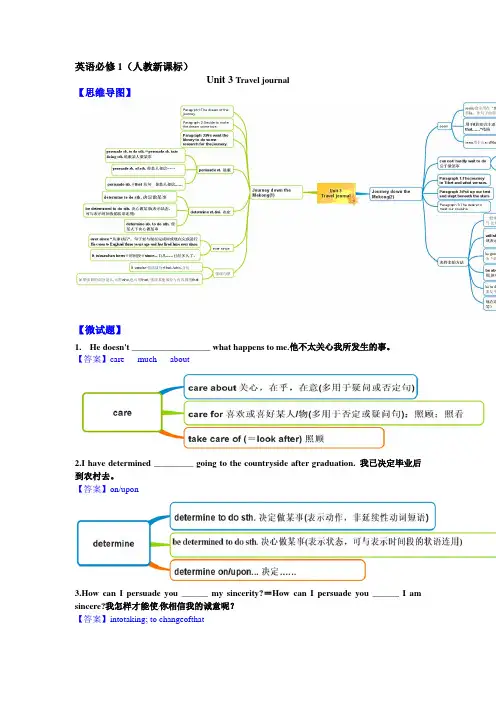
英语必修1(人教新课标)Unit 3 Travel journal【思维导图】【微试题】1.He doesn't __________________ what happens to me.他不太关心我所发生的事。
【答案】care much about2.I have determined _________ going to the countryside after graduation. 我已决定毕业后到农村去。
【答案】on/upon3.How can I persuade you ______ my sincerity?=How can I persuade you ______ I am sincere?我怎样才能使你相信我的诚意呢?【答案】intotaking; to changeofthat4.[2014山东高考]完形填空。
Charlotte Whitehead was born in England in 1843, and moved to Montreal, Canada at the age five with her family. While 1 her ill elder sister throughout the years, Charlotte discovered she had a(an) 2 in medicine. At 18 she married and 3 a family. Several years later, Charlotte said she wanted to be a 4 . Her husband supported her decision.5 , Canadian medical schools did not6 women students at the time. Therefore, Charlotte went to the United States to study7 at the Women’s MedicalCollege in Philadelphia. It took her five years to8 her medical degree.Upon graduation, Charlotte9 to Montreal and set up a private 10 . Three years later, she moved to Winnipeg, Manitoba, and there she was once again a 11 doctor. Many of her patients were from the nearby timber and railway camps. Charlotte12 herself operating on damaged limbs and setting 13 bones, in addition to delivering all the babies in the area.But Charlotte had been practicing without a license. She had 14 a doctor’s license in both Montreal and Winn ipeg, but was 15 . The Manitoba College of Physicians and Surg eons, an all-male board, wanted her to 16 her studies at a Canadian medical college! Charlotte refused to 17 her patients to spend time studying what she already knew. So in 1887, she appeared to the Manitoba Legislature to 18 a license to her but they, too, refused. Char lotte 19 to practice without a license until 1912. She died four years later at the age of 73.In 1993, 77 years after her 20 , a medical license was issued to C harlotte. This decision was made by the Manitoba Legislature t o honor “this courageous and pioneering woman.”1. A. raising B. teaching C. nursing D. missing2. A. habit B. interest C. opinion D. voice3. A. invented B. selected C. offered D. started4. A. doctor B. musician C. lawyer D. physicist5. A. Besides B. Unfortunately C. Otherwise D. Eventually6. A. hire B. entertain C. trust D. accept7. A. history B. physics C. medicine w8. A. improve B. save C. design D. earn9. A. returned B. escaped C. spread D. wandered10. A. school B. museumC. clinic D. lab11. A. busy B. wealthyC. greedyD. lucky12. A. helped B. found C. troubled D. imagined13. A. harmful B. tired C. broken D. weak14. A. put away B. taken over C. turned in D. applied for15. A. punished B. refusedC. blamed D. fired16. A. display B. change C. preview D. complete17. A. leave B. charge C. test D. cure18. A. sell B. donate C. issue D. show19. A. continued B. promised C. pretended D. dreamed20. A. birth B. death C. wedding D. graduation【答案】1-5CBDAB 6-10 DCDAC 11-15ABCDB 16-20 DACAB【解析】文章讲述了一位加拿大女医生冲破性别歧视的樊篱救死扶伤的故事。
人教版高中英语必修一教案Unit 3 Travel journal (含答案)
Unit 3 Travel Journal 单元教学目标I.Target language目标语言Ⅲ教材分析与组合1. 教材分析本单元以travel为主题,使学生通过travel了解他们所去国家或地区的风土人情,地理地貌及气候特征。
让学生体会英语作为工具给他们带来的乐趣。
学生可以利用英语扩大自己的视野,获取知识,了解世界。
学生可以通过相互讨论和相互交流以丰富各自的地理知识。
进一步扩大学生的词汇量。
能正确使用现在进行时的形式表达将来的计划和安排。
本单元把Travel Down the Mekong分成六部分,其中三部分作为阅读材料而另三部分作为听力材料。
通过本单元的学习使学生掌握一些重要词汇及词组,并能够写出自己的旅行日志来提高自己的写作水平。
1.1 Warming-up 让学生想象去旅游并选择一个地方为题,讨论所需费用,并决定四种交通方式,使学生了解旅行前的准备及计划。
1.2 Pre-reading 部分的三个问题是通过讨论河流在人民生活中的作用以及看图回答问题,让学生找到湄公河流域的国家,作为阅读的“热身”1.3 Reading 是日志的第一部分,它讲述了王坤和王薇的骑车旅行梦想和计划,描述了他们为这次旅游所做的准备,对旅游路线的选定以及他们通过查阅地图对湄公河情况的了解。
文章用第一人称的方式,通过对王薇做事的方式的介绍,让大家了解了她的性格特点,使人倍感亲切,给人留下深刻的印象。
日志的第二部分放在workbook 中,主要讲述他们在西藏山中度过的一宿,以及旅行中的苦与乐。
1.4 Comprehending第一题是信息题,通过问答使学生进一步理解课文以训练学生获取信息的能力。
第二题是理解题,让学生用自己的话解释课文中的句子。
第三题是推断题,让学生通过主人公的行为来推断他们对旅行的态度。
第四、五题是语言运用题,用以提高学生运用语言的能力。
1.5 Learning about language分两部分,第一部分是旨在通过三个题型的练习使学生掌握目标语言。
Unit3 Travel Journal Reading(新人教版必修1)
by train
by bicycle
by ship/boat/sea
by plane/ air
Learn some useful words when talking about our journey:
1. Places of interest (名胜) 2. Weather 3. Object (天气) (物品)
Para.2
Different attitudes between them Decide to take a great bike trip along the Mekong river
Para.3
Paragraph 1: Dream
Since middle school…
Two years ago… Last year…
China
Myanmar
The Mekong River flows through…
Laos
Thailand
Cambodia Vietnam
South China Sea
(Part I: the dream and the plan)
Journey plan
Who
How where
When after graduating from college
My sister Wang Wei and I have dreamed about taking a great bike trip.
She bought… . Then she persuaded me to buy one. She visited our cousins… We finally got the chance to do it. She is planning our schedule for the triekong River”better
浙江省义乌三中高一英语《Unit 3 Travel journal》(人教版必修1)学案
Unit 3 Travel journal一. 单词拼写1. Professor King often contributes (投稿) to the medical j________.2. The goods will be t________ to Singapore by air.3. The salesman p________ us into buying his product yesterday.4. Is the s________ of the Changjiang River in Tibet?5. These clothes are p________ for such an occasion.6. I need a d________ report about that accident not just a summary.7. The plane was then flying at an a________ of 8000 feet.8. Your face seems f________. I must have seen you somewhere.9. What’s you’re a________ to this idea? Good or not?10. Her purse was stolen so she didn't have money for the train f________.二.翻译下列单词或短语1.结束______________________2.一个意志坚强的人_________________3.坚持做某事________________4.说服某人做某事__________________5.改变某人的主意____________6.屈服,让步_______________________7.决定做某事________________ 8.对某人或某事的态度________________9.下定决心__________________10.破记录__________________________11.车费____________________ 12.自从那时起________________________13.梦想_________________ 14.使某人对…..产生兴趣________________15.做某事的方式____________16.担心,在乎_______________________17.与……比较______________18.立刻,马上_________________________三. 单项选择.1. My little sister ____ me into buying the Five Friendlies.A. wantedB. advisedC. persuadedD. told2. The manager insisted that the work ____ finished by the end of this month.A. should beB. will beC. must beD. ought to be3. The aim isn’t to persuade people to ____, but to reaf- firm their beliefs.A. make up their mindsB. put their mindsC. change their mindsD. turn their minds4. The mayor ____ the prizes on the school sports day.A. gave upB. gave inC. gave backD. gave away5. ____ to get a ticket for the 2006 FIFA World Cup, George has been standing in a queue for two days.A. DeterminingB. Being determinedC. To determineD. Determined6. —It’s getting dark. I’m afraid I must be off now.—____.A. That’s all rightB. You are niceC. What a pityD. See you7. Margie shows a very positive attitude ____ her work.A. toB. withC. ofD. about8. Before you leave Beijing for New York, you should be familiar ____ English.A. withB. toC. onD. about9. —Is there anything you want to know?—I just wonder ____ that makes Jim so excited.A. what it isB. what he doesC. how it isD. why it does10. Betty and Arthur ____ on separate holidays in a few days’time.A. goB. goingC. are goingD. went11. ____ printed, this science fiction will be popular among the students.A. BeforeB. UnlessC. WhenD. Once12. Taxi ____ have stayed fixed for more than five years.A. feesB. costC. chargesD. fares13. —I am taking the college entrance examination next week.—____!A. Well doneB. Good luckC. CongratulationsD. Have a good day14. The one and only thing I ____ is whether you take a good rest!A. care forB. look forC. care aboutD. look after15. The dog, if trained ____, will be made a good watch-dog one day.A. properlyB. hopefullyC. personallyD. usually四. 单句改错1. From what I have seen and heard, I must say Chinese people are living happily.___________2. Everyone agreed to his suggestion which we should hold a meeting to talk about the problem. _________3. Oliver Twist, the hero of the story, he was an orphan. _________4. Why don’t you ask anybody else to help you? _________5. The pen is missing, for we cannot find it everywhere. _________6. Sorry, I have a such book. _________7. The two languages are not at all the same in neither spelling or grammar. _________8. Most people can quick get help from a doctor when ill. _________9. He told me that how important it is to learn English. _________10. Can’t you remember tell me that the other day?_________五:完形填空(共20小题;每小题1分,满分20分)阅读下面短文,从36-55各题所给的四个选项(A、B、C和D)中,选出可以填入空白处的最佳选项并在答题卡上将其涂黑。
高一上人教版英语必修1 Book Unit 3 Travel Journal学案阅读导学案
②As a young man, he ________________ ________(积极参与)politics in his spare time.4.devote vt.致力于,献身I don't think we should devote any more time to this question.我认为我们不应该在这个问题上再花时间。
He has devoted his life to helping blind people.他为帮助盲人而献出一生。
归纳拓展】devoted adj.忠实的,深爱的devotion n. 热爱,献身,奉献,忠诚devote oneself to... 献身于,致力于,专心于devote one's life to... 把某人的一生致力于/奉献于……devote one's energy/time/effort/money to sth把某人的精力/时间/努力/金钱投入/花费在……上be devoted to... 致力于,献身于;热爱……注意:devote...to.../be devoted to...短语中,to用作介词,后多接名词、代词或动名词。
①这个男孩把他绝大多数时间用在上网上。
The boy ______________________________________surfing the Internet.②他将一生都致力于帮助残疾人上。
He ________________ ________ ________ helping the disabled.③他毕业后要致力从事音乐。
He ________________ ________ ________ ________ after graduation.5.found vt.建立,建设They founded the company themselves.他们自己创办了这家公司。
高中英语_Unit3_Travel_journal-Reading课件_新人教版必修1
The water is clear and cold. Then it begins to move quickly. It becomes rapids & passes through deep valleys. Sometimes the river enters wide valleys and becomes waterfalls.
Why and When
Ever since … have dreamed about taking…
after graduating from colleage
the main idea of each paragraph:(choose A.B.C ) Paragraph 1:_D__re_a_m________
1. Which adjectives can best describe Wang Wei’s attitude about the trip? Why?
uninterested crazy curious scared brave determined stubborn excited careless
Paragraph 2:_A__s_tu__b_b_o_r_n_s_i_ster
Paragraph 3:__P_r_e_p_a_ra_t_i_o_n__ A.Preparation B.Dream C.A stubborn sister
Discuss the text in details.
Paragraph 1: Dream
she bought an expensive mountain bike. Then she persuaded me to buy one.
高一上人教版英语必修1 Book Unit 3 Travel Journal学案语言运用导学案1
Book I Unit 3 Travel journal (Reading)语言运用导学案编写人:审核人:审批人:领导签字:【使用说明及学法指导】1、20分钟理解并熟记基本有法,建立每个词条的知识树。
2、10分钟合作探究,联系生活实际灵活运用所学知识。
3、5分钟成果展示点评课内探究案的内容。
4、5分钟巩固落实、当堂检测。
【学习目标】1、扎实掌握8个单词、3个短语和2个句型的用法,提高语言运用的能力。
2、通过自主学习和合作探究,学会归纳总结的方法。
3、激情投入,高效参与课堂,体验用英语表达情感的快乐。
1.Ever since middle school ,my sister Wang Wei and I have dreamed abouttaking a great bike trip .品味经典1. ever since①He’s had a car ever since he was 18 years old.②She has been off work ever since Tuesday.③I was bitten by a dog once and I have been afraid of them ever since.④He left home two years ago and we haven’t heard from him ever since.自主探究ever since意为或“自……起”;其中since可用作、或副词,它所修饰的主句通常用时态或现在完成进行时。
自我检测①The first use of atomic weapons was in 1945,and their power __________increased enormously ever since.A. isB. wasC. has beenD. had been②Ever since the Greens moved to the country a year ago,they __________better health.A. are enjoyingB. have been enjoyingC. could have enjoyed D .had enjoyed易混辨析ever since与from then on①Ever since eight years ago, we have learned English.②From then on, the boy didn’t make the same mistake any more.自主探究ever since 多用于时态; from then on 多用于时态。
高一英语课件Unit3 Travel journal-Reading(新人教版必修1)
Their attitudes about the trip
Similar attitudes about the trip Different attitudes about the trip
They both think Wang Wei believes 1.they must start in Qinghai 1.taking this trip is a where the river begins/see dream that comes true 2.they will enjoy the trip a all of the Mekong. 2.that they don’t need to lot prepare much 3.they should see a lot of Wang Kun believes the Mekong 4.that most of the Mekong 1.it is too cold and high to will be found in Southeast start in Qinghai 2.that using an atlas is very Asia important
Travelling
1.When are you leaving? 2.How are going to…? 3.When are you arriving in/at …? 4.Where are you staying? 5.How long are you staying in….? 6.When are you coming back?
a long ,low, wide place between hills
waterfall
a high place from which a river suddenly goes down