
人教版七年级下册Unit11知识点梳理+习题
七年级下册
Unit 11 How was your school trip? 讲义
一、重点单词
k 挤奶
2.cow .奶牛
3.horse 马
4.feed 喂养;饲养
5.farmer 农民;农场主
6.quite 相当;安全
7.anything (常用于否定句或疑问句)任何东西;任何事物
8.everything 一切;所有事物
9.grow 种植;生长;发育
10.farm 农场;务农;种田
11.pick 采;摘
12.excellent极好的;优秀的
13.countryside 乡村;农村
14.yesterday 昨天
15.flower花
16.worry 担心;担忧
17.luckily 幸运地;好运地
18.sun 太阳
19.museum博物馆
20.fire 火灾
21.painting .油画;绘画
22.exciting adj.使人兴奋的;令人激动的
23.lovely可爱的
24.expensive 昂贵的
25.cheap 廉价的;便宜的
26.slow缓慢的;迟缓的
27.fast 快地(的)
28.robot .机器人
29.guide 导游;向导
30.gift 礼物;赠品
31.dark 黑暗的;昏暗的
hear(heard) 听到;听见
二、短语归纳
1.school trip 学校旅行
2.go for a walk 去散步
k a cow 给奶牛挤奶
4.ride a horse 骑马
5.feed chickens 喂鸡 6.talk with 和......交谈
7.take photos /a photo拍照
st week上周
9.ask some questions问一些问题
10.quite a lot 相当多
11.show sb. around sp.带某人参观某地
12.learn about 了解
13.grow strawberries种植草莓
14.from...to... 从…到…
15.pick some strawberries摘草莓
16.take sth home带…回家
17.climb the mountains 爬山
18.visit my grandparents看望我的祖父母
19.go fishing 去钓鱼
20.so much 如此多的
21.go to the zoo去动物园
22.go to a farm去农场
23a lot of fun很多乐趣
24.play games 做游戏
e out 出来
26.go to the countryside去乡下
27.science museum科学博物馆
28.visit a museum 参观博物馆
29.play chess with sb... 和…下棋
30.buy sth for sb为某人买
31.be interested in… 对…感兴趣
32.all in all总的来说
33.not...at all 一点也不,根本不
三、词汇、句型讲解及拓展
1. How was your school trip? 学校旅行怎么样?
【解析】How + be + 主语?= What be +主语 + like?意为“….怎么样?” ★★★
本句的答语:It was great./It was OK./It was /wasn’t good….
【拓展】how是疑问副词,意为“怎么样,怎么”,用来构成特殊疑问句,主要用法如下:
1)询问如何做某事,或者做某事方式。
How do you go to school?你怎么去上班?
2)询问健康状况怎么样或情况怎么样.
How is your grandfather? 你爷爷的身体怎么样?
How is it going? 情况怎么样?
2. Did you see any cows? 你看见奶牛了吗? Yes,I did. I saw quite a lot. 是的,看到了,看到了相当多的奶牛。
【解析】quiet a lot (相当多)+of+可数或不可数, 也可以单独使用。 ★★★
e.g. We drank quite a lot of milk.
I play tennis quite a lot in the summer.
quite a little 相当多+不可数名词
e.g. There is quite a little water in the bottle.
quite a few 相当多+可数名词
e.g. Quite a few students were late.
3. Did Carol take any photos ? 卡罗照了很多照片吗?
【解析】take与photo, picture等词搭配时,表示“拍摄,摄影”。表示“拍摄某物或人”,就要在短语后面接介词“of”引入所拍摄的对象。 ★★
e.g. The girl likes to take photos of herself with her cell phone.
4. Carol learned a lot about farming. 卡罗学到了很多关于种田的知识。
【解析】learned a lot about farming. 学到了很多关于种田的知识。 ★★
【拓展】learn sth. 学习某物 如:learn English
learn about 学习关于某事, 如:learn about English.
learn to do sth. 学习做某事,如:learn to swim
5. It was so much fun. 那真是蛮好玩的。
【解析】fun 表示“乐趣,开心,有趣的人或者事情”,为不可数名词。★
e.g. He plays the violin for the fun of it. 他拉小提琴只是为了好玩。
Swimming in the sea is great fun. 在海里游泳很好玩。
【拓展】1)have fun意为“玩的开心”,相当于have a good time
My brother often has much fun in the park.我弟弟经常在公园玩得很开心。
2)funny作为形容词,意为“滑稽的,可笑的”。
The kids are all making fun of little Tom’s funny hat today.
孩子们都在取笑小汤姆今天戴的那顶滑稽的帽子。
6.Lucky you! 你真幸运!
【解析】这是一句非正式口语,相当于You’re so lucky. lucky 之后的人称还可改为me, him 等。 ★★★
e.g. A: There was no power at school last night. It was so dark.
昨天晚上学校停电了,漆黑一片。
B: Lucky me. I was not here.
我多幸运呀,不在那里。
【拓展】luckily 幸运地,adv 修饰句子
Luckily, he passed the exam in the end.
7. But at about two o’clock, it got very cloudy and we worried it would rain.
但是在两点钟左右的时候,天变得多云了,我们担心将会下雨。
【解析】get: 做系动词,意为“变得” ★★
eg. You have to eat the soup before it gets cold. 再汤变冷之前你要多喝点。 get 的用法
1)get +sb./sth.叫来某人,弄来某物 Please go and get him.
2)get sb.sth.给某人弄来某物=get sth. for sb. I get a dress for my daughter.
3)get +sth.+adj. 使某物处于某种状态 She got her dress dirty.
4)get sb. to do sth. 使某人做某事 we will get a man to help us.
5)get+adj. (此时做连系动词) 某人/某物变得怎样 I got angry . It gets dark.
8. All in all, it was an exciting day. 总的来说,总而言之
【解析1】all in all 意为“总的来说,总之,整体上说”,常用于句首,用来对所阐述的内容进行概括性总结及归纳。★★★
All in all, it is a great success.总的来说,它非常成功。
【拓展】 in all总共,合计。即可放在句首,也可放在句末。★★★
There are 30 students in all.共有30名学生。
at all 根本。常用于否定句当中。
not...at all 一点也不,完全不
I can’t swim at all.我一点也不会游泳
I don’t like apples at all. 我根本不喜欢吃苹果
【解析2】an exciting day 让人兴奋的一天 ★★★
exciting是形容词, 后接名词,意思是“让人兴奋的,使人兴奋的”,多形容物。
excited也是形容词, 多用来形容人
9.There were also too many people and I couldn’t really see or hear the guide.
里面也有太多人我真的不能看到或听到导游。
【拓展】too many, too much ,much too★★★
too many +可数名词 太多
too much +不可数名词 太多
much too +形容词 太,非常
1).too many意为"太多",用于修饰可数名词的复数。
There are too many students in our class. 我们班上有太多的学生。
He's got too many questions to ask you.他有很多问题要问你。
2).too much意为"太多",用于修饰不可数名词。
We have too much work to do.我们有太多的工作要做。
七年级下册Unit 11 人教版英语中考一轮复习(词汇+语法讲解)
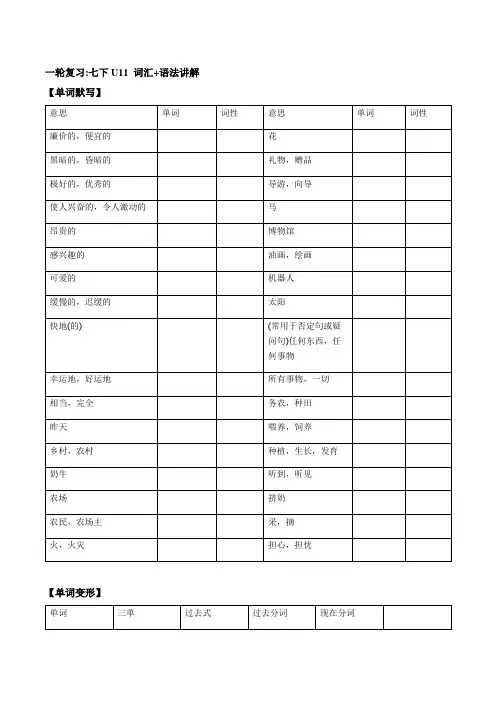
一轮复习:七下U11 词汇+语法讲解
【单词默写】
意思 单词 词性 意思 单词 词性
廉价的,便宜的 花
黑暗的,昏暗的 礼物,赠品
极好的,优秀的 导游,向导
使人兴奋的,令人激动的 马
昂贵的 博物馆
感兴趣的 油画,绘画
可爱的 机器人
缓慢的,迟缓的 太阳
快地(的) (常用于否定句或疑问句)任何东西,任何事物
幸运地,好运地 所有事物,一切
相当,完全 务农,种田
昨天 喂养,饲养
乡村,农村 种植,生长,发育
奶牛 听到,听见
农场 挤奶
农民,农场主 采,摘
火,火灾 担心,担忧
【单词变形】
单词 三单 过去式 过去分词 现在分词 farm
feed
grow
hear
milk
pick
worry
单词 复数 单词 复数 单词 复数
countryside fire museum
cow flower painting
farm gift robot
farmer guide sun
horse
单词 比较级 最高级 单词 比较级 最高级
cheap exciting
dark expensive
lovely fast
slow luckily
【单词变性】
exciting 形容词变动词 __________________
interested 形容词变动词 __________________
slow 形容词变副词 __________________
luckily 副词变形容词 __________________
painting 名词变动词 __________________
人教版七年级下册英语11、12单元知识点总结
WORD格式
专业资料整理
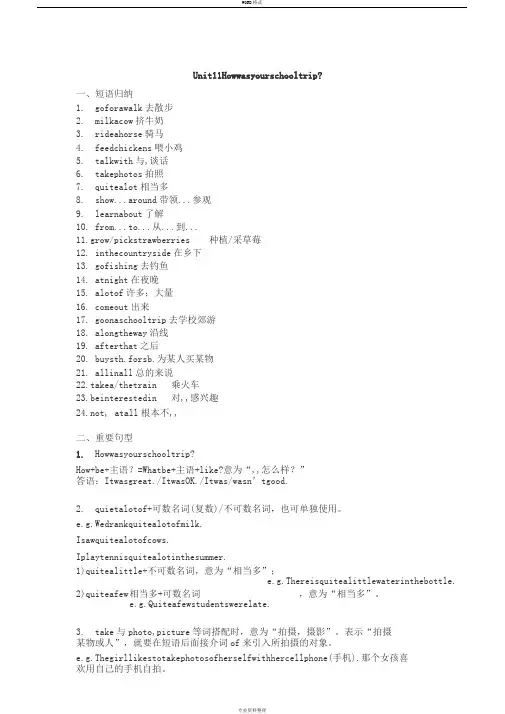
Unit11Howwasyourschooltrip?
一、短语归纳 1. goforawalk去散步 2. milkacow挤牛奶 3. rideahorse骑马 4. feedchickens喂小鸡 5. talkwith与,谈话 6. takephotos拍照 7. quitealot相当多 8. show...around带领...参观 9. learnabout了解 10. from...to...从...到... 11.grow/pickstrawberries 种植/采草莓 12. inthecountryside在乡下 13. gofishing去钓鱼 14. atnight在夜晚 15. alotof许多;大量 16. comeout出来 17. goonaschooltrip去学校郊游 18. alongtheway沿线 19. afterthat之后 20. buysth.forsb.为某人买某物 21. allinall总的来说 22.takea/thetrain 乘火车 23.beinterestedin 对,,感兴趣 24.not, atall 根本不,, 二、重要句型
1. Howwasyourschooltrip?
How+be+主语?=Whatbe+主语+like?意为“,,怎么样?”答语:Itwasgreat./ItwasOK./Itwas/wasn’tgood. 2. quietalotof+可数名词(复数)/不可数名词,也可单独使用。
e.g.Wedrankquitealotofmilk.
Isawquitealotofcows.
Iplaytennisquitealotinthesummer. 1)quitealittle+不可数名词,意为“相当多”; e.g.Thereisquitealittlewaterinthebottle. 2)quiteafew 相当多+可数名词 ,意为“相当多”。 e.g.Quiteafewstudentswerelate.
人教版七年级下册英语Unit 11词汇运用专项练习(含答案)
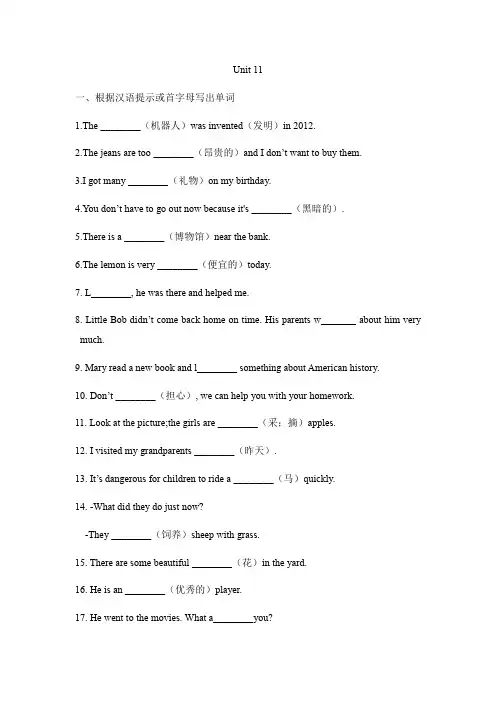
Unit 11
一、根据汉语提示或首字母写出单词
1.The ________(机器人)was invented(发明)in 2012.
2.The jeans are too ________(昂贵的)and I don’t want to buy them.
3.I got many ________(礼物)on my birthday.
4.You don’t have to go out now because it's ________(黑暗的).
5.There is a ________(博物馆)near the bank.
6.The lemon is very ________(便宜的)today.
7. L________, he was there and helped me.
8. Little Bob didn’t come back home on time. His parents w_______ about him very
much.
9. Mary read a new book and l________ something about American history.
10. Don’t ________(担心), we can help you with your homework.
11. Look at the picture;the girls are ________(采;摘)apples.
12. I visited my grandparents ________(昨天).
13. It’s dangerous for children to ride a ________(马)quickly.
14. -What did they do just now?
-They ________(饲养)sheep with grass.
15. There are some beautiful ________(花)in the yard.
人教版 英语 七年级下册 11单元知识点笔记

Unit11
1. 一般过去时
意义:表示过去某个时间里发生的动作或存在的状态。
结构: v +ed
时间标志词:1.yesterday 昨天 , the day before yesterday 前天, in the past在过去, just now 刚才
st+时间, last week, 上周, last year 去年, last month 上个月
3.时间+ago, 3 days ago 三天前, a year ago 一年以前, one hour ago 一小时前
4.in+ 过去的年,月。 In 2017, 在2017年
动词原形变过去式的变化规则:
1)一般情况加ed look----looked play----played
2) 以e结尾的, 直接加d, live- lived use---used
3) 以辅音字母加y结尾的,变y为i, 再加ed, study---studied, worry---worried
4) 以辅元辅,重读闭音节结尾的,双写最后一个字母,再加ed, stop—stopped,
5)不规则变化, have-had, is—was, are---were, do---did, go- went, come---came,
注意:ed的读音, 以清辅音加ed的读/t/, 如 look—looked /lukt/
以浊辅音或元音加ed的读/d/,如 live---lived /livd/ play—played /pleid/
2. 过去式变一般疑问句, 用Did来引导, 后面动词变回原形。
例:I had much homework to do yesterday. --Did you have much homework to do yesterday?
新人教版英语七年级下册必背金句及练习 unit11
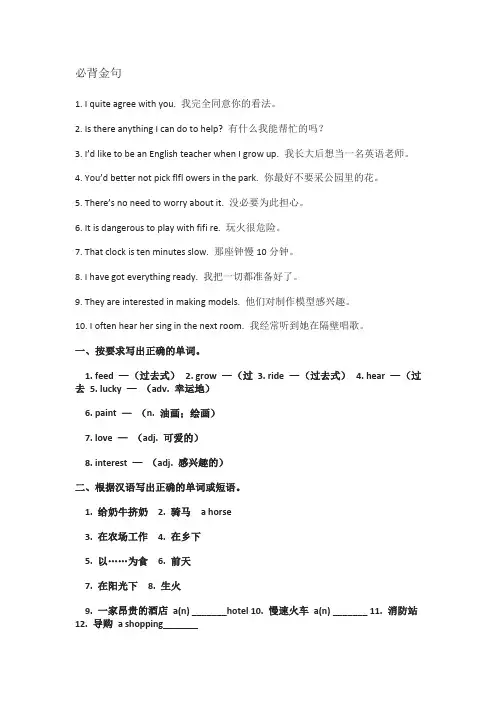
必背金句
1. I quite agree with you. 我完全同意你的看法。
2. Is there anything I can do to help? 有什么我能帮忙的吗?
3. I’d like to be an English teacher when I grow up. 我长大后想当一名英语老师。
4. You’d better not pick flfl owers in the park. 你最好不要采公园里的花。
5. There’s no need to worry about it. 没必要为此担心。
6. It is dangerous to play with fifi re. 玩火很危险。
7. That clock is ten minutes slow. 那座钟慢10分钟。
8. I have got everything ready. 我把一切都准备好了。
9. They are interested in making models. 他们对制作模型感兴趣。
10. I often hear her sing in the next room. 我经常听到她在隔壁唱歌。
一、按要求写出正确的单词。
1. feed — (过去式) 2. grow — (过 3. ride — (过去式) 4. hear — (过去 5. lucky — (adv. 幸运地)
6. paint — (n. 油画;绘画)
7. love — (adj. 可爱的)
8. interest — (adj. 感兴趣的)
二、根据汉语写出正确的单词或短语。
1. 给奶牛挤奶 2. 骑马 a horse
3. 在农场工作 4. 在乡下
5. 以……为食 6. 前天
7. 在阳光下 8. 生火
9. 一家昂贵的酒店 a(n) _______hotel 10. 慢速火车 a(n) _______ 11. 消防站
人教版英语七年级下册 Unit11 section B 知识点
1 Unit11 How was your school trip?
(Section B)
1. visit a fire station参观消防站
fire (un.)物质名词“火”, (cn.)“炉火;火灾” (v.)开火
Eg: Don’t play with fire, because it’s very dangerous. 不要玩火,因为它很危险。
There was a big fire in the next street last night. 昨晚邻街起了大火。
拓展:关于fire 的常见短语:
be on fire 着火 catch a fire 着火 make a fire生火
put out the fire 灭火 play with fire玩火
2. saw some paintings 看到一些油画
painting(cn.) 意为“油画;绘画”
Eg: There are some paintings on the wall.墙上有一些油画。
拓展:①paint (v.),“绘画;给......上油漆”指用颜料或涂料作画,其余的‘画画’常用draw
Eg: My elder sister is learning to paint in a school.我姐姐正在一所学校里学绘画。
He painted the wall red.他把墙漆成了红色。
②painter (cn.)“画家;油漆工”, drawer抽屉
3. exciting 令人激动的
辨析: exciting与excited
两者都用作形容词,都有“兴奋”之意,但用法不同
exciting 使人兴奋的;令人激动的 常说明事物具有的特征 在句中可作定语或表语
excited 兴奋的;激动的 常说明人的感受 在句中常作表语,此时主语通常为人
人教版七年级下册英语Unit 11 知识点语法归纳总结
人教版七年级下册英语Unit 11 知识点语法归纳总结
2)We went for a walk in the countryside.我们在乡下散步。
3)I XXX.我了解了如何挤牛奶。
4)XXX farm.我们在农场骑马、喂小鸡。
5)XXX families.我们采摘了草莓,为家人买了一些。
6)After that。XXX us around the farm.之后,我们的导游带领我们参观了农场。
7)All in all。it was a great school trip.总的来说,这是一次非常棒的学校郊游。
I ate quite a lot last night and didn't XXX。We also saw quite
a lot of sheep in the XXX。I milked a cow.
As a noun。XXX。For example。I'd like a cup of milk。As
a verb。milk means to extract milk from a cow。For instance。I
helped the XXX.
XXX XXX。XXX。For example。she went to the garden
and picked some strawberries.
Pick up is a fixed phrase that means to XXX something that is
on the ground。The object of pick up can either be placed een pick
and up or after pick up。For instance。please pick up the wallet or
please pick the wallet up。If the object is a pronoun。it must be
人教版新目标go for it 七年级下册Unit11 单词拼写,课文填空和知识点总结梳理
人教版新目标七年级下册Unit 11 How was your school trip?
单词拼写1
1. Carol’s father is a f _______.He has to feed the cows every day.
2. I like life in the city, but my parents like life in the c________.
3. The robot is very e__________. It’s not cheap
4. There are many f _______in my garden in spring.
5. You will need a tour g_____ if you visit a new city.
6. Yesterday, I went to the history m _______with my classmates.
7. It’s d ____here. I can’t see anything
8. To save birds, we should g______ more trees
9. Peter is good at all his subjects. He is an e ______student.
10. I don’t think there is still anything I have to buy .I have e __________I want.
【答案】1.farmer 2.country 3.expensive 4.flowers 5.guide 6.museum 7.dark 8.grow
9.excellent 10.everything
单词拼写2
1. I like spring(春天)best, because e________in it is new and fresh.
(完整版)最新人教版七年级下册英语Unit11所有知识点、句型精学笔记
1
七年级英语unit11精学笔记
精学要求 1.每个例子后面要对子互讲。
2.每一知识点,都要求互检互签,互检在知识点的右侧空白处签上检查人员的名字。
精学笔记 基础知识一 单词
1挤奶 ________ 2奶牛_________3马_______ 4喂养_______
5农民_________ 6相当,完全_____ 7任何东西_______
8种植,生长________9农场_______ 10采摘________
11极好的;优秀的__________ 12乡村;农村___________13昨天___________
14花__________ 15担心________ 16幸运的_______17太阳_________
18火灾_____________19博物馆_________ 20油画________
21使人兴奋的__________22可爱____________23昂贵的____________
24便宜的______________25缓慢的___________ 26快的_______
27机器人_______28导游_______29礼物_______30所有事物___________
31感兴趣的_____________ 32黑暗的_________ 33听见__________
知识点一精炼:
1.—What’s your father’s job?
--He’s a _______(farm).
2.There are some ___ and ___ in the fridge(冰箱)。
A .tomatos ; milk B. tomatos ; milks
C. tomatoes ; milk D. tomatoes ; milks
互检互签__________
2019-2020年人教版英语七年级下册Unit11知识点复习与练习(无答案)
2019-2020学年人教版英语七年级下册
知识点复习与练习
Unit 11 How was your school trip?
主编人: 审稿人:
学习目标
1. 知识目标
基本词汇:milk, cow, horse, feed, farmer, quite, anything, grow, farm, pick,
excellent, coutryside, yesterday, flower, worry, luckily, sun, museum,
fire, painting, exciting, lovely, expensive, cheap, slow, fast, robot,
guide, gift, everything, interested, dark, hear
基本词组:milk a cow, ride a horse, feed chickens, quite a lot (of…), in the
countryside, fire station, all in all, be interested in
基本句型:How was your school trip ? It was great !
Did you go to the zoo ? No, I didn’t. I went to a farm.
Did you see any cows ? Yes, I did. I saw quite a lot.
Did Carol ride a horse ? No, she didn’t. But she milked a cow.
Were the strawberries good ? Yes, they were . No, they weren’t.
2. 技能目标: 能运用一般过去时描写过去发生的事情,分析总结写出自己的学校旅行日记。e
3. 情感目标: 学会客观地表达对事物的看法,培养乐观向上的性格