
【最新】牛津译林版八年级英语下册Unit4 task精品课件.ppt
译林版牛津英语八年级下册教学课件 Unit 1 Task 课件
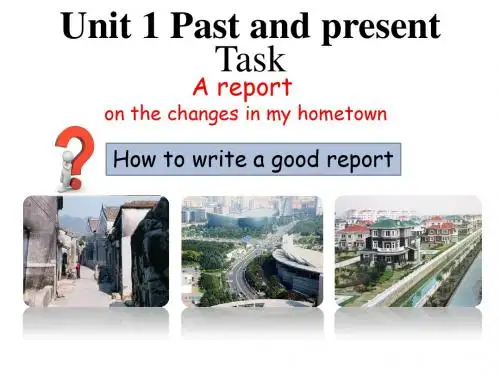
Para 3
Life
Main body (facts)
Para 4
Transport
Para 5 Conclusion (opinion)
Introduction (topic)
Many changes have taken place in .... ... has changed a lot over the years.
Add more details.
Airport has been in service since 2012. The city subway is also
being built. It’s exciting to see that Yangzhou is becoming a
modern city. Years ago, people
Transport
? The changes have brought people a happy life. The changes have
got Yangzhou plenty of attention, too. Every year, lots of people from all over the world come to visit Yangzhou and it has become
In the past, there were …. But now there are ….
People used to ....
The government has built .... 3
Make a fact file
Past
Present
Topic
Moonlight Town has changed a lot over the years.
Unit4知识归纳牛津译林版八年级英语下册
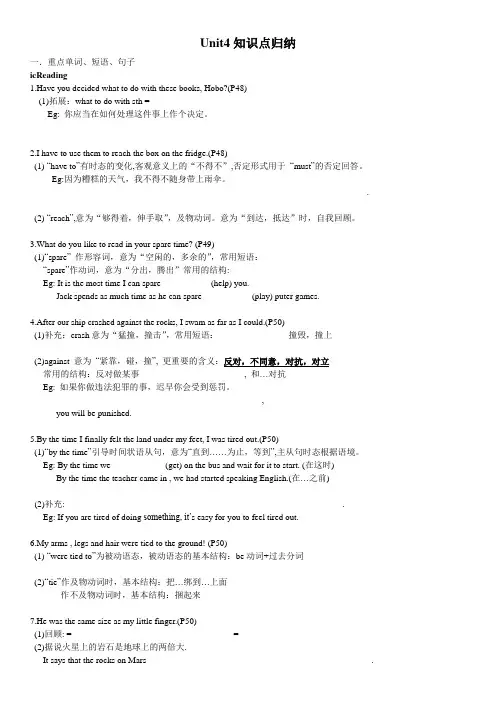
Unit4知识点归纳一.重点单词、短语、句子icReading1.Have you decided what to do with these books, Hobo?(P48)(1)拓展:what to do with sth =_______________________________Eg: 你应当在如何处理这件事上作个决定。
______________________________________________________________________2.I have to use them to reach the box on the fridge.(P48)(1) “have to”有时态的变化,客观意义上的“不得不”,否定形式用于“must”的否定回答。
Eg:因为糟糕的天气,我不得不随身带上雨伞。
_____________________________________________________________________.(2) “reach”,意为“够得着,伸手取”,及物动词。
意为“到达,抵达”时,自我回顾。
3.What do you like to read in your spare time? (P49)(1)“spare”作形容词,意为“空闲的,多余的”,常用短语:__________________________“spare”作动词,意为“分出,腾出”常用的结构:_____________________________________ Eg: It is the most time I can spare ___________(help) you.Jack spends as much time as he can spare ___________(play) puter games.4.After our ship crashed against the rocks, I swam as far as I could.(P50)(1)补充:crash意为“猛撞,撞击”,常用短语:_______________ 撞毁,撞上(2)against 意为“紧靠,碰,撞”, 更重要的含义:反对,不同意,对抗,对立常用的结构:反对做某事________________________, 和…对抗_____________________ Eg: 如果你做违法犯罪的事,迟早你会受到惩罚。
最新牛津译林版八年级英语下册 Unit 1 Past and Present grammar精品课件
has seen saw
最新初中英语精品课件设计
Task3: Learn the rules
How to form the past participle of verbs?
Most verbs
Verbs ending in e Verbs ending in a consonant + y
最新初中英语精品课件设计
Task4: Finish Part A on page 14
1 borrow borrowed 2 hope hoped 3 make made 4 get got 5 plan planned 6 cry cried
7 send 8 watch 9 say 10 grow 11 hit 12 enjoy
一、写出下列词的过去分词 1. be______b_e_e_n____2. become_b_e_c_o_m__e____ 3. begin____b_eg__u_n__ 4. blow___b_l_o_w_n______ 5. build____b_u_il_t____6. choose__c_h_o_se_n_____ 7. cost_____c_o_st_____8. do_____d_o_n_e_______ 9. drink____d_ru_n_k____10. eat___e_a_t_en________ 11. drive___d_r_iv_e_n___12. fall____fa_l_le_n_______ 13. fly_____fl_o_w_n____14. forget_f_o_r_g_o_tt_e_n____ 15. know___k_n_o_w_n____
上海牛津沪教版八年级(下)同步课件unit4
第四讲Unit4 newspapers教学过程一、课堂导入教师讲述一个与本节课题目有关的英文小故事,引出今日所要讲解的知识点,然后让学生简单梳理一下所涉及的问题,带着问题学习本节课的内容。
二、复习预习教师引导学生复习上节课学的重点内容,检测单词的用法,(以提问、回顾的形式进行),针对上节课的作业进行讲评、订正、答疑,并通过英文小故事导入本节课所要学习的新知识。
三、知识讲解1、知识点一:重点单词1)publish[pʌblɪʃ]【词性】v【词义】出版;发表2)hold [həʊld]【词性】v【词义】举行【经典例句】They held a meeting.他们举行了一个会议。
3)elect [ɪˈlekt]【词性】v【词义】选举;挑出,挑选;决定【易混淆点】choose, select, electchoose 含有运用判断力在一些人、物或行为方式中选出一个的意思:e.g. choose any one you like任你选一个你喜欢的select 侧重于从许多不同种类中进行选择时的挑剔态度:e.g. Four skiers will be selected to represent each country.每个国家将选出四名滑雪者作为代表。
elect 强烈地暗示着通常在两者之间作出挑选时的深思细想:e.g. I elected not to go.我决定不去。
【经典例句】We elected Joyce to be the chief editor.我们选举Joyce 成为总编辑。
4)chief [tʃi:f]【词性】adj.【词义】最重要的;主要的【易混淆点】chief, main两者均可用作形容词,意为“主要的”、“首要的”,注意以下用法:①两者通常都只用作定语,一般不用作表语,有时可互换。
e.g. the chief [main] task主要任务e.g. the chief [main] problem 主要问题② 用于人时,通常用chief而不用main。
牛津译林版八年级英语下册Unit4重点知识点汇总
牛津译林版八年级英语下册Unit4重点知识点汇总1.使学生掌握本单元掌握Comic strip—Task 重要的短语搭配与重点词汇的意思与运用;2.对单元重点句型能够细致的理解,并能模仿句型进行写作;3.能够将每个知识点灵活地运用到单项选择和词汇运用等基础题型当中。
Comic strip —W elcome to the unit 教材知识详解1. Have you decided what to do with these books, Hobo?霍波,你决定怎样处理这些书了吗?decide 此处用作及物动词,意为“决定”,后跟名词、代词、不定式或从句等。
decide 的名词形式是decision ,意为“决定”。
make a decision (to do sth.)意为“做决定(去做某事)”。
如:She decided to live in London.她决定住在伦敦。
do with 意为“处理;处置;对待”等,常与疑问词what 连用。
如:What did you do with those newspapers?你把那些报纸怎么处理了?do with 的同义词组是deal with ,但deal with 常与疑问词how 连用。
What will you do with those books?= How will you deal with those books?你将怎样处理那些书?2. I have to use them to reach the box on the fridge.我必须用它们来够电冰箱上的盒子。
reach 此处用作及物动词,意为“接触,拿到”。
reach 作及物动词,还意为“到达,抵达”,后面跟表示地点的名词。
如:I’m too short. I can’t reach the apple.我太低了,够不着那个苹果。
They reached London last night.他们昨天晚上到达了伦敦。
牛津译林版英语八年级下册Unit4【吃透语法】:too...to结构用法详解
【吃透语法】:too…to结构用法详解too...to…意为“太……而不能……”,其结构的基本形式是:too+adj./adv.+to do sth.,它在形式上是肯定的,但在意义上是否定的。
使用该结构应注意以下几点:1.当主语本身是动词不定式的逻辑宾语时,不定式后不接宾语,此时的不定式如果是不及物动词,动词之后应加上适当的介词,这时的主语就变成了介词的宾语。
The water in the glass is too hot to drink.玻璃杯内的水太热了不能喝。
(drink是及物动词)The house is too old to live in.这房子太旧了不能住。
(live是不及物动词,其后需接介词in)2.当主语不是不定式的逻辑宾语,而不定式是及物动词时,动词之后要接宾语。
The hall is too small to hold so many students.大厅太小了不能容纳这么多学生。
3.动词不定式之前可以带逻辑主语,表示不定式动作的执行者,常用for sb。
The house is too expensive for him to buy.对他来说这房子太贵了,买不起。
4.如果在too之前加上not,该结构就不再有否定意义。
Chinese is not too difficult to learn.汉语并不太难学。
5. “to o…to...”结构可以与“so... that... ”结构及“not... enough to do sth”互换。
My brother is too young to join the army.=My brother is so young that he can’t join the a rmy.=My brother is not old enough to join the army.我弟弟太年轻了不能参军。
【拓展】l)to o…not to do sth.意为“太......不会不......”。
牛津译林版八年级英语下册Unit1 Task精品课件
Unit 1 Task
Changes in my hometown
Moonlight Town’s past and present an old photo
a recent photo
Topic
Amy ‘s fact file
Many changes have taken place in Moonlight Town over the years.
Past
Present
narrow and dirty wide and clean streets;
1. Have your parents returned from abroad? Not yet.
2. A river runs through the town centre.
3. My dad used to go to work by car, but now he takes a bus.
然而,在过去的三十年中,我的家乡发生了巨大 的变化。马路已经变得宽阔整洁,道路两边高楼 林立。大多数人已搬进了社区,住进了现代化的 公寓,出行公交车或打的,甚至有些买了小汽车。
杨舍西街 (1982年)
houses
the countryside
不习惯读书进修的人,常会自满于现状,觉得再没有什么事情需要学习,于是他们不进则退。经验丰富的人读书用两只眼睛,一只眼睛看到纸面上的话,另 一眼睛看到纸的背面。2022年3月30日星期三2022/3/302022/3/302022/3/30 书籍是屹立在时间的汪洋大海中的灯塔。2022年3月2022/3/302022/3/302022/3/303/30/2022 正确的略读可使人用很少的时间接触大量的文献,并挑选出有意义的部分。2022/3/302022/3/30March 30, 2022 书籍是屹立在时间的汪洋大海中的灯塔。
译林版八年级英语下册 Unit 4 A good read+Period 3 Grammar
how what when where which who
ask for find hand in read travel write about
Unit4 A good read Period 3 Grammar
课文呈现
Grammar A. Using question words + to-infinitives
We can use a question word with a to-infinitive after a verb. Millie has decided what to read. Daniel did not say who to talk to about this book. Simon forgot when to meet his friends.
how what when where which who ask for find hand in read travel write about
Amy: Thank you. Anyway, I know (6) ___w_h_o__to__a_s_k_f_o_r__ help with writing. Mr Wu is always there to help us.
how what when where which who
ask for find hand in read travel write about
Amy: You can try our school library or Sunshine Library. Oh, did you know Peter is reading Around the World in Eighty Days? He wants to find out (3) __h_o_w__t_o_t_r_a_ve_l__ around the world in such a short time.
2023年牛津译林版八年级英语下册Unit4 task教案
Unit4 task教案1.Learning aims1) To get the Ss to finish a survey on the reading habits.2) To learn how to write a report about reading habits according to Millie’s report.3) To develop the Ss’ writing skills.2.Teaching key points and difficult points1)To help the students learn how to write a report about reading habits according to Millie’s report.2)To help the students develop their skills especially, writing skills.3.Teaching Proceduresstep1 lead inTeacher asks students some questions by showing a video of the film called Harry Potter. By doing this, teacher lea ds in the names of different types of books.Step2 presentationA.Give some pictures and the stude nts learn the new wordsB. Make a dialogue to practiseStep3 Doing a survey1. Look at the survey. Help the students understand all the questions first , then finish it according to their own case.2. The students answer all the questions .3. The students talk about their reading habits.Step4 Listening and reading (1)--Part B1.listen and read paragraph1,then answer the given questions2.listen and read para graph2, then choose the correct answer.3.read the third paragraph and fill in the banks.Step5 Rea ding(2)The students read part B and match the main ideasStep6. WritingUse Millie’s report as a mod el. The students learn the useful express ions to get ready for the coming writing.They do the exercise orally paragraph by paragraph first, then write dow n their own reading habits .Step7. checkStep8 homework。
江苏省兴化市昭阳湖初级中学(牛津译林版)八年级英语下
tried to p_u_ll_o_n_e__h_a_nd__f_r_ee;
began to __sh_o_u_t__
managed to _br_e_a_k__th_e__r_op_e_s_;
_li_f_te_d_____ his left hand;
were coming straight towards him…
After Gulliver’s ship…
Para.1
Para.2
swam – tired out
woke up – could not move
– fell down – went to sleep — be tied
Para.3-4
Para.5
felt-lookedmove up-started down-saw climbing-fall over
If you are tiny men,
what will you talk about ?
small men Para.5
Gulliver
began t_a_lk_i_ng__t_o_h_i_m;
could not u_n_d_e_r_st_a_n_d_____;
didn’t know _w_h_at__t_o_s_a_y____;
couldn’t understandmanaged to-
began talking
-shouted -continue moving lifted-looked down
kind
calm
镇静的
brave
(勇敢的)
I think Gulliver was …because he …
.tw/English_Literature /englit_1/gulliver.htm