
仁爱版八年级上册Unit 4 Topic 3 Section B
5.’Really? ’Which was the ’most ’serious ? 6. A ’reporter said ’scientists
could ’put ’little ’computers ’right into
1b
Listen to 1a and complete the table. Name
Jane Micr heard online
录音1a-P99
photo of ______ Mars saw a new ______ birds studied pictures of ______
2 Work in pairs and make up conversations with the sentences in the box.
Example
A: I’m sure there are many interesting
things to see on the Internet.
B: I’m not sure whether/if it is good to
Read and act out the conversation in pairs.
I’m sure you can find lots of information on the Internet now.
be sure ( that ) + 句子 确信…… ; 肯定…… 不确定……是否…… I’m not sure if that is a good idea. be not sure if/whether + 句子
Will people have computers in their bodies some day ?
将来某天
3
Discuss in groups about what you saw or heard on the Internet. Then make a report and present it to the class.
Write another passage from Jane’s point of view.
You can begin like this : Last night, Maria, Michael and I saw a new photo of Mars on the Internet.We think it looks like a big red plate of pizza.Though(尽管)Mars is far from us,we´re sure people will fly to it some day.
A: I saw/looked at/watched…
B: I’m sure … C: I visited the website and a reporter said … D: I’m not sure if/whether … …
4a
Read the pairs of words and pay attention to the difference between / w /and / v /. 录音4a-P100
We can enjoy movies on the Internet.
We can study on the Internet.
From Section A, we knew something about the uses of the Internet.
We can chat with our friends.
Last night, Jane saw ____________________________ a new photo of Mars on the
looked at photos online ________ Internet and Michael also ____________________
scientists could put Kangkang heard that _________ little computers right into heads our______ movie Maria watched a _______
1c Rewrite the conversation into passage based on 1b . 视频1a-P99
for his science lesson. Kangkang visited his favorite website and heard a reporter said that __________ scientists ________________________________________. could put little computers right into our heads He was not sure if that was a good idea. Maria _______ watched _________ a movie online and she was sure no scientist was going to put a computer into her head.
Section B
From Section A, we knew something about the uses of the Internet.
We can do shopping at home.
The Internet can help us find the way.
From Section A, we knew something about the uses of the Internet.
Eg : 我确信他会来参加我的生日晚会。
am sure ( that ) he will come to my birthday party. I _______________
他不确定他是否去我的生日晚会。 He ____________________ is not sure if/whether he will go to my birthday party.
单项选择: ( D) 1. I’m sure _______ we will win the game. A. that B. / C. whether D. Both A and B (C ) 2. I’m not sure _______ he comes from Canada. A. that B. / C. whether D. Both A and B (B ) 3. Will everyone in the world use the Internet _____ the future? A. on B. in C. for D. at (C ) 4. Do you know ____ to protect yourselves from the earthquake? A. what B. who C. how D. when ( D) 5 Don’t let him ______. I want him ______ here for one more night. A. leaves; stays B. leave; stay C. to leave; to stay D. leave; to stay
What did each of them do last night ?
学习目标 1. Learn some new words: website, pizza, reporter, Mars 2. Sentence structures. (1)I’m sure you can find lots of information on the Internet Now. (2)I’m not sure if/whether that is a good idea. 3. Useful expressions. Guess what! 4. Pronunciations: (1) /w/--/v/ wet—vet west— vest wine---vine (2) The rising tone and the falling tone. (升调和 降调)
/ w / - / v / : wet- vet wine- vine
west- vest
4b
Listen to the sentences, paying attention to the liaison, weak form, stress and intonation. Then read after the tape and imitate. 录音4b-P100
shop online.
将来
Will everyone in the world use the Internet in the future ? Are there any good movie websites online ? Can we find interesting books on the Internet ?
1.’Good ’morning .
’Good ’evening.
2.Will ’everyone in the ’world ’use
the ’Internet in the ’future ?
3.Well. ’Some people ’watch ’TV ’online.
4.Do you know ’how to ’protect ’ourselves
We can listen to music to relax.
From Section A, we knew something about the uses of the Internet.
We can read books we like.
仁爱版八年级英语上册Unit4Topic2SectionB优质教案
八年级上册教案设计Unit 4 Our WorldTopic 2 How can we protect ourselves from the earthquake?Section BⅠ. Material analysisSection B的主要教学活动为1a, 3a和3b。
本节课主要通过Miss Wang和班里的学生之间的谈话引出玉树地震的话题,在对话中了解玉树地震的信息。
简单讲述了如何在地震中逃生的问题以及复习双多音节形容词的比较级和最高级形式。
第二部分通过听力训练的方式要求学生学习表达关心的句子。
3a部分主要通过图片、音标的提示,展示了有关灾难的名词。
复习了/ð/ /θ/的不同发音以及升降调、连读和不完全爆破。
教师在讲解音标的时候可以借助多媒体或者图片,让学生直观地感受唇形、齿形和口型。
Ⅱ. Teaching aimsKnowledge aims:1. 能根据音标正确朗读出单词表中本课的单词:level, sad, calm, typhoon等。
2. 能在老师的引导下,读出句子的升降调、连读和不完全爆破,分清/ð/ /θ/之间的区别。
3. 能正确拼读并运用单词表中的黑体单词:level, sad等。
能根据音标正确地书写typhoon, flood 等。
4. 能掌握双多音节形容词的比较级和最高级的变化规则,能在具体句子中正确地应用。
5. 能正确运用本课所学知识谈论地震的话题,能够用所学知识向受灾的人们给予关爱。
Skill aims:1. 能听懂有关谈论地震的话题及用形容词比较级最高级谈论关于灾难的话题。
2. 能谈论灾难的情况,并能用所学知识表达自己的关怀。
3. 能正确朗读课本的文本材料及含有/ð/ /θ/的句子的正确发音。
4. 能用形容词的比较级和最高级写一篇有关灾难程度的文章。
Emotional aims:1. 通过本课学习,了解自然灾害带给人类的危害,学会沉着应对困难。
仁爱版英语八年级上册Unit4OurWorldTopic3SectionC优秀教学案例
(五)作业小结
1.教师布置作业,让学生运用所学知识,写一篇关于澳大利亚和巴西文化差异的意作业的完成时间和质量,鼓励他们独立思考和解决问题。
3.教师对学生的作业进行批改和评价,给予及时的反馈,帮助他们提高作业质量。
3.教师通过观察学生的合作过程,了解他们的合作能力和团队精神,为他们提供反馈和指导。
(四)反思与评价
1.教师鼓励学生在课堂结束后,进行自我反思,思考自己在课堂上的表现和学习收获,提高他们的自我评价和自我调整能力。
2.教师组织学生进行同伴评价,让他们互相评价对方的学习成果和合作表现,培养他们的评价能力和批判性思维能力。
二、教学目标
(一)知识与技能
1.学生能够掌握并运用本节课的核心词汇,如culture, tradition, festival等,听懂并正确说出不同国家的文化特点。
2.学生能够理解并运用比较级结构,描述两个国家的文化特点,如Australian culture is different from Brazilian culture.
3.教师根据学生的学习表现和成果,给予及时的反馈和评价,鼓励他们的优点,指出他们的不足,帮助他们不断提高。
四、教学内容与过程
(一)导入新课
1.教师通过展示澳大利亚和巴西的图片、视频等资料,引导学生关注两个国家的文化特点,激发他们的学习兴趣。
2.教师提出问题,如“你们对澳大利亚和巴西的文化了解多少?”让学生分享自己的观点和经验,引发课堂讨论。
3.学生能够尊重和理解其他国家的文化,培养他们的包容心和宽广的国际视野。
4.学生能够运用所学知识,积极参与实际场景的交际,提高他们的社交能力,为他们未来的学习和生活打下坚实的基础。
最新仁爱英语八年级上册第二单元Unit-2-Topic-3-SectionA-B课文知识点讲解

八年级上册第二单元Topic 3 SectionA-B一、重点句型及知识点讲解1. May I ask you some questions, Dr. Li ? ---- Sure, go ahead. 我能问你一些问题吗,李医生?当然,请问吧。
(1) 1)疑问句和否定句中,表“一些”,常用any, 不用some. 但当此疑问句表建议或请求时,Some不改成any. 如:Would you like some tea ?2)question意为“问题,疑问”,指较易解决的问题及口头回答的问题。
如:Can you answer the question?你能回答这个问题吗?【辨析】problem和question都当“问题”讲,但它们是有区别的。
Problem 通常指难以解决的问题,尤指比较困难的问题,如社会、政治和经济等。
与它搭配的动词一般是work out或solve;而question常指对某事疑惑不解需要寻找答案的问题,它常与动词ask或answer搭配使用。
如:We must solve the problem of heavy traffic in Beijing as soon as possible.我们必须尽快解决北京的交通拥挤问题。
This is a difficult question to answer.这个问题很难回答。
(2) Sure , go ahead 当然可以,请问吧!Go ahead.(口语)表示同意对方的请求,根据情况可译为“说吧”!“做吧”! 如:__Can I read the sports section ? 我可以看看体育版吗?__Yeah, go ahead.请看吧!【拓展]】(1)go ahead and do sth .赶紧做某事。
如:Go ahead and eat before everything gets cold.趁东西还没凉赶紧吃。
(2)go ahead of 在……之前去。
Unit4+Topic2+Section+D+教案 仁爱版英语八年级上册+
初中英语仁爱版八年级上册Unit 4 Our WorldTopic 2 How can we protect ourselves from the earthquake?Section D【Teaching aims】知识与能力:1. 引导学生复习本话题的重点词汇。
2. 引导学生复习形容词的比较级和最高级的变化规则及其在句子中的具体使用。
3. 引导学生熟练谈论有关地震的话题,能用英语自由地交流如何从自然灾害中逃生。
核心素养:1. 能听懂有关灾难的话题,以及介绍如何在灾难中逃生的短文。
2. 能用英语谈论生活中发生的有关灾难的话题,如地震、火灾、暴风雪等以及用比较级和最高级谈论在灾难中如何保护自己。
3. 能够读懂跟课文水平相当的文章,如介绍火灾、洪涝、旱灾的文章等。
4. 根据所学内容用新闻的方式写出介绍某种自然灾害的文章,并能够写出如何在灾难发生的时候好好保护自己。
【Teaching key points and difficult points】Key points:1. 复习形容词比较级和最高级的用法以及本单元的功能句,如:I am sorry to hear that等。
2. 学习新闻的写作方法。
Difficult points:根据新闻的要素进行新闻写作。
【Teaching methods】Situational language learning, task-based language teaching, group discussionteaching.【Teaching procedures】Lead in:1. Get students ready for learning.2. Invite students to report his/her homework.3. Show the pictures, make a short conversation.A: The __________ is ________.B: I think the ________ is _________ than the ________.C: Yes, but the _________ is __________ of the three.Presentation:1. Give students 3 minutes to read through Sections A-C. Ask them to underline or write down the key points they think.2. Provide 1 minute for students to classify their notes.3. Make a competition. Divide students into three parts. One part writes down the new words, and another part writes down the new sentences. The last part aims to write down the phrases. There are three groups in each part.4. Ask students to look at the blackboard and check whether they can remember all of these on the blackboard.5. Show “Grammar and Functions” to students. And check the answers.6. Organize students to read “Grammar and Functions”.7. Give explanations if necessary.Presentation:1. Ask students to read the passage in 1 carefully.2. Show the first table on Page 96 to students. Make sure every student knows the meaning of the table. Complete the table.3. Invite students to share their answers.4. Listen and find out important phrases. Learn the key points.1) five million2) with the help of …3) the whole nation4) rebuild their homes5) return to normal life6) be able toConsolidation:1. Show the table in 2 to students.2. Ask students to write a piece of news similar to 1 about Tangshan earthquake. Remind students to pay attention to the elements in news.3. Invite students to share their news in class.4. Organize students to choose the best announcer and the best team.5. Praise the best announcers.6. Finish Project. Ask your friends how they feel about children from disaster areas.7. Make a short report to your class about your survey.8. Write a letter to the children in disaster areas. Give your comfort, concern and best wishes to them.9. Do some exercises.Summary:We learn:1. 复习形容词比较级和最高级的用法以及本单元的功能句。
仁爱版九年级上册英语说课稿:Unit4Topic3SectionB
我将使用以下教具、多媒体资源或技术工具来辅助教学:
1. PPT课件:用于展示课程内容、重点知识点和示例,帮助学生更好地理解和记忆。
2.视频资源:播放与课程主题相关的视频片段,增强学生的直观感受,激发学习兴趣。
3.白板和马克笔:用于板书和实时展示学生的思考过程,便于教师和学生之间的互动。
(2)如何引导学生运用情态动词“can”和“could”表达可能性。
(3)如何激发学生的写作兴趣,提高写作质量。
二、学情分析
(一)学生特点
本节课所面向的学生为九年级学生,他们正处于青春期,具有以下特点:年龄特征上,他们具有较强的求知欲和好奇心,喜欢探索新知识;认知水平上,他们已经具备了一定的英语基础,能够理解和运用基本的语法知识;学习兴趣上,他们对生动有趣的学习内容更感兴趣,对抽象的语法规则可能缺乏热情;学习习惯上,他们可能习惯于被动接受知识,缺乏主动探索和自主学习的能力。因此,在教学过程中,需要创造性地设计教学活动,以吸引学生的注意力,提高他们的学习积极性。
(3)能够用英语描述自己的梦想,并表达实现梦想的信心。
2.过程与方法目标:
(1)通过阅读短文,培养学ห้องสมุดไป่ตู้获取关键信息、概括文章大意的能力。
(2)通过课堂讨论,提高学生的口语表达能力和合作意识。
(3)通过写作训练,锻炼学生的书面表达能力,提高写作水平。
3.情感态度与价值观目标:
(1)激发学生对英语学习的兴趣,增强学习动力。
2.视频导入:播放一段关于梦想实现的励志视频,让学生在视觉和情感上得到冲击,快速吸引注意力。
3.趣味活动:设计一个小游戏或互动活动,如快速问答或小测验,让学生在轻松愉快的氛围中进入学习状态。
4.实物展示:展示与课程内容相关的实物或图片,如梦想板、时间轴等,引发学生的好奇心和探究欲望。
最新仁爱版英语八年级上册Unit3 Topic2 SectionB知识点
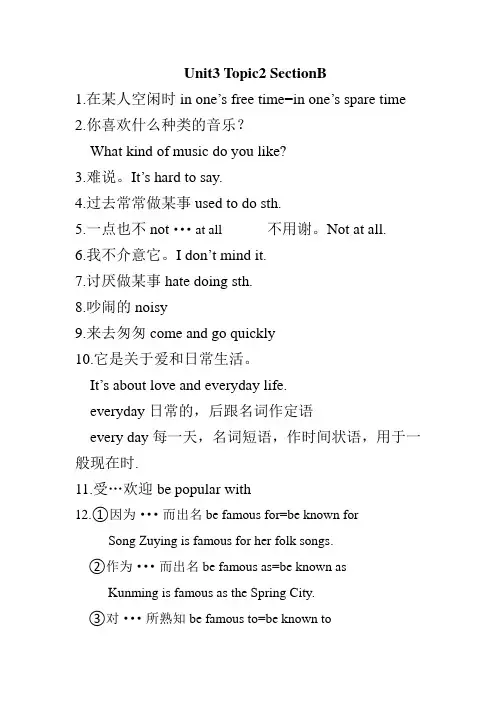
Unit3 Topic2 SectionB1.在某人空闲时in one’s free time=in one’s spare time2.你喜欢什么种类的音乐?What kind of music do you like?3.难说。
It’s hard to say.4.过去常常做某事used to do sth.5.一点也不not···at all不用谢。
Not at all.6.我不介意它。
I don’t mind it.7.讨厌做某事hate doing sth.8.吵闹的noisy9.来去匆匆come and go quickly10.它是关于爱和日常生活。
It’s about love and everyday life.everyday日常的,后跟名词作定语every day每一天,名词短语,作时间状语,用于一般现在时.11.受…欢迎be popular with12.①因为···而出名be famous for=be known forSong Zuying is famous for her folk songs.②作为···而出名be famous as=be known asKunming is famous as the Spring City.③对···所熟知be famous to=be known toBeijing Opera is famous to the people all over the world.13.music。
八年级英语上册 Unit 4《Our World》Topic 3 Section C 教案 仁爱版
Topic 3 The workers used live models, didn’t they?Section CThe main activityis 1a. 本课重点活动是1a。
Ⅰ. Teaching aims and demands 教学目标1. Learn some new words and phrases:king, ancient, be made up of, true, according to2. Learn some useful sentences:(1) The building is made up of two million stones.(2) Each stone weighs more than two tons.3.Go on learning about measurement:(1) The Great Pyramid has four sides and each side is 230.4 meters long.(2) It’s 146.5 meters high.4.Talk about the Great Pyramid:(1) The pyramids in Egypt are world-famous.(2) It is one of the“Seven Wonders”of the ancient world.(3) Until the 19th century, it was the tallest building on earth.(4) It took about 100 000 people over 20 years to build it.(5) Khufu ordered his men to build the Great Pyramid as his tomb in about 2 560 B.C.(6) Many people believe the Great Pyramid is the oldest and greatest building in the world. Ⅱ. Teaching aids 教具录音机/幻灯片/图片/小黑板Ⅲ. Five-finger Teaching Plan 五指教学方案Step 1 Review 第一步复习(时间:8分钟)师生对话,复习旧知识,导入新课。
Unit 3 Topic 1 Section B 教案2022-2023学年仁爱版八年级英语上册
Unit 3 Topic 1 What’s your hobby?Section B【教学构思】一、教材分析:本课属于课标话题人与自我——“个人兴趣(Personal interests)”中爱好(Hobbies)项目,主要谈论Maria集邮的场景并引入有关兴趣爱好的话题。
本课属于课标功能意念表“态度(Attitudes)”中喜欢和不喜欢(Likes and dislikes)项目,主要学习表示兴趣爱好以及used to的表达法。
主要教学活动为1a和3。
本节课主要通过Michael,Maria和Kangkang之间的对话,继续学习表示兴趣爱好的话题。
Section B是对Section A的延伸,谈论的内容也从谈论现在的兴趣爱好扩展到了对过去兴趣爱好的谈论,即used to do sth.和它的否定形式used not to do sth. / didn’t use to do sth.,并能够在生活中自由谈论现在和过去的兴趣爱好并能够进行书面表达。
二、设计说明:根据学情和本课的语法及话题,本节课的教学设计将听与说相结合,以1a为载体,立足话题,通过听说练习内化知识;在语言生成阶段,循序渐进,学生通过同伴合作完成学习任务。
本课在重、难点突破的方法上有所创新,教师通过导入新课时的听力和group work等,引导学生感知本课重点句型,接着通过对话和文本写作汇报,重现重点句型,让学生在活动中实践应用所学知识。
【教学目标】1.能听懂有关过去的兴趣爱好和现在的兴趣爱好进行对比的简单对话和陈述,学会以“听”的方式理解语言意义;2.能正确地口头表达有关喜欢和不喜欢及它们的过去式的话题,学会选用恰当的交际方式,关注语言的得体性;3.能正确朗读课本的文本材料,准确把握语音、语调及连读,构建语言意识,提升“说”的语言能力;4.能正确地运用书面表达写出自己和他人现在及过去的兴趣爱好,学会运用多样学习策略,提高“写”的语言能力。
仁爱版英语八年级上册 Unit2 Topic2 SectionB 教学设计
Unit2 Topic2 SectionB 教学设计Ⅰ. Material analysisSection B 是本单元第二课时和第三课时。
主要活动为Section B 的1a, 3a和3b。
本课就吸烟这个坏习惯展开讨论,呈现了本单元语法重点:情态动词must + 动词原形:I must ask him to give up smoking. 表示建议、劝告。
同时巩固了动名词做主语的句式:Smoking is bad for his health. 通过学习Section B, 让学生能够辨别好习惯与坏习惯,并能帮助亲人戒掉坏习惯。
课后要求学生会用动名词做主语造句,能用must提建议。
Ⅱ. Teaching aimsKnowledge aims:1. 能正确运用以下短语巩固动名词短语做主语的书面表达:read in the sun, give up smoking, go to school without breakfast, take a walk,study late, drink enough water2. 能正确地运用must, mustn’t进行劝告或提建议:I must ask him to give up smoking.3. 能正确辨别/7/, /3 /和/D/的发音。
4. 朗读时连读现象。
Skill aims:1. 能听懂有关影响健康的好习惯和坏习惯的话题。
2. 能熟练地运用must, mustn’t提建议。
3. 能正确朗读有关影响健康的好习惯和坏习惯的对话或文章。
Emotional aims:通过语言学习,影响学生的自身品格,要学会辨别好习惯与坏习惯,养成好习惯,戒掉坏习惯,并帮助他人戒掉坏习惯,保持健康。
Ⅲ. The key points and difficult pointsKey points:理解和运用must 表示“建议、劝告”的用法:I must ask him to give up smoking. 我得劝他戒掉烟。
Unit4 Topic1仁爱版英语八年级上册课文同步翻译知识梳理和话题写作范文
仁爱版英语八年级上册Unit4 Topic1 课文同步翻译知识梳理和话题写作范文Unit 4 Topic 1 同步翻译Unit 4 Our worldTopic 1 What's the strongest animal on the farm?Section C 1a雨林雨林是生长在世界上热带地区的茂盛森林。
降雨量很多,地面通常都是湿的。
雨林中又热又暗。
雨林覆盖了地球表面6%的面积。
它们为无数地球上其它地方没有的动植物提供了栖息地。
那里有很多高大的树木和其他不同的植物。
有无数动物居住在雨林中。
它们生活在30多米高的树上。
雨林对我们很重要。
它们是地球的肺。
雨林中的植物让空气更新鲜更洁净。
下雨时还能储存水分,促进水循环。
它们在控制气候方面扮演着重要的角色。
雨林还能保存自然美。
如果没有雨林,很多漂亮的动植物都会灭绝。
雨林为我们提供木材、食物、水果、药材和很多其他有用的东西。
有很多原因让我们离不开雨林。
但是现在,雨林变得越来越少,我们必须要保护它们。
Unit 4 Topic 1 知识梳理Topic1【重点短语】1.think about 思考,考虑2.the beauty of nature 自然美3.run after 追逐4.live a happy life 过着愉快的生活5.keep a pet dog 养宠物狗6.as we know 众所周知7.share sth. with sb. 与某人分享某物8.provide sth. for sb.= provide sb. with sth. 为某人提供某物9.nowhere else 没别的地方10.be important to sb. 对某人很重要11.keep sb./sth. doing sth. 让……一直做某事12.play an important part/role 扮演重要的角色13.die out 灭绝14.feed on (动物)以……为食15.live on (人类)以……为食16.in number 在数量方面17.be in danger 处于危险之中【重点句型】1.I think the countryside is much quieter than the city, too.我认为乡下也比城市更加安静。