
pep四年级下册unit2全英详细教案
PEP四年级下册Unit 2全英详细教案
-CAL-FENGHAI-(2020YEAR-YICAI)_JINGBIAN Unit 2单元教材分析 Teaching Contents: Unit 2 What time is it?
Teaching Aims: 1. Learn to know how to ask the time and answer the time correctly. 2. Be able to describe one’s own usual activities using the language items learned before. 3. Learn to know some new instructions like: Time for breakfast. 4. Be able to learn and make one’s own schedule for usual activities. 5. Learn to make a clock by oneself
Teaching Points: Words and letters
Teaching Difficult: 1. Learn to master the words and sentences of Read and write in listening, speaking, reading, and writing. 2. Learn to know the words and sentences in let’s learn and let’s talk. Teaching Aids: Pictures, Cards, Tape. The 3rd week and 1st plan Unit 2 What time is it?
The 1st period Teaching Contents: Part A: Let’s learn Let’s do
Teaching Aims: 1. Be able to know the key words in this period in listening, speaking and reading. 2. Learn to know the main sentences: What time is it It’s…/ It’s time for…. 3. Try to know some instructions such as: Time for breakfast.
Ability Aims: Be able to learn and make one’s own schedule for usual activities.
Emotional Aims: Guide students cherish the time.
Important points and difficult points: 1. Try to know and master the key words in this period. 2. Learn to know and use the new sentences. Teaching Aids: computer, word cards, flash cards, VCD, pictures, tape, tape-recorder etc
Teaching Procedures: Step 1: Warm-up 1. Greetings. 2. Play the tape for Ss to listen and review Story time of Unit 1, then let Ss act out the story in groups.
Step 2: Preview 1. Ask and answer. Where is Zoom? He’s in the canteen. Why?
He’s hungry. Why is he hungry? 2. Free talk: What time is it 3. It’s time for lunch. Let Ss talk about what can tell us the time. e.g. The sun, the moon, the tree etc. Step 3: Presentation Let’s learn 1. Show Ss a clock. T: Look! It’s a clock. It’s 8 o’clock. Are you hungry Why
Ss;It’s time for breakfast. T: Follow me. “It’s 8 o’clock. It’s time for breakfast.” Ss: “It’s 8 o’clock. It’s time for breakfast.” 2. T: Look! It’s 10 o’clock. Do you have English class?
Ss;Yes. It’s time for English class. T: Follow me. “It’s 10 o’clock. It’s time for English class.” Ss: “It’s 8 o’clock. It’s time for breakfast.” 4. T: Look! It’s 12 o’clock. Are you hungry Why 5. Ss;Yes. It’s time for lunch. T: Follow me. “It’s 12 o’clock. It’s time for lunch.” Ss: “It’s 12 o’clock. It’s time for lunch.” 6. T: Look! It’s 2 o’clock. Do you have music class? 7. Ss;Yes. It’s time for music class. T: Follow me. “It’s 2 o’clock. It’s time for music class.” Ss: “It’s 2 o’clock. It’s time for music class.” 8. T: Look! It’s 4 o’clock. Do you have P.E. class? 9. Ss;Yes. It’s time for P.E. class. T: Follow me. “It’s 4 o’clock. It’s time for P.E. class.” Ss: “It’s 4 o’clock. It’s time for P.E. class.” 10. T: Look! It’s 6 o’clock. Are you hungry Why 11. Ss;Yes. It’s time for dinner. T: Follow me. “It’s 6 o’clock. It’s time for dinner Ss: “It’s 6 o’clock. It’s time for dinner.”
Step 4: Practice. Let’s do 1. Listen and repeat. Let Ss listen to the tape, repeat together. Time for breakfast. Drink some milk. Time for lunch. Have some chicken. Time for dinner. Eat some rice. Time for P.E. Jump and run. Time for English. Read and write. Time for music. Sing and dance. 2. Game: (response quickly) Change the time in the clock, ask Ss: What time is it To see who can answer more quickly. 3. Guessing. Show Ss flash cards quickly, ask Ss to guess the words and new expressions.
Step 5:Homework Master the new phrases. Listen to the tape and imitate the accent.
Board-writing: Unit 2 What time is it?
music class What time is it? P.E class it’s…. English class it’s time for…. breakfast lunch dinner
Reflection: The 3rd week and 1st plan Unit 2 What time is it?
The 2nd period Teaching contents: Part A: Let’s talk Let’s play.
Teaching Aims: 1. Learn to know the new words and expressions. 2. Learn to know the main idea of the dialogue. 3. Be able to listen and read the dialogue well. 4. Be able to use the main sentences skillfully.
人教PEP版四年级下英语Unit2第4课《What time is it》教案
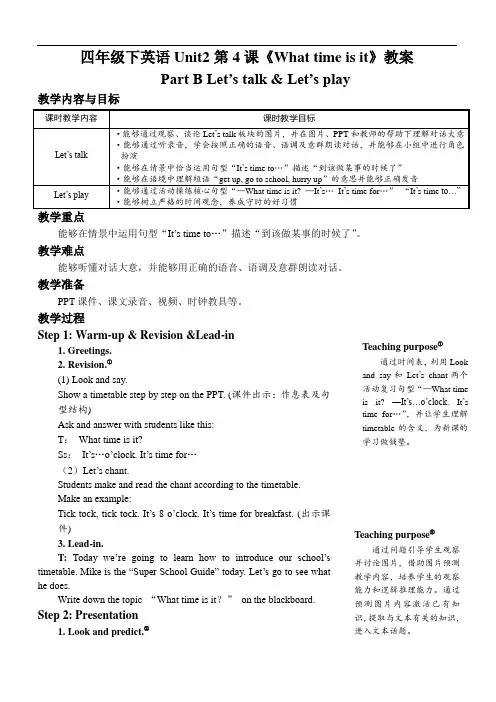
四年级下英语Unit2第4课《What time is it》教案Part B Let’s talk & Let’s play教学内容与目标教学重点能够在情景中运用句型“It’s time to…”描述“到该做某事的时候了”。
教学难点能够听懂对话大意,并能够用正确的语音、语调及意群朗读对话。
教学准备PPT课件、课文录音、视频、时钟教具等。
教学过程Step 1: Warm-up & Revision &Lead-in1. Greetings.2. Revision.①(1) Look and say.Show a timetable step by step on the PPT. (课件出示:作息表及句型结构)Ask and answer with students like this:T:What time is it?Ss:It’s…o’clock. It’s time for…(2)Let’s chant.Students make and read the chant according to the timetable.Make an example:Tick tock, tick tock. It’s 8 o’clock. It’s time for breakfast. (出示课件)3. Lead-in.T:Today we’re going to learn how to introduce our school’s timetable. Mike is the “Super School Guide” today. Let’s go to see what he does.Write down the topic “What time is it?”on the blackboard. Step 2: Presentation1.Look and predict.②Teaching purpose①通过时间表,利用Look and say和Let’s chant两个活动复习句型“—What time is it? —It’s…o’clock.It’s time for…”,并让学生理解timetable的含义,为新课的学习做铺垫。
四年级英语下册教案-Unit2 Part A Let’s learn人教PEP版

Unit2 What time is it?教学设计【教学内容】人教PEP四年级下册【课题】What time is it?【课时】第2课时:Part A: Let’s learn一、教学目标1.能听说认读本课主要词汇:breakfast,lunch,dinner,English class,PE class。
2.能听懂会说本课的会话“What time is it?It's 9 o'clock. It's time for English class.Let's go!”3.能熟练运用句型It's time for…来表示该做……了。
4.能熟练运用句型“What time is it?It's 9…o'clock.”问答时间。
5.呼吁学生养成珍惜时间,合理安排时间的好习惯。
二、教学重难点重点:能听说认读本课主要词汇:breakfast,lunch,dinner,English class,PE class.难点1、能熟练运用句型It's time for…来表示该做……了。
2、能熟练运用句型“What time is it?It's …o'clock.”问答时间。
三、教学准备教师准备教学过程中所需的教学音频、视频、课件、卡片、用于竞争机制的两个自制闹钟等。
四、教学过程Step I:Warm-up&Review1.Greetings:Good morning,boys and girls.How are you today?2.Let’s chant:What time is it? And write “What time is it?”on the blackboard.Students read it together.(通过看视频、吟唱,活跃了气氛,复习了数字1-10,让学生感知新知,为新课学习做了良好的铺垫)3.Say numbers(1-12),and then numbers become to be a clock.T:What’s this? Ss:It’s a clock.T:Good! So can you tell me what time is it?(把What time is it?卡片贴在黑板)Ss:It’s one o’clock. (以魔法的形式由复习数字引出时间的问答,对时间的问答进行复习)Step II:Presentation1.Present pictures about John’s Day and learn the words:breakfast, Englishclass,lunch,music class, PE class,dinner(1) 先出示图片和时间7:00T: This is John’s timetable.Look at the picture one.What time is it?Ss:It’s 7 o’clock.(把卡片贴在黑板上)T:It’s time for what? Ss:It’s time for breakfast.(把句型卡片先贴在黑板上,再出示breakfast的单词卡:听音跟读后,进行发音指导br/br/,ea/e/,a/ə/再进行操练:小组读,单个读,大小声,最后师生对话)T:What time is it? S1:It’s 7 o’clock. It’s time for breakfast. ......同样的方法引出English class, PE class,dinner(操练方法:拆分法,单个读,小组读,师生对话)(2)由单词English class延伸出maths class,computer class和Chinese class.同时巩固孩子对It’s...o’clock.和It’s time for...句型的用法。
人教版(PEP)四年级下册 Unit 2 A Let’s talk(教案)
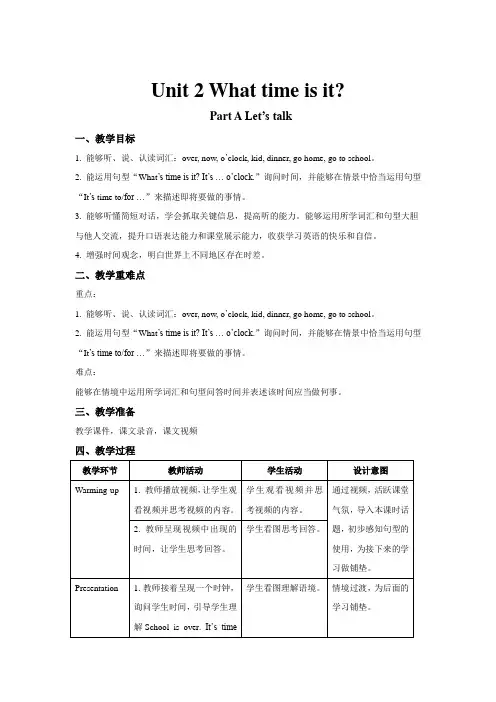
Unit 2 What time is it?Part A Let’s talk一、教学目标1. 能够听、说、认读词汇:over, now, o’clock, kid, dinner, go home, go to school。
2. 能运用句型“What’s time is it? It’s … o’clock.”询问时间,并能够在情景中恰当运用句型“It’s time to/for …”来描述即将要做的事情。
3. 能够听懂简短对话,学会抓取关键信息,提高听的能力。
能够运用所学词汇和句型大胆与他人交流,提升口语表达能力和课堂展示能力,收获学习英语的快乐和自信。
4. 增强时间观念,明白世界上不同地区存在时差。
二、教学重难点重点:1. 能够听、说、认读词汇:over, now, o’clock, kid, dinner, go home, go to school。
2. 能运用句型“What’s time is it? It’s … o’clock.”询问时间,并能够在情景中恰当运用句型“It’s time to/for …”来描述即将要做的事情。
难点:能够在情境中运用所学词汇和句型问答时间并表述该时间应当做何事。
三、教学准备教学课件,课文录音,课文视频四、教学过程五、板书设计Unit 2 What time is it?Part A Let’s talkWords:over, now, o’clock, kid, dinner, go home, go to school.Key sentences:—What time is it now? —It’s 5 o’clock.It’s time for dinner. / Time to go home.。
PEP四年级下册英语Unit 2 Part A let'slearn 教案
课件、单词卡片、磁带、录音机等。
五、教学过程:
教学环节
教师活动
学生活动
应用资源
建议与说明
1.播放Let’s chant歌曲“One Two Three Four Five”。
1.跟录音唱歌曲,边唱边做动作。
动画:
Let’s chant
将学生的视线转移到英语课堂上来,活跃课堂气氛,复习数字。
结合学生的具体情况,让学生在听的过程中自然理解时间的表达。(多做几组)
2.教师让学生仔细听Unit 2第一课时课件传出的钟声(次数为7)。提问学生:What time is it?让学生说出:It’s 7 o’clock.课件展示张鹏喝牛奶的场景,同时出现句型:
It’s time for breakfast.引出句型:It’s time for ____.和单词breakfast。(点击单词有发音)
2.句型:What time is it? It’s …. It’s time for ….
三、教学重难点:
1.重点:能听、说、认读单词与词汇:music class, P.E. class, English class, breakfast, lunch, dinner。
2.难点:新句型What time is it? It’s nine o’clock. It’s time for ….的理解和运用。
5.让学生根据张鹏的时间作息表,分别说出:
It’s 2 o’clock. It’s time for music class.
It’s 9 o’clock. It’s time for English class.
It’s 4 o’clock. It’s time for P.E. class.
人教版(PEP)四年级下册 Unit 2 Let’s talk; Let’s play(教案)
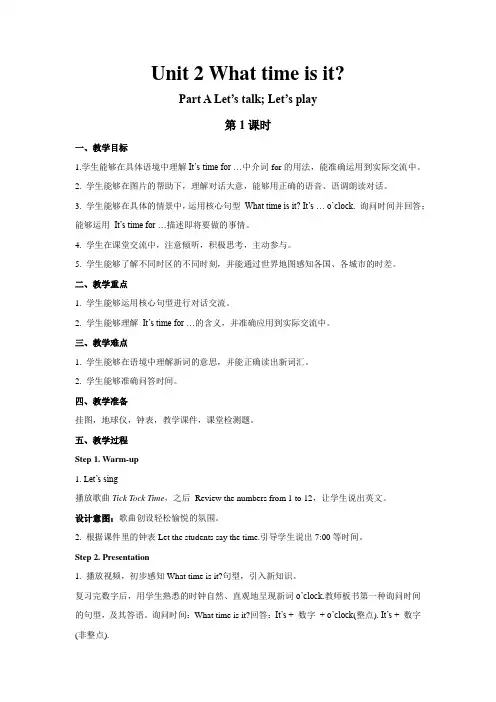
Unit 2 What time is it?Part A Let’s talk; Let’s play第1课时一、教学目标1.学生能够在具体语境中理解It’s time for …中介词for的用法,能准确运用到实际交流中。
2. 学生能够在图片的帮助下,理解对话大意,能够用正确的语音、语调朗读对话。
3. 学生能够在具体的情景中,运用核心句型What time is it? It’s … o’clock. 询问时间并回答;能够运用It’s time for …描述即将要做的事情。
4. 学生在课堂交流中,注意倾听,积极思考,主动参与。
5. 学生能够了解不同时区的不同时刻,并能通过世界地图感知各国、各城市的时差。
二、教学重点1. 学生能够运用核心句型进行对话交流。
2. 学生能够理解It’s time for …的含义,并准确应用到实际交流中。
三、教学难点1. 学生能够在语境中理解新词的意思,并能正确读出新词汇。
2. 学生能够准确问答时间。
四、教学准备挂图,地球仪,钟表,教学课件,课堂检测题。
五、教学过程Step 1. Warm-up1. L et’s sing播放歌曲Tick Tock Time,之后Review the numbers from 1 to 12,让学生说出英文。
设计意图:歌曲创设轻松愉悦的氛围。
2. 根据课件里的钟表Let the students say the time.引导学生说出7:00等时间。
Step 2. Presentation1. 播放视频,初步感知What time is it?句型,引入新知识。
复习完数字后,用学生熟悉的时钟自然、直观地呈现新词o’clock.教师板书第一种询问时间的句型,及其答语。
询问时间:What time is it?回答:It’s + 数字+ o’clock(整点). It’s + 数字(非整点).设计意图:从上面的环节自然过渡呈现新对话,让学生带着问题看视频,初步理解对话大意。
新版PEPUnit2Waystogotoschool.全英教案
新版PEPUnit2Waystogotoschool.全英教案Unit 2 Ways to go to schoolI Knowledge aims: 1.To learn the new words : on foot , by bus , by taxi ,by plane , by ship , by subway , by train2.To learn the key sentences: Where is the library?It’s near the post office.3. Student can make sentences use the key sentences.4. To learn the “let’s talk ’’II Learning aims:Can use the English to talk about how to get somewhere. III. Emotional Aims:Pass learning by the text,let them use the English totalk in the real life.And have encironmental protectionconsciousness.IV.Teaching plan: Use 6 lessons.The first period:Main scene Part A Let’s try. Part A Let’s talk.The second period:Part A Let’s learn .Part A Write and say.The third period:Part B Let’s try. Part B Let’s talk.The fourth period:Part B Let’s learn. Part B Role play.The fifth period:PartB Read and write.The sixth period: PartB :Let’s check.PartB Let’s wrap it up.Part C Story time.Unit1 The First PeriodI.Teaching contents:Main scence,Part A Let’s try &Let’s talk.II.Teaching aims:1.Can read and use the sentences “How do you come to school?I come by….”exactly.2.Can listen,say ,read and write the words of vehicle.Then use them to talk abouat the ways to get somewhere.III.Teaching key points:Can use the sentences from the dialogue to ask theway in the real life.IV.Teaching difficulties:Can use “How do you come to school?to ask the waysto get to school.V.Teaching aids:Multimedia ,map and the PPT.VI:.Teaching procedure:I Organization1 , Let’s try : Turn to page fourteen2 , Free talkII Revision1 , Review the new words : on foot , by bus , by taxi , by plane , byship , by subway , by train2 , Review the key sentencesIII Presentation1 , Open your book2 , Today , We’re going to learn the “let’s talk ”3 , This is the dialogue of Mike, Amy and Mrs Smith4 , Let’s translate i nto Chinese : Teacher say English5 , Listen to me carefully6 , Read after me7 , Listen to the tape and read after itIV Practice1 , Read “Let’s talk ” by themselves2 , Listen to the tape and read after it3 , Answer the questions and write down the booksV Summary and homework1 , Read and write down the “Let’s talk ”2 , Recite the “Let’s talkThe Second PeriodI.Teaching content: A Let’s learn .Part A Write and say.II.Teaching aim:A.Can understand and use the sentences “How do we get there? We go by…”to ask and the ways to go.B.Can listen,say and read the words of the vehicals.C.Can use the words of vehicals exactly.III.Teaching key points:The students can use the sentences parten to ask and say out the ways to go somewhere in the real life.IV.Teaching difficulties:Can use the words of traffic vehicals, tell the ways to go.V.Teaching aids:recorder,tape,picture and PPT.VI.Teaching procedures: I Organization1 , Let’s play2 , Free talkII Revision1 , Review the words2 , Review the rules and pronunciationIII Presentation1 , Open the book “let ’s learn ”2 , Show the new words: on foot , by bus , by taxi , by plane , by ship ,by subway , by train3 , Listen to me carefully4 , Read after me5 , Listen to the tape and read after it6 , Learn the key sentences :Let’s go to the nature park.How do we get there?By bus.7 , Translate into Chinese and teacher explain8 , Read after meIV Practice1 , Read new words by themselves2 , Listen to the tape and read after it3 , Give enough time to read them4 , Let students make sentencesV Summary and homework1 , Read and write down the new words2 , Recite the key sentencesThe Third PeriodITeaching content: Part B Let’s try. Part B Let’s talk.II Teaching aims: 1.Can read and use the sentences:”Don’t go at the res light.I must pay attention to the traffic lights.2. Can listen,say and read the words:helmet,wear,Mrs,traffic and payattention to.3. Student can act out the dialogue..4. To learn the “let’s talk ’’IIITeaching key point: The key sentences: Know the rules of the traffic lights.IV Teaching difficult:1. Obery the traffic rules.2. Know the different traffic rules in different country.V Teaching aids :The word cards, a tape ,three colour lights.VI Teaching prucedures:I Organization1 , Free talk2 , Write and say : Turn to page fifteen II Revision1 , Review the “Let’s talk ”2 , Let’s readIII Presentation 1 , First , open your book “ Read and write ”2 , This is the text of Robin3 , Let’s tr anslate into Chinese : Teacher say English4 , How many ways can you think of to go to school?5 , Talk with your partner6 , Read the text and answer the questionsIV Practice1 , Recite the “Let’s talk ”2 , Read “Let’s talk ” by themselves3 , Listen to the tape and read after it4 , Give enough time to read themV Summary and homework1 , Read and write down the new words2 , Finish the English excise3 , Recite the “Let’s talk ”The fourth periodITeaching contents: B Let’s learn. Part B Role play.II.Teaching aims:Can use the sentences in the real life exactly. Can use the words and sentences parton to talk.III.Teaching key point:Know the traffic rules about the traffic lights.IV.Teaching difficult:Can remember the traffic rules about the traffic lights.V.Teaching aid:red,yellow and green card lights and tape,recorder.I Organization1 , Greetings :sing a song2 , Free talkII Revision1 , Review the words2 , Review the rules and pronunciation of the tenseIII Presentation1 , Open the book “let ’s learn ”2 , Teacher show cards of the new words :Learn the traffic rules about the traffic lights.3 , Listen to me carefully4 , Read after me5 , Listen to the tape and read after it6 , Learn the key sentences :Slow down and stop at a yellow light.Stop and wait at a red light.Go at a green light.7 , Translate into Chinese and teacher explain8 , Read after meIV Practice1 , Read new words by themselves2 , Listen to the tape and read after it3 , Give enough time to read them4 , Let students make sentencesV Summary and homework1 , Read and write down the new words2 , Recite the key sentencesThe Fifth PeriodI.Teaching contents:Part B Read and write.II.Teaching aim:Know in different places,the kids use different ways to go to school..III.Teaching key points:Know what must do,or what don’t do in differentvehicals.Know some traffic rules in different country. IV.Teaching difficult:Can talk about what must or what don’t do with the traffic tool.V.Teaching aids: Multimedia ,pictures and the PPT.VI.Teaching procdures:I Organization1 , Make a map and talk2 , Free talkII Revision1 , Review the new words :By subway,by taxi,by plane,by ship,by bus,on foot.2 , Review the key sentencesIII Presentation1 , Open your book2 , Today , We’re going to talk about different way to go to school.3 , These are some pictures about the kids in different places usedifferent ways.4 , Let’s translate into Chinese :Teacher say English5 , Listen to me carefully6 , Read after me7 , Listen to the tape and read after itIV Practice1 , Read the text and answer the questions.2 , Listen to the tape and read after it3 , Answer the questions and write down in the books. V Summary and homework1 , Write the suggestions to your friends.2 , Recite the text.The Sixth PeriodI.Teaching contents:Part B Let’s check.&Let’s wrap it up.PartC story .II.Teaching aim:Can understand the story,know the different traffic rulesin different countries.III.Teaching key points:Depand the story to learn about the traffic rulesin different country.IV.Teaching difficult:Pass the story,Know how to use the sentences learn bythis unit to talk about the traffic rules in the real life.V.Teaching aids:computer and PPT.VI.Teaching procedures:I Organization1 , Free talk : the key sentences2 , Let’s tryII Revision1 , Review the “Let’s talk ”2 , Let’s readIII Let’s check1 , Listen and number.2 , Listen again and answer the question.IV Let’s wrap it upTry to tick out the correct one.V Story time.1 , Watch the video,learn the story.2 , Read “ story ” by themselves3 , Listen to the tape and read after it4 , Give enough time to read them5.Act out the story.Let all the students know in different countries,they have different traffic rules. VI Summary and homework1 , Finish the English excise2 , Act out the story.3 , Read and write down the new words。
人教PEP版-英语-四年级下册--Unit2 第一课时教案
第一课时课时目标1.能够听、说、认、读本课时主要生词:breakfast,lunch,dinner,English class,music class, PE class。
2.学习句子:What time is it? It's 9 0'clock.lt's time for English class.3.能听懂指示语,并按照指令做出相应的动作,如:It's time for breakfast. Let's drink some milk..4.会唱歌曲《It's twelve o'clock》。
教学重难点1.重点:学习生词:breakfast, lunch, dinner, English class, music class, PE class,学习句子:What time is it? It's 9 0'clock.lt's time for English class.2.难点:正确使用句子It's time for....媒体链接1.单词卡片。
2.教学挂图和配套VCD。
3.录音机和磁带。
教学过程一、热身(Warm-up)师生问好,导入新课。
T: It's time for English class. Are you ready? How are you?Ss: I'm fine, thank you. And you?T: I'm fine, too.二、复习(Revision)1.复习各学科课本的英文表达T:(拿起一本英语书)What's this?Ss: It's an English book.T;(拿出一本数学书)And this?Ss: It-s a math book.T: Do you have a Chinese book?Ss: Yes,I do.T: Put your art book and music book on your desk.Ss: OK.2.复习数词1-12(1)师生一起边说数词1-12,边用手势表示这些数字。
2016人教PEP版英语四年级下册Unit 2《What time is it》单元教案
2016人教PEP版英语四年级下册Unit 2《What time is it》单元教案一. 教材分析本单元主题是“What time is it”,主要学习时间表达法和相关词汇。
通过本单元的学习,学生能够掌握1-12点的英语表达法,以及运用句型“What time is it?”进行询问和回答。
教材内容丰富,插图生动,有利于激发学生的学习兴趣。
二. 学情分析四年级的学生已经掌握了基本的日常英语口语交流,对于时间的认知也有一定的基础。
但部分学生对于时间表达法和词汇的掌握还不够熟练,需要通过本节课的学习加以巩固。
三. 教学目标1.能够正确表达1-12点的时间。
2.能够用“What time is it?”进行询问和回答。
3.提高学生的听说能力和团队协作能力。
四. 教学重难点1.重点:掌握1-12点的时间表达法,能够用“What time is it?”进行询问和回答。
2.难点:对于不同时间的表达,如“half past”和“quarter past”的运用。
五. 教学方法采用情境教学法、互动教学法和任务型教学法,通过设置情境、生生互动、小组合作等形式,引导学生主动参与学习,提高学生的听说能力和团队协作能力。
六. 教学准备1.准备教学课件和图片。
2.准备钟表模型,方便学生直观地学习时间表达法。
3.准备相关时间词汇的卡片,用于游戏和练习。
七. 教学过程1.导入(5分钟)利用课件展示一个忙碌的早晨场景,引导学生说出自己喜欢的起床时间,从而引出本节课的主题“What time is it”。
2.呈现(5分钟)通过展示钟表模型和图片,引导学生认识1-12点的时间表达法。
教师可以用英语描述时间,让学生猜测并说出中文翻译。
3.操练(10分钟)将学生分成小组,每组分发一套时间词汇卡片。
学生轮流抽取卡片,用英语说出时间,并让其他组的学生进行翻译。
通过这个游戏,让学生在实践中掌握时间词汇。
4.巩固(10分钟)教师创设一个情境,如学校作息时间表,让学生根据情境进行角色扮演,用英语询问和回答时间。
人教PEP四年级下册英语unit2第二单元教案
人教PEP四年级下册英语unit2第二单元教案教案一、教学目标1.能听、说、读、写1到10的数字单词.2.掌握并能运用单词“o'clock”及句型“What time is it?”“It's...”“It's time to ...”3.认读单词“get up ,go to school,go home,和go to bed."二、能力目标能运用所学的语言知识在创设的情景中进行熟练的交际.并在此基础上将其应用于生活之中.三、情感目标激发学生学校的兴趣.帮助学生树立学好英语的信心.增强学生的参与意识.引导学生积极与他人合作.共同完成学习任务.并在成功中体会英语学习的乐趣.四、德育目标通过本科的学习.培养学生珍惜时间、热爱生活的良好品德.五、教学重难点What time is it? 本课设计根据《小学英语课程教学基本要求》和学生的知识情况.结合学生爱唱、跳、表演等特点.充分采用TPR英语教学法.教学过程先复习导知——学习新知——游戏操练——总结评价四步.通过热身营造学习氛围.让学生愉快地进入课堂.教师还充分利用了许多媒体课件的优势和巧妙的设计游戏.让学生在游戏中学知识.使整堂课活跃起来.避免了枯燥无味的教学.使学生愿学.乐学.学生的积极性得到了提高. It's ...o'clock. It's time to ...六、课前准备1.CAI课件2.“o'clock”单词卡片及“What time is it ?”“It's ...”“It's time to ...等句型卡片. 3.挂钟一个. 4.模拟钟一个[可任意调时间].七、板书设计What time is it? It's ...o'clock. It's time to ...八、教学步骤Step1:Free talk T:Boys and girls,nice to meet you. Ss:Nice to meet you,too. T:What’s this ?[黑板上方悬挂的时钟] [引出Clock]Step 2:Warming up [带领学生用一只手模仿时针转圈.同时Count from 1 to 12] Step 3resentation[1] 1. Learn the new word ’clock[1] 继而count from 1 o’clock to 12 o’clock. [2] 利用“教具钟”认读钟点.2. Learn the sentence pattern:What time is it ? T:I have many clocks. Do you want to see them ? T:OK,Let’s go! [CAI显示若干钟面] Step 4rill 1. CAI依次显示钟面[6:30.7:05,4:35,9:00].同时操练T:Excuse me.What time is it ? Ss:It’s... 2.用滚动钟面时刻设置游戏[抢答竞赛] T:What time is it ? Ss:It’s…3.时刻转为一个显示7:30的“大钟面” T:What time is it? Ss:It’s 6:30 o’clock.[同时出现情景画面] T:It’s time to get up. Step 5resentation[2] 1. Learn the sentence pattern:It’s time to… [根据课件图示的动作说句子:It’s time to go to school /watch TV/go home/go to bed]2. “It’s time to …”句型造句Step 6:Practice [pair work:Make dialogues] 1.老师就挂钟提问T:What time is it? Ss:It’s… 2.范例课件显示情景画面[5 点钟.回家]及小对话. A:What time is it? B:It’s 4:35o’clock. A:It’s time to go home. [Read the diaogue in the CAI] 3:Act t he dialogue Step7:Presentation T:Now let’s look at the picture,and listen to a dialogue. What do you want to do ? I want to go home . Step8:Consolidation 1.把今天所学的内容用于我们的校园生活.看谁用的多、用得好.1 / 1。
【PEP】四年级下英语Unit2优质精品课教学设计
【PEP】四年级下英语Unit 2优质精品课教学设计一. 教材分析PEP教材四年级下英语Unit 2的主题是关于日常活动,涉及到日常生活中的动作和活动,如“eat”,“drink”,“sleep”等。
本课时的主要句型是“What does he/she do? He/She does…”,以及问题“What are you doing?”的回答。
教材内容贴近学生生活,易于激发学生的学习兴趣。
二. 学情分析四年级的学生已经掌握了基本的英语单词和简单的句子结构,具备一定的听、说、读、写能力。
但是学生的英语水平参差不齐,部分学生对英语的学习兴趣不足,需要通过有趣的教学活动来激发他们的学习兴趣。
三. 教学目标1.知识目标:学生能够听懂、会说、会读单词“eat”,“drink”,“sleep”等,以及句子“What does he/she do? He/She does…”和“What are you doing?”的回答。
2.能力目标:学生能够运用所学单词和句型进行简单的日常交流。
3.情感目标:培养学生对英语学习的兴趣,增强自信心。
四. 教学重难点1.重点:单词“eat”,“drink”,“sleep”等,以及句子“What does he/shedo? He/She does…”和“What are you doing?”的回答。
2.难点:学生能够运用所学单词和句型进行日常交流。
五. 教学方法采用情境教学法、游戏教学法和任务型教学法,通过创设情境、设计有趣的游戏和任务,激发学生的学习兴趣,提高学生的参与度,培养学生的实际运用能力。
六. 教学准备1.准备单词卡片和图片,用于展示和操练单词。
2.准备PPT,包含教材中的插图和动画,用于创设情境和辅助教学。
3.准备教学录音机和录音带,用于播放单词和句型的录音。
4.准备小组活动所需的小道具,如玩具、食物等。
七. 教学过程1.导入(5分钟)利用音乐、歌曲或游戏等方式,引导学生进入英语学习氛围。