
七年级英语下册 Unit 2 复习学案 人教新目标版
Unit2 Where’s the post office?1. 问路:(1) Excuse me, how can I get to the post office?(2) Excuse me, can you tell me the way to the post office?2. --这儿附近有一个邮局吗?-- Is there a post office near here?--是的。
-- Yes, there is. (否定:No, there isn’t.)① there be翻译为―有‖,不能拆开翻译。
用法:There is+单数/不可数;There are+复数;②在附近:near here = in the neighborhood3. –邮局在哪里?-- Where is the post office?--它在第五大街上。
-- It’s on Fifth Avenue. (第五:用序数词fifth)在…街上:介词用on4. 它在沿大桥街右侧:It’s down Bridge Street on the right.沿…街左侧:down…street on the left5. 散步通过花园:Take a walk through the park. (指―穿过park的内部‖)6. 在宾馆旁边是一间有着漂亮花园的小房子:Next to the hotel is a small house with a beautiful garden. (不能用has)7. 我爸爸很享受散步的乐趣:My father enjoys taking a walk very much.①句型:享受做某事的乐趣:enjoy doing sth②散步:take a walk 去散步:go for a walk③走着去某地:walk to sp = go to sp on foot8. 这是花园之旅的开始:This is the beginning of the garden.①开始,开端:beginning 如:Let’s read from the beginning of this book.②在…的开端:at the beginning of…9. 大桥街是一个很好玩的地方:Bridge Street is a good place to have fun.10. 让我告诉你去我家的路:Let me tell you the way to my house.①去某地的路:the way to sp.②在某人去某地的路上:on one’s way to sp. home, there, here前的介词―to‖要省略③做某事的好方法:a good way to do sth11. 比较:(表示―位置‖)在…前面:in front of… 在…后面:behind…(表示―时间‖)在…之前:before… 在…之后:after…比较:(1) in front of…在(外部)的前面;如:There is a big tree in front of my house.(2) in the front of…在(内部)的前面;如:The teacher is in the front of classroom.12. 在左边/右边:on the left/right.在…左边/右边:on the left/right of…13. 笔直走:go straight 沿着…街(路)走:go down…Street/Road(两者合并)沿着…街(路)笔直走:go straight down…Street/Road14. 向左转:turn left 向右转:turn right 掉头:turn around15. 玩得(很)高兴:have a good time = have (great) fun句型:很高兴做某事:have (great) fun doing sth16. 打的:take a taxi 打的去某地:take a taxi to sp = go to sp by taxi乘公交车:take a bus 乘公交车去某地:take a bus to sp = go to sp by bus17. 我希望你过一个愉快的旅途:I hope you have a good trip.对于别人的赞美与祝愿,回答用―Thanks, Thank you‖来表示―感谢‖18. 到达某地方:(1) arrive in+大地方;arrive at+小地方;(2) arrive单独使用;如:When he arrives, the class is over.(3) get to+地方;到家:get home 到达那里:get there 到达这里:get here 19. 穿过:(1) 从表面穿过:across 穿过马路:walk acorss the road(2) 从内部穿过:through 穿过公园:walk through the park20. 在…上面:(1) on (指―表面接触‖) 如:There is a book on the desk.(2) over (指―表面不接触‖,悬空) 如:There is a bridge over the river. 21. 不定冠词a/an与定冠词the的选择使用——看―翻译‖。
(1) 翻译为―一…‖,用a/an;(2) 翻译为―这…‖或―不需要翻译‖,用the;如:(1) There is ______ old man next to ______ post office.(2) – Do you know ______ London? -- Of course. It’s in _____ United Kingdom. 22. (1) straight adv. 笔直地;如:Go down straight and turn left.(2) straight adj. 直的;如:He has short straight black hair.23. (1) turn v. 转弯;如:向后转:Turn around.(2) turn n. 轮到某人的一次机会;如:It’s your turn to tell a story.24. (1) left n. 左边;如:Turn left.(2) left v. 离开leave的过去式;如:He left home early yesterday.25. (1) right n. 右边;如:The post office is on your right.(2) right adj. 正确的;如:Which one is right?26. (1) down adv. 向下;如:Sit down, please.(2) down prep. 沿着;如:The post office is down Bridge Street on the right.27. (1) open v. 打开;如:The shop opens at seven o’clock am.(2) open adj. 开着的;营业中的;如:The shop is open for 24 hours a day.28. (1) clean v. 打扫;如:We clean the classroom every day.(2) clean adj. 干净的;如:Our classroom is very clean.29. (1) if 如果;如:If you are hungry, you can buy some food in the supermarket.(2) if 是否;如:I don’t know if he will come.30. (1) visit v. 参观,访问;(2) visit v. 看望,拜访;二、重点短语1. 在邮局/图书馆/宾馆/饭店/公园in the post office/library/hotel/restaurant/park2. 在警察局/电视台at the police station / TV station3. 在一条繁忙的大街上on a busy Street4. 在…附近near here = around here = in the neighborhood5. 在……对面across from6. 在…旁边next to7. 在…前边in front of 8. 在…之间between … and …9. 直走go / walk straight 10. 沿…直走go/walk straight along/down/up 11. 在(你的)左边on the / your left 12. 右转turn right13. 享受城市美好的街道enjoy the city’s quiet streets 14. 散步take / have a walk= walk15. 步行穿过公园take a walk / go through the park16. 一座带着有趣花园的小房子a small house with an interesting garden17. 在花园之旅的开始at the beginning of the garden tour18. 一个好玩的地方a good place to have fun19. 打的take a taxi 20. 路过你右边的一家银行pass a bank on your right 21. 旅途愉快have a good trip 22. 忙于做某事be busy doing sth23. welcome to…欢迎24. enjoy+名词/doing喜欢做某事25. have fun 过得愉快26. play +the+乐器弹奏乐器27. take a walk 散步28. the way to …去...的路29. let sb do sth 让某人做某事30. arrive at(小地方)/in(大地方)到达31. at the end of 在...结束的时候32. hope to do sth希望去做某事/三、句型。
1、Is there a ….?句型Eg:-Excuse me.Is there a hotel in the neighborhood. -Yes, there is. No.there isn’t2、Where is …?句型Eg:-Where is the park,please? -It’s behind the bank.(肯定回答)-I’m sorry I don’t know. (否定回答)3、Which is the way to +地点? 句型.例如:- Which is the way to the library.4、How can I get to +地点?句型.例如:-How can I get to the restaurant?5、Can you tell me the way to +地点?句型.例- Can you tell me the way to the post office?6、Let me tell you the way to my house.7、Just go straight and turn left.四、重点难点讲解:1.there be句型1). There be + 人/ 物+ 地点,意为__________________.2). 辨析there be与have:⑴__________ a ruler on the desk. ⑵They _______ a pencil.⑶______ your friend ______ a new pen pal?3). There be就近原则,be动词由紧跟的名词单复数决定;4). There be sb. doing sth. , 意为“__________”1). __ there a pen and two books on the table? A. Is B. Are C. Am D. Be2). Is there a big supermarket on this street? __.A. Yes, there be.B. No, there are.C. Yes, there is.D. Yes, there isn’t.3). There are some people in the room. (疑) ______ there ______ people in the room?4). There are many apples on the apple tree. _____ _____ on the apple tree?5). There are some children ________ (play) on the playground.2. 各“家”各异:house为“房屋,住宅”,;home为“家”,指一个人出生或居住的地方;family 为“家庭,家庭成员”,与居住的房子无关。
人教版七年级英语下册unit2 Section B(1a-1e)学案
本文由一线教师精心整理/word可编辑unit2 Section B(1a-1e)学案【自研课导学】(一)预习内容及目标:预习课本p10的单词(二)【展示课导学】学习内容:Unit2 What time do you go to school? Section B (1a—1e)学习目标:学会用准确的时刻表达方式来谈论一天的作息,并能够和你的搭档进行问答。
1 / 3本文由一线教师精心整理/word 可编辑2 / 3当堂检测:想想自己学过的时刻表达方式,请在这里汇总(总分5分,酌情给分。
)_______________________________ ____ ________________________________________________________________________________________【训练课导学】1.时段: 晚自习2.时间: 20’3.训练方式: ,自主完成巩固提升三级达标训练题基础题:完成下面的句子。
1. Tom 一般几点起床?他一般4点15起床。
. What time ______ Tom _______ _____ up? He usually ____ ______ _____ 4:15 .2. 人们一般都什么时候吃晚饭?一般在晚上吃。
What time ____ people usually _______ ________ ? People usually ____ ______ in ____ ______.3. 你经常几点吃早饭?What time _____ _____ ______ ______ _______?4. — 你的哥哥几点淋浴?______________________________________________________ —他经常在七点淋浴。
_______________________________________________________5. 我姑姑喜欢在中午一点吃午餐。
人教版新目标英语七年级下册《Unit 2 What time do you go to school
人教版新目标英语七年级下册《Unit 2 What time do you go to school》优质教学设计2一. 教材分析人教版新目标英语七年级下册《Unit 2 What time do you go to school》主要介绍了日常生活中的时间安排,包括起床、吃早餐、上学、放学、做作业、娱乐等活动。
本节课主要让学生学会询问和回答别人日常活动的时间,并能够用英语描述自己的时间安排。
教材内容贴近学生生活,有利于激发学生学习兴趣,提高学生英语表达能力。
二. 学情分析七年级的学生已经掌握了基本的英语语法和词汇,具备一定的听说读写能力。
但部分学生对英语学习仍存在恐惧心理,缺乏自信心。
此外,学生在生活中对时间的认识和安排各有不同,需要教师引导学生逐步养成良好的时间管理习惯。
三. 教学目标1.知识目标:学生能够掌握日常活动词汇,如sleep, wake up, get up,go to school等;学会用What time do you go to school?询问别人日常活动的时间,并能用英语描述自己的时间安排。
2.能力目标:学生能够听懂、会说、会读、会写日常活动相关的句子,提高英语表达能力;学会用英语询问和回答别人日常活动的时间。
3.情感目标:培养学生珍惜时间、合理安排时间的意识,养成良好的时间管理习惯。
四. 教学重难点1.重点:学生能够运用所学词汇和句型询问和回答别人日常活动的时间。
2.难点:学生能够用英语描述自己的一日生活,并在实际情景中灵活运用所学知识。
五. 教学方法1.任务型教学法:通过设定各种实际情景,让学生在完成任务的过程中运用所学知识,提高语言实际运用能力。
2.情境教学法:创设生活情境,让学生在真实的环境中感受和体验英语,激发学习兴趣。
3.激励性评价:注重鼓励学生,提高学生自信心,激发学生学习积极性。
六. 教学准备1.教材:人教版新目标英语七年级下册《Unit 2 What time do you go to school》。
最新人教版新目标初中英语七年级下册《Unit 2 What time do you go to school全单元导学案》精品优秀导学单

最新精品最新人教版新目标初中英语七年级下册Unit 2 What time do you go to school?优秀导学案(全单元完整版)前言:该导学案(导学单)由多位一线国家特级教师根据最新课程标准的要求和教学对象的特点结合教材实际精心编辑而成。
实用性强。
高质量的导学案(导学单)是高效课堂的前提和保障。
(最新精品导学案)Unit 2 What time do you go to school?第一课时Section A(1a-2c)【教师寄语】Knowledge is power.【Free talk】Talk about what you can do to join a club.【Learning tasks】1. 熟练掌握本课单词和短语.2. 学会谈论自己及他人的日常生活及日常作息习惯,并能合理安排.3. 掌握时间表达法.【Importance and difficulties】谈论自己及他人的日常生活及日常作息习惯.【学习过程】 一、超前预习 Ⅰ. 你能用英语读出下列单词和短语吗?并试着写下来(1) 单词: 时间_______淋浴,淋浴器_________通常________......点钟______(2)短语: 几点,什么时候_____________ 去上学____________起床_________吃早饭/午饭/晚饭 ______________淋浴 ____________ 一个大家庭 ___________九点______ ___9:05 _____ _____ 12:54 ____ _____II.你能通过预习完成下面的句子吗?1. 我早上六点起床. I ______ ______ _______ six in the morning.2. 他的爸爸晚上九点洗澡.His father ______ ______ _______ ____ nine in the evening.3. 你每天早上七点跑步吗? _____ you _______ ______ seven every morning?4. 你姐姐几点吃晚饭? ______ ______ _____ your sister eat _______?5. 他的爸爸不是六点起床.His father _______ _____ ______ at six o'clock.6. Rick有一个大家庭. Rick _______ a _____ _____.Ⅲ. 找出你的疑惑:时间的表达方式,你学会了吗?试着总结一下,好吗?____________________________________________________________________________________________________________________________二、课中学习I. 预习检测II. 解决疑惑 自主互助学习知识剖析:1.get up 是一个固定词组,意为 “起床” .相似的说法还有 “be up”.如: He gets up very early. = He is up very early.另外,get 与不同的词组搭配,还有很多固定词组.如:get back 归还,取回. get home 到家 get …for 为某人拿/买 get …from 从某人那得到2. go to school “上学”是一个固定词组,go 也有很多的固定搭配。
湖南省株洲市天元区马家河中学七年级英语下册《Unit 2 Where is the post off
湖南省株洲市天元区马家河中学七年级英语下册《Unit 2 Where isthe post office 》学案人教新目标版[学习重点]1.词汇:post office, library, restaurant , bank, supermarket, pay phone, street , park, avenue, bridge, center.across from , in front of ,behind, next to.between.2.语法功能:学习一些问路的句子 Grammar focus .3.重点:Is there a supermarket ? Yes, there is ./No, there isn’t.4.难点:Is there a supermarket ? Yes, there is ./No, there isn’t .where is ……? It is in front of ……【学习目标】1、学会询问某一场所的位置。
2、学会如何问路【学习过程】一.预习指导与检测(一)预习指导1) 根据音标预习第七页的生词,做到会读知意2) 复习学过的表示方位的介词3).知识点拨:A.句子There be 的用法。
There be + 名词(人或者物)+介词短语e.g. There is a bank near here. There are two pay phones in the park.Is there a library in Center Street? Yes, there is.There aren’t any supermarkets in Fifth Avenue .B. 常用的问路方法有以下几种:(1) Can you tell / show me the way to the church?你能告诉我去教堂的路吗?(2) Which is the way to North Street Hospital? 请问去北街医院怎么走?(3) Where's the ladies' room? 女洗手间在哪?(4) How can I get to the café? 请问去咖啡厅怎么走?(5) Is there a store near here? 附近有商店吗?(二)预习检测1.Match the English words with the Chinese words. 中英文词汇配对。
七年级英语下册Unit2Whattimedoyougotoschool第3课时学案新版人教新目标版
Un it 2 What time do you go to school?学习目标:1 .掌握重点单词短语如:do homework,go to bed,take a walk2.通过听力训练巩固目标句型" What time do you , ?”2.自主探究一:1)Skimming.Find the answers in the passage.① What are their n ames?② Whose life do you think is healthy,a nd whose life is un healthy?2)Sca nnin g:Read the passage aga in ,the n finish the exer cise 2c.3.自主探究二:If you are a healthy consultant (顾问),please try to make a healthy timetable for Tony .Please make a short dialogue.A:T ony B:Healthy con sulta nt第二段〖长课导学〗模块二:交流研讨模块四:当堂训练•单项选择•)1.T his kind of peach looks really ni ce,but it very sour.A.tastesB.looksC.feelsD.sounds)2.1 have work to do every day.A.a lotB.lots ofC.a lots ofD.many) 3.They are able to talk openly to one another whenever of them feels hurt.A.eitherB.bothC.someD.all)4.What time does she school and home every day?A.get;goB.get to;get toC.go to;getD.go;get to二.句型转换。
七年级英语下册 Unit 2 B(2a-Self Check)教案 (新版)人教新目标版
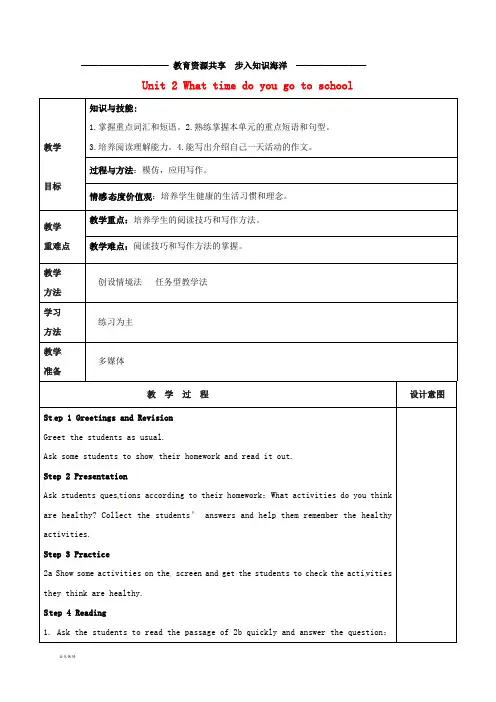
Encourage the students to write about their own daily routine. And then get two or three students to read it out.
Step 7 Homework
Finish Self Check after class.
Step 5 Βιβλιοθήκη ractice3a Get the s tudents to number these sentences in order to make a st ory about a daily routine. Then get some studen ts to report their answers. Finally get the students to read it aloud.
教学
重难点
教学重点:培养学生的阅读技巧和写作方法。
教学难点:阅读技巧和写作方法的掌握。
教学
方法
创设情境法任务型教学法
学习
方法
练习为主
教学
准备
多媒体
教学过程
设计意图
St ep 1 Greetings and Revision
Greet the students as usual.
Ask some students to show their homework and read it out.
——————————教育资源共享步入知识海洋————————
Unit 2 What time do you go to school
教学
目标
知识与技能:
1.掌握重点词汇和短语。2.熟练掌握本单元的重点短语和句型。
人教版新目标英语七年级下册《Unit 2 What time do you go to school
人教版新目标英语七年级下册《Unit 2 What time do you go to school》教学设计3一. 教材分析人教版新目标英语七年级下册《Unit 2 What time do you go to school》主要围绕着日常生活中的时间安排展开。
本节课通过学习不同的时间表达方式,使学生能够灵活运用英语询问和描述日常作息时间。
教材内容丰富,包括对话、词汇、语法及任务型活动等,旨在培养学生的听说读写技能,提高他们的语言运用能力。
二. 学情分析七年级的学生已经掌握了基本的英语语法和词汇,具备一定的听说读写能力。
他们对新知识充满好奇心,善于模仿和交流。
但同时,部分学生可能对时间表达方式的掌握还不够熟练,需要教师的引导和练习。
三. 教学目标1.知识目标:学生能够掌握日常时间表达方式,如“What time do yougo to school?”、“I go to school at 7:00.”等;2.能力目标:学生能够在实际情境中运用英语询问和描述时间;3.情感目标:培养学生珍惜时间、合理安排作息的良好习惯。
四. 教学重难点1.重点:学生能够正确使用时间表达方式进行问答;2.难点:学生能够在实际情境中灵活运用时间表达方式。
五. 教学方法1.情境教学法:通过设定真实的生活情境,让学生在实际交流中学会运用时间表达方式;2.任务型教学法:设计各种任务活动,让学生在完成任务的过程中提高语言运用能力;3.互动式教学法:引导学生积极参与课堂互动,增强学生的自信心和合作精神。
六. 教学准备1.准备教材、课件和教学资源;2.设计相关任务活动和练习题;3.准备时间表、闹钟等教具。
七. 教学过程1.导入(5分钟)利用多媒体展示不同的时间场景,如早晨起床、上学、放学等,引导学生用英语描述这些场景。
2.呈现(10分钟)教师展示教材中的对话,让学生边听边跟读,掌握日常时间表达方式。
同时,教授时间词汇如“morning”、“afternoon”、“evening”等。
七年级英语下册《Unit2 What time do you go to school Period 2》人教新目标版
七年级下册Unit2 What time do you go to school? 导学案 Period2【学习目标】1.知识目标:巩固表示日常作息的词汇。
2.技能目标:熟练表达自己一天作息情况。
3.情感目标:培养学生良好的生活习惯。
【学习重难点】熟练掌握表达一天作息的句型。
【学习过程】:一、自主复习1.试翻译下列句子。
你每天什么时候起床?______________________________________________我每天六点穿衣。
___________________________________________________她每天六点十分刷牙。
______________________________________________他总是七点半吃早饭。
______________________________________________他每天晚上八点洗澡。
______________________________________________二、对话练习听2d录音跟读模仿。
Pair work 两人展示:Interviewer: Scott has an interesting job. He works at a radio station.Scott, what time is you r radio show?Scott: From twelve’s o’clock at night to six o’clock in the morning. Interviewer: What time do you usually get up?Scott: At eight thirty at night. Then I eat breakfast at nine. Interviewer: That’s funny time for breakfast.Scott: Yeah. After that, I usually exercise at about ten twenty. Interviewer: When do you go to work?Scot t: At eleven o’clock, so I’m never late for work.Group work: 小组合作:调查本组内成员信息,展示调查结果。
七年级英语下册 Unit 2 What time do you go to school听说课导学案1 新版人教新目标版
1 Unit 2What time do you go to school 导 学 目 标
1、使学生会用 get up, go to school, get dressed, brush teeth, eat breakfast, take a shower等表达日常活动。 2、掌握时间的不同表达方式。 3、能听懂别人谈论日常活动,并能简单谈论自己一天的活动安排。 4、会用 What time ---, When---询问别人日常活动安排。
重 点 1、掌握不同的时间表达方式。 2、会用 What time ---, When---询问别人日常活动安排;并能简单叙述自己一天的活动安排。
难 点 熟练使用句型:What time ---, When---询问别人日常活动安排。 教 学 过 程 教学 环节 教学内容 任务设计 教师活动 学生活动 预见性问题及解决对策 备习 理清自己日常活动时间的安排。查找英语时间的不同表达方式
复习 检测学生单词的记忆情况。 听写上一节课所学单词。 考单词 写单词 部分学生单词拼写有误。组长课后追踪考察。
预习 1.学习常见的日常活动名称。 2. 掌握时间的不同表达方式。 3.会用 What time---, When---询问别人日常活动安排;并能简单叙述自己一天的活动安排。 1.完成单词与图片的匹配。 2. 根据图中提示,编对话 P7 1a。 3. 听录音,把不同活动与相应的时间连接起来P37 1b。 4. 就1a中的内容,模仿1c进行问答。 5. 听录音,完成2a,2b中的听力任务。 6.学习并表演2的中对话。 1.帮助学生完成单词与图片的匹配。 2. 检查学生完成情况。 3. 播放录音P7 1b。让学生把不同活动与相应的时间连接起来。与学生讨论学习英语中时间的不同表达方式。 4. 就1a中的内容,模仿1c进行问答。提示学生正确使用What time ---,When---询问别人日常活动安排。 5. 播放录音,帮助学生完成2a,2b中的听力任务。 6.引导学习2d中对话。 1.完成单词与图片的匹配。 2. 根据图中提示,编对话 P7 1a。 3. 听录音,回答问题。把不同活动与相应的时间连接起来。讨论学习英语中时间的不同表达方式。 4. 正确使用所学语言编对话。练习正确使用What time ---, When---询问别人日常活动安排。 5. 听录音,完成2a,2b中的听力任务。 6.学习并表演2d中的对话。 英语中时间的不同表达方式是学生学习的难点。要结合话题内容多加训练。尤其是past 和to的用法。
人教版新目标英语七年级下册《Unit 2 What time do you go to school
人教版新目标英语七年级下册《Unit 2 What time do you go to school Section B 1a-1e》优秀教学设计2一. 教材分析人教版新目标英语七年级下册《Unit 2 What time do you go to school Section B1a-1e》主要讲述了日常生活中的一些时间安排和活动。
通过本节课的学习,学生能够掌握有关时间的基本表达方式,并用英语进行简单的交流。
教材内容贴近学生的生活,有利于激发学生的学习兴趣,提高学生的英语运用能力。
二. 学情分析七年级的学生已经掌握了基本的英语语法和词汇,具备一定的英语听说读写能力。
但部分学生对英语学习仍存在恐惧心理,缺乏自信心。
因此,在教学过程中,教师需要关注学生的心理素质,鼓励他们大胆开口说英语,充分调动学生的积极性。
三. 教学目标1.知识目标:学生能够掌握日常生活中有关时间的基本表达方式,如“What time do you go to school?”、“I go to school at 7:30.”等。
2.能力目标:学生能够用英语进行简单的交流,描述自己的日常作息时间。
3.情感目标:培养学生热爱生活、珍惜时间的良好习惯,提高学生的自信心和自主学习能力。
四. 教学重难点1.重点:学生能够正确运用所学词汇和句型进行日常交流。
2.难点:学生能够灵活运用英语描述自己的作息时间,并在实际生活中运用。
五. 教学方法1.情境教学法:通过设定生活情境,让学生在实际语境中学习英语,提高学生的语言运用能力。
2.交际法:引导学生进行小组讨论和角色扮演,培养学生的口语交际能力。
3.任务型教学法:设计具有实际意义的学习任务,让学生在完成任务的过程中提高英语水平。
六. 教学准备1.准备相关的时间道具,如钟表、闹钟等。
2.制作课件,展示日常生活中有关时间安排的图片和场景。
3.准备小组讨论和角色扮演的活动材料。
七. 教学过程1.导入(5分钟)教师向学生展示一些时间相关的道具,如钟表、闹钟等,并提问:“Can you guess what time it is?”引导学生用英语进行回答,从而引出本节课的主题。