
2001年考研英语真题及解析
2001年全国攻读硕士学位研究生入学考试英语试题
PartIClozeTestDirections:Foreachnumberedblankinthefollowingpassage,therearefourchoicesmarked[A],[B],[C]and[D].ChoosethebestoneandmarkyouransweronANSWERSHEET1byblackeningthecorrespondingletterinthebracketswithapencil.(10points)
Thegovernmentistobanpaymentstowitnessesbynewspapersseekingtobuyuppeopleinvolvedinprominentcases1thetrialofRosemaryWest.Inasignificant2oflegalcontrolsoverthepress,LordIrvine,theLordChancellor,willintroducea3billthatwillproposemakingpaymentstowitnesses4andwillstrictlycontroltheamountof5thatcanbegiventoacase6atrialbegins.InalettertoGeraldKaufman,chairmanoftheHouseofCommonsmediaselectcommittee,LordIrvinesaidhe7withacommitteereportthisyearwhichsaidthatselfregulationdidnot8sufficientcontrol.9ofthelettercametwodaysafterLordIrvinecauseda10ofmediaprotestwhenhesaidthe11ofprivacycontrolscontainedinEuropeanlegislationwouldbelefttojudges12toParliament.TheLordChancellorsaidintroductionoftheHumanRightsBill,which13theEuropeanConventiononHumanRightslegally14inBritain,laiddownthateverybodywas15toprivacyandthatpublicfigurescouldgotocourttoprotectthemselvesandtheirfamilies.“Pressfreedomswillbeinsafehands16ourBritishjudges,”hesaid.Witnesspaymentsbecamean17afterWestwassentencedto10lifesentencesin1995.Upto19witnesseswere18tohavereceivedpaymentsfortellingtheirstoriestonewspapers.Concernswereraised19witnessesmightbeencouragedexaggeratetheirstoriesincourtto20guiltyverdicts.
1.[A]asto[B]forinstance[C]inparticular[D]suchas2.[A]tightening[B]intensifying[C]focusing[D]fastening3.[A]sketch[B]rough[C]preliminary[D]draft4.[A]illogical[B]illegal[C]improbable[D]improper5.[A]publicity[B]penalty[C]popularity[D]peculiarity6.[A]since[B]if[C]before[D]as7.[A]sided[B]shared[C]complied[D]agreed8.[A]present[B]offer[C]manifest[D]indicate9.[A]Release[B]Publication[C]Printing[D]Exposure10.[A]storm[B]rage[C]flare[D]flash11.[A]translation[B]interpretation[C]exhibition[D]demonstration
梦想不会辜负每一个努力的人12.[A]betterthan[B]otherthan[C]ratherthan[D]soonerthan13.[A]changes[B]makes[C]sets[D]turns14.[A]binding[B]convincing[C]restraining[D]sustaining15.[A]authorized[B]credited[C]entitled[D]qualified16.[A]with[B]to[C]from[D]by17.[A]impact[B]incident[C]inference[D]issue18.[A]stated[B]remarked[C]said[D]told19.[A]what[B]when[C]which[D]that20.[A]assure[B]confide[C]ensure[D]guarantee
PartIIReadingComprehension
Directions:Eachofthepassagesbelowisfollowedbysomequestions.Foreachquestionstherearefouranswersmarked[A],[B],[C]and[D].Readthepassagescarefullyandchoosethebestanswertoeachofthequestions.ThenmarkyouransweronANSWERSHEET1byblackeningthecorrespondingletterinthebracketswithapencil.(40points)
Passage1Specialisationcanbeseenasaresponsetotheproblemofanincreasingaccumulationofscientificknowledge.Bysplittingupthesubjectmatterintosmallerunits,onemancouldcontinuetohandletheinformationanduseitasthebasisforfurtherresearch.Butspecialisationwasonlyoneofaseriesofrelateddevelopmentsinscienceaffectingtheprocessofcommunication.Anotherwasthegrowingprofessionalisationofscientificactivity.Noclear-cutdistinctioncanbedrawnbetweenprofessionalsandamateursinscience:exceptionscanbefoundtoanyrule.Nevertheless,theword“amateur”doescarryaconnotationthatthepersonconcernedisnotfullyintegratedintothescientificcommunityand,inparticular,maynotfullyshareitsvalues.Thegrowthofspecialisationinthenineteenthcentury,withitsconsequentrequirementofalonger,morecomplextraining,impliedgreaterproblemsforamateurparticipationinscience.Thetrendwasnaturallymostobviousinthoseareasofsciencebasedespeciallyonamathematicalorlaboratorytraining,andcanbeillustratedintermsofthedevelopmentofgeologyintheUnitedKingdom.AcomparisonofBritishgeologicalpublicationsoverthelastcenturyandahalfrevealsnotsimplyanincreasingemphasisontheprimacyofresearch,butalsoachangingdefinitionofwhatconstitutesanacceptableresearchpaper.Thus,inthenineteenthcentury,localgeologicalstudiesrepresentedworthwhileresearchintheirownright;but,inthetwentiethcentury,localstudieshaveincreasinglybecomeacceptabletoprofessionalsonlyiftheyincorporate,andreflecton,thewidergeologicalpicture.Amateurs,ontheotherhand,havecontinuedtopursuelocalstudiesintheoldway.Theoverallresulthasbeentomakeentrancetoprofessional
梦想不会辜负每一个努力的人
2001年考研英语阅读真题解析上
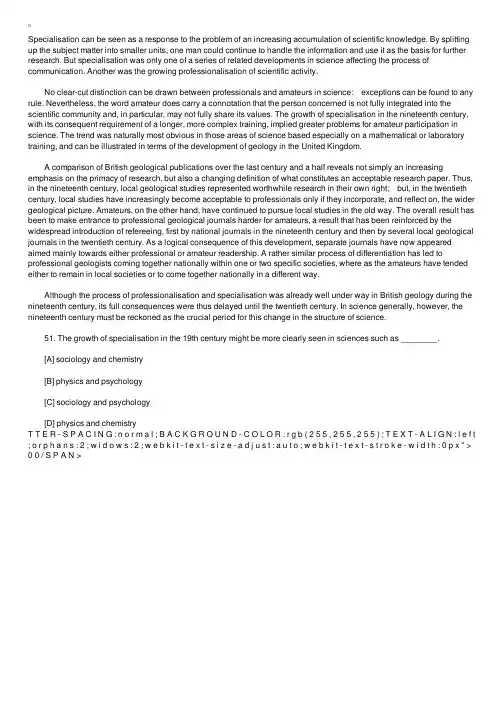
Specialisation can be seen as a response to the problem of an increasing accumulation of scientific knowledge. By splitting up the subject matter into smaller units, one man could continue to handle the information and use it as the basis for further research. But specialisation was only one of a series of related developments in science affecting the process of communication. Another was the growing professionalisation of scientific activity. No clear-cut distinction can be drawn between professionals and amateurs in science: exceptions can be found to any rule. Nevertheless, the word amateur does carry a connotation that the person concerned is not fully integrated into the scientific community and, in particular, may not fully share its values. The growth of specialisation in the nineteenth century, with its consequent requirement of a longer, more complex training, implied greater problems for amateur participation in science. The trend was naturally most obvious in those areas of science based especially on a mathematical or laboratory training, and can be illustrated in terms of the development of geology in the United Kingdom. A comparison of British geological publications over the last century and a half reveals not simply an increasing emphasis on the primacy of research, but also a changing definition of what constitutes an acceptable research paper. Thus, in the nineteenth century, local geological studies represented worthwhile research in their own right; but, in the twentieth century, local studies have increasingly become acceptable to professionals only if they incorporate, and reflect on, the wider geological picture. Amateurs, on the other hand, have continued to pursue local studies in the old way. The overall result has been to make entrance to professional geological journals harder for amateurs, a result that has been reinforced by the widespread introduction of refereeing, first by national journals in the nineteenth century and then by several local geological journals in the twentieth century. As a logical consequence of this development, separate journals have now appeared aimed mainly towards either professional or amateur readership. A rather similar process of differentiation has led to professional geologists coming together nationally within one or two specific societies, where as the amateurs have tended either to remain in local societies or to come together nationally in a different way. Although the process of professionalisation and specialisation was already well under way in British geology during the nineteenth century, its full consequences were thus delayed until the twentieth century. In science generally, however, the nineteenth century must be reckoned as the crucial period for this change in the structure of science. 51. The growth of specialisation in the 19th century might be more clearly seen in sciences such as ________. [A] sociology and chemistry [B] physics and psychology [C] sociology and psychology [D] physics and chemistryT T E R - S P A C I N G : n o r m a l ; B A C K G R O U N D - C O L O R : r g b ( 2 5 5 , 2 5 5 , 2 5 5 ) ; T E X T - A L I G N : l e f t ; o r p h a n s : 2 ; w i d o w s : 2 ; w e b k i t - t e x t - s i z e - a d j u s t : a u t o ; w e b k i t - t e x t - s t r o k e - w i d t h : 0 p x " > 0 0 / S P A N >。
2001 考研英语阅读真题Text 5(英语二)
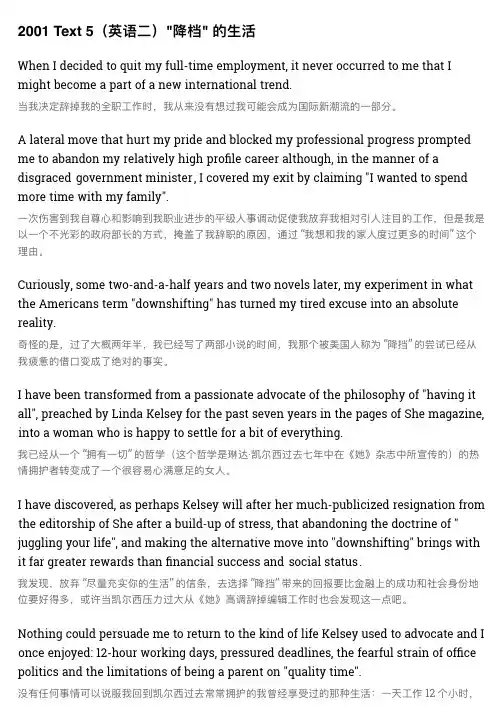
2001 Text 5(英语⼆)"降档" 的⽣活When I decided to quit my full-time employment, it never occurred to me that I might become a part of a new international trend.A lateral move that hurt my pride and blocked my professional progress prompted me to abandon my relatively high profile career although, in the manner of adisgraced , I covered my exit by claiming "I wanted to spend more time with my family".Curiously, some two-and-a-half years and two novels later, my experiment in what the Americans term "downshifting" has turned my tired excuse into an absolute reality.I have been transformed from a passionate advocate of the philosophy of "having it all", preached by Linda Kelsey for the past seven years in the pages of She magazine,into a woman who is happy to settle for a bit of everything.I have discovered, as perhaps Kelsey will after her much-publicized resignation from the editorship of She after a build-up of stress, that abandoning the doctrine of "juggling your life", and making the alternative move into "downshifting" brings with it far greater rewards than financial success and .Nothing could persuade me to return to the kind of life Kelsey used to advocate and I once enjoyed: 12-hour working days, pressured deadlines, the fearful strain of office politics and the limitations of being a parent on "quality time".当我决定辞掉我的全职⼯作时,我从来没有想过我可能会成为国际新潮流的⼀部分。
2001考研英语(一)真题

2001年全国攻读硕士学位研究生入学考试英语试题Part I Cloze TestDirections:For each numbered blank in the following passage,there are four choices marked[A],[B],[C]and[D]. Choose the best one and mark your answer on ANSWER SHEET1by blackening the corresponding letter in the brackets with a pencil.(10points)The government is to ban payments to witnesses by newspapers seeking to buy up people involved in prominent cases1the trial of Rosemary West.In a significant2of legal controls over the press,Lord Irvine,the Lord Chancellor,will introduce a 3bill that will propose making payments to witnesses4and will strictly control the amount of5 that can be given to a case6a trial begins.In a letter to Gerald Kaufman,chairman of the House of Commons media select committee,Lord Irvine said he7with a committee report this year which said that self regulation did not8sufficient control.9of the letter came two days after Lord Irvine caused a10of media protest when he said the11 of privacy controls contained in European legislation would be left to judges12to Parliament.The Lord Chancellor said introduction of the Human Rights Bill,which13the European Convention on Human Rights legally14in Britain,laid down that everybody was15to privacy and that public figures could go to court to protect themselves and their families.“Press freedoms will be in safe hands16our British judges,”he said.Witness payments became an17after West was sentenced to10life sentences in1995.Up to19 witnesses were18to have received payments for telling their stories to newspapers.Concerns were raised 19witnesses might be encouraged exaggerate their stories in court to20guilty verdicts.1.[A]as to[B]for instance[C]in particular[D]such as2.[A]tightening[B]intensifying[C]focusing[D]fastening3.[A]sketch[B]rough[C]preliminary[D]draft4.[A]illogical[B]illegal[C]improbable[D]improper5.[A]publicity[B]penalty[C]popularity[D]peculiarity6.[A]since[B]if[C]before[D]as7.[A]sided[B]shared[C]complied[D]agreed8.[A]present[B]offer[C]manifest[D]indicate9.[A]Release[B]Publication[C]Printing[D]Exposure10.[A]storm[B]rage[C]flare[D]flash11.[A]translation[B]interpretation[C]exhibition[D]demonstration12.[A]better than[B]other than[C]rather than[D]sooner than13.[A]changes[B]makes[C]sets[D]turns14.[A]binding[B]convincing[C]restraining[D]sustaining15.[A]authorized[B]credited[C]entitled[D]qualified16.[A]with[B]to[C]from[D]by17.[A]impact[B]incident[C]inference[D]issue18.[A]stated[B]remarked[C]said[D]told19.[A]what[B]when[C]which[D]that20.[A]assure[B]confide[C]ensure[D]guaranteePart II Reading ComprehensionDirections:Each of the passages below is followed by some questions.For each questions there are four answers marked[A],[B],[C]and[D].Read the passages carefully and choose the best answer to each of the questions. Then mark your answer on ANSWER SHEET1by blackening the corresponding letter in the brackets with a pencil.(40points)Passage1Specialisation can be seen as a response to the problem of an increasing accumulation of scientific knowledge. By splitting up the subject matter into smaller units,one man could continue to handle the information and use it as the basis for further research.But specialisation was only one of a series of related developments in scienceaffecting the process of communication.Another was the growing professionalisation of scientific activity.No clear-cut distinction can be drawn between professionals and amateurs in science:exceptions can be found to any rule.Nevertheless,the word“amateur”does carry a connotation that the person concerned is not fully integrated into the scientific community and,in particular,may not fully share its values.The growth of specialisation in the nineteenth century,with its consequent requirement of a longer,more complex training, implied greater problems for amateur participation in science.The trend was naturally most obvious in those areas of science based especially on a mathematical or laboratory training,and can be illustrated in terms of the development of geology in the United Kingdom.A comparison of British geological publications over the last century and a half reveals not simply an increasing emphasis on the primacy of research,but also a changing definition of what constitutes an acceptable research paper.Thus,in the nineteenth century,local geological studies represented worthwhile research in their own right;but,in the twentieth century,local studies have increasingly become acceptable to professionals only if they incorporate,and reflect on,the wider geological picture.Amateurs,on the other hand,have continued to pursue local studies in the old way.The overall result has been to make entrance to professional geological journals harder for amateurs,a result that has been reinforced by the widespread introduction of refereeing,first by national journals in the nineteenth century and then by several local geological journals in the twentieth century.As a logical consequence of this development,separate journals have now appeared aimed mainly towards either professional or amateur readership.A rather similar process of differentiation has led to professional geologists coming together nationally within one or two specific societies,whereas the amateurs have tended either to remain in local societies or to come together nationally in a different way.Although the process of professionalisation and specialisation was already well under way in British geology during the nineteenth century,its full consequences were thus delayed until the twentieth century.In science generally,however,the nineteenth century must be reckoned as the crucial period for this change in the structure of science.21.The growth of specialisation in the19th century might be more clearly seen in sciences such as_______.[A]sociology and chemistry[B]physics and psychology[C]sociology and psychology[D]physics and chemistry22.We can infer from the passage that_______.[A]there is little distinction between specialisation and professionalisation[B]amateurs can compete with professionals in some areas of science[C]professionals tend to welcome amateurs into the scientific community[D]amateurs have national academic societies but no local ones23.The author writes of the development of geology to demonstrate______.[A]the process of specialisation and professionalisation[B]the hardship of amateurs in scientific study[C]the change of policies in scientific publications[D]the discrimination of professionals against amateurs24.The direct reason for specialisation is_______.[A]the development in communication[B]the growth of professionalisation[C]the expansion of scientific knowledge[D]the splitting up of academic societiesPassage2A great deal of attention is being paid today to the so-called digital divide-the division of the world into the info(information)rich and the info poor.And that divide does exist today.My wife and I lectured about this looming danger twenty years ago.What was less visible then,however,were the new,positive forces that work against the digital divide.There are reasons to be optimistic.There are technological reasons to hope the digital divide will narrow.As the Internet becomes more and more commercialized,it is in the interest of business to universalize access-after all,the more people online,the more potential customers there are.More and more governments,afraid their countries will be left behind,want to spread Internet access.Within the next decade or two,one to two billion people on the planet will he netted together.As a result,I now believe the digital divide will narrow rather than widen in the years ahead.And that is very good news because the Internet may well be the most powerful tool for combating world poverty that we’ve ever had.Of course,the use of the Internet isn’t the only way to defeat poverty.And the Internet is not the only tool we have.But it has enormous potential.To take advantage of this tool,some impoverished countries will have to get over their outdated anti-colonial prejudices with respect to foreign investment.Countries that still think foreign investment is an invasion of their sovereignty might well study the history of infrastructure(the basic structural foundations of a society)in theUnited States.When the United States built its industrial infrastructure,it didn’t have the capital to do so.And that is why America’s Second Wave infrastructure-including roads,harbors,highways,ports and so on-were built with foreign investment.The English,the Germans,the Dutch and the French were investing in Britain’s former colony. They financed them.Immigrant Americans built them.Guess who owns them now?The Americans.I believe the same thing would be true in places like Brazil or anywhere else for that matter.The more foreign capital you have helping you build your Third Wave infrastructure,which today is an electronic infrastructure,the better off you’re going to be.That doesn't mean lying down and becoming fooled,or letting foreign corporations run uncontrolled. But it does mean recognizing how important they can be in building the energy and telecom infrastructures needed to take full advantage of the Internet.25.Digital divide is something_______.[A]getting worse because of the Internet[B]the rich countries are responsible for[C]the world must guard against[D]considered positive todayernments attach importance to the Internet because it_______.[A]offers economic potentials[B]can bring foreign funds[C]can soon wipe out world poverty[D]connects people all over the world27.The writer mentioned the case of the United States to justify the policy of_______.[A]providing financial support overseas[B]preventing foreign capital’s control[C]building industrial infrastructure[D]accepting foreign investment28.It seems that now a country’s economy depands much on______.[A]how well-developed it is electronically[B]whether it is prejudiced against immigrants [C]whether it adopts America’s industrial pattern[D]how much control it has over foreign corporationsPassage3Why do so many Americans distrust what they read in their newspapers?The American Society of Newspaper Editors is trying to answer this painful question.The organization is deep into a long self-analysis known as the journalism credibility project.Sad to say,this project has turned out to be mostly low-level findings about factual errors and spelling andgrammar mistakes,combined with lots of headscratching puzzlement about what in the world those readers really want.But the sources of distrust go way deeper.Most journalists learn to see the world through a set of standard templates(patterns)into which they plug each day’s events.In other words,there is a conventional story line in the newsroom culture that provides a backbone and a ready-made narrative structure for otherwise confusions news.There exists a social and cultural disconnect between journalists and their readers which helps explain why the “standard templates”of the newsroom seem alien many readers.In a recent survey,questionnaires were sent to reporters in five middle size cities around the country,plus one large metropolitan area.Then residents in these communities were phoned at random and asked the same questions.Replies show that compared with other Americans,journalists are more likely to live in upscale neighborhoods, have maids,own Mercedeses,and trade stocks,and they’re less likely to go to church,do volunteer work,or put down roots in community.Reporters tend to be part of a broadly defined social and cultural elite,so their work tends to reflect the conventional values of this elite.The astonishing distrust of the news media isn’t rooted in inaccuracy or poor reportorial skills but in the daily clash of world views between reporters and their readers.This is an explosive situation for any industry,particularly a declining one.Here is a troubled business that keeps hiring employees whose attitudes vastly annoy the customers.Then it sponsors lots of symposiums and a credibility project dedicated to wondering why customers are annoyed and fleeing in large numbers.But it never seems to get around to noticing the cultural and class biases that so many former buyers are complaining about.If it did,it would open up its diversity program,now focused narrowly on race and gender,and look for reporters who differ broadly by outlook,values,education,and class.29.What is the passage mainly about?[A]needs of the readers all over the world.[B]causes of the public disappointment about newspapers.[C]origins of the declining newspaper industry.[D]aims of a journalism credibility project.30.The results of the journalism credibility project turned out to be______.[A]quite trustworthy[B]somewhat contradictory[C]very illuminating[D]rather superficial31.The basic problem of journalists as pointed out by the writer lies in their______.[A]working attitude[B]conventional lifestyle[C]world outlook[D]educational background32.Despite its efforts,the newspaper industry still cannot satisfy the readers owing to its_______.[A]failure to realize its real problem[B]tendency to hire annoying reporters[C]likeliness to do inaccurate reporting[D]prejudice in matters of race and genderPassage4The world is going through the biggest wave of mergers and acquisitions ever witnessed.The process sweeps from hyperactive America to Europe and reaches the emerging countries with unsurpassed might.Many in these countries are looking at this process and worrying:"Won't the wave of business concentration turn into an uncontrollable anti-competitive force?"There's no question that the big are getting bigger and more powerful.Multinational corporations accounted for less than20%of international trade in1982.Today the figure is more than25%and growing rapidly. International affiliates account for a fast-growing segment of production in economies that open up and welcome foreign investment.In Argentina,for instance,after the reforms of the early1990s,multinationals went from43% to almost70%of the industrial production of the200largest firms.This phenomenon has created serious concerns over the role of smaller economic firms,of national businessmen and over the ultimate stability of the world economy.I believe that the most important forces behind the massive M&A wave are the same that underlie the globalization process:falling transportation and communication costs,lower trade and investment barriers and enlarged markets that require enlarged operations capable of meeting customers'demands.All these are beneficial, not detrimental,to consumers.As productivity grows,the world's wealth increases.Examples of benefits or costs of the current concentration wave are scanty.Yet it is hard to imagine that the merger of a few oil firms today could re-create the same threats to competition that were feared nearly a century ago in the U.S.,when the Standard Oil trust was broken up.The mergers of telecom companies,such as WorldCom, hardly seem to bring higher prices for consumers or a reduction in the pace of technical progress.On the contrary, the price of communications is coming down fast.In cars,too,concentration is increasing-witness Daimler andChrysler,Renault and Nissan-but it does not appear that consumers are being hurt.Yet the fact remains that the merger movement must be watched.A few weeks ago,Alan Greenspan warned against the megamergers in the banking industry.Who is going to supervise,regulate and operate as lender of last resort with the gigantic banks that are being created?Won't multinationals shift production from one place to another when a nation gets too strict about infringements to fair competition?And should one country take upon itself the role of“defending competition”on issues that affect many other nations,as in the U S.vs.Microsoft case?33.What is the typical trend of businesses today?[A]to take in more foreign funds.[B]to invest more abroad.[C]to combine and become bigger.[D]to trade with more countries.34.According to the author,one of the driving forces behind M&A wave is______.[A]the greater customer demands.[B]a surplus supply for the market.[C]a growing productivity.[D]the increase of the world's wealth.35.From paragraph4we can infer that______.[A]the increasing concentration is certain to hurt consumers[B]WorldCom serves as a good example of both benefits and costs[C]the costs of the globalization process are enormous[D]the Standard Oil trust might have threatened competition36.Toward the new business wave,the writer's attitude can he said to be_______.[A]optimistic[B]objective[C]pessimistic[D]biasedPassage5When I decided to quit my full time employment it never occurred to me that I might become a part of a new international trend.A lateral move that hurt my pride and blocked my professional progress prompted me to abandon my relatively high profile career although,in the manner of a disgraced government minister,I covered my exit by claiming“I wanted to spend more time with my family”.Curiously,some two-and-a-half years and two novels later,my experiment in what the Americans term “downshifting”has turned my tired excuse into an absolute reality.I have been transformed from a passionate advocate of the philosophy of“having it all”,preached by Linda Kelsey for the past seven years in the pages of She magazine,into a woman who is happy to settle for a bit of everything.I have discovered,as perhaps Kelsey will after her much-publicized resignation from the editorship of She after a build-up of stress,that abandoning the doctrine of“juggling your life”,and making the alternative move into “downshifting”brings with it far greater rewards than financial success and social status.Nothing could persuade me to return to the kind of life Kelsey used to advocate and I once enjoyed:12-hour working days,pressured deadlines,the fearful strain of office politics and the limitations of being a parent on“quality time”.In America,the move away from juggling to a simpler,less materialistic lifestyle is a well-established trend. Downshifting-also known in America as“voluntary simplicity”has,ironically,even bred a new area of what might be termed anticonsumerism.There are a number of bestselling downshifting self-help books for people who want to simplify their lives;there are newsletter's,such as The Tightwad Gazette,that give hundreds of thousands of Americans useful tips on anything from recycling their cling-film to making their own soap;there are even support groups for those who want to achieve the mid-'90s equivalent of dropping out.While in America the trend started as a reaction to the economic decline——after the mass redundancies caused by downsizing in the late’80s——and is still linked to the politics of thrift,in Britain,at least among the middle-class downshifters of my acquaintance,we have different reasons for seeking to simplify our lives.For the women of my generation who were urged to keep juggling through the’80s,downshifting in the mid-'90s is not so much a search for the mythical good life——growing your own organic vegetables,and risking turning into one——as a personal recognition of your limitations.37.Which of the following is true according to paragraph1?[A]Full-time employment is a new international trend.[B]The writer was compelled by circumstances to leave her job.[C]“A lateral move”means stepping out of full-time employment.[D]The writer was only too eager to spend more time with her family.38.The writer’s experiment shows that downshifting____.[A]enables her to realize her dream[B]helps her mold a new philosophy of life[C]prompts her to abandon her high social status[D]leads her to accept the doctrine of She magazine39.“Juggling one’s life”probably means living a life characterized by_____.[A]non-materialistic lifestyle[B]a bit of everything[C]extreme stress[D]anti-consumerism40.According to the passage,downshifting emerged in the U.S.as a result of_____.[A]the quick pace of modern life[B]man’s adventurous spirit[C]man’s search for mythical experiences[D]the economic situationPart III English-Chinese TranslationDirections:Read the following text carefully and then translate the underlined segments into Chinese.Your translation should be written clearly on ANSWER SHEET2.(15points)In less than30years’time the Star Trek holodeck will be a reality.Direct links between the brain’s nervous system and a computer will also create full sensory virtual environments,allowing virtual vacations like those in the film Total Recall.41)There will be television chat shows hosted by robots,and cars with pollution monitors that will disable them when they offend.42)Children will play with dolls equipped with personality chips,computers with in-built personalities will be regarded as workmates rather than tools,relaxation will be in front of smell television,and digital age will have arrived.According to BT’s futurologist,Ian Pearson,these are among the developments scheduled for the first few decades of the new millennium(a period of1,000years),when supercomputers will dramatically accelerate progress in all areas of life.43)Pearson has pieced together the work of hundreds of researchers around the world to produce a unique millennium technology calendar that gives the latest dates when we can expect hundreds of key breakthroughs and discoveries to take place.Some of the biggest developments will be in medicine,including an extended life expectancy and dozens of artificial organs coming into use between now and2040.Pearson also predicts a breakthrough in computer-human links.“By linking directly to our nervous system, computers could pick up what we feel and,hopefully,simulate feeling too so that we can start to develop fullsensory environments,rather like the holidays in Total Recall or the Star Trek holodeck,”he says.44)But that, Pearson points out,is only the start of man-machine integration:“It will be the beginning of the long process of integration that will ultimately lead to a fully electronic human before the end of the next century.”Through his research,Pearson is able to put dates to most of the breakthroughs that can be predicted.However, there are still no forecasts for when faster-than-light travel will be available,or when human cloning will be perfected,or when time travel will be possible.But he does expect social problems as a result of technological advances.A boom in neighborhood surveillance cameras will,for example,cause problems in2010,while the arrival of synthetic lifelike robots will mean people may not be able to distinguish between their human friends and the droids.45)And home appliances will also become so smart that controlling and operating them will result in the breakout of a new psychological disorder—kitchen rage.Section V Writing46.Directions:Among all the worthy feelings of mankind,love is probably the noblest,but everyone has his/her own understanding of it.There has been a discussion recently on the issue in a newspaper.Write an essay to the newspaper to1)show your understanding of the symbolic meaning of the picture below.2)give a specific example,and3)give your suggestion as to the best way to show love.。
2001-2010考研英语(一)真题与解析

2001年全国硕士研究生入学统一考试英语试题Section I Structure and VocabularyPart ADirections:Beneath each of the following sentences, there are four choices marked [A], [B], [C] and [D]. Choose the one that best completes the sentence. Mark your answer on ANSWER SHEET 1 by blackening the corresponding letter in the brackets with a pencil. (5 points)Example:I have been to the Great Wall three times ________ 1979.[A] from[B] after[C] for[D] sinceThe sentence should read, “I have been to the Great Wall three times since 1979.” Therefore, you should choose [D].Sample Answer[A] [B] [C] [■]1. If I were in movie, then it would be about time that I ________ my head in my hands for a cry.[A] bury[B] am burying[C] buried[D] would bury2. Good news was sometimes released prematurely, with the British recapture of the port________ half a day before the defenders actually surrendered.[A] to announce[B] announced[C] announcing[D] was announced3. According to one belief, if truth is to be known it will make itself apparent, so one ________wait instead of searching for it.[A] would rather[B] had to[C] cannot but[D] had best4. She felt suitably humble just as she ________ when he had first taken a good look at her cityself, hair waved and golden, nails red and pointed.[A] had[B] had had[C] would have and[D] has had5. There was no sign that Mr. Jospin, who keeps a firm control on the party despite ________from leadership of it, would intervene personally.[A] being resigned[B] having resigned[C] going to resign[D] resign6. So involved with their computers ________ that leaders at summer computer camps often haveto force them to break for sports and games.[A] became the children[B] become the children[C] had the children become[D] do the children become7. The individual TV viewer invariably senses that he or she is ________ an anonymous,statistically insignificant part of a huge and diverse audience.[A] everything except[B] anything but[C] no less than[D] nothing more than8. One difficulty in translation lies in obtaining a concept match. ________ this is meant that aconcept in one language is lost or changed in meaning in translation.[A] By[B] In[C] For[D] With9. Conversation becomes weaker in a society that spends so much time listening and being talkedto ________ it has all but lost the will and the skill to speak for itself.[A] as[B] which[C] that[D] what10. Church as we use the word refers to all religious institutions, ________ they Christian, Islamic,Buddhist, Jewish, and so on.[A] be[B] being[C] were[D] arePart BDirections:Beneath each of the following sentences, there are four choices marked [A], [B], [C] and [D]. Choose the one that best completes the sentence. Mark your answer on ANSWER SHEET 1 by blackening the corresponding letter in the rackets with a pencil. (10 points)Example:The lost car of the Lees was found ________ in the woods off the highway.[A] vanished[B] scattered[C] abandoned[D] rejectedThe sentence should read. “The lost car of the Lees was found abandoned in the woods off the highway.” There fore, you should choose [C].Sample Answer[A] [B] [■][D]11. He is too young to be able to ________ between right and wrong.[A] discard[B] discern[C] disperse[D] disregard12. It was no ________ that his car was seen near the bank at the time of the robbery.[A] coincidence[B] convention[C] certainty[D] complication13. One of the responsibilities of the Coast Guard is to make sure that all ships ________ followtraffic rules in busy harbors.[A] cautiously[B] dutifully[C] faithfully[D] skillfully14. The Eskimo is perhaps one of the most trusting and considerate of all Indians but seems to be________ the welfare of his animals.[A] critical about[B] indignant at[C] indifferent to[D] subject to15. The chairman of the board ________ on me the unpleasant job of dismissing good workers thefirm can no longer afford to employ.[A] compelled[B] posed[C] pressed[D] tempted16. It is naive to expect that any society can resolve all the social problems it is faced with________.[A] for long[B] in and out[C] once for all[D] by nature17. Using extremely different decorating schemes in adjoining rooms may result in ________ andlack of unity in style.[A] conflict[B] confrontation[C] disturbance[D] disharmony18. The Timber rattlesnake is now on the endangered species list, and is extinct in two easternstates in which it once ________.[A] thrived[B] swelled[C] prospered[D] flourished19. However, growth in the fabricated metals industry was able to ________ some of the decline inthe iron and steel industry.[A] overturn[B] overtake[C] offset[D] oppress20. Because of its intimacy, radio is usually more than just a medium; it is ________.[A] firm[B] company[C] corporation[D] enterprise21. When any non-human organ is transplanted into a person, the body immediately recognizes itas ________.[A] novel[B] remote[C] distant[D] foreign22. My favorite radio song is the one I first heard on a thick 1923 Edison disc I ________ at agarage sale.[A] trifled with[B] scraped through[C] stumbled upon[D] thirsted for23. Some day software will translate both written and spoken language so well that the need forany common second language could ________.[A] descend[B] decline[C] deteriorate[D] depress24. Equipment not ________ official safety standards has all been removed from the workshop.[A] conforming to[B] consistent with[C] predominant over[D] providing for25. As an industry, biotechnology stands to ________ electronics in dollar volume and perhapssurpass it in social impact by 2020.[A] contend[B] contest[C] rival[D] strive26. The authors of the United States Constitution attempted to establish an effective nationalgovernment while preserving ________ for the states and liberty for individuals.[A] autonomy[B] dignity[C] monopoly[D] stability27. For three quarters of its span on Earth, life evolved almost ________ as microorganisms.[A] precisely[B] instantly[C] initially[D] exclusively28. The introduction of gunpowder gradually made the bow and arrow ________, particularly inWestern Europe.[A] obscure[B] obsolete[C] optional[D] overlapping29. Whoever formulated the theory of the origin of the universe, it is just ________ and needsproving.[A] spontaneous[B] hypothetical[C] intuitive[D] empirical30. The future of this company is ________: many of its talented employees are flowing into moreprofitable net-based businesses.[A] at odds[B] in trouble[C] in vain[D] at stakeSection II Cloze TestDirections:For each numbered blank in the following passage, there are four choices marked [A], [B], [C] and [D]. Choose the best one and mark your answer on ANSWER SHEET 1by blackening the corresponding letter in the brackets with a pencil. (10 points)The government is to ban payments to witnesses by newspapers seeking to buy up people involved in prominent cases 31the trial of Rosemary West.In a significant 32of legal controls over the press, Lord Irvine, the Lord Chancellor, will introduce a 33bill that will propose making payments to witnesses 34and will strictly control the amount of 35that can be given to a case 36 a trial begins.In a letter to Gerald Kaufman, chairman of the House of Commons Media Select Committee, Lord Irvine said he 37with a committee report this year which said that self regulation did not 38sufficient control.39of the letter came two days after Lord Irvine caused a 40of media protest when he said the 41of privacy controls contained in European legislation would be left to judges 42to Parliament.The Lord Chancellor said introduction of the Human Rights Bill, which 43theEuropean Convention on Human Rights legally 44in Britain, laid down that everybody was 45to privacy and that public figures could go to court to protect themselves and their families.“Press freedoms will be in safe hands 46our British judges,” he said.Witness payments became an 47after West was sentenced to 10 life sentences in 1995. Up to 19 witnesses were 48to have received payments for telling their stories to newspapers. Concerns were raised 49witnesses might be encouraged to exaggerate their stories in court to 50guilty verdicts.31. [A] as to [B] for instance [C] in particular [D] such as32. [A] tightening [B] intensifying [C] focusing [D] fastening33. [A] sketch [B] rough [C] preliminary [D] draft34. [A] illogical [B] illegal [C] improbable [D] improper35. [A] publicity [B] penalty [C] popularity [D] peculiarity36. [A] since [B] if [C] before [D] as37. [A] sided [B] shared [C] complied [D] agreed38. [A] present [B] offer [C] manifest [D] indicate39. [A] Release [B] Publication [C] Printing [D] Exposure40. [A] storm [B] rage [C] flare [D] flash41. [A] translation [B] interpretation [C] exhibition [D] demonstration42. [A] better than [B] other than [C] rather than [D] sooner than43. [A] changes [B] make [C] sets [D] turns44. [A] binding [B] convincing [C] restraining [D] sustaining45. [A] authorized [B] credited [C] entitled [D] qualified46. [A] with [B] to [C] from [D] by47. [A] impact [B] incident [C] inference [D] issue48. [A] stated [B] remarked [C] said [D] told49. [A] what [B] when [C] which [D] that50. [A] assure [B] confide [C] ensure [D] guaranteeSection III Reading ComprehensionDirections:Each of the passages below is followed by some questions. For each question there are four answers marked [A], [B], [C] and [D]. Read the passages carefully and choose the best answer to each of the questions. Then mark your answer on ANSWER SHEET 1 by blackening the corresponding letter in the brackets with a pencil. (40 points)Text 1Specialization can be seen as a response to the problem of an increasing accumulation of scientific knowledge. By splitting up the subject matter into smaller units, one man could continue to handle the information and use it as the basis for further research. But specialization was only one of a series of related developments in science affecting the process of communication. Another was the growing professionalisation of scientific activity.No clear-cut distinction can be drawn between professionals and amateurs in science: exceptions can be found to any rule. Nevertheless, the word “amateur” does carry a connotation that the person concerned is not fully integrated into the scientific community and, in particular, may not fully share its values. The growth of specialization in the nineteenth century, with its consequent requirement of a longer, more complex training, implied greater problems for amateur participation in science. The trend was naturally most obvious in those areas of science based especially on a mathematical or laboratory training, and can be illustrated in terms of the development of geology in the United Kingdom.A comparison of British geological publications over the last century and a half reveals not simply an increasing emphasis on the primacy of research, but also a changing definition of what constitutes an acceptable research paper. Thus, in the nineteenth century, local geological studies represented worthwhile research in their own right; but, in the twentieth century, local studies have increasingly become acceptable to professionals only if they incorporate, and reflect on, the wider geological picture. Amateurs, on the other hand, have continued to pursue local studies in the old way. The overall result has been to make entrance to professional geological journals harder for amateurs, a result that has been reinforced by the widespread introduction of refereeing, first by national journals in the nineteenth century and then by several local geological journals in thetwentieth century. As a logical consequence of this development, separate journals have now appeared aimed mainly towards either professional or amateur readership. A rather similar process of differentiation has led to professional geologists coming together nationally within one or two specific societies, whereas the amateurs have tended either to remain in local societies or to come together nationally in a different way.Although the process of professionalisation and specialization was already well under way in British geology during the nineteenth century, its full consequences were thus delayed until the twentieth century. In science generally, however, the nineteenth century must be reckoned as the crucial period for this change in the structure of science.51. The growth of specialization in the 19th century might be more clearly seen in sciences such as________.[A] sociology and chemistry[B] physics and psychology[C] sociology and psychology[D] physics and chemistry52. We can infer from the passage that ________.[A] there is little distinction between specialization and professionalisation[B] amateurs can compete with professionals in some areas of science[C] professionals tend to welcome amateurs into the scientific community[D] amateurs have national academic societies but no local ones53. The author writes of the development of geology to demonstrate ________.[A] the process of specialization and professionalisation[B] the hardship of amateurs in scientific study[C] the change of policies in scientific publications[D] the discrimination of professionals against amateurs54. The direct reason for specialization is ________.[A] the development in communication[B] the growth of professionalisation[C] the expansion of scientific knowledge[D] the splitting up of academic societiesText 2A great deal of attention is being paid today to the so-called digital divide -- the division of the world into the info (information) rich and the info poor. And that divide does exist today. My wife and I lectured about this looming danger twenty years ago. What was less visible then, however,were the new, positive forces that work against the digital divide. There are reasons to be optimistic.There are technological reasons to hope the digital divide will narrow. As the Internet becomes more and more commercialized, it is in the interest of business to universalize access -- after all, the more people online, the more potential customers there are. More and more governments, afraid their countries will be left behind, want to spread Internet access. Within the next decade or two, one to two billion people on the planet will be netted together. As a result, I now believe the digital divide will narrow rather than widen in the years ahead. And that is very good news because the Internet may well be the most powerful tool for combating world poverty that we’ve ever had.Of course, the use of the Internet isn’t the only way to defeat poverty. And the Int ernet is not the only tool we have. But it has enormous potential.To take advantage of this tool, some impoverished countries will have to get over their outdated anti-colonial prejudices with respect to foreign investment. Countries that still think foreign investment is an invasion of their sovereignty might well study the history of infrastructure (the basic structural foundations of a society) in the United States. When the United States built its industrial infrastructure, it didn’t have the capital to do so. And that is why America’s Second Wave infrastructure -- including roads, harbors, highways, ports and so on -- were built with foreign investment. The English, the Germans, the Dutch and the French were investing in Britain’s former colony. They financed them. Immigrant Americans built them. Guess who owns them now? The Americans. I believe the same thing would be true in places like Brazil or anywhere else for that matter. The more foreign capital you have helping you build your Third Wave infrastructure, which today is an electronic infrastructure, the better off you’re going to be. That doesn’t mean lying down and becoming fooled, or letting foreign corporations run uncontrolled. But it does mean recognizing how important they can be in building the energy and telecom infrastructures needed to take full advantage of the Internet.55. Digital divide is something ________.[A] getting worse because of the Internet[B] the rich countries are responsible for[C] the world must guard against[D] considered positive today56. Governments attach importance to the Internet because it ________.[A] offers economic potentials[B] can bring foreign funds[C] can soon wipe out world poverty[D] connects people all over the world57. The writer mentioned the case of the United States to justify the policy of ________.[A] providing financial support overseas[B] preventing foreign capital’s control[C] building industrial infrastructure[D] accepting foreign investment58. It seems that now a country’s economy depends much on ________.[A] how well-developed it is electronically[B] whether it is prejudiced against immigrants[C] whether it adopts America’s industrial pattern[D] how much control it has over foreign corporationsText 3Why do so many Americans distrust what they read in their newspapers? The American Society of Newspaper Editors is trying to answer this painful question. The organization is deep into a long self-analysis known as the journalism credibility project.Sad to say, this project has turned out to be mostly low-level findings about factual errors and spelling and grammar mistakes, combined with lots of head-scratching puzzlement about what in the world those readers really want.But the sources of distrust go way deeper. Most journalists learn to see the world through a set of standard templates (patterns) into which they plug each day’s events. In other words, there is a conventional story line in the newsroom culture that provides a backbone and a ready-made narrative structure for otherwise confusing news.There exists a social and cultural disconnect between journalists and their readers, which helps explain why the “standard templates” of the newsroom seem alien to many readers. In a recent survey, questionnaires were sent to reporters in five middle-size cities around the country, plus one large metropolitan area. Then residents in these communities were phoned at random and asked the same questions.Replies show that compared with other Americans, journalists are more likely to live in upscale neighborhoods, have maids, own Mercedeses, and trade stocks, and they’re less likely to go to church, do volunteer work, or put down roots in a community.Reporters tend to be part of a broadly defined social and cultural elite, so their work tends to reflect the conventional values of this elite. The astonishing distrust of the news media isn’t rooted in inaccuracy or poor reportorial skills but in the daily clash of world views between reporters and their readers.This is an explosive situation for any industry, particularly a declining one. Here is a troubled business that keeps hiring employees whose attitudes vastly annoy the customers. Then it sponsors lots of symposiums and a credibility project dedicated to wondering why customers are annoyed and fleeing in large numbers. But it never seems to get around to noticing the cultural and class biases that so many former buyers are complaining about. If it did, it would open up its diversity program, now focused narrowly on race and gender, and look for reporters who differ broadly by outlook, values, education, and class.59. What is the passage mainly about?[A] needs of the readers all over the world[B] causes of the public disappointment about newspapers[C] origins of the declining newspaper industry[D] aims of a journalism credibility project60. The results of the journalism credibility project turned out to be ________.[A] quite trustworthy[B] somewhat contradictory[C] very illuminating[D] rather superficial61. The basic problem of journalists as pointed out by the writer lies in their ________.[A] working attitude[B] conventional lifestyle[C] world outlook[D] educational background62. Despite its efforts, the newspaper industry still cannot satisfy the readers owing to its________.[A] failure to realize its real problem[B] tendency to hire annoying reporters[C] likeliness to do inaccurate reporting[D] prejudice in matters of race and genderText 4The world is going through the biggest wave of mergers and acquisitions ever witnessed. The process sweeps from hyperactive America to Europe and reaches the emerging countries with unsurpassed might. Many in these countries are looking at this process and worrying: “Won’t the wave of business concentration turn into an uncontrollable anti-competitive force?”There’s no question that the big are getting bigger and more powerful. Multinational corporations accounted for less than 20% of international trade in 1982. Today the figure is more than 25% and growing rapidly. International affiliates account for a fast-growing segment of production in economies that open up and welcome foreign investment. In Argentina, for instance, after the reforms of the early 1990s, multinationals went from 43% to almost 70% of the industrial production of the 200 largest firms. This phenomenon has created serious concerns over the role of smaller economic firms, of national businessmen and over the ultimate stability of the world economy.I believe that the most important forces behind the massive M&A wave are the same that underlie the globalization process: falling transportation and communication costs, lower trade andinvestment barriers and enlarged markets that require enlarged operations capable of meeting customer’s demands. All these are beneficial, not detrimental, to consumers. As productivity grows, the world’s wealth increases.Examples of benefits or costs of the current concentration wave are scanty. Yet it is hard to imagine that the merger of a few oil firms today could re-create the same threats to competition that were feared nearly a century ago in the U.S., when the Standard Oil Trust was broken up. The mergers of telecom companies, such as WorldCom, hardly seem to bring higher prices for consumers or a reduction in the pace of technical progress. On the contrary, the price of communications is coming down fast. In cars, too, concentration is increasing -- witness Daimler and Chrysler, Renault and Nissan -- but it does not appear that consumers are being hurt.Yet the fact remains that the merger movement must be watched. A few weeks ago, Alan Greenspan warned against the megamergers in the banking industry. Who is going to supervise, regulate and operate as lender of last resort with the gigantic banks that are bein g created? Won’t multinationals shift production from one place to another when a nation gets too strict about infringements to fair competition? And should one country take upon itself the role of “defending competition” on issues that affect many ot her nations, as in the U.S. vs. Microsoft case?63. What is the typical trend of businesses today?[A] to take in more foreign funds[B] to invest more abroad[C] to combine and become bigger[D] to trade with more countries64. According to the author, one of the driving forces behind M&A wave is ________.[A] the greater customer demands[B] a surplus supply for the market[C] a growing productivity[D] the increase of the world’s wealth65. From Paragraph 4 we can infer that ________.[A] the increasing concentration is certain to hurt consumers[B] WorldCom serves as a good example of both benefits and costs[C] the costs of the globalization process are enormous[D] the Standard Oil Trust might have threatened competition66. Toward the new business wave, the writer’s attitude can be said to be ________.[A] optimistic[B] objective[C] pessimistic[D] biasedText 5When I decided to quit my full time employment it never occurred to me that I might become a part of a new international trend. A lateral move that hurt my pride and blocked my professional progress prompted me to abandon my relatively high profile career although, in the manner of a disgraced government minister, I covered my exit by claiming “I wanted to spend more time with my family”.Curiously, some two-and-a-half years and two novels later, my experiment in what the Americans term “downshifting” has turned my tired excuse into an absolute reality. I have been transformed from a passionate advocate of the philosophy of “having it all,” preached by Linda Kelsey for the past seven years in the page of She magazine, into a woman who is happy to settle for a bit of everything.I have discovered, as perhaps Kelsey will after her much-publicized resignation from the editorship of She after a build-up of stress, that abandoning the doctrine of “juggling your life,” and making the alternative move into “downshifting” brings with it far greater rewards than financial success and social status. Nothing could persuade me to return to the kind of life Kelsey used to advocate and I once enjoyed: 12-hour working days, pressured deadlines, the fearful strain of office politics and the limitations of being a parent on “quality time”.In America, the move away from juggling to a simpler, less materialistic lifestyle is a well-established trend. Downshifting -- also known in America as “voluntary simplicity” -- has, ironically, even bred a new area of what might be termed anti-consumerism. There are a number of best-selling downshifting self-help books for people who want to simplify their lives; there are newsletters, such as The Tightwad Gazette, that give hundreds of thousands of Americans useful tips on anything from recycling their cling-film to making their own soap; there are even support groups for those who want to achieve the mid-’90s equivalent of dropping out.While in America the trend started as a reaction to the economic decline -- after the mass redundancies caused by downsizing in the late ’80s -- and is still linked to the politics of thrift, in Britain, at least among the middle-class downshifters of my acquaintance, we have different reasons for seeking to simplify our lives.For the women of my generation who were urged to keep juggling through the ’80s, downshifting in the mid-’90s is not so much a search for the mythical good life -- growing your own organic vegetables, and risking turning into one -- as a personal recognition of your limitations.67. Which of the following is true according to Paragraph 1?[A] Full-time employment is a new international trend.[B] The writer was compelled by circumstances to leave her job.[C] “A lateral move” means stepping out of full-time employment.[D] The writer was only too eager to spend more time with her family.68. The writer’s experiment shows that downshifting ________.[A] enables her to realize her dream[B] helps her mold a new philosophy of life[C] prompts her to abandon her high social status[D] leads her to accept the doctrine of She magazine69. “Juggling one’s life” probably means living a life characterized by ________.[A] non-materialistic lifestyle[B] a bit of everything[C] extreme stress[D] anti-consumerism70. According to the passage, downshifting emerged in the U.S. as a result of ________.[A] the quick pace of modern life[B] man’s adventurous spirit[C] man’s search for mythical experiences[D] the economic situationSection IV English-Chinese TranslationDirections:Read the following passage carefully and then translate the underlined sentences into Chinese. Your translation must be written neatly on ANSWER SHEET 2. (15 points)In less than 30 years’ time the Star Trek holodeck will be a reality. Direct links between the brain’s nervous system and a computer will also create full sensory virtual environments, allowing virtual vacations like those in the film Total Recall.71) There will be television chat shows hosted by robots, and cars with pollution monitors that will disable them when they offend. 72) Children will play with dolls equipped with personality chips, computers with in-built personalities will be regarded as workmates rather than tools, relaxation will be in front of smell-television, and digital age will have arrived.According to BT’s futurologist, Ian Pearson, these are among the developments scheduled for the first few decades of the new millennium (a period of 1,000 years), when supercomputers will dramatically accelerate progress in all areas of life.73) Pearson has pieced together the work of hundreds of researchers around the world to produce a unique millennium technology calendar that gives the latest dates when we can expect hundreds of key breakthroughs and discoveries to take place. Some of the biggest developments will be in medicine, including an extended life expectancy and dozens of artificial organs coming into use between now and 2040.Pearson also predicts a breakthrough in computer-human links. “By linking directly to our nervous system, computers could pick up what we feel and, hopefully, simulate feeling too so that we can start to develop full sensory environments, rather like the holidays in Total Recall or the Star。
2001年 英语一真题(未排版)【小白考研】

2001年全国硕士研究生入学统一考试英语试题Section I Use of EnglishDirections:For each numbered blank in the following passage, there are four choices marked A, B, C and D. Choose the best one and mark your answer on ANSWER SHEET 1 by blackening the corresponding letter in the brackets with a pencil. (10 points)The government is to ban payments to witnesses by newspapers seeking to buy up people involved in prominent cases 1 the trial of Rosemary West.In a significant 2 of legal controls over the press, Lord Irvine, the Lord Chancellor, will introduce a 3 bill that will propose making payments to witnesses 4 and will strictly control the amount of 5 that can be given to a case 6 a trial begins.In a letter to Gerald Kaufman, chairman of the House of Commons Media Select Committee, Lord Irvine said he 7 with a committee report this year which said that self regulation did not 8 sufficient control.9 of the letter came two days after Lord Irvine caused a 10 of media protest when he said the 11 of privacy controls contained in European legislation would be left to judges 12 to Parliament.The Lord Chancellor said introduction of the Human Rights Bill, which 13 the European Convention on Human Rights legally 14 in Britain, laid down that everybody was 15 to privacy and that public figures could go to court to protect themselves and their families.“Press freedoms will be in safe hands 16 our British judges,” he said.Witness payments became an 17 after West was sentenced to 10 life sentences in 1995. Up to 19 witnesses were 18 to have received payments for telling their stories to newspapers. Concerns were raised 19 witnesses might be encouraged to exaggerate their stories in court to 20 guilty verdicts.[A] as to[B] for instance[C] in particular(D)[D] such as[A] tightening[B] intensifying[C] focusing(A)[D] fastening[A] sketch[B] rough[C] preliminary(D)[D] draft[A] illogical[B] illegal[C] improbable(B)[D] improper[A] publicity[B] penalty[C] popularity(A)[D] peculiarity[A] since[B] if[C] before(C)[D] as[A] sided[B] shared[C] complied(D)[D] agreed[A] present[B] offer[C] manifest(B)[D] indicate[A] Release[B] Publication[C] Printing(B)[D] Exposure[A] storm[B] rage[C] flare(A)[D] flash[A] translation[B] interpretation[C] exhibition(B)[D] demonstration[A] better than[B] other than[C] rather than(C)[D] sooner than[A] changes[B] makes[C] sets(B)[D] turns[A] binding[B] convincing[C] restraining(A)[D] sustaining[A] authorized[B] credited[C] entitled(C)[D] qualified[A] with[B] to[C] from(A)[D] by[A] impact[B] incident[C] inference(D)[D] issue[A] stated[B] remarked[C] said(C)[D] told[A] what[B] when[C] which(D)[D] that[A] assure[B] confide[C] ensure(C)[D] guaranteeSection Ⅱ Reading ComprehensionPart ADirections:Each of the passages below is followed by some questions. For each question there are four answers marked [A], [B], [C] and [D]. Read the passages carefully and choose the best answer to each of the questions. Then mark your answer on ANSWER SHEET 1 by blackening the corresponding letter in the brackets with a pencil. (40 points)Text 1Specialization can be seen as a response to the problem of an increasing accumulation of scientific knowledge. By splitting up the subject matter into smaller units, one man could continue to handle the information and use it as the basis for further research. But specialization was only one of a series of related developments in science affecting the process of communication. Another was the growing professionalisation of scientific activity.No clear-cut distinction can be drawn between professionals and amateurs in science: exceptions can be found to any rule. Nevertheless, the word “amateur” does carry a connotation that the person concerned is not fully integrated into the scientific community and, in particular, may not fully share its values. The growth of specialization in the nineteenth century, with its consequent requirement of a longer, more complex training, implied greater problems for amateur participation in science. The trend was naturally most obvious in those areas of science based especially on a mathematical or laboratory training, and can be illustrated in terms of the development of geology in the United Kingdom.A comparison of British geological publications over the last century and a half reveals not simply an increasing emphasis on the primacy of research, but also a changing definition of what constitutes an acceptable research paper. Thus, in the nineteenth century, local geological studies represented worthwhile research in their own right; but, in the twentieth century, local studies have increasingly become acceptable to professionals only if they incorporate, and reflect on, the wider geological picture. Amateurs, on the other hand, have continued to pursue local studies in the old way. The overall result has been to make entrance to professional geological journals harder for amateurs, a result that has been reinforced by the widespread introduction of refereeing, first by national journals in the nineteenth century and then by several local geological journals in the twentieth century. As a logical consequence of this development, separate journals have now appeared aimed mainly towards either professional or amateur readership. A rather similar process of differentiation has led to professional geologists coming together nationally within one or two specific societies, whereas the amateurs have tended either to remain in local societies or to come together nationally in a different way.Although the process of professionalisation and specialization was already well under way in British geology during the nineteenth century, its full consequences were thus delayed until the twentieth century. In science generally, however, the nineteenth century must be reckoned as the crucial period for this change in the structure of science.21.The growth of specialization in the 19th century might be more clearly seen in sciences such as ________.[A] sociology and chemistry[B] physics and psychology[C] sociology and psychology a [D] physics and chemistry22. (D)We can infer from the passage that ________.[A] there is little distinction between specialization and professionalisation[B] amateurs can compete with professionals in some areas of science[C] professionals tend to welcome amateurs into the scientific community(B)[D] amateurs have national academic societies but no local ones23. aThe author writes of the development of geology to demonstrate ________.[A] the process of specialization and professionalisation[B] the hardship of amateurs in scientific study[C] the change of policies in scientific publications(A)[D] the discrimination of professionals against amateurs24.a The direct reason for specialization is ________.[A] the development in communication[B] the growth of professionalisation[C] the expansion of scientific knowledge(C)[D] the splitting up of academic societiesText 2A great deal of attention is being paid today to the so-called digital divide -- the division of the world into the info (information) rich and the info poor. And that divide does exist today. My wife and I lectured about this looming danger twenty years ago. What was less visible then, however, were the new, positive forces that work against the digital divide. There are reasons to be optimistic.There are technological reasons to hope the digital divide will narrow. As the Internet becomes more and more commercialized, it is in the interest of business to universalize access -- after all, the more people online, the more potential customers there are. More and more governments, afraid their countries will be left behind, want to spread Internet access. Within the next decade or two, one to two billion people on the planet will be netted together. As a result, I now believe the digital divide will narrow rather than widen in the years ahead. And that is very good news because the Internet may well be the most powerful tool for combating world poverty that we’ve ever had.Of course, the use of the Internet isn’t the only way to defeat poverty. And the Internet is not the only tool we have. But it has enormous potential.To take advantage of this tool, some impoverished countries will have to get over their outdated anti-colonial prejudices with respect to foreign investment. Countries that still think foreign investment is an invasion of their sovereignty might well study the history of infrastructure (the basic structural foundations of a society) in the United States. When the United States builtits industrial infrastructure, it didn’t have the capital to do so. And that is why America’s Second Wave infrastructure -- including roads, harbors, highways, ports and so on -- were built with foreign investment. The English, the Germans, the Dutch and the French were investing in Britain’s former colony. They financed them. Immigrant Americans built them. Guess who owns them now? The Americans. I believe the same thing would be true in places like Brazil or anywhere else for that matter. The more foreign capital you have helping you build your Third Wave infrastructure, which today is an electronic infrastructure, the better off you’re going to be. That doesn’t mean lying down and becoming fooled, or letting foreign corporations run uncontrolled. But it does mean recognizing how important they can be in building the energy and telecom infrastructures needed to take full advantage of the Internet.25. Digital divide is something ________.All [A] getting worse because of the Internet[B] the rich countries are responsible forAll [C] the world must guard against[D] considered positive today26. (C)Governments attach importance to the Internet because it ________.As i[A] offers economic potentials[B] can bring foreign fundsA ai[C] can soon wipe out world poverty[D] connects people all over the world27. The writer mentioned the case of the United States to justify the policy of ________.As i[A] providing financial support overseas[B] preventing foreign capital’s controlA d [C] building industrial infrastructure[D] accepting foreign investment (D)It seems that now a country’s economy depends much on ________.As i[A] how well-developed it is electronicallyAs i[B] whether it is prejudiced against immigrantsAs i[C] whether it adopts America’s industrial pattern(A)As i[D] how much control it has over foreign corporationsText 3Why do so many Americans distrust what they read in their newspapers? The American Society of Newspaper Editors is trying to answer this painful question. The organization is deep into a long self-analysis known as the journalism credibility project.Sad to say, this project has turned out to be mostly low-level findings about factual errors and spelling and grammar mistakes, combined with lots of head-scratching puzzlement about what in the world those readers really want.But the sources of distrust go way deeper. Most journalists learn to see the world through a set of standard templates (patterns) into which they plug each day’s events. In other words, there is a conventional story line in the newsroom culture that provides a backbone and a ready-made narrative structure for otherwise confusing news.There exists a social and cultural disconnect between journalists and their readers, which helps explain why the “standard templates” of the newsroom seem alien to many readers. In a recent survey, questionnaires were sent to reporters in five middle-size cities around the country, plus one large metropolitan area. Then residents in these communities were phoned at random andasked the same questions.Replies show that compared with other Americans, journalists are more likely to live in upscale neighborhoods, have maids, own Mercedeses, and trade stocks, and they’re less likely to go to church, do volunteer work, or put down roots in a community.Reporters tend to be part of a broadly defined social and cultural elite, so their work tends to reflect the conventional values of this elite. The astonishing distrust of the news media isn’t rooted in inaccuracy or poor reportorial skills but in the daily clash of world views between reporters and their readers.This is an explosive situation for any industry, particularly a declining one. Here is a troubled business that keeps hiring employees whose attitudes vastly annoy the customers. Then it sponsors lots of symposiums and a credibility project dedicated to wondering why customers are annoyed and fleeing in large numbers. But it never seems to get around to noticing the cultural and class biases that so many former buyers are complaining about. If it did, it would open up its diversity program, now focused narrowly on race and gender, and look for reporters who differ broadly by outlook, values, education, and class.29.What is the passage mainly about?[A] needs of the readers all over the world[B] causes of the public disappointment about newspapers[C] origins of the declining newspaper industry(B)[D] aims of a journalism credibility project30.The results of the journalism credibility project turned out to be ________.[A] quite trustworthy[B] somewhat contradictory[C] very illuminating i(D)[D] rather superficial31.The basic problem of journalists as pointed out by the writer lies in their ________.[A] working attitude [B] conventional lifestyle[C] world outlook(C)[D] educational background32.Despite its efforts, the newspaper industry still cannot satisfy the readers owing to its ________.[A] failure to realize its real problem[B] tendency to hire annoying reporters[C] likeliness to do inaccurate reporting(A)[D] prejudice in matters of race and genderText 4The world is going through the biggest wave of mergers and acquisitions ever witnessed. The process sweeps from hyperactive America to Europe and reaches the emerging countries with unsurpassed might. Many in these countries are looking at this process and worrying: “Won’t the wave of business concentration turn into an uncontrollable anti-competitive force?”There’s no question that the big are getting bigger and more powerful. Multinational corporations accounted for less than 20% of international trade in 1982. Today the figure is more than 25% and growing rapidly. International affiliates account for a fast-growing segment of production in economies that open up and welcome foreign investment. In Argentina, for instance, after the reforms of the early 1990s, multinationals went from 43% to almost 70% of the industrial production of the 200 largest firms. This phenomenon has created seriousconcerns over the role of smaller economic firms, of national businessmen and over the ultimate stability of the world economy.I believe that the most important forces behind the massive M&A wave are the same that underlie the globalization process: falling transportation and communication costs, lower trade and investment barriers and enlarged markets that require enlarged operations capable of meeting customer’s demands. All these are beneficial, not detrimental, to consumers. As productivity grows, the world’s wealth increases.Examples of benefits or costs of the current concentration wave are scanty. Yet it is hard to imagine that the merger of a few oil firms today could re-create the same threats to competition that were feared nearly a century ago in the U.S., when the Standard Oil Trust was broken up. The mergers of telecom companies, such as WorldCom, hardly seem to bring higher prices for consumers or a reduction in the pace of technical progress. On the contrary, the price of communications is coming down fast. In cars, too, concentration is increasing -- witness Daimler and Chrysler, Renault and Nissan -- but it does not appear that consumers are being hurt.Yet the fact remains that the merger movement must be watched. A few weeks ago, Alan Greenspan warned against the megamergers in the banking industry. Who is going to supervise, regulate and operate as lender of last resort with the gigantic banks that are being created? Won’t multinationals shift production from one place to another when a nation gets too strict about infringements to fair competition? And should one country take upon itself the role of “defending competition” on issues that affect many other nations, as in the U.S. vs. Microsoft case?33.What is the typical trend of businesses today?[A] to take in more foreign funds [B] to invest more abroad[C] to combine and become bigger (C)[D] to trade with more countries34.According to the author, one of the driving forces behind M&A wave is ________.[A] the greater customer demands[B] a surplus supply for the market[C] a growing productivity(A)[D] the increase of the world’s wealth35.From Paragraph 4 we can infer that ________.[A] the increasing concentration is certain to hurt consumers[B] WorldCom serves as a good example of both benefits and costs[C] the costs of the globalization process are enormous(D)[D] the Standard Oil Trust might have threatened competition36.Toward the new business wave, the writer’s attitude can be said to be ________.[A] optimistic[B] objective[C] pessimistic(B)[D] biasedText 5When I decided to quit my full time employment it never occurred to me that I might become a part of a new international trend. A lateral move that hurt my pride and blocked my professional progress prompted me to abandon my relatively high profile career although, in the manner of a disgraced government minister, I covered my exit by claiming “I wanted to spend more time with my family”.Curiously, some two-and-a-half years and two novels later, my experiment in what theAmericans term “downshifting” has turned my tired excuse into an absolute reality. I have been transformed from a passionate advocate of the philosophy of “having it all,” preached by Linda Kelsey for the past seven years in the page of She magazine, into a woman who is happy to settle for a bit of everything.I have discovered, as perhaps Kelsey will after her much-publicized resignation from the editorship of She after a build-up of stress, that abandoning the doctrine of “juggling your life,” and making the alternative move into “downshifting” brings with it far greater rewards than financial success and social status. Nothing could persuade me to return to the kind of life Kelsey used to advocate and I once enjoyed: 12-hour working days, pressured deadlines, the fearful strain of office politics and the limitations of being a parent on “quality time”.In America, the move away from juggling to a simpler, less materialistic lifestyle is a well-established trend. Downshifting -- also known in America as “voluntary simplicity” -- has, ironically, even bred a new area of what might be termed anti-consumerism. There are a number of best-selling downshifting self-help books for people who want to simplify their lives; there are newsletters, such as The Tightwad Gazette, that give hundreds of thousands of Americans useful tips on anything from recycling their cling-film to making their own soap; there are even support groups for those who want to achieve the mid-’90s equivalent of dropping out. While in America the trend started as a reaction to the economic decline -- after the mass redundancies caused by downsizing in the late ’80s -- and is still linked to the politics of thrift, in Britain, at least among the middle-class downshifters of my acquaintance, we have different reasons for seeking to simplify our lives.For the women of my generation who were urged to keep juggling through the ’80s, downshifting in the mid-’90s is not so much a search for the mythical good life -- growing your own organic vegetables, and risking turning into one -- as a personal recognition of your limitations.37.Which of the following is true according to Paragraph 1?[A] Full-time employment is a new international trend.[B] The writer was compelled by circumstances to leave her job.[C] “A lateral move” means stepping out of full-time employment.(B)[D] The writer was only too eager to spend more time with her family.38.The writer’s experiment shows that downshifting ________.[A] enables her to realize her dream[B] helps her mold a new philosophy of life[C] prompts her to abandon her high social status(B)[D] leads her to accept the doctrine of She magazine39.“Juggling one’s life” probably means living a life characterized by ________.[A] non-materialistic lifestyle[B] a bit of everything[C] extreme stress(C)[D] anti-consumerism40.According to the passage, downshifting emerged in the U.S. as a result of ________.[A] the quick pace of modern life[B] man’s adventurous spirit[C] man’s search for mythical experiences(D)[D] the economic situationPart BDirections:Read the following passage carefully and then translate the underlined sentences into Chinese. Your translation must be written neatly on ANSWER SHEET 2. (15 points)In less than 30 years’ time the Star Trek holodeck will be a reality. Direct links between the brain’s nervous system and a computer will also create full sensory virtual environments, allowing virtual vacations like those in the film Total Recall.41) There will be television chat shows hosted by robots, and cars with pollution monitors that will disable them when they offend. 42) Children will play with dolls equipped with personality chips, computers with in-built personalities will be regarded as workmates rather than tools, relaxation will be in front of smell-television, and digital age will have arrived.According to BT’s futurologist, Ian Pearson, these are among the developments scheduled for the first few decades of the new millennium (a period of 1,000 years), when supercomputers will dramatically accelerate progress in all areas of life.43) Pearson has pieced together the work of hundreds of researchers around the world to produce a unique millennium technology calendar that gives the latest dates when we can expect hundreds of key breakthroughs and discoveries to take place. Some of the biggest developments will be in medicine, including an extended life expectancy and dozens of artificial organs coming into use between now and 2040.Pearson also predicts a breakthrough in computer-human links. “By linking directly to our nervous system, computers could pick up what we feel and, hopefully, simulate feeling too so that we can start to develop full sensory environments, rather like the holidays in Total Recall or the Star Trek holodeck,” he says. 44) But that, Pearson points out, is only the start of man-machine integration: “It will be the beginning of the long process of integration that will ultimately lead to a fully electronic human before the end of the next century.”Through his research, Pearson is able to put dates to most of the breakthroughs that can be predicted. However, there are still no forecasts for when faster-than-light travel will be available, or when human cloning will be perfected, or when time travel will be possible. But he does expect social problems as a result of technological advances. A boom in neighborhood surveillance cameras will, for example, cause problems in 2010, while the arrival of synthetic lifelike robots will mean people may not be able to distinguish between their human friends and the droids. 45) And home appliances will also become so smart that controlling and operating them will result in the breakout of a new psychological disorder -- kitchen rage.Section III Writing46.Directions:Among all the worthy feelings of mankind, love is probably the noblest, but everyone has his/her own understanding of it.There has been a discussion recently on the issue in a newspaper. Write an essay to the newspaper to1) show your understanding of the symbolic meaning of the picture below,2) give a specific example, and3) give your suggestion as to the best way to show love.You should write about 200 words neatly on ANSWER SHEET 2. (20 points)。
2001年考研英语真题答案
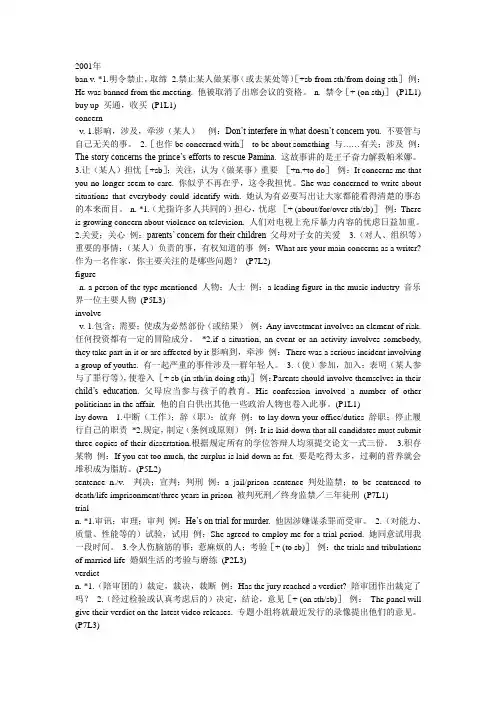
2001年ban v. *1.明令禁止,取缔2.禁止某人做某事(或去某处等)[+sb from sth/from doing sth]例:He was banned from the meeting. 他被取消了出席会议的资格。
n. 禁令[+ (on sth)](P1L1) buy up 买通,收买(P1L1)concernv. 1.影响,涉及,牵涉(某人)例:Don’t interfere in what doesn’t concern you. 不要管与自己无关的事。
2.[也作be concerned with]to be about something 与……有关;涉及例:The story concerns the prince’s efforts to rescue Pamina. 这故事讲的是王子奋力解救帕米娜。
3.让(某人)担忧[+sb];关注,认为(做某事)重要[+n.+to do]例:It concerns me that you no longer seem to care. 你似乎不再在乎,这令我担忧。
She was concerned to write about situations that everybody could identify with. 她认为有必要写出让大家都能看得清楚的事态的本来面目。
n. *1.(尤指许多人共同的)担心,忧虑[+ (about/for/over sth/sb)]例:There is growing concern about violence on television. 人们对电视上充斥暴力内容的忧虑日益加重。
2.关爱;关心例:parents’ concern for their children 父母对子女的关爱3.(对人、组织等)重要的事情;(某人)负责的事,有权知道的事例:What are your main concerns as a writer? 作为一名作家,你主要关注的是哪些问题?(P7L2)figuren. a person of the type mentioned 人物;人士例:a leading figure in the music industry 音乐界一位主要人物(P5L3)involvev. 1.包含;需要;使成为必然部份(或结果)例:Any investment involves an element of risk.任何投资都有一定的冒险成分。
考研英语历年阅读理解真题精析--2001年part4
Part FourThe world is going through the biggest wave of mergers and acquisitions ever witnessed. The process sweeps from hyperactive America to Europe and reaches the emerging countries with unsurpassed might. Many in these countries are looking at this process and worrying: Won't the wave of business concentration turn into an uncontrollable anti-competitive force?"There's no question that the big are getting bigger and more powerful. Multinational corporations accounted for less than 20% of international trade in 1982.Today the figure is more than 25% and growing rapidly. International affiliates account for a fast-growing segment of production in economies that open up and welcome foreign investment. In Argentina, for instance, after the reforms of the early 1990s,multinationals went from 43% to almost 70% of the industrial production of the 200 largest firms. This phenomenon has created serious concerns over the role of smaller economic firms, of national businessmen and over the ultimate stability of the world economy.I believe that the most important forces behind the massive M&A wave are the same that underlie the globalization process: falling transportation and communication costs, lower trade and investment barriers and enlarged markets that require enlarged operations capable of meeting customer's demands. All these are beneficial, not detrimental, to consumers. As productivity grows, the world's wealth increases.Examples of benefits or costs of the current concentration wave are scanty. Yet it is hard to imagine that the merger of a few oil firms today could recreate the same threats to competition that were feared nearly a century ago in the U.S., when the Standard Oil trust was broken up. The mergers of telecom companies, such as WorldCom, hardly seem to bring higher prices for consumers or a reduction in the pace of technical progress. On the contrary, the price of communications is coming down fast. In cars, too, concentration is increasing-witness Daimler and Chrysler, Renault and Nissan-but it does not appear that consumers are being hurt.Yet the fact remains that the merger movement must be watched. A few weeks ago, Alan Greenspan warned against the megamergers in the banking industry. Who is going to supervise, regulate and operate as lender of last resort with the gigantic banks that are being created? Won't multinationals shift production from one place to another when a nation gets too strict about infringements to fair competition? And should one country take upon itself the role of "defending competition" on issues that affect many other nations, as in the U.S. vs. Microsoft case?13.What is the typical trend of businesses today?[A]to take in more foreign funds [B]to invest more abroad[C]to combine and become bigger [D]to trade with more countries14.According to the author, one of the driving forces behind M&A wave is _________.[A]the greater customer demands [B]a surplus supply for the market[C]a growing productivity [D]the increase of the world's wealth15.From paragraph 4 we can infer that _________.[A]the increasing concentration is certain to hurt consumers[B]WorldCom serves as a good example of both benefits and costs[C]the costs of the globalization process are enormous[D]the Standard Oil trust might have threatened competition16.Toward the new business wave, the writer's attitude can be said to be _________.[A]optimistic [B]objective [C]pessimistic [D]biasedUnit 8 (2001) Part 4重点词汇:1.acquisition (收购;获得;获得物)即acquisit+(t)ion,acquisit为acquire(v.获得)之变形,-tion名词后缀。
2001考研英语二真题及答案
2001考研英语二真题及答案Section 1 Use of EninglishDirections :Millions of Americans and foreigners see GI.Joe as a mindless war toy ,the symbol of American military adventurism, but that’s not how it used to be .To the men and women who 1 )in World War II and the people they liberated ,the GI.was the 2) man grown into hero ,the pool farm kid torn away from his home ,the guy who 3) all the burdens of battle ,who slept in cold foxholes,who went without the 4) of food and shelter ,who stuck it out and drove back the Nazi reign of murder .this was not a volunteer soldier ,not someone well paid ,5) an average guy ,up 6 )the best trained ,best equipped ,fiercest ,most brutal enemies seen in centuries.His name is not much.GI. is just a military abbreviation 7) Government Issue ,and it was on all of the article 8) to soldiers .And Joe? A common name for a guy who never 9) it to the top .Joe Blow ,Joe Magrac …a working class name.The United States has 10) had a president or vicepresident or secretary of state Joe.GI .joe had a (11)career fighting German ,Japanese , and Korean troops . He appers as a character ,or a (12 ) of american personalities, in the 1945 movie The Story of GI. Joe, based on the last days of war correspondent Ernie Pyle. Some of the soldiers Pyle(13)portrayde themselves in the film. Pyle was famous for covering the (14)side of the warl, writing about the dirt-snow -and-mud soldiers, not how many miles were(15)or what towns were captured or liberated, His reports(16)the “willie”cartoons of famed Stars and Stripes artist Bill Maulden. Both men(17)the dirt and exhaustion of war, the (18)of civilization that the soldiers shared with each other and the civilians: coffee, tobacco, whiskey, shelter, sleep. (19)Egypt, France, and a dozen more countries, G.I. Joe was any American soldier,(20)the most important person in their lives.1.[A] performed [B]served [C]rebelled [D]betrayed2.[A] actual [B]common [C]special [D]normal3.[A]bore [B]cased [C]removed [D]loaded4.[A]necessities [B]facilitice [C]commodities [D]propertoes5.[A]and [B]nor [C]but [D]hence6.[A]for [B]into [C] form [D]against7.[A]meaning [B]implying [C]symbolizing [D]claiming8.[A]handed out [B]turn over [C]brought back [D]passed down9.[A]pushed [B]got [C]made [D]managed10.[A]ever [B]never [C]either [D]neither11.[A]disguised [B]disturbed [C]disputed [D]distinguished12.[A]company [B]collection [C]community [D]colony13.[A]employed [B]appointed [C]interviewed [D]questioned14.[A]ethical [B]military [C]political [D]human15.[A]ruined [B]commuted [C]patrolled [D]gained16.[A]paralleled [B]counteracted [C]duplicated [D]contradicted17.[A]neglected [B]avoided [C]emphasized [D]admired18.[A]stages [B]illusions [C]fragments [D]advancea19.[A]With [B]To [C]Among [D]Beyond20.[A]on the contrary [B] by this means [C]from the outset [D]at that pointSection II Resdiong ComprehensionPart ADirections:Read the following four texts. answer the question after each text by choosing A,B,C or D. Mark your answers on ANSWER SHEET 1.(40 points)Text 1Homework has never been terribly popular with students and even many parents, but in recent years it has been particularly scorned. School districts across the country, most recently Los Angeles Unified, are revising their thinking on his educational ritual. Unfortunately, L.A. Unified has produced an inflexible policy which mandates that with the exception of some advanced courses, homework may no longer count for more than 10% of a student’s academic grade.This rule is meant to address the difficulty that students from impoverished or chaotic homes might have in completing their homework. But the policy is unclear and contradictory. Certainly, no homework should be assigned that students cannot do without expensive equipment. But if the district is essentially giving a pass to students who do not do their homework because of complicated family lives, it is going riskily close to the implication that standards need to be lowered for poor children.District administrators say that homework will still be a pat of schooling: teachers are allowed to assign as much of it as they want. But with homework counting for no more than 10% of their grades, students can easily skip half their homework and see vey little difference on their report cards. Some students might do well on state tests without completing their homework, but what about the students who performed well on the tests and did their homework? It is quite possible that the homework helped. Yet rather than empowering teachers to find what works best for their students, the polic y imposes a flat, across-the-board rule.At the same time, the policy addresses none of the truly thorny questions about homework. If the district finds homework to be unimportant to its students’ academic achievement, it should move to reduce or eliminate the assignments, not make them count for almost nothing. Conversely, if homework does nothing to ensure that the homework students are not assigning more than they are willing to review and correct.The homework rules should be put on hold while the school board, which is responsible for setting educational policy, looks into the matter and conducts public hearings. It is not too late for L.A. Unified to do homework right.21.It is implied in paragraph 1 that nowadays homework_____.[A] is receiving more criticism[B]is no longer an educational ritual[C]is not required for advanced courses[D]is gaining more preferences22.L.A.Unified has made the rule about homework mainly because poor students_____.[A]tend to have moderate expectations for their education[B]have asked for a different educational standard[C]may have problems finishing their homework[D]have voiced their complaints about homework23.According to Paragraph 3,one problem with the policy is that it may____.[A]discourage students from doing homework[B]result in students' indifference to their report cards[C]undermine the authority of state tests[D]restrict teachers' power in education24. As mentioned in Paragraph 4, a key question unanswered about homework is whether______. [A] it should be eliminated[B]it counts much in schooling[C]it places extra burdens on teachers[D]it is important for grades25.A suitable title for this text could be______.[A]Wrong Interpretation of an Educational Policy[B]A Welcomed Policy for Poor Students[C]Thorny Questions about Homework[D]A Faulty Approach to HomeworkText2Pretty in pink: adult women do not rememer being so obsessed with the colour, yet it is pervasive in our young girls’ lives. Tt is not that pink is intrinsically bad, but it is such a tiny slice of the rainbow and, though it may celebrate girlhood in one way, it also repeatedly and firmly fuses girls’ identity to appearance. Then it presents that connection, even among two-year-olds, between girls as not only innocent but as evidence of innocence. Looking around, I despaired at the singular lack of imagination about girls’ lives and interests.Girls’ attraction to pink may seem unavoidable, somehow encoded in their DNA, but according to Jo Paoletti, an associate professor of American Studies, it is not. Children were not colour-coded at all until the early 20th century: in the era before domestic washing machines all babies wore white as a practical matter, since the only way of getting clothes clean was to boil them. What’s more, both boys and girls wore what were thought of as gender-neutral dresses.When nursery colours were introduced, pink was actually considered the more masculine colour, a pastel version of red, which was associated with strength. Blue, with its intimations of the Virgin Mary, constancy and faithfulness, symbolised femininity. It was not until the mid-1980s, when amplifying age and sex differences became a dominant children’s marketing strategy, that pink fully came into its own, when it began to seem inherently attractive to girls, part of what defined them as female, at least for the first few critical years.I had not realised how profoundly marketing trends dictated our perception of what is natural to kins, including our core beliefs about their psychological development. Take the toddler. I assumed that phase was something experts developed after years of research into children’s behaviour: wrong. Turns out, acdording to Daniel Cook, a historian of childhood consumerism, it was popularised as a marketing trick by clothing manufacrurers in the 1930s.Trade publications counselled department stores that, in order to increase sales, they should create a “third stepping stone” between infant wear and older kids’clothes. Tt was only after “toddler”became a common shoppers’ term that it evolved into a broadly accepted developmental stage. Splitting kids, or adults,into ever-tinier categories has proved a sure-fire way to boost profits. And one of the easiest ways to segment a market is to magnify gender differences - or invent them where they did not previously exist.26.By saying "it is...the rainbow"(Line 3, Para.1),the author means pink______.[A]should not be the sole representation of girlhood[B]should not be associated with girls' innocence[C]cannot explain girls' lack of imagination[D]cannot influence girls' lives and interests27.According to Paragraph 2, which of the following is true of colours?[A]Colours are encoded in girls' DNA.[B]Blue used to be regarded as the colour for girls.[C]Pink used to be a neutral colour in symbolising genders.[D]White is prefered by babies.28.The author suggests that our perception of children's psychological development was much influenced by_____.[A]the marketing of products for children[B]the observation of children's nature[C]researches into children's behavior[D]studies of childhood consumption29.We may learn from Paragraph 4 that department stores were advised to_____.[A]focus on infant wear and older kids' clothes[B]attach equal importance to different genders[C]classify consumers into smaller groups[D]create some common shoppers' terms30.It can be concluded that girls' attraction to pink seems to be____.[A] clearly explained by their inborn tendency[B]fully understood by clothing manufacturers[C] mainly imposed by profit-driven businessmen[D]well interpreted by psychological expertsText 3In 2010. a federal judge shook America's biotech industry to its core. Companies had won patents for isolated DNA for decades-by 2005 some 20% of human genes were parented. But in March 2010 a judge ruled that genes were unpatentable. Executives were violently agitated. The Biotechnology Industry Organisation (BIO), a trade group, assured members that this was just a “preliminary step” in a longer battle.On July 29th they were relieved, at least temporarily. A federal appeals court overturned the prior decision, ruling that Myriad Genetics could indeed holb patents to two genss that help forecast a woman's risk of breast cancer. The chief executive of Myriad, a company in Utah,said the ruling was a blessing to firms and patients alike.But as companies continue their attempts at personalised medicine, the courts will remain rather busy. The Myriad case itself is probably not over Critics make three main arguments against gene patents: a gene is a product of nature, so it may not be patented; gene patents suppress innovation rather than reward it; and patents' monopolies restrict access to genetic tests such as Myriad's. A growing number seem to st year a federal task-force urged reform for patents related to genetictests. In October the Department of Justice filed a brief in the Myriad case, arguing that an isolated DNA molecule “is no less a product of nature... than are cotton fibres that have been separated from cotton seeds. ”Despite the appeals court's decision, big questions remain unanswered. For example, it is unclear whether the sequencing of a whole genome violates the patents of indivi dual genes within it. The case may yet reach the Supreme Court.AS the industry advances ,however,other suits may have an even greater panies are unlikely to file many more patents for human DNA molecules-most are already patented or in the public domain .firms are now studying how genes intcract,looking for correlations that might be used to determine the causes of disease or predict a drug’s efficacy,companies are eager to win patents for ‘connecting the dits’,expaains hans sauer,alawyer for the BIO.Their success may be determined by a suit related to this issue, brought by the Mayo Clinic, which the Supreme Court will hear in its next term. The BIO rtcently held a convention which included seddions to coach lawyers on the shifting landscape for patents. Each meeting was packed.31.it canbe learned from paragraph I that the biotech companies would like-----A.their executives to be activeB.judges to rule out gene patentingC.genes to be patcntablcD.the BIO to issue a warning32.those who are against gene patents believe that----A.genetic tests are not reliableB.only man-made products are patentableC.patents on genes depend much on innovatiaonD.courts should restrict access to gene tic tests33.according to hans sauer ,companies are eager to win patents for----A.establishing disease comelationsB.discovering gene interactionsC.drawing pictures of genesD.identifying human DNA34.By saying “each meeting was packed”(line4,para6)the author means that -----A.the supreme court was authoritativeB.the BIO was a powerful organizationC.gene patenting was a great concernwyers were keen to attend conventiongs35.generally speaking ,the author’s attitude toward gene patenting is----A.criticalB.supportiveC.scornfulD.objectiveText 4The great recession may be over, but this era of high joblessness is probably beginning. Before it ends,it will likely change the life course and character of a generation of young adults. And ultimately, it is likely to reshape our politics,our culture, and the character of our society for years.No one tries harder than the jobless to find silver linings in this national economic disaster. Many said that unemployment, while extremely painful, had improved them in some ways; they had become less materialistic and more financially prudent; they were more aware of the struggles of others. In limited respects, perhaps the recession will leave society better off. At the very least, it has awoken us from our national fever dream of easy riches and bigger houses, and put a necessary end to an era of reckless personal spending.But for the most part, these benefits seem thin, uncertain, and far off. In The Moral Consequences of Economic Growth, the economic historian Benjamin Friedman argues that both inside and outside the U.S. ,lengthy periods of economic stagnation or decline have almost always left society more mean-spirited and less inclusive, and have usually stopped or reversed the advance of rights and freedoms. Anti-immigrant sentiment typically increases, as does conflict between races and classes.Income inequality usually falls during a recession, but it has not shrunk in this one,. Indeed, this period of economic weakness may reinforce class divides, and decrease opportunities to cross them--- especially for young people. The research of Till Von Wachter, the economist in Columbia University, suggests that not all people graduating into a recession see their life chances dimmed: those with degrees from elite universities catch up fairly quickly to where they otherwise would have been if they had graduated in better times; it is the masses beneath them that are left behind.In the internet age, it is particularly easy to see the resentment that has always been hidden winthin American society. More difficult, in the moment , is discerning precisely how these lean times are affecting society’s character. In many respects, the U.S. was more socially tolerant entering this resession than at any time in itshistory, and a variety of national polls on social conflict since then have shown mixed results. We will have to wait and see exactly how these hard times will reshape our social fabric. But they certainly it, and all the more so the longer they extend.36.By saying “to find silver linings”(Line 1,Para.2)the author suggest that the jobless try to___.[A]seek subsidies from the govemment[B]explore reasons for the unermployment[C]make profits from the troubled economy[D]look on the bright side of the recession37.According to Paragraph 2,the recession has made people_____.[A]realize the national dream[B]struggle against each other[C]challenge their lifestyle[D]reconsider their lifestyle38.Benjamin Friedman believe that economic recessions may_____.[A]impose a heavier burden on immigrants[B]bring out more evils of human nature[C]Promote the advance of rights and freedoms[D]ease conflicts between races and classes39.The research of Till Von Wachther suggests that in recession graduates from elite universities tend to _____.[A]lag behind the others due to decreased opportunities[B]catch up quickly with experienced employees[C]see their life chances as dimmed as the others’[D]recover more quickly than the others40.The author thinks that the influence of hard times on society is____.[A]certain[B]positive[C]trivial[D]destructivePart BDirections:Read the following text and answer the questions by finding information from the left column that corresponds to each of the marked details given in the right column. There are two extra choices in the right column. Mark you r answers on ANSWER SHEERT 1.(10 points)“Universal history, the history of what man has accomplished in this world, is at bottom the History of the Great Men who have worked here,” wrote the Victorian sage Thomas Carlyle. Well, not any more it is not.Suddenly, Britain looks to have fallen out with its favourite historical form. This could be no more than a passing literary craze, but it also points to a broader truth about how we now approach the past: less concerned with learning from forefathers and more interested in feeling their pain. Today, we want empathy, not inspiration.From the earliest days of the Renaissance, the writing of history meant recounting the exemplary lives of great men. In 1337, Petrarch began work on his rambling writing De Viris Illustribus - On Famous Men, highlighting the virtus (or virtue) of classical heroes. Petrarch celebrated their greatness in conquering fortune and rising to the top. This was the biographical tradition which Niccolo Machiavelli turned on its head. In The Prince, the championed cunning, ruthlessness, and boldness, rather than virtue, mercy and justice, as the skills of successful leaders.Over time, the attributes of greatness shifted. The Romantics commemorated the leading painters and authors of their day, stressing the uniqueness of the artist's personal experience rather than public glory. By contrast, the Victorian author Samual Smiles wrote Self-Help as a catalogue of the worthy lives of engineers , industrialists and explores . "The valuable examples which they furnish of the power of self-help, if patient purpose, resolute working and steadfast integrity, issuing in the formulation of truly noble and many character, exhibit,"wrote Smiles."what it is in the power of each to accomplish for himself"His biographies of James Walt, Richard Arkwright and Josiah Wedgwood were held up as beacons to guide the working man through his difficult life.This was all a bit bourgeois for Thomas Carlyle, who focused his biographies on the truly heroic lives of Martin Luther, Oliver Cromwell and Napoleon Bonaparte. These epochal figures represented lives hard to imitate, but to be acknowledged as possessing higher authority than mere mortals.Communist Manifesto. For them, history did nothing, it possessed no immense wealth nor waged battles:“It is man, real, living man who does all that.” And history should be the story of the masses and their record of struggle. As such, it needed to appreciate the economic realities, the social contexts and power relations in which each epoch stood. For:“Men make their own history, but they do not make it just as they please; they do not make it under circumstances chosen by themselves, but under circumstances directly found, given and transmitted from the past.”This was the tradition which revolutionized our appreciation of the past. In place of Thomas Carlyle, Britain nurtured Christopher Hill, EP Thompson and Eric Hobsbawm. History from below stood alongside biographies of great men. Whole new realms of understanding - from gender to race to cultural studies - were opened up as scholars unpicked the multiplicity of lost societies. And it transformed public history too: downstairs became just as fascinating as upstairs.[A] emphasized the virtue of classical heroes.41. Petrarch[B] highlighted the public glory of the leading artists.42. Niccolo Machiavellli[C] focused on epochal figures whose lives were hard to imitate.43. Samuel Smiles[D] opened up new realms of understanding the great men in history.44. Thomas Carlyle[E] held that history should be the story of the masses and their record of struggle.45. Marx and Engels[F] dismissed virtue as unnecessary for successful leaders.[G] depicted the worthy lives of engineer industrialists and explorers.Section III Translation46.Directions:Translate the following text from English into Chinese.Write your translation on ANSWER SHEET2.(15 points)When people in developing countries worry about migration,they are usually concerned at the prospect of ther best and brightest departure to Silicon Valley or to hospitals and universities in the developed world ,These are the kind of workers that countries like Britian ,Canada and Australia try to attract by using immigration rules that privilege college graduates .Lots of studies have found that well-educated people from developing countries are particularly likely to emigrate .A big survey of Indian households in 2004 found that nearly 40%of emigrants had more than a high-school education,compared with around 3.3%of all Indians over the age of 25.This "brain drain "has long bothered policymakers in poor countries ,They fear that it hurt s their economies ,depriving them of much-needed skilled workers who could havetaught at their universities ,worked in their hospitals and come up with clever new products for their factories to make .Section IV WritingPart A47.DirectionsSuppose you have found something wrong with the electronic dictionary that you bought from an onlin store the other day ,Write an email to the customer service center to1)make a complaint and2)demand a prompt solutionYou should write about 100words on ANSERE SHEET 2Do not sign your own name at the end of the letter ,Use "zhang wei "instead .48、write an essay based on the following table .In your writing you should1)describe the table ,and2)give your commentsYou should write at least 150 words(15points)参考答案:完形填空:1.B2.B3.A4.A5.C6.B7.C8.A9.D 10.B11.D 12.B 13.C 14.D 15.B16.A 17.C 18.B 19.B 20.DTEXT1:21. A 22.C 23.A 24.B 25.DTEXT2:26.A 27.B 28.A 29.C 30.CTEXT3:31.C 32.B 33.A 34.D 35.DTEXT4:36.D 37.D 38.B 39.D 40.A新题型:41-45:AFGCE小作文范文:Dear Sir or Madame,As one of the regular customers of your online store, I am writing this letter to express my complaint against the flaws in your product-an electronic dictionary I bought in your shop the other day.The dictionary is supposed to be a favorable tool for my study. Unfortunately, I found that there are several problems. To begin with, when I opened it, I detected that the appearance of it had been scratched. Secondly, I did not find the battery promised in the advertisement posted on the homepage of your shop, which makes me feel that you have not kept your promise. What is worse, some of the keys on the keyboard do not work.I strongly request that a satisfactory explanation be given and effective measures should be taken to improve your service and the quality of your products. You can either send a new one to me or refund me my money in full.I am looking forward to your reply at your earliest convenience.。
1994-2001考研英语阅读真题解析(含全文翻译)
解析:作者的观点:The author believes,这个是在关注定位词devoted concertgoers后的另外一个关键点;作者认为concertgoers miss the point;但具体是什么,需要看选项了.A ,忽略了现场演奏的费用,B,拒绝大多数的唱片演奏.这两个是没有根据的属于未提及选项.C有一定的干扰性:the variety of live performances,二段中是有variety这个单词的,并且在段落中出现了好多并列的成分,这样对于很多没有读懂原文的同学其实是会产生视觉干扰的.但是the value of live performances这个宾语和动词是没有原文依据的.最后一个选项之所以正确是由于:作者在一直说唱片的好,而前面又说concertgoers认为现场演奏不会被唱片代替.这样就是论点上的正话反说了.通过排除法我们直接可以把答案定位到最后一个:高估了现场表演的价值.
23. The author believes that the devoted concertgoers
[A]ignore the expenses of live performances.
[B]reject most kinds of recorded performanve performances.
就我看来,我不知道Gilbert是否是一个伟大的指挥家或者是一个好的指挥.但是我能确定的是,他能表现出很多有趣的乐章,但是我却应该不会去Avery Fisher Hall或者其他地方去听一场有趣的交响乐演出.我要做的事情就是去我的CD架上,或者打开的我的电脑从ITUNES上下载更多的唱片.
2001年考研英语试题及参考答案(2)
2001年考研英语试题及参考答案(2)Passage 2A great deal of attention is being paid today to the so called digital divide-the division of the world into the info(information) rich and the info poor. And that divide does exist today. My wife and I lectured about this looming danger twenty years ago. What was less visible then, however, were the new, positive forces that work against the digital divide. There are reasons to be optimistic.There are technological reasons to hope the digital divide will narrow. As the Internet becomes more and more commercialized, it is in the interest of business to universalize access-after all, the more people online, the more potential customers there are. More and more governments, afraid their countries will be left behind, want to spread Internet access. Within the next decade or two, one to two billion people on the planet will be netted together. As a result, I now believe the digital divide will narrow rather than widen in the years ahead. And that is very good news because the Internet may well be the most powerful tool for coMBAting world poverty that we've ever had. Of course, the use of the Internet isn't the only way to defeat poverty. And the Internet is not the only tool we have. But ithas enormous potential.To take advantage of this tool, some impoverished countries will have to get over their outdated anti-colonial prejudices with respect to foreign investment. Countries that still think foreign investment is an invasion of their sovereignty might well study the history of infrastructure (the basic structural foundations of a society) in the United States. When the United States built its industrial infrastructure, it didn't have the capital to do so. And that is why America's Second Wave infrastructure-including roads, harbors, highways, ports and so on-were built with foreign investment. The English, the Germans, the Dutch and the French were investing in Britain's former colony. They financed them. Immigrant Americans built them. Guess who owns them now? The Americans. I believe the same thing would be true in places like Brazil or anywhere else for that matter. The more foreign capital you have helping you build your Third Wave infrastructure, which today is an electronic infrastructure, the better off you're going to be. That doesn't mean lying down and becoming fooled, or letting foreign corporations run uncontrolled. But it does mean recognizing how important they can be in building the energy and telecom infrastructures needed to take full advantage of the。