
人教版新目标英语八年级上全册教案
在...0希望这些教案对你有一定的帮助!!!Unit 1 Where did you go on vacation?Section A 1 (1a-2d)一、教学目标:1. 语言知识目标:1) 能掌握以下单词:anyone, anywhere, wonderful, quite a few, most, something, nothing, everyone, of course, myself, yourself能掌握以下句型:①—Where did you go on vacation? —I went to the mountains.②—Where did Tina to on vacation? —She went to the beach.③—Did you go with anyone? —Yes, I did./No, I didn’t.2) 能了解以下语法:—复合不定代词someone, anyone, something, anything等的用法。
—yourself, myself等反身代词的用法。
3)一般过去时态的特殊疑问句,一般疑问句及其肯定、否定回答。
2. 情感态度价值观目标:学会用一般过去时进行信息交流,培养学生的环保意识,热爱大自然。
二、教学重难点1. 教学重点:1) 用所学的功能语言交流假期去了什么旅行。
2) 掌握本课时出现的新词汇。
2. 教学难点:1) 复合不定代词someone, anyone, something, anything等的用法。
2) yourself, myself等反身代词的用法。
三、教学过程Ⅰ. Lead-in1. 看动画片来进入本课时的主题谈论上周末做了些什么事情,谈论过去发生的事情。
Ⅱ. Presentation1. Show some pictures on the big screen. Let Ss read the expressions.2. Focus attention on the picture. Ask: What can you see? Say: Each picture showssomething a person did in the past. Name each activity and ask students to repeat:Stayed at home, Went to mountains, went to N ew York City 6. Went to the beach,visited my uncle, visited museums, went to summer camp3. Now, please match each phrase with one of the pictures next to the name of theactivity,point to the sample answer.4. Check the answers. Answers: 1. f 2. b 3. g 4. e5. c6. a7. dIII. Listening1. Point to the picture on the screen.Say: Look at the picture A. Where did Tina go on vacation? She went to mountains.Ask: What did the person do in each picture?2. Play the recording the first time.3. Play the recording a second time.Say: There are three conversations. The people talk about what did on vacation. Listen to the recording and write numbers of the names in the right boxes of the picture.4. Check the answers.IV.Pair work1. Point out the sample conversation. Ask two Ss to read the conversation to the class.2. Now work with a partner. Make your own conversation about the people in the picture.3. Ss work in pairs. As they talk, move around the classroom and give any help they need.4. Let some pairs act out their conversations.V. Listening1. Tell Ss they will hear a conversation about three students’ conversations. Listen for the first time and fill in the chart. Then listen again and check Yes, or No.2. Let Ss read the phrases in the chart of 2b.3. Play the recording the first time. Ss listen and fill in the chart.4. Play the recording a second time for the Ss to check “Yes, I did.”or “No, I didn’t. ”5. Check the answers with the Ss.VI. Pair work1. Let two Ss read the conversation between Grace, Kevin and Julie.2. Let Ss work in pairs and try to role-play the conversation.3. Ask some pairs to act out their conversations.VII. Role-play1. First let Ss read the conversation and match the people and places they went.2. Let Ss act out the conversations in pairs.3. Some explanations in 2d.Homework:用英语询问你的一位好朋友,她(他)假期去了哪里?看到了什么?并将此对话写在作业上。
A: Where did you go…?B: I went to…A: Did you see…B: Yes, I did. / No, I didn’t.板书设计:教学反思:Section A 2 (Grammar focus-3c)一、教学目标:1. 语言知识目标:1) 复习所学的重难点句型及句式结构。
2)总结学习anyone, someone, everyone, something, anything, nothing等不定代词的用法。
3)练习运用所学的句型及句式结构。
2. 情感态度价值观目标:学会用一般过去时进行信息交流,培养学生的环保意识,热爱大自然。
二、教学重难点1. 教学重点:1) 用所学的功能语言交流假期去了什么旅行。
2) 复习运用本课时出现的新词汇。
2. 教学难点:1) 复合不定代词someone, anyone, something, anything等的用法。
2) 阅读填空能力的提高。
三、教学过程Ⅰ. Warming- up and revision1. Free talk: Ask Ss the questions: Where did you go on vacation?Ss try to answer the questions.2. Review the usage of “复合不定代词”Ⅱ. Grammar focus.1. 学生阅读Grammar Focus中的句子,然后做填空练习。
1. 你去了什么地方去度假?______ ______ you go on ___________?2. 我去了纽约市。
I _______ _______ New York City.3. 你和什么人别一起去的吗?______ ______ go out with ________?4. 不,没有别人在这儿。
每个人都在度假。
No. ____ ______ was here.________ was on _________.… (其余试题见课件部分)3. 学生们完成填空试题后,可以打开课本检查答案,对错误的句子,单独进行强化记忆。
Ⅲ. Try to Find一、复合不定代词总结:1. some, any, no, every与-one, -thing可以组成八个不定代词,他们分别是:someone, ________ _______ ________ __________ __________ ______________。
2. 带some的复合不定代词常用于肯定句中;带any的复合不定代词常用于否定句或一般疑问句中。
例如:我想吃点东西。
I’d like _____________ to eat.今天有人给我打电话吗?Did ________ call me today?3. 当形容词修饰不定代词时,应放在其后面。
例如:这本书里有什么新东西吗?Is there __________ _______ in this book?今天没有什么特别的事。
There’s ___________ ________ today.4. 由some, any, no, every构成的复合不定代词作主语时,都作单数看待,其谓语动词用单数第三人称形式。
例如:Something is wrong with my watch.Well, everyone wants to win.Nobody knows what the future will be like.There is something for everyone at Greenwood Park.5. 除no one以外,其他复合不定代词都写成一个词。
八年级上册英语教案 人教版八年级英语教案
八年级上册英语教案人教版八年级英语教案【篇一】八年级上册英语教案2022年新目标英语八年级上全册教案2022年下期八年级英语全册教案(人教版)Unit 1 Where did you go on vacation?Section A 1 (1a-2d)一、教学目标:1. 语言知识目标:1) 能掌握以下单词:anyone, anywhere, wonderful, quite a few, most, something, nothing, everyone, of course, myself, yourself能掌握以下句型:① —Where did you go on vacation? —I went to the mountains.② —Where did Tina to on vacation? —She went to the beach.③ —Did you go with anyone?2) 能了解以下语法:—复合不定代词someone, anyone, something, anything等的用法。
—yourself, myself等反身代词的用法。
3)一般过去时态的特殊疑问句,一般疑问句及其肯定、否定回答。
2. 情感态度价值观目标:学会用一般过去时进行信息交流,培养学生的环保意识,热爱大自然。
二、教学重难点1. 教学重点:1) 用所学的功能语言交流假期去了什么旅行。
2) 掌握本课时出现的新词汇。
2. 教学难点:1) 复合不定代词someone, anyone, something, anything等的用法。
2) yourself, myself等反身代词的用法。
三、教学过程Ⅰ. Lead-in1. 看动画片来进入本课时的主题谈论上周末做了些什么事情,谈论过去发生的事情。
Ⅱ. Presentation1. Show some pictures on the big screen. Let Ss read the expressions.2. Focus attention on the picture. Ask: What can you see? Say: Each picture shows —Yes, I did./No, I didn’t.something a person did in the past. Name each activity and ask students to repeat: Stayed at home, Went to mountains, went to New York City 6. Went to the beach, visited my uncle, visited museums, went to summer camp3. Now, please match each phrase with one of the pictures next to the name of the activity,point to the sample answer.4. Check the answers. Answers: 1. f 2. b 3. g 4. e5. c6. a7. d III. Listening1. Point to the picture on the screen.Say: Look at the picture A. Where did Tina go on vacation? She went to mountains. Ask: What did the person do in each picture?2. Play the recording the first time.3. Play the recording a second time.Say: There are three conversations. The people talk about what did on vacation. Listen to the recording and write numbers of the namesin the right boxes of the picture.4. Check the answers.IV.Pair work1. Point out the sample conversation. Ask two Ss to read the conversation to the class.2. Now work with a partner. Make your own conversation about the people in the picture.3. Ss work in pairs. As they talk, move around the classroom and give any help they need.4. Let some pairs act out their conversations.V. Listening1. Tell Ss they will hear a conversation about three students’ conversations. Listen for the first time and fill in the chart. Then listen again and check Yes, or No.2. Let Ss read the phrases in the chart of 2b.3. Play the recording the first time. Ss listen and fill in the chart.4. Play the recording a second time for the Ss to check “Yes, I did.” or “No, I didn’t. ”5. Check the answers with the Ss.VI. Pair work1. Let two Ss read the conversation between Grace, Kevin and Julie.2. Let Ss work in pairs and try to role-play the conversation.3. Ask some pairs to act out their conversations.VII. Role-play1. First let Ss read the conversation and match the people and places they went.2. Let Ss act out the conversations in pairs.3. Some explanations in 2d.Homework:用英语询问你的一位好朋友,她(他)假期去了哪里?看到了什么?并将此对话写在作业上。
人教版新目标八年级英语(上)unit1第三课时教案
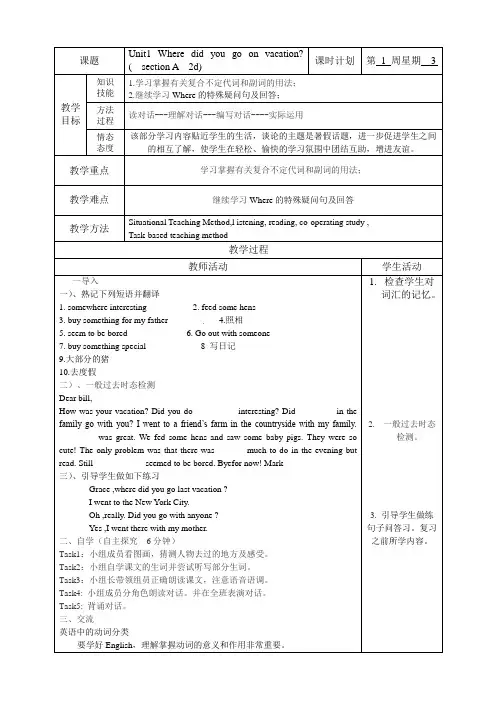
9. Don’t worry. There’s ______ wrong with your ears.
10. There’s __________ in the box. It’s empty.
11. Maybe ______ ____ put my pencil _________. I can’t find it ___________.
2.用法:
(1)合成不定代词在句中可以作主语,宾语或表语等。
Nobody will listen to him.
He wants somet hing to e at.
(2)不定代词作主语时,谓语动词要用单数。
There is nothing wrong with the TV.
Everybody likes to be free.
7. buy something special __________ 8写日记__________
9.大部分的猪_______________________
10.去度假____________________
二)、一般过去时态检测
Dear bill,
How was your vacation? Did you do _________ interesting? Did ________ in the family go with you? I went to a friend’s farm in the countryside with my family. _________was great. We fed some hens and saw some baby pigs. They were so cute! The only problem was that there was ______ much to do in the evening but read. Still ___________ seemed to be bored. Byefor now! Mark
人教新目标八年级英语上册教案Unit 1 Section A

Unit 1 Where did you go on vacation?SectionA教学设计Period 1 1a-1c教材分析本节课是一节听说课。
首先通过图文将学生带入刚刚过去的暑假,回忆在暑假期间做过的事情,在这语境中,引入相关短语以及目标语言。
因为这是本单元第一课时,对其基础地位和铺垫作用应予以高度重视,课堂任务应该追求语言学习的实践和应用能力的提升。
教学目标1. 学生能学会重点单词、短语以及目标语句。
重点单词及短语:went to summer camp, stayed at home,went to the beach, visited museums,have a good time目标语句:- Where did you go on vacation?-I went to New York City.2. 熟练运用目标语言谈论发生在假期的事情。
3.在听的过程中体验并感知目标语言的内容,学会提取所需要的关键信息。
教学重难点:【教学重点】要求学生掌握一般过去时的疑问句及其答语。
【教学难点】学生能流利的说出自己发生在假期的事情。
课前准备:1. 搜集中国乃至世界的名胜景点。
2. 了解学生的暑假经历。
3. 准备好录音机、制作多媒体课件及学案。
教学过程:Step 1 Lead-inAsk students what he/she did last weekend using the verbs they learned. Focus their attention on the form of verbs, using the flash cards on the computer.went to the mountains stayed at homewent to New York City went to the beachvisited my uncle visited museumswent to summer camp【设计意图】从教师谈论自己入口,抛砖引玉,让同学们简单分享假期有趣的事情,引出今天的重点内容。
新目标初中英语八年级上册教案
新目标初中英语八年级上册教案篇一:2013年人教版新目标英语八年级上全册教案希望这些教案对你有一定的帮助Unit 1 Where did you go on vacation?Section A 1 (1a-2d)一、教学目标:1. 语言知识目标:1) 能掌握以下单词:anyone, anywhere, wonderful, quitea few, most, something, nothing, everyone, of course, myself, yourself能掌握以下句型:① —Where did you go on vacation?—I went to the mountains.② —Where did Tina to on vacation? —She went to the beach.③ —Did you go with anyone?2) 能了解以下语法:—复合不定代词someone, anyone, something, anything等的用法。
—yourself, myself等反身代词的用法。
3)一般过去时态的特殊疑问句,一般疑问句及其肯定、否定回答。
2. 情感态度价值观目标:学会用一般过去时进行信息交流,培养学生的环保意识,热爱大自然。
二、教学重难点1. 教学重点:1) 用所学的功能语言交流假期去了什么旅行。
2) 掌握本课时出现的新词汇。
2. 教学难点:1) 复合不定代词someone, anyone, something, anything等的用法。
2) yourself, myself等反身代词的用法。
三、教学过程Ⅰ. Lead-in —Yes, I did./No, I didn’t.1. 看动画片来进入本课时的主题谈论上周末做了些什么事情,谈论过去发生的事情。
Ⅱ. Presentation1. Show some pictures on the big screen. Let Ss read the expressions.2. Focus attention on the picture. Ask: What can you see? Say: Each picture showssomething a person did in the past. Name each activity and ask students to repeat:Stayed at home, Went to mountains, went to New York City 6. Went to the beach,visited my uncle, visited museums, went to summer camp3. Now, please match each phrase with one of the pictures next to the name of theactivity,point to the sample answer.4. Check the answers. Answers: 1. f 2. b 3. g 4. e5.c 6. a 7. dIII. Listening1. Point to the picture on the screen.Say: Look at the picture A. Where did Tina go on vacation? She went to mountains.Ask: What did the person do in each picture?2. Play the recording the first time.3. Play the recording a second time.Say: There are three conversations. The people talk about what did on vacation. Listen to the recording and write numbers of the names in the right boxes of the picture.4. Check the answers.IV.Pair work1. Point out the sample conversation. Ask two Ss to read the conversation to the class.2. Now work with a partner. Make your own conversation about the people in the picture.3. Ss work in pairs. As they talk, move around the classroom and give any help they need.4. Let some pairs act out their conversations.V. Listening1. Tell Ss they will hear a conversation about three students’ conversations. Listen for the first timeand fill in the chart. Then listen again and check Yes, or No.2. Let Ss read the phrases in the chart of 2b.3. Play the recording the first time. Ss listen andfill in the chart.4. Play the recording a second time for the Ss tocheck ―Yes, I did.‖ or ―No, I didn’t. ‖5. Check the answers with the Ss.VI. Pair work1. Let two Ss read the conversation between Grace, Kevin and Julie.2. Let Ss work in pairs and try to role-play the conversation.3. Ask some pairs to act out their conversations.VII. Role-play1. First let Ss read the conversation and match the people and places they went.2. Let Ss act out the conversations in pairs.3. Some explanations in 2d.Homework:用英语询问你的一位好朋友,她(他)假期去了哪里?看到了什么?并将此对话写在作业上。
人教版(新目标)英语八年级上Unit9教案
Unit 9Can you come to my party?Section A (1a-1c)1.重点单词:prepare,exam,flu2.重点短语:prepare for an exam,have the flu3.重点句式:—Can you come to my party on Saturday afternoon?—Sure,I'd love to./Sorry,I can't.I have to prepare for an exam.I'm sorry,too.I must go to the doctor.1.会用“Can you...?”来对别人发出邀请2.学会接受和拒绝对方的邀请1.熟练掌握情态动词can的用法2.学会有礼貌地发出、接受和拒绝对方的邀请一、预习课本P65新单词并背诵,完成下面的汉译英。
1.准备____________ 2.考试____________3.流感____________二、认真预习1a-1c,找出下列短语和句型。
1.准备考试____________________2.患流感____________________3.你能在星期六的下午参加我的聚会吗?当然了,我非常乐意去。
/抱歉我不能。
我必须要准备考试。
/ 我也很抱歉,我必须去看医生。
________________________________________________________________________Step 1情景导入Teacher:I'm very happy today,because it is my birthday tomorrow,and I am going to have a birthday party.Would you like to come to my party?Students:Yes,we'd love to.Teacher:Welcome to my party.But do you know another wa y of saying “Would you like to come to my birthday party”?You don't need to be worried,today we will learn it.Now let's learn “Unit 9 Can you come to my party?”.环节说明:由过生日邀请学生参加生日聚会引出将要学习的新句型,过渡自然,简洁明了。
人教版(新目标)英语八年级上Unit2教案第五课时 Section B (3a - Selfcheck)

第五课时Section B (3a~Self Check)【学习目标】1.学生能询问或谈论别人饮食、锻炼的频率、休息的时间及选择不同频率的理由。
2.学生能够综合总结回顾所有的频率词,并学会运用所学的频率词书面描述某人的生活习惯。
3.学生能够养成良好的生活习惯,合理安排时间。
【学习重点】学生能综合运用所学的重难点词汇来完成相关任务。
【学习难点】总结回顾所有的频率词,并学会运用所学的频率词书面描述某人的生活习惯Learning action tips:The main content of this lesson is about talking about their own or others' living habits. Ask students to talk about their own living habits according to the knowledge learned.Learning action tips:Preview the words on Page 15-16 in the word list. Students read the words by phoneticsymbols, then underline new words in 3a and mark the Chinese meaning.【Method coach】▲however和but区别(1)however作副词,意为“然而,可是”,表示转折关系,可放在句首、句中或句末,其前或其后通常要加逗号。
(2)but作连词,一般位于它所引出的分句之首,其后直接跟句子,but后一般不用逗号。
【导练】(1)She is very smart,however,she is quite lazy.(2)She is very smart,but she is quite lazy.Task 2Learning action tips:1.Students talk about the frequency of doing something according to the sentences learned in the unit and make the dialogue according to them.2.Students read 3a and finish the exercises in 3a, answer the questions according to the main idea of the passage.3.Students sum up their own good habits and bad habits and their frequency.4.Students imitate 3a and string together the sentences they write to introduce their own living habits.情景导入生成问题1.T:What are your good habits?S:________________________________________________________________________2.T:What are your bad habits?S:________________________________________________________________________自学互研生成能力Task 1Let's read the new words and the phrases.1.I can read.(我会读)dentist,magazine,however,than,almost,less,none,point2.I can write.(我会写)翻译下列短语。
人教版八年级上册英语全册教案(2023年秋修订)
人教版八年级上册英语全册教案(2023年秋修订)Unit 1: School LifeLesson 1: Greetings and Introductions- Objectives:- Learn basic greetings and introductions.- Practice using greetings and introductions in conversations.- Procedures:1. Warm-up activity: Play a video or audio recording of different greetings and have students repeat after the recording.2. Present and explain new vocabulary and sentence patterns related to greetings and introductions.3. Model a conversation with a student and practice greetings and introductions in pairs.4. Engage students in a role-play activity where they create dialogues using greetings and introductions.5. Wrap-up: Have students share their dialogues with the class and provide feedback.Lesson 2: Classroom Language- Objectives:- Improve listening and speaking skills in a classroom setting.- Procedures:1. Review vocabulary and sentence patterns from the previous lesson.2. Introduce new vocabulary and phrases related to classroom language.3. Practice listening skills by playing audio clips of classroom situations and having students identify the correct response.4. Engage students in a pair or group activity where they simulate a classroom setting and use the learned language.5. Wrap-up: Discuss the importance of using appropriate classroom language and have students reflect on their own language use.Lesson 3: My School- Objectives:- Learn and talk about school facilities and subjects.- Develop reading and speaking skills.- Procedures:1. Review vocabulary related to school subjects and facilities.2. Introduce new vocabulary and sentence patterns about describing school facilities.4. Engage students in pair or group discussions about their own schools, using the learned vocabulary and sentence patterns.5. Wrap-up: Have students present their discussions to the class and provide feedback.Unit 2: Personal InformationLesson 1: Describing People- Objectives:- Learn adjectives to describe people's physical appearance and personality.- Practice using adjectives to describe people.- Procedures:1. Warm-up activity: Show pictures or videos of people and have students describe their appearance and personality.2. Introduce new adjectives related to physical appearance and personality.3. Engage students in pair or group activities where they describe people using the new adjectives.4. Provide a reading passage about a person and have students identify and discuss the adjectives used to describe the person.5. Wrap-up: Discuss the importance of using respectful and appropriate language when describing people.Lesson 2: Talking About Hobbies- Objectives:- Learn vocabulary related to hobbies and leisure activities.- Practice talking about personal hobbies.- Procedures:1. Review vocabulary related to hobbies and leisure activities.2. Introduce new vocabulary and sentence patterns about talking about hobbies.3. Engage students in pair or group discussions about their own hobbies, using the learned vocabulary and sentence patterns.5. Wrap-up: Have students share their discussions and talk about similarities and differences in their hobbies.Lesson 3: My Family- Objectives:- Learn and talk about family members and relationships.- Develop reading and speaking skills.- Procedures:1. Review vocabulary related to family members.2. Introduce new vocabulary and sentence patterns about talking about family.4. Engage students in pair or group discussions about their own families, using the learned vocabulary and sentence patterns.5. Wrap-up: Have students present their discussions to the class and provide feedback....。
新目标英语八年级上册教学设计与反思(大全五篇)
新目标英语八年级上册教学设计与反思(大全五篇)第一篇:新目标英语八年级上册教学设计与反思英语七年级下册Unit 11 How was your school trip? 教学设计教学目标:一,Knowledge and skills: Talk about events in the past and let Ss learn to use or master the simple past tense.二,Process and methods: pair work and task on groups 三,Emotion and outlook on value: Get students to realize the importance of protecting animals 教学重点:the simple past tense 教学难点:a.The past form of the verbs.b.Let students use the past tense and talk about the events in the past.教学要点:a.Learn some new words: aquarium, seal, shark, hang, hang out, souvenirb.The important drills: Did you go to the..? Yes, I did.No, I didn’t.Were there any seals? Yes, there were.No, there weren’t.There were some…./ There weren’t any…Was there a …? Yes, there was./No, there wasn’t.教学方法:Scene teaching method;Listening , speaking,reading and writing methods 教具:Multi-media computer 教学流程: Step 1 Warming up 1.Greeting.T:Hello, boys and girls!How are you today? Ss: Fine!T: Well, I am glad to hear that.Before class, Let’s sing a song “do re mi”(show flash card)(播放英文歌,可以营造一种气氛,让学生们在快乐中学习英语)2.Free talk T: Are you happy today? I’m very st weekend, I took an exam, I didn’t do it very well.What did you do last weekend?(让学生回忆上周末做过的事,同时也复习一些过去时态的短语)S1: I did my homework.S2:I stayed at home.S3: I went to …T: Now, I show you some pictures on the screen, please answer my this question: What did you do on your school trip?(呈现图片,操练本单元1a,1b部分已学过的过去时态短语)S1: I went to the beach.T: Now look at these pictures, let’s work in pairs, ask and answer freely.S1: What did you do on your school trip? S2: I took photos S3:….S4:…..Step 2 pre-task 1.lead in T: On National Day, I had a trip.During the trip I did something interesting.Do you want to know about my trip.Let’s enjoy a video.(根据学生的好奇心理,本人以自己的旅行经历来导出本课重点单词及词组,首先本人采用播放录像的方式,使同学们直观的感受水族馆的氛围)Ss: Read after me(学读新词aquarium, shark, seal, hang out, souvenir)2.Memory test Ss: remember the words and phrases 3.Presentation T : The aquarium is very wonderful, Did you go to the aquarium?(很自然的导入到过去时的一般疑问句)Ss: Yes, I did./ No, I didn’t.T: Were there any sharks in the aquarium?(呈现新句型)S1:Yes, there were.There were some sharks in the aquarium.T : Did you go to the zoo? S2: Yes, I did.T :Were there any seals in the zoo? S2: No, there weren’t.T : I show you a video about an animal, guess!What animals did we see? Was there a seal in the aquarium? Ss: Yes.There was.4.practice T : OK, Let’s read these new sentences.Were there any sharks in the aquarium? Yes, there were.There were some sharks in the aquarium./no, there weren’t.Was there a seal in the aquarium? Yes.There was./No, there wasn’t(老师在黑板上呈现板书,学生们跟读以达到反复操练本单元重点句型,以及肯定、否定回答的目的)T: Use some pictures on the screen to ask and answer in pairs.(给出几组图片,让学生们根据图片内容,用所学句型进行对话,目的是想让学生们熟练操练这个句型,更突出本节课重点句型的学习,为下面的活动打好基础。
人教版新目标 初二英语 八年级上册Unit1 单元教案
人教版新目标初二英语八年级上册Unit1 单元教案XXX knowledge and create interest in the topic.XXX1a。
The teacher can show pictures of XXX and ask the students to identify them。
Then。
the teacher can introduce the new words - anyone。
anywhere。
wonderful。
quite a few。
most - and explain their meanings.1b。
The teacher can ask the students to work in pairs and ask each other where they went on n。
They can use the target language - "Where did you go on n?" "I went to the XXX" - to practice.2a。
The teacher can ask the students to listen to a XXX。
XXX.Step III。
PracticeXXX can ask the students to work in groups and share their own n experiences using the target language and new words they have learned。
The teacher can also encourage them to ask follow-up XXX.Step IV。
nXXX can ask the students to write a short paragraph about their favorite n using the target language and new words。
人教版八年级上册英语全册教案设计(2022年10月修订)
人教版八年级上册英语全册教案设计(2022年10月修订)新目标英语八年级第一学期教材分析一、解读课标要求基础教育阶段英语课程目标的各个级别均以学生语言技能、语言知识、情感态度、学习策略和文化意识五个方面的综合行为表现为基础进行总体描述。
本册教学内容属于英语课程标准中的四级目标部分,以培养学生的综合语言运用能力为总体目标;以培养学生语言技能、语言知识、情感态度、学习策略和文化意识等素质为具体目标;以促进学生个性发展为根本目标。
在教学中的主要任务是培养学生的学习兴趣、培养语言综合运用能力、培养创新能力和培养跨文化意识。
针对本册重难点内容,将课程标准要求解读为:听力技能:听懂正常语速、熟悉话题的语段,识别主题,获取主要信息;能根据连续的指令完成任务;能听懂广播、电视中初级英语教学节目。
口语技能:能根据提示给出连贯的简单指令;能引出话题并进行几个回合的交谈;能在教师的帮助下或根据图片用简单的语言描述自己或他人的经历;能在教师的指导下参与角色扮演等活动;能在上述口语活动中使用正确的语音、语调。
阅读技能:能连贯、流畅地朗读课文;能读懂说明文等应用文体的材料;能从简单的文章中找出有关信息,理解大意;能根据上下文猜测生词的意思;能理解并解释图表提供的信息;能理解简易读物中的事件的发生顺序和人物行为;能读懂简单的个人信件;能使用英汉词典等工具书帮助阅读理解;除教材外,课外阅读量应累计达到10万词以上。
技能:能正确使用标点符号;能用词组或简单句为自己创作的图片写出说明;能写出简短的文段,如简单的指令、规则;能在教师的帮助下或以小组讨论的方式起草和修改作文。
编写者根据教学内容有机地渗透了学习策略、情感态度以及文化意识的培养。
学习策略主要包括:认知策略、调控策略、交际策略、资源策略。
情感态度主要体现在培养学生的学习兴趣;学习动机与目的;学习自信心;克服学习上的困难;在英语交际中理解并尊重他人情感;合作精神。
文化意识包括文化知识、文化理解和跨文化交际能力。